Develop the Mind of the Dakini Part 4 of 4: Full Length Video Teaching

The following is a full length video teaching by Jetsunma Ahkon Lhamo offered at Kunzang Palyul Choling:

In this final part of the workshop, Jetsunma goes through the practice she developed of Supreme Generosity (called Chod by Tibetan Buddhists). Through this she was able to deepen in her practice. We hope you will too.

© copyright Jetsunma Ahkon Norbu Lhamo All rights reserved.

Let Good Intention Guide Your Life: Full Length Video Teaching

The following is a full length video teaching offered by Jetsunma Ahkon Lhamo:

Following on the visit of H.E. Mugsang Tulku Rinpoohce, Jetsunma used him as an example of using your intention to benefit beings in all aspects of your life. By offering all y see, do, hear or anything for the benefit of all – this is a living mandala practice and can transform your life to an extraordinary one.

© copyright Jetsunma Ahkon Norbu Lhamo All rights reserved.

Endowed with Garland of Flowers: The Reasons for Exhaustion by Longchen Rabjam

The following is respectfully taken from “Drops of Nectar” published by Ngagyur Nyingma Institute:

Endowed with Garland of Flowers: The Reasons for Exhaustion by Longchen Rabjam:

Om Svasti Siddham!

The delightful enlightened form, like a blooming lotus garden,
Whom gods and humans honor as the omniscient one,
The glorious Samyepa of mountain retreat,
Offers some verses to the ears of people with clear minds!
Nowadays, some people have been, in a manner of speaking,
Claiming I lack knowledge of appropriate manners, wealth and
short of an unconfused frame of mind,
That I am not firmly established in solitude and am extremely exhausted.
To all these, I answer. Listen as I speak!

Although criticized by sublime beings, non-dharmic evil behavior is increasing.
Lies, cunning and fraud are the basis of deceiving others,
Causing regret at the time of death and falling to lower realms in future lives.
Such appropriately worldly manners are better done without!

Sublime beings criticize sensual pleasures as the lasso of samsara.
Bringing on quarrels with everyone, it is the basis for many kinds of suffering.
Even if you have enough, you’re not satisfied and craving increases.
Since it’s the cause for downfalls, it’s fine to be devoid of wealth!

If revulsion towards worldly dharmas does not arise,
There will never be liberation from the ocean of existence.
Toward impermanent and essence-less phenomena,
It’s good to be unattached and better if you are short of worldly plans!

While staying together as one, attachment and hatred naturally increases.
Distractions, diversions and activities become even greater.
By binding one to existence, ego clinging is the cause of bondage.
In this kind of situation it’s better not to have any certainty!

Even my exhaustion is not without a cause.
As I ponder the auspicious throughout the day and night,
[I see] the ocean of samsara, with its waves of birth and death.
We wander here from the natural illusion of ego clinging.

Having seen the deep ocean of existence that is difficult to cross,
I despair and, shedding tears, become exhausted!
Please listen to how I am even more wearied by
Examining behavior of other people.

Venerable abbots, teachers and lamas, though quite secure,
Do not pursue the path of Dharma but chase after sense
pleasure and entertainment.
Outwardly peaceful, they are extremely arrogant within,
Having seen their cunning ways, I become exhausted!

Even those endowed with the Dharma pay attention to the wealthy.
The straightforward guides as well are more benevolent
towards their dissimulating retinues.
They pursue the eight worldly concerns, those versed in non-Dharma.
Seeing mere reflections of the Gurus, I become exhausted!

The slanderous ones who engage in divisiveness know nothing
about what is meaningful.
The crooked demonic ones who never take a stand but who live by flattery
Are not pleased by goodness and separate two who are in harmony.
Seeing friends like this, I become exhausted!

Unable to bear it themselves, while expecting others to cope with effort;
Not helping in times of need, and upholding others’ unworthy positions.
Displaying all kinds of moods even for minor things;
Seeing friends like this, I become exhausted!

If you teach those who have no proper respect, you evoke harsh words.
Lacking faith and devotion, rigid as unyeilding wood
They run after food and leave behind the activity of exertion.
Seeing students like this, I become exhausted!

They praise you to your face, and speak badly behind your back.
Not striving on the path of Dharma, but chasing after sense pleasures,
As the final return for your nurture they manufacture quarrels.
Seeing students like this, I become exhausted!

If your food and clothing are inferior, you’re cast down even if
you’re learned.
With great wealth, even the stupid are venerated
And reckoned as talented although their companions are evil and cunning.
Seeing this kind of people, I become exhausted!

They look on those who live in an honest way as being completely uncultured.
They take those who lack wealth as having merit.
They say that those who follow the Dharma have accomplished
only worthless methods.
Seeing this kind of people, I become exhausted!

Those who are expert at fitting into the ordinary are counted
excellent scholars.
Those who mimic good qualities are said to be wise in Dharma
Those who are good at using harsh, stupid and deceitful words
are considered quite exemplary.
Seeing this kind of people, I become exhausted!

With only verbal generosity, they dedicate as though the merits
were complete.
Bringing harm, they are proud as though they had created virtue.
Engaging in non-Dharma, they clearly believe they have
accomplished the journey to the bliss realm.
All these perversions make me quite exhausted!

Without Dharma, obtaining mere trifles is counted as happiness.
And genuine monks without wealth are scorned by all who see them.
When fools are more valued than noble ones,
If there is any feeling, exhaustion is appropriate!

At this time and place, principles are perverted.
Being the opposite of one’s mistakes, good qualities are
reckoned as erroneous.
Just as the beings of Tsuta (a realm where all beings have only one leg) laugh at two-legged humans,
Saying one leg is extra,
The one called Samyepa who composes, teaches and debates,
Now faces insults for acting in accord with the Dharma!

When I expound this truth, the throng of heedless, ignorant fools,
The most stupid who pretend to be studying and contemplating
the system of logic,
The foolish hypocrites with their imposing air of mastery of the
supreme precious three trainings,
And those lofty associates who easily befriend them, are most displeased.

However my body of discipline is superb; the petals of the
three trainings are formed and expanded.
And the excellent ones who can discern the causes assemble at
the fortress of honesty.
In order to awaken delight in their minds I arranged this composition.

All whose minds are clear, please examine whether the
meaning is true or false.
In this manner the sweet-voiced one of mountain retreat
I, Tshultrim Lodro Zangpo composed this.

By this virtue, may I and all beings,
Sit before the great tree of the essence of enlightenment;
After defeating the devils of unpleasant speech,
May we become Dharma Kings with the spontaneously established three kayas!

With the intention of a perfect exposition, this answer, called “Endowed with Rosary that Completely Subjugates”, was composed by the greatly learned poet, the glorious Samyepa, Tsultrim Lodr. It is here complete.


If You Can Open Your Heart and Ask

The following is from a series of tweets by Jetsunma Ahkon Lhamo:

For whom is Dharma written? Not for the ones who feel they know it. That would be a waste. If you are like that don’t listen to me.

Remember I was born in Brooklyn. (So not trustworthy?). I learned late, Aha! But was born young. I’ve always been kind and generous which makes me stupid, a joke.

I am a women past her prime. What use am I? I have seen my nature long ago, yet cannot hardly speak of it. I know the pulse of life, so must be repelled and fought. And because I have a throne and crown will never be loved truly.

But I love you. If you can open your heart and ask me in I will be there. A whore for Dharma, sure. A healer, speaker, -piece of shit, a rose, whatever you need me to be for you.

But not beaten. I will never be beaten as it is pre-ordained.

If you can hear me, I am here for you.

Abandon you? It is the only thing I cannot do.

 © copyright Jetsunma Ahkon Norbu Lhamo All rights reserved.


From “The Gift of Fear” by Gavin De Becker

The following is respectfully quoted from “The Gift of Fear” by Gavin De Becker:

Many homicides have occurred at the courthouse where women were seeking protection orders, or just prior to the hearings. Why? Because the murderers were allergic to rejection. They found it hard enough in private but intolerable in public. For men like this, rejection is a threat to identity, the persona, to the entire self, and in this sense their crimes could be called murder in defense of the self. In To Have or To Harm, the first major book on stalking, author Linden Gross details case after case in which court orders did not prevent homicides. Here are just a few:

Shirley Lowery was waiting outside the courtroom for the TRO hearing when she was stabbed nineteen times by her husband. Tammy Marie Davis’s husband beat and terrorized her and their twenty-one-month-old child, sending them both to the hospital. Right after he was served with the restraining order Tammy obtained, he shot and killed her. She was nineteen years old.

Donna Montgomery’s husband had held a gun to her head and stalked her, so she obtained a restraining order. He came to the bank where she worked and killed her, then himself.

Theresa Bender obtained a restraining order that her husband quickly violated. Even though he was arrested, she remained so committed to her safety that she arranged for two male co-workers to accompany her to and from work. Her husband was equally committed: He shot all three to death before turning the gun on himself.

Maria Navarro called 911 and reported her estranged husband had just threatened to kill her and was on the way to her house. Despite the fact he’d been arrested more than once for battery, police declined to dispatch officers to her home because her restraining order had expired. Maria and three others were dead within fifteen minute, murdered by the man who kept his promise to kill.

Hilda Rivera’s husband had violated two restraining orders and had six arrest warrants when he killed her in the presence of their seven-year-old son. Betsy Murray’s husband violated his TRO thirteen times. He reacted to her divorce petition by telling her, “Marriage is for life and the only way out is death.” When nothing else worked, Besty went into hiding, even after police assured her that her husband had fled country to avoid being arrested again, she still kept her new address a secret. When she stopped by her old apartment one day to collect mail a neighbor had been holding, her estranged husband killed her and then himself. He had been stalking her for more than six months.

The fact so many of these murderers also commit suicide tells us that refusing to accept rejection is more important to them than life itself. By the time they reach this point, are they really going to be deterred by a court order?

The last case I want to cite is that of Connie Chaney. She had already obtained four protective orders when her husband raped her at gunpoint and attempted to kill her. The solution recommended by police? Get a restraining order; so she did. Before gunning her down, her husband wrote in his diary: “I couldn’t live with myself knowing she won, or shot got me. No! This is war.” Those three words speak it all, because the restraining order is like a strategy of war, and the stakes are life and death, just as in war.

In a study of 1979 stalking cases sponsored by San Diego District Attorney’s office, about half of the victims who had sought restraining orders felt their cases were worsened by them. In a study done for the U.S. Department of Justice, researchers concluded that restraining orders were “ineffective in stopping physical violence.” They did find that restraining orders were helpful in cases in which there was no history of violent abuse. The report wisely concluded that “given the prevalence of women with children who utilize restraining orders, their general ineffectiveness in curbing subsequent violence may leave a good number of children at risk of either witnessing violence or becoming victims themselves.”

A more recent study done for the U.S. Department of Justice found that more than a third of women had continuing problems after getting restraining orders. That means, favorably, that almost two thirds did not have continuing problems — but read on. While only 2.6 percent of respondents were physically abused right after getting the orders, when they were recontacted six months later, that percentage had more than tripled. Reports of continued stalking and psychological abuse also increased dramatically after six months. This indicates that the short-term benefits of restraining orders are greater than the long-term benefits.

I want to make clear that I am not saying TROs never work, because in fact, most times that court orders are introduced, the cases do improve. It is often for the very reason one would hope: The men are deterred by the threat of arrest. Other times, TROs demonstrate the woman’s resolve to end the relationship, and that convinces the man to stay away. Whatever the reasons they work, there is no argument that they don’t work in some cases. The question is: Which cases?

Restraining orders are most effective on the reasonable person who has a limited emotional investment. In other words, they work best on the person least likely to be violent anyway. Also, there is a substantial difference between using a restraining order on an abusive husband and using one on a man you dated a couple of times. That difference is the amount of emotional investment and entitlement the man feels. With a date-stalker (discussed in the next chapter), a TRO orders him to leave the woman alone and go about his life as it was before he met her. The same court order used on an estranged husband asks him to abandon, at the stroke of a judge’s signature, the central features of his life: his intimate relationship, his control and ownership of another human being, his identity as a powerful man, his identity as a husband, and on and on. Thus, a TRO might ask one man to do something he can easily do, while it asks another to do something far more difficult. This distinction has been largely ignored by the criminal-justice system.

There is a glib response to all this: When men are very violent and dangerous, they are going to kill no matter what, so the TRO can’t make things worse. But here’s the rub: The TRO does hurt by convincing the woman that she is safe. One prominent family-court judge has said, “Women must realize that this paper won’t stop the next fist or the next bullet.” But it isn’t only women who must realize it — it is the whole criminal justice system. A woman can be expected to learn from her own experience, but the system should learn from all the experiences.

Carol Arnett has had experience running a battered women’s shelter and, years before that, running to a battered women’s shelter. Now the executive director of the Los Angeles County Domestic Violence Council, Arnett says:

We shelter workers have watched the criminal justice system fail to protect, and often even endanger women for so many years that we are very cautious about recommending restraining orders. We rely upon the woman herself to plan a course of action. Anyone, in or out of the system, who tells a woman she must follow a particular course that goes against her own judgment and intuition is not only failing to use the philosophy of empowerment, but may well endanger the woman.

Above all, I want to encourage people to ask this simple question: Will a restraining order help or hurt in my particular case? At least then, whatever choice is made can be called a choice and not an automatic reaction. Think of restraining orders as an option, not the only option.

Among those options, I certainly favor law enforcement interventions such as arrests for battery, assault, breaking and entering, or other violations of the law. You might wonder how this differs from being arrested for violating a TRO. Charges for breaking the law involve the system versus the lawbreaker, whereas restraining orders involve and abuser versus his wife. Many batterers find intolerable the idea of being under the control of their victims, and with a court order, a woman seeks to control her husband’s conduct, thus turning the tables of their relationship. Conversely, when the system pursues charges for a crime like battery, it is the man’s action — not those of his wife — that bring him a predictable consequence. Abusers should be fully prosecuted for every offense, and I believe prosecutions are an important deterrent to further abuse, but even then, the women must be prepared for the possibility of escalation.

The bottom line is that there is really only one good reason to get a restraining order in a case of wife abuse: The woman believes the man will honor it and leave her alone. If a victim or a professional in the system gets a restraining order to stop someone from committing murder, they have probably applied the wrong strategy.


Drops of the Nectar of Oral Instructions 1

The following is respectfully taken from “Drops of Nectar” by Ngagyur Nyingma Institute:

Drops of the Nectar of Oral Instructions 1: Orgyen Terdag Lingpa

Om Svasti!

Relying upon him, one is completely protected from the many fears of worldly existence.
And established on the path of liberation.
I pay homage to the most kind Master, the Three Jewels Incarnate.
Understanding that he is the essence of my own wakeful awarness.

It is the responsibility of those who wish to attain liberation to follow the displine
Concerning what must be cultivated and what must be abandoned
In accordance with the Victorious One’s teachings, commentaries and instructions,
Thus, adopting this way of acting is appropriate.

The human body, adorned with freedoms and favorable conditions,
Is more extremely difficult to find and is of great importance.
At the time you have something like this, if you do not accomplish the ultimate aim
Who could be more stupid and deluded than that?

All composite things are impermanent and are certain to die.
The time of death is uncertain and the circumstances of death are limitless.
Since at the moment nothing but the sublime teachings will be of benefit,
Without procrastinating practice diligently.

The sufferings of the lower realms are unbearable like a pit of fire.
Sinking there once, how will you find the opportunity for liberation?
Even in the realms of happiness, suffering is actually experienced.
Therefore, you must conclusively establish the means of becoming free.

The seeds of constructive and destructive actions unfailingly
Ripen into the fruit of happiness and sorrow.
As this is the very nature of interdependence, you must rely on attentiveness and mindfulness
Concerning the manner of what to engage in and what to avoid.

From the bottom of your heart, pray to rest your hope permanently
In the unfailing protector, your Master, and the Three Jewels.
Cultivate the enlightened mind of Bodhicitta by offering your compassionate responsiveness
To your fathers and mothers, beings most kind, who are as pervasive as space.

From beginningless samsara until this moment,
Your mind has wandered continuously through ignorance and delusion.
From now on, with no attachment to deluded activity,
Make effort to realize the undeluded true nature of reality

Respectfully following a spiritual master who has all the defining characteristics,
By ripening your mind stream through receiving the perfectly pure four empowerments
Of the great mandala of Vajrayana
Establish yourself unmistakenly in profound interdependence.

As spiritual commitments themselves are the only root of accomplishment,
Without transgressing the boundary of prescribed precepts,
Knowing the restrictions and purposes, practice without confusion
The disciplines of adopting and abandoning according to the Three Vehicles.

The primordial reality and the nature of all phenomena
Is profound, tranquil, unelaborated, luminous and unconditioned.
Apply yourself in the methods of realizing exactly as it is
This vajra mind, perfected in its ground and unchanging.

The manifold appearances of mind, as many as there are,
From their mere appearance, are unreal as magical illusions.
Under the power of habitual tendencies towards singular phenomena,
The causes and conditions of attachment and hatred are
uncertain, and lack single identity.

If analyzed and investigated, it cannot be established as anything.
Yet everyting arises in the brilliant clear awarenss.
As the manifestations of mind are arising unceasingly
It is said that the appearances are themselves what is called mind.

The nature of mind is luminous, intangible and inconceivable.
Its expanse is free of mental constructs, and falls in no particular direction.
Vividly wakeful in the continuity of unconfined self-appearance.
Rest in the primordial purity that is changeless and perfect from the ground.

Binding the essential movements of body with the key points,
Let the movement of the breath in and out come to its natural state.
With no distraction from the focus of meditation on mind itself,
Focus the three doors in union on the essential practice.

Without attachment to the apparent yet empty form of the deities, the illusory bodies,
Engaging in recitation with indivisible wind and mantra train in the continuity
Of mind– luminous, uncompounded great bliss,
The path of method that purifies channels, energies and essential drops.

Through the yoga of the indestructible three vajras: body, speech and mind,
Cleanse the energy channels, dissolve the energies and thoroughly purify the essential drops.
Drawing on the interrelated enhancing pracitces of day and night.
You will experience the fruition of the natural state.

Clearly and without grasping, recognize your own nature by yourself
By the pair of calm abiding cultivated through resting in awareness
And the extraordinary insight of perceiving your nature nakedly.
Nurturing this without distraction is the essence of the path.

The view that understands emptiness is the natural state itself.
Cultivating undistracted mindfulness is the path of meditation.
For the yogi who trains in compassionate expressiveness
As diligently as possible, the foundation of liberation will be firmly laid.

Putting enormous effort into the meaningless activities of this life,
Many are left with only superficial practice toward the ultimate purpose.
Even with the intention to practice the Dharma, those who take it in hand are very rare.
Thus in short, concentrate on the holy dharma.

Persevere in the pure vision that knows with certainty the
Master to be your own awareness.
By arousing unbearable devotion and fierce respect,
You will be blessed to realize the self-arising primordial wisdom
And effortlessly conviction will develop from deep within.

Whatever unfavorable conditions of illness or malevolent influences may arise,
Through never finding their essential nature to be truly established
Except as manifestations of deluded ignorance,
Train yourself by taking adversities on to the path as the play of illusion.

Seek out different spiritual masters upholding their respective Dharma traditions.
According to the interests of those to be tamed, each is profound in its own manner.
In this way, without accumulating the evils of attachment and anger.
Genuinely train in pure vision, non-sectarianism and superior intention.

In a place of solitude, engaging in ordinary food and drink,
Being occupied with frivolous entertainment in attending to your retinue of disciples and patrons,
Endlessly engaged in deceiving people,
Do not be caught in samsara, deceiving yourself through confusion.

By becoming distracted into the many kinds of knowledge that appear to benefit others,
Methods of healing and astrological calculations,
Coming up with examples, and so on, ordinary thoughts build up, and
The images of a great many dharma practitioners are lost.

The natural disposition of the mind is to be self-aware and to rest in its own place;
The radiance of the mind is the unceasing arising of all manner of things.
Recognizing delusion’s own faults and the non-existence of the basis of delusion,
Study, contemplate, and train on the path of indivisibility.

In short, whatever arises, don’t construct thoughts about it;
Nurture it without fabrication, naturally, in its own radiance,
just as it is.
Whatever occurs, be it abiding or moving, do not obstruct or strive.
Always sustain the self-nature of your awareness without distraction.

When gazing directly at your mind,
From the instant of emergence, without defining it as ‘it is thus’
Strive to maintain with no distraction the original face
Of the natural state of your primordially self-liberated awareness.

You have the power to bear the meaningless hardships of this life
Yet for the sake of dharma you don’t give up a single session of sleep.
Be unmistaken in your choice of what to adopt and what to abandon;
Always strive to achieve the ultimate goal.

So be it. This copy is offered from the admonition of oral advice in the words of the King of Dharma, Orgyen Terdag Lingpa, which is known as the Drops of Nectar.

Nectar for Faithful Disciples: From “Drops of Nectar” by Ngagyur Nyingma Institute

The following is respectfully taken from “Drops of Nectar” by Ngagyur Nyingma Institute:

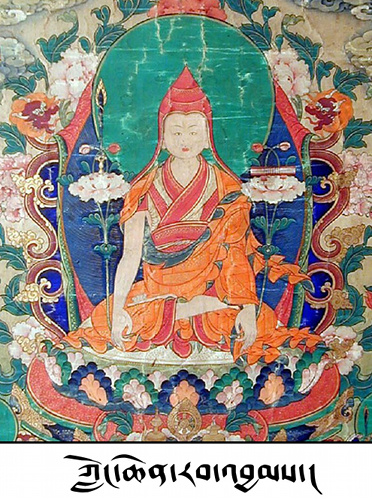
Biography of Longchen Rabjam (1308-1363)

Having acquired the enlightened intention of Dharmakaya in the expanse of exhausted phenomena,
And having seen the pure realm of Sambhogakaya in the sphere of luminosity,
He appears in Nirmanakaya form to untamed beings and benefits them through his enlightened activities.
To Longchenpa, the omniscient King of Dharma, I pay homage.

As stated in the Compendium of Sutras:
“One who possesses the wisdom that realizes the unborn nature
and the supreme quiescence of contemplation
Is a Bodhisattva who is adept in calm abiding
Thus it was prophesied by the Buddhas of the past.”

In the chronicles of Guru Padmasambhava entitled, “Sheldragma” it says;
“In the Monkey Year, my emanation will be born who is endowed with wisdom and sharp intellect. He will bless the Land of Jewels, Bumthang, guide fortunate ones and reveal treasure teachings from the lower part of the region. At that time I will be known as Drimed Ozer.”

As clearly prophesied in authentic scriptures, one of the Three Great Emanations of Manjushri in the Land of Snows, the Omniscient Kind of Dharma, Longchen Rabjam was born in Todrong village situated in the Tra valley of Yoru, middle part of U Tang province, on Saturday, 2nd March 1308 (10th day, 2nd Month, Earth Monkey Year of the Fifth Rabjung Cycle.)

His grandfather Lhasung, who lived for one hundred and five years, was a descendent of Gyalwa Choyang, one of the Seven Intelligents who were tested. His father, Lopon Tenpa Sung, was a master of the sciences and tantric practices, and his mother Dromza Sonam Gyen, was a descendent of the family of Dromton Gyalwai Jungne, the foremost disciple of Atisha.

Immediately after his birth, the Dharma protectress Namdru Remati appeared. Holding the baby in her arms, she said, “I shall protect him!” After returning the newborn back to the mother, she disappeared. From then onwards, the deity served him in various physical forms. From childhood, he naturally possessed the noble qualities of a bodhisattva such as faith, compassion and wisdom. At the age of five, he learned how to read and write. He received many esoteric teachings like, “The Eight Transmitted Precepts on the Gathering of the Sugatas” as well as other sciences.

When he was only 12, he understood the nature of samsara and felt that, like a nest of poisonous snakes, a pit of fire, and a continent of demons, he saw the world was not a safe place to live. He realized the only means of freedom from the suffering of samsara was to practice pure moral ethics, the basis of all noble qualities. Therefore, he gave up all worldly affairs and the clothing of a layperson and went to Samye, the monastery where he received the novice vows from Khenpo Samdrup Rinchen, Lopon Kunga Ozer and accurate number of sangha, who possessed both qualities of scholar and strict observer of moral discipline. After ordination, he was given the name Tshultrim Lodroe. He studied the vinaya teachings and without much difficulty, he understood it perfectly, which enabled him to teach it to others.

At nineteen, he went to the great university of Sangphu Neuthok, a popular center for advanced studies that was founded by Ngog Lekpei Sherab, the reputed Tibetan scholar of logic. There, under Lopon Tsengonpa and Ladrangpa Chopel Gyaltsen, he studied the Buddhist teachings of the Causal Vehicle including Maitreya’s Five Classes of Teachings, Dharmakirti’s Seven Treatises on Valid Cognition, the Madhyamika philosophy,Pranjnaparamita and so on. He also received the five profound sutras, which include the Samadhirajsutra (Sutra of the King of Contemplation) from Pang Lodroe Tenpa. In addition, he learned the common sciences of poetry, grammar, prosody, so forth, and mastered whatever he studied. He propitiated various deities such as Manjushri, Achala and as a sign of accomplishment; he had visions of these deities. Particularly Saraswati, the Goddess of Melody, placed him in the palm of her hand and showed him the four continents and Mt. Meru in seven days. At that time, Saraswati prophesied that he would become a great master and benefit countless beings in the future. After having this particular vision, he actualized the spiritual attainment of unobstructed intelligence, due to which he displayed fearless confidence in the ocean of scriptural teachings and reasoning. Thus, he came to be popularly known as Samye Lung Mangwa (Master from Samye who holds the Treasury of Scriptural Knowledge), and the great drum of his fame resounded in all directions.

He received the Trio of the Sutra with Gathers All Intentions, Magical Net Tantra and the Mental Classes as well as the collected tantras of the Nyingmapa tradition from Lopon Zhonu Dhondrup. Karma Rangjung Dorje bestowed him the empowerment and explanation on the Six Applications, the Means to Dispel Obstacles, the Six Yoga Trainings of Naropa and the introduction to the three truth bodies. From the supreme master of the Sakya tradition, Dampa Sonam Gyaltsen, he received the entire instructions on the Lamdre Chenmo (Great path and fruit), the three visions and three tantras. Lopon Zhongyel transmitted him the Chandrakirti’s Prasanapada (Clear worded Commentary)  and the Madyamakavatara (Introduction to the Middle Way). Following more than twenty spiritual masters from all the different schools of Buddhism, he mastered all the renowned tenet systems existing in Tibet.

Immensely disgusted and fed up with samsara, he resolved to live in solitude. The constant provocation by his fellow monks also added fuel to the fire thus compelling him to leave all worldly cares. On his way he had the auspicious and miraculous signs of meeting the teachings of Dzogpachenpo.

At the age of 29, he met Vidyadhara Rigdzin Kumaraza (1266-1343) in the upper part of Yartokyam valley, who took care of him with great compassion. The master always moved from place to place in order to free all his disciples from attachment to the material world never settling anywhere for long.

During the spring and summer of that year, Longchenpa wandered nine times from one deserted valley to the next due to which he faced many hardships surviving on three measures of flour and twenty-one mercury pills for two months. In the bitter cold of snowy winter, he lived on a sack garment, which served him as both a robe and a bed. He endured such inconceivable austerity for the sake of dharma, following the example of Milarepa.

After serving his root master with the three kinds of delight, his master conferred him all the transmissions and esoteric instructions on the three classes of Dzogchen together with the rites of the protectress. Hereby he was appointed as the lineage holder of the teachings.

At 32, when he gave the Nyingthig (Innermost Spirituality) teachings to eighteen fortunate yogis and yoginis, Ekasati, the protectress of Nyingthig appeared and served him at his command. At that time, Khandro Yeshe Tsogyal got into one of the yoginis and showed him the symbols, meanings and texts of the Khandro Nyingthig (Teachings of Innermost Spirituality transmitted from Guru Rinpoche) together with the entrustment seal. Thus, he is the direct recipient of the Khandro Nyingthig teachings.

As prophesied by Vimalamitra, during the renovation of the monastery of Zha in Uru, he arose in the wrathful form of Padmasambhava and pacified all the negative forces. During the consecration ceremony, he had the clear vision of Buddha Shakyamuni, Maitreya and the Sixteen Arhats. Particularly, Maitreya prophesied thus, “Your final birth will be in the pure realm of Pema Tsekpa where you will be enlightened as the Buddha Rirab Marmei Gyaltsen.”

Knowing the forthcoming conflict between the Sakya and Phagmodrubpa, Longchen Rabjam went to Bumthang. There he founded a monastery called Tharpa Ling (Palace of Liberation) with a gathering of monks. His enlightened activities enhanced the widespread propagation of Nyingma teachings in general and the Dzogchen teachings in particular.

When he returned to Lhasa and visited the image of Buddha Shakyamuni, (Jowo) light rays were emitted from the circle of hair between the eyebrows and dissolved between his eyebrows, which enabled him to recollect his former lives as a scholar at Vulture Peak and in Khotan. While expounding the vast teachings such as Bodhicitta at Lhasa and Ramoche, he subdued the pride of many learned Geshes who were there to test the level of his spiritual understanding and intellect, through his scriptural quotes and logical reasoning. In this way, he established them in ascertained faith and as a result, he was later addressed as “Kunkhyen Choeje” (All Knowing King of Dharma). Thus, his name and fame spread widely in all directions.

He had innumerable visions of the buddhas and bodhisattvas and with their encouragement and approval, he composed many treatises including Seven Great Precious Treasuries, the “Triology of Rest” and so forth, as mind treasure teachings. His works also include common study like prosody, up to the most profound Dzogchen teachings like Nyingthik Yabshi (The Four Parts of the Innermost Spirituality). Thus, his compositions totals to more than two hundred and fifty categories of teachings. All his teachings have these seven distinct qualities:

  1. With his knowledge of orthography, his writings delight the learned ones.
  2. Their profound meanings have the ability to liberate the fortunate ones.
  3. They are the image of ultimate realization that will exhilarate followers.
  4. They are like a spiritual friend who shows what to follow and what to discard.
  5. They are the roar of the lion that surpasses all opponents.
  6. They are the rays of the sun and moon, which illuminate the teachings of the Conquerors.
  7. They are the pinnacle of teachings adorned with precious gems.

In short, his teachings were no different from the direct teachings of Buddha Samantabhadra. They have the unique characteristics of elucidating the correct meanings with the clear words; uncomplicated and perfectly pure that cleanses all the negativities and obscurations. With compassion, he composed works for the well being of future disciples. In particular, while composing the Seven Treasuries at Gangri Thodkar, his attendant witnessed how Longchenpa ordered Vishnu to prepare ink for writing.

Longchenpa meditated in total isolation at various places like Gangri Thodkar, Samye, Chimpu and so forth. He spent most of his later life at Gangri Thodkar. Because of his boundless compassion towards his increasing gathering of disciples, he never accepted payment for his teachings and never wasted offerings made by the faithful. Concentrating only on the welfare of others, he tolerated all misdeeds of his disciples. His enlightened activities of skillful means were unbelievable, like knowing other’s minds and so forth.

Seeing his miraculous activities and scholastic achievements, even powerful persons in Tibet like Gompa Kunrin of Drigung, Situ Jangchub Gyaltsen, Yadrog Tripon and many others honored him like their precious crown yet had neither pride nor expectations of reward. He particularly loved the poor, sick and humble and he would joyfully accept their invitation as well as their frugal offerings without any arrogance. No matter how poor the food served to him was, he would eat it as if it were a great treat. He would then recite the sutras and the dedicational prayers with enthusiasm.

Ever ready to sacrifice his life and body for the welfare of others he was trained in the ocean-like conduct of the bodhisattvas. After accomplishing limitless benevolent deeds for his disciples, he intended to demonstrate his final enlightened activity. So at the age of 56, in the year 1363 (Water Hare Year, Six Rabjung Cycle), he went to the charnel ground in the Chimpu forest and said to Gyalse Zoepa, “Having understood the nature of samsara from the beginning, as there is no essence in the worldly things, I will discard this illusory body of impermanence, so, listen to this esoteric instruction which is of sole benefit.”

On the eighteenth of that month, leaving behind his last will, he relaxed in the sphere of the primordial nature, in the posture of Dharmakaya. The earth trembled at the time and countless miracles occurred. When his mind entered the state of the Dharmakaya, even the four seasons lost their fixed order. After his cremation, to indicate his attainment of enlightened body, speech and mind, his heart, tongue and eyes remained intact and fell into the laps of fortunate disciples.

Longchen Rabjam’s main disciples, who experienced the nectar of his enlightened speech, were the three learned and accomplished ones Deleg Gyamtso and others, the five sons of his enlightened mind were Gyalse Zoepa and so forth, his four spiritual friends included Tulku Paljor Gyamtso.

Work It Out

The following is from a series of tweets by Jetsunma Ahkon Lhamo:

I just watched some program on TV about sociopathic criminals and killers. Fascinating stuff. They do not know their crimes are wrong.

The killers, particularly, do not have empathy, thinking they are entitled to murder. They identify all people to be “less” than them. And their victim’s pain is pleasure to them, sometimes even erotic. They fixate, and cannot disengage unless there is a new victim. They may obsess over the victim until their “personality” totally unravels and they cannot control their rage.

Some have awful childhoods, though not all. There is a genetic component. They also cannot cope with feelings inside them. It is all directed outward, toward certain types, race, religion, or the world at large. Facts don’t influence them, they construct their own.

Fascinating how different they are from the norm of society. Really interesting stuff, the interviewer was a retired FBI special agent. She was impressive, knew how to manage the prisoner to avoid agitation and was skillful.

I’m still scratching my head, because many who also have had childhood trauma manage to work it out. They do not abuse others but they do suffer. But they do the inner “work” and grow to care for others. That’s how they fix it. They work it until they can make a medicine, an antidote. They flush the hate and live with compassion and love.

© copyright Jetsunma Ahkon Norbu Lhamo All rights reserved.

WP2Social Auto Publish Powered By : XYZScripts.com