Setting Aside Judgment

The following is an excerpt from a teaching by Jetsunma Ahkon Lhamo called “Your Treasure is Heart”

We view our own liberation as non-dual with the liberation of others: As I reach liberation, as I move closer to enlightenment, I am more and more able to be of benefit to others.  So I am interested in my own spiritual practice, interested in my own enlightenment for their sake, as well as for my sake. Of course, I am one of them.  My own liberation and the liberation of others become non-dual, and we begin to understand that we are truly and utterly inseparable in essence and in truth.

So we begin by walking with these simple and mindful meditations.  Now don’t get obsessive about it.  If you forget to do it for an hour a day, just like anything else, you just climb back on. Judgment is useless—you can toss it out.   What is needed, what you should cultivate, is the ability to view yourself honestly, without self-hatred.  Self-hatred has no place on this path.  Hatred of any kind has no place on this path.  So, too, that kind of ridiculous judgment. I would prefer that you do not judge me as a Bodhisattva, expecting me to look or act a certain way. I would prefer that you do not judge yourself as a budding Bodhisattva to look and act a certain way, and thereby condemn and end your potency on the path.  So don’t do it to me, and don’t do it to you.  You won’t catch me doing it to me or you.

Copyright © Jetsunma Ahkon Lhamo.  All rights reserved

Mindfulness and Compassion: A Meditation on Bodhicitta in Everyday Life

The following is an excerpt from a teaching by Jetsunma Ahkon Lhamo called “Your Treasure is Heart”

There are many different ways that one can actually engage and begin to train the mind as a Bodhisattva.  Actually, as a Bodhisattva the goal is to make every aspect of one’s life a vehicle for the benefit for others.  So, what would that look like?  Well, what about the ordinary things that you do?  Westerners have all these different elements in their lives, divided into sections, pigeon holes.  There’s the holy part, and there’s the ordinary part. There’s your regular personality and the way you are to your husband, wife,  kids, in-laws, and all those people that know you better than anybody.  There’s another part of your life where you’re out on the street, and people get to see you with your street-face on.  And then there’s the personal part.  You go to the bathroom and all those kinds of things. There’s the intellectual part,  the part that goes to the movies, and the part that exercises.  There are all these different parts, and because we’re so deluded, none of them seems to have much relationship to each other.  It’s like we’re juggling cats all the time.

One of the things that you have to do as a Bodhisattva is to make your entire life a basket, a vehicle for this compassion.  But how do you do that?  Well, there are these walking mindfulness meditations that you can do that are extremely beneficial.  If you find yourself moving into a depression or some sort of negative mood, if you really try to practice some sort of absorption with them, they’ll pull you right out of it, It’s very simple.  You don’t have to sit down and do the “holy” thing.  You don’t even have to put on your dharma clothes, pick up your pretty beads, or wear your particular medallions showing that you’re cool. You don’t have to do any of that.  All you have to do is, oh, I don’t know, let’s say, eat lunch.  As you’re eating lunch, you would pick up a spoonful of the food and you would say a quiet, loving prayer, a heart-felt wish, “As I take this nourishment into my body, may all sentient beings be nourished by the light and power of Bodhichitta.  As I take this drink into my body, may all sentient beings be watered and nurtured by the nectar of dharma.”  As you walk through the door, “May the suffering of all sentient beings be ended by the virtue of my walking through this door. May they be led through the door of liberation.”  It’s a constant mindfulness meditation.  As I walk down the street, “May all sentient beings walk down the path to liberation.”  In the car while looking at a map trying to find these crazy Washington streets and where they go, “By the virtue of this activity, may all sentient beings receive the proper guidance and direction by which they can accomplish dharma and be free.”

So you have a choice with everything that you engage in.  You can be looking at the map and cussing like a trooper, hating the way D.C. is laid out with those weird tunnels, or you can be utilizing the opportunity. You’re going to be looking at the map and finding your street anyway.  So instead of getting into a bad mood, perhaps you could use that as an opportunity to understand that all sentient beings are directionless and hungry for direction.  A small prayer at that moment that all sentient beings be guided on the path to liberation is appropriate and beneficial. It organizes your mind and thought. Mindfulness becomes so profound and so clarified that almost anything that you’re doing at that time is better, happier.  It takes on more meaning.  The mind is more clear, less filled with the kinds of hyper-emotions that make us crazy and confused.

Turn everything into that kind of meditation, that kind of consideration for the well-being of others.  Everything. “As I ascend the staircase, may all sentient beings ascend into the true meaning of dharma.”  You’re free to make up your own prayer concerning the welfare of sentient beings.  It doesn’t have to be my prayer.  Make up your own.  If you constantly walk around like that, you’ll find that you are changing in some subtle way that you can’t understand. You have less bad moods, less depression, less frequent overwhelming concern with your ego to the point where you are busy doing nothing but manipulating everything and everybody around you in order that they will get it right for you, which is pretty much how we live.  That kind of thing begins to change and you’re less concerned with manipulating everything and everyone around you in order to get what you want. You spend less time accomplishing the great mantra of “gimme gimme gimme iwant iwant iwant hung phat!” And you are more concerned with the welfare of others.  Something inside of you begins to change.  Remember, our habitual tendency is so strongly biased toward ego cherishing that we really have to spend a lot of time putting something in the pile of concern for others in order to bring the mind back into some kind of balance.  This kind of meditation really brings about that kind of balance, and your habit begins to change.

Copyright © Jetsunma Ahkon Lhamo.  All rights reserved

Bodhicitta and Generating the Deity

The following is from a series of tweets by Jetsunma Ahkon Lhamo in response to some comments from one of her students:

Gonpo: To say one “generates” this or that — deity or Bodhichitta – is a type of that materialism. Kind of like, “wow, look at me!” Our great Vajrayana teachers like Jetsunma Ahkon Lhamo help is cut through such materialism. Help us cut ego, relax mind, do nothing maybe! I don’t know, but my understanding from Jetsunma is that the Bodhichitta, our Buddhanature isn’t where the work needs to happen. Our habits are.

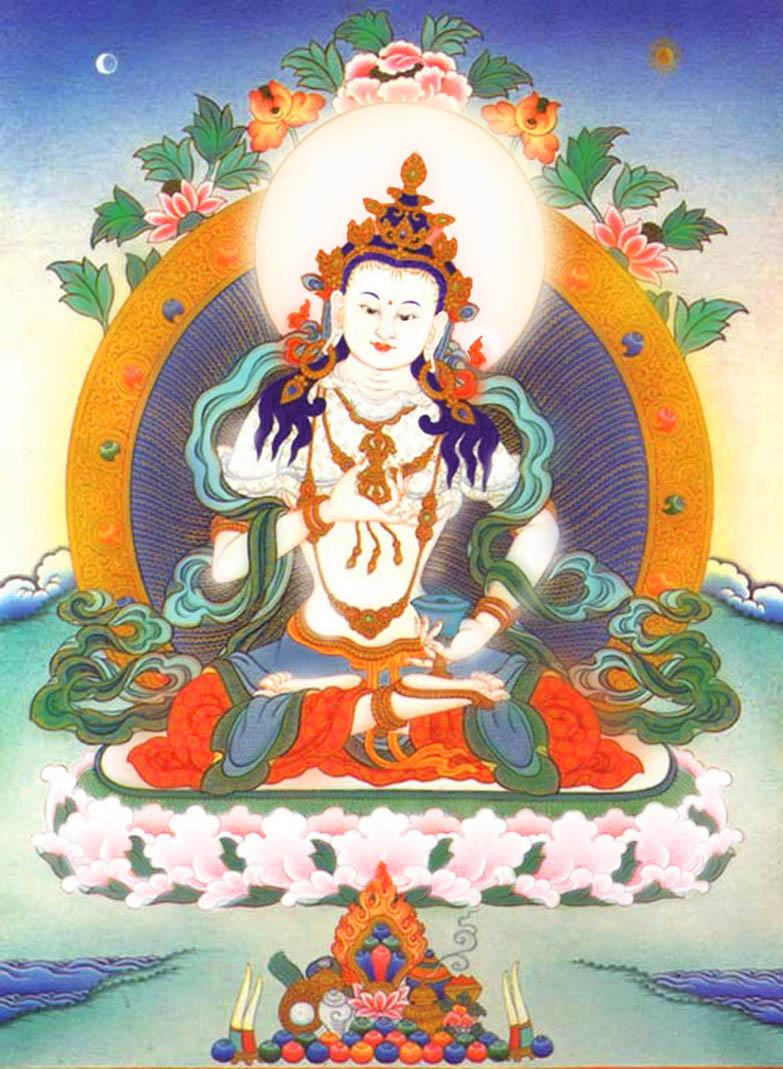
Jetsunma: Your statement Gonpo, bears a little comment. “Yidam generation stage” is indeed Vajrayana. In the generation stage one generates the qualities of the yidam, mixing one’s mind so as to gain the mind aspect. One generates the handheld implements and their meaning to gain the qualities and activities of the Deity. Say your generation stage is Bodhisattva Manjushri. The implements are meant to be generated with a deep understanding of their meaning. Like Manjushri’s sword of wisdom is seen to cut through ignorance. The text he holds is a symbol of wisdom, purity of mind. All yidams are practiced like that. Now say you are practicing a yidam in yab/yum posture. What are you practicing there? The union of compassion and method! Or also called “wisdom and display” which also means one must accomplish the meaning and the concerned activities as your own very display in samsara.

All yidams, deities are the very door to liberation, and that is the great blessing power they offer. They are not ordinary, they emanate from primordial awareness, the profound Buddha Nature. Why is this? In their great compassion their sole concern is to liberate beings from the cycle of suffering and rebirth. Therefore, if one generates any yidam their first and primary concern should be the same. To benefit and liberate all motherly beings from suffering.

OM MANI PEDME HUNG!

OM AH RAPATSANA DHI!

Copyright © Jetsunma Ahkon Lhamo.  All rights reserved

Moods, Bodhicitta and Mental Discipline

The following is an excerpt from a teaching called “Your Treasure is Heart”

In order to understand how mental discipline will help you feel more compassionate, you need to understand that compassion is not an emotion.  Bodhichitta is not an emotion.  It doesn’t exist on that dense a level.  It’s not as dense as an emotion.  Emotions are actually reactions.  If you take perception, delusion, duality, confusion, hatred, greed and ignorance, all of those things that are characteristic of samsara, and you shake them up in a jar, the bubbles that you would get, like the bubbles from soap, are roughly the equivalent of emotions.  Emotions are the result of conceptual proliferation, whipped up into a very exaggerated state.  They are reactive. Bodhichitta really has nothing to do with that.

When we begin to give rise to the Bodhichitta, we do so, first of all, through mental discipline.  As we begin to practice, we have some understanding of the suffering of sentient beings and why we should engage in loving concern for them.  When we examine the thoughts that turn the mind, we really tune into the sufferings of samsara.  We tune in, as well, to the fact that we have lived so many lifetimes that literally anyone that we can see, or see a picture of, or hear or think of has been our own kind parent in some previous life.  Yet these beings are wandering in samsara just like a bee that’s caught in a jar, absolutely clueless as to how to create the causes by which their terrible suffering might end.

Once you learn that, you discipline your mind not to ignore it.  We like to surf on the sensual pleasure of the moment.  We like to enjoy, and try to get as high in our daily routine as possible, so we can just surf on the moment of experience.  We don’t want to think about the condition of sentient beings.  So this mental discipline is required in order to be a serious practitioner. You can’t cut corners here. If you don’t put in the time, your practice will never be up to snuff.

Many students come to me saying “Well, I just don’t feel this compassion.”  My answer is, so what!  Compassion is not an emotion.  Nobody is going to benefit by how you feel.  They’re going to benefit by what you do.  So do the practice.  Discipline yourself to contemplate the causes and conditions of both happiness and suffering; and particularly contemplate the suffering of sentient beings,  These contemplations cannot be short-circuited. They must be delved into with everything you have. Once you do that you begin to feel a certain kind of determination and motivation, and it begins to make sense.

When I was 20, I had not met with the path of Dharma yet, but I was actually given these contemplations directly in my own meditation and in the dream state. So I began to practice them.  What happened to me was I realized that compassion is the only thing that makes sense.  Think about the logic of it. Here you are, one sentient being on our planet where in the human realm alone, there are roughly six billion of us.  On our planet there are also uncountable animal forms.  You can’t even count the number of ants in an ant hill.  Each one of them is a sentient being with the Buddha nature within them, just as surely as you are, yet they appear in this form due to their own habitual tendency and the way that their consciousness is functioning. How many uncountable sentient beings can be seen with the eye on this planet alone!

If this absolute Buddha nature, this ground of being, is my nature, and you are that also, and yet we appear in these multitudinous forms, wandering and suffering in samsara, it made perfect sense to me to dedicate my life to the liberation and salvation of all sentient beings.  Nothing else seemed logical or reasonable.  And from that, gradually, this determination grew.  For about ten months,  I went through the mental discipline. I practiced for eight to ten hours a day only on those contemplations until I could see clearly for myself that this is the only game in town that made sense.  With that knowledge, living any other kind of life seemed like whoring or prostitution to me, and it didn’t seem reasonable.  So my discrimination was born.

In the Buddha’s teachings we are told that there are three thousand myriads of universes, three thousand myriads of universes.  That’s just one number that gives us some understanding that we’re talking big!  The Buddha also teaches us that there are formless realms, and there are uncountable sentient beings in these formless realms.  So logically, if my nature is this Buddha nature, completely inseparable from the very Lord that I call Buddha, completely inseparable and indistinguishable from all these sentient beings, it is logical and reasonable that I would do everything that I can to bring benefit to others instead of spending my entire life in ego-gratification and self-cherishing.  It is logical and reasonable also to me, that I will never be happy until every sentient being is free.  That’s what seems reasonable to me.

Once you have that kind of understanding, you have to go through the process of reminding yourself, keeping it alive every step of the way.  If any of you have been married, you know that taking the vow is not the end of the issue.  If you want to remain in that situation, you really have to work at it.  Giving rise to the Bodhichitta is like that .  The effort doesn’t stop once you come to the great conclusion.  You have to remind yourself every day.  It’s part of the discipline of practice so that you remain mindful.  On the path of Dharma these contemplations are crucial.

So this is how it starts.  It starts in mental discipline which gives rise to determination.  Where’s the emotion in all that?  Emotions become inconsequential.  Once you realize that there are six billion humans, that you know of, wandering in samsara, not understanding how to create the causes of happiness, whether you have gas at that moment or are in a good or a bad mood, those kinds of things become a moot point.  You learn that it’s OK to be a Bodhisattva in a bad mood.  But you don’t get to stop, you see, because you’ve learned something.

Copyright © Jetsunma Ahkon Lhamo.  All rights reserved

Prayer for Mental Clarity

The following is from a twitter conversation between Jetsunma Ahkon Lhamo and a follower on twitter:

Student: need your advice. I am so nervous to face my exam tomorrow. What should i do? is there a pray for it and to get success maybe?

Jetsunma: Hi, a good mantra to recite for memory, mental clarity, wisdom is to the great Manjushri. mantra: Pronounce “OM AH RA PA TSA NA DHI”

Student: Thanks a lot! It can be read anytime or just before doing something?

Jetsunma: Any time at all!

Copyright © Jetsunma Ahkon Lhamo.  All rights reserved

Use Your Heart

The following is from a series of tweets by Jetsunma Ahkon Lhamo:

I hope and pray all people will come to see that kindness is the way. Most trouble can be avoided if we are simply good hearted. Bitterness and meanness poison just about every situation. If people would communicate skillfully and with respect nearly all arguments can be solved without war or hate. Only when one’s very life and livelihood are threatened, then legal council should be sought for advice.

In general, no resolution is ever possible with insults, snarky talk, or childish cruel jokes or rants. It is possible to grow up and grow in the capacity for compassion with practice. If we care about any sentient beings, we must care about all, as we are all of the same nature. So the obsession with harming others is a strong indication that this is not well understood. From the view of say, Lord Buddha’s extraordinary awakened state, there is no “place” where one life “ends” and another life “begins.” There is only the empty and complete display of the primordial ground of being. Beyond that, we are not separate- not in being, not in distance, and not in time, as these are all relative, where the absolute nature is unchanging, and fulfilled at once.

Relative view can be a real mess, and discord results when one has no healthy boundaries or indulges the ignorant, ordinary monkey-mind to do as it pleases. We are not here for that. We are all, in ultimate view, Buddha in physical form. How well the “light” shines through one’s “window” depends entirely on how well we clean and keep the “glass”, and this is our true job. We must see all as it is. Not as our habits dictate. You can change, you can do better. You are Buddha! Never forget that. Use your heart, and stand tall for the sake of all!

OM MANI PEDME HUNG!

Copyright © Jetsunma Ahkon Lhamo.  All rights reserved

Six Realms of Cyclic Existence

An excerpt from a teaching called How Buddhists Think by Jetsunma Ahkon Lhamo

Most people, however, fixated as they are on self-nature, experience hatred, greed, and ignorance.  This is the content of their mindstream.  We all have a great amount of self-concern, craving, desire, and grasping, which Buddhists consider a form of greed.  We have abundant anger.

You know you have anger; everyone has anger, which Buddhists consider a form of hatred.  And we have ignorance, which in Buddhist terminology signifies the lack of awareness of the primordial Wisdom State.  It means the lack of being awake as the Buddha is awake.

In the Bardo, some of the latent karmic potential, or the karmic seeds in our mindstream, will ripen.  For instance, if we have hatred within our mindstream, we will perceive it externalized as some kind of demonic entity––and respond with fear.  And we will try to take rebirth as soon as possible.  We will go compulsively into the next rebirth.  So it’s very possible that we take rebirth in an undesirable form.

Even if we achieve again the precious human form, we might be reborn in poverty in Calcutta, or as the offspring of parents who have AIDS.  And we ourselves could have AIDS.  There is no way to predict how karma will ripen.  This is the unpredictability of cyclic existence.

Of the six realms of cyclic existence, the human realm is considered the most precious––because it is the only realm in which we can practice Dharma in order to achieve Realization.  In all the other realms, preoccupation with immediate experience is too tight, too intense––so much so that one cannot meditate, contemplate, or practice.   This is true even in the higher realms.

The highest realm into which we can be reborn is the realm of the long-life gods.  The suffering in this realm is actually related to pleasure.  You may think, “I’d like to suffer like that,” but in this realm pleasure really is the source of suffering.

To be reborn in this realm requires tremendously good karma, but also involves the karma of pride.  (It is your pride that will, despite a great accumulation of positive causes, keep you from being born in an Enlightened state.)  Positive causes produce the experience of great pleasure which prevails in the long-life god realm. The scent there is an overpowering experience, sensual and erotic, healing instantly and completely.  Any sense––touch, taste, sight, hearing––is so potent that one is completely intoxicated, completely consumed by it.  The gods in this realm are extremely, excruciatingly beautiful.  Their bodies are sweetly scented; their skin, exceedingly pure.  They swim in nectar-like water; everything they taste is the elixir of life.  And they live for thousands of years.

Some people may think: “How do I get into that place?”  But there’s a catch.  When the thousands of years of their god-realm karma are exausted, these beings begin to change.  Suddenly they are no longer so sweet-smelling.  Then the other gods and goddesses start to move away from them––as far away as they can.

Soon the god-realm beings whose good karma is depleted become aware that they are deteriorating.  No longer are they quite so beautiful; their “high” is wearing off.  They realize that they’ve used up all the fortunate causes they had accumulated for aeons.  Since they have a touch of clairvoyance, they can look down and see that there is nowhere to go but to a lower rebirth.  And they get no help from the other gods and goddesses, who are still absorbed in their intoxication.  This is the most pleasurable rebirth.  You suffer only as it ends.

Immediately below the long-life gods is the realm of the jealous gods.  The causes for being reborn there are power-hunger, competitiveness, and jealousy.  There is much wealth in this realm, and intoxication too, but of another sort––intoxication with power.  There is continual warfare––and the suffering which comes from it.  There is suffering, but also pleasure.  The jealous gods are very powerful, very demanding.  They engage in battle with other gods, and they sometimes become involved with other realms in order to use them for their warfare agenda.

Some say that the Old Testament God Jehovah is actually a jealous god, exhibiting the characteristics of this realm––wielding destruction and demanding exclusive allegiance.

The realm below the jealous gods is the human realm.  In this realm, old age, sickness, and death are our main sufferings.  If we live long enough, all of us experience them.  One cause for being born human––instead of appearing miraculously in the state of Enlightenment––is doubt.  Everyone in the human realm experiences doubt.  You must look at yourself as if from the outside and recognize that doubt is an obstacle to your practice.  We have the habitual tendency of only believing what we can see and hold in our hands.

We may not believe that there are non-physical realms.  Well, we’ve heard of them, and think they may possibly exist.  We think we may have lived before, but we don’t know for sure.

Right below the human realm is the animal realm, in which a rebirth results from “dullness.”  The word actually translates as “stupidity,” but we hesitate to use that term because we all love animals.  Here however we are focusing on the consciousness of animals and their inability to absorb the teachings needed to achieve Realization.  They can’t reason, they can’t be taught in the way humans can.  They’re tightly reactive, completely involved in their experience of phenomena, without any spaciousness between event and reaction.

A tiny bit of spaciousness is the difference between us and animals.  Unlike them, we can consider and formulate in a creative way some kind of impression and response.  An animal’s inability to do this is termed ignorance, or stupidity, or dullness.  Animals are preyed upon by predators, pursued and eaten by one another.  They are often at the mercy of humans, who eat them or use them for their own purposes.  Animals suffer greatly from all that.

Below the animal realm is the realm of the hungry ghosts.  These beings are not visible to our eyes, but we have information about them: the Buddha in his omniscience saw and described them.  The cause for being reborn as a hungry ghost is grasping or desire.  With very small mouths and very big stomachs, these beings are weak from hunger and hardly ever able to get what they need.  They suffer from physical and other kinds of hunger and cannot be satisfied.  They have the unfortunate karma of strange, mixed perception.

When you drink a cup of tea, it tastes like tea to you.  (To long-life gods, it would taste like the most exquisite nectar.)  Hungry ghosts would experience it as pus or another equally horrid substance.  Their perception is askew because of their greed and desire.

The lowest rebirth is in the hell realms.  The main causes for being reborn there are hatred and anger, and the suffering is tremendous.  Who can claim a mind free of anger and hatred?  If you’ve ever had a frightening nightmare from which you felt you could not escape, then you have the potential to create the phenomena of a hellish realm.  It’s the same.


© Jetsunma Ahkön Lhamo

To download the complete teaching, click here and scroll down to How Buddhists Think

For the Benefit of All

The following is from a series of tweets by Jetsunma Ahkon Lhamo:

I haven’t been on twitter so much in a teaching or connecting capacity, as I am required to testify in this upcoming case between the US Government and William Cassidy, with others involved. I would prefer not to testify but there is no choice. I am the main victim, and my Ordained Sangha. It is sad it has come to this. But this is a criminal case, and laws have been broken. As well as hearts and even spirits. Many of us have suffered greatly. And grieved for Buddhism here in the west. We have done our part, screen shots, every bit of cruelty, every single threat. All these three horrible years. Now the FBI has taken this as criminal and due process is underway.

My motivation is not punitive, but a hope that hate-filled people will think before harassing women or anyone for whatever reason. I hope Buddhist Sanghas everywhere see they need not accept such abuse. Nor will I, nor should any other woman. Cyber stalking and threats, all forms of it should be eradicated from Buddhism, Dharma, and any true spiritual path.

OM MANI PEDME HUNG

OM TARE TUTTARE TURE SOHA

May virtue and compassion prevail!

Copyright © Jetsunma Ahkon Lhamo.  All rights reserved

United States v. William Cassidy 8:11-cr-00091

Dialogue and critical thinking are valuable gifts we share as sentient beings. Freedom of belief and freedom of expression are valuable rights we cherish in our democracy. Hatred and violent threats, however, are neither valuable nor right. In recent years, Jetsunma and KPC have been threatened repeatedly and made the target of hateful, homophobic and misogynistic epithets.These threats were reported to law enforcement and, following a full investigation conducted by FBI and U.S. Department of Justice, federal criminal charges were filed in the case of United States v. William Cassidy, 8:11-cr-00091 and he has been charged with cyberstalking.

We understand from law enforcement that, as part of that criminal investigation, search warrants were executed upon the residences of both William Cassidy and an individual named Andrew Wilson. KPC has no comment on these matters and possesses no authority over the ultimate outcome of this criminal case. The matter now is up to the courts and our criminal justice system. KPC has cooperated fully with law enforcement requests and will continue to do so.

What matters remain in our hands and in the hands of all responsible, peace-seeking and law abiding citizens is our own behavior. Persons seeking the path of truth do not taunt and seek to hurt others through hateful and demeaning epithets directed at women and sexual orientation.  That is not an esoteric concept but common decency. Hatred and fear wear many masks in our world but their true face is eventually revealed. We call upon all to engage in healthy dialogue  and critical thinking free of hatred and fear. Love, forgiveness and acceptance are the way of  peace and enlightenment.

Overcoming Life’s Obstacles

An excerpt from a teaching by Jetsunma Ahkon Lhamo called Turning Adversity Into Felicity

Ours is not a religion that believes you can get through a room full of obstacles—which life basically is—without turning on the lights and seeing where the things are that you might trip over.  Our religion is one where we turn on the light, we look with our eyes, we do not absent ourselves from the responsibility of clear thought, of the reality of cause and effect relationships, of engaging in those practices that will clear the obstacles.

In our lives, perhaps, we might suffer from the loss of fortune.  Let’s say that we have a certain situation where we were very wealthy, we had everything that we needed, and suddenly bam! Misfortune hits.  It happens, doesn’t it?  It happens a lot.  Misfortune hits and suddenly we are no longer wealthy.  Perhaps it isn’t about money.  Perhaps it’s about relationships.  At one point, for the women, the prince rides up on the white horse and everything looks like it’s going to be happily-ever-after, you know, the Dream.  For men, the Queen of Sheba has landed in our lap somehow, and here she is with all her blazing glory.

So maybe that kind of thing has happened.  But eventually we will find that the cloud definitely has another side to it.  It has a silver lining, yes, but it has a little rain in it as well.  For many of us, we would experience some loss.  Perhaps we might think that we have everything we need, and then simply it is lost.  That might occur with our health.  Many of us, we don’t plan to die, we don’t plan to get sick, but suddenly, perhaps even at a point where we thought we were young enough and sturdy enough to have been healthy, we find that our health slips and we can no longer rely on our health.  And then, for others of us that survive all these other things without too many disasters, eventually we will get old and we will die.  So there are these situations that must be dealt with.

Now when we deal with them, should we just paste some sort of unthinking, syrupy, positive statement on top of it and therefore make it acceptable?  Should we say, “Ah, well, you know I’ve lost the great love of my life, but hey, it’s not so bad.  What’s the big deal?  I can do this!”  Or, “Once I was rich and now I’m poor, but hey, I’m a positive thinker and wealth will come to me soon, I’m sure.”  Do we think like that?  I don’t think so.

We are taught by our teachers to engage in creating the causes by which our suffering might end.  Clearly if you do not have enough fortune or money in your life, the causes by which that might come to you have not been created, or they haven’t been created in sufficient amounts.  So we turn to the guru, not with an empty prayer of, “Gee, hope you’ll land a few thousand in my box.  Just stick it in the mailbox.  I’ll pick it up tomorrow.”  You don’t pray like that.  You don’t pray to win the lottery.  That isn’t how it goes.  In our religion, the difference is that we actually pray for guidance and we use the teachings that the teacher gives us and we begin to create the causes by which we can overcome the obstacles in our lives.

© Jetsunma Ahkön Lhamo

WP2Social Auto Publish Powered By : XYZScripts.com