Discerning the Extraordinary

The following is an excerpt from a teaching by Jetsunma Ahkon Lhamo called “The Lama Never Leaves”

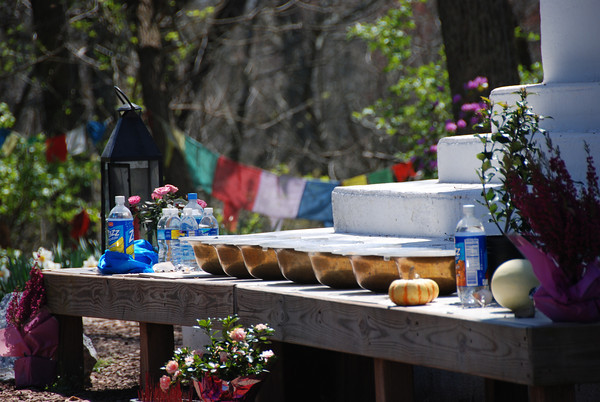
Now, we have these amazing stupas.  How amazing!  Even when the lamas are not here, we have this occurrence of the living Buddha here on this property.  The living Buddha remains on this property.  The problem is that our mind is so deluded and so lacking in wisdom that we don’t see that.  We let the Buddha sit there with no company. Not that they need company, but we need them.  Rarely do we go and visit the Buddhas. Rarely do we make them offerings. Rarely do we offer them a little cleaning, you know, to take a little cloth and say, ”Even though the Buddha doesn’t need to be cleaned, may I offer you this. May I take this dirt from you.  And by that merit, may all sentient beings be free of suffering.”  We don’t do that because we’ve forgotten. Because we go to sleep in our minds whenever our living lama is not around to shake us awake.

The teaching that I want to give to you today is how to avoid that.  First of all, let me tell you the way that Asian cultures, particularly Tibetans (I can speak for them), that have stupas, chortens, available in their land, normally incorporate them into their lives. Usually once a year, around the time of New Years, Losar, there are certain days when one does religious activity and that religious activity is increased by 100,000 or 10,000. And of course, we have our 10,000,000 days where we look to accomplish a great deal of practice.  Tibetans always think of times like that as a very joyful occasion, particularly during Losar, a time to celebrate.  They all get out and the wealthier patrons (by the way, that’s how they get to be wealthy) buy the gold wash or the white wash or whatever color they are going to repaint the stupas with. They clean the stupas and give them a fresh coat of gold or white wash.  And that’s a very joyful thing because they realize how much merit they are accomplishing, and they are already, because of their confidence, enjoying the fruits of that.  Because of their confidence!

We’re saying, “Boy, when’s it gonna happen?”  And they’re saying, “I rejoice in my future merit.  By this merit, there will be plenty of clothing, I will be warm and comfortable. All sentient beings will be pleased and this is tremendous.  I am so happy about that.”  And so with the simplicity of just the joyful accomplishment, they are able to experience the happiness right away.  It’s like a festival.  After they finish doing that, there’s always a lovely dinner; and maybe the great patrons will offer a beautiful dinner for the Sangha. And there is always a beautiful tsog offered to the Buddhas and the Bodhisattvas. It’s a gathering of the Sangha and the Lamas and all the people that is extremely joyful.  Because we all say, “By this merit, may we never be separated,”  it becomes a very joyful event.  And so, of course then, the stupas are living Buddhas that are brought into the occasion because they are washed, they are cared for. We offer great offerings to them—of course the eight auspicious offerings of water to drink, water to bathe in, all the different offerings and their different meanings.  We make offerings of food and butter lamps or candles. Sometimes Tibetans will make Mani rocks—write the Mani mantra on rocks and offer many of those.  So there are many things that the Tibetans do during that time to celebrate and to incorporate the stupas as living beings in their lives.

Plus, the Tibetans that care for stupas would not think of letting the sun rise without offerings being present on the stupas.  To let the sun rise without these offerings would be unthinkable.  That would be, in the way Tibetans have been taught, in the way that they teach us, that would be like if your Root Guru had spent the night outside and was cold and hungry and needed her attendants or his attendants to come and no one brought him any tea to warm him.  It would be like that.  Would you do that to your Root Guru?  Even before you took your own coffee in the morning, wouldn’t you bring your Guru his tea?  I certainly would.  I certainly would.

What does that say if we have our own coffee in the morning before we make an offering to the Buddha. That says ‘my ego is more important.’ That says, ‘I take refuge in me’ or ‘I take refuge in my coffee,’ which I know is not hard to do.  Of course, we don’t all of us live with the stupas, and so each in our own way, in our homes, maintain altars and, hopefully, we make offerings to the Buddhas before we take any offering ourselves.

Traditionally, lamas have a little cup. It looks like a protector cup but it’s not exactly.  It’s a little tiny cup, and it has a removable top that you can turn over. A lot of times the lamas will take their first tea of the morning and offer it in the little top and put it up on the altar for the Buddhas.  Such a simple gesture but so beautiful.  And so profound.  To do that every day of one’s life is quite beautiful.  Some have the custom that whenever a family gathers for a big meal, the Buddha always gets the first portion. Perhaps for the Sunday meal here at the temple, we can make the first portion and give it to the stupa outside.  Or in a home family situation, the householder family can celebrate their lives together as Buddhists by creating a meal, whether it’s an ordinary family meal or whether it’s Hanukkah or whether it’s Easter or whether it’s Christmas and offering the first portion to the Buddhas.  That’s the way that a householder practices.

We should always think of the objects of refuge as being so sacred to us that we care for them very mindfully, so mindfully that we, through thought, word, and deed,  indicate to ourselves in our own practice and also to all sentient beings, that our caring is such that our eyes are opened. Spiritually our eyes are open and we see the preciousness and the value of the objects of refuge.  We recognize their exquisiteness and extraordinariness and how much more important they are than our own phenomena.

Copyright © Jetsunma Ahkon Norbu Lhamo All rights reserved

 

Soothing the Inflamed Mind

The following is an excerpt from a teaching by Jetsunma Ahkon Lhamo called “The Lama Never Leaves”

Beginning to appreciate the condition and the suffering of other sentient beings, turning the mind in that way, does two things.  Offering merit to them does several things.   First of all, it builds on our merit/non-virtue scale.  We’ve got the merit on this side, we’ve got the non-virtue on that side.  And we’re heavier on the non-virtue side.  So offering merit puts more focus on virtue.  Our minds are more attuned to virtue and this tends to bring forth ripenings that are more congruous with what we want on our path, more sympathetic, more joyful, more fulfilling. More meritorious things will ripen.  Happiness will ripen because our minds are more focused on the heavier [virtuous] pile.  That’s naturally how it is.  When we are more focused on the virtue pile rather than the non-virtue pile, which is like something that is sore and raw and inflamed, the samsaric mind becomes then soothed, calmed.  We are not wallowing in the inflammation of it.   We are on the virtuous side now.  So we find that temporarily and that ultimately, more permanently, the inflammation starts to go down.  The inflammation going down is almost like putting hydrocortisone on a horrible, raw, terrible rash. It calms the angriness of it; it calms the rawness of it.  So it’s a little bit like that.  It takes the inflammation down a whole lot.  And we find that when our minds are calmer and more rested, we are happier.

Now, when our minds are very active and very agitated, we may feel more energetic. Sadly some of us have had so few true moments of happiness and joy and peaceful calm abiding that when we’re really active and really hyper and really busy doing something really fun, we think we’re great. We’re really joyful!  Then what happens later is like after a sugar high.  We’re totally wiped out afterwards and we have the other side of that mood swing.  So ultimately, as we turn our minds towards Dharma, as we begin to commit virtuous acts and to gather meritorious thoughts and ways of being, then we find out that gradually over time, we become more joyful, happier.  We begin to notice things that we didn’t notice before like some beautiful smell. Then we offer it to the Buddhas and we find a moment of happiness.  Or some beautiful sight, and then we offer it to the Buddhas, or maybe to our own Root Guru, and we think, “Oh, just for a moment, I felt happy there, just for a moment.”  Then we begin to catch on and that’s wonderful.  When we start to catch on, that’s the right stuff!

Copyright © Jetsunma Ahkon Norbu Lhamo All rights reserved
The Nature of Stupas

The following is an excerpt from a teaching by Jetsunma Ahkon Lhamo called “The Lama Never Leaves”

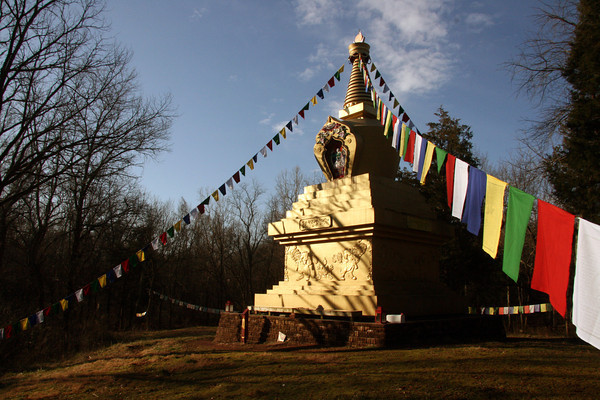
Today, I would like to talk about what we have here.  Not only the objects of support that I’ve talked about, but we have the stupas.  I would like to explain to you the nature of the stupas.  I would like to explain to you a little bit about the treasures that we have here. To say that there is nothing like this in America sounds prideful.  Yet, I am not the one saying it, really.  I’m telling you what other teachers who have come here and who have been around America have said—that there’s nothing else like this, that this is quite remarkable.  And I say, “Well, we’re just getting started.  I hope it’s good.” We have here these extraordinary stupas that have been built according to the ancient Palyul tradition by a number of lamas—His Holiness, and then Tulka Rigzin Pema Rinpoche who is a renowned stupa builder.  The stupas have  been blessed by every lama that has come here; but they have been properly consecrated, about that there is no doubt.

The stupas have different levels and ultimately when they are born, that is to say, after they are completely built and the lama actually generates the entire mandala of the deities and all the objects of refuge, , and descends that entire mandala into the stupa, the stupa becomes then a living presence.  The stupa becomes like the Buddha in Nirmanakaya form, that is to say in the physical form.

On the bottom of the Stupa, there are many objects there that indicate the things of the world to be overcome, such as objects of violence like knives and guns and weapons, and they are buried underneath.  There are prayers and objects and images of suppression, including symbols of death, that go on top of that and they suppress the things of the world that are harmful.,  At the time of the filling of the Enlightenment Stupa, His Holiness said, “Well, it would be good if we had the skull of a wolf to put down underneath there.”  I went, “The skull of a wolf?  In Maryland???”  So we were rushing around thinking, “How in the world does one get the skull of a wolf?”  trying to figure it out.  And then we had the great good fortune, I guess… A fox up the road got run over and we had an intact fox skull.  So we brought the poor little fox skull to His Holiness and said, “Would this do?”  And he went, “This is pathetic.  Look how small it is.  Well, if that’s what you call wolf in America, this will have to do!”  So it turns out, the fox gets in there   asthe symbol of death.  We have symbols of old age, of sickness, of death, of all kinds of suffering, and the suppression of that.

Above that, there are different layers.  There are the practices: beginning stage practice, generation stage practice, completion stage practice, accomplishment. Then there are the objects and prayers and mantras that are associated with all these different levels wrapped in a very succinct way, arranged perfectly like the mandala of the deities.  It has to be arranged very perfectly, and it’s all very secret and careful.  Nobody can look in there unless they’ve been on the stupa diet, which is no animal flesh, no alcohol, no sexual activity and no ordinary stuff of any kind while you’re building the stupa.   And the many many gizillions—I don’t even know how many—of mantras , with saffron water sprayed on them that are rolled so tight, some done by machine, because we could get them rolled tighter, and some of them done by students who themselves were reciting mantra at the same time they were rolling them very tightly and sticking to the stupa diet.  So everything very carefully arranged, everything very perfect.  You can’t leave a drop of sweat or a bit of DNA in the stupa unless you have achieved enlightenment.  So nobody gets to really climb in there without being clothed up and very very careful.

When the lama then brings the stupa to fruition, there is of course the vestibule in which the deity sits, and the deity itself is completely consecrated like the deities on the altar, and they themselves have all the accomplishment figures in them. And then the relics are at the top.  Some of them are wrapped up to the spine, that is a very large piece of wood with mantra written all over it going down the middle.  Some of them are wrapped body, speech, and mind mantras of enlightenment.  So then when the lama descends the deities into the stupa, the stupa is completely able to receive every blessing that the lama is capable of conferring.  All the materials are blessed, purified and perfect.  All the needs have been met.

The lama that actually empowers the stupa is always a lama of accomplishment.  That is to say, Tulku Rigzin Pema Rinpoche is known as a stupa lama and maintains the stupa diet always. He maintains retreat a lot of the time in order to keep the stupa-related accomplishments fresh in his mind as though they were like fresh bread, just right there at the tip of his tongue or the tip of his mind—however you would put it—able to be conferred.  Then of course His Holiness Penor Rinpoche who empowered the Enlightenment Stupa is a living Buddha and is known worldwide as a living Buddha.  In Tibet, people gather the dirt that he walks on and save it and put it on their altars.  His foot-print even.   He never is not practicing.  I’ve seen the way his mind works.  He is like…   Well, he is a living Buddha.  There is no other thing to say about it.

Copyright © Jetsunma Ahkon Norbu Lhamo All rights reserved
Right in Front of You

The following is an excerpt from a teaching by Jetsunma Ahkon Lhamo called “The Lama Never Leaves”

What I would like to talk about today is our opportunity right here.  We have a tremendous opportunity.  Whenever lamas come to this temple, they say, “This is a living jewel in America.”  That’s what they say.  They say that this temple is a living jewel; that it’s the real thing. They use phrases like that.  This is really Dharma; this is the right stuff. They also say that we have all the objects of support here.  We don’t really know what that means, but we’re glad we have it.  So I’ll tell you.

We have these visible objects of support, meaning that, for instance, right in front of us, we have the cosmological display of the mind of enlightenment.  That is the sand mandala that remains there.  His Holiness [Penor Rinpoche] allowed it to remain so that we can have with us that display and take refuge and meditate and be mindful of that and to learn.  It is the very display of the mind of enlightenment.  Each object in the mandala has specific meaning and so we are delighted to have this.

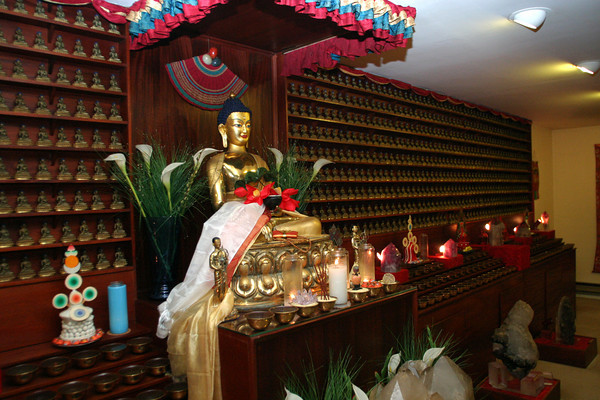
Then we also have beautiful statues.  The statues are not specifically the objects of refuge, but they are physical supports for the objects of refuge.  In other words, our eyes are allowed to rest on these objects. Our eyes are allowed to, for instance, study the hand positions, the objects that are being held and to learn from them the meaning of the objects, because each of the objects that any of the statues hold has to do with a quality of the Enlightened Buddha.  So each and every object that is held has to do with quality or maybe in some cases activity, like in the case of, statue of Mahakala that may hold a great lasso. He lassoes the negativity and pacifies itSo it has to do with the qualities and the activities of the enlightened mind.  We ourselves use the same images in our practice so that we can practice these very qualities and these very activities.  For instance, if we generate ourselves as Manjushri, we then are holding the sword that cuts the darkness of ignorance.

Then we have an altar where we can make many offerings.  We try to make the offerings as extensive and as beautiful and as exceptional as possible.  Maybe we wouldn’t think to have so many flowers in our own home.  Maybe we wouldn’t think to offer so many bowls of rice. Why would you want to have so much rice or so much water or so many candles? Why would you put so many sweets and delicacies and things on the cabinets like that?  You wouldn’t do that in your own home.  And that reminds you that here we are in this amazing temple with these objects of refuge and we are making many offerings.  It reminds us that these are offerings; and we again, in some subtle way, offer them when we see them being offered that way.  So that is a condition by which we can practice virtue and gather merit.  Anytime we make an offering to an altar, there is a great deal of merit in that, and our minds become more purified and more virtuous.  And so that is a cause for happiness.

Here are the statues. They’re not just ordinary statues, that is to say, lumps that are formed to look like the Buddha.  Each of them has been empowered, and there are specific mantras that are within each one of them. Usually there are mantras that are general and there are mantras that are specific to the deity.  Inside there is a central channel, as though it were a living deity where the central channel is the beginning emanation of the deity’s form.  Inside each and every one of them is a  a copper tube, or maybe it can be wood, like the spine of the deity.  And so in every single one, there are profound prayers and many offerings.  Some of them have relics in them.  Some of them have jewels, no really fabulous diamonds, so there’s no sense stealing any of them.  We actually had somebody in Poolesville steal a ring from the stupa once and he lost his finger—the finger with the ring on it— so he returned the ring.  You don’t want to do thatYou want to think of whatever offerings are in there as being the very jewel of enlightenment and that that is something precious.

By the lama’s power, each and every statue is empowered; that is to say, the lama generates the deity and invites the deity to remain.  And so the deity actually remains as this statue.  That doesn’t mean Guru Rinpoche is here and not there, or there and not here.  It doesn’t mean that, but it does mean that these statues should be treated like living Buddhas.  And that is the cause for great merit.  There are many practices that are done, particularly during Losar [Tibetan new year], where we take a statue of the Buddha and we carefully wash it and say many prayers. We say, “Although the Buddha does not need washing, by this washing may all sentient beings be cleansed of the suffering of non-virtue.” And so the cleansing of the Buddha is a tremendous virtuous offering to make, you know, to cleanse the Buddha with saffron water and to offer the Buddha a cloak.  Although the Buddha is never cold, one would offer that cloak in the hopes that, “By this offering may all sentient beings be free of the suffering of want, of nakedness or of cold, or of not having any clothing, and may they be clothed eventually with the gorgeous array of Dharma.”  So we make these kinds of wishing prayers.

When we make these wishing prayers for others, we are making them for ourselves, as well.  In fact, there’s almost no need to include ourselves in those prayers, although we certainly may, and many of the prayers have words like that, “May I and all beings…,” or “May all beings and myself included…,” like that.  But whenever we make prayers for the liberation and salvation of all sentient beings, for the end of their suffering, for their continued advance upon the path, then surely you must know that by the merit of that, we also are accumulating a great deal of merit to do that very same thing. So that merit is ours as well.   In fact, when you accomplish something meritorious, by dedicating that merit, the minute you dedicate it, you can no longer burn it up in an adverse way.  It’s like you put it in the bank.  You can’t spend it anymore.  And even though it goes to benefit all sentient beings, it’s still in your bank.  It’s awful we have to explain it that way, but ours is a materialistic society, and that’s how we understand things.

So whenever we commit some kind of virtuous act, we should immediately think, “This I dedicate to the liberation and salvation of all sentient beings.”  Whenever we go round and round the stupas—even trying to relieve our own suffering, which many of us do and should really, because we have had cures around the Stupas—we have had amazing turn-arounds in people’s mental states, their habitual tendencies, even mental illness.  We’ve had amazing events come about through circumambulating the stupas and making many prayers.  The minute we do that, we should absolutely dedicate that to the liberation and salvation of all sentient beings.

When we pray for our own health, we should not do so without praying for the health of others as well.  When we pray for our own happiness, we should think, “Oh, here I am in this land of great fortune; and here I am securely, hopefully, upon the path, and here I am in front of the objects of refuge and yet I can be so miserable. If this is possible, then how much more miserable than I am must other sentient beings be—those who have no food, who have no home, who are in war, who experience earth changes or tsunami or terrible events.  Here I am in comfort and I am suffering, then therefore I pray that their suffering will cease also.

Copyright © Jetsunma Ahkon Norbu Lhamo All rights reserved

 

Cause and Effect and the Antidote to Unhappiness

The following is an excerpt from a teaching by Jetsunma Ahkon Lhamo called “The Lama Never Leaves”

Lord Buddha’s teachings are always reasonable and logical.  He teaches us that, for instance, if we are lonely and unhappy, we should look to find the causes of that.  He teaches us that causes are never outside.  They seem to be, but they are never outside because actually we are living with our own karmic habitual tendencies and propensities.  So if we are lonely and unhappy, we should look to the deeper causes.  The deeper causes may be that in the past, whether in this lifetime or in some previous lifetime, we allowed the others around us to be unsupported and lonely and unhappy.  Or perhaps we committed some profound non-virtue with our minds and so now, in our mind, we have the habit or the result of loneliness and unhappiness.  Perhaps in the past, we caused someone mental suffering or mental affliction, and so now in the present, we find ourselves feeling that same mental affliction. But we can only remember since the time of our birth, or somewhat after that, and we don’t know what the cause was really.  It’s hard to see.  We have to go by the Buddha’s teachings because Lord Buddha is that state of enlightenment which has the wisdom to see causes and results.  So we are taught if we have certain results within our life, such as unhappiness and loneliness, we should look for deep causes If we can’t find some reason in this lifetime for our loneliness and unhappiness, that is to say, that we ourselves have not brought about similar loneliness and unhappiness to others, then we should think that probably the cause has been in the deep past.  So we must assume that in the past, we have caused some unhappiness to others.

Now, here we are on the path, and we are told to apply the antidote. I shouldn’t leave that part out.  And the antidote, of course, would be to do one’s best to uphold the Bodhisattva Vow and to benefit others as strongly and as purposefully as we possibly can.  Of course, as monks and nuns, we will do that within the context of Dharma activities. As lay people, hopefully, we will do that within the context of Dharma activities as well. Yet we also have many opportunities in our lives to be of benefit to others in ordinary but very special ways. Some of us are doctors or nurses or counselors or those who help others.  So there are human ways to help others and there are extraordinary Dharma ways to help others, and we should apply that antidote.

One thing that not only I have noticed but practically every pop-psychologist that has arms to write a book with nowadays will tell you is that in doing for others, one becomes happy.  Self-absorption and ego cherishing, only thinking about what you want and what you don’t have, leads to further unhappiness and selfishness.  So it’s doing for others that actually brings up the spirit, and I personally know that this is true.  I know that this is true.

Copyright © Jetsunma Ahkon Norbu Lhamo All rights reserved
 

Non-Duality

The following is an excerpt from a teaching by Jetsunma Ahkon Lhamo called “Tools to Deepen in Your Practice”

We think that bodhichitta is something that we must practice, and yes, in order to build proper habitual tendency, that’s what we should do.  That is the basis and foundation for the next level of practice.  But this level of practice requires going beyond simple human kindness, or even extraordinary kindness where we practice from life to death, you know, in order to practice medicine or give out food, or make some phenomenal contribution.

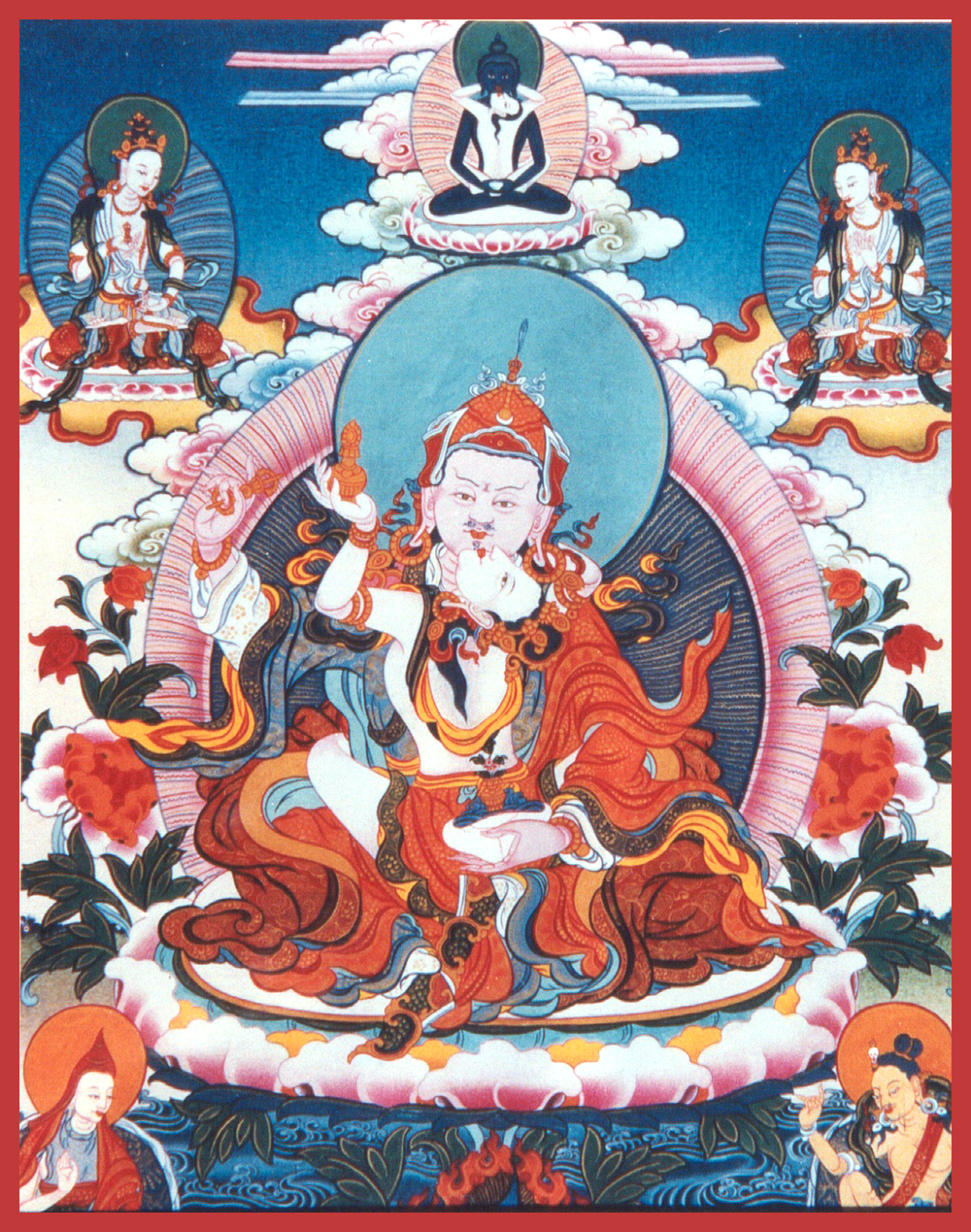
But here in the Vajrayana path, we must understand that you cannot create the bodhichitta.  You cannot establish it, nor can you tear it down or destroy it.  All you can do is deny that you are that; and you can do that from now ‘til kingdom come, whenever that is.  But you cannot deny the understanding that when we seethe fundamental picture we see again and again and again in Vajrayana of the Lama and Consort in union, this is emptiness and method, emptiness and compassioninseparable, functional as one.  We can take them apart to discuss or to understand them, but in truth the bodhichitta cannot be separated from emptiness.  And the true awakening to the bodhichitta comes from the fundamental view of understanding the emptiness of all nature.

In Vajrayana, we are asked to accomplish many things.  One thing we are asked to accomplish is, of course, the realization of emptiness, the understanding of emptiness.  We are asked to understand the arising of compassion as being consistent with the understanding of emptiness.  What we can’t do is change that or build it or control it, or anything.  By simply letting go of the idea of duality, the display of truth must surely arise, and that display is the bodhichitta.

 Copyright © Jetsunma Ahkon Norbu Lhamo All rights reserved
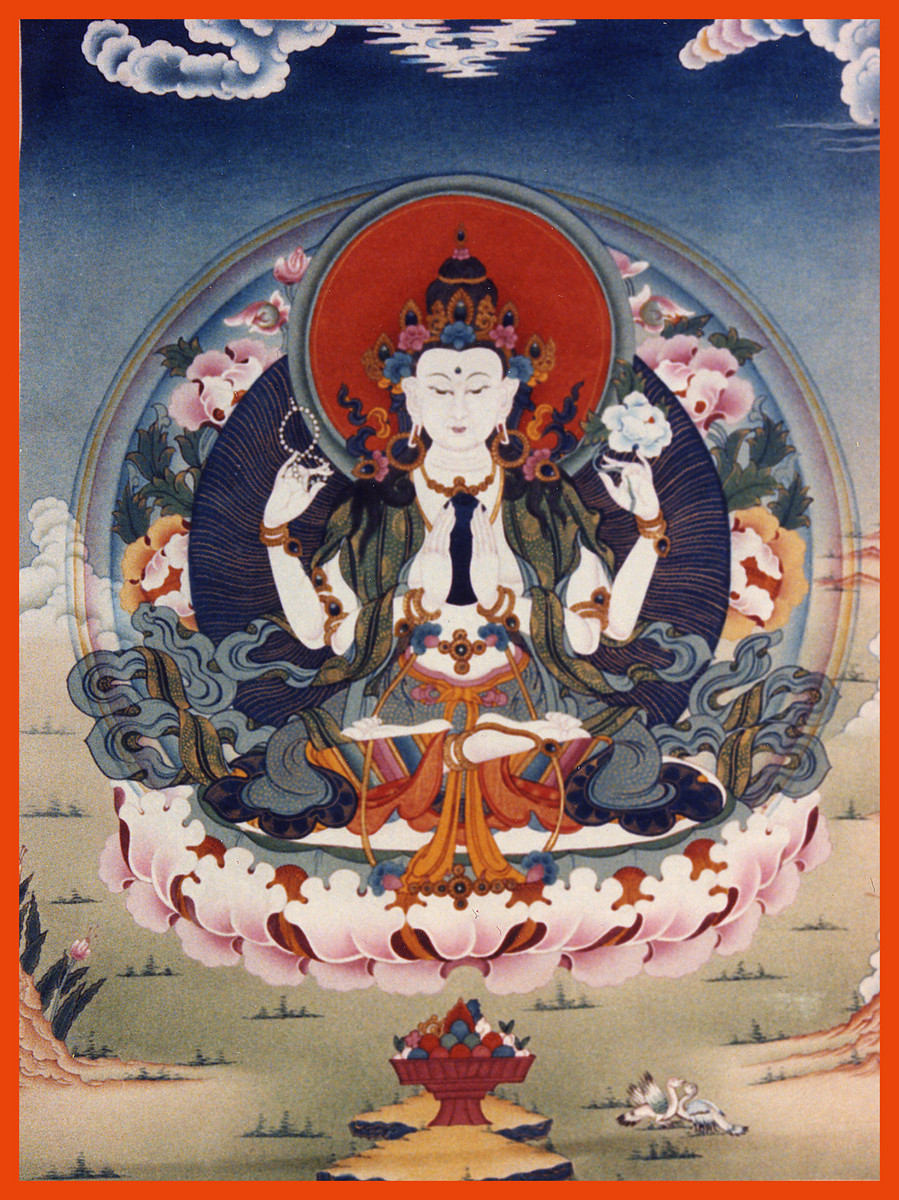
Avalokiteshvara in the 6 Realms (Chenrezig)

Downloads available: a PDF of the practice and an mp3 file of Palyul monk Lama Pasang chanting the practice.


Avalokiteshvara of the Six Realms

Avalokiteshvara (Tibetan name: Chenrezig) is known as the Buddha of Compassion.   His name literally means “Lord of Dharma who looks down with infinite compassion on all beings in a state of suffering.”  He appears throughout the realms of existence, in whatever form is necessary in order to guide beings on the path to enlightenment. His mantra OM MANI PADME HUNG is said to contain all the teachings of the Buddha.  Chenrezig Practice serves to awaken the great compassion (Bodhicitta) within our minds and also antidotes our mental afflictions, such as pride, jealously, anger, and so forth.

“Every person whose heart is moved by love and compassion, who deeply and sincerely acts for the benefit of others without concern for fame, profit, social position, or recognition expresses the activity of Chenrezig.”

Bokar Rinpoche

— Chenrezig: Lord of Love

Download Chenrezig Practice PDF


Proper Conduct: Understanding the Source of Happiness

The following is an excerpt from a teaching by Jetsunma Ahkon Lhamo called “The Lama Never Leaves”

Whenever we are on the path and we have a spiritual friend in the form of a teacher, whether it is on the earlier path of Theravadin Buddhism or whether we have a spiritual guru who is from the Vajrayana point of view, a very profound friend who one can expect will mingle with our lives and hopefully mingle with our mindstreams, and give us the appropriate information in order to practice the path, there is one set of instructions that is almost always given in one way or another.  And so I’d like to give these instructions.  They are about gathering and accomplishing “merit”…or meritorious activity.

Here in our society, we are taught in a materialistic way.  We are taught that of course if we get education we will make money.  If we make money, we will get things.  If we get things, we will be happy and we can pass those things on to our children who hopefully will be happy also.  And that’s the idea that we have in this society about material things.

Very rarely do our parents teach us about profitable conduct.  We’re taught about how to live profitably.  Hopefully, if we had good parenting, they taught us about how to keep a bank account and all of those passages of adulthood that we learn about.  But nowadays, it has become much less popular, unfortunately, for parents to teach us profitable conduct; in other words, how to act, how to present oneself, how to hold oneself, what deeds to act upon and so forth, that will bring us happiness and joy.  We in fact, in growing up, we are not really taught that acting in a certain way will bring us happiness or joy; or making offerings in a certain way, or certain kinds of conduct.  Generally what happens is the child imitates the parent.  Many times the parent, like any other samsaric being, is neurotic and we see them acting neurotically in their relationships, and we see that it’s like a roll of the dice.  According to how we act, half the time it produces happiness, and half the time it doesn’t.  And sometimes when we’re in a real spiral…that means the downward kind…we can experience a great deal of neuroses and our children will watch that habitual patterning and they will pattern themselves after it.  It’s natural.  It’s hard-wired in children to do that.  And of course in this day and age, it seems like we have lost touch with what it is that actually creates happiness.  We are so confused in our minds…we’re in such turmoil…we’re always grasping and grabbing and trying and often we’re working very hard at it.  It’s not that we’re lazy.  We don’t just lay around all day.  We’re often working very hard at things that ultimately produce no good result.  Pursuing endless distractions, the Buddhas have called it.

And so, we turn to the people of authority in our lives and we look to them for guidance.  Well, we look to the government and the government says, “Let’s cut down on social services, screw the poor people, we’ll go to war!”  So maybe that’s not so good.

So then we look at our parents…and let’s see, parent’s are on maybe second or third marriage, and they’re very much trying to be happy but they don’t know how to be happy and the parents are in as much turmoil as perhaps the child is.

And then the child turns to the teachers and even religious figures.  And if the religious figure is not enlightened, often times they are lead down horrible paths; perhaps even abusive paths where they are taught some strict dogma that has no relationship to anything really; or in the worst case scenario, they are used and abused by a religious figure of authority.

So where do we actually go to understand what it is the Buddha taught about cause and result…because this is where the Buddha really shone…showed his immense wisdom, his immense capacity.  …Is that not only Shakyamuni Buddha, himself, but every teacher and lama that has studied his teachings, followed his ways and accomplished.  And all the teachers yet to come that revealed Terma, including Guru Rinpoche and those that were Treasure Revealers later on, each in their own way, taught us Proper Conduct.

Proper Conduct is actually part of our Ngondro practice in which we learn to turn the mind toward Dharma.  And that doesn’t mean…what do you call it when somebody…a person that sings the rap of a certain company and…public relations, right.  It’s not like that.  Our teachers actually indicate to us how we should live and actually that’s one of the signs of the Buddha is that the Buddha comes to the earth and shows us how to live because we are living in confusion.  We have not been taught of cause and effect.  And this is one thing that Lord Buddha really taught about was cause and result.  And he said that, if spiritual thinking isn’t reasonable and logical, that is, if one cannot think it through first before one decides to really open the heart in faith, then we should think again.

Copyright © Jetsunma Ahkon Norbu Lhamo All rights reserved

Taking Bodhicitta Home

The following is an excerpt from a teaching by Jetsunma Ahkon Lhamo offered at Palyul Ling Retreat 2012:

We have to remember that kindness is the way, and bodhicitta is the most powerful thing in the world.  If you are afraid because someone has wronged you or harmed you in some way (and I’ve had that experience), I’ve also found out that bodhicitta solves the problem.  Bodhicitta ends the problem.  If someone harms you and you instead give bodhicitta, some kindness, then the problem is over.  His Holiness himself with his own mouth told me there is nothing more powerful in the entire world than the great bodhicitta, nothing more powerful.

Whatever practice you do, meditate on compassion.  Meditate on the suffering of sentient beings.  Come to understand what it is that they go through.   They will never have what you have because the karma is not there.  But you could help by offering the bodhicitta and offering yourself to the three precious jewels for their sake.  Keep this phrase in your mind.  If you are uncomfortable and your knees hurt or anything like that, remember, “For their sake. For their sake, my children.”  Please hold that in your heart and hold that in your mind, even though these are just very simple words and nothing to take home or be so proud of. Still I want to tell you that if you don’t have the bodhicitta, you have nothing.

You are so needed in a world that is hungry for love.  But if you forget that, then your practice again becomes dry and dull, and you may forget.  Dharma is like a wedding cake.  The bottom of the cake is the support.  Without support, everything falls down.  And bodhicitta is the support.

I know your hips hurt and your knees hurt and your eyes are tired.  I know what it is like with retreats and the long times that you sit in that one certain position.  I can’t even do it anymore because my knees have gotten so bad.  I inherited that from my father, His Holiness Penor Rinpoche.  That’s all I am going to burden you with tonight.  I feel that you have spent a long day working very hard,  and you should have your rest; but I wanted to tell you this one small thing.  Don’t forget love.  Don’t decide what it has to be.  Don’t forget the bodhicitta that is so needed, like food and water.  Look and see what you can do to help others on ordinary levels too. You can’t practice when you are hungry.  Try to help all beings in any way that you can.  If you find yourself unable to keep going in your practice, stop.  Go back to the beginning.  Do the bodhicitta all over again, and then move on.  You will be refreshed.  Your heart will be moved.

That is all I am going to share tonight.  I thought that it might be helpful in your practice, especially in the middle when it’s just getting really hard.  Take care of yourself.  Take care of your hearts.  Give yourself the food you need to go on through practicing kindness.  Be kind to yourself as well.  I am thrilled to have this opportunity to be with you, even though I have nothing much to say.  Thank you for coming.

Copyright © Jetsunma Ahkon Norbu Lhamo All rights reserved
WP2Social Auto Publish Powered By : XYZScripts.com