Why Enlightenment Matters

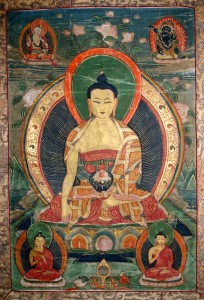
Shakyamuni Buddha

After practicing Aspirational Bodhicitta, you will move into Practical Bodhicitta. Practical Bodhicitta is where one actually attempts and begins actually to develop the technology or method by which the cessation of suffering can be brought about.

Again, back to the foundational teachings of the Buddha: The Buddha teaches us that the sufferings that we see and think we understand the causes for are only symptomatic of a deeper suffering; and that deeper suffering is actually the faults of cyclic existence. These are the real sufferings: Impermanence; the fact that cyclic existence has nothing inherent within it that leads to the end of suffering. These things are the faults of cyclic existence.

Having understood the faults of cyclic existence, we must then think what the Buddha has told us: Only enlightenment brings about the cessation of suffering. And to carry that further, only an enlightened being, and ultimately a supremely realized being, can truly bring about the end of suffering. So you have to consider Practical Bodhicitta in more than one way. You must actually consider that you wish to accomplish whatever means will bring about the cessation of suffering for all sentient beings: whatever practices will bring about the end of suffering; whatever methods. You have to employ these methods; but you must also think that your own enlightenment then becomes significant. Even if you are thinking only of sentient beings—and that is the proper motivation—even if you are thinking only of motherly sentient beings and their suffering and not thinking of your own suffering so much, if you have come to that profound level of Aspiration Bodhicitta because of entering into the phase of Practical Bodhicitta and the need for you to accomplish enlightenment in order to lead other beings to enlightenment, then one’s own enlightenment becomes significant. And that is the real reason why one’s own enlightenment becomes significant. Yes, it’s true that each of us wishes to be free of suffering. But from the point of view of Bodhicitta, the proper motivation for practice then is the cessation of suffering for all sentient beings.

An excerpt from a teaching by Jetsunma Ahkon Lhamo called “Bodhicitta”

Copyright © Jetsunma Ahkon Lhamo.  All rights reserved

The Causes of This Present State

BULLY,SCHOOLYARD BULLY,BULLIES

There are some cause and effect relationships that we become acquainted with.  Especially if, as I’m sure all of you are, you are engaged in watchfulness in your life. And really wanting to progress spiritually in some way, your capacity for learning is that much greater. We may learn that if we’re really kind and loving to others, we get better result. We may learn that if we’re generous, people are generous to us. We may learn that if we’re really hateful and arrogant, we never really get anything good out of that. We may learn some lessons like that. And if that’s the case, those are all precious and valuable lessons to learn.

However, there are lots of things that we don’t learn. The reason why is that, for one thing, we really don’t fully understand how it is that we came into this life under the conditions that we have. We don’t understand how it was that we were born to the families that we were born to, or how it was that we arrived in the condition that we arrived in. How it is that we arrived at our genetic structure? How it is that we arrived with certain mental, physical and emotional propensities? Certain habitual tendencies? Why is it that they have arisen so strongly within us? And it seems as though other people, even in the same family, do not have the same habitual tendencies. We don’t have a full and complete understanding. And the reason why is because we cannot really understand the conditions that have occurred previous to this lifetime. We don’t have an understanding of that. We cannot actually view the cause and effect relationships that brought us to this present state.

Another thing is that we don’t often understand the outcome of causes that we ourselves have begun during the course of this lifetime. For instance, we may be able to see very simple kinds of cause and effect realities. Like if you walk up and punch somebody in the nose who’s approximately the same size as you, there’s a real good chance he or she is going to punch back. And you might learn some cause and effect reality by trying that. But, on the other hand, you might not learn that if you sit there and instead of punching the person who is not your favorite person, you sit there and think hateful thoughts, thoughts of wishing to do harm, thoughts of condemnation and judgment. You may think that having those thoughts, just because you haven’t said them, just because you haven’t acted on them, just because you haven’t punched, is somehow ok. That having those thoughts is secret, that no one knows about them. And that it’s really all right to think like that because you won’t see it play itself out. And even if it does play itself out during the course of that lifetime, perhaps the person that you have these thoughts toward is at some time in the future, maybe even just a couple of weeks from that time, strongly hateful toward you. You may not understand the connection. You may not see what has happened. Certainly you will not see if that cause and effect relationship ripens in some future life because you won’t remember that you just got what you deserved. You won’t remember that you had the same thoughts about that person.

Copyright © Jetsunma Ahkon Lhamo.  All rights reserved

Excitement

get-inflamed

The following is a teaching by Jetsunma Ahkon Lhamo called “Desire Blocks Happiness”

I don’t know how many times people have come to me and said, “Gosh, I’m so excited about this path! I would love to practice this path. It seems so wonderful! I’m so excited about this path. But you know, that’s like me. I always get really excited about things, and I jump into them; and I get really on fire, and then I burn out real quick. But maybe this one is different! This could be it!” Well, you know, that’s the example that I can give you that I see again and again and again and again. But people are like that about everything!  Whenever we get a new object, we get real excited about it, or we become attached to it; and we think this is the thing that is going to make us happy. But it isn’t. Or we get a new relationship, and we just get all in love, and in friendship, and whatever it is, enamored. And then we think, “Oh, this is going to be the one that makes a difference!”  And then, well it does, but it isn’t. It really isn’t.

What are we actually seeing? First of all, we’re actually seeing the faults of cyclic existence. What begins must end. What goes up must come down. What causes us to be supremely elated must also cause disappointment. What comes together must result in separation. That is the fault of cyclic existence. That is its quality. We’re seeing the reflection of the condition of cyclic existence. More than that, we are seeing the reflection of our own mind. Our own mind. Our own mind has within it the karma, or cause and effect set-up, if you will, to be able to experience that kind of thing again and again and again. That is our habitual tendency. We are suffering from a kind of inflammation of the mind. The mind is inflamed. Interestingly, the very thing that causes us to be so inflamed by some new toy, you know, some new relationship, some new thing that comes into our life, some new event, some new job, some new spiritual path, some new idea… Something that comes into our mind that causes us to be so oh, gosh! everything’s going to be different now! So breathlessly excited. Everything that comes into our mind like that, that quality of inflammation. And it is like an inflammation, isn’t it? We become all puffed up and red like inflammations. That quality of inflammation is the same quality that will actually lead to the downfall of that particular circumstance to satisfy us, because that very inflammation is an indication of the instability of our minds.

Copyright © Jetsunma Ahkon Lhamo.  All rights reserved
Kunzang Palyul Choling: NEWS

The following YouTube video was prepared in response to recent challenges faced by Kunzang Palyul Choling Buddhist Temple:

If you would like to help support the restoration of all activities KPC has offered to the community please click here.

Learn more about Kunzang Palyul Choling (KPC) in this excerpt from “Reborn in the West” by Vicki Mackenzi

The Seven Line Prayer as Practice

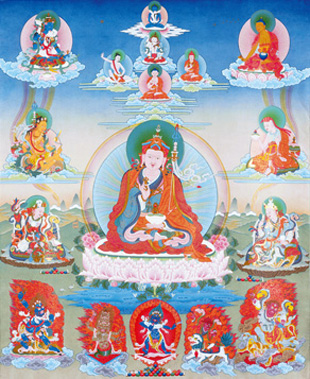
8_Manifestations

The following is an excerpt from a teaching by Jetsunma Ahkon Lhamo called “The Guru Is Your Diamond”

Likewise, when the student accepts the teacher, they must honor that vow and they must make a similar vow in their own way. That vow is contained in The Seven Line Prayer. “Following you, I will practice.”  Even though the prayer is directly to Guru Rinpoche, the prayer has an inner, outer and secret level of meaning. So we recite it thinking of Guru Rinpoche on a lotus and having the intention, hopefully, to understand that even though this appears as Guru Rinpoche on the lotus, it is inseparable from our own root gurus—same nature, same taste, same essence, same uncontrived primordial essence. And so, every time we recite the prayer to Guru Rinpoche, The Seven Line Prayer, we reconfirm that entire process: recognizing that Guru Rinpoche was the one who came from Orgyen; that he was born on a lotus in an extraordinary way. This is like our saying, ‘I understand that this is not ordinary. I understand that this did not happen as ordinary births, as ordinary conditions happen. And so having understood, I also promise to follow and to practice.’  And then we ask for the Guru’s blessing, Guru Pedma Siddhi Hung. Guru Pedma, grant me your blessings.

There is so much condensed into the power of that little prayer that I make you say again and again and again. There’s so much. One can go so deeply with just that one prayer. One can move through the stages of recognition to a depth that we didn’t think we could ever reach. One can create that connection by reciting again and again and again, “Following you I will practice. Following you I will practice.”  And so those meaningful words, even though they are simple, we can understand them more deeply and more deeply and more deeply. “Following you I will practice.”  What does it even mean?  Does it mean I dress like Guru Rinpoche, or act like Guru Rinpoche, or do I wear some of his funny earrings, or what do I do?  (I’ve got some funny earrings on, by the way.)

That’s not it. “Following you I will practice.”  First, we practice the way Guru Rinpoche practiced, for the sake of sentient beings. That’s how Guru Rinpoche practiced. He came and was born into the world for no reason other than to benefit beings. He didn’t have to come and learn; he didn’t have to come and hang out. Like Lord Buddha himself, he didn’t have to come and learn or hang out. And yet he came for the benefit of sentient beings. And so that’s the way in which we promise to practice. Not only throughout this prayer, throughout this hour that I am practicing, but throughout this day, throughout this week, throughout this month, throughout this year, throughout all my lifetimes, may I follow the Buddhas and Bodhisattvas and liberate beings. We’re talking here about liberating beings from suffering. This is what Guru Rinpoche did. Yes, he taught. Yes, he hid termas. Yes, he gave us the means, the method. But the intention was about liberating sentient beings. Following you therefore I will practice.

And so that’s our commitment. We take on this tremendous commitment, this tremendous opportunity to liberate beings from the clutches and the ravages of samsara. And that means we’ll live the week like that, the month like that, the year like that, the decade like that, our lives like that. And at the time of our death, we will make prayers to be reborn following Guru Rinpoche. And in our next life, we are reborn again to continue and to benefit beings. This is the method. This is the way. This is the powerhouse. We rely on this promise, this blessing.

Link to The Seven Line Prayer with audio files for practice accumulations.

Copyright © Jetsunma Ahkon Lhamo.  All rights reserved
 

Jewel of the Dharma in the West

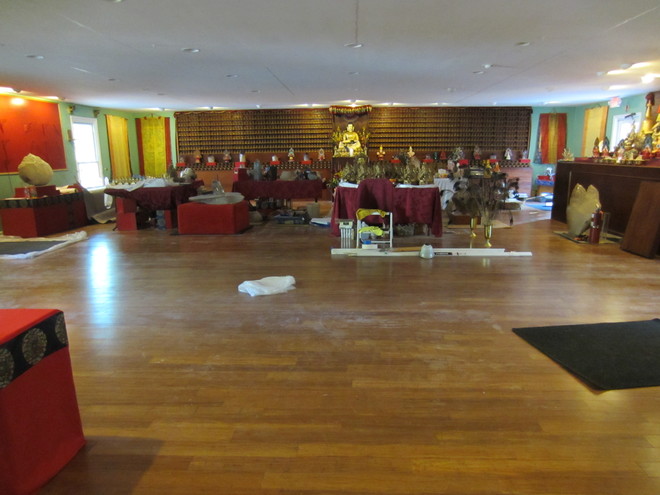
Prayer Room In Progress

The following is from a series of tweets by Jetsunma Ahkon Lhamo:

I am racking my brain to think of more ways to fund raise. It feels like crying in the darkness. His Holiness Karma Kuchen Rinpoche tells me KPC is absolutely necessary, as did His Holiness Penor Rinpoche. Palyul needs us to be strong for the sake of all beings and for western Dharma.

We are not on time, we are lagging. Please wake up and march forward with me and make the world a better, kinder place.

Support the Renovation


The Seven Line Prayer: An Introduction

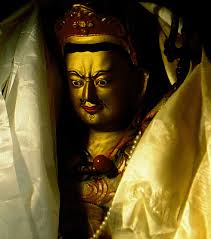
Guru Rinpoche

The following is an excerpt from a teaching by Jetsunma Ahkon Lhamo called “Experiencing the Hook of Compassion”

The Seven Line Prayer is so important. It is a magnificent prayer. It was not made up or composed by an ordinary person. It was miraculously manifested when primordial wisdom dakinis appeared literally from the sky to devout practitioners and told them, “This is how one calls the Guru. This is how one practices.”One will actually move toward enlightenment and can achieve enlightenment merely by reciting this prayer. Whenever a student asks me formally to be their teacher, I ask them to repeat this prayer many, many times. In fact I hope that each student will repeat it a hundred thousand times. Now that sounds like a piece of work, doesn’t it?  In fact, it is. But eventually you will learn to say the prayer so well that you can say it really quickly. You don’t have to say it slowly; you can say it very quickly and you can do a whole mala, that’s a whole prayer beads’ worth, in maybe ten, fifteen minutes. That’s pretty easy to do. That’s pretty easy to do. And then you can get to eight minutes. I don’t know what the world record is, but you can do it. You can, but you’re a blur. Your lips go “bluhbluhbluh..”.

Actually you can feel the wind on your nose.

This prayer actually occurs on three different levels. It has three different levels of meaning. The most profound level of meaning is so profound that the teachers do not give that level of meaning until you have accumulated three hundred thousand repetitions of that prayer. Isn’t that amazing?  This prayer has in it everything. It has refuge; it has bodhicitta. There is every kind, every element of practice within this prayer; but it’s in such a succinct form, that it’s just a prayer. It isn’t really a practice. You know, pujas in the Tibetan tradition take hours and hours and hours. There are all kinds of mudras that you do, and instruments that you play, and all kinds of amazing technologies that you apply. But this prayer, in a very succinct form, really has the seed of everything.

On the most external level, it is, according to the translation, an invocation to Guru Rinpoche, who is the actual emanation and display of Lord Buddha who brought Vajrayana to Tibet; and he is supremely realized. On a deeper level, there are so many different levels of meaning, layer upon layer of meaning. The syllables that are in this prayer are power syllables. They have some particular power due to the way in which they were given through miraculous means, and due to the vibrational quality that is associated with these syllables. As you sound the syllables, they actually purify the inner, psychic channels, winds and fluids, that in sentient beings are polluted and kinked and distorted and actually blocked. The sounding of these syllables begins the process of purifying them and unkinking them, and actually changing you in some profound way, some psychic way, that is really extraordinary, actually extraordinary. Plus in a hidden and symbolic secret way, all the elements of practice are in this prayer, including extraordinary devotion to one’s guru . As you begin to sound it with faith that this miracle will take place, the change begins to occur, even though you are not doing the full practice. So if you want to begin, learn how to say this practice. Learn how to say this prayer.

See the prayer and listen to Jetsunma recite it by clicking here

Our Best Hope

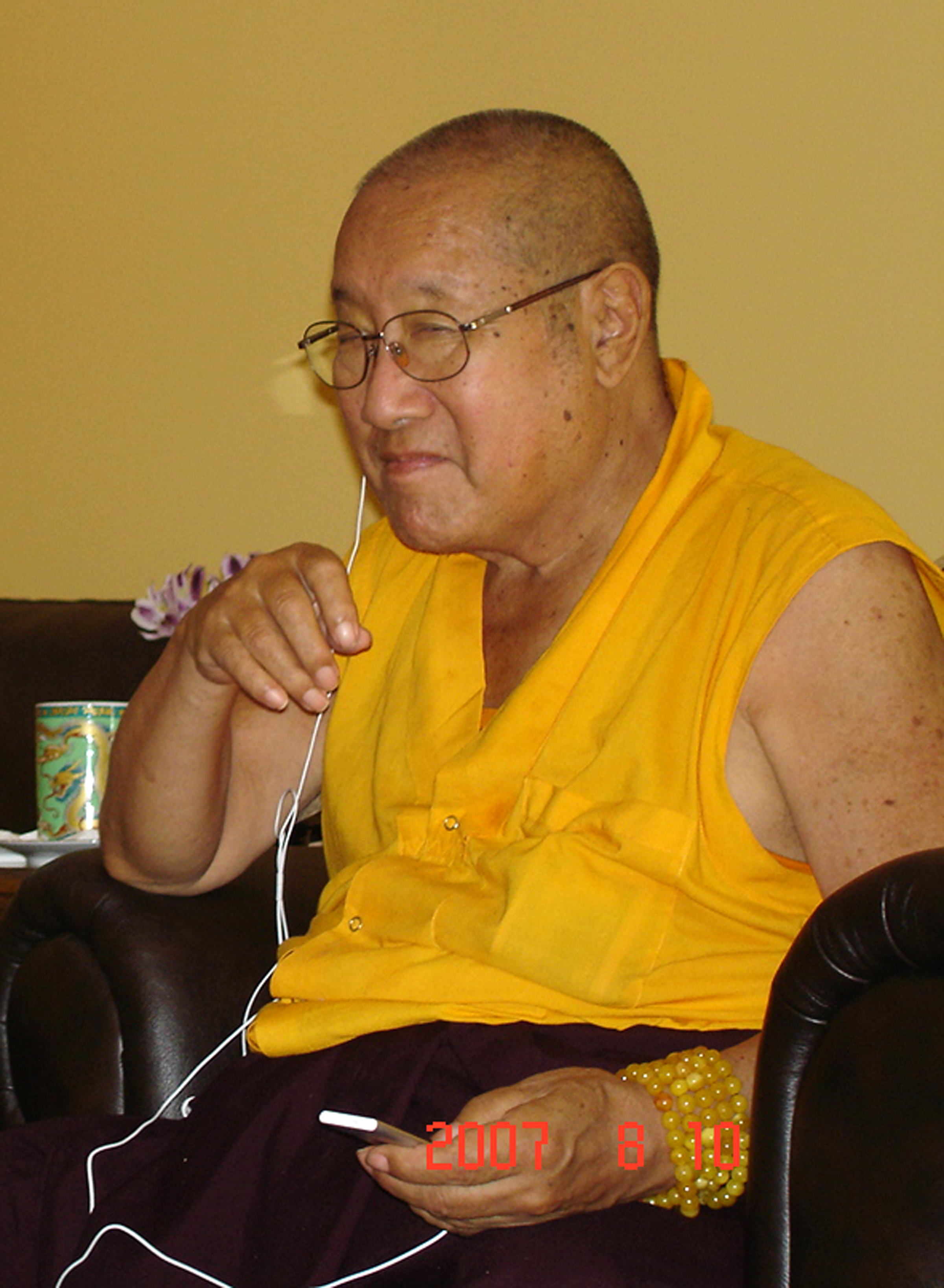
NP-89 HHPR Listening to RoC-crop

The following is an excerpt from a teaching by Jetsunma Ahkon Lhamo called “This Time is Radical”

When we practice meditating on emptiness and non-duality, we think we should come out of that feeling oh so peaceful, like milk. And then after that, we should be so peaceful. And I think, “Right on. Whatever.”  Mostly, I think, let’s gather together and be of benefit. I think that’s the most important thing.

At this time, there are people who have come in contact with Dharma. From this time forward, there are those who have the karma to practice but will not have the opportunity because the darkness is getting thicker.For them, we will record mantra and we will send it out to the world. And if it can wake them up, it will wake them up and they will come. And if you don’t know that His Holiness gave his blessing to this, then I’ll tell you that he has.

His Holiness is interested in this. He doesn’t care what it sounds like. He’s not a big rock and roll fan. Not into Hip Hop. Wouldn’t know 80s music from Sub Dub. Just doesn’t know. But His Holiness said, ‘We’ve got to get it out and we’ve got to get it out now.’  And so for me in my practice and in my activity, and that includes the music, we have two streams going here. I’m going to go up to New York and record with John Ward on Monday; and then we have another stream that is in the studio. We are going to do more and more and more and more until everyone who can hears it, and they will come. I find that there is no way to reach out to them because they have, through the thickness and the darkness and the delusion, become too dense to hear. But my determination, our determination, is to call to them so loudly and so clearly in their language, which is today’s language, that they can’t resist us. And they will come. And with every effort that we make, we will continue to practice and pray. And I believe that because of that, they will come in droves.

So I wanted to tell you that. Not because I wanted to put out energy before its time or to brag or anything like that. It’s not like that really. I’m not ambitious in that way. I’m only ambitious in one way, and that is, get it out. Sound the call. So while it’s so dark they can’t see, still maybe they can hear.

I want you to know that when people hear me doing this, they won’t know that His Holiness wants me to do it. They’ll think, ‘What is this?  A tulku?  A reincarnate lama from a throne singing whatever? Blues or hip-hop or whatever?’  But if you listen to it, there’s mantra in it, and there’s Dharma in it, and it’s real. And so I say to you that I have permission, first of all, and I have the heart for it, second of all. God, I hope I have the voice for it. I feel that this is a time of either despondency or empowerment. You are either getting left behind or you’re climbing onboard now. Things are going to get really exciting around here really fast. So I want you to keep your heart practice, and never be swayed by anything you see, no matter what you see. Even if someone says, ‘Well, why is a Dharma teacher making this music?’  Then you can repeat the teaching, “All sounds are the Dharma.”  Learn it. Learn it well and speak it, because that is the truth.

The other thing that His Holiness said is that the Dharma can’t be broken. You can’t break it. You can’t break something that is not of this world. The meaning of that is that in whatever context we can put the Dharma out to sentient beings, so long as it is with good motivation and completely respectful, it will manage. It will do its job. The way it works, as I’ve instructed you before, is that the very vibration, the very sound of Dharma, which is why you have to speak the mantra out loud, the very sound of it reverberates and corresponds with the winds, channels, and fluids within your deepest nature. So if one hears mantra, or sees some connection with the Dharma, even though they may be ordinary and kind of down in the dust and living a very secular, commercial, ordinary life, the power of mantra is such that boom!  they can wake up. It is an ancient resonance that comes to them and they change quickly because of that. I see that happening. And I see that in this time, that’s our best hope. It’s our best hope.

Copyright © Jetsunma Ahkon Norbu Lhamo All rights reserved

The view and purchase music produced by Jetsunma please visit http://www.cdbaby.com/Artist/Jetsunma

Free download of “The Promise

Wisdom on Social Media

mosquito

The following are excerpts from teachings offered by Jetsunma Ahkon Lhamo on Facebook and twitter:

Jetsunma’s Tweet: We have all types of karma. We have killed – ever killed a mosquito?

Facebook User: Are you saying that killing a mosquito is wrong?

Jetsunma’s response: Killing is always wrong but cannot always be avoided.

Facebook User: Why is killing a mosquito wrong? Does it have a soul? I understand the part about killing being wrong and that it cannot always be avoided.

Jetsunma’s response: We don’t think of “souls” in Buddhism. We feel that all sentient beings have the same primordial nature – all sentient beings are made of the same stuff.

A twitter teaching from the same day:

As I get older I have come to realize how precious life is and how little we do to live long. We don’t think of kindness or charity or that other sentient beings are suffering just like yoy and I. How sad! We don’t understand the connection at all. We think things just happen to us. Ha! Like we had nothing to do with this at all. Good grief!

WP2Social Auto Publish Powered By : XYZScripts.com