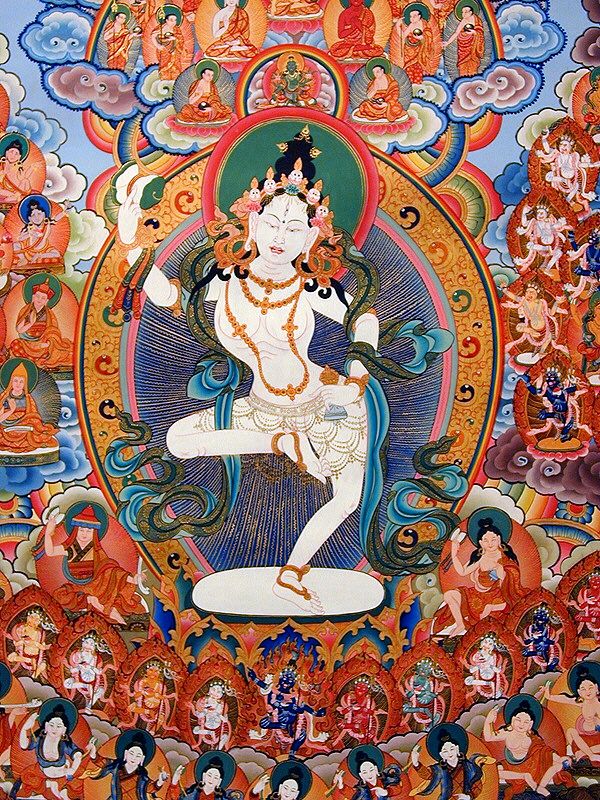
Mother Song and 7 Line Prayer

KW 176-x JAL with Atira-web

Mother Song & Seven Line Prayer

The following are the lyrics to The Mother’s Song, recorded by Jetsunma Ahkon Lhamo in 1992. You can listen to the recording by clicking the link above.

The Mother’s Song

This morning I woke up

With the sounds of suffering

Speaking their names

In my ear

Spoke of a time

When the Bodhisattvas

Could no longer appear

How can my heart bear the sorrow?

How can my eyes bear to see?

All of my babes lost and fearful

Having no means to be free.

No way to know of liberation

No way to cross samsara’s sea

How can I comfort the sick and dying?

How can I hold them within me?

If they are called, will they hear?

Will they see?

© Jetsunma Ahkon Lhamo, March 1992

Excitement

get-inflamed

The following is a teaching by Jetsunma Ahkon Lhamo called “Desire Blocks Happiness”

I don’t know how many times people have come to me and said, “Gosh, I’m so excited about this path! I would love to practice this path. It seems so wonderful! I’m so excited about this path. But you know, that’s like me. I always get really excited about things, and I jump into them; and I get really on fire, and then I burn out real quick. But maybe this one is different! This could be it!” Well, you know, that’s the example that I can give you that I see again and again and again and again. But people are like that about everything!  Whenever we get a new object, we get real excited about it, or we become attached to it; and we think this is the thing that is going to make us happy. But it isn’t. Or we get a new relationship, and we just get all in love, and in friendship, and whatever it is, enamored. And then we think, “Oh, this is going to be the one that makes a difference!”  And then, well it does, but it isn’t. It really isn’t.

What are we actually seeing? First of all, we’re actually seeing the faults of cyclic existence. What begins must end. What goes up must come down. What causes us to be supremely elated must also cause disappointment. What comes together must result in separation. That is the fault of cyclic existence. That is its quality. We’re seeing the reflection of the condition of cyclic existence. More than that, we are seeing the reflection of our own mind. Our own mind. Our own mind has within it the karma, or cause and effect set-up, if you will, to be able to experience that kind of thing again and again and again. That is our habitual tendency. We are suffering from a kind of inflammation of the mind. The mind is inflamed. Interestingly, the very thing that causes us to be so inflamed by some new toy, you know, some new relationship, some new thing that comes into our life, some new event, some new job, some new spiritual path, some new idea… Something that comes into our mind that causes us to be so oh, gosh! everything’s going to be different now! So breathlessly excited. Everything that comes into our mind like that, that quality of inflammation. And it is like an inflammation, isn’t it? We become all puffed up and red like inflammations. That quality of inflammation is the same quality that will actually lead to the downfall of that particular circumstance to satisfy us, because that very inflammation is an indication of the instability of our minds.

Copyright © Jetsunma Ahkon Lhamo.  All rights reserved

Early Practices: The Life of Jetsunma Ahkon Lhamo

The following is respectfully quoted from “Reborn in the West”  by Vicki Mackenzie as she recounts Jetsunma’s life story. This section begins as Jetsunma describes her early practice:

‘I left the party at that point,’ was how she put it. ‘I felt “There’s nothing here.”‘ Her meditation then took a quantum leap–right to the heart of mysticism, to the fount of truth.

‘In my next dream I was guided to meditate on the question “If what I have here does not amount to much because it is so finite, then what is there of value?”‘ Suddenly she found herself contemplating absolute reality, or ultimate truth, the primordial wisdom state and the most profound and difficult subject of all Buddhist meditations.

‘I didn’t have the words for it but I knew it wasn’t like God, the old-man-on-the-throne idea. What I was meditating on was a non-dual, all-pervasive essence–that is, form and formless, united, indistinguishable from one another. I saw that it was the only validity–that and the compassionate activity that was an expression of it.’

What Jetsunma was telling me was, I recognized, quite exceptional. What yogis and scholars in Tibetan monasteries take years to achieve after long intellectual delving and even longer years of retreat, Jetsunma had arrived at entirely of her own accord. Tucked away on her farm in North Carolina without any guru, any book, any established doctrine or example to follow, she had not only discovered but realized the two essential truths–wisdom and compassion, the two wings of Tibetan Buddhism that are said to fly you all the way to Enlightenment. Without them you can barely get off the ground. It was an amazing feat.

But she didn’t stop there. While she continued to meditate on absolute nature and compassion she simultaneously began to offer up her body, part by part.

‘This is going to sound strange,’ she said, laughing, ‘but I would lie down–I didn’t know you were suppose to do all of this sitting up–and I would look down at my feet and say, “OK, here they are, ten toes.” And I would really look at my feet and consider all the things that my feet could do for me. And then I  would contemplate what was the ultimate good of these things–no ultimate use at all!” ‘ She would continue in that vein throughout her body, staying longer on the parts she felt attached to. ‘No one wants to give up their head, for instance. Our head is like the last bastion of our individuality. And I’d pay special attention to my female parts and my hands. You don’t want to do without them!’

She didn’t know it then, but what she was doing was no less than Chöd, another profound Tibetan meditation whereby you relinquish your body to emptiness for the good of all. It is considered the ultimate physical surrender. How she had come across such a strange meditation in the middle of North Carolina, with only a baby and husband for company, adds to the mystery. I asked again, to make sure, if there were any outside influences that could have been directing her.

‘We were in Ashville in the seventies and nothing metaphysical was happening there,’ she replied. ‘Actually there was one thing–a small transcendental meditation centre had started and friends kept urging me to join. But I resisted. It didn’t feel as though it was the right place for me. They said I had to have a guru, that I couldn’t get anywhere without one, and I replied, “That may be true, but I haven’t found my teacher yet and I will know when I do.” ‘

She continued these intense periods of individual meditation over several years. ‘I would meditate for hours at a time. Luckily I had a baby who was peaceful and slept a lot, and a husband who was supportive of what I was doing. I am eternally grateful for that. But it was still a householder’s retreat. I had a husband, a child and all the chores to do. Even so, I had a much stricter schedule of meditation than I do now.’

The meditations grew in strength and clarity, and when she was around thirty she had a spiritual experience which showed that the time to begin her work had begun. She was reluctant to tell me about it, except to say that she entered a long period of meditation from which she emerged knowing that her personal life had finished and that she had been born solely to be of benefit for others. ‘I never said anything to anyone about it. But oddly, after that people started coming to me.’


Authorization to Teach: from “Reborn in the West”

The following is respectfully quoted from “Reborn in the West” by Vicki Mackenzie:

Before receiving her bodhisattva vows she had told Penor Rinpoche of her own vow that she was teaching to her students: ‘I dedicate myself to the liberation and salvation of all sentient beings. I offer my body, speech and mind in order to accomplish the purpose of all sentient beings. I will return in whatever form necessary, under extraordinary circumstances, to end suffering. Let me born in times unpredictable, in places unknown, until all sentient beings are liberated from the cycle of death and rebirth.

Taking no thought for my comfort or safety, precious Buddha make me a pure and perfect instrument by which the end of suffering and death in all forms might be realized. Let me achieve perfect enlightenment for the sake of all beings. And then, by my hand and heart alone, may all beings achieve full enlightenment and perfect liberation.’

Penor Rinpoche had rocked to and fro in unbridled mirth, slapping his thigh in amusement. She had replicated, almost exactly the same prayers that Tibetan lamas spoke. It was another proof of her identity.

He handed her another certificate, authorizing her to teach. ‘This is important,’ he said. ‘People will say you haven’t been studying the dharma, that they have never heard of you. They will not understand. With this paper no one will doubt that you are capable of teaching the dharma.’

Penor Rinpoche went on to tell Jetsunma a little about her famous ‘predecessor’. The first Ahkön Lhamo was the direct student of Tertön Migyur Dorje, a famous revealer of secret teachings, he said. She was a great dakini and spent decades in retreat, only coming down from her cave to help her brother with his monastery. Otherwise people would go to her to receive healing and teaching.

I asked Jetsunma if she were curious to find out more about Ahkön Lhamo or had any memories of the yogini who had lived in Tibet in 1665 and had inspired a religious order that had survived to this present day.

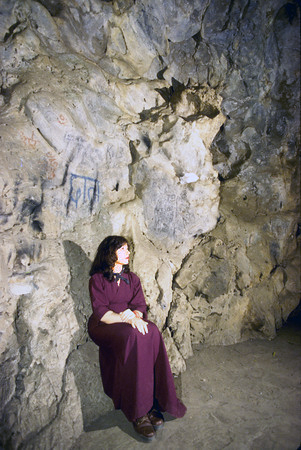
‘I discovered she was pretty wild,’ she replied. ‘She stayed up in her cave and looked pretty wretched, with her hair sticking out all over the place,’ she said, picking up her own unruly locks. ‘She was a crazy yogini type. Some things never change! There was no water in her cave, of course, and she never bathed. Her clothes were rotting on her. But people said whenever they went to her cave it would smell like perfume. Penor Rinpoche told me that people would give her turquoise, gold and coral, but she would refuse it. She was probably holding out for gifts she could accept, like hair-driers! She was probably waiting for electricity to be put into her cave and she could have central heating!’ she joked.

‘As for any memories, I don’t like to make any fuss about the inner experience I have. I can tell you I have some awareness of it, but it’s pretty “Swiss cheesy”. I am curious. I want to go back to Tibet, to see the cave where she practiced. Gyaltrul Rinpoche, the reincarnation of Kunzang Sherab who is now in Oregon, said that when he went back to Tibet he remembered a lot. It’s as though the airways are clearer there.’

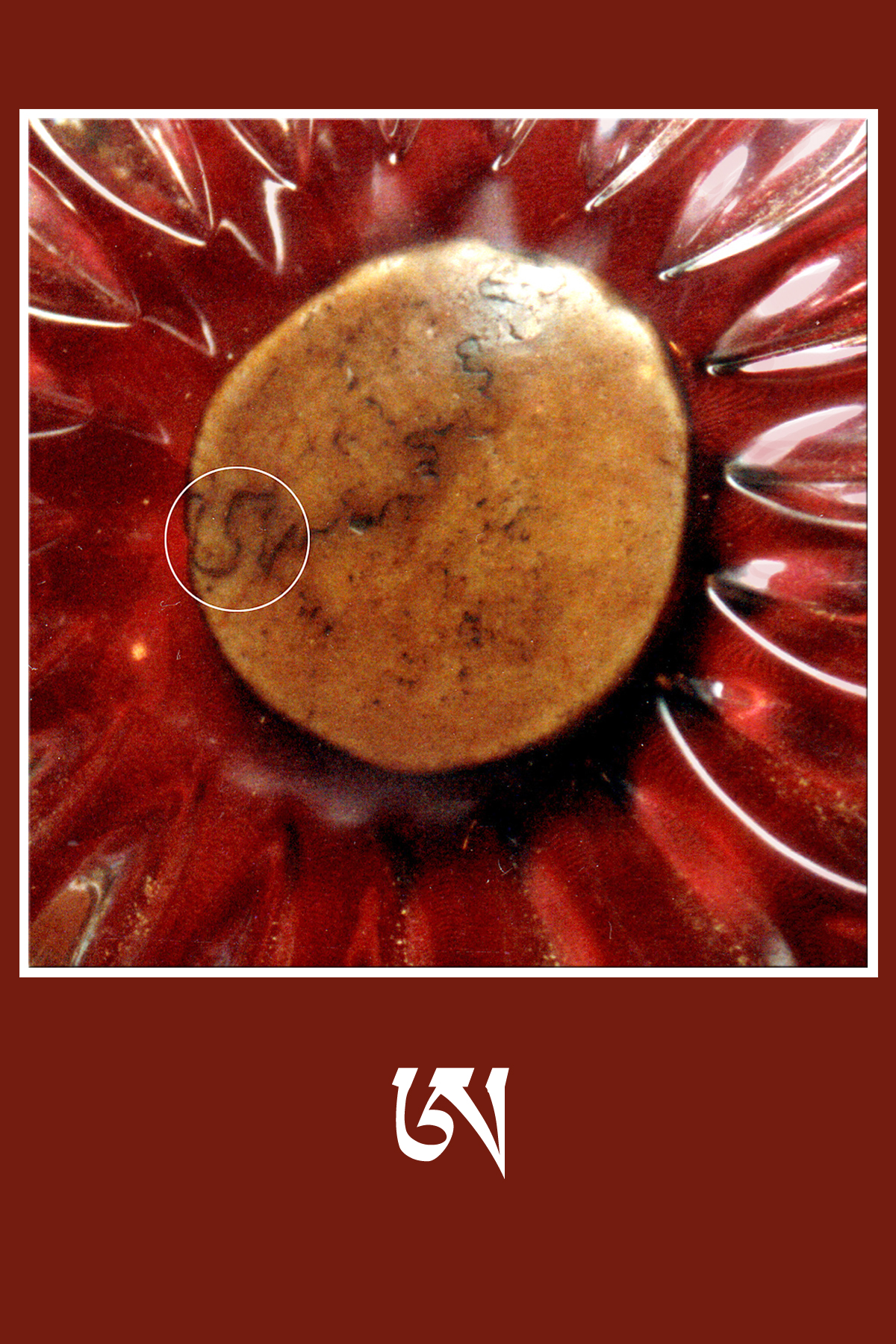
There is at least one concrete link between this latter-day bodhisattva, the girl from Brooklyn, and the seventeenth century Tibetan yogini who had helped found a Buddhist lineage. Ahkön Lhamo’s skull, or part of it, is still in existence. It bears an unmistakable hallmark of sanctity. On its top is etched the holy sanskrit syllable ‘Ah’.

The story goes like this. When the first Ahkön Lhamo passed away, they prepared a pyre to cremate her and duly put the body on it. When the last vestige of flesh was burnt away, the skull rose up in the air in front of hundreds of people and flew about a mile before landing at the Palyul monastery, at the foot of her brother Kunzang Sherab’s throne. This was considered the final ultimate display of Ahkön Lhamo’s power and spiritual accomplishments. The great dakini, who was already known for the many miracles she performed, had revealed her true greatness.

The skull became a most treasured relic and was used as a kapala, and instrument used in ritual ceremonies for holding nectar. It remained intact until in the mid-twentieth century the invading Chinese hacked to pieces everything of spiritual significance, including the precious kapala at the Palyul monastery. A lay person saw a piece of the skull among the rubble and, hiding it in his clothes, took it to safety. It was some years before Penor Rinpoche got word that at least part of the holy relic had survived.

The was a vast gap in time between 1660 and 1949, when the present Jetsunma Ahkön Lhamo was born. I asked her the same question I had asked Tenzin Sherab. What lives did she think she had been living in between?

‘I think there were other incarnations, but as Penor Rinpoche told me, they don’t keep track of women. It wasn’t because they were prejudiced against women’s wisdom. In fact, dakinis are the primordial wisdom beings and are held in very high regard. Generally, though, dakinis were not the lineage holders. They spent their lives in solitude, doing spiritual practices. Penor Rinpoche says, and I feel, that there have been many incarnations.

But this present one, as the American woman doing it ‘her way’ as undoubtedly she always had, was the life that was to capture widespread attention. Jetsunma left the United States as a married woman, mother of two and teacher of New Age metaphysics with a bent for worldwide caring, and returned a recognized tulku, a reincarnate lama. For her students this took some adjustment. While they had been happily following the teachings of a woman whom they treated as their equal, they now had to contend not only with a ‘Buddhist’ but also with someone whose rank placed her on an entirely different footing. There was protocol to observe, a new language to learn for the same concepts they had learnt, and the mantle of an old and established ‘religion’ from the East to adopt. Some disciples fell out, but most survived the transition.

Whatever misgivings they might have had about the authenticity of their teacher’s new lofty reincarnate status, however, were completely dispelled when Penor Rinpoche came to see them for the second time in 1988. “He arrived at Poolesville with twelve monks in attendance and conferred the Rinchen Terzod, the revealed teachings of the great Padma Sambhava to all member of KPC. It was the first time he had ever performed the task in his lifetime, and the first time in North America”.

He then conducted an official enthronement of Jetsunma Ahkön Lhamo. News of the thirty-nine-year-old woman who had been recognized as the reincarnation of a famous Tibetan yogini reached the media. Newspaper reporters and television crews descended on KPC. ‘Meet Ahkön Norbu Lhamo, Tibetan Saint,’ blazed the front-page headline of the International Herald Tribune. ‘The Unexpected Incarnation’ cried the Washington Post. She appeared in the popular People magazine. Leading Japanese and German magazines ran articles on her. This was when my own journalist’s antennae, primed for good stories, must have picked up the importance of the event and stored it away for later use.

The Seven Line Prayer as Practice

8_Manifestations

The following is an excerpt from a teaching by Jetsunma Ahkon Lhamo called “The Guru Is Your Diamond”

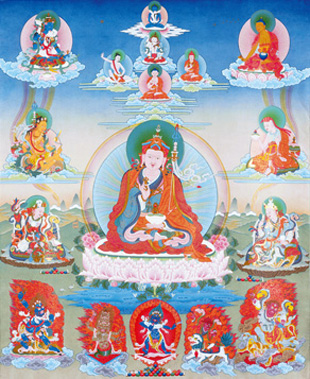
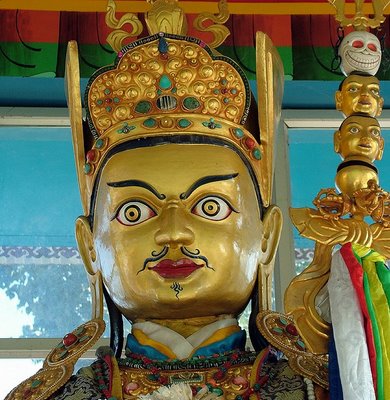
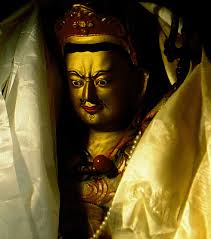
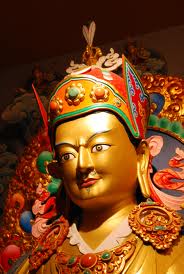
Likewise, when the student accepts the teacher, they must honor that vow and they must make a similar vow in their own way. That vow is contained in The Seven Line Prayer. “Following you, I will practice.”  Even though the prayer is directly to Guru Rinpoche, the prayer has an inner, outer and secret level of meaning. So we recite it thinking of Guru Rinpoche on a lotus and having the intention, hopefully, to understand that even though this appears as Guru Rinpoche on the lotus, it is inseparable from our own root gurus—same nature, same taste, same essence, same uncontrived primordial essence. And so, every time we recite the prayer to Guru Rinpoche, The Seven Line Prayer, we reconfirm that entire process: recognizing that Guru Rinpoche was the one who came from Orgyen; that he was born on a lotus in an extraordinary way. This is like our saying, ‘I understand that this is not ordinary. I understand that this did not happen as ordinary births, as ordinary conditions happen. And so having understood, I also promise to follow and to practice.’  And then we ask for the Guru’s blessing, Guru Pedma Siddhi Hung. Guru Pedma, grant me your blessings.

There is so much condensed into the power of that little prayer that I make you say again and again and again. There’s so much. One can go so deeply with just that one prayer. One can move through the stages of recognition to a depth that we didn’t think we could ever reach. One can create that connection by reciting again and again and again, “Following you I will practice. Following you I will practice.”  And so those meaningful words, even though they are simple, we can understand them more deeply and more deeply and more deeply. “Following you I will practice.”  What does it even mean?  Does it mean I dress like Guru Rinpoche, or act like Guru Rinpoche, or do I wear some of his funny earrings, or what do I do?  (I’ve got some funny earrings on, by the way.)

That’s not it. “Following you I will practice.”  First, we practice the way Guru Rinpoche practiced, for the sake of sentient beings. That’s how Guru Rinpoche practiced. He came and was born into the world for no reason other than to benefit beings. He didn’t have to come and learn; he didn’t have to come and hang out. Like Lord Buddha himself, he didn’t have to come and learn or hang out. And yet he came for the benefit of sentient beings. And so that’s the way in which we promise to practice. Not only throughout this prayer, throughout this hour that I am practicing, but throughout this day, throughout this week, throughout this month, throughout this year, throughout all my lifetimes, may I follow the Buddhas and Bodhisattvas and liberate beings. We’re talking here about liberating beings from suffering. This is what Guru Rinpoche did. Yes, he taught. Yes, he hid termas. Yes, he gave us the means, the method. But the intention was about liberating sentient beings. Following you therefore I will practice.

And so that’s our commitment. We take on this tremendous commitment, this tremendous opportunity to liberate beings from the clutches and the ravages of samsara. And that means we’ll live the week like that, the month like that, the year like that, the decade like that, our lives like that. And at the time of our death, we will make prayers to be reborn following Guru Rinpoche. And in our next life, we are reborn again to continue and to benefit beings. This is the method. This is the way. This is the powerhouse. We rely on this promise, this blessing.

Link to The Seven Line Prayer with audio files for practice accumulations.

Copyright © Jetsunma Ahkon Lhamo.  All rights reserved


Vajrayana: For This Time

GuruRinpoche3

The following is an excerpt from a teaching by Jetsunma Ahkon Lhamo called “The Guru Is Your Diamond”

On the path of Vajrayana, we are given something like a rocket ship, rather than a slow boat, to cross the ocean of samsara. When Lord Buddha first came to the planet and taught, when he was there as Shakyamuni, he gave teachings that were absolutely necessary for that time. During that time, we were not in Kaliyuga, which is a more degenerate age. During that time, it was easier to practice. It was easier even to speak Dharma. Peoples’ minds were more spacious and more expanded so that if one were to accomplish Dharma, it would be more easy to accomplish Dharma during that time. And yet, there was a difficulty. And the difficulty was that during that time, because there was more space in the mind, there was also more relaxation, maybe more joyfulness, less reason to feel compelled to exit samsara. So there are good and bad things in both times.

True that this is Kaliyuga. True that this is the time of degeneration. There are many false teachers and many false paths. And sometimes delusion rises up like a tsunami flood, and it is a difficult time. We look to the people that even guide this country, and you wonder where is the clarity, where is the morality. So it’s difficult. Even this country that was once the prince of countries, and can still be the peacemaker, the one who guards the little guy, instead now we’ve changed. So these are all indicative of this time of delusion.

Yet at the same time, we are so pressed because of our delusion, our neuroses, which means an inappropriate response to something that is not understood well anyway. Our neuroses also thicken and deepen, and with that comes an increase in pain, fundamental pain. Maybe not even a particular pain about something, but rather an all-pervasive sense of suffering.We are more unhappy, really, now when things are happening faster and materialism is in some ways more attainable, in many ways more attainable. Still we have become more and more unhappy and continually create the causes for unhappiness. So this pushes us to find a solution. And for some people, we look to psychology or psychiatry; and for other people, we look towards creating the causes for happiness through walking the path of spirituality. But many of us are seeking, and that’s important. That is something that is useful and to be treasured during this time.

For many of us, we’ll think that what drives us to seek is this pain, this angst, this modern angst that we all seem to carry around. That pain, on the one hand, seems sometimes unbearable, and then other times, just there. And we are uncomfortable and we can’t say exactly why. We feel wobbly, unguided, unknowing and we really can’t understand why that is. That suffering, of course, even though painful, can ultimately become part of the blessing that brings us to the Path. Maybe we didn’t even come here thinking, ‘What I need is a good Path.’  Maybe we came here for some other reason: Because we heard about this place; or we’ve heard a little bit; or we’ve read some books about Dharma; or maybe His Holiness the Dalai Lama has given us some wonderful teaching through his books; and something has just hooked us a little bit. Maybe we heard about the crystals. That brings people!  Whatever it is, it’s that sense of things not being wholesome or right. It’s that sense of fundamental unhappiness that drives us forward.

And so, in the beginning, that’s how it feels. It can be a very poignant kind of search and we feel deeply moved by it. So when we begin to examine the Path of Vajrayana, we find that rather than being the gentle ship that crosses a relatively gentle ocean as was in the time of Lord Buddha’s physical life, now we have a different situation. We are propelled by the depth of our feeling, by our discomfort; and we’re looking for something. And we seem to, in this time, connect with something that is more potent, maybe a little fiercer in a certain way, more condensed definitely, than the original teachings of Lord Buddha.

Copyright © Jetsunma Ahkon Lhamo.  All rights reserved

Supplication to Mandarava’s Emanations


The following is an excerpt from “The Lives and Liberation of Princess Mandarava”

Eh Ma Ho!

In the previous aeon of Bhaskara,
As the daughter of King Indradeva known as Pandaravasini,
She trained on the path to abandon samsara and actualize buddhahood.
To the feet of Mandarava, I supplicate!

Later in the aeon known as Ratnavistirna,
Se was born into the holy caste as the princess Natyendri,
Suryagarbha and his entire kingdom was placed on the path of Dharma.
To the feet of Mandarava, I supplicate!

In the Bright Aeon of Buddha Kanakamuni’s revelation of the doctrine,
With the blessings of the buddhas of the three times,
She naturally emanated the five embodiments as manifestations in
the five continents to tame the minds of beings.
To the feet of Mandarava, I supplicate!

Born as the princess of the god Brahma and consort,
She was known as Ozer Nangyen.
All the people of the kingdom of Kanika, in India, were placed on the path of Dharma.
To the feet of Mandarava, I supplicate!

By the blessings of the aryas, in the land of Damaru,
She was born from a lotus and summoned Hayagriva as her aid.
The the peaceful and wrathful means the kingdom was turned to the path of virtue.
To the feet of Mandarava, I pray!

In the abode of the god Indra, in the land of Kangkari,
She was the mother of the Buddha Dampa Togkar, and she tamed the hordes of demigods.
She was famed for her subjugation of the entire country, which was transformed to the path of the Buddha.
To the feet of Mandarava, I supplicate!

In the subterranean region at the peak of the jewel mountain,
She manifested as a nagini to cure all rampant diseases among nagas.
Known as Dharmindra, she placed all the nagas on the path to enlightenment!
To the feet of Mandarava, I supplicate!

As an emanation of the princess of demigods,
She tamed the hordes of jealous demigods,
As the one known as Samantabadri, she brought the hosts of demonic demigods to maturity and liberation.
To the feet of Mandarava, I supplicate!

In the presence of Buddha Kashyapa,
She generated the bodhicitta and emanated as the daughter of
King Sukhapala named Shri Sagara.
She was responsible for the perfect enlightenment of one hundred thousand nuns.
To the feet of Mandarava, I supplicate!

During the time of Shakyamuni Buddha,
She manifested herself twenty-five times; her further emanations are utterly inconceivable,
Such a one opening the door to the path of the secret mantra vehicle.
To the feet of Mandarava, I pray!

Then, in the western paradise of Sukhavati,
Here a million manifestations reveal the secret mantra,
Her dakini emanation appears with each of them!
To the feet of Mandarava, I supplicate!

Light from the five places of the supreme consort Pandaravasini
Radiated into all the paradises to become the manifestations of the five dakinis of the sphere of truth.
Blessing and empowering the syllable HRIH, this light emanated into the land of Zahor.
To the feet of Mandarava, I supplicate!

Through her miraculous powers, her father and mother, the king and queen, had astonishing indications in their dreams.
In the male wood-horse year, on the tenth day of the month,
She was born and immediately recited the sounds of the vowels and consonants!
To the feet of Mandarava, I supplicate!

At the very moment of birth, she prostrated to her parents to repay their kindness,
And sang a pleasing song for all who had gathered.
The gods came to bathe her, and her fame encompassed this world.
To the feet of Mandarava, I supplicate!

Seeing the suffering of birth, old age, sickness, and death, she felt deep repulsion,
Her mind turned from samsara, and became well-trained
In the five sciences of the holy Dharma.
To the feet of Mandarava, I supplicate!

Into the land of Gautala, in accordance with the prophecies of
Master Drime and Vajravarahi, she debated the heretic Kyabsel.
She defeated and subjugated all heretics at that time.
To the feet of Mandarava, I supplicate!

In the land of Zahor, she brought three hundred women to the path
and transformed the suffering of the king and queen at the death of Prince Palde.
She discovered the flesh of the holy sage, which became the chief object of the people’s devotion.
To the feet of Mandarava, I supplicate!

She reconciled Bheta and Zahor, ending their war.
in accordance with the prophecy of Pandaravasini, she brought her entourage to the Dharma.
She generated fervent prayers to remain in samsara for the welfare of others.
To the feet of Mandarava, I supplicate!

Meeting with the king, she discussed the requests for her hand in marriage from the royal suitors of every direction.
Without attachment to samsara, she received a prophecy from Vajrasattva.
Skillfully escaping, she took the vows of ordination before the Abbot preceptor.
To the feet of Mandarava, I supplicate!

Thoroughly investigating the scriptures, she studied the Tripitaka,
And in the pleasure grove she taught the Dharma to her five hundred attendants.
She received prophecy directly from the emanation of Guru Padmasambhava.
To the feet of Mandarava, I supplicate!

Arriving in the flower garden, she actually met face to face with the guru.
When she invited him to her palace to teach Dharma, a wandering cowherd took notice.
Rumors ensued, and the king took action to punish them.
To the feet of Mandarava, I supplicate!

Despite the king and queen’s attempt to burn Guru Padmasambhava alive, he revealed his miraculous powers.
The king and ministers were filled with deep remorse.
The guru stayed with the king and queen, at which time the king formally offered Mandarava as the consort of the guru of Oddiyana.
To the feet of Mandarava, I supplicate!

All the males in the land of Oddiyana became disciples of the guru;
And Mandarava revealed the Dharma to all the females, who achieved liberation.
She reached perfect maturity through receiving the master’s pointing-out instructions.
To the feet of Mandarava, I supplicate!

Receiving the profound Dharma of indication,
She went to Maratika cave together with the guru
And truly accomplished the deathless state of becoming an immortal pure awareness holder.
To the feet of Mandarava, I supplicate!

In the land of Kotala, she tamed the beings through miraculous means
And achieved great victory over the magic of heretics,
In the charnel ground of Yogndu, she placed the hordes of obstructors under oath.
To the feet of Mandarava, I supplicate!

In accordance with the prophecy of Padmasambhava,
She went to the land of Chamara, where she placed all the male and female cannibals upon the Dharma path.
They accomplished the rainbow body, and the entire country was emptied!
To the feet of Mandarava, I supplicate!

In Ngampatsal and the eight great countries,
And in Kailadrog and the eight minor power places,
She revealed eight major and minor miraculous, enlightened physical deeds.
To the feet of Mandarava, I supplicate!

Then the Guru Padmasambhava and consort went together
To the land of Oddiyana to banish all perverted views through skillful means.
They turned the wheel of Dharma, and everyone was liberated in the rainbow-light body.
To the feet of Mandarava, I supplicate!

In accordance with the prophecy of the guru,
She went to Shambhala and, with her great skillful means, tamed beings in the twenty-five paradises.
One million, three hundred thousand fortunate disciples were liberated in the rainbow body.
To the feet of Mandarava, I supplicate!

Then she traveled to the peak of the highest mountain in Bheche, India.
Where all remaining transmissions, without exception, were given.
She manifested herself as two utpal flowers of white and red — one in Tibet and one in Nepal.
To the feet of Mandarava, I supplicate!

Dissolving in the expanse of space like a rainbow, without remains,
She departed to the Akanishta Paradise of Padmavyuha.
She transformed into the embodiment of the supreme consort, the secret primordial wisdom dakini.
To the feet of Mandarava, I supplicate!

Together with nine hundred pure awareness holder disciples,
After dissolving into a rainbow body, she manifested herself once again for the benefit of others.
Mandarava emanated unceasingly, manifesting herself as a dakini to tame the minds of beings in every essential way.
To the feet of Mandarava, I supplicate!

In the Realm of Great Bliss, she is known as the secret wisdom consort Pandaravasini;
In the realm of Khechari, as Natyendri;
And in Zahor, as Dungmen Karmo.
To the feet of Mandrava, I supplicate!
The Seven Line Prayer: An Introduction

Guru Rinpoche

The following is an excerpt from a teaching by Jetsunma Ahkon Lhamo called “Experiencing the Hook of Compassion”

The Seven Line Prayer is so important. It is a magnificent prayer. It was not made up or composed by an ordinary person. It was miraculously manifested when primordial wisdom dakinis appeared literally from the sky to devout practitioners and told them, “This is how one calls the Guru. This is how one practices.”One will actually move toward enlightenment and can achieve enlightenment merely by reciting this prayer. Whenever a student asks me formally to be their teacher, I ask them to repeat this prayer many, many times. In fact I hope that each student will repeat it a hundred thousand times. Now that sounds like a piece of work, doesn’t it?  In fact, it is. But eventually you will learn to say the prayer so well that you can say it really quickly. You don’t have to say it slowly; you can say it very quickly and you can do a whole mala, that’s a whole prayer beads’ worth, in maybe ten, fifteen minutes. That’s pretty easy to do. That’s pretty easy to do. And then you can get to eight minutes. I don’t know what the world record is, but you can do it. You can, but you’re a blur. Your lips go “bluhbluhbluh..”.

Actually you can feel the wind on your nose.

This prayer actually occurs on three different levels. It has three different levels of meaning. The most profound level of meaning is so profound that the teachers do not give that level of meaning until you have accumulated three hundred thousand repetitions of that prayer. Isn’t that amazing?  This prayer has in it everything. It has refuge; it has bodhicitta. There is every kind, every element of practice within this prayer; but it’s in such a succinct form, that it’s just a prayer. It isn’t really a practice. You know, pujas in the Tibetan tradition take hours and hours and hours. There are all kinds of mudras that you do, and instruments that you play, and all kinds of amazing technologies that you apply. But this prayer, in a very succinct form, really has the seed of everything.

On the most external level, it is, according to the translation, an invocation to Guru Rinpoche, who is the actual emanation and display of Lord Buddha who brought Vajrayana to Tibet; and he is supremely realized. On a deeper level, there are so many different levels of meaning, layer upon layer of meaning. The syllables that are in this prayer are power syllables. They have some particular power due to the way in which they were given through miraculous means, and due to the vibrational quality that is associated with these syllables. As you sound the syllables, they actually purify the inner, psychic channels, winds and fluids, that in sentient beings are polluted and kinked and distorted and actually blocked. The sounding of these syllables begins the process of purifying them and unkinking them, and actually changing you in some profound way, some psychic way, that is really extraordinary, actually extraordinary. Plus in a hidden and symbolic secret way, all the elements of practice are in this prayer, including extraordinary devotion to one’s guru . As you begin to sound it with faith that this miracle will take place, the change begins to occur, even though you are not doing the full practice. So if you want to begin, learn how to say this practice. Learn how to say this prayer.

See the prayer and listen to Jetsunma recite it by clicking here

The Teacher

Guru Rinpoche Face

The following is an excerpt from a teaching by Jetsunma Ahkon Lhamo called “Experiencing the Hook of Compassion”

The teacher is considered to be the very door of liberation. The students are looking to walk through, just as they’re wanting to exit that burning house. They want to walk through that door. And it’s a really amazing thing.

In the Vajrayana tradition, we are taught that when a tulku appears in the world, a tulku is considered to be an emanation of Lord Buddha or Guru Rinpoche’s enlightened compassion. The teacher is considered to be an extension of that. Guru Rinpoche himself said, “I will appear in the world as your root teacher.” The root teacher is defined as the one with whom you have such a relationship that upon meeting this teacher, upon hearing this teacher, you have immediately understood, or perhaps over time, have understood something of the nature of your mind. You have seen something; you have recognized something. And -perhaps through some words that the teacher has given you, perhaps simply through being with the teacher; perhaps through some experiences that you have had while you are with the teacher,  you have come to understand something of your own mind. You’ve come in some small way to see your face. That may not necessarily be pleasant at first. You see?  You think that that should be a beatific experience, and you’re waiting for the Hallelujah Chorus . That may not be the way it happens to you. It may be painful at first. You may realize how puffed up you are at first. You may realize how vapid your life has been thus far. That’s painful. Of all realizations, that’s the most painful. And you may take account of yourself; and the account may not be so good. And suddenly, suddenly you have this urge and this yearning. That’s your face. That’s your face just as surely as if you had been struck enlightened immediately upon seeing your teacher. That is your face. That face that turns you around and moves you… That’s your face too.

So when you meet your root teacher, that relationship becomes so fantastic, so wonderful. And that is the display of Guru Rinpoche’s touch. That is how Guru Rinpoche has appeared in your life. You cannot doubt that. That is how the Buddha has appeared to you, because that is the beginning. That is the face; that is the movement; that is the method of enlightened awareness. That is the beginning of the awakening. So that must be the Buddha. That must be the Buddha appearing in your mind.

Copyright © Jetsunma Ahkon Norbu Lhamo All rights reserved


WP2Social Auto Publish Powered By : XYZScripts.com