Pride and Ego: Dangers on the Path

From a series of tweets by Jetsunma Ahkon Lhamo:

All karma is the culmination of various activities. Therefore sentient beings possess various types of karma. Whosoever believes that one’s actions do not produce specific causes and results maintains a nihilistic, atheistic view. At the moment of death rebirth will be taken in the lowest hell realm. Such a view is self-destructive and detrimental to others.  ~ The Great Perfection: Buddha in the Palm of the Hand – Nam Cho Ngondro

In this view, one is unable to discern what to accept or what to reject, which is a necessity in practicing the path purely and with comprehension.

It is never possible for the maturation of karma to be deceptive. Whatever negative karma one accumulates does not ripen instantaneously like being pierced by a weapon. When the time of death arrives one’s negative karma will produce the result of whatever was caused.  ~ The Great Perfection: Buddha in the Palm of the Hand – Nam Cho Ngondro

What is amazing in these times is that no one believes in cause and result. Not really. Even some Dharma students don’t grasp it. We all continue to revolve in the cycle of birth and death, yet do not ask why we cannot be free from this endless wandering. We think, I suppose, that enlightenment is instant, a piece of cake. And therefore one is no longer susceptible to these irrefutable laws.  One is above it all. So it is the ego and pride that defeat one’s efforts. One simply does not have the power to walk the path of Dharma as it is.

Having failed that, then one makes up one’s own path and cannot see that there is a difference. Therefore, without the proper path one fails to attain, and lives under the delusion that one has already attained. This is the method for the destruction of the Dharma. And this is the destruction of purity and method. This will end the potency of the method eventually.

Do not abandon wholesome, pure Dharma! If one abandons pure Dharma, one will harm oneself, and be of no benefit whatsoever.

Copyright © Jetsunma Ahkon Lhamo.  All rights reserved

Mantra-thon!

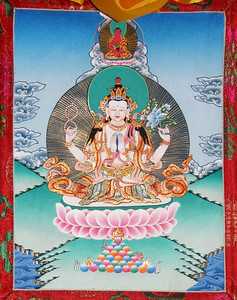
Chenrezig

Now is a wonderful time to benefit beings, and one way we can do that is through the recitation of mantra.  From now until Chotrul Duchen on March 19,  we will be accumulating mantra for the benefit of the world and all beings.  The time between Tibetan New Year, called Losar, and Chotrul Duchen is considered to be very auspicious.  Meritorious activity is said to be multiplied 100,000 times.

The mantra we are accumulating is the Mani mantra:

Om Mani Pedme Hung

525px-Om-mani-padme-hum_02.svg

To learn more about the Mani mantra, click here.

How to participate in the Mantra-thon:

1.  Set your intention to benefit beings

2.  Accumulate the mantra – Om Mani Pedme Hung as many times as possible

3.  Dedicate the merit you have accumulated, and

4.  Send your accumulations to [email protected]!

On Chotrul Duchen we will announce the grand total accumulated!

The following is a dedication prayer written by Jetsunma Ahkon Lhamo that can be used to dedicate the merit:

By this effort may all sentient beings be free of suffering.

May their minds be filled with the nectar of virtue.

In this way may all causes resulting in suffering be extinguished

And only the light of compassion shine throughout all realms.

by Jetsunma Ahkon Lhamo


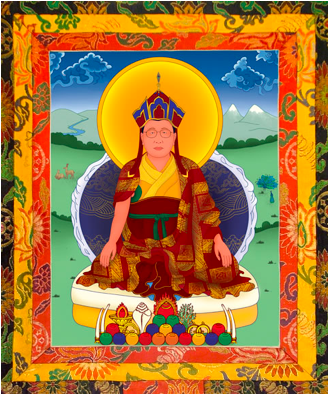
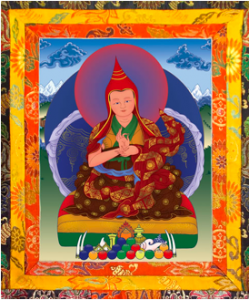
The Eleventh Throne Holder

The Third Drubwang Pema Norbu Rinpoche,
Thubten Leshed Chokyi Drayang, also known as
Do-Ngag Shedrub Tenzin Chog-Lei Namgyal
(1932 – 2009)

The third Drubwang Pema Norbu Rinpoche was born in the year of the Water Monkey (1932) in the Powo region of Kham, in South-Eastern Tibet. Details of his birth were exactly as described in the prophecy of Thubten Chokyi, the fifth Dzogchen Rinpoche. The incarnation of the second Drubwang Pema Norbu was recognized by Khenpo Ngaga Rinpoche. At the age of four, the small child was enthroned by Thubten Chökyi Dawa and Karma Thekchok Nyingpo at the Palyul Monastery. There he began his study in sutra and tantra from a full range of Nyingma lineages and received all the transmissions and empowerments from Khenpo Ngaga Rinpoche, the second Chogtrul Rinpoche, the fourth Karma Kuchen Rinpoche, Khenpo Legshed Jordan, Khenpo Lodrö, Pema Jigmed, and other eminent Masters at the time.

The third Drubwang Pema Norbu Rinpoche applied himself diligently in dharma practice. It took a mere seventeen days for him to complete one hundred thousand accumulations of prostrations in the Ngondro preliminary practices of Nam Chö Dzogchen’s Liberation in the Palm of the Hand. Under the guidance of his root guru, he went into a four-year retreat and attained accomplishment in all the stages of the practices he received. By the time they came out of the retreat, Chogtrul Rinpoche proclaimed that the third Drubwang Pema Norbu Rinpoche was the only lama at the time who held the entire lineage of Terton Migyur Dorje’s Nam Chö and Ratna Lingpa’s revelations.

During the 1950s, the third Drubwang Pema Norbu Rinpoche made numerous pilgrimages across Tibet to all the major holy sites to which he made generous offerings. He continued to propagate Buddha Doctrine far and wide through the sponsoring and supporting of a diversified range of compassionate activities. In 1959, the third Drubwang Pema Norbu Rinpoche decided to relocate to India for the sake of preserving Buddha Doctrine for the sake of all sentient beings. Accompanied by a small group of monks, he settled in the region of Bylakuppe in Mysore, South India.

In the year of the Water Rabbit (1963), under the personal supervision of the third Drubwang Pema Norbu Rinpoche, the Thekchog Namdrol Shedrub Dargye Ling (Namdroling monastery) commenced its first phase of construction. Since its beginning as a small bamboo temple with a handful of monks in 1963, the main seat of the third Drubwang Pema Norbu Rinpoche in India now includes numerous temples, Stupas, primary schools, dratsang, shedras, a retreat center, nunnery, guest house, old people’s home and hospital. It has evolved to become the largest Tibetan monastery in India with an ordained sangha of over six thousand monks and over one thousand nuns. Apart from propagating Buddha Doctrine in India and in Tibet, to where he has made return visits since 1982, the third Drubwang Pema Norbu Rinpoche established many dharma centers around the world, including the USA, Canada, Mexico, Taiwan, Hong Kong, Macau, Philippines, Singapore, Malaysia, Nepal, Bhutan, United Kingdom, Greece, Germany, Switzerland, Australia, and Portugal.

On the evening of 27th March 2009 (the first day of the second Tibetan month), the third Drubwang Pema Norbu Rinpoche departed from this world and entered the meditative state of thugdam. After spending six and a half days in the meditative state of luminosity, on the morning of Friday 3rd April 2009, he released his body from meditation and entered Parinirvana. His body is currently enshrined in the Zangdokpelri Temple at Namdroling Monastery.

References:  Pathgate Institute of Buddhist Studies

A Garland of Wish-Fulfilling Trees by Ven. Tsering Lama Jampal Zangpo

Contemplations on Love and Compassion

From a series of tweets by Jetsunma Ahkon Lhamo:

Imagine! The iron in our blood and planet both came from a dying star. A sun! We consist of that.

Imagine! The light in our eyes, the Bodhicitta, the sweetness of love, this is the essence of Primordial Nature; Buddhahood!

Just suppose we were fully awake – would we see that we are the seed, the path and the fruit? We are the gift to be given.

If we could abandon pride and ego would we finally be the light of the world? What stops us from turning it over?

If we knew the future Buddha to be in the far future would we follow the Buddha Dharma without snark, do our best?

If we for some reason experienced hatred and judgment can we still keep the commitment? Can we still love?

As His Holiness the Dalai Lama says, can we see those who make war with us as a blessing? If we contemplate Karma we can. All arises within mind.

If we treat animals and sentient beings as inferior we demonstrate that we are dull in our practice and have poor qualities.

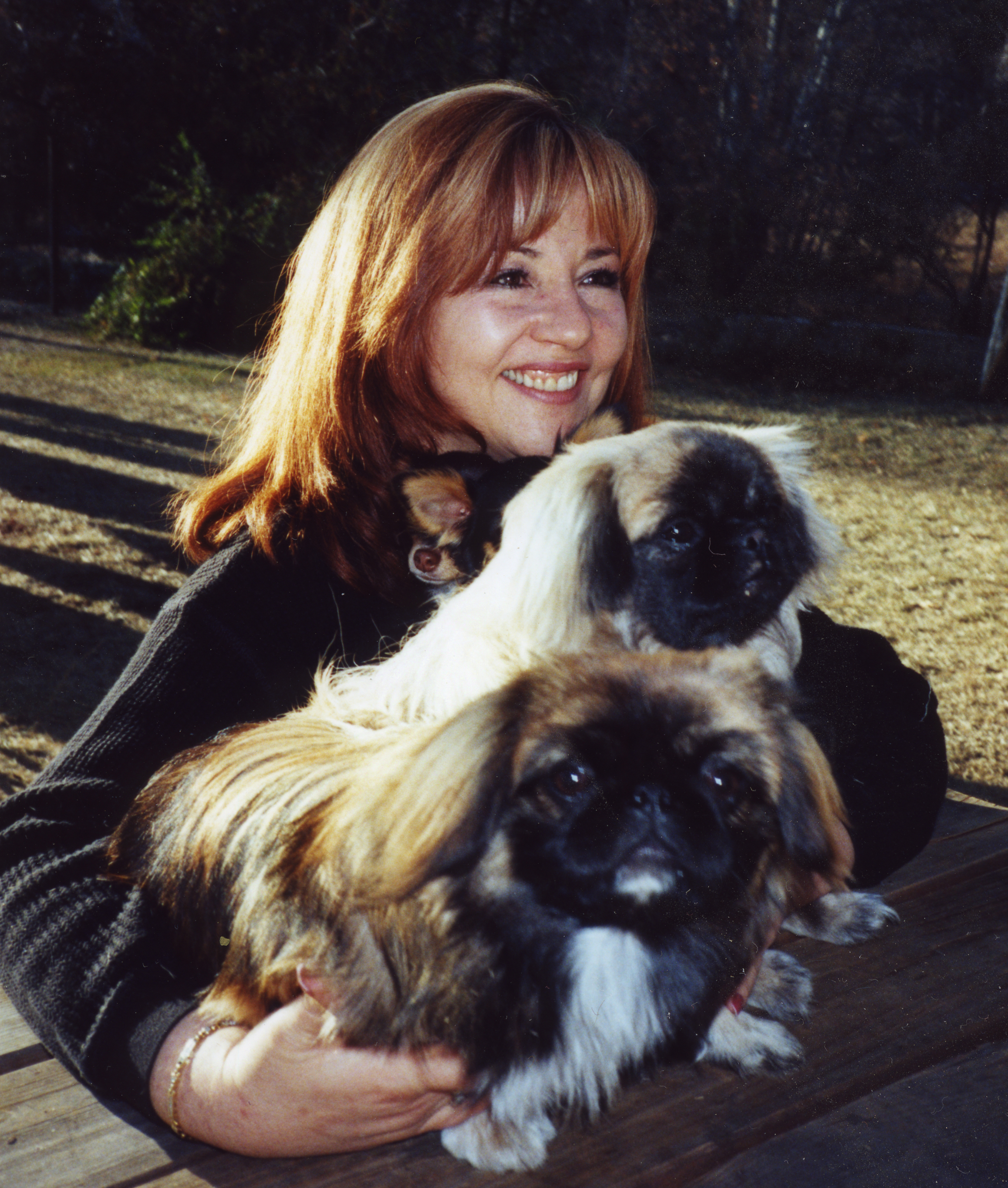
Today I saw Jada, my sweet Queen Pekinese has cataracts and is nearly deaf. Impermanence is happening now. Commit virtue!

I respect, love, cherish and would do anything for those who love and respect those less fortunate than us!

Copyright © Jetsunma Ahkon Lhamo.  All rights reserved

Let the Circle Be Unbroken

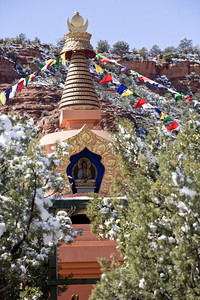
At the invitation of Jetsunma Ahkön Lhamo, Khenpo Tenzin Norgay was in Sedona the weekend of February 25-27 for several events, including an Amitabha empowerment at KPC’s Amitabha Stupa, several talks on the significance of the stupa and the sacred land upon which it is built, and even a guest appearance at the Sedona International Film Festival to answer questions at the screening of a documentary movie called Journey from Zanskar: A Monk’s Vow to Children.  The weekend’s events were a great success, drawing large audiences despite the chilly February weather and the competition of the film festival.  But the event at the stupa on Sunday, February 27th, provided a special treat to those who braved the elements.

Sunday – Dakini Day – dawned to a world of white with fluffy fresh snow blanketing the town and the red rocks.  Such a snow is considered a blessing by Tibetans, but it seemed an inauspicious start to a day that was planned to feature a talk by Khenpo at the stupa and a song offering by Hopi Indians.  It appeared that the Hopi would not be able to make it to Sedona as all roads leading from the Flagstaff area were closed.  In addition, the wet, rapidly melting snow had turned the dirt road leading up to the stupa into a quagmire.  This meant that no vehicles would be able to drive to the stupa to carry heavy equipment like a PA system or a generator to power the planned webcast.  In view of the situation, it was decided to change the schedule and replace the planned talk with a Shower of Blessings practice, which is the heart practice at KPC, and including a sang (smoke) offering to purify negativity.

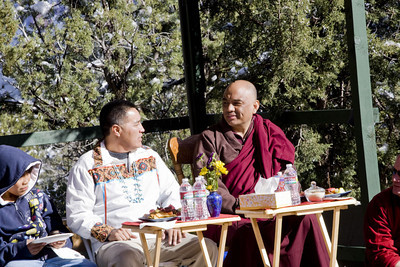
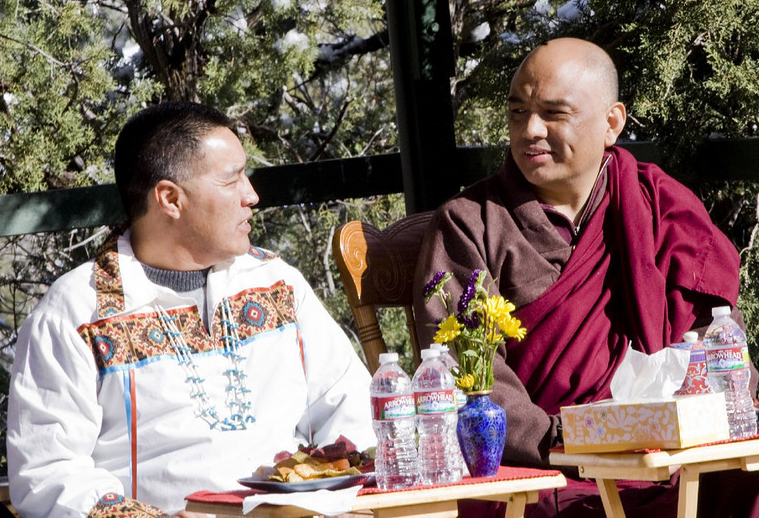
By 2:00 the warm sun had melted much of the snow, and the clouds had long since abandoned the sky to the brilliant Arizona sun.  A group of about thirty people had assembled, many of whom had never participated in any kind of Tibetan Buddhist practice.  Partway through the practice, to everyone’s surprise, word arrived that the Hopis were indeed on their way and were expected shortly.  The practice was speeded to finish by the time they arrived.  As people were enjoying the food offering that is a part of the practice, Ruben Saufkie Sr. came walking up the hill with his two young sons.  They were seated on the stage next to Khenpo, and Ruben and Khenpo talked for several minutes.  People were invited to come and sit close to the stage, and Ruben then repeated what he had shared with Khenpo.

Ruben said that he personally had been out of balance for many years, caught up in the throes of alcoholism, disrespectful to everyone, out of control.  But then he looked into the eyes of his children and recognized the same look of fear and hopelessness that he had experienced as a child, for both his father and grandfather had also been alcoholics.  This realization caused him to reexamine his life as a father and as a Hopi.  His Hopi elders gave him the teachings to help him overcome his addictions and to return to balance.  As he emerged from his addictions, he also began to see how the Hopis as a tribe were also out of balance and that this was destroying them.  The population has shrunk to a mere 13,000, and out of over a hundred clans, only less than thirty survive.  Disagreements between individual Hopis and Hopi villages abound on how the Hopi nation should cope with the modern world.  What Ruben came to realize was that Hopis should return to their original teachings of how to live life in balance, that they needed to move out of their egos and return to their hearts as this was the seat of power and balance.

Ruben’s mission now, as he explained, was to do everything he could to restore this balance, both in the Hopi nation and the world.  He said he began with his own life and family, and that he was now reaching out to his fellow Hopi and to those beyond the reservation.  This has often resulted in attacks by other Hopis, accusing him of just pursuing money, consorting with non-Hopis, and not caring about his people.  Ruben said that this has been very painful for him and there have been times when he has felt like abandoning his mission.  When he received the invitation to come to Sedona to participate in the events with Khenpo, however, he felt like a new door had been opened, and his enthusiasm to continue was renewed.  On Sunday morning he saw the snow and heard the traffic reports, but he felt certain that this meeting was meant to happen, so he set out.  As he and his sons approached Flagstaff, a pure white hawk flew directly over his car, so he felt certain that everything would be auspicious.  And indeed, I-17 was reopened by the time he got to Flagstaff, and he was able to safely drive down the mountain to Sedona.

Ruben then talked about the location of the stupa and explained how this area had been known to his people long ago.  They thought it was extraordinarily beautiful, but they chose not to live there because they knew that someday someone would take the land from them for its beauty.  After a short stay, they proceeded on their way to their permanent home on the Hopi Mesas, which are shaped like a hand.  He said that building a stupa in this place is a wonderful way to honor its sacredness.

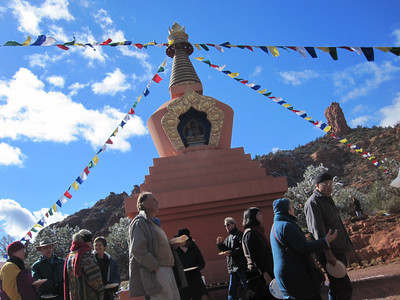
Then Ruben and his sons donned their traditional Hopi dress and prepared to sing.  First Ruben blessed the stupa, Khenpo, and the audience with condor and eagle feathers, representing the 500 year-old prophecy of the coming together of the ancient teachings of the North (eagle) with those of the South (condor) – in other words, the joining of the ancient wisdom of the Indian tribes of the North, such as the Hopi, with those of the South, the Incas, Aztecs, Mayas.  Then he and his sons formally introduced themselves, first in Hopi, then in English.  They proceeded to sing several traditional Hopi songs dedicated to bear, deer and other native animals, accompanied by drum and rattle.  The songs evinced the beauty of the high windswept mesas where the Hopi found their permanent home, evoking a feeling of ancient wisdom and a connection to the earth that has been largely lost in our modern, hyperactive world.

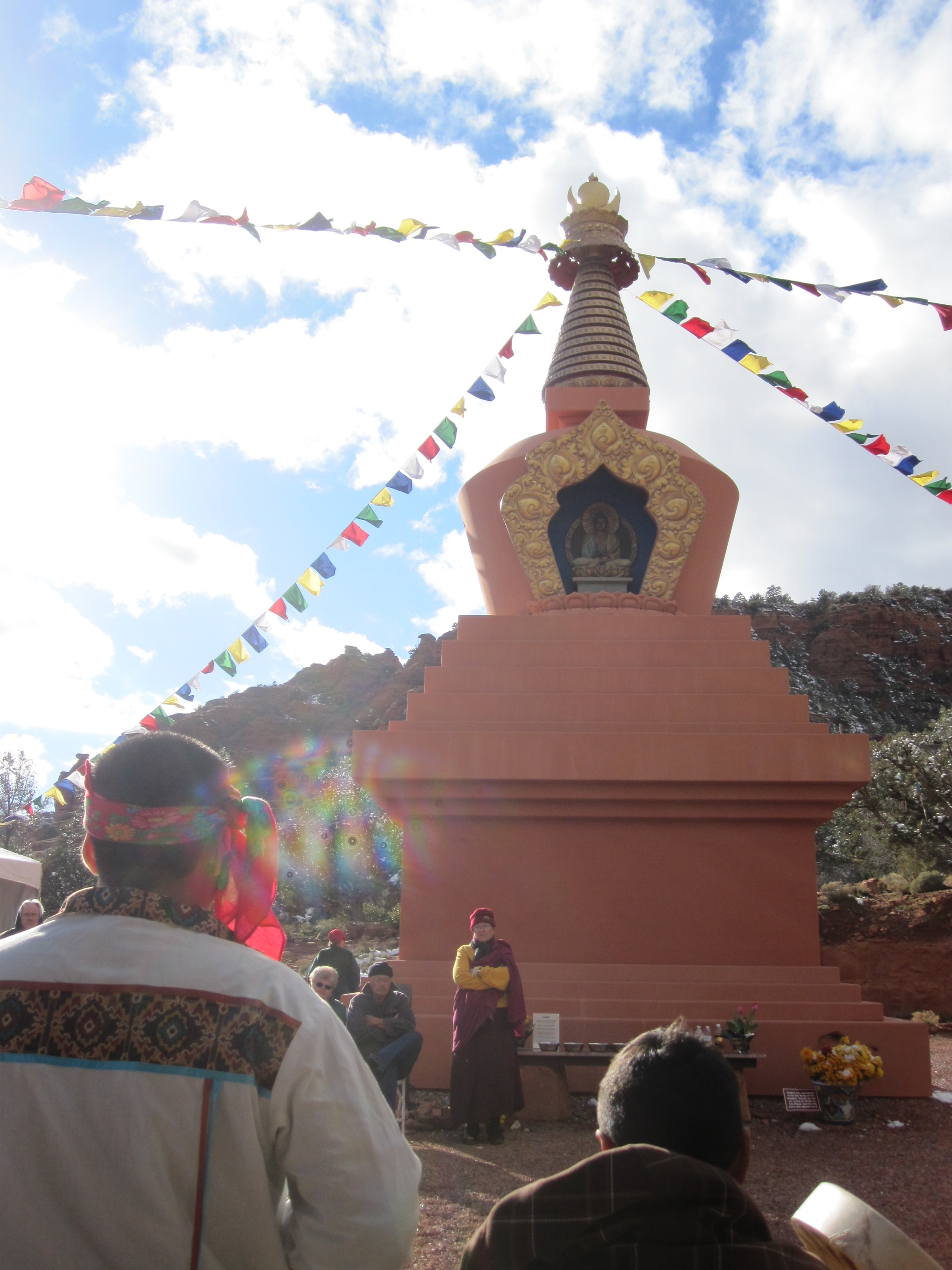
Several photographs taken at the time of the songs reveal miraculous images of rainbow light and bindus – small orbs of energy which, according to Khenpo (who took the picture seen here), are signs of the auspiciousness of the two traditions coming together.  Jetsunma, who followed the day’s events closely via texting and photographs,  added, “Here are two Ancient Tribes returning.”  She went on to say, “This is so auspicious!!!  I cannot tell you!”

The ancient prophecies are coming true before our eyes.  EH MA HO!

This article was written by Thubten Palzang

Shining Lake of Crystal Tears

248176483_mC7w6-S

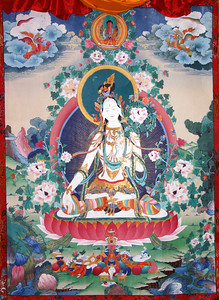
Arya Tara, Noble One

We bow down to your Lotus Feet

And beg you to remain enthroned

On the Lotus Throne within our hearts

We, your daughters and sons

Offer you the essence of whatever purity we may possess in the three times

Please accept the nectar of our pitiful practice

Please bless the potential of all our hopes and aspirations

And guide our lips and blind eyes

To suckle at the breast of the Sublime Bodhichitta

Mother Tara, protect us, now and at the time of our death.

Sooth and cleanse our minds of the sickness and fever of worthless distraction.

Hear us, Holy One, even though our very voices are tainted

With fear and slothfulness, weakened by Samsara’s spell.

Oh Mother, when we have caused you sorrow

How will you then appear for us in Nirmanakaya form

Through endless aeons for our sake –

How, Mother, will this occur

When our hearts and minds turn inward

With darkness and lack of caring for the suffering of others?

Oh Mother Tara, Holy One, Perfect One

We are lost.

Now more than ever darkness comes

And we are overcome with our weakness and poor view.

Yet you remain for us

Blessed Mother, Holy One, this very day

We make our hearts and minds your home

We beg you to come in glory

And to remain with us

With your Supreme Beauty, Sublime Power and Faultless Light

Until we are inseparable

And Samsara is emptied

Colophon:  Written by Jetsunma Ahkon Lhamo, August 24th, 2004 Sedona, Arizona, when one of Tara’s daughters herself had fallen under Samsara’s dark spell

Copyright © Jetsunma Ahkon Lhamo.  All rights reserved

The Tenth Throne Holder

The Fourth Karma Kuchen Rinpoche, Thegchog Nyingpo

(1908 – 1958)


The fourth Karma Kuchen Rinpoche, Thegchog Nyingpo was born in the fifteenth rabjung year of the Earth Monkey (1908). He was recognized in accordance with the prophecy of the fifteenth Karmapa Khakyab Dorje and authenticated by Drodul Lama Azom Drugpa. After being enthroned as the tenth Throne Holder at the Palyul Monastery, he began his study in sutra and tantra and received all the lineage transmissions from the second Drubwang Pema Norbu, the Dzogchen Khenpo Rigdzin Odzer, Jamgon Tai Situ Pema Wangchog Gyalpo, Drodul Lama Azom Drugpa and Kathog Khenpo Legshed Jordan. He excelled in all the teachings he received and attained an all-encompassing mind that merged with the true nature of transcendental reality. Soon after the completion of a three-year retreat during which his main practice was Ratna Lingpa’s Three Kaya Accomplishment, Thegchog Nyingpo commenced his service to all sentient beings by giving teaching, transmission and empowerment to a multitude of followers. During his lifetime, he commissioned the making of many thangkas and statues, having scores of Dharma texts printed, old temples renovated, new constructions erected, and gave generous support to a great many sangha communities elsewhere.

When Thegchog Nyingpo was fifty-one years of age, he decided it was time for him to pass beyond this world and transferred his life essence into the body of rainbow luminescence leaving nothing tangible behind.

Reference:  Pathgate Institute of Buddhist Studies

Start with Kindness: Cultivating Faith

From a series of tweets by Jetsunma Ahkon Lhamo:

When we see His Holiness the Dalai Lama’s teachings, I cannot help seeing how His Holiness loves all, respects all religions and faith, and gently insists our true responsibility and work is kindness, tolerance, loving spirit, ethics, compassion, etc. His Holiness also states that dogma is less important. Oddly, although I so love lineage for its unbroken method, I also teach exactly that. What I am truly adamant about is Bodhicitta, or compassion.

I am sad to see there are so many in every in every faith that don’t appreciate the value of starting the path with kindness. I’ve found if there is no compassion, no Bodhicitta, there is no progress to make. It is pride that stops us, allows us to claim progress when there clearly is none. Progress is indicated by change and developing good qualities. Yet we see blustering haters with huge egos insist their way is the only way, and having graced the praying world with their sermons for 30 years! 40! Sat at the feet of Who-ha and Ding-dong and found the religion they can live with. It suits their agenda. I can only imagine how much ego and pride it takes to do that. In faith, no one should ever have an agenda. What, you want to wear gold lame’ and your choice of the women or men? Or wear robes and be as ordinary as you please. Or dress like a farmer and insist that is your claim to correct view. Is this the “Kabuki Theatre” of faith? We show our progress by demonstrating our loving qualities and truthful method. Claiming you are the real deal while being the judge, jury and executioner does not qualify. That is hatred and ignorance. Opinions are only opinions and should never be considered truth. We must never rigidly adhere to that, particularly when there is no kindness and love.

I feel, for instance for Waylon at Elephant Journal and a former blogger. Here is a war that is so petty it would be funny if not true. $1.00 – a dollar- to keep the journal afloat. The ex-blogger takes up wars and takes this one as a cause. Like Waylon is not supposed to pay bills and keep it going. Ridiculous. Small minds love small things, my mom said. She was actually quite correct. What do you sleep in? Your own poo-poo? The leakage of your neurotic notions? Why not gain a good heart and healthy mind and altruism to benefit all sentient beings?

See, faith and love are not about you. You don’t own truth. And you are not entitled to spew your false view or nastiness all over others. We can see, if you do, how flawed your practice must be. No good results! Yet here the grand proselytizer continues to offer others their lack of wisdom – while whining and strutting. We call this the “king baby” syndrome. Baby needs his milk, and must be coddled. Oh, don’t argue. “King baby” is ruthless as he feels he is a “king” above all. In my heart it seems to me that when I bow it is to the Three Precious Jewels, my Root Lama, Lord Buddha, Guru Padmasambhava. Not to needy ordinary people with way too much to say, and no love to back it up. I will not bend my knee to judgment and hate. I do not honor the needs of “king baby.” He is ordinary and he is a useless fool. All about actual pride in the pain inflicted. But he doesn’t matter. You do! You have the Buddha seed, and still have the time to grow it well. How can I help? All my life is about helping. Tell me what I can do to guide your path.

Copyright © Jetsunma Ahkon Lhamo.  All rights reserved

A New World

By Thubten Rinchen Palzang:

A NEW WORLD

It has become clear that the entire world is out of balance, and the only way to restore it is to return to balance.  Ruben Saufkie Sr, a Hopi singer and activist, is trying his best to do just that.  Jetsunma Ahkön Lhamo, an American Buddhist teacher, is trying her best to do just that.  On Sunday,  February 27th, 2011 – Dakini Day – these two paths intersected at the Amitabha Stupa in Sedona, Arizona.  It was a most auspicious day for the whole world.

How do we return balance to a world that is increasingly out of balance?  Ruben says that it is vital for his people to return to the old ways so that they can return to balance and heal the social ills that threaten the very existence of the Hopi.  The same is true in Tibet where the Tibetan elders, the lamas and tulkus, see a return to the traditional Tibetan way of life as the only way to save their people.  But it is a hard sell.  Living according to the laws of Maasaw or following the Dharma is not easy.  It is hard work.  It means dealing with one’s own poisons, which is never attractive or fun.  The so-called modern world is much more flashy and appealing, particularly to the young people.  They fall prey to its allures and forget the old ways.  The result is suffering and the end of their way of life.

In the Hopi religion, it is said that the people came to this world, the Fourth World, when the people of the Third World had strayed from the teachings of Maasaw, the caretaker of the land.  Some Hopi  say that the people who had remained in balance in the Third World were led to the Fourth World, the present world, through a sipapu, or navel, located in the Grand Canyon, a rock that is still present in the Canyon.  Other Hopi say that when the people arrived in the Fourth World all they saw was water stretching in every direction, and the people had to make a long sea voyage before finding the mountainous shores of the new world.

Maasaw had been appointed the head of the Third World by the other deities, but he had become a little self-important himself and lost his humility.  The other deities decided to give him another chance in the Fourth World.  When the people arrived on the shores of the Fourth World, Maasaw told them to separate into clans and make a series of migrations guided by the stars.  Eventually they would meet the other clans again and settle in the center of the world.  Maasaw gave the clans sacred tablets to guide them on their journey.

Not all of the clans who began the migrations completed them.  Only those who “kept the door on top of their heads” open, those who understood the purpose and meaning of the migrations – purification, completed them and settled in their present homeland, the Hopi Mesas of Northern Arizona.

Many Hopi even today live the old way of balance, but many have been lured by the temporary pleasures of the world around them and have lost their balance.  The high incidence of alcoholism and drug abuse on the reservation and social problems including sexual abuse and domestic violence threaten the very fabric of Hopi society.  The situation on the Hopi reservation reflects that of other indigenous societies, including Tibet, where the people struggle to maintain their way of life in the face of “modernity”.  As cultural values fall, the people become lost and forget how to live in balance.   The Hopi believe that the people failed to live in balance in three previous worlds, and each time they had to start over again in a new world.  Is there to be a Fifth World, or can we finally learn to live in balance in this world?

Caretaking the earth and living in balance are two hallmarks of both the Tibetan and Hopi cultures.  Joining together the two cultures is something that has been foretold by prophecy and is said to be key to the survival of life on earth.  It is the sincere wish of Jetsunma and her sangha, along with Ruben and the other Hopis who are working to achieve this goal, that this auspicious meeting will be the beginning of a fruitful long-term relationship that will ultimately benefit all sentient beings.  Jetsunma has had a strong interest in the Hopi for years and has visited the Hopi Mesas several times.  She vowed to Ruben and the Hopi people that she will do anything to help them restore their balance, including building a stupa on Hopi land to help the process.

This may be a good time to remind ourselves of the Caretaker Vow written by Jetsunma nearly 25 years ago:

We the Caretakers of the Earth, dedicate ourselves to the liberation and salvation of all sentient beings.

We vow to work for the liberation of planet earth from the clutches of suffering, poverty, famine and death. We vow to return in whatever form necessary, under whatever necessary conditions, so that all earth creatures can be liberated from the ravages of cyclic existence.

We vow to work for world peace. We vow to work for the raising of all nations of earth into a state of union and ultimately into the blessed state of supreme wisdom, the wisdom that is beyond all description.

We vow to work toward a great Universal Quickening of mind and heart, leading all beings to a state of clarity, a state in which Chenrezig, the Buddha of Compassion, is enthroned within all hearts and within the planetary heart.

We vow to offer as food and drink to all sentient beings the clear, sweet Dharma so that they may feast and be satisfied at last. We offer our bodies, our speech, and our minds to be filled like bowls with Dharma that in our joy we will spill over into the waiting hearts of all our brethren. May their suffering cease forever.

To all the blessed Tathagatas, to all the root Lamas, to all the Sangha, to all the caretakers, grant us the strength to continue, the clarity to overcome self-cherishing, the determination to return forever until we are the last, and finally, the grace to find our way home.

May the Dharma take root in the West, on the Earth, and in hearts of all sentient beings. So be it.

May we all join in the fulfillment of these aspirations!  EH MA HO!
WP2Social Auto Publish Powered By : XYZScripts.com