For the Benefit of Beings

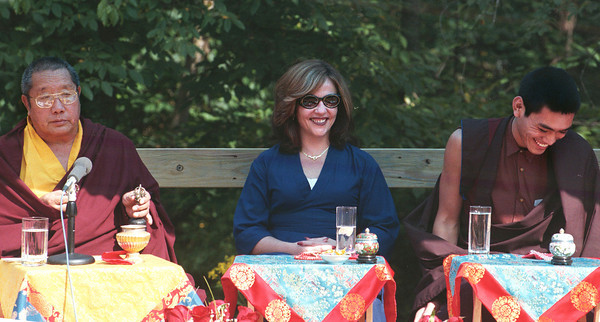
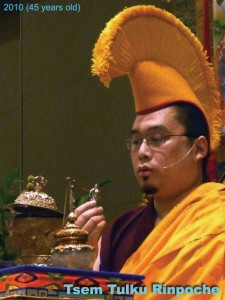
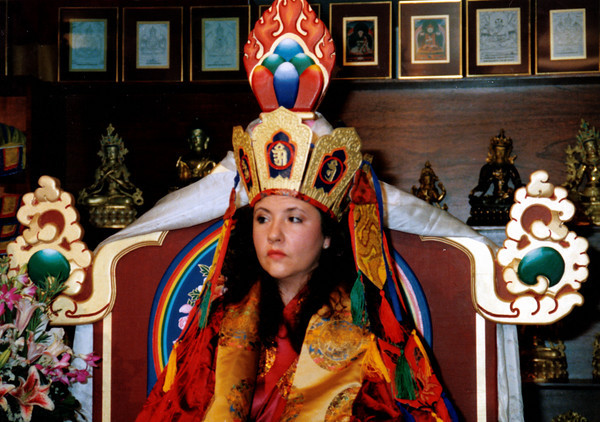
During my Enthronement, I was in meditation the whole time. I was really annoyed at the flashes and the sounds from the news reporters. Any flashes like that, I felt wrath, “This is so sacred, there shouldn’t be any modern shit here.” And yet His Holiness was kind enough to let that happen so that modern people could see it.

The ceremony itself went off perfectly, but it hit like a bomb. When it was over, there were certain things I had to do, but all I wanted to do was just go be quiet. I didn’t want to go out to dinner, I just wanted to go be quiet. But His Holiness leaned over and said, “You don’t get to do that.” You never get to do what you want again! “You’re in jail” Gyaltrul Rinpoche said. That’s how it turned out.

Copyright © Jetsunma Ahkon Norbu Lhamo.  All rights reserved

Truth and Healing

The following is from a series of tweets by Jetsunma Ahkon Lhamo:

Please forgive me. This is my twitter space and yours too, as I offer it as a teaching vehicle. I’ve not been on and I am sorry. My body is breaking down. My mind too. So beat up. Now it seems I must divulge more of my story. I will as I must. And I can’t tell why. But it is the truth. They he/she must print tonight. Why? I don’t know bit I will cooperate. No choice. Tonight a post will come out on a multiple “user groups”(?) and will be seen by all.

The horror KPC has been through, and myself as well. So much must be disclosed. And must be told well. I can’t do it and I don’t know who will. I just know it will happen and I give permission. So I trust. And will do what I can.

Copyright © Jetsunma Ahkon Norbu Lhamo.  All rights reserved

The First Object of Refuge

The following is an excerpt from a teaching by Jetsunma Ahkon Lhamo called “Essence of Devotion”

Although the Buddha that we remember as Siddhartha, Gautama Buddha, Shakyamuni is not present in his physical body as we understand it right now, we look at the Lama as the embodiment of the qualities, intentions, compassion and activity of the Buddha in the world.  Our Lamas, those reincarnate Lamas who are recognized as reincarnate Lamas, are considered to be the Nirmanakaya form of the Buddha.  They are the Buddha in the world. So we look at the Lama as being the embodiment of the Buddha.  We look at the Lama as being the embodiment of the Dharma because, if we were to try to study Dharma on our own, even though all the books in our bookstore are written with the commentary of a qualified Lama, when you read those books you must also have first of all the teachings from the guru that deepen and ripen the mind ..Empowerment, lung, commentary teaching, the taking of vows, those teachings that deepen and ripen the mind, can only be given by the Lama, only be given by the Lama, and you must have them.  You must have your mind ripened.  A mind that is not ripe may delude itself into feeling spiritual and may even be able to speak spiritually.  However, if it is not ripe, it cannot fulfill itself.  So we should consider like that.

The Lama is considered to be the path.  The Dharma is given to us by the Lama.  The Lama connects us with the Dharma.  The Lama ripens us in the Dharma.  The Lama is the Dharma in that sense.  The Lama is also the Sangha because without the Lama there would be no Sangha.  It is the Lama’s qualities and compassionate activities that sound the note that eventually calls the Sangha.  When one of the Sangha has come to practice in some way, there is a personal and private circumstance that has called them, has pulled them in some secret inner way, particular and unique only to them, and their response is like a bell tolling somewhere deep in their minds—very unique, very individual, very present.  That is the gathering of the Sangha and it is done through the influence and compassionate activity of the Lama.  So the Lama is the first object of refuge, and the supreme object of refuge on the Vajrayana path.  That is our view.

Copyright © Jetsunma Ahkon Norbu Lhamo.  All rights reserved

What It Means to Be Sectarian: by Tsem Tulku Rinpoche

The following is respectfully quoted from “Gurus for Hire Enlightenment for Sale” by Tsem Tulku Rinpoche:

If you are a member of the royalty of one country and you criticize your own royalty, its okay because inadvertently, you include yourself. For example, if I were in the royal family of a certain country and I criticized the royalty of my country, some people in our country or i the royal house may be a little unhappy, but it is generally acceptable because I have included myself in the criticism. I am showing humility and not pointing fingers at other people.

However, it would not be acceptable if I started saying that our royalty was very good, but the royalty of another country was excessive, stupid, not educated, spoiled and did not do anything for their country. Some people who are fanatical in our country might agree but the people who can think will see that it is not a very good policy and not very diplomatic. They will say that we do not have the full information, that we are just looking at things in the media and that we do not know the inside story. They will question our right to criticize another royal family of another country that people respect. Once we start saying those kinds of things, we invite criticism of our own royal family and we open the doors for other people to criticize us also.

Similarly, we have four sects of Buddhism in Tibet. Each sect has its own head but the four sects have the same goal, priorities and requirements for Enlightenment. All their teachings are textually and scripturally sound, based on reliable sources that come from India, stemming back to Lord Buddha himself.

I have not studied other lineages. I have read a little here and there but I can never claim to know anything about other lineages. However, i can tell you from observing the other lineages and erudite Gurus that I do not see a difference between them and the erudite masters of my lineage. They are compassionate, just as the ones in my lineage are. If a master of another lineage becomes a Buddha or becomes highly attained, I do not see them as different from a master of my lineage. Once he attains Enlightenment, a Buddha is a Buddha, without any lineage. Once we climb to the top of the mountain, it is what flag we put on the top of that mountain that identifies who we are. Actually, the person who climbs to the top is just a mountain climber who go to the top!

I can only say that the other lineages (besides Gelugpa) are definitely valid because I have checked out their masters, their students and disciples. I can say they are good because I look at the results. Just as in my own lineage (Gelugpa), they also have great practitioners and practitioners who do not really practice. It is the same. (I do not say this politically. If I say this politically, I can see through my motive and so can you.)

His Holiness the 14th Dalai Lama has mentioned this during teachings. What His Holiness says is correct. I believe it, but I am a critical person and will still check it out and think about it.

When one sect criticizes another sect, it is very, very serious. One sect has no right to criticize another sect. One sect has not fully studied another sect’s or another school’s tenets in order to have the knowledge to criticize or to say anything. That is why I would not ever criticize, even if I had studied it; and dare not since I have never studied it. I would not even go in that direction.

Prejudice and bias toward another sect or another form of Buddhism is dangerous, as explained in the Lamrim Chenmo. The karmic effect of saying negative things about other lineages is very damaging.

Let’s consider how dangerous it is to kill an animal; how bad the karma is to kill a person or a monk. We cannot kill a Buddha because a Buddha does not have the karma to be killed, but if we could kill a Buddha, imagine the incredible amount of negative karma that would arise from that action. The Lamrim says that if we spread sectarian views, it is understood, the other person accepts and we rejoice, the four completing actions or the four factors of intention are complete: the demerit of spreading sectarian views is equivalent to killing 1,000 Buddhas. That is what His Holiness Pabongkha Rinpoche explained in the Lamrim Chenmo.

If other people dare spread sectarian views, we should have great compassion for them, never listen and just cut their talk off. We should not entertain or listen to them. Remember, we are trying to gain merit! If the demerit of spreading sectarian views is equivalent to killing 1,000 Buddhas, then all the merit we create from doing prostrations, making offerings and meditating will down the drain! Symbolically, the amount of practice we do can fill up one bathtub. If we were to put that bathtub into the ocean, it becomes nothing. The karma of killing 1,000 Buddhas is like the ocean. When we engage in sectarian talk, it is like putting our little bathtub of merit into the ocean and wondering what happened!

If we were to judge another school or sect of Buddhism and say they are not as good as ours, then we are also presupposing that no attainments can be gained from their practice. It is saying that in their lineage, there are no enlightened Gurus, no high-level, attained teachers or practitioners. It is impossible. It cannot be!

Every lineage and every school of Buddhism in every country, everywhere, has elite, erudite, practiced masters who prove to us that if we practice each school individually and correctly, we will get the results. The techniques and the way the different schools are formed may differ a bit due to time, place, geography and culture but that does not mean they are not complete paths in themselves.

It is sectarianism to have biased views against another lineage, another school or another form, based on prejudice, ego, self-centeredness, insecurity, fear and ignorance; or to think that it might not be good if someone is not practicing what we are practicing.

You will never see, feel, hear or sense one bit of sectarianism in a real practitioner of Buddhism who wishes to become a fully enlightened Buddha for the benefit of others. Why would a real Dharma practitioner speak about something that was never on their mind? Why would they dwell on or express things that are not true? Real Buddhist practitioners do not lie or have baseless bias.

We cannot even be biased against other religions, as spoken by the perfect Buddha and as taught by the perfect Dalai Lama. If we cannot be biased against other religions, how can we be biased against different sects within our own religion?

Prayers and Healing

The following is from a series of tweets by Jetsunma Ahkon Lhamo:

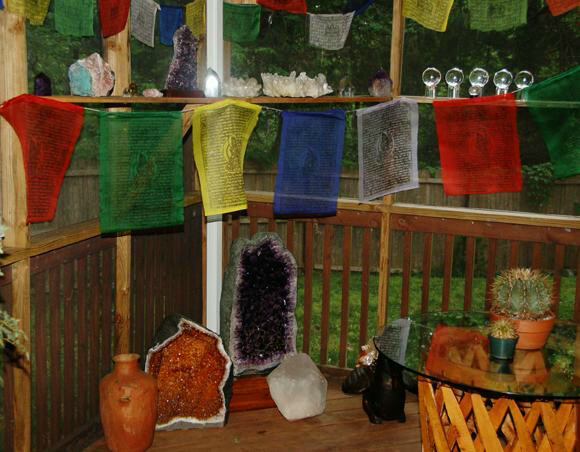
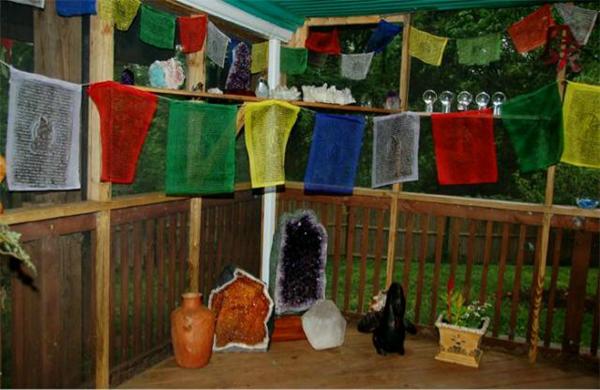
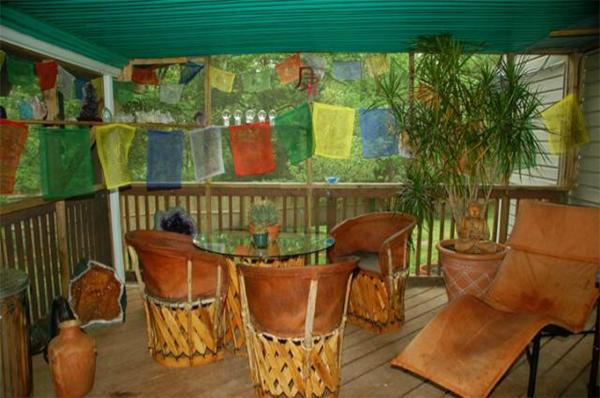
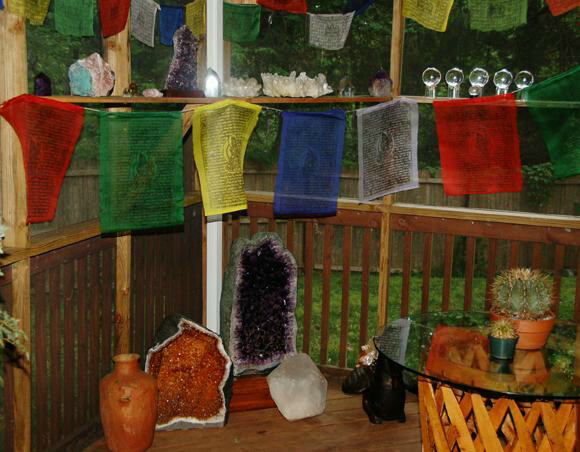
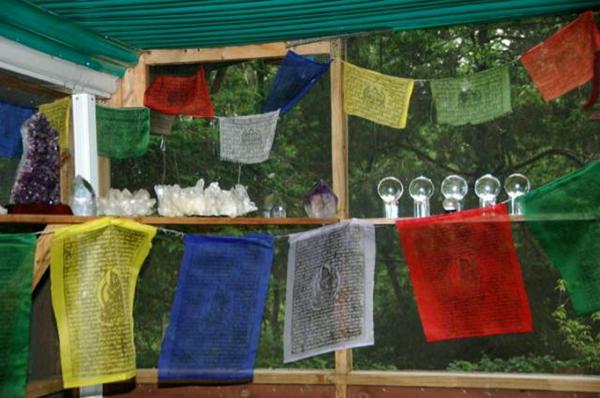
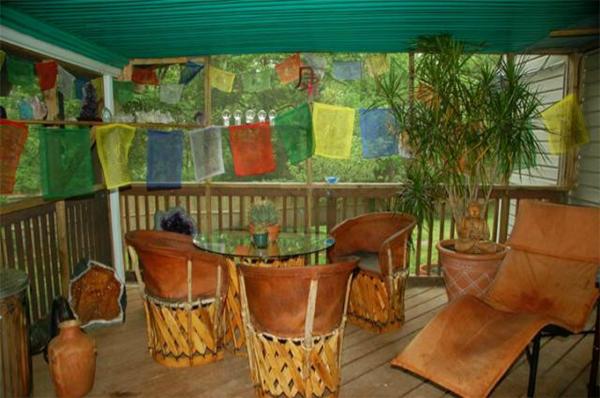
More of my healing lanai, and it feels like heaven! Prayer flags are so inspiring.

Here is the beginning of a crystal garden.


The crystals and flags are wonderful. When wind blows prayers are whispered.

This time of evening the birds sing loudly

The Amethyst and citrine are powerful:

© copyright Jetsunma Ahkon Lhamo All rights reserved.

Living the Sacred Life

An excerpt from a teaching called Intimacy with the Path by Jetsunma Ahkon Lhamo

What if it were possible to live in such a sacred way that instead of thinking of ourselves as separate human beings who want to go there and get that, we were able to see everything in the world around us as the same as us, a display of an underlying primordial natural state.  What if we could see that all things are the display of a fundamentally empty and yet full primordial nature, not separate from Buddhahood?   Supposing that, instead of clinging to what we see and putting ourselves in the posture of acceptance or rejection, like or dislike, or hope and fear—the hope that it will work out well and someone will love you, or the fear that it won’t and no one will.  Instead of approaching life with that kind of idea, which wears us out and does us in, supposing we could live a truly sacred life?

Supposing when we see a tree, a person, something beautiful or not so beautiful, supposing we were in a quiet way simply to know that this too is a display of the Buddha nature.  Supposing that when we see something that delights our eyes, we would think of it in a more sacred way as something that can be offered to the Buddhas and Bodhisattvas for the sake of sentient beings, rather than clinging and grasping.

Supposing everything could be offered.  Supposing that every experience that happened to us could be offered, whether we liked it or didn’t like it.  Supposing we could develop a sense of everything being sacred, precious, having its own weight and depth and taste, and that each experience on its essential level can be offered.

Supposing that we grew in the awareness that every single thing that occurs, and every single thing that we see, feel, touch and taste within the context of our life is inseparable from this fundamental spiritual reality that is both our beginning, our ground or basis, our ultimate goal and result.  Supposing we could really practice deeply in that way.

Once you get past the point of being an effort, once you really begin to awaken to the interconnectedness and sacredness of everything, then within the mind there becomes a kind of simplicity that is the result of such thoughts.  When you’re really in the posture of making offerings for the sake of sentient beings, there is no sense planning on how you’re going to get everything.  Once the joy of that begins to catch hold, of seeing everything not as a materialistic, external, or attainable thing, but more as a display of everything you long for, then you begin to move into the understanding that it’s not the display itself that you want, but the underlying joyful, spiritual reality that is in fact the essence we all long for.

In every major religion in the world, there is something about approaching it with the eyes of a child.  Every religion has a different way of explaining that, but there is a simplicity and naturalness that if one can engage in that on their spiritual path, it is sustaining, joyful, and natural.  It gives us the means by which we will not separate ourselves from the path – having times when we feel that we are very spiritual, and times when we feel that we have other things to do.

If we begin to practice the path in that way, it is much simpler.  It is simply our life.  It is so inseparable that, in the same way that you cannot stop breathing and continue to move and have your being, neither could you even consider not having one’s spiritual path be the most integral, most core, most central, nourishing and profound element within your life.  And so you become empowered.

© Jetsunma Ahkon Lhamo

Living in Prayer

The following is from a series of tweets by Jetsunma Ahkon Lhamo:

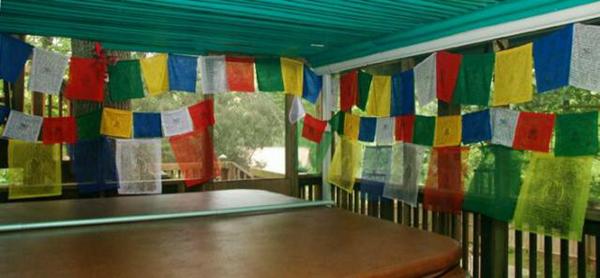
Last night we made a special room, a healing prayer room with tons of prayer flags:

The room will be finished but able to open completely in good weather- it’s called a Lanai. So peaceful!

It’s like living in a prayer…

Or floating in a dream with every pore awake and laughing, yet at peace.

Surround yourself with prayer flags someday and see for yourself. When the prayer flags blow you are blessed and happy.

© copyright Jetsunma Ahkon Lhamo All rights reserved.

The Students Call

The following is from a series of tweets by Jetsunma Ahkon Lhamo:

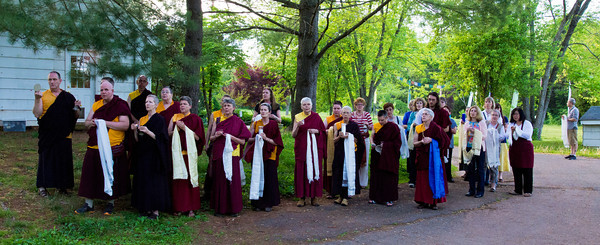
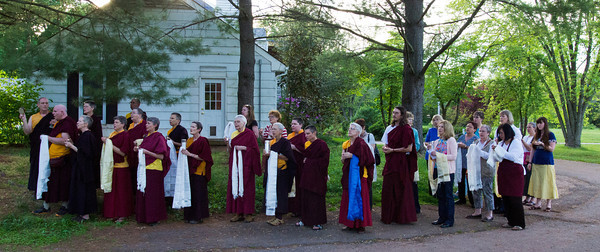
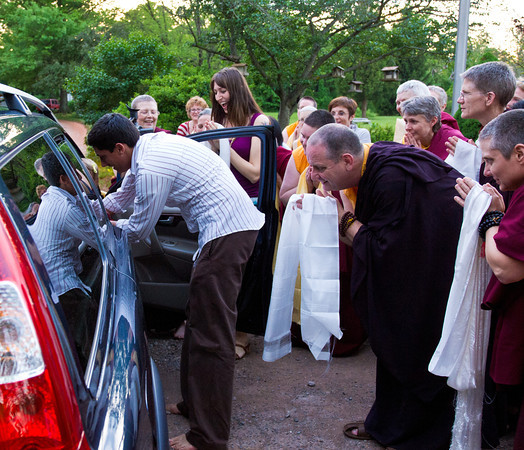
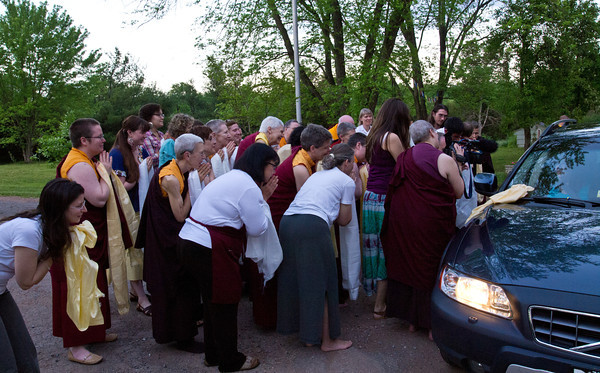
Wasn’t feeling well last evening, so students lined the driveway reciting 7-Line Prayer:

Here’s another photo of students calling:

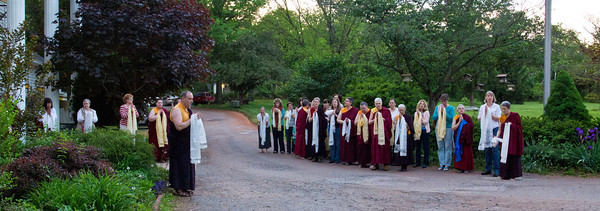
Despite the pain in my back, couldn’t resist the student’s call. Here they are lining the driveway waiting:

Though I couldn’t get out of the car, was able to offer blessings. Here offered blessings to one of the youngest sangha members:

Here are students receiving the Blessings:

Photos courtesy of Ted Kurkowski.

© copyright Jetsunma Ahkon Lhamo All rights reserved.

Why Criticize Others?

The following is from a series of tweets by Jetsunma Ahkon Lhamo:

If one disagrees with another tweeter, why be ugly and bitter? Just stop reading their stream. Problem solved.

To obsess about people you don’t know and couldn’t care less about your stuff shows mental illness. Such bitterness shows jealousy and a dark heart.

Better to become a more advanced being. Warm- hearted. Generous.

© copyright Jetsunma Ahkon Lhamo All rights reserved


WP2Social Auto Publish Powered By : XYZScripts.com