Family: What Is the Purpose?


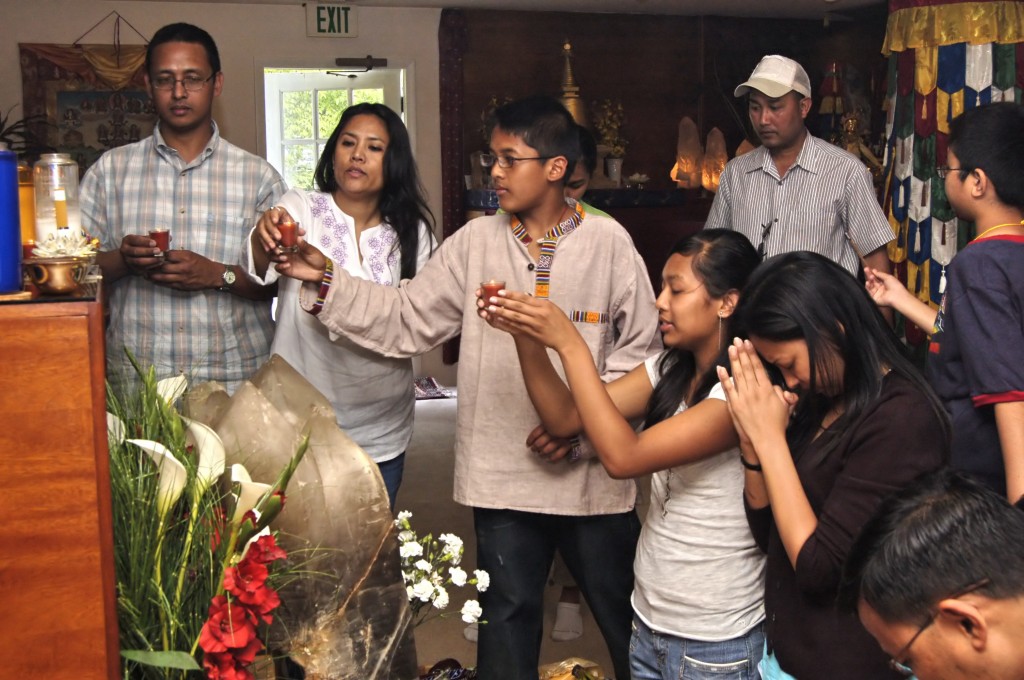
Family making offerings at Kunzang Palyul Choling Temple

Family:  What Is the Purpose?

By Jetsunma Ahkon Lhamo

Since ordination is so central to Tibetan Buddhism, I am often asked what the point is of marriage and family.

First, I will say that the status of householder is well recognized. A Buddhist householder who upholds Genyen vows is committed to the path to the point that there is a certain degree of renunciation. Not to the degree of bikshu or bikshuni, but still present.

From that description, one can see that the modern ideas of love and marriage are not helpful. Generally we “fall in love” due to strong attraction, sexual desire, the wish to be connected in a profound way. Often there is the biological need to procreate and pass our genes on. Due to strong attraction and desire, we are often compelled or driven to be with someone.

Actually, those are not good reasons to get married. The best reasons are shared goals, shared path, shared capacity both spiritual and intellectual, and the love that is born of respect for one another, understanding of each other’s needs, and a willingness to share life’s ups and downs.

The superior way of marriage is when both parties are committed to the path and to living the life of a Bodhisattva together. The best marriage is the one that supports both parties in such a way as to enhance their spiritual life.  To interact with kindness and a respect for each other’s efforts on the path, and to catalyze true effort and result. An example would be one parent “holding down the fort” while the other is in retreat.

In a marriage, both parties should encourage each other to develop their very best qualities, and support each other in uprooting their poisons and abandoning them. The quality of a relationship born of faith and compassion is much different from an ordinary marriage based on material goals. The mutual embrace of a sacred life is deepening, and bonding. And satisfying in the long run.

Such a marriage is capable of bringing into the world children of great promise. By their parents’ teachings, they will come to know truth. By their parents’ example, they will learn to love and respect. These are the children who will be empowered to stand for truth, inner peace, strong wholesome values, and faith.

In short, marriage and family can be powerful agents for creating a better, more balanced world.  From generation to generation, therefore, this is a blessing that keeps on giving.

Chime Tsog Thig

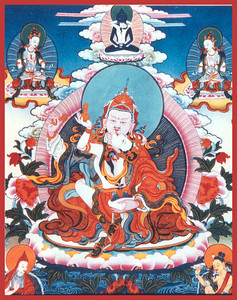
Guru Rinpoche and Consort Mandarava

Seven Line Prayer

HUNG – ORGYEN YUL GYI NUB JANG TSAM

On the northwest border of the country of Urgyen

PEDMA GESAR DONG PO LA


In the pollen heart of a lotus

YA TSEN CHOG GI NGODRUP NYE


Marvelous in the perfection of your attainment


PEDMA JUNG NE ZHE SU DRAG

You are known as Lotus Born

KOR DU KHANDRO MANG PO KOR


And are surrounded by your circle of Dakinis

KYED KYI JE SU DAG DRUP KYI


Following you I will practice

JIN GYI LOB CHIR SHEG SU SOL


I pray you, come and confer your Blessings.

GURU PEDMA SIDDHI HUNG!


(Not translatable. Sacred words)

Chime Tsog Thig Mantra

OM AH HUNG BENZAR GURU PEMA AYURJÑANA SIDDHI HUNG HRI

OM AMARANI DZIWEN TAYE SWAHA

The Chime Tsog Thig is a long-life practice of Amitayus and consort, Chendali, revealed by H.H. Dudjom Rinpoche. This is the practice accomplished in Maratika cave by Guru Rinpoche and Mandarava. Mandarava was the first of five main consorts of Padmasambhava, Guru Rinpoche. Said to be an emanation of White Tara, she was born a Princess in the 8th century in Northern India. At age 16, she and Padmasambhava together practiced in union in the cave of Maratika, fully realizing the longevity practices of Amitayus that had been hidden there as termas. The realization that came from this practice changed the course of spiritual history – making it possible to break the cycle of death & rebirth while in a human body. That practice, revealed by H.H. Dudjom Rinpoche, is known as “Chime Sog Thig.”


Auspicious Signs on Lha Bab Duchen

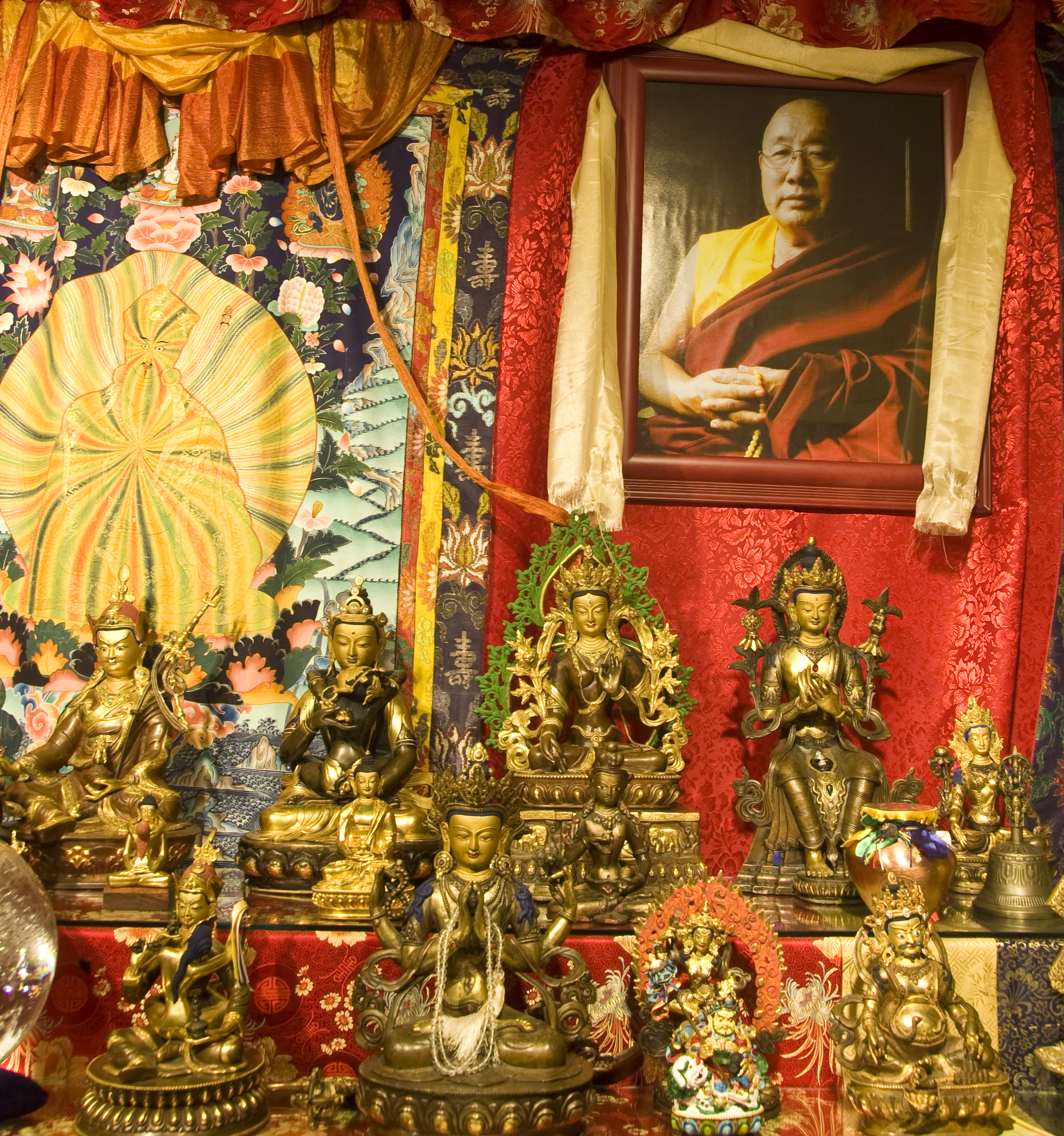
On this holiest of days, Lha Bab Duchen, through the great kindness of my Teacher, Jetsunma Ahkon Lhamo, I had the good fortune to be able to sit in her prayer room for a short time of practice. At the end of the practice, I looked up to enjoy the great splendor of Jetsunma’s many objects of devotion — the statues, thangkas, crystals, and relics.

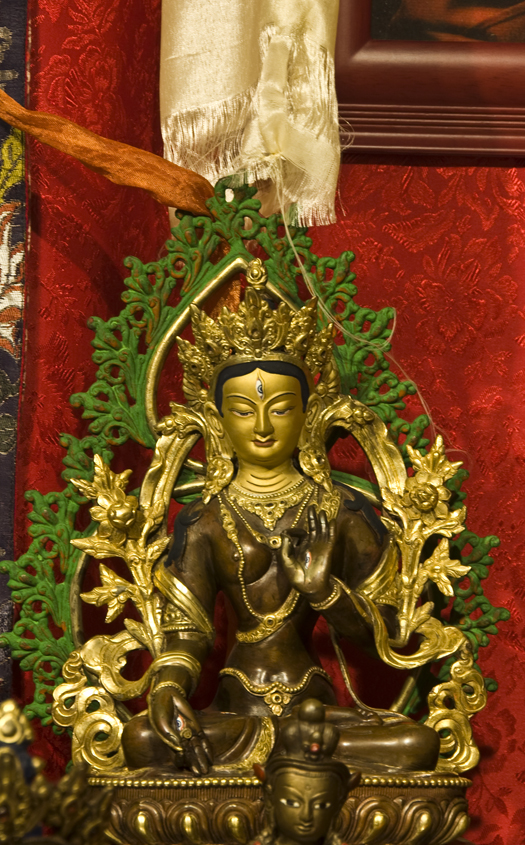
It was then I noticed that a silk sash from the thangka of Guru Rinpoche which hung in the center of the main altar, had moved to drape over the crown of a White Tara statue to its right. And then I saw that the katag that hung on the picture of His Holiness Penor Rinpoche had somehow moved to its left to also gently drape on the crown of the same White Tara statue. Windows were all closed, there was no fan or breeze in the room to explain this event.

It was astonishing, as though both Guru Rinpoche and His Holiness were blessing and protecting White Tara’s presence among us, who is Jetsunma Ahkon Lhamo herself. Eh Ma Ho!

Recounted by Ariana Chantal, personal attendant to Jetsunma Ahkon Lhamo

Are We REALLY Kind?

An excerpt from a teaching called True Motivation for Kindess by Jetsunma Ahkon Lhamo

In the Mahayana vehicle the Buddha teaches us that we should be more concerned for the welfare of sentient beings than we should for our own welfare. If we examine ourselves carefully, however, we understand that that is not a natural way for us to behave. The survival of self has always been our primary concern, and the habit or strong habitual tendency of preserving the ego is so deeply ingrained we do not actually understand how frequently we engage in it.

Now you might disagree, thinking, “Well, I was very kind to my family yesterday, and I was kind and generous to my friends last week. I even gave some things away.” If you think like that, think again. The only way that you can remember when you were kind is by comparison to other times. This means that there has to be a hefty measure of time when you were not kind, to be able to compare the two.

If we were truly bodhisattvas here solely to benefit sentient beings, the activity of kindness would be so all-pervasive and natural we wouldn’t be able to discriminate it. One would not know that one was kind. If someone were to say to you, “You’re really kind. Your whole life is kindness,” one would say, “Really?” because one wouldn’t know. There would be nothing to compare it to.

When we look at our kindness truthfully, we often find out it is all about us, and for the most part has very little to do with anyone else. This is a hard truth to face, but it must be faced in order to discover what the Buddha is talking about when he speaks of kindness toward all sentient beings.

Self-examination often leads us to the decision to be a kind person. When your decision is about being a kind person, however, there is actually very little true caring for the welfare of sentient beings. What you are really trying to do is to find yourself, or to like yourself, or to label yourself, to discriminate between self and other and to continue the continuum of egocentricity. When a person decides to be kind, they do so because they want to be a certain way or they want to present themselves a certain way, but generally it’s all about them.

The Buddha teaches us that when we wish to embody the virtue of compassion — when we actually decide to be kind — we should do so for very logical reasons. First, we should study cyclic existence, the cycle of death and rebirth well enough to see its faults. One of the main faults of cyclic existence is that everyone who is born will die. Coupled with this is that during the entire time you’re alive until you start to age or become extremely sick you forget that simple fact, and you do not act appropriately.

We’re all going to experience death. But the way you’re thinking now and the way you act the rest of the day will demonstrate that you’re not thinking like that. You will act like a person who does not remember his or her own death. Because the other thing that you learn about your death is that when you die you can’t take anything with you, not a thing — except the condition, or karma, or habitual tendency of your mind.

Knowing you can only take the habitual tendency of your mind with you when you die, are you going to act appropriately the rest of the day? No way. For the rest of the day, the rest of the week, we will try to accumulate as much approval as possible. “I’m going to make people like me; I’m going to make people proud. I’m going to get love. I’m going to do anything I can — lie, cheat, steal — I’ll put on an act, pretend. I’ll mask my true feelings and do anything just to get a little bit of approval. Who cares if that creates a habit of grasping? Who cares if I take only for me and don’t much care what happens to anyone else? I need that approval, that love.”

The other thing we’ll do is try to accumulate material goods for no good purpose other than that we want them. We forget we can’t take them with us. We don’t act like people who know that. We act like people who believe in some kind of hokey fairy tale or story that can’t possibly come true.

In cyclic existence we also suffer from the suffering of suffering. If we had a different kind of mind, we could see birth and death and our minds would be stable and spacious.  Perhaps these events wouldn’t bother us so much.

Unfortunately everything bothers us. Everything is something we react toward, because it is the nature of our mind to react toward everything with acceptance or rejection, hope and fear. What must come from that is hatred, greed and ignorance. We either hate something, or we want it, or we ignore it. Thus, we engage in the suffering of suffering. We not only experience death, we suffer because of our reaction to death. We not only experience separation, we suffer because of our reaction to separation.

So these are the faults of cyclic existence, and what else would you do other than practice a path that leads to the cessation of suffering? You could accumulate material goods, but what good will that do? Or you could continue the habit of being hateful. What good would that do? Or you could continue to grasp. What good would that do?

The Buddha teaches us that there is an end to suffering. That end is to exit cyclic existence; and in order to leave, one must achieve liberation, or enlightenment. Upon awakening to the enlightened state, one no longer revolves in cyclic existence, because one does not have the building blocks of death and rebirth which are based on the assumption of ego, or self-nature as being inherently real, and the reaction to phenomenal experiences. That is what cyclic existence actually is–that through that means one actually creates the karma of suffering and death, the endless experience or cycle we find ourselves in.

The Buddha teaches us that to attain enlightenment, to awaken to the primordial wisdom state, one no longer accumulates karma. In fact all of that perceptual experience is pacified, in that one finally awakens to and truly views the primordial wisdom nature. So there is an end to suffering. So, if you become a spiritual person in order to be something, you’re still clinging to ego and you’ll actually never attain enlightenment by awakening to the primordial wisdom nature.

And the Buddha teaches us that this can be done through the systematic pacification of hatred, greed and ignorance, the pacification of desire, through meditation, prayer, contemplation, study, through the pursuance of enlightened activity.

© Jetsunma Ahkon Lhamo
Spiritual Technology

An excerpt from a teaching by Jetsunma Ahkon Lhamo from the Vow of Love series

You are at the beginning. You have arrived at the door to liberation. You are knocking on a door that opens to the end of suffering. You have a tremendous capacity here, and in order to utilize that capacity you have to begin to utilize the technology being offered you. That technology is very simple: you have to soften and turn your mind. Whether you are a Buddhist or not, in order to achieve any realization at all – in fact in order to continue in a steadfast way on a path without being pulled away by the craziness of your own mind – you have to develop stability. That stability has to be based on the softening and gentling of your mind. You have to free it as much as possible from discursive thought, and from the conceptualization associated with the belief in self-nature as being real. You have to free it enough to be able to get some perspective.

Through that stability and deepening we can begin to examine these essential thoughts: that all sentient beings want to be happy, that all beings are suffering, that there is a cessation to suffering, and that the cessation to suffering is called enlightenment.

We should examine these thoughts, because Westerners have a very complicated world. Maybe it is hard to understand that all beings wish to be happy here in the West, because here we listen to the news and we hear about people throwing bombs at each other. We hear about robbery, rape and murder. We think, “Wow, that person raped and murdered; he is a horrible person.” We condemn him immediately and forget the other side of that thought, which is that he is trying to be happy. Can you believe that? Is that not an awesome thought? People who are raping and murdering, people throwing bombs in each other’s windows – how can you believe that these people want to be happy? Yet, it is absolutely the case. All sentient beings want to be happy, but they are drunk with the idea that there is no cause and effect. They are drunk with the idea that they can attain happiness by manipulating their environment in some crazy way. It just doesn’t work.

For instance, a freedom fighter might believe if he destroys a thousand people by throwing a bomb into a building, he might attain some liberty for his people, and through that effort he will be happy. That might be his thinking, but he doesn’t realize he has killed a thousand people, and through his action has created the karma in his mindstream of a thousand deaths that can only be the cause of suffering. He really believes he is doing something good. Even the rapist and murderer – maybe he has an uncontrollable urge that is deep and profound. Where does that urge come from? Why don’t you have it? It is because he has the karma of that urge. Maybe it was caused when many lifetimes ago he threw a bomb in somebody’s window and killed a thousand people, and maybe that is why he has that urge in his mindstream now. So what does he do? He continues to rape and murder. At the moment of doing so, he thinks he will end the suffering of his uncontrollable urge through raping and murdering just once more.

That is how horrible it is, but these people really are trying to be happy. Think about that. Think about how they are suffering uncontrollably, revolving again and again in cyclic existence, helplessly, because of the karma that has infected their minds. They are helpless in the midst of the cause and effect that they have created — simply helpless. Even in these horrible cases it is true, all sentient beings are trying to be happy. On the other side of this law, which the Buddha declared, is that not understanding how to create happiness, they constantly create the causes of suffering through non-virtue.

These are things you absolutely must remember. You have to allow them to deepen your mind. They have to become as instinctive and natural to you as breathing. If you understand the infallibility of cause and effect to such a profound extent that it begins to change the compulsion you have to create non-virtue and therefore the causes of unhappiness, then you are a practitioner. You are practicing a technology that will lead you to realization. Whether you consider yourself a Buddhist or not, you are practicing a valid technology, a spiritual technology.

© Jetsunma Ahkon Lhamo

Want a Taste?

Excerpt from a teaching by Jetsunma Ahkon Lhamo from the Vow of Love series

From the first day that I began teaching until the last day that I ever have the opportunity to teach, I will invariably speak of compassion. If compassion were ice cream, by the time you finish with me you will have tasted every flavor at least 475 times. So, now we will talk about another flavor of compassion.

Previously, we have discussed why compassion is necessary. Then we spoke about how to begin to apply that compassion. We talked about various ways in which one could be motivated by compassion, as well as thoughts that you might have found moving or encouraging and that were geared to deepen and soften your mind. These are very important. One of the greatest, most precious jewels that you will hopefully attain in traveling the Buddhist path, or any spiritual path, is to have your mind softened and deepened.

There is an expression in one of our prayers, that one’s mind becomes ‘hard as horn.’ The minute I first read that particular phrase, it touched me deeply. Every time I have thought about it, it has meant more and more to me. One’s mind becomes hard as horn because of the discrimination, the conceptualization that is involved with the idea of ego, because of the pride and arrogance that arise from our belief in self-nature as being inherently real. We have established in our minds all of the clothing, the dogma, the discrimination of this idea of self as being real. These things become rigid in our minds, and our minds are no longer gentle.

The moment you decide in some subconscious way you have an ego, that you are a self, you have to start gathering the constructs of self-identity around you. You have to determine where self ends and other begins. In order to do that your mind has to be filled with conceptualization. In order to be a self you have to survive as a self.  In order to maintain this conceptualization that makes survival possible, your mind has to become rigid. So if I say to you that your mind is rigid, you shouldn’t think I have insulted you. I am talking about a condition all sentient beings have, and it is a condition that is the cause of a great deal of suffering.

When I say that all sentient beings are suffering, I don’t wish it to be a real downer for you. That is not the point. Realizing all sentient beings are suffering is meant to soften your mind, because to realize all sentient beings are suffering, you have to be willing to examine phenomena and to examine yourself in a deep way, in a way that you don’t normally do. Therefore, you have to challenge your concepts. Why is that? Because naturally, and without any teaching or any encouragement, you will try to convince yourself that you are happy.

You may do this in much the same way that a person who is hungry and unable to eat will do something to take his mind off his hunger. Let’s say its 10 o’clock. You’re on the job, you’re famished, and you know you can’t get off for lunch until 12 o’clock. You are going to try to think of something else. You’re going to try to keep your mind busy, or try not to focus on your hunger. In much the same way, if you are suffering and you don’t have the technology to remove from your mind the causes of this suffering, you are going to try to convince yourself that you are okay. You are going to put a band-aid on it, and in order for you to do so, your mind has to become more hardened.

It is useful to really look around at sentient beings and see they are suffering. It is also useful to look at yourself. This is not meant to make you depressed or sad. It is meant to give you what it takes to go to the next step, which is to try to determine for yourself the way to remove the causes of suffering.

Even though there are times when hunger is not comfortable, when you would rather not think about it, there are also times when hunger is useful in that it keeps you alive. In the same way, while it may be uncomfortable for you to think that all sentient beings are suffering, it is actually quite useful for you to realize that. It is this realization that will give you the foundation and the ability to turn your mind in such a way that you have to seek out the causes of suffering, and how you can remove them from your mind.

It is not useful in any long-term way to try to convince yourself, by putting a band-aid on an ulcer, that everything is okay, because you still have to face the same things that you’ve always had to face. Nothing has changed. You still have to face old age, sickness and death. Neither does it help you to be helpful to other sentient beings. Look at the animal realm. Go to India and see how the oxen are beaten and tied up in order to be worked. They are worked all of their lives. That is suffering. Look at all the different ways that other creatures suffer just out of ignorance, because they have no way to help themselves.

Once you have determined suffering does exist, there is no need to dwell on it in a morbid way. Rather, you should think, “This is how it is. Now I have to realize that there is, in fact, a cure, there is a way to deal with this.” It is not useful to dwell on suffering without also accepting the antidote. In other words, if you just think about hunger all the time, and you don’t eat, that is stupid. When hunger is no longer useful to you, it is simply suffering. You should use your awareness of suffering to prod you to seek and practice the antidote to suffering. Use your awareness; it is your tool.

© Jetsunma Ahkon Lhamo

GARUDA AVIARY: TIME TO STEP UP TO THE PLATE

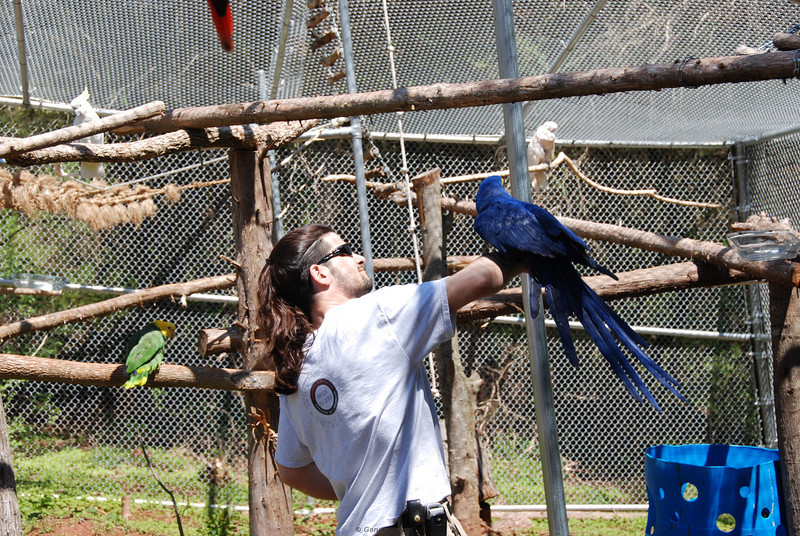
Nearly everyone considers the Garuda Aviary Parrot Rescue to be a great thing.  The Aviary cares for over 40 parrots and other large birds that have been abused, abandoned or neglected, and visitors to the temple are always impressed with the birds.  We get lots of praise for the Aviary, but how many of us actually take part in supporting this meritorious activity?

It is hard work, taking care of that many hungry mouths every day.  They eat a lot, and they have to eat every day.  It costs a lot of money just to feed them.  When the money runs out, they still have to eat.  We can’t skip a few days until we get some more money.  A generator is also needed for the Aviary to keep the temperature safe for the birds when the power goes out, which it does sometimes.  Right now there is only one person actually taking care of the parrots.  They need a lot of attention. They’re like two-year olds that live 80 years or more.  There is very little money coming in, despite the widespread interest. The plain truth is that the donations don’t match the praise.

There are many ways that each of us can help with the Aviary.  If you don’t know how you can help, ask.  Call Claire Waggoner at 928-713-3522 or email garudaaviary@earthlink.net if you want to find out how you can help or to volunteer.  You can also make a cash donation here: http://www.garudaaviary.org/financial_donations.html.  Even just taking a donation can home to put your spare change in helps.

Perhaps we should ask ourselves if we still have the ability to love.  These sentient beings need us.  Their very lives depend on us.  We have the power and the means to give them what they need.  Can we look inside ourselves and find the love that can accomplish that?  Because that’s the only way it’ll happen.

Astrology Tuesday

Early in the day you dither around, unsure of what to do. As the day picks up speed, you move into a sensitive and reflective mood. You are still working hard, and humility is the order of the day. Bounce your ideas off others, and take criticism and suggestions seriously. Make no attempt to conceal your mistakes, and you have made some, but fess up and move on. No shifting blame. Thomas Merton said “Pride makes us artificial and humility makes us real.” Keep swallowing your pride, and you will have an opportunity to shift the issues of your world onto a more stable foundation.

The daily astrology post affects everyone. Because individual charts vary, the circumstances outlined in the post will affect people differently. Some will feel this energy in the personal arena, some in finances, some with children or family, some in work and so forth. There are many departments of life. Look to see where the dynamic affects you!

Astrology

You’re still working to accomodate a friend’s wishes and you feel somewhat overwhelmed.  At the same time you’re enjoying your work as well as the people you meet.  This is a good day to spend time shopping, banking, preparing food.  Take time to relax frequently during the day and you’ll re-charge rapidly.  A financial decision is successful and brings good results, and you choose quality items while shopping. If you follow a fantasy or illusion today you will be disappointed, but if you do something you are both good at and love doing, you will succeed.  John Ruskin said  “When love and skill work together expect a masterpiece.”  Nice.

The daily astrology post affects everyone.  Because individual charts vary, the circumstances outlined in the post will affect people differently.  Some will feel this energy in the personal arena, some in finances, some with children or family, some in work and so forth.  There are many departments of life.  Look to see where the dynamic affects you!

WP2Social Auto Publish Powered By : XYZScripts.com