Astrology for 8//13/2016

8/13/2016 Saturday by Norma

Harmony between Leaders characterizes this day, but others are in disarray. A setback at work is mitigated by an attitude of acceptance and generosity. It’s crucial to avoid decisions based on sweeping generalities, you’ll feel ridiculous later. (“All 14 year olds are left handed, so I’ll make baseball gloves for them.”) Irrational thinking is the bane of the day, yours and others. Smile pleasantly as people make ludicrous statements, and everything goes well. Hugh Allen said, “Tact is the rare ability to keep silent while two friends argue, and you know both of them are wrong.” What’s good today? Remembering that leaders are in harmony and underlings are quibbling, so go with the leader. This is an excellent day to abandon your work, take a break, and relax.

The astrology post affects everyone differently, depending on individual horoscopes. Look to see how this message reflects your life today!

Astrology for 8/12/2016

8/12/2016 Friday by Norma

A riveting event or announcement pulls you into the fray, sweeping aside work commitments and generating non-stop pontificating. Fast action is compelling but unwise. If you can’t stop yourself, be sure to fix anything you knock over as you charge into action. This is a tricky day where action begets remorse. Break up with a dear one and you’ll regret it, kick something out of your life and you’ll want it back. C. S. Lewis said, “Forgiving and being forgiven are two names for the same thing. The important thing is that a discord has been resolved.” What’s good today? Work and health, sitting out the urge to act, taking the long view of life and remembering who and what is most important to you.

The astrology post affects everyone differently, depending on individual horoscopes. Look to see how this message reflects your life today!

Ahkön Norbu Lhamo

The following is respectfully quoted from “Reborn in the West” by Vicki Mackenzie:

After Penor Rinpoche had left, the group dwelt on all that had happened and what he had said. Dutifully they began looking for a property, and sure enough, they found a beautiful place which would suit their purposes perfectly. It had white pillars all along the front. But the price was astronomical. Scraping together whatever money they could, and taking out a huge mortgage (which now necessitates many ingenious fund-raising schemes), they bought what is now KPC and established what over five years later has become the largest ordained Tibetan Buddhist community in the USA. Every Sunday over 120 people came here from the surrounding area to hear Jetsunma’s teachings.

At this stage Jetsunma still didn’t know precisely who she was. That was still to come.

A year after Penor Rinpoche’s visit Jetsunma felt the urge to see again the small, round man who had come into her life and touched her so deeply. She decided to go to India, to his monastery in Bylakuppe in Karnataka state. For the girl from Brooklyn who had never set foot outside the USA, landing in Bombay with its chaos, colour and poverty was merely a prelude for the greater revelation that was to follow.

Facing Penor Rinpoche on his own territory, she said she wanted to take the bodhisattva vows. This is the ceremony in which you formally promise to dedicate your life to the well-being of others. She asked if he would give her a spiritual name, as was the custom at such an occasion.

‘When the time is right,’ replied Penor Rinpoche.

‘When will the time be right?’ pushed Jetsunma, with typical Western impatience.

‘I’ll give it to you when the right day comes,’ continued Penor Rinpoche.

‘When is the right day going to come?’ persisted Jetsunma, not giving up.

‘When I say so,’ retorted Penor Rinpoche firmly.

Jetsunma gave up.

One day, when the moon was in a particular place in the heavens, Penor Rinpoche called her to him and announced: ‘Now I am ready to give you your name.’

He then wrote out her spiritual name on a piece of paper, rolled it up into a scroll, put his personal seal on it, then handed it to her with the white katag (scarf) of respect wrapped around it. ‘That’s your name–Ahkön Norbu Lhamo,’ he said.

There was no apocalyptic vision, not instant flashback to another time, another place, another body. There wasn’t even shock or surprise. Just a sense of intense familiarity.

‘I experienced serious dejà vu,’ was how Jetsunma recalls the occasion. ‘I felt a strong connection to that name. I asked him to say it again. It was like milk to my ears.’

Through his translator he then uttered the monumental words: ‘I now recognize you as the sister of Kunzang Sherab. Her name was Ahkön Lhamo. In that life she and Kunzang Sherab co-founded the Palyul tradition. I recognize you as her incarnation.’

And in those few simple sentences Penor Rinpoche made sense of the extraordinary life that Jetsunma had teched out for herself and the otherwise inexplicable abilities she possessed. This, at last, was the official explanation of how a woman with no Buddhist training whatsoever, no books on Tibetan Buddhism, no teacher, no outward example to follow, had been driven to enter years of strict meditation by herself and to emerge with not only profound wisdom but also the wish and the ability to help others fulfill their spiritual potential.

Astrology for 8/11/2016

8/11/2016 Thursday by Norma

Magnetic people are mopping up the floor with everyone else and all you can do is stand back, mouth agape. Avoid the temptation to offer critical comments that irritate others today, and you’ll want to! If something goes missing relax, it’ll come back. Philosophical discussions and politics will divert you from work, if you let them, but it’s best to keep your nose to the grindstone. W.B. Prescott said, “In any contest between power and patience, bet on patience.” (“I’d love to debate, but I’ve got work to do!”) What’s good today? Well, work! The two benefics are in the sign of work just itching to help you out, take advantage! Health is good, employees are excellent and the boss likes what you’re doing. In a lull, organize the files and feed the pets.

The astrology post affects everyone differently, depending on individual horoscopes. Look to see how this message reflects your life today!

Peerless Guru: His Holiness Penor Rinpoche

PenorRinpoche

The following is an excerpt from a teaching by Jetsunma Ahkon Lhamo called “Love Now, Dzogchen Later”

At the same time I first got to know His Holiness and we began to actually have conversations,  I was talking a great deal to Gyaltrul Rinpoche, because I met him soon after that visit. But I remember first learning about Dzogchen, not from my teachers, but from other students, which was kind of horrible. I kept hearing the term. I questioned; I tried to find out what it was. I tried to read some books. I asked my teachers, and His Holiness particularly said, “Soon I’ll give you plenty of explanation so you will understand.” And I questioned. Actually I didn’t question His Holiness, but I questioned Gyaltrul Rinpoche, “ Why is it then that some people are talking about Dzogchen, but His Holiness seems to be holding back on Dzogchen.” And at that time Gyaltrul Rinpoche told me, “Well, you should ask him directly; but from the conversations I’ve had with him, Americans are not ready for Dzogchen. He says that they are, you know, too prideful, too arrogant. They don’t really understand the benefit. It would be like throwing something precious on the ground where it can’t be used, for instance, like a seed. You would want to throw it into fertile ground or put it into fertile ground. You wouldn’t want to put it on, you know, a highway where it’s never going to sprout.”

So that was the explanation I got, and I was satisfied with that. But then later on I kept seeing that more and more, particularly in Dudjom Rinpoche’s lineage, they were always talking about Dzogchen this and Dzogchen that. And if you didn’t know Dzogchen, they thought you were a little silly. You know, they didn’t think you were quite there. So I persisted in trying to find out. And His Holiness reiterated again and again,   “You have to get the preliminaries. You have to build a foundation. Americans are not ready.” For quite a number of years, even though His Holiness returned here many times, he did not want to give out Dzogchen. And it was like that until he set up the summer program in New York where you could go Shedra style—step by step, stage by stage, from one level to the other. When he did that, he kind of reversed his direction in a sense, because he was real hesitant to give Dzogchen and really held back for a long time. And then suddenly he was offering it; and I remember thinking, ‘Well, students will have to go stage by stage no matter what.’ You know, they’ll have to do like in India where if a student wants to go to level 3, he has to graduate from level 2. That sort of thing.

And then I heard that His Holiness had totally opened it up where he left it to the student in conference with the teacher there to decide what practice, to say what practice they had accomplished and what they had done. And if you receive Year 2 the year before, you could always go on to Year 3 unless you were having terrible obstacles. You could always go on to Year 3, and then the next. It’s kind of like the “No child left behind.” No Dharma student left behind here. I remember at that time being completely blown away by that. I was so completely blown away because it was such a reversal for him, such a change.  And I tried to seek the reason for that. His Holiness had switched his tone so thoroughly. He was saying, “Not much time left.”  And, of course, that scared me. I thought he meant for him. “No, it’s not like that,” he said. “No, not much time left for sentient beings.”

And so, that was his decision. He is peerless. There is no lama like him. There is no lama that can top him in any way. He is extraordinary. He is a living Buddha. I mean he is extremely orthodox and yet extremely flexible, an unbelievable combination,  because with orthodoxy comes dogma and rigidity. He is fully qualified and fully able to be the head of his lineage and to steer the course of this great ship, the Buddhadharma. Yet, he is completely flexible.

Copyright © Jetsunma Ahkon Norbu Lhamo All rights reserved

Astrology for 8/10/2016

8/10/2016 Wednesday by Norma

Pride is an issue today, yours and other people’s. Be as respectful as possible, particularly where you feel respect is unwarranted. Hold the door open, say thank you to everyone, accept gifts you don’t want and applaud loudly. A friendly comment or idea generates a new, successful, direction in work or organizational matters. Spies are succeeding, Homeland Security is doing a great job, all underground matters are flourishing and employees everywhere are performing brilliant work. Mundane matters are most important today. Terry Pratchett said, “It’s still magic even if you know how it’s done.” What’s good today? Work, health, support from behind the scenes and refusing to rise to rhetorical bait. Smile and keep working.

The astrology post affects everyone differently, depending on individual horoscopes. Look to see how this message reflects your life today!

The Importance of Samaya

The following is respectfully quoted from “Perfect Conduct: Ascertaining the Three Vows” by Dudjom Rinpoche:

6.b.1(e.4) Restoring through the general cleansing of three yogas:
As is taught in the Hasti-upapraveśya-tantra, the general cleansing yoga of the nest of remorse is the “Stirring the Depths.” By confessing in this way, there is nothing that cannot be purified. Practice this accordingly.

According to the tantra called Hasti-upapraveśya and the Vimaladeśanā contained within it, this is the sole text for practitioners of all three yogas who, having engaged on the path and then allowed their samaya to deteriorate, wish to confess and perfectly restore it. The king of all confessions is Narakakhadāpravāsaprasphotana (Stirring the Depths of Vajra Hell). Here, it is clearly taught that by offering the external gathering of substances, the internal gathering of own’s own aggregates, and the secret gathering of the awakened mind of bodhicitta on the fifteenth, thirtieth, or eighth day of the lunar month, all deteriorations will be fully purified. If that is not possible, but one still makes prostrations and recalls the deity in order to confess, purification will occur. It is important to persevere in this practice as much as possible.

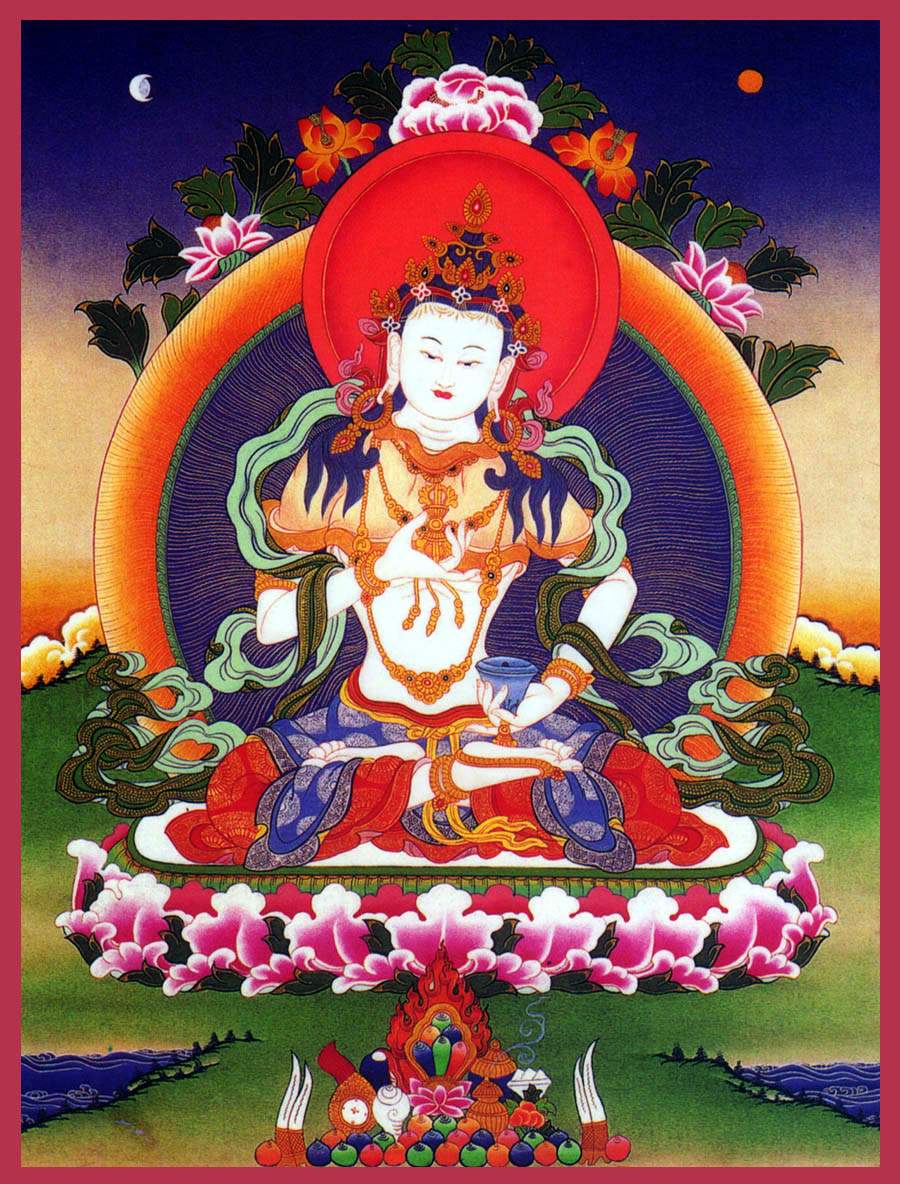
As is said in this text, “To all the enlightened peaceful and wrathful deities and to their mandalas, I pay homage. I pray that I may cleanse all of my broken commitments without exception. There is no doubt that the five limitless non-virtues can be cleansed and that even the lower realms can be emptied from their depths and that beings will be led to the well-known pure realm of the enlightened beings of pure awareness. Since Vajrasattva is the essential nature of secret mantra and cleanses all of our karmic obscurations and obscurations caused by broken commitments, in order to empty the realms of cyclic existence, recite the mantra.”

Accordingly, if one just hears the names of the deities in this mandala, all deteriorations of one’s root and branch words of honor can be repaired. Signs of accomplishing the purification through confession include indications in the dream state; indications from the lama or deity; and dreams of bathing, putting on white clothing, ascending to the peak of a mountain, and the arising of the sun and moon and so forth. Until such signs arise, one should continue to make confession and apply the four remedial powers.

6.b.2 The faults of failing to restore broken words of honor:

If one fails to make confession in this life, extremely unpleasant consequences will ensue. In the next life, one will be born in the vajra hell of irreversible torment and suffering.

If mantra words of honor are left unconfessed, this becomes a cause for rebirth in what is called “vajra hell.” There is no place of greater suffering. As it says in the Guhyagarbha, “If the root or branch of words of honor deteriorate, the result is that falls to the lower realm.”

In the Prakativavictra-tantra, it states: “If a root word of honor deteriorates and no effort is made to restore it, one will fall to the vajra hell. If all the suffering of the ordinary hells were to be combined, that suffering would not equal one fraction of one hundred-thousandth of the suffering experienced in vajra hell.”

It can thus be understood that even an association with an individual who has accrued this degree of negativity can cause one’s own words of honor to deteriorate. Strong adverse effects may occur for those who even come into contact with such an individual. As it says in the Sarvasamudita, “Just as spoiled milk will taint are pure milk with which it mingles, a singe mantra practitioner who has allowed his words of honor to deteriorate can spoils the words of honor of everyone with whom he comes into contact.” Even if one precedes the breaking of samaya by discussing this with others as a means to communicate one’s intention, this too must be immediately confessed. As it says in the Mahānyūha, “If one harms lama, his or her retinue, or the vajra brothers and sisters by casually speaking negatively or by just a subtle sign of dissent, even if only in the dream state, this must be confessed and cleared from the mind. Actual and inadvertent neglect of samaya that remains unconfessed will cause one to fall headfirst into the hells.”

According to these teachings, it is clear that the loss of any root or branch word of honor is a cause for rebirth in vajra hell. However, there are differences in the degree and duration of the suffering experienced, which vary according to the severity of the downfall.

7. The benefits of guarding the words of honor:

With no deterioration, the maximum will be sixteen consecutive rebirths; the minimum will be in this life, at death, or in the intermediate period. Other benefits include accomplishment of the eight common powers; and obtainment of the seven features of a divine embrace. For this purpose, spontaneously accomplish the twofold purpose of self and others.

The words of honor are the source of all noble qualities and are the very support for the stability and presence of such qualities. As it says in the Samānya-sūtra, “Just as the planting of a seed is dependent upon the earth in order for the result to mature, the life essence of the Dharma remains within the words of honor, which fully mature into the unsurpassed state of awakening as the precious life-essence of virtue.”

Temporary benefits include the accomplishment of all that one aspires to obtain; an appearance that is pleasing to all; becoming an object of the veneration of others, including the most powerful worldly gods; and being blessed by the buddhas, bodhisattvas, dākas, dākinis, and all objects of refuge, who guard one like their own child. Having understood the importance of pure samaya by entering the path of all the buddhas, one will quickly ascend the stages of vidyādharahood to realize enlightenment.

If in one’s immediate life one is unable to persevere in the accomplishment of the two stages, yet never allows the words of honor to become defiled, then after taking sixteen successive rebirths enlightenment will be realized. This is the longest possible period of time it will take just through the force and purity of the words of honor alone. After at least seven rebirths, one will meet with the profound path of the two stages and gradually be liberated. The speediest result occurs if one maintains pure words of honor coupled with diligence in the two stages of practice, resulting in the realization of nondual vidyādharahood in that very life. Those of average sensibility will realize the illustrative clear light, which will become the actualization of absolute clear light at the time of their death, and the obtainment of nondual kāya that arises from training. If absolute clear light itself is realized, then at death the nondual kāya (arising from no-training) will be obtained. Those of common sensibility, due to their practice, faith in the lama, and strong aspiration for the pure realms, will be liberated in the bardo (antarābhava) [intermediate state] by arriving in the natural nirmānakāya pure realm.

These are not the only noble qualities that arise from pure samaya. In addition, both extraordinary and mundane spiritual attainments are obtained. The eight mundane spiritual attainments include the power to make an eye medicine, which, when applied, allows one to see without impediment or physical obstruction; speed walking; the sword accomplishment; seeing underground; making power pills; flying in space; disappearing; and extracting the essence. These eight powers are called mundane because they are still of this world and can also be accomplished by non-Buddhists. They qualify as accomplishments belonging to the paths that are both worldly and transcendental. According to Vajrayāna, these qualities are developed during the two yogic states and are thus termed common because they are not the ultimate result. In addition, the eight sovereign qualities are achieved.
Astrology for 8/9/2016

8/9/2016 Tuesday by Norma

Dig deeply into a matters and you’ll strike gold and come up with a successful formula, leading to improvement on multiple fronts. Careful observation, combined with a willingness to consider unusual options, is the key to success today. Terry Pratchett said, “It is well known that a vital ingredient of success is not knowing that what you’re attempting can’t be done.” Use intuition, not logic, in your search. Accept a disappointment graciously. Avoid tantrums, emotional venting and long term judgments of others (“You’ll never succeed!”), just slowly disappear like the Cheshire cat, whose smile remained after the rest was gone. What’s good today? Health, work, new directions, getting to the bottom of something and surgery.

The astrology post affects everyone differently, depending on individual horoscopes. Look to see how this message reflects your life today!

Understanding Duality

Fly

The following is an excerpt from a teaching by Jetsunma Ahkon Lhamo called “Art of Dispelling Anger”

So what happens in the awakening? Well, we’ve worked with our poisons sufficiently. We have some inner knowledge and honesty. We’ve worked some method and now we’re accomplishing view. That’s where we really start to get cooking is where we practice the view. The view is—I love this part—every woman you see is a goddess and I’m the queen. We see that all beings are Buddha. We see that the females, whether they look like goddesses or act like goddesses, are goddesses in their nature. They are Tara. They are, as are you, the primordial pristine state. We look at men, and rather than list their faults, which most of us do, we look at them and think, ‘This is Buddha. When you think of your husband, your child, your friend, your enemy and even President Bush, you think, ‘Yeah, this is Buddha, in his nature.’ And when we look around and we see that the appearance in relative view doesn’t look like Buddha, we shouldn’t take that as proof that the teaching is wrong and that we have a good excuse to hate.  We should take that as a reasonable display of the fact that we are lost in samsara. Here we are in our nature, the very Lord Buddha. When we awaken, we are Buddha. And yet we are in prisons; we are in hell realms; we are in abusive situations; we are hungry; we are angry; we are at war; we suffer. And yet we are the very Buddha we aspire to follow.

In Buddhism we are taught there are the ground, the path, and the fruit. All three must be present in order for liberation to be possible. And this is one way in which we understand our natures. The ground is the basis of accomplishment. If you did not arise as phenomena from the fundamental primordial self-luminous view, if you did not arise from that, if you were not the very bodhicitta in its display form, if the Buddha seed did not rest within you, if it were not so that each and every cell of your body is replete with the entire mandala of peaceful and wrathful deities, if that were not true, there would be no basis for accomplishment. But in our nature, we are Buddha. That is the basis.

And then there is the path. The path is as important as the basis, because while we have the Buddha seed, we may not have method or a way in which to awaken to that or to bring it forth. A fly is Buddha. He also arises in the display of duality in the samsaric world; and yet his nature is Buddha. His nature is the very same, no different. We each of us stand in the presence of our root teacher, whether it’s in our private practice or whether it’s here at the temple, and we could be a fly. But the difference between you and the fly is the fly has no method. The fly cannot practice method. The thing he is doing is not prostrations. He’s wiping his thighs or something. So we have to apply method. That’s what the Buddha’s teaching is all about. It’s all about different methods at different stages for different people.

Copyright © Jetsunma Ahkon Norbu Lhamo All rights reserved

WP2Social Auto Publish Powered By : XYZScripts.com