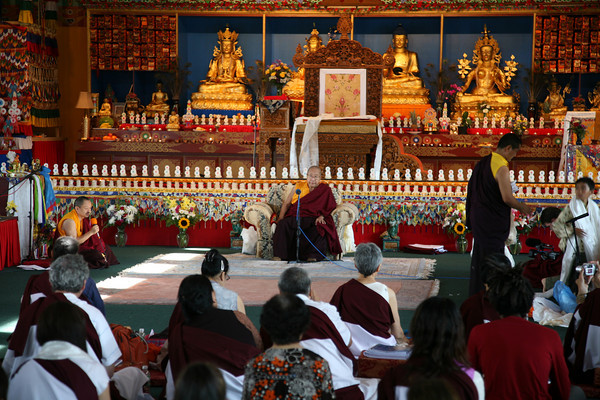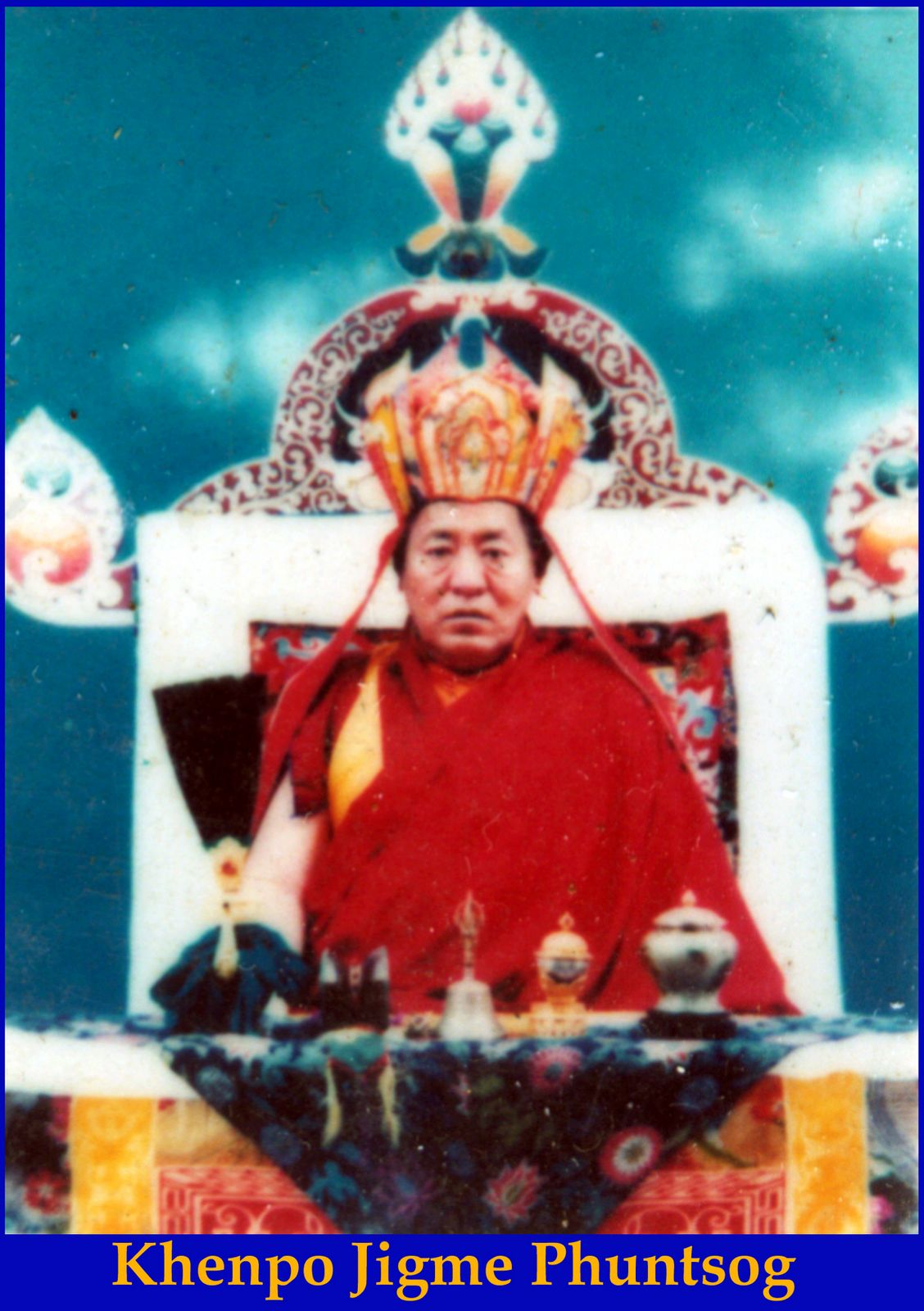
Introduction to the Three Vehicles: His Holiness Khenpo Jigme Phuntsok

The following is an excerpt from a public talk given by His Holiness Khenpo Jigme Phuntsok:

​Recognizing suffering for what it is, understanding the causes that produce suffering, we are then able to engage on the path of true freedom and bliss which culminates in the experience of enlightenment or full awakening, the status of Buddhahood.  When the status of Buddhahood is realized we will know permanent happiness.  To be able to cessate all types of suffering in this way so that permanent happiness is achieved is totally dependent upon the spiritual path, the practice itself.  Therefore we must understand how to practice the pure path.

​The goal of liberating all beings from suffering is predominant in all vehicles, but in addition to that one would consider the thought of never harming others and of somehow being of benefit to others.  Anything that is harmful, in any way at all, is absolutely abandoned.  To practice on that level, of maintaining refuge and never harming others intentionally is the essence of the Hinayana pursuit.  In this world of ours these days the Hinayana vehicle of Buddhism is primarily practiced as the sole pursuit in countries such as Sri Lanka, Burma, Thailand, Cambodia and other Southeast Asian countries.

​The Mahayana pursuit, or the greater spiritual pursuit, more than focusing upon one’s own purpose one focuses upon the purpose and welfare of others.  One is always thinking how to be of benefit to others.  In fact, it becomes one’s sole concern to not only think about being of benefit to others, but to engage in activities which bring direct benefit to all other sentient beings impartially to the point where one is ultimately able to establish all other sentient beings in the status of Buddhahood.  That is done based on one’s altruistic attitude of love and compassion for all other beings.  So that type of motivation and practical application qualifies one as a practitioner of Mahayana.  The essence of the Hinayana is already incorporated into that because, if you’ll recall, in Hinayana the main focus is not to harm others, but as a Mahayanist, not only are you not harming others, but you are only doing that which benefits others.  So it is taken a step further.  In this word, those countries where the Mahayana doctrine is predominant include China and Japan and some others.

​In the context of Mahayana, as an inner division we find the vehicle of secret mantra, Vajrayana. What sets the secret mantra Vajrayana path apart from the others is that it is called the resultant vehicle.  This is because it produces results in a very short period of time.  It does not take a long time of practice to receive the results because method and wisdom are combined in such a way that in one short lifetime enlightenment can be realized.  The secret mantra path of Vajrayana combines the two yogic stages of generation stage — which is the practice of generating visualizations of self-nature as the deity — and the completion stage — which is the practice of dissolving visualizations and other types of elaborations into the fundamental nature of emptiness.  These two yogic stages are combined in such a way that the result is achieved in a very short period of time.

​This vehicle of secret mantra Vajrayana is the principal vehicle of Buddhism that is practiced in Tibet, and now we find it spreading throughout America and other countries.  There are many Dharma centers that have been established in America, primarily by Tibetan lamas who are upholders of the Vajrayana tradition.  This means that many of the American disciples are now becoming practitioners and upholders of this tradition.  In fact, throughout this world, Vajrayana Buddhism is already firmly established in some 32 countries.

​Within the secret mantra vehicle, the ultimate, absolute pinnacle, the enlightened mind of all the Buddhas and Bodhisattvas condensed into one essence, the heart blood of all the dakinis, is the quintessential path known as the Clear Light Great Perfection, or Ati Yoga.  This Doctrine of the Great Perfection is dependent upon the receiving of what is termed pointing out instructions or pith essential instructions which can be passed from teacher to disciple in the form of just a word or two.  In fact, if everything is auspicious according to the way that the Clear Light Great Perfection is actually transmitted, it is taught that if those essential instructions are given in the evening, by sunrise one will be enlightened.  If they are given at sunrise, by evening one will be enlightened.  So this is considered to be the most expedient path to liberation.

​To meet with the Clear Light Great Perfection is something that is so precious and rare that it is taught that just to hear the words of the dzogchen teaching, the teachings on the level of Ati Yoga, closes the door to rebirth in the three lower realms and puts one safely and directly on the path to liberation as a Buddha.  So it is a Dharma that has the power to liberate just by contact, just by sight, just by recollection.  Even to recall the words of the dzogchen teachings is something that is so precious and profound that it is likened to having a wish-fulfilling jewel in the palms of your hands.  It is not a Dharma that is filled with elaborations and complexities that takes a lot of time to accomplish or establish.  It is a Dharma that, if it meets with the right individual or the perfect aspirant, is something that is easy to practice and that can be applied to every aspect of life in a very simple way producing very direct results.  However, this Dharma, this Doctrine, must only fall into the hands of those disciples who have the karmic affinity for it which is something that must be established due to karmic connections.  Otherwise it is a Dharma that is meant to be kept secret or to be guarded from any other type of situation.

Heart Advice on Saga Dawa Duchen 2013

The following is a full length video teaching offered by Jetsunma Ahkon Lhamo on Saga Dawa Duchen 2013. Kunzang Palyul Choling temple is currently closed for public assembly due to required renovations to meet Montgomery County, Maryland Use and Occupancy Codes. Read more about the situation here

Copyright © Jetsunma Ahkon Norbu Lhamo All rights reserved

Sweet Intention


The following is from a series of tweets by Jetsunma Ahkon Lhamo:

Sensitive people should protect themselves, not become hard and mean. We are all sensitive at the core.

We grieve for the feel of love, and yet we all avoid love with responsibility, just live fast? Doesn’t work.

At this time, in my Sangha, people are dying, and people are popping awake. How? Who are you?

How hideous the dying part. How real the life, and joyful.

Waxing poetic here, still, this is Dharma thought. We bare joy and pain, and we can only control them with love. Dear sweet intention, Bodhicitta will save us all.

Copyright © Jetsunma Ahkon Norbu Lhamo All rights reserved

Offered for the Benefit of All Beings

The following is an excerpt from a teaching by Jetsunma Ahkon Lhamo called “Western Chod”

My teachers have instructed me that that practice is actually called ‘chöd’ (and there is an umlaut above the o).  Actually there is no text to go with it so you couldn’t say it was the practice of chöd as it is written in the text.  It has been called by my teachers the essence or essential nectar of chöd.  So I have been given permission to continue to practice that way and also to teach others to practice in that way. My experience has been that it has made my life a lot easier.

Now how is that? Well, I’ll tell you.  It came to pass that there were many sacrifices that needed to be made.  I’m not saying this so that you’ll say “Oh, isn’t she a good girl!”   Save it.  I don’t care.  But there were sacrifices that needed to be made. If I’d had my druthers, I would still be on a farm in North Carolina.  By now I would not only know how to put up beans, but I would have the best darn garden you’d ever seen, and all the farmers around would be impressed.  And I would have a dairy cow to boot.  I would still be there.  I would still be there, much isolated.  I prefer a lot of privacy.  Even though I seem to be good at this (I don’t know why but I seem to be good at this),  I have to tell you that everyone who knows me well knows that to get me out of the house so that I’ll come and do my job, it takes oh, spraying with Pam and loosening her up with a crowbar.  It’s not my natural tendency to want to come out and do this. I really don’t like this kind of thing.

Not only did privacy have to be given up (and that seems to be getting worse and worse), but also personal freedom.  Now I am in the position where if I decide that I want to go somewhere and just not think about whether I look like a dharma teacher or not, just sort of be myself, I find that it’s a little tricky. It happens pretty often that people will come up to me and they will say “Are you that Buddha lady?”  It really happens on a regular basis.  In fact one time at the airport somebody came running up to me, “Are you that Jetsa Jetsa Buddha lady?”  That Jetsa Jetsa Buddha lady, that’s me!  So I have that kind of going on. And you know, I was not brought up as a Tibetan.  I was not groomed for this job; I just got this job.  So I found that many sacrifices had to take place, including watching my children have to give up their own privacy.

There are just a lot of issues.  When we first came to this temple, none of the doors that you see were here.  There were hardly any doors on the inside of the temple.  Everything was very open and this room was divided in half. We used to live upstairs, but there were no doors between the upstairs and the lower, and so basically I was not separate from the temple whatsoever. And the only coffee pot, get this!, the only coffee pot in the whole place was downstairs where the kitchen room is downstairs now, and I slept upstairs.   , Because this place was open 24 hours a day, I would have to wade through students to get to my first cup of coffee in the morning.  If that’s not love, what is? ?  Then my students would say to me, “You never smile at me in the morning.”  Smile in the morning!!  The weight of the bags under my eyes keep my cheeks from going up, what can I tell you!  So anyway, smiling was not forthcoming before the coffee, I’m sorry.  There’s not that much compassion in the world!

I eventually came to draw a lot of strength and a great deal of comfort from that early practice because I found out that I never actually had to make another decision.  And that’s what we struggle with all the time.  Should I spare this time to do my practice?  Should I spare this time to practice compassion toward others?  Should I spend the effort to go over here and help that person?  Should I do that? It’s that thinking—should I, should I, should I?  You burn more calories doing that than any of the good works that you actually do in your life.  So I found out that that head thing that we do when we can’t decide and we always go through the dilemma of being a samsaric being, that was alleviated, and I never really had to make another decision ever again.  I felt that from that point on, everything in my life had already been decided because I didn’t own my feet, I didn’t own my ankles, didn’t own my body, didn’t own my speech, didn’t own my hearing, didn’t own anything. Anything!  I had already decided that I owned nothing.  None of it was mine.

So then whenever I was called upon, well will you do this, will you do that, will you do that?  Now the ultimate test, the moving!  Will you do that?  Yeah, I’ll do that.  You know why I’ll do that?  Because it’s already decided.  None of this really belongs to me.  My job now is to protect every capability that I have or any effort that I’ve made in order to benefit beings.  That I will protect, with fangs out and nails extended.  That’s when you’ll see the meanness in me.  That I will protect, but regarding anything personal, it’s no big deal because it’s already gone.  I don’t own it.  So I take good care of it.  I feed it well.  I exercise it, but ultimately I realize that I’m doing that in order to maintain its strength in order to benefit sentient beings.  I don’t feel that I own it.  I’ve  already given it up.

 Copyright © Jetsunma Ahkon Norbu Lhamo All rights reserved

Hope for All

The following is from a series of tweets by Jetsunma Ahkon Lhamo:

It is going well here, I’m still in NY, happy and meditating. It is so lovely here. The Lamas are teaching, so the students are doing well.

Here we try not to gossip or make bad feelings, or divide the Palyul sangha. When His Holiness Penor Rinpoche was here, he set the precedent for not allowing gossip and we try hard to maintain. I’ve been around a while and seen for myself the glory of His Holiness Penor Rinpoche’s pure and kind leadership, and how He kept expanding and growing, even when he was sick.

I am sure His Holiness Karma Kuchen will carry on with the highest Bodhicitta. So there is confidence in the future.

Remember, if there is no heart in one’s practice there is no Bodhicitta and no result. Remember, in Tibet many pure practitioners without formal training would accumulate mantra with great heart all day and night and achieve the rainbow body. So we need not fear! There is hope and realization for all. And room for all types of practitioners, just do your Dharma!

 Copyright © Jetsunma Ahkon Norbu Lhamo All rights reserved

Kindness is The Way

The following is from a series of tweets by Jetsunma Ahkon Lhamo:

Last evening I taught my class at Palyul Ling. Lots came and lots tuned in from around the world. I enjoyed it and tears of love were everywhere! I hope you tuned in, and if not it is still up on line on U-stream, or you can watch it here – check it out!

Video streaming by Ustream


I’d like to teach again. Feedback was that it was good to hear teachings on the Boddhicitta, and from a Western Tulku. From a woman.

Anyhow, this is the place and time to be! It is gorgeous here, weather is good. I’m resting today.

OM TARE TU TARE TU TURE YE SOHA

OM MANI PEDME HUNG

What joy! I’m finding out students have formed a connection with Palyul Buddhism from my online activities. They practice together, have study groups from my blog and tweets. I knew it was through twitter and other social media that we could all be together and I am thrilled to be a doorway for this. I’ve met students I’ve never seen before! What joy to open wide the doors of Palyul and connect as family. And want to support their efforts by writing instructions and teachings from Palyul and myself as well. A good way to make Dharma free! Once His Holiness Penor Rinpoche told me I’d have Palyul centers all around the world. I thought that seemed impossible, but maybe not. Maybe this is the way.

As my pain heals I will not be as challanged, and will be able to travel. And you may contact us about how that may happen. How exciting! I am 100% Palyul and will open doors for this noble family as well as I can. Kindness is the way. Come to KPC and I am well I will come to you. Wherever you are, whoever you are, I honor you and reach out with love, compassion and respect for all.

Kindness is the way!

OM AH MI DEWA HRI

Fire and Gentleness

An excerpt from a teaching called Dharma and the Western Mind by Jetsunma Ahkon Lhamo given on January 29, 1989

Adapting Dharma for Westerners is not difficult if you understand what our needs are.  The first thing that a Westerner has to do is to become stable in this path.  You have to remain stable and you have to remain stable for the right reasons.  I have seen old time practitioners that have seen the best Lamas and had the best opportunities and the most glorious teachings, but I am not impressed with the stability of their path and I feel that the reason for that is that they have not come to the point where they have really cultivated a gentleness of mind.  They haven’t really cultivated the necessary fire in the heart that keeps everything going.  They haven’t lit that dynamo that makes them remain passionate about loving.

Sometimes I am disappointed in when I see old time practitioners doing the Dharma talk and walking the Dharma walk and spouting this name and knowing that term but their hearts are unchanged.  There is a hardness there. The most tragic thing about that is that even though they are hot and heavy on the path now they may not remain firm on the path.  And time has born that out.   There are many Western Dharma practitioners who were really on and now they are really off.  I think that the reason why this happens is because they did not take the time to build a foundation based on compassion. We cannot consider that it is a baby teaching.  I talk about bodhicitta and compassion all the time.  If bodhicitta, which is the term for compassion, were ice cream you would come here and you would get a different flavor every week.  That is how I teach.  And I teach it as many different ways as I can. I try to be creative and sometimes I pull rabbits out of hats and sometimes I whisper it and sometimes I shout it and sometimes I give it to you to read, but it is always about Bodhicitta.  It is always about compassion, it is always about love in some form or another.

I really have had old time Dharma students say, “Hey I have had Bodhicitta already, and I am tired of Bodhicitta.” I am so sad when I hear that because if you can get tired of that subject then you don’t know it at all. You think that it is a baby subject yet it is the very union of the wisdom of realizing the emptiness of self-nature and the compassionate self that is truly the awakened mind.  There is no time when you are finished learning about compassion.  There is no time when you are finished learning about love.

Westerners who have been to college, to university and have papers are the worst problem we have in this country when it comes to practice, because we think that having got papers we don’t need to be learning about this simple stuff.  We say, “I need the real teachings.  Give me some Dzogchen.  Give me some heavy stuff.  I want the real stuff, because I am an American and I can deal with it.”  The problem is that as Westerners, no matter who we are, if the mind is not prepared, it is like the ground not being cultivated.  You drop the seed and it goes plunk on the top and if our minds are not gentled and deepened we go plink.  We may be able to memorize a wonderful Dzogchen teaching, we may be able to read the text but we are still plinking merrily away.  We have to have these foundational teachings and they have to be with us always.  There is never a time, no matter how advanced you are that you should forget that the greatest Dzogchen teaching, the most pure and pristine understanding of the Nature of Mind is an understanding of the nature of compassion. The most pristine, achingly beautiful understanding of the Primordial Wisdom State is the awakening to love.  There is no difference: the two of them are inseparable.  You can’t have one without the other.  And you may think to yourself, “What comes first the chicken or the egg? Can’t I learn to love after I am wise already?”  I don’t think so because really the mind has to be prepared for these precious deeper teachings.  It has to be gentled.

There is a confession that His Holiness Dudjom Rinpoche gave to us and the translation that I have says, “That my mind is as hard as horn.” And I think about that all the time because at any stage it is possible for the mind to become hard as horn, to become so impressed with its prowess in playing with Dharma terms, to become so impressed with how we can sit straight when we meditate, to become so impressed with how good we live and how sorry we are for every one else, to become so impressed that we are hard. It is important for us as Westerners and as part of the human family to cultivate gentleness so that we can truly accomplish Dharma.

©Jetsunma Ahkön Lhamo

If You Can Open Your Heart and Ask

The following is from a series of tweets by Jetsunma Ahkon Lhamo:

For whom is Dharma written? Not for the ones who feel they know it. That would be a waste. If you are like that don’t listen to me.

Remember I was born in Brooklyn. (So not trustworthy?). I learned late, Aha! But was born young. I’ve always been kind and generous which makes me stupid, a joke.

I am a women past her prime. What use am I? I have seen my nature long ago, yet cannot hardly speak of it. I know the pulse of life, so must be repelled and fought. And because I have a throne and crown will never be loved truly.

But I love you. If you can open your heart and ask me in I will be there. A whore for Dharma, sure. A healer, speaker, -piece of shit, a rose, whatever you need me to be for you.

But not beaten. I will never be beaten as it is pre-ordained.

If you can hear me, I am here for you.

Abandon you? It is the only thing I cannot do.

 © copyright Jetsunma Ahkon Norbu Lhamo All rights reserved.


Love and Compassion: From Compassion in Tibetan Buddhism

The following is respectfully quoted from “Compassion in Tibetan Buddhism” by Tsong-ka-pa

The fourth of the seven cause and effect precepts is love. The field of observation is all sentient beings, and the subjective aspects are three:

  1. How nice it would be if all sentient beings had happiness and its causes.
  2. May all sentient beings have happiness and its causes.
  3. I will cause all sentient beings to have happiness and its causes.

These are three levels of increasing strength which should be cultivated gradually until the point of spontaneity is reached.

The King of Meditations Sutra (Samadhiraja) says that the benefit of cultivating love with all sentient beings as the field of observation is immeasurably greater than that of offering to  Buddhas and Bodhisattvas over many aeons even lands filled with food, drink, and articles. The Sutra of Manjushri’s Buddha Land (Manjushribuddhak shetra) says that there is a Buddha Land to the north-east of this world where beings have attained cessation of coarse feelings and discriminations, abiding most comfortably in meditative stabilization without suffering. Being so happy, they find it easy to behave purely, not killing, stealing, engaging in sexual misconduct, and so fort, for many thousands of ten millions of years. The sutra says that although the benefit of their practice is great, it is more beneficial to cultivate love here for the time it takes to snap the fingers.

One should first take as the object of observation a friend and cultivate the wish that this person have happiness. When this becomes easy, one should consider a neutral person and cultivate the wish as before. Then, one should consider an enemy and cultivate love until there is no difference between the wish for happiness that one has for the friend, the neutral person, and the enemy. The meditation should be extended slowly to all sentient beings throughout space, reflecting again and again on the disadvantages of not have the advantages of having happiness. One may then gradually ascent through the three subjective aspects.

Even if one meditates only for five minutes taking cognizance of all sentient beings and if even the love consciousness, due to unfamiliarity is weak, the virtue is inconceivable because the scope is so vast. For example, if a sesame seed is squeezed, only a little oil comes out, but if many are squeezed, a barrel can be filled with oil.

Initially the meditation should not be longer than fifteen minutes in order to avoid fatigue and retain enthusiasm. Later, it can be lengthened until immeasurable love, conjoined with meditative equipoise, is eventually attained. When love is cultivated little by little, very clearly, with all beings as the field of observation, it is as if one is repaying in part the immeasurable kindness that others have extended in former lifetimes.

The next step is to cultivate compassion. The field of observation of a compassionate mind is all sentient beings who have any of the three types of suffering – of pain, of change, and of being so composed as to be always  ready to undergo pain.

The suffering of pain is actual physical or mental discomfort including in which are birth, aging, sickness and death. Many billions of years have passed since this world was formed; many have been born here, but there is no one who has managed just to stay alive. It is necessary to die and take rebirth again and again.

Sufferings of change are feelings of pleasure which, when superficially considered, seem to be pleasurable but can change into suffering. For example, if a person is out in the sun where it is too hot, he is pleased to go to a cooler spot, but if he stays there too long, he will become cold and sick. Similarly, when one becomes too cold and then goes to a hot place, if one gets too hot, one will fall sick. Although there is seeming pleasure in becoming cooler or warmer, if one stays in that state too long, it turns into suffering. This shows that these situations do not have an inherent nature of pleasure.

Similarly, in this world of beings–whether animal or human–mate with pleasure, but if it is not done in a moderate amount, the pleasure is lost. Excessive copulation can cause a disease called “cold and wind” in the lower abdomen, harming both male and female genitals. Though enjoyable at first, it can ruin the very basis of comfort in the vital channels (nadi). Thus, these feelings of pleasure are said to be contaminated and are called sufferings of change.

The third type of suffering is called that of pervasive composition. Whenever a sentient being takes birth by the power of contaminated actions and afflictions in the desire, form, or formless realms, there are periods when he does not have manifest suffering. However, if certain conditions aggregate, suffering will be generated because the basic causes misery pervade all types of life within the three realms. For instance, though one might have no manifest suffering now, if one is pricked with a needle, cut with a knife, or kicked, pain is immediately produced.

The field of observation for the compassionate mind is all sentient beings who have these three types of suffering; however, to understand the suffering of others, it is necessary first to know the immeasurable fault of one’s own birth in cyclic existence. One should think:

I have engaged in non-virtue since beginningless time and have accumulated bad actions (karma). I suffer pain and change. I am afflicted by being always liable to suffer pain.

One should contemplate the causes of suffering–the ten non-virtues, how one has engaged in them, and how one has suffered in this lifetime. There are three physical, four verbal, and three mental non-virtues.

PHYSICAL NON-VIRTUES

  1. Killing: taking the life of a human or any other being. If one has committed murder, one is born in a bad migration, and then when the migration is finished, even if one is reborn as a human, the lifespan will be very short.
  2. Stealing: taking what is not given. Through its force one will have few resources in the future, and whatever one has others will steal.
  3. Sexual misconduct: incest, copulation in the presence of an image that is an object of refuge, or with a woman about to give birth, and so forth. Such misconduct leads to being controlled by desire and hatred in the future.

VERBAL NON-VIRTUES

  1. Lying: saying what is is not, that what one does not have one has, or the opposite. From such deception one will not hear the truth in the future.
  2. Divisiveness: creating dissension between people or increasing dissension that already exists. The fruit of dividing people is that one will not have friends and will hear oneself frequently faulted by others.
  3. Harsh speech: speaking from anger in order to harm. For instance, when directing someone to go here or there, one does not speak politely but says, ‘Can’t you get over here?!’ The effect is that one will be reborn in a place where one must always be scolded.
  4. Senseless talk: conversation that is not about religious practice, the affairs of one’s family or country, but about meaningless subjects. Through wasting one’s life unsconscientiously in meaningless talk one will not hear sensible talk in the future and will be reduced to speaking gibberish.

MENTAL NON-VIRTUES

  1. Covetousness: the desire for acquisition upon seeing the property of another person. This causes poverty and leads to losing whatever property one has.
  2. Harmful intent: the wish to injure another, male, female, animal and so forth. Based on this deed, people will not be agreeable in the future.
  3. Wrong views: asserting that the cause and effect of actions do not exist, that the Three Jewels are not sources of refuge, and the like. If due to such views one perversely holds that there is no fault in engaging in the three physical or four verbal non-virtues, this harms the roots of virtue already formed in one’s mental continuum and thereby induces great suffering in the future.

One should gradually call to mind one’s own non-virtues and reflect on the cause and effect process that induces suffering. It is appropriate to generate contrition, a sense of discomfort with former misdeeds, and a promise to refrain from those deeds henceforth.

Reflection on one’s own involvement in the causes of suffering ultimately generates an intention to leave cyclic existence. One comes to know that just as one has suffered in this lifetime, after death the process will begin again and wherever one is born–even as a god or a human, oe must suffer. Having formed a clear sense of one’s own situation, one should then consider a friend:

This person has the three types of suffering and is also engaging in the causes the further misery. Even when he finishes undergoing the suffering of this lifetime, he will have more in the next. How nice if he were free from suffering and its causes! May he become so! I will cause him to become so!

Then one should consider a neutral person and after that an enemy. Gradually and over a long period of time, one can slowly extend the meditation to all sentient beings.

Having developed facility first with respect to a friend, such as one’s mother, one is able to measure the progress with respect to neutral persons and enemies by comparing it to the strong feeling for the friend. Why should one make all neutral persons and enemies equal to one’s mother? If she had fallen into a ravine or a river, or into a chasm made by an earthquake, and if her own child whom she had helped from the time of his entry into her womb would not help her, who would?

WP2Social Auto Publish Powered By : XYZScripts.com