Bird Stew: Compassion in Action

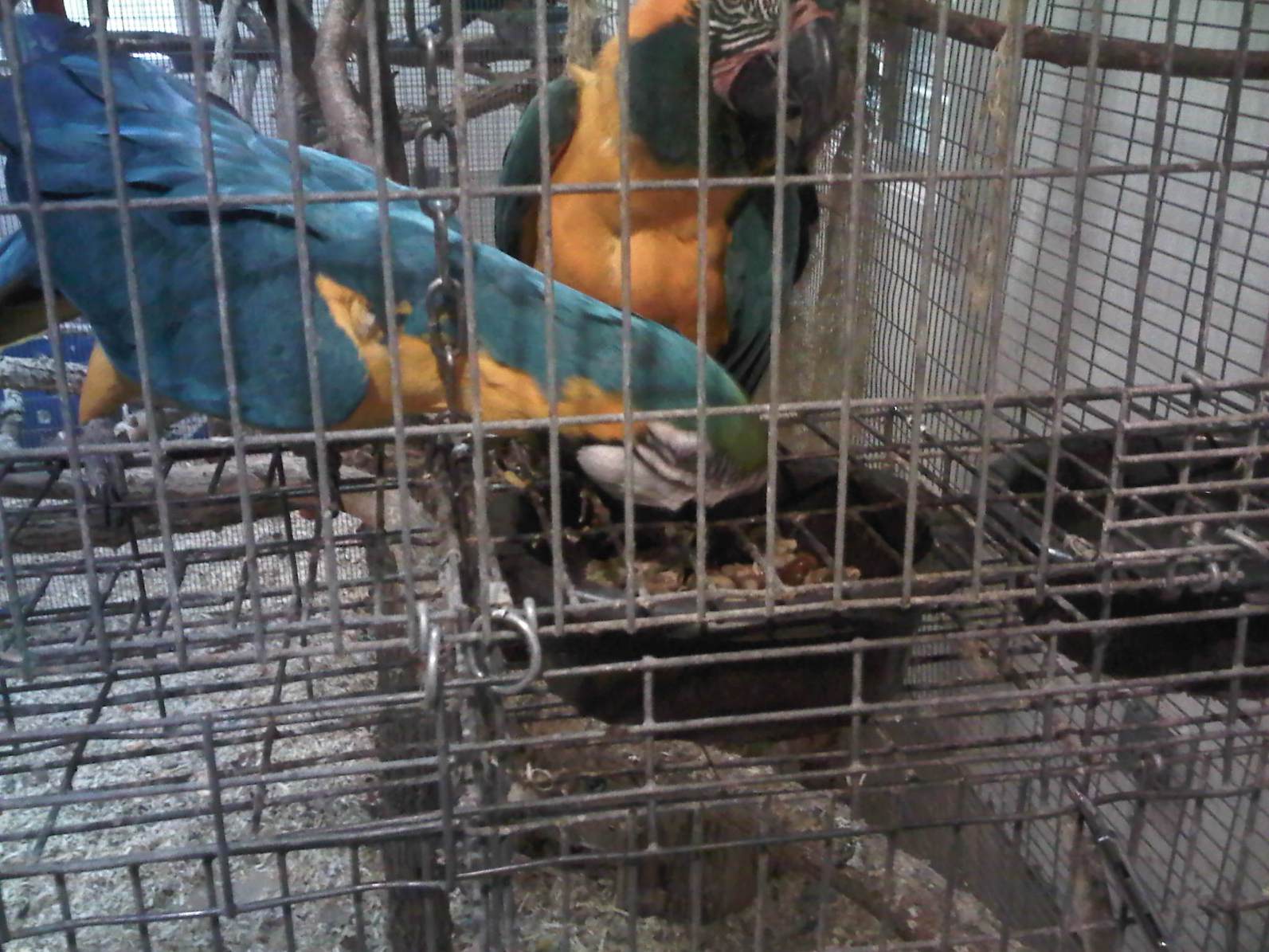
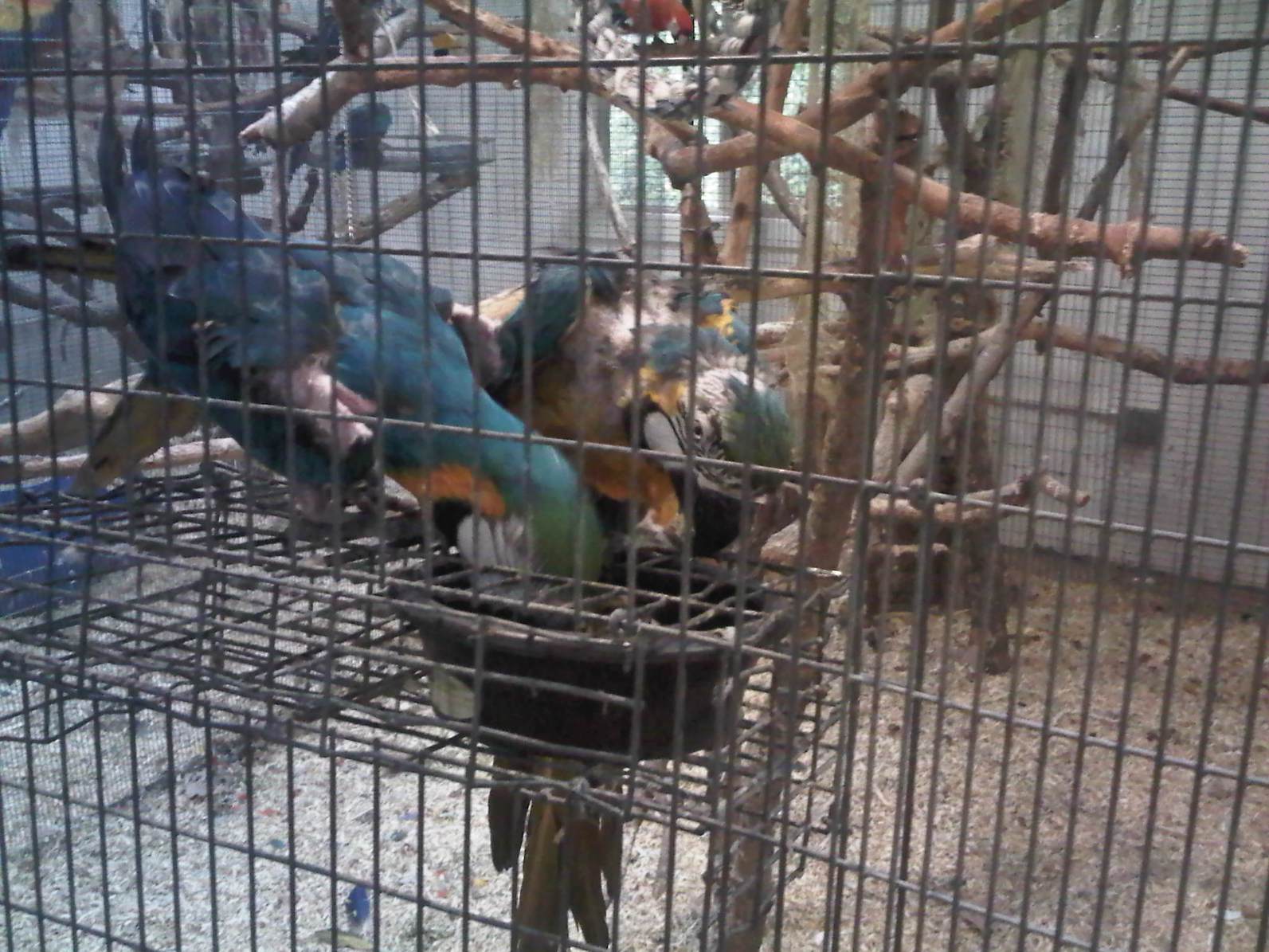
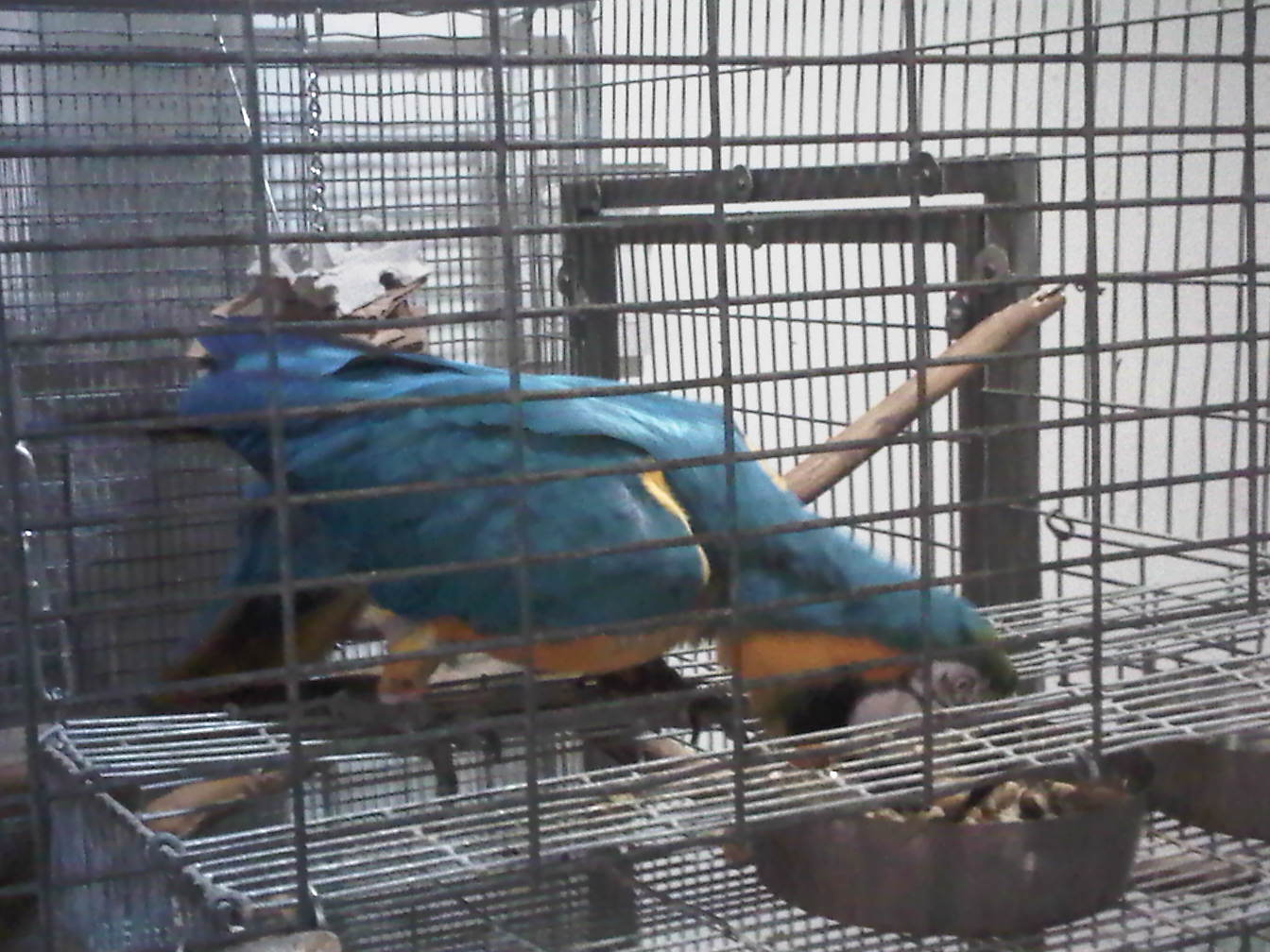
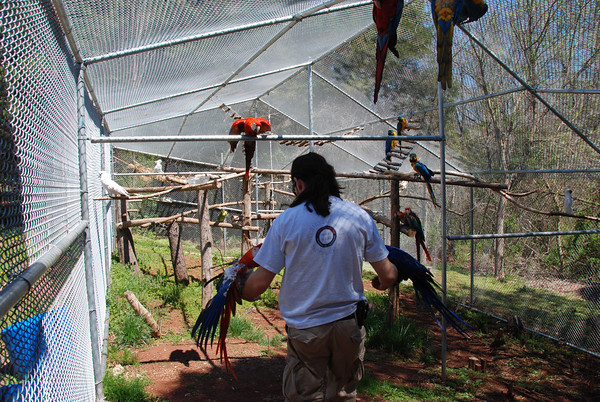
Jetsunma Ahkon Lhamo started the Garuda Aviary in 1999 after she adopted Tashi bird, a Moluccan Cockatoo who was driving her former owner crazy with her screaming. Jetsunma soon discovered there are countless parrots suffering from neglect and abuse due to owners ill prepared for their needs.

Jetsunma was so moved by the awareness of the suffering of these intelligent, long lived beings, that one bird quickly grew to 36, and the Garuda Aviary was founded to provide life long sanctuary to abused and neglected birds.

Now Garuda Aviary, a non-profit organization with one paid caretaker and a small staff of volunteers, cares for more than 50 birds, committed to caring for each of them for the duration of their lives.

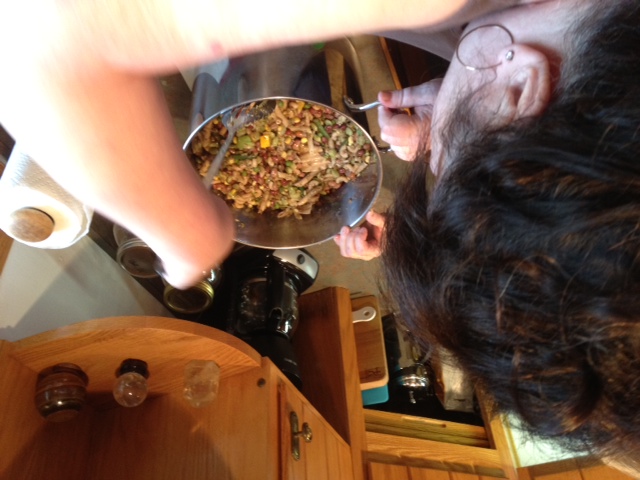
Jetsunma continues to support the birds by preparing large pots of fresh food, “Bird Stew”, for the birds on a regular basis. Parrots enjoy fresh, healthy and nutritious foods, and Rigdzin, the primary caretaker of the birds, reports they have come to love her stew.

Wishing that others may share in this joyful practice, Jetsunma has asked that this simple recipe be offered so others may feed their birds a nutritious, healthy treat.

This recipe produces a large amount of food, enough to feed 50 birds as a supplement to their diet for several days, so amounts may be adjusted for those with fewer birds. Jetsunma also suggested the stew can be portioned into ice cube trays or empty margarine containers and frozen. These smaller portions can then be warmed in a pan for those with smaller birds.


Supplies:

Large pot

2 bags of dried beans (pinto, red, black, navy, white, or a combo)

1 bag of lentils

1 package of frozen vegetables (mixed vegetables, butter beans, peas, carrots, corn, a variety)

Any left over vegetables from family dinners, but do not feed avocados or white potatoes.

2 lbs of pasta (elbow, spaghetti or penne)

seasoning: Mrs. Dash italian flavor, spicy flavor, hot peppers


Process:

Put two bags of beans in 6 quarts of water and bring to a boil for 20 minutes then turn off heat.

Allow beans and water to sit until completely cooled for an hour.

Bring pot back to a boil and add lentils, vegetables, pasta and seasoning and cook until pasta is Al Dente.

Immediately remove mixture from heat, drain, and run under cold water to stop the cooking process (birds prefer beans and pasta Al Dente rather than mushy.)

May every being be free of suffering!


 Copyright © Jetsunma Ahkon Norbu Lhamo All rights reserved

Heart Teaching from Palyul Ling in Upstate New York

The following is a teaching offered by Jetsunma Ahkon Lhamo at Palyul Ling in upstate New York on July 29th, 2012:


Video streaming by Ustream

You can download an mp3 file of the teaching here:

Kindness is The Way

 Copyright © Jetsunma Ahkon Norbu Lhamo All rights reserved

Kindness is The Way

The following is from a series of tweets by Jetsunma Ahkon Lhamo:

Last evening I taught my class at Palyul Ling. Lots came and lots tuned in from around the world. I enjoyed it and tears of love were everywhere! I hope you tuned in, and if not it is still up on line on U-stream, or you can watch it here – check it out!

Video streaming by Ustream


I’d like to teach again. Feedback was that it was good to hear teachings on the Boddhicitta, and from a Western Tulku. From a woman.

Anyhow, this is the place and time to be! It is gorgeous here, weather is good. I’m resting today.

OM TARE TU TARE TU TURE YE SOHA

OM MANI PEDME HUNG

What joy! I’m finding out students have formed a connection with Palyul Buddhism from my online activities. They practice together, have study groups from my blog and tweets. I knew it was through twitter and other social media that we could all be together and I am thrilled to be a doorway for this. I’ve met students I’ve never seen before! What joy to open wide the doors of Palyul and connect as family. And want to support their efforts by writing instructions and teachings from Palyul and myself as well. A good way to make Dharma free! Once His Holiness Penor Rinpoche told me I’d have Palyul centers all around the world. I thought that seemed impossible, but maybe not. Maybe this is the way.

As my pain heals I will not be as challanged, and will be able to travel. And you may contact us about how that may happen. How exciting! I am 100% Palyul and will open doors for this noble family as well as I can. Kindness is the way. Come to KPC and I am well I will come to you. Wherever you are, whoever you are, I honor you and reach out with love, compassion and respect for all.

Kindness is the way!

OM AH MI DEWA HRI

Blessings and Opportunities

The following is from a series of tweets by Jetsunma Ahkon Lhamo:

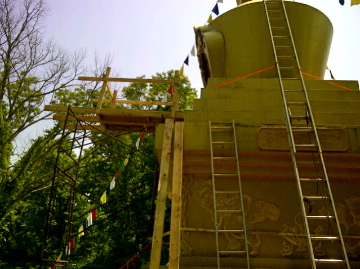
I made it to the Stupa today, difficult for me, and was happy to see repair continues. Joy to my heart! Weeding and gardening too. Gratitude.

It’s hard to express how important the Stupa is. So many blessings, opportunity to gather merit, a righteous life.

We need clearing too. All invited to come help, please, help is needed. We are aging fast here, and some are too old to do outdoor labor. But there are buyers needed to gather supplies, painters, mowers, etc. Who wants to change their life doing good works? It works when you work it.

I went to the aviary too. Such joy watching macaws and other wild beauties fly! Riggs gives them a good life. We always need help there too.

Now my back feels pretty sore.

I kinda hoped I’d see workers there to thank them. Maybe next time. Maybe I’ll bring pizza and fruit and nuts next time. I always bring offerings. And happily.

I love you all but especially those who help others. Don’t forget the Occupy folks and the homeless. The system is hurting us all.

Copyright © Jetsunma Ahkon Norbu Lhamo.  All rights reserved

Fire and Gentleness

An excerpt from a teaching called Dharma and the Western Mind by Jetsunma Ahkon Lhamo given on January 29, 1989

Adapting Dharma for Westerners is not difficult if you understand what our needs are.  The first thing that a Westerner has to do is to become stable in this path.  You have to remain stable and you have to remain stable for the right reasons.  I have seen old time practitioners that have seen the best Lamas and had the best opportunities and the most glorious teachings, but I am not impressed with the stability of their path and I feel that the reason for that is that they have not come to the point where they have really cultivated a gentleness of mind.  They haven’t really cultivated the necessary fire in the heart that keeps everything going.  They haven’t lit that dynamo that makes them remain passionate about loving.

Sometimes I am disappointed in when I see old time practitioners doing the Dharma talk and walking the Dharma walk and spouting this name and knowing that term but their hearts are unchanged.  There is a hardness there. The most tragic thing about that is that even though they are hot and heavy on the path now they may not remain firm on the path.  And time has born that out.   There are many Western Dharma practitioners who were really on and now they are really off.  I think that the reason why this happens is because they did not take the time to build a foundation based on compassion. We cannot consider that it is a baby teaching.  I talk about bodhicitta and compassion all the time.  If bodhicitta, which is the term for compassion, were ice cream you would come here and you would get a different flavor every week.  That is how I teach.  And I teach it as many different ways as I can. I try to be creative and sometimes I pull rabbits out of hats and sometimes I whisper it and sometimes I shout it and sometimes I give it to you to read, but it is always about Bodhicitta.  It is always about compassion, it is always about love in some form or another.

I really have had old time Dharma students say, “Hey I have had Bodhicitta already, and I am tired of Bodhicitta.” I am so sad when I hear that because if you can get tired of that subject then you don’t know it at all. You think that it is a baby subject yet it is the very union of the wisdom of realizing the emptiness of self-nature and the compassionate self that is truly the awakened mind.  There is no time when you are finished learning about compassion.  There is no time when you are finished learning about love.

Westerners who have been to college, to university and have papers are the worst problem we have in this country when it comes to practice, because we think that having got papers we don’t need to be learning about this simple stuff.  We say, “I need the real teachings.  Give me some Dzogchen.  Give me some heavy stuff.  I want the real stuff, because I am an American and I can deal with it.”  The problem is that as Westerners, no matter who we are, if the mind is not prepared, it is like the ground not being cultivated.  You drop the seed and it goes plunk on the top and if our minds are not gentled and deepened we go plink.  We may be able to memorize a wonderful Dzogchen teaching, we may be able to read the text but we are still plinking merrily away.  We have to have these foundational teachings and they have to be with us always.  There is never a time, no matter how advanced you are that you should forget that the greatest Dzogchen teaching, the most pure and pristine understanding of the Nature of Mind is an understanding of the nature of compassion. The most pristine, achingly beautiful understanding of the Primordial Wisdom State is the awakening to love.  There is no difference: the two of them are inseparable.  You can’t have one without the other.  And you may think to yourself, “What comes first the chicken or the egg? Can’t I learn to love after I am wise already?”  I don’t think so because really the mind has to be prepared for these precious deeper teachings.  It has to be gentled.

There is a confession that His Holiness Dudjom Rinpoche gave to us and the translation that I have says, “That my mind is as hard as horn.” And I think about that all the time because at any stage it is possible for the mind to become hard as horn, to become so impressed with its prowess in playing with Dharma terms, to become so impressed with how we can sit straight when we meditate, to become so impressed with how good we live and how sorry we are for every one else, to become so impressed that we are hard. It is important for us as Westerners and as part of the human family to cultivate gentleness so that we can truly accomplish Dharma.

©Jetsunma Ahkön Lhamo

Why Criticize Others?

The following is from a series of tweets by Jetsunma Ahkon Lhamo:

If one disagrees with another tweeter, why be ugly and bitter? Just stop reading their stream. Problem solved.

To obsess about people you don’t know and couldn’t care less about your stuff shows mental illness. Such bitterness shows jealousy and a dark heart.

Better to become a more advanced being. Warm- hearted. Generous.

© copyright Jetsunma Ahkon Lhamo All rights reserved


Freedom from Fear


The following is from a series of tweets by Jetsunma Ahkon Lhamo:

The need for power is born of fear.
The need for hateful speech is born of fear.
There is no good reason for hate.
The reason for arrogance is fear. There is no other reason and it makes fear worse.
Mean speech is ugly and unseemly and also born of fear. It is hurtful to the receiver and deadly to the sender.
Look at your twitter stream. If hateful and full of judgment and making fun at the expense of others, hard life lessons are at your door.
Desire for another’s goods or life is due to fear that you will never accomplish anything meaningful. Only obsession results.
It is possible to have a singularly beautiful life with simply wishing everything good for everyone else- sincerely.
Try to see the Buddha, or Christ in all beings. Then feed and care for them the best you can.
I teach you even if you think meanly about me. Why? Because I love you. I love you. I want you to be happy and well.

 © copyright Jetsunma Ahkon Lhamo all rights reserved

Returning

The following is from a series of tweets by Jetsunma Ahkon Lhamo:

Tomorrow will be a happy day, I will teach. And I’m looking forward to it. It’s been a while, and I feel stronger again. I hope to meet Some of the people I connect with online every day.

Must warn you, my hair is graying and I’m getting old. But face it. It happens to all. It isnt the package that matters at this age, it’s the message. Mine is kindness and love, Bodhicitta, Palyul.

In getting stronger I can Teach often. I am grateful for that. I am happy to say we are being remodeled, Temple and Stupas are looking great. I am proud of the work my Sangha is doing. Today we had about 50 volunteers and tons of visitors, including college classes. Busses. Wow. The feeling is full steam ahead, joyfully. A joyful heart is part of the way. And we are feeling it. I miss my students and can’t wait to touch hearts.

One Disappointment is I cannot climb into my throne as my lower back and hip still hurt constantly. Oh well. We’ll put a chair in front of the throne. But I have my Zen and Chuba and I’m ready to rock! Will you be there? Hugs from Palyul, Buddhism and KPC!

Copyright © Jetsunma Ahkon Norbu Lhamo.  All rights reserved

Emptiness

The following is an excerpt from a teaching by Jetsunma Ahkon Lhamo called “Nature of Mind” given in 1988, one month after her enthronement by His Holiness Penor Rinpoche:

Do you remember when you first started to seek the spiritual path?  The innocent sense of longing that you felt.  You must have felt in at one point of another, or you could not be here.  You could not, you must have longed to purify suffering.  You must have longed to be of benefit to someone, sometime.  You must have longed to attain the end of suffering.  And there must have been somewhere in there, the desire to do that in order to help others.  There has to be.  So that innocence, beautiful longing.  Remember how happy you were at that time.  There was a time when you were really happy, when you thought that.  Now, of course we’re too sophisticated.  We’re on the path and we’re already practitioners.  So we tend not to continue that thought in our minds, but we should.  We should constantly, with great longing.  And we should make prayers in that direction.  And that’s how you begin aspiration Bodhicitta.  You begin to make prayers of longing.  I long to benefit beings.  I pray with all my heart than I can take whatever form necessary in order to bring peace to the world.  In order to benefit beings.  In order to end the suffering of beings.  You should cultivate that, really and truly, you should do that until there are tears in your eyes.  And you will find that when you begin to develop that ability, those tears are not sad tears.  They are the happiest tears you’ll ever cry and they are heck of a lot more happy than going to the shopping mall and buying something new.  I mean, really, that sounds like a superficial comparison, and it is.  But, we spend much more time at the shopping mall than we do longing.  And we should long constantly to end suffering.

So you begin in that way.  And then you begin to think of the emptiness of self nature.  Begin to, even if you don’t know how to meditate, if you haven’t the technique, then you might begin, or contemplate at least, think of the emptiness of self nature.  And it goes hand in hand with that living the extraordinary life with that idea of compassion.  They are inseparable.  Because along with the emptiness of self nature, is the understanding that all suffering is born of delusion.  And the antidote to that is the annihilation of that delusion.  It’s the same as the meditation on emptiness.  For instance, let’s see what do I need, we used to have a crystal ball up here, do we not have it anymore?  How can I make a demonstration that I really want to.  Well maybe I can come over here if my little wire goes far enough.

Look here, if you see this crystal, it looks really really clear and you may not, this may not be a good example.  Oh here, can you see my hand coming through this crystal, can you see that?  Okay, then can you see the blue.  okay.  Okay look at this crystal.  This crystal is exactly like your mind.  It is exactly like the nature of your own mind in this way.  It is clear.  It is in its natural state, it is free of any form.  There is no form in there.  It is said that the nature of mind is clear, self-luminous.  That it exists in such a form that once any distinction is made, it is not understood.  It is free of any contrivance.  In the same way that this crystal is free.  You look in there, and you see only clarity.  A better example, of course is a crystal that is perfectly clear without any flaw.  Because that is the crystal that is exactly like your mind.  Perfectly clear, without any flaw.  You in the natural state are that.  You are pure suchness.  And the moment you began to appear as you do now, was the moment you began to make distinction.  But, in the natural state it is not so.  The mind is clear, self-luminous, free of contrivance.  Completely relaxed.  It is not gathered around itself, because it has no conceptualization of self.  It’s completely relaxed.  It is suchness.

Now you look at the crystal and you think that the crystal is like that also, and that the crystal might be understood as a symbol of that suchness in this way.  Now you put your hand behind it, and look, you see blue.  Has the crystal become blue.  Well, you have to look at it on two levels.  Your looking right now, this crystal looks blue.  So, in that sense, the crystal appears to have become blue.  But, if I take it away, does the Crystal change?  Is it blue now?  So what is blue?  Who perceives blue?  Look at that, you can see this hand.  See the flesh tone in there.  It’s very, when you look at it, do you see flesh tone?  Do you see it?  So the crystal has become like that, hasn’t it.  But, then you take it away, and the flesh tone is gone.  The crystal is the same.  It is the same, it is completely unaltered.  Who perceives the flesh tone?  What is the flesh tone?  This appearance of blue.  This appearance of this tone.  This appearance of phenomena in general.  This appearance of phenomena in general is merely conceptualization.  Who is it perceived by?  Think for instance about this.

Here is a very crude example, but then I told you I was born in Brooklyn, I’m not making any apologies, that’s it.  Okay, let’s take two objects, we have two objects here, we have chocolate, and we have shit, yes shit, you heard it right.  We have chocolate and we have shit, okay, there both brown, I mean, I’m sorry but we have to do this, there both brown right?  They both have a creamy consistency.  So sorry.  They both have a strong aroma.  What make one chocolate, and the other one shit?  Who determines the difference.  Who is the taster?  Who sees this?  Who sees that?  What is happening here?  All conceptualization, all phenomena arises from the belief in self nature and from the compulsion at that point to make self appear separate from other and to make a reactive relationship necessary.  All of your mind consists of the phenomena of hope and fear.  Of discrimination in a subtle and dense way.  But, the nature of mind itself remains steadfast, clear, uncontrived and when there is no concept of self it is just like that, pure, perfect, it is only suchness.  Only that.  And it cannot be altered, it remains unchanged.  And the weird thing about is the minute you that start talking about it, you’ve removed yourself from the potential to understand it.

How do you get free then of distinction between shit and chocolate.  How do you stop seeing the hand?  How do you stop seeing the blue?  How do you perceive that true nature?  Little by little you have to dis-engage the idea of self and you have to meditate on that.  And you can begin in this way, and I recommend that you do this.  Whether you are a dyed in the wool, or dyed in the cotton, I don’t know which fabric is, dyed in the cotton Buddhist, or whether you are person that has never even heard of any of this before.  You can begin to do in this way.  I don’t recommend that you taste both shit and chocolate, but you can try, let’s say, honey and lemon juice.  And you can look for yourself, who is the taster?  You say, I taste.  Where am “I”?  Well I’m right here.  Okay, where here?  Okay, let’s take you apart.  Let’s take you apart.  Let’s find out where “I” is.  We’ll look first in the feet, we’ll start low and work high.  Did you find “I” in there?  Take it apart.  Really, you have to make slides of everything.  You have to buy yourself a microscope and make slides and see if you can find “I”, okay?  Go all the way up, look everywhere that you can, examine every single molecule.  Go all the way up to the heart.  Everybody thinks hearts are big these days.  Let’s look in the heart, see if we can find “I”.  Then we’ll look in the throat.  What part do you identify with the most.  You have great legs?  We’ll look at your legs.  You have beautiful figure, we’ll look at every part of it.  Look at everything.  Let’s look in the brain.  Everybody thinks they come from their head right?  So we’ll look in the brain.  Where is “I”?  You can even look in your eye, eyeball.  See if you can find “I” there.  No matter how hard you look, if you make microscopic slides of every single part of it, you will not find “I” in this body.  You will not find it.  Well you say, there must exist an “I”, because how can I go from lifetime to lifetime?  And, I’m telling you that the idea of “I” is only that.  It is a conceptualization that has built around it so much karmic flagellants that the profundity of it has managed to exists for lo these many eons.  And at that point you can begin to understand that essentially, nothing has happened.  In truth, nothing has happened.  You can begin to mediate on the emptiness of all phenomena.

You want to look at cup, look at cup.  Find cup in there.  Take it apart.  Grind it up, find cup.  Cup is the idea of cup.  And you can continue with everything, your house, family.  You can’t practice Dharma because you have a family.  Ok, let’s take your house.  We’re going to take your house.  We’re going to examine your house.  Let’s take it apart, we’ll put it all under the microscope.  Find family.  Then we’ll examine the people that you are calling family.  Which one of them is family.  We’re going take them all apart, just the way we took you apart.  Where are we going to find family.  Family is a concept.  Who made it up?  You did.  Where are you?  I haven’t found me yet.

It’s crazy, but it’s a good way to start practicing.  It’s a good way to start practicing because your going to find that everything you live by, the things that make you suffer, the things that you bust your tail trying to do, everything that you do is based around an idea that you made up.  You did, you made it up.  And it has effected you for all this time.  So you can begin there.  It’s true that it would take sometime to achieve realization by meditating in that way.  But, it’s a really good place to start.  And meditating on the emptiness of self and on the emptiness of phenomena as well can give you the foundation and the strength to live the extraordinary life of compassion that I’m talking about.  And it’s that kind of extraordinary life of compassion and with the profound prayers that you will return in whatever form necessary in order to benefit beings and that even now you will able to benefit beings if you consider that that is the utmost important thing in your entire life and you yearn for that.

You actually have a little side benefit there that I’d like to tell you about.  And the side benefit is that you are purifying your mind of the garbage that we have gathered around it associated with self and desire in such a way that you will be able to actually move closer meditating on successfully and knowing that profound nature of mind.  That uncontrived natural state.  Just through the virtue of considering things in this way.  Considering yourself to be only important in as much as you can benefit beings.  And to begin to function in that way.  But, I tell you, the more that you get on an ego trip about this, or anything else.  I’ve done this, and I was ? in my last life, you know that kind of thing, the kind of thing.  The kind of thing that we do, and your ? is doing it.  The more that you do that kind of thing, the more you are creating the causes of suffering and the further and further away you get from perceiving the natural state.  Because the natural state, is as it is.  Remains unpolluted.  Untarnished.  Untainted.  And the only thing that makes us perceive something else, is that we have stuck the blue in the back of the crystal basically and that blue symbolically is conceptualization.  The way to liberate the mind from the belief in that phenomena of blueness as being inherently real is to meditate on the emptiness of phenomena.  The emptiness of self nature and to live a life that causes the purification of the mind.  And actually cleanses of discursive thought.  That is the ticket.  And no matter who your teacher is, if you really could talk heart to heart with any profound, profoundly realized teacher of any religion.  I believe and I’m willing to say this publicly, any teacher, any time if they are profoundly realized, no matter what religion they started, if they are profoundly realized, will tell you that the answer is the end of ego and all of it’s desire.  And the conceptual proliferation’s that come with it.  That the realization of the natural state is the answer, and that that state is uncontrived, unchanging, unborn and infinite.

So, that’s your Kellogg’s cereal boxtop nature of mind teaching for today.  Complete with Brooklynese language and I’m afraid that that happens to be on a regular basis.  I sort of slip back into Brooklyn, Jewish, Italian mode.  But, anyway, I hope that you enjoyed that.

Copyright © Jetsunma Ahkon Norbu Lhamo.  All rights reserved
WP2Social Auto Publish Powered By : XYZScripts.com