Getting Connected

An excerpt from a teaching called How to Pray by Being by Jetsunma Ahkon Lhamo

How do we pray?  How do we rely on the Buddha, the Dharma and the Sangha and the Lama who is the embodiment of all three?  First of all, we have to get connected. We have to get wired up. And the way we get wired up is to practice refuge.

We have to view the Three Precious Jewels as though we were hanging over a giant abyss with crocodiles at the bottom, and the only rope to safety is held by the Three Precious Jewels. The rope is Guru Rinpoche—it is the Lama—and we hold on and start climbing. In other words, we sincerely take refuge, deeply in the most profound way that we can.

Most of the time we take refuge in ordinary things. We take refuge in our television programs, in our computer, in our social life or whatever it is that we like to do. We go to them to be happy. That’s 180 degrees away from prayer. Instead, we should realize that here we are asleep, living in a dream state, and that we must rely completely on the awakened ones and their teachings in order to wake up. We can’t rely on the teachings of someone who is also sleeping. That would be the blind leading the blind.

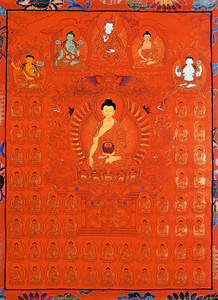
Lord Buddha was called the Perfect One because in every appearance and in everything that he did, he demonstrated that state of pure awakening and enlightenment. The Dharma, the method that we are using, has come from that awakened state.

© Jetsunma Ahkon Lhamo

How to Pray by Being

242305534_TmWni-S

A teaching by Jetsunma Ahkon Lhamo given in the wake of the Tsunami in 2004

In order to pray, first we have to understand that we are Uncontrived Primordial View – Suchness.  The Uncontrived Primordial View is every potential in its essential uncontrived form.  Our nature is that which is unborn, absolutely complete and perfect in every detail.  It isn’t made, it isn’t grown, and it can’t become stronger or weaker.  It is conditionless.  So we practice VIEW to allow the “boxes” of our mind to fall away so we can recognize that conditionless state and awaken to it, at last.  Our prayers have to be like this as well.

Because we haven’t really awakened to that conditionless state yet and we are unable to disentangle or to let the boxes down so that our view opens and we are in a state of recognition, then we should rely on the Three Precious Jewels of Refuge. Sincerely take Refuge deeply in the most profound way that you can. Rely completely and unwaveringly on the Three Precious Jewels and the Lama who embodies all three.

How do we do this? First we have to get connected – wired up.  The way we get wired up and connected is to practice Refuge.  Realize we are in this dream state and so we rely completely on the Awakened One.  Take Refuge Deeply.

In order to really pray we must let go of pride, our clinging to self.  The one that says, “Look at me, I’m praying.  Maybe if I recite this mantra, it will go over there to that person.” That’s not very awakened, is it?  Rather, this is dualistic.  The most important element in learning to pray is to let go of pride, the idea that I am a practitioner, I am praying, I am doing this, I must be good at it. Me, Me, I, I.

Our pridefulness and doubt are the two main obstacles to true prayer. Haughtiness and pride lead to anger.  Pride precedes anger because you think you are right.

With prideful thoughts, we are clinging to self-nature as being inherently real and we are always in a state of judgment.  If we are high, others are low.  Develop awareness that we are the same nature.  All of us are expressions of the infinite possibility of the Primordial Uncontrived Wisdom State…. Like white light going into a crystal and the colors are all broken up into different shades and beautiful reflections.

So instead of pridefulness when we get ready to pray, we should get down on our knees and pray and say:  “These are my brothers and sisters, some of them swept off the face of the earth by this giant wave, some of them are hungry, they’ve lost their families, many of them are in the bardo….”  So we think with that kind of compassion and consider the situation of other sentient beings rather than worrying so much about ourselves.  Simply consider their suffering.  Keep one’s ears open to their calls, to their suffering and to recognize that they are the same.  Not higher, not lower…. the same.  They are the same in their Nature.

Adopt the posture of a  “clear hearing” of the calls of sentient beings. “I hear you.  I am not separate from you”.  We have to hear the cries of sentient beings and then remember they are the same as us.   Have the posture of  “It is a privilege to honor that which you are”.

Untangle your pride.  Its like a constricting force on your heart.  It keeps you from opening up.  It keeps you separate.  It keeps you miserable and it affirms samsara every day. You are praying for suffering when you pray with pridefulness.  Lose the prideful stance and connect, wire-up to the Three Precious Jewels.  Pridefulness is the opposite of prayer.

“So, as we realize that others need our help and we begin to heed their call, we turn to what is real, what is profound.  From the Great Void…. from the absolute uncontrived undifferentiated spontaneously complete emptiness, is the brilliance of the Great Bodhicitta.  The Great Bodhicitta is the first movement, like the first word, the first movement.  It’s the arising of the Buddha Nature in a gossamer seemingly phenomenal form.  The Bodhicitta, the first movement of emptiness contains all potential…the Big YES.  Separate from nothing, containing all potential, containing all accomplishment…the Great Bodhicitta is the first movement of the Absolute, and that is also called Compassion.”

Compassion is your nature. You have deprived yourself of the deliciousness, the comfort and the happiness of true compassion, of the Bodhicitta for so long that the Bodhicitta seems to you like something you have to work on, like an outsider that you have to bring into your home.  How sad.  Because it is your nature.

How do we develop the unconstricted, uncontrived view?  First we practice Guru Yoga.  Guru Yoga is the nest in which prayers are developed.  In Guru Yoga we see the Lama as the embodiment of all the fields of refuge, all of the excellent extraordinary displays of Buddha nature that did not arise in samsara, that are pure and untainted.  Through your practice, you become absolutely non-dual with the Guru.  You mix your mind stream with the Guru like milk with water.

Train yourself to remember to receive the Three Light Empowerment of body, speech and mind 24 hours a day.  Receive the nectar, the blessing every minute of every day.  Receive this amazing phenomena of connection.  Develop the habit of constantly keeping that connection.  This is prayer without ceasing.  When we receive that empowerment, our mind is mixed with the Guru and the blessings are all-present.  Mix your mind with the Guru’s mind. Awaken to the non-duality. The Nature that is your Nature.

We have to be willing to change.  It takes getting down on our knees and challenging our habitual tendencies.  Dharma cuts like a knife.  It’s supposed to.  It’s doing a big job.  We have to do a lot of work because most of our life we spend chanting, “Om samsara Hung.” So we look to the teacher, we look to the Buddha, we look to the Dharma, and we look to the sangha with determination and strength.  It takes steadfast Vajra Courage.

Prayer is when you are in a state of awakening; when the Bodhicitta that is the nectar of the Guru’s mind is mixed with your own mind, and the nectar becomes inseparable.  That nectar is the Bodhicitta.  It is being fully aware that your nature is the Bodhicitta and it is the Bodhicitta that benefits sentient beings.  When you are aware that you are that, it is that that you send to others.  Being confident, not prideful, confident in that blessing; and therefore you can pray.  Now you have the Bodhicitta.  Now you ARE the Bodhicitta.  And that is the potency and power that you rely on.

It’s every minute.  It’s a path.  It’s a way of life.  And it is the true method to achieve the precious awakening.  When you know that other beings are suffering so terribly and we have found this “Jewel” and it is in our hands, and this nectar is given freely, then I ask you “Why not learn to pray?”

© Jetsunma Ahkön Lhamo
The Importance of Consciousness

An excerpt from a teaching called How to Pray by Being by Jetsunma Ahkon Lhamo

Quantum physicists are beginning to understand that the universe is multidimensional. They are beginning to understand that because their math is not working, there must be something else out there that they can’t figure out. The reason why their calculations don’t work is because they leave out one of the components of reality—consciousness. Time, space and consciousness are inseparable. So scientists are mistakenly looking out with their telescopes for the birth of the universe.

I’ve been asked, “How did this explosion of phenomena start?” I tell people, “Close your eyes. Let everything go. Dissolve into emptiness.” They do it. After a while I say, “Okay open your eyes.” Then I explain: “When you opened your eyes, that was the Big Bang. That was the moment. That was when movement started. That was it. It’s not out there.”

Phenomena appear in many different ways, in as many different ways as we can conceive, in as many different ways as we can move away from emptiness. The universe is an entanglement of intentions, dreams and potentials. Each one of us, every sentient being, experiences a separate and different phenomenon. Even though we are all in the same room, everyone here is experiencing a separate and different reality according to his or her individual karma.

The places that we can go in samsara are endless. They are infinite. As we conceive something, more phenomena are created. Lord Buddha taught about interdependent origination, that cause and effect arise simultaneously. They are linked. Even though we see the cause, we usually don’t see the result. That’s because we are still in a place where everything seems to be outside of us.

We pray like that, too.  We think, “I am praying to Guru Rinpoche, and he’s going to make everything better.” We think, “I’ll say some words or I’ll say some mantra and magically they will go there and sprinkle star dust on everybody.” We pray as though we are unconnected. We pray as though we are not in charge. We pray by rote like parrots. We repeat our prayers and hope for the best, as if prayer is a magic incantation. We don’t have any idea how there’s going to be any benefit.

In order to pray let’s understand that, first of all, we are all that is, suchness, the uncontrived primordial view. We are every potential in its essential uncontrived form. Our nature is that which is unborn and yet absolutely complete and perfect in every detail. It isn’t made. It isn’t grown. It can’t become stronger or weaker. It is conditionless. And so we practice view to allow the boxes in our mind to fall away so that we can recognize that conditionless state and awaken to it at last.  Our prayers have to be like that as well.

© Jetsunma Ahkon Lhamo

There Is No Self

An excerpt from a teaching called How to Pray By Being by Jetsunma Ahkon Lhamo

The Buddha taught that there is no self, that all that exists is primordial wisdom nature, with every potential, including the idea of self and the idea of phenomena rising out of emptiness. This potential is here. Although one of the ways that the primordial wisdom nature displays itself is in phenomena, we cling to phenomena as being inherently real. In fact, we cut our teeth on phenomena.

We have experienced phenomena since time out of mind, and so we are accustomed to the experience. It’s the only thing that makes us feel safe. Oddly enough, we spend all of our time contemplating the solidity of self nature, and we believe that self nature is inherently real. We identify with this body, thinking it’s us. We think that if we hold onto to self nature, we’ll be safe because we’ll be us. We think, “I’ll be staying here, you’ll be staying there, and we’ll continue in phenomena.”  But in fact, there is no difference between phenomena and emptiness. They are the same nature. They are the same essence. They are the same taste.

So while our habitual tendencies cause us to remain in this delusion of separation, still this nature exists—wholesome, absolutely complete and perfect, with no need for aggrandizement, with no need for construction. It is as it is. This is the nature that is our nature, and it is as much our experience, even now, as phenomena are, but it frightens us. So we cling to phenomena. Sadly enough, we become self-absorbed in that process. We think, “Oh this is me.  I’ve got to take care of myself. I’ve got to do what is right by me. I’ve got to have fun. I’ve got to have excitement. I’ve got to have pleasure.”  And that’s our experience—even though emptiness is at hand and we experience emptiness in our nature now. The Buddha nature that is our nature is complete. It doesn’t need any tinkering. Still, we cling to the idea of self. And of course, that’s the trouble that we’re in now.

© Jetsunma Ahkon Lhamo

Relying on the Three Precious Jewels

An excerpt from a teaching called How to Pray by Being by Jetsunma Ahkon Lhamo

Truth be told, we haven’t really awakened to the conditionless state yet.  Maybe we’ve had a few experiences in our meditation, a little taste of emptiness if we really go deeply into our practice, but it’s only for a second.

For most of us, we are unable to let the boxes down so that our view opens and we are in a state of recognition. Because of that, we are taught that we should rely upon the Three Precious Jewels—the Buddha, the Dharma and the Sangha, and mostly especially the Lama, as the embodiment of all three.

In other words, when we see the lama, we are seeing the Nirmanakaya or body form of the Buddha—a projection of the Buddha nature in phenomena. The Nirmanakaya has appearance and characteristics, but these are gossamer thin. These are insubstantial, like dew on a hot morning. And so we rely on our teacher as the representation of the primordial wisdom nature.

We rely on the Buddha because the Buddha is the doctor who gives us teachings—tells us what is wrong with us and how to fix it.

We rely on the Dharma, which is the medicine—the tried-and-true method that practitioners have used for thousands of years to escape the suffering of samsara.

We rely on the Sangha who care for us, like a nursemaid, until we are awake. It’s as if we are in a coma, and there’s nobody to take care of us but these nurses. The nurses bring us the medicine. They support us. And so we love and respect the sangha.

© Jetsunma Ahkon Lhamo

Letting Go of Pride

An excerpt from a teaching called How to Pray by Being by Jetsunma Ahkon Lhamo

In order to really pray we have to let go of our pride, of our clinging to self. We have to let go of our self-importance, of that part that says, “Look at me, I’m praying” or the one that says, “Maybe if I recite mantra, it will go over there to that person.”  That’s not awakened; that’s dualistic.  So pride is the main obstacle to our true prayer—pride and its twin, doubt.

There is a Christian teaching that explains why. Although I am not a Christian minister, I do very much value the teachings of Jesus and know that he was a great and realized bodhisattva.

Jesus once gave a teaching in which he said, “It is easier for a camel to go through the eye of a needle than for a rich man to enter the kingdom of heaven.”  What did he mean?  In ancient Jerusalem there was one gate that went into the city (it was known as “the eye of a needle”), and that gate was very low and very small. In order for a camel to get through it, it had to get down on its knees and crawl. But a rich person is often too proud to kneel.  So that teaching explains that pride is the obstacle. Pride is the enemy.

When we have prideful thoughts, we are clinging to self-nature as being inherently real, and we are always in a state of judgment. If we are high, others are low. So the most important element in learning to pray is to let go of pride—the idea that I am a practitioner, that I am praying, that I am doing some good. Instead of that pride, we need to develop an awareness that everyone is the same in their nature. All of us are expressions of the infinite possibility of the primordial uncontrived wisdom state—like white light going into a crystal and breaking into different colors, into beautiful reflections. Do we cling to the colors and no longer look at the light? Do we only look at the display and not look at the foundation? No. What would be the benefit of that?

So when we get ready to pray, we should do like the camel did in Jerusalem: we should get down on our knees. Our inner posture should be a heartfelt awareness of our interconnectedness. We should pray, “Here are my brothers and sisters, some of them swept off the face of the earth (by a giant wave, an earthquake, a plane crash, an act of war or some other tragedy…). Some of them are hungry. Many of them have died. Many have lost their families and loved ones.” We think with that kind of compassion and consider the situation of other sentient beings rather than just worrying so much about ourselves.

We simply consider their suffering. We keep our ears open to their calls, and we recognize that we are the same as they—not higher, not lower, but the same in our nature. We all have the seed of awakening. There is no difference. The haughtiness that we have, the games that we play, all have to go.

Instead, we adopt a posture of clear hearing. We have to hear the cries of sentient beings and then remember that they are the same as us. We have to think, “I hear you.  I am not separate from you.”  And we remember the Three Precious Jewels. It could easily be that in our next life, we are in their position and they are in ours.

By untangling our pride, we realize that it is our privilege to benefit them. Pride is like a constricting force around our heart.  It keeps us from opening up. It keeps us separate. It keeps us miserable, and it affirms samsara every day. When we are prideful, we are praying for suffering. We are praying to continue in the land of lost ones.

So we are taught to drop that prideful stance and to connect and wire up to the Three Precious Jewels. We take refuge because we realize that in samsara there is only samsara no matter what it looks like or how dynamic it appears. Samsara will dance and seduce. Samsara will say, “Drink me.” Samsara will say, “Eat me.”  Samsara will say, “Come and play. Be free.”  Samsara is a seductress who will make us suffer even more than we thought possible.

© Jetsunma Ahkon Lhamo

The Force of Compassion

An excerpt from the teaching When the Teacher Calls by Jetsunma Ahkon Lhamo

What is it that the teacher experiences as the teacher begins to call the student?  In the Vajrayana tradition we are taught to consider a tulku as an emanation of Lord Buddha or Guru Rinpoche’s enlightened compassion. Guru Rinpoche himself said, “I will appear in the world as your root teacher.” The root teacher is defined as the one with whom you have such a relationship that upon meeting this teacher, upon hearing this teacher, you have understood something of your own mind. You have come, in some small way, to see your own face. When you meet your root teacher it is truly the display of Guru Rinpoche’s touch. It is how Guru Rinpoche has appeared in your life. You cannot doubt that. It is the beginning, it is the movement, it is the method of enlightened awareness.

Generally, if the teacher is a bodhisattva or an incarnation who has achieved some realization and therefore has returned solely to benefit beings, there is some design in his or her method. The tulku will have a sense of purpose from a very young age, and all of the circumstances that arise in the tulku’s life will arise from the intention to be of benefit.  As the tulku moves toward his or her time, there is a sense of calling the students. It isn’t really like the teacher will know the name of a certain student and necessarily be about finding that student. What begins to happen is that there is a quality of intention, of loving kindness, of compassion that begins to ripen in the teacher’s mind, and it sets up a vibrational field, almost like a sound or song that will reach out and touch particular students, and their minds will respond to it. Students literally will appear from nowhere. The sound that goes out is like a hook. Just as a piece of Velcro doesn’t attach itself to a smooth surface, if the student doesn’t have the responding “piece” in them it won’t connect. But if the student has that other piece they’ll be tight. You can’t separate them. To separate them literally sounds like Velcro: it sounds like your heart is being torn out. There’s something there that is so fantastic that it cannot be explained in ordinary terms.

From the lama’s point of view there is simply the display of that compassionate intention. That’s all that happens. The student might be a course and crude construction worker, a ballerina, the student could be a disco dancer or drummer, but suddenly something begins to happen and they will say, “What am I doing here? How did I get into this? What is this?” Truly there is no “monkey business” on the part of the teacher. There is simply this call, this sound that is going out, and the student, if the hook is there, suddenly becomes velcroed.

Sometimes one is angry at first because you didn’t want to be velcroed. You didn’t ask for this. You wanted to be free and independent. But suddenly you can’t get away. You’re hooked. The hook doesn’t happen because the teacher is manipulative; the hook happens because you have seen your face and the karma in your mind is such that you have responded in a way that you could never have predicted.

The student might be very conventional, never religious before in their life. The student might be very unconventional and never thought they would deal with a conventional religion like Buddhism. They might be really ticked off about it. They just didn’t want any of these things to happen, and suddenly they’re hooked! They can’t move. What are they going to do? And they grieve. They start to grieve like someone died. Yes, something died: the part of their life when they were not hooked just died.

The teacher continues in what seems to the student a relentless way to send out this call. You can’t resist something that is like your mind. The teacher is karmically set up, due to his or her compassionate intention, really without any choice, to sound like them vibrationally, sometimes like them situationally. Sometimes a student may simply hear the words, and it’s so much like the way they are. So funny.  So strange. All you’re really experiencing is compassion. That’s all that is to be understood.

You should never think that you’re understanding the teacher by determining how much the teacher is like you. All you’re understanding is yourself. The teacher is only acting from the point of view of compassion. If the teacher is considered to be a bodhisattva or a tulku, then what you’re seeing, really, is the display of compassion, and what you’re seeing is your own face.

You must understand that all that is really happening is that there is a sound being sounded that on some level you are capable of hearing due to the karma of your mind. What is happening is happening because of you, not because of anyone else. This is your mind, this is your karma, this is your face that you are seeing. Your response is your own response.

When the student first responds, generally there are obstacles that come up. Sometimes – and this is odd – when the student first finds the path they’ll get physically sick. They’ll suddenly come down with everything you can possibly imagine. But hopefully, if they can really work on devotion and purify their connection to the teacher, whatever obstacle arises will ripen benignly. When the student starts off in a different way, sometimes with anger, they must understand that suddenly this piece of anger didn’t come from somewhere else. Who’s running this show anyway? If the student feels anger it must have been in the student’s mind. What happens is that obstacle ripens, and it comes to the surface like a bubble rising to the surface of a pond. You have the opportunity to live and breathe and hold onto the stink of anger, or you have the opportunity through your practice, through practicing the antidote which is compassion, to let the bubble do what bubbles do: come to the surface of the lake and simply pop. What is the bubble once it has popped? Gone. The first breath of kindness and devotion can surely blow it away.

The student always has this opportunity, but instead the student generally responds by saying, “I’m right here. I have reasons to be angry.” Try to realize that what is coming to the surface is an obstacle to your practice and that it has no more power than you give it.  Realize that you are capable of simply letting go, of surrendering, of practicing devotion, of using method in order to overcome the obstacle.

Remember, all the teacher is really doing is sounding that note that is so like the student’s mind that it begins to bring forth this response that is in the student’s mind. What the student sees is their own face: layer upon layer of their own face. Ultimately, if they practice devotion, they will see their true face, which is their nature. Now they’re only seeing the dust that is covering it.

The sound is some kind of thing that you can’t even hear with your own ears, but it is so powerful it can change the life of a student instantly. It is so powerful that it can change a community, it can change the world, but it’s so subtle that you probably couldn’t even hear it with your own ears. What is it? It is the greatest and the most gossamer force that there is, and that is the force of compassion, the Bodhicitta.

© Jetsunma Ahkon Lhamo

No Better Time Than This

An excerpt from a teaching called Vajrayana’s Final Hour by Jetsunma Ahkon Lhamo

One of the bits of information that has come out during the course of time is that cyclic existence is just that — it moves in cycles. There is a cycle during which the Buddha first appears, which is very expansive. During such a time, life is in some ways much simpler and much easier, particularly for attaining enlightenment. The fabric of our mindstreams is much more expansive due to the virtue of the Buddha’s appearance.

Then there is an intermediate time in which the Buddha has left, the Teachings are very strong, and are carried on by those who can remember the teachings, who have memorized them and can repeat them verbatim. The Teachings are taught in an unbroken lineage by those who have practiced the Teachings and achieved some result, but there is no true memory of anyone who actually has seen the historical Buddha, or even seen the Buddha’s disciples.

Now we find ourselves in a time that is considered to be a degenerate time. The fabric of cause and effect relationships, which includes the very fabric of our own mindstreams, is extremely contracted. Now it is much more difficult to achieve realization. One must work very hard at it. One has to take teachings, accumulate many repetitions of mantra and prayer, and accomplish puja. One must practice devotion to the highest degree, and accomplish Bodhicitta, the Great Compassion. One must renounce ordinary existence, whether as a monk or nun, or in a more internal way from the heart, being stable and unmovable in the mind.

Even though it is hard now, in another way enlightenment can be accomplished more surely and certainly than before, because in this time of degeneration when the content of our mindstream is extremely condensed and contracted, karma actually ripens very quickly. You may have noticed that. If you are kind and loving and if you practice the Bodhicitta toward other sentient beings, it will make you happy. And conversely, if you are unkind, selfish, angry, that too will come right back at you. Hasn’t this happened to you? You can be very unkind to someone, and in the same day you can see it come right back in your face. Your nose gets rubbed in it.

The good news in this is that the benefit of the practice comes back much more quickly as well. If one practices really intently and with fervent devotion (devotion is the key here), one can eat the fruit of one’s practice. If not during the course of one’s life, then at the time of one’s death, when the Buddha Nature reveals itself to us as the elements dissolve, one will perceive that Buddha Nature as the display of the deity and recognize that Nature accordingly. Having recognized that Nature, one will awaken.

© copyright Jetsunma Ahkon Lhamo all rights reserved

Climbing the Mountain

The following is an excerpt from a teaching by Jetsunma Ahkon Lhamo called “Marrying a Spiritual Life with Western Culture”

As many of you know, I like to climb the same mountain that you like to climb—the mountain of wisdom or understanding—so that we can get to the top and really have the full vista of understanding.  I find it’s best to climb the mountain, not in a linear way, but in a way that opens up to us true meaning on a conceptual level. It’s a good thing to climb that mountain from every possible angle you can think of because on each side there will be a different experience of going up the mountain. One can truly understand the mountain by moving in those various ways as opposed to having only one narrow means of approach.

In order to broaden and to deepen, then, one has to have the intention to really know and understand more deeply, so that Dharma will be real and focused and meaningful and will carry weight in one’s life. That’s what I’d like to talk about today. In order to do so, I’d like to talk about where we’re coming from and how our culture is different from a culture in which the Buddha naturally appeared and naturally emanated and naturally gave rise to certain teachings. The Buddha did not appear in Missouri—not in the way we understand.  Although in truth the Buddha is everywhere in Missouri, the historical Buddha did not appear in Missouri or Indiana or Brooklyn, not in the same way.  The original teachings, the path of Dharma that we practice, were brought to us by Lord Buddha himself.

The Dharma began in India in a culture that is very different from ours. It’s where Lord Buddha appeared. Even if it is not the most potent religion in India now, it still has had some effect on shaping and forming that culture. Here in America there are religious factors that have shaped our culture, but they are different.

So I would like to examine some of the ways in which the cultures are different, just briefly enough to have a certain idea that we can examine for ourselves. The best thing to do is to look at these cultures today, with just an idea of where they came from and how they progressed. Culture in America today is materialistically oriented. We are a culture of attainers. We accumulate things. We are given a definition of success that is handed down from generation to generation and, oddly enough, it has more to do with substance than it has to do with spirit, more to do with material gain or loss than it ever has to do with joy. Joy—what a concept!

When we are coming up, we are prepared and schooled to accomplish things that have to do with getting stuff—even if we study to become something that seems to be non-materialistically oriented, such as, for instance, a social worker. You would think that a social worker would be looking at our culture with different eyes.  You would think that a social worker would be asking, “Well, what are these social factors?  How can we organize them into something that is meaningful and deep for us? How can we express within our culture the gamut of human expressions? How can we integrate it? How can we make it work for us? How can we discard those things that do not work for society?” Yes, that is some of the training of a social worker. But why does somebody become a social worker?  And how do we approach that kind of thing? Well, we always think about how the job market is doing: “When I get out of school after I learn all of this, will I really be able to get a job?” We think of ourselves as having an office, and we think of ourselves as having that little square on the office door that says you are somebody. Then we think about whether that would be a really profitable occupation. So even if we were to approach something that could, by its nature, be fundamentally non-materialistic, we approach it from a materialistic point of view.

That’s one thing that is interesting and unique about our culture. It is so all-pervasive that it’s invisible, and you don’t really notice it until you go to other places. If you really want to learn something about your culture, leave it and come back. If mainstream America does not have that kind of experience, they cannot really see very well what the factors are. It’s more difficult. So to leave one’s culture and have another taste or another experience gives one a sense of comparison.

We approach everything in a collecting or accumulating way, in a materialistic way. We measure success by material substance.  Nobody’s parents tried to raise a great mystic because you wouldn’t do that to your kid in our society. You see what I’m saying?  You want to prevent your kid from the dark night of the soul.  You want to prevent your kid from the ambiguous, vague, cloudy, uncharted waters of mysticism.  You want your kid to be on the straight and narrow.  They know where to get a loaf of bread.  They know how to put some butter on it.  They know how to eat it.  They know how to feed it to their kids.  They know how to buy a car—that kind of thing.  You want your kid to be prepared for that.  You do not raise a mystic.  A mystic is something you have to contend with in our society.  It is an avocation that is fraught with suffering.

Now why is that?  Well, partially because a mystic goes into a very deep sense of connection.  In order to do that, the mystic has to plow through issues or plow through whatever it is that one plows through.  The other reason why being a mystic is so darn painful is because no one has any respect for that kind of thing.  A mystic in our society probably is a dreamer or a ne’er-do-well who can’t dress, who has no sense of self whatsoever, is socially inappropriate, can’t figure out how to catch a cab. Or maybe a mystic is someone who is depressed, possibly should be on Prozac. These are the kind of things that we associate with a mystic’s life and that is why nobody has ever been encouraged to be like that. The idea of really profound, deep mysticism scares the patooties out of us.

But in another culture where that kind of ideal is held up as being something pure, something wonderful, something significant, one’s experience regarding mysticism is entirely different. There is a dignity and nobility about it. There is a sense that this is a worthwhile occupation. There is definitely less fear of having the freedom to utilize one’s life as a vehicle for true deep mysticism and spirituality. One of the reasons why it’s more comfortable and easier to get connected to it is because one isn’t socially ostracized.

Now the great thing about being a mystic in America is that, once you get to the point where you’re really good at it and somebody finds you and you can market it—maybe write a book or two, maybe sell something that you’ve given rise to—then you can be a success.  Mystics in our society can also be successful after they’re dead. I really don’t know why. If any of you know why, tell me. But while we’re alive, we don’t have too much hope.

Copyright © Jetsunma Ahkon Lhamo.  All rights reserved


Does Desire End?

ailmentPhotoNervousBreak

The following is an excerpt from a teaching by Jetsunma Ahkon Lhamo called “Desire Blocks Happiness”

What is the end of it? Where does it end? It ends when you take yourself in hand and begin to practice stabilizing the mind. The Buddha teaches us that the cause of all suffering, every part of it, no matter what it is, if you trace it down to its root, is desire. How can you kick desire? Everybody’s got desire. You have the desire for life itself, don’t you? I mean, you don’t want to die or anything. You have the desire to be happy. All sentient beings have the desire to be happy. That’s one thing we all share. Do you realize that? We share with every life form that there is. All sentient beings have their common familyhood, brother- and sisterhood. They all wish to be happy. They’re all doing it in different ways, but we all wish to be happy. We have that desire, and we are inflamed with it.

How can we reduce that inflammation? It’s like we have to step off the conveyor belt. You know what I’m saying? We have to step off the merry-go-round that just makes us want and fulfill and want and keep trying to fulfill, and keep doing that round and round and round and round endlessly. It’s like you just have to stop for a minute. Step off of it and look at what you’re doing. Look at the habit pattern. Look at the pattern. Just look at it.  This is sometimes more difficult for younger people to do, because they just honestly haven’t lived long enough to see their patterns. For people who have reached maturity, it’s much easier to see the quality of the relationships and friendships that you’ve had. It’s much easier to see the level of fulfillment that you’ve had from material goods. It’s much easier to understand that you have been going through the same thing since you can remember. For younger people, it’s more difficult. But for older people, it’s very obvious. And the people that it’s easiest for are the people who are coming to the end of their life who have reached an advanced age, or an elderly age. And at that point, they’re carrying, perhaps hidden inside of them, a disappointment. There are things that we become very disappointed about. Things that have just not come together that we always assumed would. We always thought that they would.

When we come to that fantastic point, where the old gig, the old game doesn’t work for us anymore, we become disillusioned. It’s a heart-breaking time in one way, isn’t it? It’s really heart-breaking. It’s hard to bear, hard to face. But you know something? It’s the best time for you, the best time that you have ever experienced. Until you have come to that moment, you really haven’t been born yet. You’re like an egg, you know, just revolving around in your little shell, kind of a big yolk. Ha, ha. Hey, that was pretty good. You have to admit. A little levity there to cheer you up in the middle of your suffering. But anyway, revolving around inside your shell, and not getting anywhere. The moment that you become dissatisfied and panicky because your gig isn’t working any more, terrified because it may never work, uptight because you don’t know what to do next, grieving because nothing’s ever worked… At that moment, when you feel like you’re about to have a nervous breakdown, you’re on your way, kid. It’s probably the best and most mature moment of your life because you have to come to that moment to get anywhere. You can’t do this while you’re on the merry-go-round. You can’t do this unless you fall apart a little bit. You can’t get the big picture. You have to see the faults of cyclic existence. You have to look at it square on.

You must see. You must look cause and effect relationship in the eye. And you’ve got to really face one very sad fact about cyclic existence: No matter what we accumulate during the course of our lives, we can’t take even so much as a sesame seed with us. None of it. We can’t take relationships with us. We can’t take objects with us. We can’t take even ideas with us, those things that we spend so much time building up. We certainly can’t take emotions with us. And how much time do we spend watching our emotions and reacting to them? We can’t take any of that with us. We take one thing with us: the condition of our mindstreams, our own habitual tendencies. And if we have the habit of grasping, trying to satisfy ourselves, to the exclusion of virtuous living, and then being disappointed, that is the habit, that is the content of our mindstreams that we will take with us into the intermediate state, and into our next rebirth. The habits of our mindstream—that is what we take with us.

Copyright © Jetsunma Ahkon Lhamo.  All rights reserved

WP2Social Auto Publish Powered By : XYZScripts.com