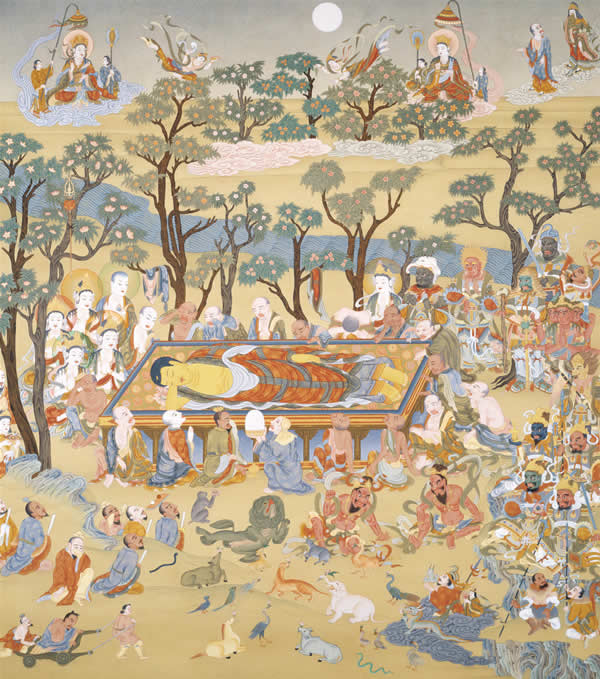
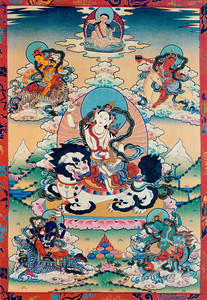
The following is an excerpt from a teaching by Jetsunma Ahkon Lhamo called “Desire Blocks Happiness”
What is the end of it? Where does it end? It ends when you take yourself in hand and begin to practice stabilizing the mind. The Buddha teaches us that the cause of all suffering, every part of it, no matter what it is, if you trace it down to its root, is desire. How can you kick desire? Everybody’s got desire. You have the desire for life itself, don’t you? I mean, you don’t want to die or anything. You have the desire to be happy. All sentient beings have the desire to be happy. That’s one thing we all share. Do you realize that? We share with every life form that there is. All sentient beings have their common familyhood, brother- and sisterhood. They all wish to be happy. They’re all doing it in different ways, but we all wish to be happy. We have that desire, and we are inflamed with it.
How can we reduce that inflammation? It’s like we have to step off the conveyor belt. You know what I’m saying? We have to step off the merry-go-round that just makes us want and fulfill and want and keep trying to fulfill, and keep doing that round and round and round and round endlessly. It’s like you just have to stop for a minute. Step off of it and look at what you’re doing. Look at the habit pattern. Look at the pattern. Just look at it. This is sometimes more difficult for younger people to do, because they just honestly haven’t lived long enough to see their patterns. For people who have reached maturity, it’s much easier to see the quality of the relationships and friendships that you’ve had. It’s much easier to see the level of fulfillment that you’ve had from material goods. It’s much easier to understand that you have been going through the same thing since you can remember. For younger people, it’s more difficult. But for older people, it’s very obvious. And the people that it’s easiest for are the people who are coming to the end of their life who have reached an advanced age, or an elderly age. And at that point, they’re carrying, perhaps hidden inside of them, a disappointment. There are things that we become very disappointed about. Things that have just not come together that we always assumed would. We always thought that they would.
When we come to that fantastic point, where the old gig, the old game doesn’t work for us anymore, we become disillusioned. It’s a heart-breaking time in one way, isn’t it? It’s really heart-breaking. It’s hard to bear, hard to face. But you know something? It’s the best time for you, the best time that you have ever experienced. Until you have come to that moment, you really haven’t been born yet. You’re like an egg, you know, just revolving around in your little shell, kind of a big yolk. Ha, ha. Hey, that was pretty good. You have to admit. A little levity there to cheer you up in the middle of your suffering. But anyway, revolving around inside your shell, and not getting anywhere. The moment that you become dissatisfied and panicky because your gig isn’t working any more, terrified because it may never work, uptight because you don’t know what to do next, grieving because nothing’s ever worked… At that moment, when you feel like you’re about to have a nervous breakdown, you’re on your way, kid. It’s probably the best and most mature moment of your life because you have to come to that moment to get anywhere. You can’t do this while you’re on the merry-go-round. You can’t do this unless you fall apart a little bit. You can’t get the big picture. You have to see the faults of cyclic existence. You have to look at it square on.
You must see. You must look cause and effect relationship in the eye. And you’ve got to really face one very sad fact about cyclic existence: No matter what we accumulate during the course of our lives, we can’t take even so much as a sesame seed with us. None of it. We can’t take relationships with us. We can’t take objects with us. We can’t take even ideas with us, those things that we spend so much time building up. We certainly can’t take emotions with us. And how much time do we spend watching our emotions and reacting to them? We can’t take any of that with us. We take one thing with us: the condition of our mindstreams, our own habitual tendencies. And if we have the habit of grasping, trying to satisfy ourselves, to the exclusion of virtuous living, and then being disappointed, that is the habit, that is the content of our mindstreams that we will take with us into the intermediate state, and into our next rebirth. The habits of our mindstream—that is what we take with us.
The following is an excerpt from a teaching by Jetsunma Ahkon Lhamo called “Desire Blocks Happiness”
Our minds are so unstable. They are so inflamed, so on fire. With what? With excitement? With the idea that something is going to happen for us? What are we inflamed with? According to the Buddhist teachings, we are actually inflamed with desire. Desire. I want! I want! And I’m going to have it! I’m going to get it! I’m finally going to get it! The excitement that you feel when you’ve got that dress, and those shoes!, And those stockings! And those $150 earrings, all of it together. That same excitement is the inflammation that you feel when you’ve got the dress, but you haven’t got the shoes yet; and you want them so bad, you can taste them. It’s the same thing. It’s an inflammation. It’s like a fever. And no one can ever be happy no matter what while they’ve got that fever in their minds because it isn’t the satisfaction of that fever that composes happiness. That isn’t what makes happiness.
In fact, in cyclic existence, there ain’t no such thing. You can’t satisfy that fever. That fever is the symptom. It is the problem. Satisfying that fever would be like treating a physical fever by heating up the room to be the same temperature. Think about it. It doesn’t work. Temporarily you may feel strangely like there’s not much difference between the heat in your body and the heat in the room. I don’t really know how it would affect you physically. But I do know this: It won’t cure the fever. The fever ends when the fever ends, when it subsides. And here’s where the analogy ends, because, in an ordinary fever, if the fever doesn’t kill you, it will eventually naturally subside. It will naturally calm down. The body will rally itself to create a cure. It will come to its own defense.
But, in fact, the Buddha teaches us that cyclic existence will not naturally cure itself. We must take steps. Here’s why. Because in cyclic existence, we’re busy buying those shoes and those earrings. We’re busy finding the first perfect relationship, and convincing ourselves that it’s going to work. Or ditching it and finding another one when it doesn’t. We’re busy suffering the disappointment of watching things that have come together fall apart. We’re busy going through what we have always gone through: the ups and downs of cyclic existence. Just the cycle of death and rebirth, up and down, happy and sad, high and low, hot and cold. We’re busy doing that. And every single time we hit a certain point, whether it be high or low, at that point we are creating more cause and effect relationships and more habitual tendencies within our mind. Specifically this: Let’s say we buy the dress. We want the dress so badly. We buy the dress. Let’s say, now we want the shoes, so bad we can taste them, or in the case of men, maybe it might be… Let’s say he’s a drummer and he bought himself one drum. And he’s got to have the other one to make the set. Let’s say that’s the case. He’s just gotta have it! There’s no ifs, ands. He can just taste it! It’s just in him so bad. So let’s say that we have the one object, and we have to have its complement. We want it so bad.
Well, first of all, there’s no satisfaction there, and here’s the reason why. In getting the object in the first place, we’ve reinforced an old and very bad habit of ours. We saw something; we accepted it at face value; we took a lot of energy to secure that thing. We grasped at it, and we got it. We strengthened that habitual tendency. We strengthened it. And then, of course, what was the result of that? The result of that was that you had to have more because that habitual tendency has been strengthened. So now we’ve got to have the shoes. So okay, now we’re going to go for the shoes. Save up lots of money, buy this big pair of shoes. Well, hopefully they’re not too big, but anyway, buy this great pair of shoes. They’re really expensive; they’re really beautiful; they’re perfect for the dress. And now you have to go through this whole thing of making it practical for yourself. Now you’ve got to go through so much, so much. And in doing so, you have substantiated, you have reinforced, you have continued the cause and effect relationships within your mind that cause you to look at things on a superficial level, to reach out, to grasp for them. It continues the inflammation of desire.
So even though you might have everything that you can think of, the habit of desire and the inflammation are still there. They’re still there. How is that going to happen? What’s going to result in that? You’ll think of more. You’ll think of more. You’re endlessly creative, always have been. Endlessly creative. You will think of more. And maybe you’ll satisfy yourself by thinking that, ‘Well okay, I’m not on clothes right now.’ So now you’ll think of something else. You’ll think of something else that you must have—a certain kind of happiness even if it’s a certain kind of mental state. I don’t know what it’s going to be next. Do you? But it will be something. You’ll think of more.
How to understand that your faith is alive? Try being alive in your faith. The ball’s in your court, and you’re not going to get away from that. You cannot change the religion and think that it’s going to suit your needs, because then you’re doing something else entirely. You’ve already decided what it’s going to look like and how you’re going to act. You’re on a track, that is unbendable, unmovable, unadaptable, and you’re going to bend things around you to fit. You cannot do that to the world any more than you can do that to yourself. Bash-to-fit and paint-to-match doesn’t work.
So our job then is to get in, to make this faith more than a formalized external thing just like an exoskeleton. The only way to get in it is by really understanding it, by really going through the process that empowers you, to see what the truth actually is. For instance, we’re told that cause and effect is for real. Cause and effect should be blatantly obvious to us by this time because most of us here are above five years old. But we don’t get it. Lord Buddha tells us that cause and effect really matter. If you engage in virtuous, loving, generous, kind acts, the results will be love, happiness, fulfillment, higher rebirth, all of these kinds of things. That seems pretty reasonable to me.
But if we don’t go through what it takes to truly understand this on a deep level, if we end up approaching even this very visible piece of truth by saying, “Oh this is another thing I have to learn.” I’ve seen my students do this – from my very oldest to the brand new ones. “From now on I’m going to do good things, because good things will get good results and I’m going to be happy. Okay. Let’s see now. It’s 7 o’clock in the morning. I will be out of bed by 7:15. Can I get a good thing done by 7:20? This is the way that we think, you know. It’s by rote. A chicken can do this! A parrot that can be taught to talk can learn these rules, but where is the heart of the parrot?
What if we could hear the Buddha’s teaching and say, “This is amazing wisdom that has come into the world. The Buddha organizes this wisdom and says to us, ‘Virtuous actions produce excellent results.’” What if we went through the process of really looking at this? What if we really tried to connect the dots? What if we looked at our own life experience? Yes, its’ hard to do. We know that. The reason it’s hard to do is that in order for you to examine what virtuous conduct looks like and how it relates to result, you have to determine what is nonvirtuous conduct. In order to do that you have to face some terrible truths about yourself, for example, that you don’t always engage in virtuous conduct. The minute we get near that sucker we back off fast, because isn’t religion supposed to make us feel better? Well, yes, if it’s an opiate. Well, yes, if it’s a drug – one of your many drugs.
Religion can be compared more to exercise. When we first start to exercise, especially nowadays, we join a club and get an outfit. (I have some killer workout outfits, I want you to know.) We get an outfit and everything matches, the socks, the headband. Or else we jock out about it. Maybe everything doesn’t match, but it’s all cool. And then we get in there, and we don’t work out or exercise because it feels good to lift vast amounts of weight over and over again. Not at first. In fact at first there’s a lot of pain. You get on those machines, and the next thing you know you can’t move. So starting never feels good but afterwards – when you’re in shape and your body is tuned up and you’re strong – you feel great! It’s an organic thing. It benefits all your systems. It comes up from inside of you. It changes everything about your life. It feels great. But initially no. Most people stop with that initial stuff, don’t they? The minute it doesn’t feel good, that’s when they stop.
We do the same thing with religion. Can you see that? We go into it with an outfit, and we do it until it’s a little uncomfortable, such as changing something about our lives or seeing something. Then we’re out of there, because we have the don’t wannas. We don’t wanna; it doesn’t feel god. We think, “I thought this was going to make me happy, and it really doesn’t. It’s kind of depressing to think about reality. I don’t want to.”
Now let’s look at a person who moves into making exercise part of their lives. You do it in a more directly related way. You learn something about it. You learn about the physiology of exercise. You learn that there are certain problems your body has that it doesn’t have when you exercise. Well, that’s one thing that will empower you to keep on going: You go for that goal of producing a certain result. Have you ever thought of that in your practice? Producing a certain result, instead of just putting in your time? There is a difference. With exercise we get to a certain point where we just begin to see because we’re looking inside of ourselves and we’re looking in the mirror. Suddenly, we notice that there is some result. The first time you see a result, it can be a life-changing experience, if you work to integrate it into your life.
It’s just exactly like that with religion. Initially, you have to change. Change is not comfortable. We already know this. So initially you change and then after that you begin to connect the dots. You begin to see some cause and effect relationships. You begin to see that virtuous behavior actually does make you feel pretty good, and you explore that. You don’t take it for granted like a big dope. You work it out in your mind – work the numbers, work the equations. What feels good? Does it feel good to be in charge of your own internal progress? I think so. It doesn’t feel good to walk through life and just let life hit you like a truck. It feels good to walk through life in my practice, knowing in my heart that I am deeply empowered by this direct intimate relationship to spirituality. I know what kindness tastes like. I can see direct results from certain kinds of behavior patterns, behavior changes. I can see them directly in my mind. I feel comfortable with that. How is it that Tibetan monks have the same restrictions as our ordained and they are so much more comfortable with them? How is it that Tibetan lay people feel so much more comfortable with their lives? It’s because they have some kind of direct experience that makes it sensible and realistic and reasonable to conduct themselves in a certain way.
We have not developed that sense. I don’t know how many times I can present this same teaching. It’s about understanding that the ball is in our court. It’s about having a direct hands-on experience, not about being a good boy or girl. Aren’t you sick of that? This moralizing stuff has got to go! Instead, have a direct understanding, a natural wisdom – your wisdom – that dry times cannot take away from you, that broken hearts cannot take away from you, that no one else can take away from you? Your wisdom. You don’t look to anyone else to get your wisdom. You’ve got it inside. You understand the path in a deep way. You are empowered.
I’m not talking about ritual empowerment. I’m talking about a deeper, truer kind of empowerment. How wonderful if we can know that spiritual empowerment deeply within ourselves, to then go through the process of ritual empowerment according to the teaching and know what it’s about. It’s not just a vase (or a bhumpa) being knocked on your head. You could do that from now until your head and the bhumpa are both flat, and there would be no direct relationship. If it’s all academic and intellectual then it’s the same as getting a Ph.D. Anywhere in technical sciences or whatever. It’s not really a path. A path is a way to go. A path is not an object that you consume or collect or put in your crock-pot and boil all day until it makes a gravy at night. A path is where you are. Where are you then?
What I’m talking about is carefully considering how to overcome the limitations of confinement of our kind of society, of our kind of culture; how to go more deeply to have a more direct relationship with our spiritual nature – a real mystical relationship with that nature. And I don’t mean just meditating on some sort of internal cartoon circus where you think you’re getting messages from the Pleiades or some baloney like that.
An excerpt from a teaching by Jetsunma Ahkön Lhamo from The Spiritual Path
Sometimes the ordained have problems with desire. When you take on robes, it doesn’t mean that desire ceases. Why not make that desire meaningful? You can offer desire to the Three Precious Jewels. It’s not a big secret that you’re feeling it. Use it as an offering! It is the most profound and auspicious offering. Of course, this is true for lay people as well. All the ego-clinging that you participate in can be offered. But what do you do instead? How many precious minutes do you waste? You sit there and think about how profound your understanding of the Dharma is, and you juggle your insights in the air. Aren’t you just continuing the habitual tendency of perceiving phenomenal reality according to you? You use your insights to increase your ego-clinging. Maybe you’re doing it right now, contriving your own version of the insight you think I want you to have. What you are not doing is offering your perception to the Three Precious Jewels. You aren’t, are you? You forgot. With this practice, you can break through the seduction of phenomenal existence. It is a way to break the cycle of desire and ego inflation. It is a way to awaken to the Nature. If you did that and nothing else, you would be an excellent practitioner, and you would achieve the auspicious result.
How can you break the cycle? If you remember just three times during the course of one day, three minutes of generosity, that’s a start. If you lose it after a minute, don’t give up. Keep climbing back on. When you fall off the horse, climb back on. That’s how you establish generosity in your mind. Write yourself a note. Put it on all your favorite places: your mirror, refrigerator, CD player. Whenever you turn on your CD player, you’ll remember to offer the experience of sound. A little at a time, day by day, you can have that experience. I have had the experience of going for a walk and doing that for an extended period of time. Each time I sensed the experience of perception, I would turn it over immediately, turn it over.
Your habit is to take a perception, hold on to it, and make something. Have you noticed that? But you can come between that moment of perceptual experience and making something. It’s tricky, and you have to practice it, but you can learn to put a little space in there. And you can use that space to turn it over, to dedicate it, to offer it. You can develop a repeatable experience. It can even become automatic. Just remember: the moment you experience your own perception, avoid forming it into a superstructure that enhances your ego. Turn it over, turn it over, offer it. What will happen? Your whole personality will change. Your behavior will change. It will have to change—because your behavior has been based on desire and on inflating your ego. Not only that, but if you engage in this kind of practice for an extended period, you can have something like a blissful experience. I say this with dread in my heart because I know what’s going to happen. You’ll go for a walk. You’ll put some minimal effort into this practice, and you’ll contrive for yourself an amazing, blissful experience. And then you’ll seize upon that experience and have a more meaningful self because of it. Don’t do that! Just engage in the practice and continually make that offering. You’ll find there’s a happiness that comes with it. There’s a joy, a spontaneous feeling of joy. But don’t cling to it. The minute you see yourself sensing the feeling, you’ve got to turn that over too. You simply make an offering. That experience of joy is an offering. See all your connections with the world through the five senses as a kapala filled with precious jewels. But don’t contrive something out of it. Instead, find the subtle moment right before the experience. Then, once you find it, simply use that moment to make the offering.
I hope all this is helpful to you. I hope you will use it. This is the kind of teaching that can change your life. It can change everything about your practice. I don’t think it is arrogant to say that. It is my personal experience. This practice, I think, has contributed more to my well-being than anything, even though, if I tried, I could find reasons to be unhappy. But for me, this practice has been like a happiness machine. I feel it has deepened my mind. I feel it has made my mind more spacious, more relaxed, more peaceful. I feel it has created a lot of merit. I visualize an altar in my mind at which I can constantly make offerings. You should think of your consciousness as an altar—and all phenomenal experience as the offering. The instant you decide that you must have the best apples, make those apples count for something. Offer them and everything that is delicious and beautiful and satisfying. Offer as well all experience, in its purest form. Dedicate the value of that offering to the end of suffering for all sentient beings. You have entered the path of ultimate happiness.
How do you cultivate compassion? The first step is to open your eyes and look at the nature of suffering. In our culture, we keep ourselves removed from this. The deformed, severely handicapped, or terminally ill are often hidden from view.
There are countries where this is not so. During my trip to India, I was shocked by the poverty, the leprosy, the filth. Every time my cab stopped, someone with stubs where arms had been would stick one in the window. I started to give out all the money I had with me. Soon the driver pulled over and said, “Lady, please stop that. My cab will be mobbed. Besides, you’ll lose all your money, and they’ll still be sick and poor. Even if you buy each of them a meal, they’ll be just as hungry tomorrow.”
His words were a vivid reminder that this type of compassion, though well-meaning, is not the ultimate answer. Hunger and sickness are only two kinds of suffering. Philanthropic compassion may temporarily relieve hunger pangs, but it does not begin to address the causes.
What did the Buddha think when he saw the poor, the decrepit, and the sick? Not merely that they were suffering from poverty, old age, or sickness. With His great wisdom and compassion, He understood that all this suffering results from karma created by desire.
Where does desire come from? From the belief that self-nature is inherently real. From the compulsive tendency of the self to perpetuate itself and to see others as separate and real. This begins a process of attraction and repulsion, action and reaction. A sentient being’s every thought is built around attraction and repulsion. Desire becomes stronger and stronger, reinforcing the belief in “self” and “other” as separate—and in all phenomena as inherently real. From this, karma arises. The process continues for eons and eons of cyclic existence.
Have you ever suffered from loneliness or depression? Have you experienced violence or poverty? A pro-longed illness? The heartbreak of divorce? Have you seen deliberately deformed children? Lepers? Have you visited a slaughterhouse? According to the Buddha, there are states, or realms, in which beings suffer much more horribly.
The forms we take in these realms result from the qualities of our minds. If we are filled with hatred or anger, we are born in a hell realm. How can this happen? It is not difficult to understand. When you are filled with hate, are you not in your own private hell? We have all gone through periods of intense anger or hatred in which we found excuses to get more angry. Each of us has had moments in such private hells. If your mind is capable of producing a nightmare, rebirth in a hell realm is a possibility.
There also exists a state or realm populated by what the Buddha called “hungry ghosts.” Have you ever gone through a period of feeling terribly needy? You needed love, approval, or nourishment so badly that you were in a state of constant, restless despair. Yet when people reached out to you, they were unable to get through. It is the hungry ghost realm in which similar needy states of mind congregate.
According to the Buddha, when beings die, they experience the intermediate state between incarnations and are then reborn in a form appropriate to the qualities or the karma of their minds. If they had a great deal of hatred, that hatred will clearly manifest itself and influence their next rebirth. If they were greedy, that greed will influence their rebirth. If they had the karma of ignorance, that ignorance will determine their rebirth.
Even if you had every good intention and all the material means by which to support beings throughout their lives, you could not do anything about the process of rebirth. You cannot change what is inevitable. You cannot influence future lives because you cannot permanently change minds and hearts. Thus continues the cycle of suffering. And that is why we embrace, with all our hearts, a pure path to bring about the ultimate end of suffering.
We must realize that any action we take—or even merely intend to take!—will play itself out in some way. We must understand that we create every single piece of our experience, every moment of our lives. If you kill someone, you will eventually be killed. This is the Buddha’s teaching. But the subtle intention to kill, the subtle hatred that preceded the act, also has an effect on your mindstream: it will cause you to change in such a way that the mind becomes hard. This hatred begets more hatred, which begets more suffering, which, since you experience it to be external, causes you to change again, to react in ways that cause even more cycles to begin. The only way to stop them is to attain enlightenment.
When the mind no longer functions in the state of duality, subtle energies and channels throughout the body are purified. Then, when one has achieved the enlightened state, there is no karma. Wait! How can we say that karma is irrefutable and then declare that it does not exist in the enlightened state? How can it be that karma simply falls away? In that state, one realizes the cessation of the cause-and-effect relationship because there is no self and no other. There is no longer the bouncing back and forth between them that creates karma. But as long as you call this book a book and give it the reality of a book—as long as “other” appears out there—the mind is sufficiently divided that you are in the relative view.
Karma is certain and solid as a rock as long as you perceive self and other to be inherently real. In order for your mind to cease to operate in a dualistic fashion, you must understand karmic cause and effect. That is the catch. In one sense, karma might seem to be our enemy. If we suffer, that is our karma. But in another sense, karma is a tool that we must use. We must understand it fully or we are ill-equipped to practice this path and create the causes for enlightenment.
In order to understand the Buddha’s teachings one has to understand cause and effect relationships, and in order to understand cause and effect relationships, one has to understand the two extremes of eternalism and nihilism. In this nation we are actually afflicted with both nihilism and eternalism. Culturally we have absorbed them. They are part of our mindstreams, they are prevalent throughout our culture, and they are hard to spot.
Eternalism is the belief that we will continue as we are, based on a belief in our self nature and its continuation. It is like postulating a stick with one end: it begins at some place and then continues on forever. Nihilism is the belief that nothing essentially exists. It says that things come together in some sort of natural, physiological way or through some chemical means, but that there is no real order to it or no context within which an evolutionary pattern exists. It is the belief that there is nothing outside what one sees with one’s eyes or feels with one’s hands or smells with one’s nose. It is the belief in the possibility, in our case, of experiencing cause without experiencing effect.
This is not the textbook definition of nihilism, but it is the description of nihilism as we experience it within our minds. For instance, it is possible for us to know the teachings of the Buddha and to see their logic, yet have our actions and lifestyle be inconsistent with that belief. We may understand that compassion reaps good results and brings us closer to enlightenment, so we exhibit kindness and have faith. Yet within our minds we think judgmentally about others and hold hatred and desire. We think that it is acceptable to act kindly toward a person even if at the same time we are thinking we would like to have that person’s clothes or that we don’t like that person. This is actually a form of nihilism, because we feel that what matters is what people see, not understanding that even what remains in our thoughts and feelings also produces results. We don’t really understand that cause and effect relationships occur from the subtlest levels to the grossest of levels, and are the underlying fabric of cyclic existence. We do not understand, therefore, our own nature and that all things are an emanation of our minds. We practice nihilism constantly because we believe that the only thing that is counted somehow in the book of countings (whatever that might be) is that which is seen and can be judged by others.
We are content to live with that kind of thinking, never realizing the terrible results that it produces. We continue to engage in activity that is not conducive to enlightenment, because we do not understand the depth and profound effect that cause and effect has upon us. We may act in a kind way when people are watching but in our minds, in our secret places where no one is watching, we are selfish, judgmental, uncaring, and jealous. All of these qualities we allow to exist within our minds, and we do not understand that if they exist within the mindstream they will also somehow appear in our physical reality. Holding hatred in our mindstreams, or jealousy, selfishness, grasping, feeling needy constantly, feeling that we must have something in order to be content, acting in a selfish way that is inconsistent with the Buddha’s teaching, these things produce the same results that physical activity of that kind produce, even though we may not see right away the effects that will surely ripen.
The Six Realms of Cyclic Existence
The Buddha teaches us that there are different causes that we hold within our mindstreams that create the circumstances by which we are reborn in the six different realms of cyclic existence.
Contrary to the popular New Age philosophy that says we always achieve a higher rebirth, or that since we are human beings now we can always count on being human beings in future incarnations, the Buddha teaches that we achieve rebirth according to the content or fabric of our mindstreams. For example, if we hold a great deal of hatred or anger, we can be reborn in the lowest realms called hell realms. These realms are extremely uncomfortable; they have a great deal of heat and fire or extremes of cold that are unbearable. It is so unbearable there that it is impossible to practice. It would be like trying to meditate while someone is sawing off your knee. All you can think about is yelling and screaming and how to get out of there quickly. That is the nature of the hell realms.
If you experience a great deal of desire, grasping, and neediness, you will be reborn in what is called the hungry ghost realm. This realm is so filled with longing that the nonphysical beings there have mouths as tiny as a pinhole and their stomachs are as large as Mount Mehru. It is impossible to satisfy them. It is the experience of insatiability. Beings there are so empty and unable to take in what is needed.
If we experience dullness, stupidity, or ignorance, we will be reborn in the animal realm. Animals are considered to be incapable of the kind of thought necessary to make fully aware decisions. They fall prey to whatever sufferings man might visit upon them. Oxen that must pull heavy carts all day with very little nourishment, animals that must endure testing, these animals are unable to save themselves and they suffer horribly. Animals in the wild are eaten or helplessly pursued by bigger animals. Even our pets do not know how to take care of themselves. If we feed them they are fed, if we forget them they are forgotten.
To be reborn in the human realm is considered the most auspicious of circumstances because here it is possible to practice the Buddha’s teaching and experience true awakening, Although it takes a great deal of merit to be reborn in the human realm, there is also a negative cause for human rebirth, and that is doubt. As humans we constantly experience doubt. It is so pervasive that we do not understand how great our doubt is. If we really examine ourselves, we will discover that we think and feel differently from the way that we believe intellectually. We may follow a certain philosophy, but we never follow any philosophy consistently because we are so filled with doubt. It is the same in following Buddhist teaching. We will follow it externally, but not consistently until we have come very close to realization and can understand for ourselves fully and completely about cause and effect relationships.
If we experience a great deal of jealousy and competitiveness, if we have a warlike quality to our minds, we will be reborn in what is called a jealous gods’ realm. Beings there have a great deal of power with super-normal experiences. They are very strong, competing constantly in war. There is no peace, no security, no time to think or feel or love. There is only a constant need to guard oneself against hurt and attack, and a compulsive need to be aggressive about maintaining whatever you have that seems to be yours.
The last of the six realms is the gods’ realm. It is considered to be the highest realm because it is the most pleasurable and the most blissful. The beings there are extremely beautiful with gorgeous fragrances, brilliant colors, and music that is so pleasurable that if we were to hear it, there would be instant healing. Bodies of the gods are pure and perfectly sweet. There is not a bit of decay, sweat, bacteria, aging or any processes that produce the foul smells we have. It is beauty beyond what we can understand, completely free of ugliness or decay. Pride is the main cause for being reborn here, and even though the gods live for thousands of years, life is not permanent there. It actually takes a tremendous amount of good karma and pure virtue to be reborn in the gods’ realm, but while there you use up all your accumulated good karma very fast, like a big V8 engine burning gas going up hill. Suddenly after a very long life span, decay sets in. One’s accumulated virtue becomes exhausted and death approaches. It is horrible to them because they who have experienced nothing but beauty, sweetness, bliss, gorgeous music, and celestial food are about to experience terrible suffering. This impermanence is the predominant suffering of the gods’ realm.
We as humans have within our mindstreams all of the seeds of the peculiar sufferings and the unfortunate qualities associated with the six realms of cyclic existence. The Buddha cautions us not to take this teaching symbolically, but to take it absolutely. He could actually see the six realms and could remember having lived in those realms. Having achieved the precious awakening, he was able to recall how he moved from these realms into enlightenment The head of our lineage, His Holiness Penor Norbu Rinpoche, has said that if you could only part the curtains of your inability to see, if you could only see for one moment what the six realms of cyclic existence were like and how you have come and gone in each of the realms, and what you have experienced and what you are yet to experience because of the qualities inherent in your thinking if you could understand this you would do nothing but recite the mantra OM MANI PADME HUM again and again. You would never stop.
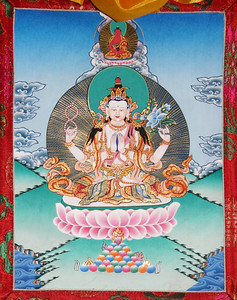
The mantra of Chenrezig is OM MANI PADME HUM. Chenrezig is the Buddha of Compassion, and has within his mindstream a clear and pure crystal awareness, which is the same as the mind of enlightenment. Inherent within that mindstate are the qualities that bring about the end of rebirth in all of the six realms. Constant mindfulness of Chenrezig, and learning to generate one’s mind as Chenrezig through the use of visualization, mantra, recitation and pure intention, can bring about the end of rebirth in cyclic existence, even in one lifetime.
The logic here is that in the practice you are the one who generates yourself as the Bodhisattva Chenrezig. You accomplish this pure mind state in order to be of benefit to sentient beings. The real end of suffering therefore can be understood as your capacity to generate yourself as that Bodhisattva of Compassion, thereby becoming the cause for the end of all suffering. In so doing, one brings about the end of one’s own suffering as well.
The mantra of Chenrezig, which is OM MANI PADME HUM, has six syllables. Each syllable has the ability to eradicate causes for rebirth in each of the six realms, because the mantra itself and each of the syllables is considered to be a miraculous condensation of wisdom. Through the activity of Guru Rinpoche we are able to experience in the hearing or reciting of the syllables and visualizing ourselves as Chenrezig, the perfect purification of the causes for rebirth in all of the six realms of cyclic existence. This is absolutely possible. It is promised that if you practice this every day you can achieve the end of rebirth in the lower realms. And if practiced in conjunction with other practices it is part of a proven technology to end suffering in all of the realms.
The following is an excerpt from a teaching by Jetsunma Ahkon Lhamo called “Marrying Spiritual Life with Western Culture”
So ask yourself, where are you? If you find that deadness inside of you, don’t blame your path, don’t blame your teacher, don’t blame your society, don’t blame the Buddha. Instead, go within and find what is true and meaningful to you. Work the sums. Reason it out. Lord Buddha himself said, “Forget blind faith.” He said, “Reason it out.” The path should make sense. It should be logical and meaningful to you, not to me. What’s it going to mean to you if it’s meaningful to me? It has to be logical and meaningful to you. This is what the Buddha said. It would really help you to try that out for yourself.
We live in a society where we are separate from some fundamental life rhythms and where we are trained to think that things are happening outside of us. We’re in a world filled with terrorism and racial abuse, religious abuse, all kinds of conflict, and yet we think racial intolerance, for instance, is happening out there. We read about it in the paper. No, racial intolerance is happening in here. That’s where it’s happening.
It’s like that with everything on this path. You cannot let it happen out there. It’s your responsibility, your empowerment, your life. Waiting for someone to tell you how to live it is not going to fly. When you walk on a spiritual path that you know, that you have examined, that you have given rise to understanding, you draw forth your natural innate wisdom. That fills your heart with a sense of truth because you understand it—not because someone else does. That’s the way to do it, and that’s what the Buddha recommended. In fact, he said, “I’ve given you the path. Now work out your own salvation.”
That wasn’t just a flip thing. When people hear that they go, “It’s such a cool thing that he said that! He must have had a great sense of humor.” He meant it! The path is there, but you’ve got to work it out. That’s how you walk on the path. Otherwise you’re walking alongside the path. Then you’re a friend of Dharma, an admirer of Dharma, but not a practitioner—even if you wear the robes.
So handle the dead zone. Empower yourself. There is no reason why you can’t. Don’t live your life by “bash-to-fit, paint-to-match.” Don’t do that. You are alive. In every sense, your nature is the most vibrant force in the universe, the only force in the universe. It is all there is. To play this game of duality where you stand outside your own most intimate experience and like a sheep get led through your life, that is not the way to go.
Many of you came to this path from another path because you felt dead there. But remember this: Wherever you go, there you are. You brought the deadness with you. So handle it.
I hope that you really, really take this teaching to heart because it’s really an important thing. If I had one gift that I could give you all, it would be to stay alive in your path, to have your spiritual life be like a precious jewel inside of you, living, something to warm you by. If life took everything else away from you, which it will eventually, this is the thing that cannot be taken.
The Stanzas of Offering Water from the Pure Vision, An Ocean of Blessings
By His Holiness Dudjom Lingpa
HUNG YAN LAG GYED DAN DUD TSI DZING BU DI
HUNG Offering a lake of nectar possessing the eight qualities of pure water
CHOM DAN KHOR DANG CHE LA BUL WAR GYI
To all the Buddhas and Bodhisattvas
ZHE NE DAG DAG SEM CHAN THAM CHAD KYI
By acceptance of this offering, may I and all sentient beings
TSOG DZOG DRIB TAG KHOR WA TONG TRUK SHOG
Accumulate merit and wisdom, purify all obscurations and liberate all beings.
Mantra:
OM SARVA TATHAGATA SAPARIWARA ARGHAM PRATI TSA PUJA MEGHA SAMUDRA SAPA RANA SAMAYA AH HUNG
One night in a dream a white Dakini appeared to Dudjom Lingpa. She said that she was Sukha Siddhi and proceeded to recite the above offering stanzas for the sake of all sentient beings. She said that this wishing prayer included everything. This vision arose in the dream of Dudjom Lingpa after a prayer for water offering was requested of him by Lama Tsultim Dorje. It was recorded by Dudjom Lingpa’s secretary, Phuntsog Tashi.
An excerpt from a teaching by Jetsunma Ahkon Lhamo from the Dakini Workshop
On a more superficial level, let us describe the method of dakini activity, and how it actually can appear in the world. Well, you cannot do that in one afternoon. You cannot do that in one lifetime. There are as many different ways that the Buddha nature can dance or move or generate activity as there are ways to be infinite. It cannot be described. Yet for our purposes, we can make some useful points about the method of Dakini activity.
First of all, anything having to do with the appearance of the Buddha’s activity in the world, that is to say, enlightened activity or compassionate activity should be understood as being inseparable from the dakini nature and should be understood as being dakini activity. It should be understood that the movement or dance or display of the Buddha’s activity is always pure, not because of the phenomena that one sees, but because of the purity of the Buddha nature. We like to evaluate phenomena that we see and that is where we run into trouble. That is the mistake. That is the cosmic mistake. You cannot know the nature by evaluating phenomena as you see it, because you are seeing your own confusion, period.
When you see the display of the Buddha’s activity in the world, that which brings you closer to enlightenment, that which propagates the Dharma, that which contributes compassion to the world in some form or another that should be understood as pure activity. You should see the purity. The purity is judged by understanding that the source of that activity is, and always has been and always will be, the enlightened nature.
That activity which is consistent with the nature of the dakini should be understood to be effortless in this way. Typically and characteristically it is not born of the struggle to confirm self-nature. It is born of spacious non-specific luminosity, the very nature of emptiness and having been born from that, all that appears as effortless and consistent with that nature, will eventually have the result of that nature.
While we have the habit of looking at an event midstream and seeing the middle of the picture, not the beginning, not the end, but the middle, we see certain things as if through a peephole. What appears to us is a very small picture and we do not understand the whole picture. But if we could see that activity having its beginning, having its middle and having its end, we could see that activity in its completeness and then we would understand that it will always result in enlightenment, even while in the beginning there may be friction and in the middle there may be struggle, it will always result in enlightenment. This is because the seed is the same as the fruit, always. If the activity is born of the sphere of truth and is inseparable from the sphere of truth, if it is consistent with the Buddha nature, if it is the enlightened activity of the Buddha nature, it will always result in the Buddha nature. That is always the case and that is the basis of devotion and faith.
Again, it is not based on what you see. It is based on the purity of the Buddha nature. Think about when the Buddha taught. The Buddha had no great teachers, really, that taught him on a physical level. He had achieved a very great level of awareness through his previous compassionate and virtuous acts. At the time of being the Buddha, he was able through his great effort to sit down and achieve realization. But once he began to teach, he taught effortlessly. It is said that people who spoke very different languages could sit down in front of him and they would hear the teaching in their own language. It is also said that he would be able to teach any student on his/her own level. He would be able to reach out and touch them exactly where they had a place to be touched. He would be able to give to some students a teaching that to another student would seem superficial, but for that student, was the key to enlightenment. And he could give to another student a teaching that would seem so profound to that student as to kick them into enlightenment very quickly, but to another student who might hear that teaching, if they were to hear that teaching in the same way, it would be blah, blah, blah. Nothing. Useless to them, like banana peels. You have to throw it out. No good. But the Buddha did not teach in that way. The Buddha taught each person the nature of their own mind by showing them their poison, by ripening in their mind their potential for enlightenment, by shoving down their throat their own garbage, by giving them teaching that touched them in their language.
Now, if we were to do that, we would have to go to school to learn many different languages and learn all the different levels of the Buddha’s teaching in order to be able to do that. And then we would have to have some kind of computer to be able to shoot this teaching to this one and that teaching to that one. We would have to be thinking about this all the time so that we could get it right. Not so with the mind of enlightenment. The mind of enlightenment can appear in whatever way necessary in order to teach and can speak to that person in the language that that person requires in an effortless way, completely effortlessly.
Of course, we have no real understanding of that, because of our confusion and our delusion. We still continue to cling and to see what floats on the surface of our mind, like shit. We see shit. Yet, the method that is employed with enlightened activity is a method that will lead to enlightenment in an effortless way. It is typical of the activity of the dakini to hit where it hurts, to get you where you live, to create for you a method by which you can try to run, but the road in front of you is turned around so that you can only run in a circle right back and it is as tricky and convoluted and sneaky as your own mind. It will rub your face in your shit. It will make you eat your own poison. But eventually, with faith and devotion, you will come out of it enlightened.