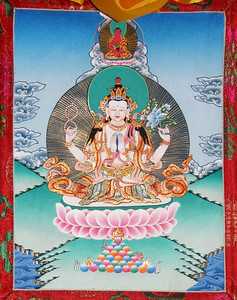
Mantra-thon!

Chenrezig

Now is a wonderful time to benefit beings, and one way we can do that is through the recitation of mantra.  From now until Chotrul Duchen on March 19,  we will be accumulating mantra for the benefit of the world and all beings.  The time between Tibetan New Year, called Losar, and Chotrul Duchen is considered to be very auspicious.  Meritorious activity is said to be multiplied 100,000 times.

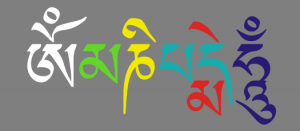
The mantra we are accumulating is the Mani mantra:

Om Mani Pedme Hung

525px-Om-mani-padme-hum_02.svg

To learn more about the Mani mantra, click here.

How to participate in the Mantra-thon:

1.  Set your intention to benefit beings

2.  Accumulate the mantra – Om Mani Pedme Hung as many times as possible

3.  Dedicate the merit you have accumulated, and

4.  Send your accumulations to [email protected]!

On Chotrul Duchen we will announce the grand total accumulated!

The following is a dedication prayer written by Jetsunma Ahkon Lhamo that can be used to dedicate the merit:

By this effort may all sentient beings be free of suffering.

May their minds be filled with the nectar of virtue.

In this way may all causes resulting in suffering be extinguished

And only the light of compassion shine throughout all realms.

by Jetsunma Ahkon Lhamo
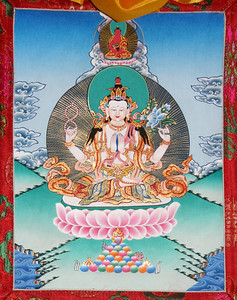

The Power of Om Mani Padme Hung

Chenrezig (Avalokiteshvara) is the embodiment of the Compassion of all the Buddhas.
Every aspect of the eighty-four thousand sections of the Buddha’s teachings are contained in Chenrezig’s six syllable mantra “Om Mani Padme Hung.”  Repeating the mantra (prayer), out loud or silently to oneself, invokes the powerful benevelent blessings of Chenrezig.

The mantra is endowed with the capacity to purify our mind from the veils that obscure it. The six syllables correspond to the six perfections, helping one to achieve perfection in the practice of generosity, pure ethics, tolerance, patience, perserverance, concentration and wisdom.

The mantra opens the mind to love and compassion and leads it toward awakening.
Any being who hears the sound of the mantra is blessed and it is particularly beneficial to animals and those who are suffering.

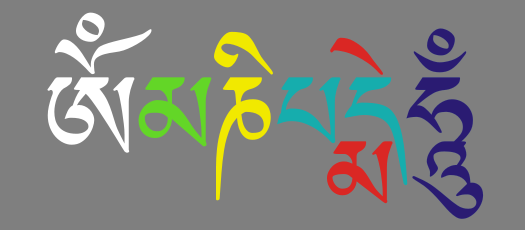
These are the six syllables of the mantra written in the Tibetan alphabet:

Reading from left to right the syllables are:
Om
(ohm)
Ma
(mah)
Ni
(nee)
Pad
(pahd)
Me
(may)
Hum
(hum)

Chenrezigs’ mantra, is chanted constantly around the world to produce peace on earth.

Dedication Prayer by Jetsunma Ahkon Lhamo:

By this effort, may all sentient beings be free of suffering.  May their minds be filled with the nectar of virtue.  In this way may all causes resulting in suffering be extinguished and only the light of compassion shine throughout all realms.

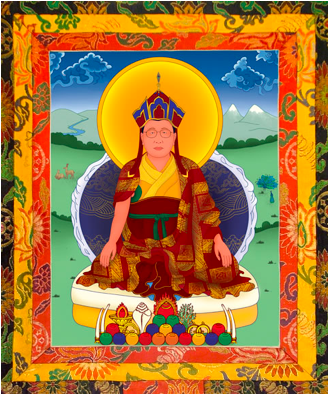
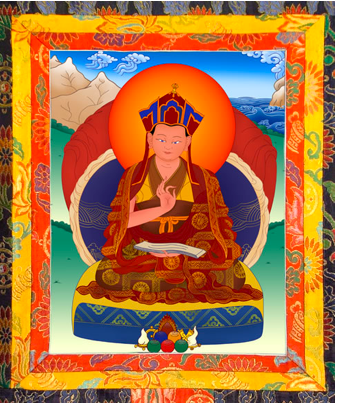
The Eleventh Throne Holder

The Third Drubwang Pema Norbu Rinpoche,
Thubten Leshed Chokyi Drayang, also known as
Do-Ngag Shedrub Tenzin Chog-Lei Namgyal
(1932 – 2009)

The third Drubwang Pema Norbu Rinpoche was born in the year of the Water Monkey (1932) in the Powo region of Kham, in South-Eastern Tibet. Details of his birth were exactly as described in the prophecy of Thubten Chokyi, the fifth Dzogchen Rinpoche. The incarnation of the second Drubwang Pema Norbu was recognized by Khenpo Ngaga Rinpoche. At the age of four, the small child was enthroned by Thubten Chökyi Dawa and Karma Thekchok Nyingpo at the Palyul Monastery. There he began his study in sutra and tantra from a full range of Nyingma lineages and received all the transmissions and empowerments from Khenpo Ngaga Rinpoche, the second Chogtrul Rinpoche, the fourth Karma Kuchen Rinpoche, Khenpo Legshed Jordan, Khenpo Lodrö, Pema Jigmed, and other eminent Masters at the time.

The third Drubwang Pema Norbu Rinpoche applied himself diligently in dharma practice. It took a mere seventeen days for him to complete one hundred thousand accumulations of prostrations in the Ngondro preliminary practices of Nam Chö Dzogchen’s Liberation in the Palm of the Hand. Under the guidance of his root guru, he went into a four-year retreat and attained accomplishment in all the stages of the practices he received. By the time they came out of the retreat, Chogtrul Rinpoche proclaimed that the third Drubwang Pema Norbu Rinpoche was the only lama at the time who held the entire lineage of Terton Migyur Dorje’s Nam Chö and Ratna Lingpa’s revelations.

During the 1950s, the third Drubwang Pema Norbu Rinpoche made numerous pilgrimages across Tibet to all the major holy sites to which he made generous offerings. He continued to propagate Buddha Doctrine far and wide through the sponsoring and supporting of a diversified range of compassionate activities. In 1959, the third Drubwang Pema Norbu Rinpoche decided to relocate to India for the sake of preserving Buddha Doctrine for the sake of all sentient beings. Accompanied by a small group of monks, he settled in the region of Bylakuppe in Mysore, South India.

In the year of the Water Rabbit (1963), under the personal supervision of the third Drubwang Pema Norbu Rinpoche, the Thekchog Namdrol Shedrub Dargye Ling (Namdroling monastery) commenced its first phase of construction. Since its beginning as a small bamboo temple with a handful of monks in 1963, the main seat of the third Drubwang Pema Norbu Rinpoche in India now includes numerous temples, Stupas, primary schools, dratsang, shedras, a retreat center, nunnery, guest house, old people’s home and hospital. It has evolved to become the largest Tibetan monastery in India with an ordained sangha of over six thousand monks and over one thousand nuns. Apart from propagating Buddha Doctrine in India and in Tibet, to where he has made return visits since 1982, the third Drubwang Pema Norbu Rinpoche established many dharma centers around the world, including the USA, Canada, Mexico, Taiwan, Hong Kong, Macau, Philippines, Singapore, Malaysia, Nepal, Bhutan, United Kingdom, Greece, Germany, Switzerland, Australia, and Portugal.

On the evening of 27th March 2009 (the first day of the second Tibetan month), the third Drubwang Pema Norbu Rinpoche departed from this world and entered the meditative state of thugdam. After spending six and a half days in the meditative state of luminosity, on the morning of Friday 3rd April 2009, he released his body from meditation and entered Parinirvana. His body is currently enshrined in the Zangdokpelri Temple at Namdroling Monastery.

References:  Pathgate Institute of Buddhist Studies

A Garland of Wish-Fulfilling Trees by Ven. Tsering Lama Jampal Zangpo

Shining Lake of Crystal Tears

248176483_mC7w6-S

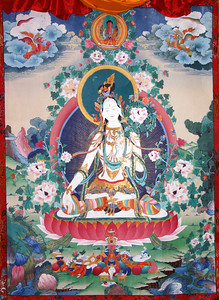
Arya Tara, Noble One

We bow down to your Lotus Feet

And beg you to remain enthroned

On the Lotus Throne within our hearts

We, your daughters and sons

Offer you the essence of whatever purity we may possess in the three times

Please accept the nectar of our pitiful practice

Please bless the potential of all our hopes and aspirations

And guide our lips and blind eyes

To suckle at the breast of the Sublime Bodhichitta

Mother Tara, protect us, now and at the time of our death.

Sooth and cleanse our minds of the sickness and fever of worthless distraction.

Hear us, Holy One, even though our very voices are tainted

With fear and slothfulness, weakened by Samsara’s spell.

Oh Mother, when we have caused you sorrow

How will you then appear for us in Nirmanakaya form

Through endless aeons for our sake –

How, Mother, will this occur

When our hearts and minds turn inward

With darkness and lack of caring for the suffering of others?

Oh Mother Tara, Holy One, Perfect One

We are lost.

Now more than ever darkness comes

And we are overcome with our weakness and poor view.

Yet you remain for us

Blessed Mother, Holy One, this very day

We make our hearts and minds your home

We beg you to come in glory

And to remain with us

With your Supreme Beauty, Sublime Power and Faultless Light

Until we are inseparable

And Samsara is emptied

Colophon:  Written by Jetsunma Ahkon Lhamo, August 24th, 2004 Sedona, Arizona, when one of Tara’s daughters herself had fallen under Samsara’s dark spell

Copyright © Jetsunma Ahkon Lhamo.  All rights reserved

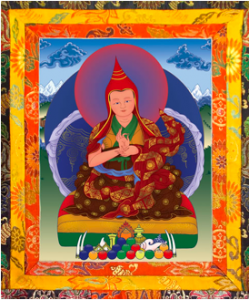
The Tenth Throne Holder

The Fourth Karma Kuchen Rinpoche, Thegchog Nyingpo

(1908 – 1958)


The fourth Karma Kuchen Rinpoche, Thegchog Nyingpo was born in the fifteenth rabjung year of the Earth Monkey (1908). He was recognized in accordance with the prophecy of the fifteenth Karmapa Khakyab Dorje and authenticated by Drodul Lama Azom Drugpa. After being enthroned as the tenth Throne Holder at the Palyul Monastery, he began his study in sutra and tantra and received all the lineage transmissions from the second Drubwang Pema Norbu, the Dzogchen Khenpo Rigdzin Odzer, Jamgon Tai Situ Pema Wangchog Gyalpo, Drodul Lama Azom Drugpa and Kathog Khenpo Legshed Jordan. He excelled in all the teachings he received and attained an all-encompassing mind that merged with the true nature of transcendental reality. Soon after the completion of a three-year retreat during which his main practice was Ratna Lingpa’s Three Kaya Accomplishment, Thegchog Nyingpo commenced his service to all sentient beings by giving teaching, transmission and empowerment to a multitude of followers. During his lifetime, he commissioned the making of many thangkas and statues, having scores of Dharma texts printed, old temples renovated, new constructions erected, and gave generous support to a great many sangha communities elsewhere.

When Thegchog Nyingpo was fifty-one years of age, he decided it was time for him to pass beyond this world and transferred his life essence into the body of rainbow luminescence leaving nothing tangible behind.

Reference:  Pathgate Institute of Buddhist Studies

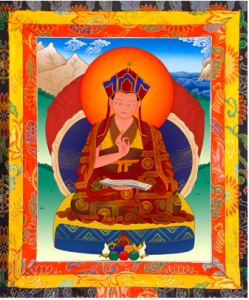
The Ninth Throne Holder

The Second Drubwang Pedma Norbu Rinpoche,

Pedma Kunzang Tenzin Norbu (Thubten Chokyi Langpo)

(1887 – 1932)

The second Drubwang Pema Norbu was born in the fifteenth rabjung year of the Fire Pig (1887) under the exact circumstances prophesied by the first Pema Norbu. “When berries bloom again on the juniper tree next to my residence, my incarnation will come again to Palyul.” A dream of Pedma Norbu by Do-ngag Chökyi Nyima caused him to remember the prophecy, and locate Pedma Norbu, who was recognized by Khenpo Ngaga and Jamgon Khomtrul.  Khenpo Ngaga said that in Drubwang Penor Rinpoche’s past lifetimes he had been Vajrapani – the dharma master, Gar Dampa – the king’s son, Damdzin Lhaje, Lhalung Palgyi Dorje, Terton Sangye Lingpa, the first Drubwang Pedma Norbu, Dodrub Kunzang Shenphen, the first Drubchen Rinpoche, and Phuntsog Jungney – the second Drubchen Rinpoche.

When Pedma Norbu was seven years of age, he was taken to the Palyul Monastery where he received a full range of transmissions and empowerments from Do-ngag Chokyi Nyima, Palpung Lama Tashi Chophel, Khenpo Gyalsten Odser, and other eminent Lamas of the time. When he was nine, Pedma Norbu had a direct vision of Padmasambhava and received blessings from him. He received full ordination (gelong) from his root guru Khenpo Ngawang Palzangpo and was given the formal name Thubten Chokyi Langpo. Under the guidance of his root guru, the Second Pema Norbu actualized the full potential of Dzogchen Togyal and exhibited signs of having attained the view of the clear light, which exists in all phenomena. He went on to receive Longchen Nyingthig transmission from Drodul Pawao Dorje, the Peaceful and Wrathful Manjushri transmission from Mipham Rinpoche, and the Choggyur Lingpa Thugdrub transmission from Jamgon Khongtrul Rinpoche. The devotion of the Second Pema Norbu to Do-ngag Chokyi Nyima was of such strength that even after the third Karma Kuchen Rinpoche had passed beyond this world, his precious guru still returned in a dream and gave the second Pema Norbu the entire transmission of the Kagyed Desheg Dupa over a period of three days. Following this he suddenly found he could now also speed read. He was 20 years old.

The second Pema Norbu was a scholar unequaled by his contemporaries. He was extensively schooled in the study of medicine, astrology, geomancy, poetry, Sanskrit, sand mandala construction and the ritual of chanting. He dedicated his life to propagating Buddha Doctrine in a diversity of dharma activities. When he was not in solitary retreat, he tirelessly gave teachings and empowerments to students, sponsored the new construction of temples and shedras, commissioned new printing blocks for the production of dharma texts, and made numerous generous offerings to support the sanghas of other monasteries. He gave the entire Rinchen Terdzod empowerments five times in that lifetime, as well as other large cycles of teachings and accomplishment ceremonies. In  1922, he opened the Palyul Shedra, fulfilling a prophecy by Terton Sangngag Lingpa, “In the Palyul tradition of accomplishment, a scholastic college will be born to propagate the sutras and tantras in a way that is unprecedented.” Fifty students enrolled in the first year. Pedma Norbu provided each one of them with every necessity. He sponsored the building of many monasteries, compiled vast numbers of teachings and practices, and instituted the practice of accomplishment ceremonies in all these locations. Through all these efforts he gave tirelessly of himself and his personal resources to sponsor these projects to completion.

In the autumn of 1931, the Second Drubwang Pema Norbu went into retreat at Khachu Trag. It was there he fell ill after he ate some food of questionable origin. His health gradually deteriorated. On the third day of the third month of the sixteenth rabjung year of the Water Monkey (1932), his mind entered into a meditative state of dhyana. He was forty-six years old. Khenpo Ngaga made many prayers wishing the second Drubwang Pema Norbu a swift rebirth and after some time awakened his heart disciple from the absorptive state of samadhi. At the cremation ceremony a few days later, the earth shook; rainbows filled the sky; wafts of fragrance were in the air, while ritual music materialized of its own accord echoing in space. The precious bone relics of the second Drubwang Pema Norbu were placed inside a one-story golden Stupa that was constructed next to the main temple.

References:  Pathgate Institute of Buddhist Studies

A Garland of Wish-Fulfilling Trees, by Ven. Tsering Lama Jampal Zangpo

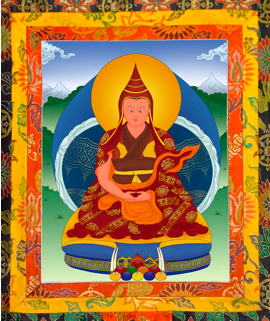
The Eighth Throne Holder

The Third Karma Kuchen Rinpoche,

Orgyen Do-Ngag Chokyi Nyima

(1854 – 1906)

The third Karma Kuchen Rinpoche Do-ngag Chokyi Nyima was born in Ahlo Khateng in the fourteenth rabjung year of the Wood Tiger (1854). His birth was prophesied by a letter left behind by Karma Gyurmed, which clearly indicated the location of the birth. As befitted the birth of a great lama, light of rainbow colors suffused the sky and awe-inspiring resonances echoed through the air.

The fourteenth Karmapa gave Do-ngag Chokyi Nyima the Refuge Vow and soon after he was enthroned as the eighth Throne Holder at the Palyul Monastery. After he received the full ordination (gelong), he was given the formal name Orgyen Do-ngag Chokyi Nyima. Transmission from many sources including those of the Palyul tradition were given to Do-ngag Chokyi Nyima by Gyatrul Rinpoche, Washul Lama Sonam Namgyal, Khang-nang Lama Tashi Phuntsok, Dzogchen Dorje Rabten, Jamyang Khyentse Wangpo, Jamgon Kongtrul Rinpoche, Lhatrul Pedma Garwang, Drubwang Drodul Pawo Dorje, and many other eminent masters of the time.

Do-ngag Chokyi Nyima’s mind was full of compassion for all sentient beings. Much as he wished to be in solitary retreat, he opted instead to follow his root guru Gyatrul Rinpoche’s advice and devoted his life to propagating Buddha Dharma. Regardless of how busy his schedule was, his personal practice started daily without fail at three in the morning. His successful attainment of having the mind inseparable from the four elements enabled him to perform many extraordinary deeds, which were deemed miraculous by others.

In the fifteenth rabjung year of the Fire Horse (1906), Chokyi Nyima dissolved into the pure realm of clear light. He was fifty-three years old. During the cremation ceremony, cloud formations resembling large tents manifested across an otherwise cloudless sky, accompanied by a mild shower of light rain. A large number of bone relics were found on the ground. These were gathered together and placed within a Stupa of gold and copper that was constructed to the left of the Avalokiteshvara temple.

Reference:  Pathgate Institute of Buddhist Studies

WP2Social Auto Publish Powered By : XYZScripts.com