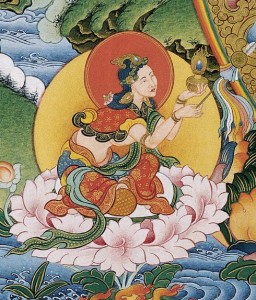
The following is a teaching by Jetsunma Ahkon Lhamo called “Desire Blocks Happiness”
I don’t know how many times people have come to me and said, “Gosh, I’m so excited about this path! I would love to practice this path. It seems so wonderful! I’m so excited about this path. But you know, that’s like me. I always get really excited about things, and I jump into them; and I get really on fire, and then I burn out real quick. But maybe this one is different! This could be it!” Well, you know, that’s the example that I can give you that I see again and again and again and again. But people are like that about everything! Whenever we get a new object, we get real excited about it, or we become attached to it; and we think this is the thing that is going to make us happy. But it isn’t. Or we get a new relationship, and we just get all in love, and in friendship, and whatever it is, enamored. And then we think, “Oh, this is going to be the one that makes a difference!” And then, well it does, but it isn’t. It really isn’t.
What are we actually seeing? First of all, we’re actually seeing the faults of cyclic existence. What begins must end. What goes up must come down. What causes us to be supremely elated must also cause disappointment. What comes together must result in separation. That is the fault of cyclic existence. That is its quality. We’re seeing the reflection of the condition of cyclic existence. More than that, we are seeing the reflection of our own mind. Our own mind. Our own mind has within it the karma, or cause and effect set-up, if you will, to be able to experience that kind of thing again and again and again. That is our habitual tendency. We are suffering from a kind of inflammation of the mind. The mind is inflamed. Interestingly, the very thing that causes us to be so inflamed by some new toy, you know, some new relationship, some new thing that comes into our life, some new event, some new job, some new spiritual path, some new idea… Something that comes into our mind that causes us to be sooh, gosh! everything’s going to be different now!So breathlessly excited. Everything that comes into our mind like that, that quality of inflammation. And it is like an inflammation, isn’t it? We become all puffed up and red like inflammations. That quality of inflammation is the same quality that will actually lead to the downfall of that particular circumstance to satisfy us, because that very inflammation is an indication of the instability of our minds.
A diplomat makes one final speech. Then things change and a more focused attitude prevails. Someone has made a decision, but you may not hear about it for a while. The indecision that has characterized the times has ended.
Spend today going over old material, reviewing matters and making adjustments. It’s not a good time to move forward in a brand new activity. Only consider things you’ve looked at previously. Communication with others is fun and someone will tell you how much you mean to them. Believe it! Everyone wants to put things in writing. Do so yourself and you’ll be surprised later at how jumpy your thoughts are. Two powerful planets are involved in a standoff with each other. Please don’t intervene. An African proverb says “When elephants fight, it’s the grass that gets hurt.” Stay away from volatile situations. What’s good? Work on small projects is energizing, news from afar brings happiness, and food is your best friend!
The daily astrology post affects everyone. Because individual charts vary, the circumstances outlined in the post will affect people differently. Some will feel this energy in the personal arena, some in finances, some with children or family, some in work and so forth. There are many departments of life. Look to see where the dynamic affects you!
The following is respectfully quoted from “Reborn in the West” by Vicki Mackenzie as she recounts Jetsunma’s life story. This section begins as Jetsunma describes her early practice:
‘I left the party at that point,’ was how she put it. ‘I felt “There’s nothing here.”‘ Her meditation then took a quantum leap–right to the heart of mysticism, to the fount of truth.
‘In my next dream I was guided to meditate on the question “If what I have here does not amount to much because it is so finite, then what is there of value?”‘ Suddenly she found herself contemplating absolute reality, or ultimate truth, the primordial wisdom state and the most profound and difficult subject of all Buddhist meditations.
‘I didn’t have the words for it but I knew it wasn’t like God, the old-man-on-the-throne idea. What I was meditating on was a non-dual, all-pervasive essence–that is, form and formless, united, indistinguishable from one another. I saw that it was the only validity–that and the compassionate activity that was an expression of it.’
What Jetsunma was telling me was, I recognized, quite exceptional. What yogis and scholars in Tibetan monasteries take years to achieve after long intellectual delving and even longer years of retreat, Jetsunma had arrived at entirely of her own accord. Tucked away on her farm in North Carolina without any guru, any book, any established doctrine or example to follow, she had not only discovered but realized the two essential truths–wisdom and compassion, the two wings of Tibetan Buddhism that are said to fly you all the way to Enlightenment. Without them you can barely get off the ground. It was an amazing feat.
But she didn’t stop there. While she continued to meditate on absolute nature and compassion she simultaneously began to offer up her body, part by part.
‘This is going to sound strange,’ she said, laughing, ‘but I would lie down–I didn’t know you were suppose to do all of this sitting up–and I would look down at my feet and say, “OK, here they are, ten toes.” And I would really look at my feet and consider all the things that my feet could do for me. And then I would contemplate what was the ultimate good of these things–no ultimate use at all!” ‘ She would continue in that vein throughout her body, staying longer on the parts she felt attached to. ‘No one wants to give up their head, for instance. Our head is like the last bastion of our individuality. And I’d pay special attention to my female parts and my hands. You don’t want to do without them!’
She didn’t know it then, but what she was doing was no less than Chöd, another profound Tibetan meditation whereby you relinquish your body to emptiness for the good of all. It is considered the ultimate physical surrender. How she had come across such a strange meditation in the middle of North Carolina, with only a baby and husband for company, adds to the mystery. I asked again, to make sure, if there were any outside influences that could have been directing her.
‘We were in Ashville in the seventies and nothing metaphysical was happening there,’ she replied. ‘Actually there was one thing–a small transcendental meditation centre had started and friends kept urging me to join. But I resisted. It didn’t feel as though it was the right place for me. They said I had to have a guru, that I couldn’t get anywhere without one, and I replied, “That may be true, but I haven’t found my teacher yet and I will know when I do.” ‘
She continued these intense periods of individual meditation over several years. ‘I would meditate for hours at a time. Luckily I had a baby who was peaceful and slept a lot, and a husband who was supportive of what I was doing. I am eternally grateful for that. But it was still a householder’s retreat. I had a husband, a child and all the chores to do. Even so, I had a much stricter schedule of meditation than I do now.’
The meditations grew in strength and clarity, and when she was around thirty she had a spiritual experience which showed that the time to begin her work had begun. She was reluctant to tell me about it, except to say that she entered a long period of meditation from which she emerged knowing that her personal life had finished and that she had been born solely to be of benefit for others. ‘I never said anything to anyone about it. But oddly, after that people started coming to me.’
The following is respectfully quoted from “Reborn in the West” by Vicki Mackenzie:
Before receiving her bodhisattva vows she had told Penor Rinpoche of her own vow that she was teaching to her students: ‘I dedicate myself to the liberation and salvation of all sentient beings. I offer my body, speech and mind in order to accomplish the purpose of all sentient beings. I will return in whatever form necessary, under extraordinary circumstances, to end suffering. Let me born in times unpredictable, in places unknown, until all sentient beings are liberated from the cycle of death and rebirth.
Taking no thought for my comfort or safety, precious Buddha make me a pure and perfect instrument by which the end of suffering and death in all forms might be realized. Let me achieve perfect enlightenment for the sake of all beings. And then, by my hand and heart alone, may all beings achieve full enlightenment and perfect liberation.’
Penor Rinpoche had rocked to and fro in unbridled mirth, slapping his thigh in amusement. She had replicated, almost exactly the same prayers that Tibetan lamas spoke. It was another proof of her identity.
He handed her another certificate, authorizing her to teach. ‘This is important,’ he said. ‘People will say you haven’t been studying the dharma, that they have never heard of you. They will not understand. With this paper no one will doubt that you are capable of teaching the dharma.’
Penor Rinpoche went on to tell Jetsunma a little about her famous ‘predecessor’. The first Ahkön Lhamo was the direct student of Tertön Migyur Dorje, a famous revealer of secret teachings, he said. She was a great dakini and spent decades in retreat, only coming down from her cave to help her brother with his monastery. Otherwise people would go to her to receive healing and teaching.
I asked Jetsunma if she were curious to find out more about Ahkön Lhamo or had any memories of the yogini who had lived in Tibet in 1665 and had inspired a religious order that had survived to this present day.
‘I discovered she was pretty wild,’ she replied. ‘She stayed up in her cave and looked pretty wretched, with her hair sticking out all over the place,’ she said, picking up her own unruly locks. ‘She was a crazy yogini type. Some things never change! There was no water in her cave, of course, and she never bathed. Her clothes were rotting on her. But people said whenever they went to her cave it would smell like perfume. Penor Rinpoche told me that people would give her turquoise, gold and coral, but she would refuse it. She was probably holding out for gifts she could accept, like hair-driers! She was probably waiting for electricity to be put into her cave and she could have central heating!’ she joked.
‘As for any memories, I don’t like to make any fuss about the inner experience I have. I can tell you I have some awareness of it, but it’s pretty “Swiss cheesy”. I am curious. I want to go back to Tibet, to see the cave where she practiced. Gyaltrul Rinpoche, the reincarnation of Kunzang Sherab who is now in Oregon, said that when he went back to Tibet he remembered a lot. It’s as though the airways are clearer there.’
There is at least one concrete link between this latter-day bodhisattva, the girl from Brooklyn, and the seventeenth century Tibetan yogini who had helped found a Buddhist lineage. Ahkön Lhamo’s skull, or part of it, is still in existence. It bears an unmistakable hallmark of sanctity. On its top is etched the holy sanskrit syllable ‘Ah’.
The story goes like this. When the first Ahkön Lhamo passed away, they prepared a pyre to cremate her and duly put the body on it. When the last vestige of flesh was burnt away, the skull rose up in the air in front of hundreds of people and flew about a mile before landing at the Palyul monastery, at the foot of her brother Kunzang Sherab’s throne. This was considered the final ultimate display of Ahkön Lhamo’s power and spiritual accomplishments. The great dakini, who was already known for the many miracles she performed, had revealed her true greatness.
The skull became a most treasured relic and was used as a kapala, and instrument used in ritual ceremonies for holding nectar. It remained intact until in the mid-twentieth century the invading Chinese hacked to pieces everything of spiritual significance, including the precious kapala at the Palyul monastery. A lay person saw a piece of the skull among the rubble and, hiding it in his clothes, took it to safety. It was some years before Penor Rinpoche got word that at least part of the holy relic had survived.
The was a vast gap in time between 1660 and 1949, when the present Jetsunma Ahkön Lhamo was born. I asked her the same question I had asked Tenzin Sherab. What lives did she think she had been living in between?
‘I think there were other incarnations, but as Penor Rinpoche told me, they don’t keep track of women. It wasn’t because they were prejudiced against women’s wisdom. In fact, dakinis are the primordial wisdom beings and are held in very high regard. Generally, though, dakinis were not the lineage holders. They spent their lives in solitude, doing spiritual practices. Penor Rinpoche says, and I feel, that there have been many incarnations.
But this present one, as the American woman doing it ‘her way’ as undoubtedly she always had, was the life that was to capture widespread attention. Jetsunma left the United States as a married woman, mother of two and teacher of New Age metaphysics with a bent for worldwide caring, and returned a recognized tulku, a reincarnate lama. For her students this took some adjustment. While they had been happily following the teachings of a woman whom they treated as their equal, they now had to contend not only with a ‘Buddhist’ but also with someone whose rank placed her on an entirely different footing. There was protocol to observe, a new language to learn for the same concepts they had learnt, and the mantle of an old and established ‘religion’ from the East to adopt. Some disciples fell out, but most survived the transition.
Whatever misgivings they might have had about the authenticity of their teacher’s new lofty reincarnate status, however, were completely dispelled when Penor Rinpoche came to see them for the second time in 1988. “He arrived at Poolesville with twelve monks in attendance and conferred the Rinchen Terzod, the revealed teachings of the great Padma Sambhava to all member of KPC. It was the first time he had ever performed the task in his lifetime, and the first time in North America”.
He then conducted an official enthronement of Jetsunma Ahkön Lhamo. News of the thirty-nine-year-old woman who had been recognized as the reincarnation of a famous Tibetan yogini reached the media. Newspaper reporters and television crews descended on KPC. ‘Meet Ahkön Norbu Lhamo, Tibetan Saint,’ blazed the front-page headline of the International Herald Tribune. ‘The Unexpected Incarnation’ cried the Washington Post. She appeared in the popular People magazine. Leading Japanese and German magazines ran articles on her. This was when my own journalist’s antennae, primed for good stories, must have picked up the importance of the event and stored it away for later use.
The following vows were composed by Jetsunma Ahkon Lhamo who received permission to offer them to her students from His Holiness Penor Rinpoche:
Renunciate Vow for Lay Practitioners
From this very moment forward I offer this life as a gift to the three precious jewels. My pure intention is to accomplish the purpose of Self and Others – Supreme Enlightenment – quickly and surely. Thus I vow that all my life, every portion, shall be used to accomplish that goal.
All my activities shall accomplish that goal.
All my thoughts and feelings are directed toward that goal.
All my possessions shall be to strengthen and support that goal.
I shall seek all appropriate teachings, empowerments, and spiritual activities in order to secure that goal.
My own enlightenment is now considered to be equal to, and non-dual with the enlightenment of others. Therefore I vow to support fully and without hesitation the practicing spiritual community.
I vow to support fully and with unconditional love the three precious jewels and their manifestations: the Sangha and temple.
I will not kill.
I will not lie to accomplish selfish purpose.
I will not steal.
I will not become intoxicated and therefore forget my purpose and vows.
I will not engage in adultery, or promiscuous activity by which my intention will be compromised.
I fully intend to do all that I can to accomplish the liberation of all sentient beings and my own equally.
I consider the realization of all beings to be equal with my own and of equal value.
I fully support the spiritual community and its purpose on earth.
Should any activity or possession or relationship be contrary to these purposes I will systematically change it or eliminate it from my life.
This I promise so that there will be an end to hatred, greed and ignorance within my mindstream and within the three thousand myriads of universes and so that myself and all beings shall achieve the precious awakening.
Bodhisattva Vow
I dedicate myself to the liberation and salvation of all sentient beings. I offer my body, speech, and mind in order to accomplish the purpose of all sentient beings. I will return in whatever form necessary, under extraordinary circumstances to end suffering. Let me be born in times unpredictable, in places unknown, until all sentient beings are liberated from the cycle of death and rebirth.
Taking no thought for my comfort or safety, precious Lama, make of me a pure and perfect instrument by which the end of suffering and death in all forms might be realized. Let me achieve perfect enlightenment for the sake of all beings. And then, by my hand and heart alone, may all beings achieve full enlightenment and perfect liberation.
The following is an excerpt from a teaching by Jetsunma Ahkon Lhamo called “The Guru Is Your Diamond”
Likewise, when the student accepts the teacher, they must honor that vow and they must make a similar vow in their own way. That vow is contained in The Seven Line Prayer. “Following you, I will practice.” Even though the prayer is directly to Guru Rinpoche, the prayer has an inner, outer and secret level of meaning. So we recite it thinking of Guru Rinpoche on a lotus and having the intention, hopefully, to understand that even though this appears as Guru Rinpoche on the lotus, it is inseparable from our own root gurus—same nature, same taste, same essence, same uncontrived primordial essence. And so, every time we recite the prayer to Guru Rinpoche, The Seven Line Prayer, we reconfirm that entire process: recognizing that Guru Rinpoche was the one who came from Orgyen; that he was born on a lotus in an extraordinary way. This is like our saying, ‘I understand that this is not ordinary. I understand that this did not happen as ordinary births, as ordinary conditions happen. And so having understood, I also promise to follow and to practice.’ And then we ask for the Guru’s blessing, Guru Pedma Siddhi Hung. Guru Pedma, grant me your blessings.
There is so much condensed into the power of that little prayer that I make you say again and again and again. There’s so much. One can go so deeply with just that one prayer. One can move through the stages of recognition to a depth that we didn’t think we could ever reach. One can create that connection by reciting again and again and again, “Following you I will practice. Following you I will practice.” And so those meaningful words, even though they are simple, we can understand them more deeply and more deeply and more deeply. “Following you I will practice.” What does it even mean? Does it mean I dress like Guru Rinpoche, or act like Guru Rinpoche, or do I wear some of his funny earrings, or what do I do? (I’ve got some funny earrings on, by the way.)
That’s not it. “Following you I will practice.” First, we practice the way Guru Rinpoche practiced, for the sake of sentient beings. That’s how Guru Rinpoche practiced. He came and was born into the world for no reason other than to benefit beings. He didn’t have to come and learn; he didn’t have to come and hang out. Like Lord Buddha himself, he didn’t have to come and learn or hang out. And yet he came for the benefit of sentient beings. And so that’s the way in which we promise to practice. Not only throughout this prayer, throughout this hour that I am practicing, but throughout this day, throughout this week, throughout this month, throughout this year, throughout all my lifetimes, may I follow the Buddhas and Bodhisattvas and liberate beings. We’re talking here about liberating beings from suffering. This is what Guru Rinpoche did. Yes, he taught. Yes, he hid termas. Yes, he gave us the means, the method. But the intention was about liberating sentient beings. Following you therefore I will practice.
And so that’s our commitment. We take on this tremendous commitment, this tremendous opportunity to liberate beings from the clutches and the ravages of samsara. And that means we’ll live the week like that, the month like that, the year like that, the decade like that, our lives like that. And at the time of our death, we will make prayers to be reborn following Guru Rinpoche. And in our next life, we are reborn again to continue and to benefit beings. This is the method. This is the way. This is the powerhouse. We rely on this promise, this blessing.