Vajrayana: For This Time

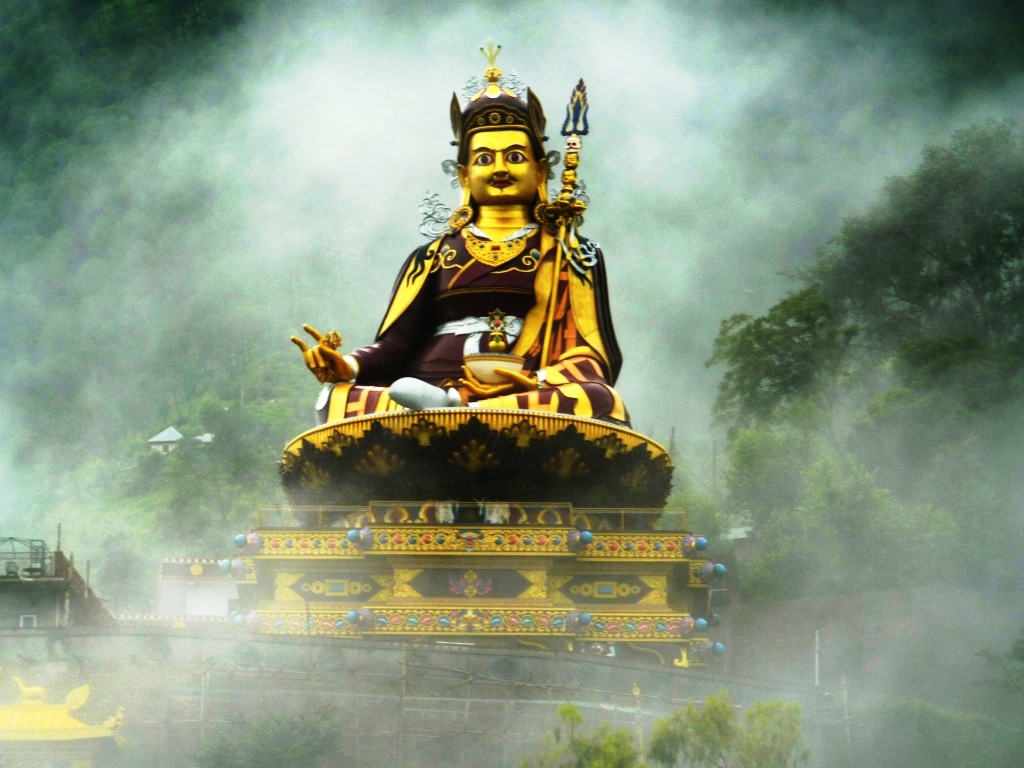
GuruRinpoche3

The following is an excerpt from a teaching by Jetsunma Ahkon Lhamo called “The Guru Is Your Diamond”

On the path of Vajrayana, we are given something like a rocket ship, rather than a slow boat, to cross the ocean of samsara. When Lord Buddha first came to the planet and taught, when he was there as Shakyamuni, he gave teachings that were absolutely necessary for that time. During that time, we were not in Kaliyuga, which is a more degenerate age. During that time, it was easier to practice. It was easier even to speak Dharma. Peoples’ minds were more spacious and more expanded so that if one were to accomplish Dharma, it would be more easy to accomplish Dharma during that time. And yet, there was a difficulty. And the difficulty was that during that time, because there was more space in the mind, there was also more relaxation, maybe more joyfulness, less reason to feel compelled to exit samsara. So there are good and bad things in both times.

True that this is Kaliyuga. True that this is the time of degeneration. There are many false teachers and many false paths. And sometimes delusion rises up like a tsunami flood, and it is a difficult time. We look to the people that even guide this country, and you wonder where is the clarity, where is the morality. So it’s difficult. Even this country that was once the prince of countries, and can still be the peacemaker, the one who guards the little guy, instead now we’ve changed. So these are all indicative of this time of delusion.

Yet at the same time, we are so pressed because of our delusion, our neuroses, which means an inappropriate response to something that is not understood well anyway. Our neuroses also thicken and deepen, and with that comes an increase in pain, fundamental pain. Maybe not even a particular pain about something, but rather an all-pervasive sense of suffering.We are more unhappy, really, now when things are happening faster and materialism is in some ways more attainable, in many ways more attainable. Still we have become more and more unhappy and continually create the causes for unhappiness. So this pushes us to find a solution. And for some people, we look to psychology or psychiatry; and for other people, we look towards creating the causes for happiness through walking the path of spirituality. But many of us are seeking, and that’s important. That is something that is useful and to be treasured during this time.

For many of us, we’ll think that what drives us to seek is this pain, this angst, this modern angst that we all seem to carry around. That pain, on the one hand, seems sometimes unbearable, and then other times, just there. And we are uncomfortable and we can’t say exactly why. We feel wobbly, unguided, unknowing and we really can’t understand why that is. That suffering, of course, even though painful, can ultimately become part of the blessing that brings us to the Path. Maybe we didn’t even come here thinking, ‘What I need is a good Path.’  Maybe we came here for some other reason: Because we heard about this place; or we’ve heard a little bit; or we’ve read some books about Dharma; or maybe His Holiness the Dalai Lama has given us some wonderful teaching through his books; and something has just hooked us a little bit. Maybe we heard about the crystals. That brings people!  Whatever it is, it’s that sense of things not being wholesome or right. It’s that sense of fundamental unhappiness that drives us forward.

And so, in the beginning, that’s how it feels. It can be a very poignant kind of search and we feel deeply moved by it. So when we begin to examine the Path of Vajrayana, we find that rather than being the gentle ship that crosses a relatively gentle ocean as was in the time of Lord Buddha’s physical life, now we have a different situation. We are propelled by the depth of our feeling, by our discomfort; and we’re looking for something. And we seem to, in this time, connect with something that is more potent, maybe a little fiercer in a certain way, more condensed definitely, than the original teachings of Lord Buddha.

Copyright © Jetsunma Ahkon Lhamo.  All rights reserved

Introduction to the Three Vehicles: His Holiness Khenpo Jigme Phuntsok

The following is an excerpt from a public talk given by His Holiness Khenpo Jigme Phuntsok:

​Recognizing suffering for what it is, understanding the causes that produce suffering, we are then able to engage on the path of true freedom and bliss which culminates in the experience of enlightenment or full awakening, the status of Buddhahood.  When the status of Buddhahood is realized we will know permanent happiness.  To be able to cessate all types of suffering in this way so that permanent happiness is achieved is totally dependent upon the spiritual path, the practice itself.  Therefore we must understand how to practice the pure path.

​The goal of liberating all beings from suffering is predominant in all vehicles, but in addition to that one would consider the thought of never harming others and of somehow being of benefit to others.  Anything that is harmful, in any way at all, is absolutely abandoned.  To practice on that level, of maintaining refuge and never harming others intentionally is the essence of the Hinayana pursuit.  In this world of ours these days the Hinayana vehicle of Buddhism is primarily practiced as the sole pursuit in countries such as Sri Lanka, Burma, Thailand, Cambodia and other Southeast Asian countries.

​The Mahayana pursuit, or the greater spiritual pursuit, more than focusing upon one’s own purpose one focuses upon the purpose and welfare of others.  One is always thinking how to be of benefit to others.  In fact, it becomes one’s sole concern to not only think about being of benefit to others, but to engage in activities which bring direct benefit to all other sentient beings impartially to the point where one is ultimately able to establish all other sentient beings in the status of Buddhahood.  That is done based on one’s altruistic attitude of love and compassion for all other beings.  So that type of motivation and practical application qualifies one as a practitioner of Mahayana.  The essence of the Hinayana is already incorporated into that because, if you’ll recall, in Hinayana the main focus is not to harm others, but as a Mahayanist, not only are you not harming others, but you are only doing that which benefits others.  So it is taken a step further.  In this word, those countries where the Mahayana doctrine is predominant include China and Japan and some others.

​In the context of Mahayana, as an inner division we find the vehicle of secret mantra, Vajrayana. What sets the secret mantra Vajrayana path apart from the others is that it is called the resultant vehicle.  This is because it produces results in a very short period of time.  It does not take a long time of practice to receive the results because method and wisdom are combined in such a way that in one short lifetime enlightenment can be realized.  The secret mantra path of Vajrayana combines the two yogic stages of generation stage — which is the practice of generating visualizations of self-nature as the deity — and the completion stage — which is the practice of dissolving visualizations and other types of elaborations into the fundamental nature of emptiness.  These two yogic stages are combined in such a way that the result is achieved in a very short period of time.

​This vehicle of secret mantra Vajrayana is the principal vehicle of Buddhism that is practiced in Tibet, and now we find it spreading throughout America and other countries.  There are many Dharma centers that have been established in America, primarily by Tibetan lamas who are upholders of the Vajrayana tradition.  This means that many of the American disciples are now becoming practitioners and upholders of this tradition.  In fact, throughout this world, Vajrayana Buddhism is already firmly established in some 32 countries.

​Within the secret mantra vehicle, the ultimate, absolute pinnacle, the enlightened mind of all the Buddhas and Bodhisattvas condensed into one essence, the heart blood of all the dakinis, is the quintessential path known as the Clear Light Great Perfection, or Ati Yoga.  This Doctrine of the Great Perfection is dependent upon the receiving of what is termed pointing out instructions or pith essential instructions which can be passed from teacher to disciple in the form of just a word or two.  In fact, if everything is auspicious according to the way that the Clear Light Great Perfection is actually transmitted, it is taught that if those essential instructions are given in the evening, by sunrise one will be enlightened.  If they are given at sunrise, by evening one will be enlightened.  So this is considered to be the most expedient path to liberation.

​To meet with the Clear Light Great Perfection is something that is so precious and rare that it is taught that just to hear the words of the dzogchen teaching, the teachings on the level of Ati Yoga, closes the door to rebirth in the three lower realms and puts one safely and directly on the path to liberation as a Buddha.  So it is a Dharma that has the power to liberate just by contact, just by sight, just by recollection.  Even to recall the words of the dzogchen teachings is something that is so precious and profound that it is likened to having a wish-fulfilling jewel in the palms of your hands.  It is not a Dharma that is filled with elaborations and complexities that takes a lot of time to accomplish or establish.  It is a Dharma that, if it meets with the right individual or the perfect aspirant, is something that is easy to practice and that can be applied to every aspect of life in a very simple way producing very direct results.  However, this Dharma, this Doctrine, must only fall into the hands of those disciples who have the karmic affinity for it which is something that must be established due to karmic connections.  Otherwise it is a Dharma that is meant to be kept secret or to be guarded from any other type of situation.

Jewel of the Dharma in the West

Prayer Room In Progress

The following is from a series of tweets by Jetsunma Ahkon Lhamo:

I am racking my brain to think of more ways to fund raise. It feels like crying in the darkness. His Holiness Karma Kuchen Rinpoche tells me KPC is absolutely necessary, as did His Holiness Penor Rinpoche. Palyul needs us to be strong for the sake of all beings and for western Dharma.

We are not on time, we are lagging. Please wake up and march forward with me and make the world a better, kinder place.

Support the Renovation


Astrology

Emotional stability is here at last. If you’ve been riled up about things, if emotional touchiness has characterized your relationships, the situation is over.  A new fire and stability enters your affairs. A leader steps up to lead, and this person is impressive and stable. Support this person and good things happen.  Robert Johnson said, “A sense of reverence is necessary for psychological health, a sense of awe.” If you look up to and admire someone else, your life goes better. A discussion is good for relationship harmony but unsuccessful in work matters.  Be careful about over-talking everything and wasting people’s time.  There is plenty of work to do.  Good news comes from a governmental agency or an older person. It’s a wonderful day to hire people and solve health issues. Love is grand.

The daily astrology post affects everyone. Because individual charts vary, the circumstances outlined in the post will affect people differently. Some will feel this energy in the personal arena, some in finances, some with children or family, some in work and so forth. There are many departments of life. Look to see where the dynamic affects you!

Following a Teacher: from “Treasury of Precious Qualities”

The following is respectfully quoted from “Treasury of Precious Qualities” by Longchen Yeshe Dorje and Jigme Lingpa as translated by Padmakara Translation Group:

The characteristics of good disciples

By contrast, good disciples don the armor of devotion like Nagabodhi, who realized the Truth. They have steadfast minds and like Pelgyi Yeshe serve the teacher and the Doctrine without a care for life and limb. Like Jetsun Mila, they do whatever their teacher tells them, without regard for their own comfort. Disciples like this are liberated merely by their devotion.

Disciples should have faith, the source of all spiritual qualities, and a clear, lucid intelligence unafflicted by doubt. They should have acquired the knowledge that enables them to distinguish virtue from non-virtue. They should have the great compassion of Mahayana and a deep respect for vows and samayas. They should be serene and disciplined in thought, word, and deed. They should be broad-minded and on friendly terms with their neighborhood as well as with their Dharma kindred. They should act with generosity toward the pure fields and should have pure perception with a sense of propriety toward others.

Good disciples should be (1) like well-behaved children, knowing how to please their teacher and how to avoid displeasing him or her. (2) Even if their teacher scolds them severely and often, as need arises, the students should behave like intelligent horses and restrain their anger. (3) In order to accomplish their teacher’s purpose, disciples should be like boats, sailing back and forth without weariness. (4) Like a bridge, they should be able to withstand any circumstance–good or bad, happiness or suffering, praise or blame. (5) Disciples should be like servants, they should be obedient and meticulous in carrying out their teachers’ instructions. (7) They should be respectful toward their teachers and spiritual community, with the humility of a street sweeper. (8) They should reflect upon their own shortcomings and avoid all arrogance, like the old bull whose horns are broken and who takes the last place in the herd. In the Bodhisattva pitaka  it is said that if disciples act in this way, they will be relying on their teacher correctly.

How to serve and follow the teacher

Spiritual teachers are embodiments of the Three Jewels; indeed, the Guru is the Fourth Jewel. As the Sarvabuddhasamaya-yoga-tantra says: “Buddha, Dharma, and Sangha: added to these, the teacher is the Fourth Jewel.” And Guru Rinpoche says, “The teacher is Buddha, the teacher is Dharma, the teacher is likewise Sangha. The peerless all-accomplisher, the teacher is the glorious heruka.” In view of this, there are said to be three ways of pleasing the teacher.

First, if one possesses material wealth, it is extremely important to make offerings. Second, in order to serve the teacher and to show respect, one should perform any necessary physical action, from house-hold chores and practical tasks of stitching and preparing a seat, to making gestures of reverence with your hands joined. One should speak up for whatever the teacher requires and, in relation with his or her teaching of the Dharma, one should do whatever is necessary, by way of explanation and so forth. The merit of all such actions is never wasted. These two kinds of action pleasing to the teacher–material offerings and physical and verbal service–are considered of the lowest and medium importance respectively. The third and best way of serving the teacher is to put the teachings into practice.

Spiritual masters have already accomplished their own aim. It is now their task to labor for the sake of others. It is important to understand that their various activities are displayed as appropriate to the inclinations and feelings of different beings and are the inconceivable operation of enlightened activities. Bearing this in mind, one should refrain from misinterpreting them. The siddhas of India like Saraha appeared for the most part as social outcasts. They adopted the way of life that was conventionally disreputable and lived without concern for purity or impurity, getting their livelihood as menials of the lowest caste or as “sinful” hunters and fishermen–living in the humblest way possible. But since their minds were undeluded, their actions were never wrong. We, by contrast, are as deluded as if we were under the power of hallucinogenic drugs. If we have not gained freedom through the three doors of perfect liberation, and have not realized the infinite purity of all phenomena, ascribe defects to our teacher, we commit an immeasurable fault. Bhikshu Sunakshatra committed to memory the entire twelve collections of the teachings, but, overpowered by his wrong views, he regarded as perfidious and underhand the actions of Buddha Shakyamuni himself, who was utterly without fault and possessed of every excellence. We should take all this to mind and confess and repair the slightest fluctuation in our faith. As it is said in the text, ‘khor lo chub pa rol pa:

If in the visions of your dreams,
The teacher seems to have fault,
As soon as you awake, confess!
For if you fail, the fault will grow
And lead to the Hell of Torment Unsurpassed.

If spiritual masters become apparently angry and scold their disciples, chiding them and behaving fiercely, the latter should understand that some fault has been perceived in them, a wrong thought perhaps, or negative behavior, and that the moment to practice discipline has come. They themselves vow never to commit the mistake again. They should never consider that the teacher is at fault. Intelligent disciples, who thus understand the underlying wisdom and purpose behind the master’s behavior, will not fall under the power of demonic forces.

The Seven Line Prayer: An Introduction

Guru Rinpoche

The following is an excerpt from a teaching by Jetsunma Ahkon Lhamo called “Experiencing the Hook of Compassion”

The Seven Line Prayer is so important. It is a magnificent prayer. It was not made up or composed by an ordinary person. It was miraculously manifested when primordial wisdom dakinis appeared literally from the sky to devout practitioners and told them, “This is how one calls the Guru. This is how one practices.”One will actually move toward enlightenment and can achieve enlightenment merely by reciting this prayer. Whenever a student asks me formally to be their teacher, I ask them to repeat this prayer many, many times. In fact I hope that each student will repeat it a hundred thousand times. Now that sounds like a piece of work, doesn’t it?  In fact, it is. But eventually you will learn to say the prayer so well that you can say it really quickly. You don’t have to say it slowly; you can say it very quickly and you can do a whole mala, that’s a whole prayer beads’ worth, in maybe ten, fifteen minutes. That’s pretty easy to do. That’s pretty easy to do. And then you can get to eight minutes. I don’t know what the world record is, but you can do it. You can, but you’re a blur. Your lips go “bluhbluhbluh..”.

Actually you can feel the wind on your nose.

This prayer actually occurs on three different levels. It has three different levels of meaning. The most profound level of meaning is so profound that the teachers do not give that level of meaning until you have accumulated three hundred thousand repetitions of that prayer. Isn’t that amazing?  This prayer has in it everything. It has refuge; it has bodhicitta. There is every kind, every element of practice within this prayer; but it’s in such a succinct form, that it’s just a prayer. It isn’t really a practice. You know, pujas in the Tibetan tradition take hours and hours and hours. There are all kinds of mudras that you do, and instruments that you play, and all kinds of amazing technologies that you apply. But this prayer, in a very succinct form, really has the seed of everything.

On the most external level, it is, according to the translation, an invocation to Guru Rinpoche, who is the actual emanation and display of Lord Buddha who brought Vajrayana to Tibet; and he is supremely realized. On a deeper level, there are so many different levels of meaning, layer upon layer of meaning. The syllables that are in this prayer are power syllables. They have some particular power due to the way in which they were given through miraculous means, and due to the vibrational quality that is associated with these syllables. As you sound the syllables, they actually purify the inner, psychic channels, winds and fluids, that in sentient beings are polluted and kinked and distorted and actually blocked. The sounding of these syllables begins the process of purifying them and unkinking them, and actually changing you in some profound way, some psychic way, that is really extraordinary, actually extraordinary. Plus in a hidden and symbolic secret way, all the elements of practice are in this prayer, including extraordinary devotion to one’s guru . As you begin to sound it with faith that this miracle will take place, the change begins to occur, even though you are not doing the full practice. So if you want to begin, learn how to say this practice. Learn how to say this prayer.

See the prayer and listen to Jetsunma recite it by clicking here

The Teacher

Guru Rinpoche Face

The following is an excerpt from a teaching by Jetsunma Ahkon Lhamo called “Experiencing the Hook of Compassion”

The teacher is considered to be the very door of liberation. The students are looking to walk through, just as they’re wanting to exit that burning house. They want to walk through that door. And it’s a really amazing thing.

In the Vajrayana tradition, we are taught that when a tulku appears in the world, a tulku is considered to be an emanation of Lord Buddha or Guru Rinpoche’s enlightened compassion. The teacher is considered to be an extension of that. Guru Rinpoche himself said, “I will appear in the world as your root teacher.” The root teacher is defined as the one with whom you have such a relationship that upon meeting this teacher, upon hearing this teacher, you have immediately understood, or perhaps over time, have understood something of the nature of your mind. You have seen something; you have recognized something. And -perhaps through some words that the teacher has given you, perhaps simply through being with the teacher; perhaps through some experiences that you have had while you are with the teacher,  you have come to understand something of your own mind. You’ve come in some small way to see your face. That may not necessarily be pleasant at first. You see?  You think that that should be a beatific experience, and you’re waiting for the Hallelujah Chorus . That may not be the way it happens to you. It may be painful at first. You may realize how puffed up you are at first. You may realize how vapid your life has been thus far. That’s painful. Of all realizations, that’s the most painful. And you may take account of yourself; and the account may not be so good. And suddenly, suddenly you have this urge and this yearning. That’s your face. That’s your face just as surely as if you had been struck enlightened immediately upon seeing your teacher. That is your face. That face that turns you around and moves you… That’s your face too.

So when you meet your root teacher, that relationship becomes so fantastic, so wonderful. And that is the display of Guru Rinpoche’s touch. That is how Guru Rinpoche has appeared in your life. You cannot doubt that. That is how the Buddha has appeared to you, because that is the beginning. That is the face; that is the movement; that is the method of enlightened awareness. That is the beginning of the awakening. So that must be the Buddha. That must be the Buddha appearing in your mind.

Copyright © Jetsunma Ahkon Norbu Lhamo All rights reserved
 

Terton Migyur Dorje: The Origin of Nam Chö by HH Penor Rinpoche

242307120_vidyadhra-migyur-dorje1

The following is an excerpt from a teaching offering by Kyabje His Holiness Pema Norbu Rinpoche at Palyul Ling in New York:

First examine your mind and try to get rid of any afflictive emotions or negative thoughts. Try to give rise to devotion, faith, inclination, and in that way, carry through the Guru Yoga prayers with a very sincere mind. From the core of one’s heart do the supplication prayers.

All the practices that we are doing during the retreat were revealed by Treasure Revealer, Tulku Migyur Dorje. The history or story of Tulku Migyur Dorje starts before the time of Shakyamuni Buddha. There was a king called Akara. When he was the son of the king, he went to collect some jewels from the ocean and wandered. As he was wandering he carried with him a cloth net called Zarapa, which is why he is also referred to as Arapa. For a while he had been looking for the guru named Apara. Apara was a great mahasidda who wandered, so Akara had not been able to find him. One day the guru master, Apara, knew that the King’s son was coming, so he waited in a certain place. When the King’s son, Arapa met the master Apara, he didn’t know who he was, and asked, “Do you know where Apara is?”

Instantly Apara flew in the air and landed on a rock where he left a footprint, and stayed there. Instantly Zarapa developed tremendous devotion. He went there and started receiving teachings. He received all the teachings and based on his practice, he had accomplishment. Then Zarapa also had many disciples.

He was reborn as three masters who had great miraculous activities. And then he was reborn several times in India. He was reborn as Kungol during the time when Shakyamuni Buddha was just attaining enlightenment in India. Kungol attended all the Buddha’s teachings and maintained the Buddha’s teachings.

During the time when Guru Padmasambhava came to Tibet, he was born as a great yogi known as Shupu Palge Senge. He helped Guru Padmasambhava’s activity by translating all the teachings from Sanskrit to Tibetan and then also by bringing tantric texts and teachings to Tibet.

Tulku Migyur Dorje had about 500 different lives. For a long time he had been manifesting in the six realms and benefiting all sentient beings, especially beings in hell. Lots of hell beings were liberated. When he was in the hell realm, of course, he didn’t experience the suffering of hell because of his power and realization. He just benefited and liberated all those hell beings. He emptied many areas of hell.  Sometimes the karma of some hell beings was so strong that he couldn’t help them, so he drew mantras on the sand and then threw them in the fire, which extinguished the fire, and benefited those beings.

Also he manifested in the animal realm just as very tiny animals like insects, and then huge animals, and birds and so forth. And then according to their own family, they started giving teachings and that way lots and lots of animal beings were benefited and liberated.

Later in Tibet he was born in a place called Ngam. When he was just three years old, he started giving teachings. His parents wouldn’t allow him saying, “What kind of ghost language you are speaking?”  When he was 11 years old, his master, Chagmed Rinpoche, knew he was a special being and invited him to his place. Chagmed Rinpoche had a relative who was a very negative guy. The relative saw that Migyur Dorje was staying there for awhile and somehow obscured his mind a bit. So Chagmed Rinpoche gave Migyur Dorje lots of purification nectar, and with that the obscurations were purified. Later he had clear visions of many deities. That is how all the Namchö teachings were revealed.

Then Chagmed Rinpoche started teaching Migyur Dorje all the scripts. And Migyur Dorje told him, “I know all those scripts.”  Then he asked Chagmed Rinpoche about the scripts from many different countries, and said, “Do you know these?”  And Chagmed Rinpoche said, “I don’t know them.”

In the beginning Chagmed Rinpoche was Tulku Migyur Dorje’s master. Then later when Tulku Migyur Dorje started revealing the Namchö cycle of teachings, Chagmed Rinpoche took Tulku Migyur Dorje as his master.  The whole complete revelation of the Namchö cycle of teachings were revealed in that way.

This Namchö is the exact Dharma teaching appropriate for this time. It is very condensed and profound, and has a great deal of blessings. In that way Tulku Migyur Dorje brought a lot of benefit. Then somewhere in another Buddhafield, a  Buddha was going to pass into Nirvana, and so Migyur Dorje needed to go there then as a kind of representative and to attain enlightenment. He lived only about 19 years on this earth.

The complete revelation of this Namchö passed from Chagmed Rinpoche to Rigdzin Kunzang Sherab until our present day lineage holders.  Many countless beings have become great mahasiddhas. It has been explained that there would be like 100 million masters who are honored with that banner. All the lamas who have the rank of Vajra Acharya, have great signs when they pass away. You are also following this tradition and practice. If you think properly and do the practice, then the same blessings are also there for you.

WP2Social Auto Publish Powered By : XYZScripts.com