A Great Time Was Had By All Creatures Great And Small
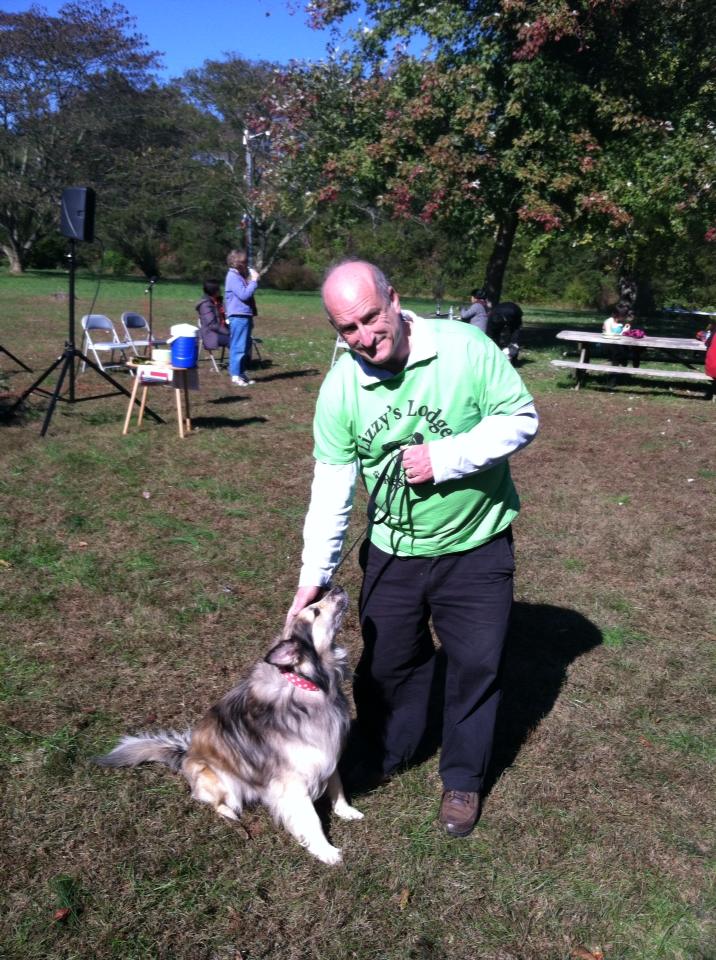
This past Saturday, October 26 was KPC’s first Love Your Pet Day, a family-friendly pet fair. Designed as a fundraiser for KPC’s ongoing renovation project, it was a resounding success, raising over $1100 to benefit the project.
The weather was beautiful – a crisp and clear fall day that was perfect for enjoying our 65 acres. Activities included pet blessings, guided tours of KPC’s Peace Park, bake sales for both humans and pets, face painting for kids and reiki and acupuncture for pets. We even had a dress-up your pet photo booth. The event was entirely outside because the number of animals visiting would have been difficult to manage in our newly renovated prayer room, open since September.
Special thanks go to Mama Lucia’s Restaurant and Nick’s Pizza & Subs for providing our lunch, Bark! Pet Store and Elizabeth Elgin for providing raffle prizes, Drs. Pema Mallu and Kitty Raichura, of Holistic Veterinary Healing, for offering pet acupuncture, Robin Gough who gave reiki and massage for pets and our partners in animal welfare, Lizzy’s Lodge Pet Rescue and MCPAW (Montgomery County Partnership for Animal Well-being).
We look forward to seeing everyone next year at the 2nd Annual Love Your Pet Day!
The “Clergy Without Borders” bus rolled up to the Unitarian Universality Church in Rockville at 4:20pm on Sunday – just about on schedule – for a rally in Montgomery County. Clergy Without Borders” is an interfaith effort that acknowledges diversity and seeks to raise consciousness of peace and unity in Maryland. A bus of 12 clergy drawn from Christian, Jewish, and Muslim traditions traveled over a 4 day period to a dozen communities in Eastern, Central and Western Maryland. The rally in Rockville featured remarks from County Executive Ike Leggett and included musical offerings from Sikh, Jewish and Unitarian musicians, statements from clergy on the bus of personal commitment to creating a safe environment for all spiritual traditions, and a rousing call to action by one Imam who asked that everyone, when they look in the mirror, to recognize the face of other spiritual traditions. Montgomery County interfaith groups also gave a short description of their work in County.
KPC friend Rev. Mansfield “Kasey” Kaseman spent three days on the bus with the Clergy Without Borders and was the emcee for the Rockville rally. He introduced County Executive Ike Leggett who reaffirmed his and the County’s commitment to a diverse and peaceful Montgomery County. The Clergy Without Borders group departed for Baltimore, their last stop, at 6pm. Four sangha from KPC attended this event – Gonpo Yeshe (David) Williams, Tashi Dawa (William) North, Ani Alyce Louise Bertsche, and Ani Tenzin (Lynn).
The following is from a series of tweets by Jetsunma Ahkon Lhamo on the first Guru Rinpoche Day of 2012:
Interesting isn’t it, how we tend to think only of ourselves, and not even realize it?
When His Holiness Penor Rinpoche passed to his Parinirvana I thought I’d never recover. But of course this happens, and we do. We must.
I knew there must be a transition for the Palyul Lineage and that although His Holiness Penor Rinpoche prepared us all, some instability may happen. It showed me how loved and powerful he was/is.
He rebuilt Palyul in India after crossing the Himalayas, starting with many and landing with so few – His Holiness Penor Rinpoche made mud bricks himself.
He was, and is, Palyul, as are his Heart Sons.
And now His Holiness Karma Kuchen Rinpoche is on the throne. Great confusion for a bit, and how it’s all right as rain.
What I never expected was how precious a jewel he was to the very fabric of reality – to many of us, the whole world, communal karma, the very universe, (cannot personally speak to the other three million myriads of universes.) The fabric of our lives changed tremendously.
We have a jewel on Palyul’s throne now. Yet the Dharmakaya Buddha who sat before is glorious, peerless, beyond measure. And I miss him so much! And always will. How precious to know he is always with us.
Lord of my life, please return to us swiftly! I’m calling you! Not like a lonely toddler, but with the force of love and the yearning of a small flower for the glory of the sun.
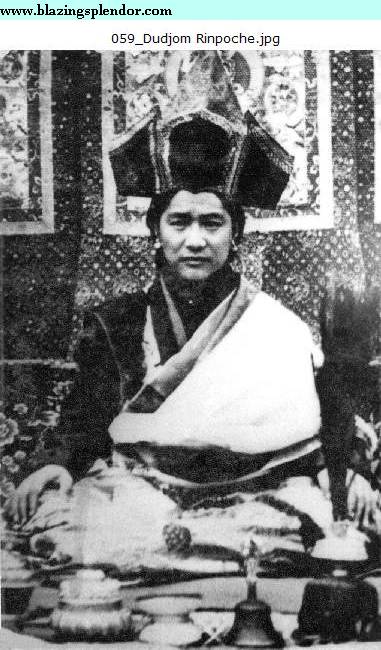
The following is respectfully quoted from “Perfect Conduct: Ascertaining the Three Vows” by Ngari Panchen with commentary by Dudjom Rinpoche as translated by Khenpo Gyurme Samdrub and Sangye Khandro
The initial virtue, the intermediate virtue, and the concluding virtue are the three divisions in this and in all commentaries that are written based on the Buddha’s spoken teachings. These three divisions are similar to the three pure recollections: those of motivation, nonconceptual awareness during the actual practice, and the concluding dedication of merit. In the initial virtue there are the three divisions that explain the title of the text, the homage, and the commitment to compose.
I. The Title of the Text:
A Branch on the Path of the Natural Great Perfection Called Ascertaining the Three Vows
Within the profound expanse of the innate, unaltered, natural mind, all meanings, including the foundation, path, and result, are originally perfected. This spontaneous presence, which is unsurpassed by any other, is called “great.” The unmistaken actualization of this nature is the ultimate fruit of all paths, the atiyoga. From anuyoga on down, all the paths of sutra and tantra are practiced in order to realize this nature. In this way they are established as “branches” of the path. The three vows, the essence of the practice of all these paths, are the main subject at hand. To establish an accurate understanding of the view of the three vows through the three investigations–actual, inferential, and scriptural–is the meaning of “ascertaining.”
Sastra literally means that which has the potential to sever all negative emotions and grant refuge from rebirth in the three lower realms. Specifically, a sastra is a commentary on the Buddha’s teachings written by a perfect follower. There are three levels to be considered here. Ideally, the author of sastra must have realization of the nature of dharmata. To qualify as average the author should have had a vision of a deity. At least, the author should be perfectly learned in the five major sciences. In addition, the commentary must be eloquently written with the qualities and ability to alleviate the causes of delusion, as well as to produce the results that grant protection from inferior rebirths in cyclic existence.
The purpose of the title will vary according to the sensibility of the reader. Those of superior sensibility, just by reading the title, will be able to realize the entire meaning of the text. Those of average sensibility will derive a general idea of its contents, and those of common sensibility will become interested and inspire to begin to study the text.
II. Homage:
A. General homage to the supremely kind guru:
Namo Guruve!
Homage to the Guru-Lama!
“Namo” means to pay homage. “Guru” describes an individual whose noble qualities are limitless, whose wisdom-knowledge is unsurpassed, and whose great loving-kindness is unequalled. To such a guru-lama, with great admiration and respect from the three doors of body, speech, and mind, homage is rendered.
B. Specific homage to the great master, Padmasambhava:
By churning the treasure ocean of the glorious two accumulations, the white light of knowledge and loving-kindness brings forth the all pervasive rain of the definitive secret vehicle. To the supreme crown jewel of all scholars and accomplished masters of Tibet’s Land of Snow, to the guide of all sentient beings, the Lake-born Vajra (Guru Padmasambhava), I pay homage!
It is believed by the Vedic school of Hinduism that by churning the ocean the moon arose. The author draws from this example to poetically illustrate the qualities of Guru Padmasambhava. By churning the vast ocean of accumulation of ordinary and wisdom merit, supreme wisdom and loving-kindness arise indivisibly, forming the mandala of the moon with its cooling, moist, illuminating rays. The all-pervasiveness of a rain shower is likened to the spontaneity of the concerned action that arises from such a “moon” to reveal the secret mantra teachings in order to tame the minds of beings.
This analogy exemplifies the object of specific homage, the great master Padmasambhava, who is the very embodiment of the great ocean of the two accmulations of merit, the source from which all enlightened qualities of wisdom-knowledge and compassion arise. As the supreme crown jewel of all scholars and accomplished masters in the three realms, including the snow land of Tibet, he is well known as the Lake-born Vajra.
The Lake-born Vajra, Padmasambhava, was born from the center of a lotus without depending on parents. The word “vajra” refers to the transcendence of the concept of birth and death. Because he possesses the wisdom to guide all beings on whatever level is necessary according to their specific needs, he is known as the supreme guide of beings.
III. Commitment to Compose:
This sage, skilled in knowing how to cleanse the mental stains of beings and upholding the lapis lazuli vase of supreme intelligence, bestows the ambrosia-like explanations of the three vows. May all those with sincere interest gather here to partake of this!
The author, Ngari Panchen, refers to himself as a sage, defined as one who is wise in the worldly knowledge of what to accept and reject. As is the case with all scriptural commentaries, the author’s “commitment” must reveal with superiority the four necessities of this Dharma. The first necessity is the subject, in this case the three vows. The second necessity is a superior explanation of the subject so that the meaning and purpose can be fully understood, leading readers to embark upon the path to liberation. This bestows temporary benefit. Fourth, the interdependent relationship between each of these four is demonstrated, in that one arises in dependence upon the other and accomplished accordingly.
The following are the lyrics to The Mother’s Song, recorded by Jetsunma Ahkon Lhamo in 1992. You can listen to the recording by clicking the link above.
The following is dedicated to the wonderful neighbor, an angel, who brought our Brenna back home to us:
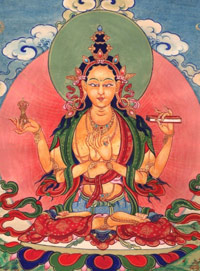
Thus have I heard. Once the Blessed One was dwelling in Rajagria at Vulture Peak Mountain, together with a great gathering of the sangha of monks and a great gathering of the sangha of bodhisattvas. At that time, the Blessed One entered the samadhi that expresses the dharma called “profound illumination,” and at the same time noble Avalokiteshvara, the bodhisattva mahasattva, while practicing the profound prajnaparamita, saw in this way: he saw the five skandhas to be empty of nature.
Then, through the power of the Buddha, venerable Shariputra said to noble Avalokiteshvara, the bodhisattva mahasattva, “How should a son or daughter of noble family train, who wishes to practice the profound prajnaparamita?”
Addressed in this way, noble Avalokiteshvara, the bodhisattva mahasattva, said to venerable Shariputra, “O Shariputra, a son or daughter of noble family who wishes to practice the profound prajnaparamita should see in this way: seeing the five skandhas to be empty of nature. Form is emptiness; emptiness also is form. Emptiness is no other than form; form is no other than emptiness. In the same way, feeling, perception, formation, and consciousness are emptiness. Thus, Shariputra, all dharmas are emptiness.
“There are no characteristics. There is no birth and no cessation. There is no impurity and no purity. There is no decrease and no increase. Therefore, Shariputra, in emptiness there is no form, no feeling, no perception, no formation, no consciousness; no eye, no ear, no nose, no tongue, no body, no mind; no appearance, no sound, no smell, no taste, no touch, no dharmas; no eye dhatu up to no mind dhatu; no dhatu of dharmas, no mind consciousness dhatu; no ignorance, no end of ignorance up to no old age and death, no end of old age and death; no suffering, no origin of suffering, no cessation of suffering, no path, no wisdom, no attainment, and no non-attainment. Therefore, Shariputra, since the bodhisattvas have no attainment, they abide by means of prajnaparamita.
“Since there is no obscuration of mind, there is no fear. They transcend falsity and attain complete nirvana. All the buddhas of the three times, by means of prajnaparamita, fully awaken to unsurpassable, true, complete enlightenment. Therefore, the great mantra of prajnaparamita, the mantra of great insight, the unsurpassed mantra, the unequaled mantra, the mantra that calms all suffering should be known as truth, since there is no deception. The prajnaparmita mantra is said in this way:
TADYATA OM GATE GATE PARAGATE PARASAMGATE BODHI SVAHA
Thus, Shariputra, the bodhisattva mahasattva should train in the profound prajnaparamita.”
Then the Blessed One arose from that samadhi and praised noble Avalokiteshvara, the bodhisattva mahasattva, saying, “Good, good. O son of notble family; thus it is, O son of noble family; thus it is. One should practice the profound prajnaparamita just as you have taught and all the tathagatas will rejoice.”
When the Blessed One had said this, venerable Shariputra and noble Avalokiteshvara, the bodhisattva mahasattva, that whole assembly and the world with its gods, humans, asuras, and gandharvas rejoiced and praised the words of the Blessed One.
Lotsawa bhikshu Rinchen De translated this text into Tibetan with the Indian pandita Vimalamitra. It was edited by the great editor-lotsawas Gelo, Namkha, and others. This Tibetan text was copied from fresco in Gegye Chemaling at the glorious Samye vihara. It has been translated into English by the Nalanda Translation Committee, with reference to several Sanskrit editions.
The following is a teaching by Jetsunma Ahkon Lhamo called “Desire Blocks Happiness”
I don’t know how many times people have come to me and said, “Gosh, I’m so excited about this path! I would love to practice this path. It seems so wonderful! I’m so excited about this path. But you know, that’s like me. I always get really excited about things, and I jump into them; and I get really on fire, and then I burn out real quick. But maybe this one is different! This could be it!” Well, you know, that’s the example that I can give you that I see again and again and again and again. But people are like that about everything! Whenever we get a new object, we get real excited about it, or we become attached to it; and we think this is the thing that is going to make us happy. But it isn’t. Or we get a new relationship, and we just get all in love, and in friendship, and whatever it is, enamored. And then we think, “Oh, this is going to be the one that makes a difference!” And then, well it does, but it isn’t. It really isn’t.
What are we actually seeing? First of all, we’re actually seeing the faults of cyclic existence. What begins must end. What goes up must come down. What causes us to be supremely elated must also cause disappointment. What comes together must result in separation. That is the fault of cyclic existence. That is its quality. We’re seeing the reflection of the condition of cyclic existence. More than that, we are seeing the reflection of our own mind. Our own mind. Our own mind has within it the karma, or cause and effect set-up, if you will, to be able to experience that kind of thing again and again and again. That is our habitual tendency. We are suffering from a kind of inflammation of the mind. The mind is inflamed. Interestingly, the very thing that causes us to be so inflamed by some new toy, you know, some new relationship, some new thing that comes into our life, some new event, some new job, some new spiritual path, some new idea… Something that comes into our mind that causes us to be sooh, gosh! everything’s going to be different now!So breathlessly excited. Everything that comes into our mind like that, that quality of inflammation. And it is like an inflammation, isn’t it? We become all puffed up and red like inflammations. That quality of inflammation is the same quality that will actually lead to the downfall of that particular circumstance to satisfy us, because that very inflammation is an indication of the instability of our minds.
A diplomat makes one final speech. Then things change and a more focused attitude prevails. Someone has made a decision, but you may not hear about it for a while. The indecision that has characterized the times has ended.
Spend today going over old material, reviewing matters and making adjustments. It’s not a good time to move forward in a brand new activity. Only consider things you’ve looked at previously. Communication with others is fun and someone will tell you how much you mean to them. Believe it! Everyone wants to put things in writing. Do so yourself and you’ll be surprised later at how jumpy your thoughts are. Two powerful planets are involved in a standoff with each other. Please don’t intervene. An African proverb says “When elephants fight, it’s the grass that gets hurt.” Stay away from volatile situations. What’s good? Work on small projects is energizing, news from afar brings happiness, and food is your best friend!
The daily astrology post affects everyone. Because individual charts vary, the circumstances outlined in the post will affect people differently. Some will feel this energy in the personal arena, some in finances, some with children or family, some in work and so forth. There are many departments of life. Look to see where the dynamic affects you!
The following is respectfully quoted from “Reborn in the West” by Vicki Mackenzie as she recounts Jetsunma’s life story. This section begins as Jetsunma describes her early practice:
‘I left the party at that point,’ was how she put it. ‘I felt “There’s nothing here.”‘ Her meditation then took a quantum leap–right to the heart of mysticism, to the fount of truth.
‘In my next dream I was guided to meditate on the question “If what I have here does not amount to much because it is so finite, then what is there of value?”‘ Suddenly she found herself contemplating absolute reality, or ultimate truth, the primordial wisdom state and the most profound and difficult subject of all Buddhist meditations.
‘I didn’t have the words for it but I knew it wasn’t like God, the old-man-on-the-throne idea. What I was meditating on was a non-dual, all-pervasive essence–that is, form and formless, united, indistinguishable from one another. I saw that it was the only validity–that and the compassionate activity that was an expression of it.’
What Jetsunma was telling me was, I recognized, quite exceptional. What yogis and scholars in Tibetan monasteries take years to achieve after long intellectual delving and even longer years of retreat, Jetsunma had arrived at entirely of her own accord. Tucked away on her farm in North Carolina without any guru, any book, any established doctrine or example to follow, she had not only discovered but realized the two essential truths–wisdom and compassion, the two wings of Tibetan Buddhism that are said to fly you all the way to Enlightenment. Without them you can barely get off the ground. It was an amazing feat.
But she didn’t stop there. While she continued to meditate on absolute nature and compassion she simultaneously began to offer up her body, part by part.
‘This is going to sound strange,’ she said, laughing, ‘but I would lie down–I didn’t know you were suppose to do all of this sitting up–and I would look down at my feet and say, “OK, here they are, ten toes.” And I would really look at my feet and consider all the things that my feet could do for me. And then I would contemplate what was the ultimate good of these things–no ultimate use at all!” ‘ She would continue in that vein throughout her body, staying longer on the parts she felt attached to. ‘No one wants to give up their head, for instance. Our head is like the last bastion of our individuality. And I’d pay special attention to my female parts and my hands. You don’t want to do without them!’
She didn’t know it then, but what she was doing was no less than Chöd, another profound Tibetan meditation whereby you relinquish your body to emptiness for the good of all. It is considered the ultimate physical surrender. How she had come across such a strange meditation in the middle of North Carolina, with only a baby and husband for company, adds to the mystery. I asked again, to make sure, if there were any outside influences that could have been directing her.
‘We were in Ashville in the seventies and nothing metaphysical was happening there,’ she replied. ‘Actually there was one thing–a small transcendental meditation centre had started and friends kept urging me to join. But I resisted. It didn’t feel as though it was the right place for me. They said I had to have a guru, that I couldn’t get anywhere without one, and I replied, “That may be true, but I haven’t found my teacher yet and I will know when I do.” ‘
She continued these intense periods of individual meditation over several years. ‘I would meditate for hours at a time. Luckily I had a baby who was peaceful and slept a lot, and a husband who was supportive of what I was doing. I am eternally grateful for that. But it was still a householder’s retreat. I had a husband, a child and all the chores to do. Even so, I had a much stricter schedule of meditation than I do now.’
The meditations grew in strength and clarity, and when she was around thirty she had a spiritual experience which showed that the time to begin her work had begun. She was reluctant to tell me about it, except to say that she entered a long period of meditation from which she emerged knowing that her personal life had finished and that she had been born solely to be of benefit for others. ‘I never said anything to anyone about it. But oddly, after that people started coming to me.’



![Attendee Group Picture[1]](https://www.tibetanbuddhistaltar.org/wp-content/uploads/2013/11/Attendee-Group-Picture1.jpeg)