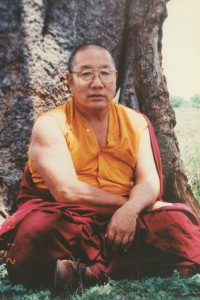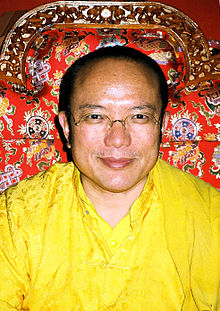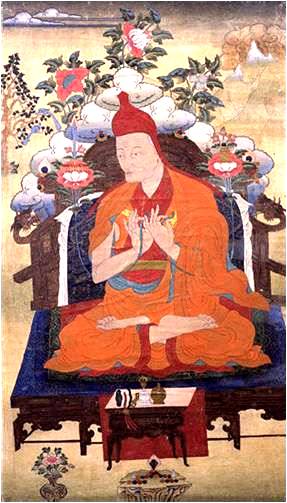
Direct Perception: Jamgön Kongtrul

jamgon_kongtrul_by_ctr_295

The following is respectfully quoted from “The Treasury of Knowledge: Book Six, Part One by Jamgön Kongtrul:

Direct Perception of the Sense Organs [1″]

The defining characteristic of the first of these is [bare] consciousness consisting of extraneous awareness, which arises without conceptuality and without bewilderment, directly from the physical sense organs that constitute an individual’s own predominant condition. It has five aspects, corresponding to the direct perception of the [five] sense organs [the eye and so forth] which apprehend their respective sense objects.

Direct Perception of Mental Consciousness [2″]

The defining characteristic of the second is [bare] consciousness consisting of extraneous awareness, which arises without conceptuality and without bewilderment, directly from the sense faculty of the mind that constitutes an individual’s own predominant condition. It too has five aspects, corresponding to the direct perception of the [five aspects of] mind, which apprehend their respective sense objects.

Direct Perception of Intrinsic Awareness [3″]

The defining characteristic of the third is [bare] consciousness transcending all the other aspects of consciousness, which is exclusively introverted (kha nang kho nar ‘phyogs pa’i shes pa).

Direct Perception of Yoga [4″]

The defining characteristic of the fourth is the [bare] consciousness of a sublime being (ārya, ‘phags pa), free from conceptuality and without bewilderment, which derives from the power of genuine meditation (bhāvanā, sgom). When the last of these is analyzed, there are in fact three modes of the direct perception of yoga, corresponding to the [meditations of] the pious attendants, the hermit buddhas (pratyekabuddha, rang rgyal), and the [bodhisattva] followers of the Greater Vehicle–these are exemplified respectively by the path of insight (darśanamārga, mthong lam) attained by the pious attendants, the path of insight attained by the hermit buddhas, [and so forth].

The Nature of Perception: His Holiness Dudjom Rinpoche

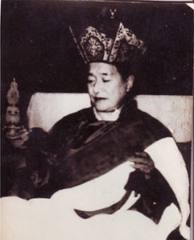
His Holiness Dudjom Rinpoche

The following is respectfully quoted from “The Nyingma School of Tibetan Buddhism” by His Holiness Dudjom Rinpoche:

Although all these phenomena are compounded internally by the mind, their apparitional aspect and supporting foundation are the five gross elements of which external objects are compounded, and which are caused, conditioned, supported and substantiated by the fourfold process of creation, duration, destruction and dissolution. As the number of mental propensities through which they appear as objects expands, the world realm of desire containing the four continents, Mount Sumeru and perimeter appears like a dream, along with the realm of form, which originates from the contemplation of the summit of existence, and so on. In brief, the entire array of the inanimate container and animate creatures, mobile and motionless, subsumed by the three world realms, does not appear in the ultimate vision of sublime beings. Rather, it is an apparitional mode of the bewildered intellect of sentient beings, which appears by the power of the subject-object dichotomy lapsing into delusion, like water in a mirage, and into erroneous perception, like seeing a mulicoloured rope as a snake. As it is said in the Pearl Necklace (mu-tig phreng-ba, NGB Vol.9):

In this way, the diverse appearances
Resemble a rope when seen as a snake.
Though not so, by clinging to them as such
The outer container and inner essence
Are established as duality.
The rope itself, on further investigation,
Is primordially empty of container and essence.
The ultimate takes form as relative.
That perception of the snake is visually true,
The perception of the rope is genuinely true.
Enduring, for example, as a bird relates to a scarecrow,
The independent existence of the two truths
Refers only to the relative world.
It has no relation to genuine reality.
Because of the expanse of emptiness
The essence of that [reality] is that all is free.

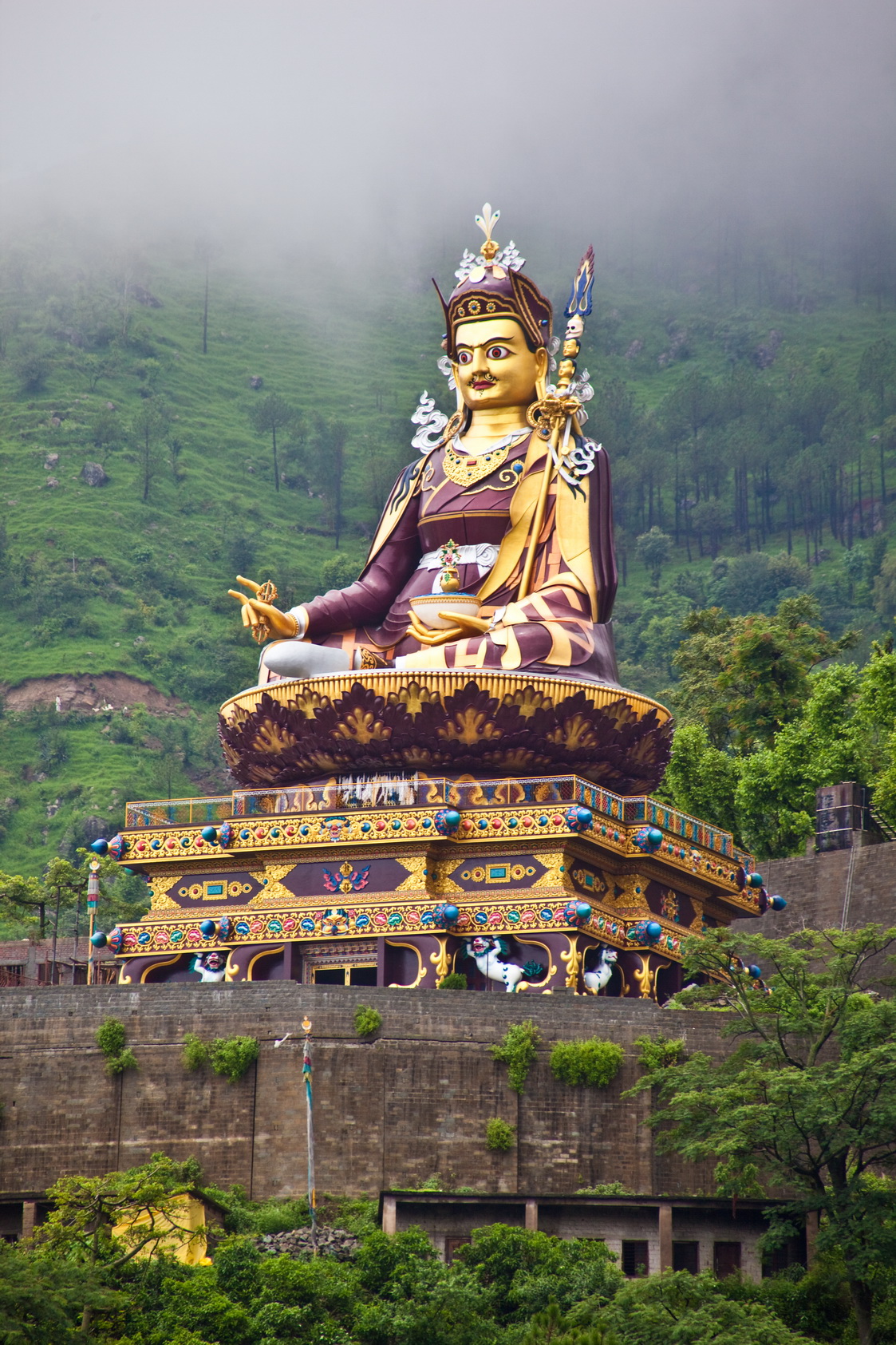
Prayer to Guru Rinpoche

The following prayer is from “Buddha in the Palm of the Hand” Nam Cho Ngondro:

HUNG HRI: NGON GYI KAL PAI DONG PO LA
HUNG HRI: In the past, at the beginning of this aeon,

ORGYEN YUL GYI NUB JANG TSAM
In the Northwest country of Uddiyana,

DANA KO SHAI TSO LING DU
On an island at lake Danakosha,

PADMA GESAR DONG PO LA
Born in the pollen heart of a lotus

YA TSEN CHOG GI NGUDRUB NYEI
Possessing astonishingly supreme spiritual attainments,

PADMA JUNG NEI SHEI SU DRAG
You are well known as Padma Jungney (the Lotus Born),

KHOR DU KHANDRO MANG PO KHOR
Surrounded by a retinue of many Dakinis,

KHYED KYI JEY SU DAG DRUB KYI
Following you, I practice

JIN GYI LAB CHIR SHEG SU SOL
Please come forth to bestow blessings,

NAI CHOG DI RU CHIN PHOB LA
Bestow blessings upon this supreme place of practice.

DRUB CHOG DAG LA WANG SHI KUR
Confer the Four Empowerments upon me, an excellent practitioner,

GEG DANG LUG DREN BAR CHED SOL
Dispel the obstructions of harmful and misleading spirits.

CHOG DANG THUN MONG NGUDRUB TSOL
Please grant me the common and supreme spiritual attainments.

OM AH HUNG BENZAR GURU PEDMA THOD TRENG TSAL BENZAR SAMAYA DZA SIDDHI PHA LA HUNG AH

The Eight Great Chariots

Marpa

The following is respectfully quoted from “Treasury of Knowledge” by Jamgön Kongtrul:

As was said by the great learned adept Prajńāraśmi:

Prophesied by the Victor, the lord of beings in the snowy land,
[Who taught] exclusively the single doctrine of the full intention
For his Royal Highness the ruler,
Is the second Teacher in these snowy ranges.
The great editor-translator Bagor Vairocana,
The heir of the victors, Upāsaka Dromtön,
The great scholar-adept Khyungpo Naljor,
The great bilingual Lama Drokmi,
The mighty yogin, honorable lord Marpa,
The Indian Dampa who dwells on levels of attainment,
The translator Gyijo, and the scholar-adept Orgyenpa
Are the eight great pillars that upheld the practice lineages in the North.
Coming perfectly from the glorious Buddha Vajradhara,
Eight great pillars of practice lineages in the snowy region
Are the legacy of former adepts.
Those who desire freedom should follow their paths.

The Celestial Sphere and Time-Conjunctions

images

The following is respectfully quoted from “Treasury of Knowledge” by Jamgön Kongtrul:

The celestial sphere pervades space between Mount Meru and the mountain of fire.
It is a belt of wind, within which the twelve houses
And the twenty-eight constellations formed first.

The celestial sphere pervades the space between the outer circumference at which the [outermost impenetrable] enclosure of Mount Meru meets Cool Mountain Range and the inner circumference of the mountains [ring] of fire [i.e., Horse-faced Fire]. The celestial sphere is a circular belt possessing the nature of wind that supports [all] the celestial palaces of the gods. Since it is slightly higher near Mount Meru, it has the bent shape of a bow. Near the mountainous [ring] of fire, it is slightly lower, resembling a lotus petal. It forms a complete circle [around Mount Meru].

Concerning the meaning of the word,

The [Sanskrit] term gola (celestial sphere) may be translated
As hollow, concave and convex, circular, heavy and light, and so forth.
Translated precisely, it denotes “that which holds up the heavens.”

The form [of the celestial sphere] is described differently by different scholars–as resembling the spokes of a wheel; rising up or spreading out; as resembling a stack of helmets, a chain or shield. [These descriptions] are based on reason and scriptural reference. The view that the celestial sphere is shaped like a cluster of boats eventually became the most prevalent. The eight lord [Karmapa] Mikyö Dorjé, with some amusement, provided a clear description of this in the Ocean of Mind.

The term “house,” from the [Sanskrit} raśi, denotes a gathering or cluster. The Fundamental Tantra of Manjuśri states that there are thirty-six houses; other sources present different enumerations. Regardless of how many houses have formed on the celestial sphere, twelve houses exert the most pronounced influence–both positive and negative–on [the affairs of] this world. They are:

Aries, Taurus, Gemini, Cancer, Leo, Virgo, Libra, Scorpio, Sagittarius, Capricorn, Aquarius, Pisces.

Infinite numbers of stars are contained within the houses, which are the area of their rotation. The sage Delight in Stars (Jyotiráma) has stated:

Know that the number of stars
Is two hundered and eighty-five million.

Further,

In some discussions related to phenomenology, it is said
That in the sky of six empty spheres,
Ngāga eyes see the number of stars.

Thus, there are [many viewpoints] such as [this one that asserts] there are 28,000,000 [stars]. In the center of all stars is the pole-star and Canopus, which are shaped like a top ornament and its surrounding canopy. In addition, twenty-seven constellations are considered in astrological calculations to predict the outcomes of specific actions:

  1. Beta Arietis
  2. Thirty-five Arietis
  3. Eta Tauri
  4. Aldebaran
  5. Lambda Orionis
  6. Alpha Orionis
  7. Beta Geminorum
  8. Delta Cancri
  9. Alpha Hydroe
  10. Regulus
  11. Delta Leonis
  12. Beta Leonis
  13. Delta Corvi
  14. Spica Virgis
  15. Arcturus
  16. Alpha Libroe
  17. Delta Scorpio
  18. Antares
  19. Lambda Scorpi
  20. Delta Sagittari
  21. Sigma Sagittari
  22. Alpha Aquiloe
  23. Beta Delphinum
  24. Lambda Aquarius
  25. Alpha Pegasi
  26. Gama Pegasi
  27. Zeta Piscum

The constellations called Lyra and Alpha Aquiloe are both situated in one star cluster; however, they may be counted separately to make twenty-eight. Concisely expressed, the houses, the twenty-eight constellations, and so on formed [before the planets].

[The houses] are situated in a clockwise arrangement.
Planets such as the sun and moon rise above them.
[Eight] move counter-clockwise; Eclipser [moves] clockwise.

Each constellation is divided into four quarters nine such quarters situated in each house. Thus, Beta Arietis, Thirty-five Arietis, and one quarter of Eta Tauri are situated in Aries House and so on. [The houses and constellations] are situated in a clockwise arrangement. The first of these houses is Aries, and the first constellation is Beta Aries, since this is where the movement of the sun begins [at the beginning of the year].

The planets rise above the stars that are positioned within their respective houses. These include the Sun in the last quarter of Beta Geminorum and the moon in the first [quarter] of Beta Arietis, and so forth. These planets govern the houses and constellations like lords.

The ten planets are Sun, Moon, Mars, Mercury, Jupiter, Venus, Saturn, Long Tail of [Smoke], Eclipser, and Fire of Time.

The eight from the Sun to Long Tail begin their natural movement counterclockwise around Mount Meru, and Eclipser and Fire of Time clockwise. Four of these–Sun, Mars, Jupiter, and Saturn–are called malelfic planets because they are right branches; and the four–Moon, Mercury, Venus, and Long Tail–are called benefic planets because they are left branches.

Heart Teaching by His Holiness Penor Rinpoche

MG-86-18 HHPR

The following is an excerpt from a Heart Teaching by His Holiness Penor Rinpoche given at Palyul Ling:

Without any kind of doubts and with complete determination, carry through the supplication prayer.  Until we attain complete enlightenment, we have to rely on and depend on the lama.  Through gratefulness to the lama we can enter the actual path. With our afflictive, emotional mind, it is possible for us to give rise to all sorts of conceptual thoughts.  Our mind has so much afflictive emotion, which constantly arises with all sorts of doubts.  This will always obscure the path of liberation.  In the past, all the great masters and highly accomplished beings, without caring about the eight worldly concerns, completely dedicated themselves through the practice to abandoning all the afflictive emotions.  Then with single-pointed mind, they spent their whole lives continuously doing the practice.  Of course we all really like the idea of getting into those high bhumis, high realizations or high paths.  But still somehow from beginningless lifetimes, we have gotten so habituated to all sorts of defilements and afflictive emotions that are constantly arising and from which we cannot liberate ourselves.  For instance, from the moment that a child is born, he or she spontaneously has all the afflictive emotions.  Nobody has to give any teaching or training on afflictive emotion.  It is naturally there.  However to turn one’s mind towards the Dharma, one must work hard and train.  It seems so difficult.

As for samsaric or worldly activity, we work our whole lives, but still we can’t get rid of our attachment or clinging to it.  No matter how much difficulty and hardship we go through, still we have a great deal of patience.  No matter what material wealth or belongings we try to get, we are never content.  We never have satisfaction thinking, “Oh now I have enough.  This much is ok.”  We are never satisfied.  We collect all these material belongings.  Even if we collected so much stuff that we filled up an empty house, we would still want more.

Our mind is also emptiness and that is why no matter how much wealth we may have, we never feel satisfied, and still want more.  We should have less attachment to material or worldly activity, and try to be content.  We should always try to give rise to devotion, inclination, and faith in relation to Dharma practice.  Within samsara no matter what sorts of sufferings we are experiencing, we should realize that there is even more suffering, and through that we should turn our mind towards the Dharma and concentrate on the real practice.  With one’s mind, body, and speech all together, concentrate on the supplication prayer with single-pointed devotion and faith, and inclination in relation with one’s root teacher until one attains complete enlightenment.  Until enlightenment one takes refuge and supplicates to continue with these practices.

You also need to generate compassion and loving kindness towards all sentient beings who, in one lifetime or another, have all been your parents and very kind to you.  Because of obscurations and not recognizing their true nature, they wander in samsara experiencing all sorts of suffering, even in the unbearable hell realms.  Understanding that, one needs to generate compassion and loving kindness.  To obtain the ultimate happiness, complete enlightenment – Buddhahood, we have to concentrate on the bodhicitta through which we can get onto the right path.  All the countless past Buddhas and Bodhisattvas concentrated on the thought of bodhicitta and benefitting other sentient beings, and completely abandoned self-cherishing.  In that way they attained the ultimate happiness.

Somehow from beginningless time, we have been constantly concentrating on self-benefit and self-cherishing, always working to accomplish that.  That is why we still are not liberated, and are wandering in samsara.  What we need to abandon and what we need to apply into practice has been completely and clearly taught by the Buddhas and all the masters.  For a moment, when we hear all the teachings, we have some sense or feeling, but we cannot retain it in our mind, and then again we forget everything.  The most important part of this practice is to obtain the ultimate happiness or Buddhahood.

With full devotion, inclination, and single-pointed faith, do these prayers.  With one’s single-pointed mind, completely relying upon the Guru, do these supplication prayers.  Have a stabilized mind with the inclination to receive the vase empowerment, the secret empowerment, and then the wisdom empowerment or word empowerment from the body, speech, and mind of the root teacher.  One’s root teacher in the form of Guru Padmasambhava is inseparable with the enlightened mind of all the past, present, and future Buddhas.  Having that sense of understanding and belief, as we do the meditation on the Guru dissolving into oneself, mingle one’s body, speech, and mind with the Guru’s enlightened body, speech, and mind.  Try to rest in that nature.  Breathe very softly and in a relaxed way with the exhalation a bit longer than the inhalation, not breathing in right away.

Places That Are Not Destroyed

Lotus

The following is respectfully quoted from “Treasury of Knowledge” by Jamgön Kongtrul:

The pure realms and the Seat of Enlightenment, etc., are not destroyed
Since they are not the result of the origin [of suffering].

Are there places in this world-system not subject to formation and destruction? The pure realms of the enjoyment dimension of awakening, the natural radiance of pristine wisdom of the exalted ones, are such places. The realms that arise from the force of the bodhisattvas’ inconceivable virtue and vows to purify all realms–Blissful and Delightful, for example–belong to the same category. These realms are not subject to formation and destruction until the activity of the buddhas has been completed.

The Seat of Enlightenment, Vulture Peak, and other sacred places are not destroyed along with this world. Although they are [part of] this world, they have not originated from [evolutionary actions and emotions that are] the origin of suffering.


Q&A: Karma, Cause and Effect

JALonBBQuote from Jetsunma: “”All phenomena, the moment it naturally arises is completed.”

Question from student: Jetsunma, can you please explain that in more detail?

Jetsunma: There is no separation in time, and when phenomena arises both cause and effect manifest completely and together.

Question from student: …often so much time separates cause &effect that we can’t remember! Why do we experience things different from the way they are?

Jetsunma: We’ve experienced uncountable lives. Plenty of room for mistakes and good result both.

Question: OK, but if no separation in time, why do we experience cause &effect as separate?

Jetsunma: Because we have dualistic minds and it is we who perceive wrongly. Om Ah Hung Benzar Guru Pedma Siddhi Hung

Copyright © Jetsunma Ahkon Norbu Lhamo All rights reserved

The Relationship Between Those to be Guided and the Enlightened Guides

Jamgon Kongtrul

The following is respectfully quoted from “Myriad Worlds: The Treasury of Knowledge Book 1” by Jamgön Kongtrul:

For as long as infinite space and sentient beings exist,
The compassion of the victorious ones and the actions
of sentient beings continue without end.
Those to be guided and enlightened guidesmanifest through inconceivable interconnections.
When the characters and dispositions of those to be guided are activated,
[The compassion of] the guide [arises], and the configurations
of the realms and the dimensions of awakening appear;
The miraculous methods of guiding others manifest beyond all bounds.

For as long as infinite space and the countless dispositions of sentient beings exist, the compassionate strength of the victorious ones [buddhas] and the actions and emotions of beings will never end. The [variety of] characters and dispositions of beings (those to be guided to enlightenment) and the expressions of the compassion of buddhas (those who guide them) manifest fully due to the inconceivable power of natural interconnections.

By way of explanation, sentient beings [are unaware of the pure nature] of the [mind’s] sphere of reality. Consequently, their characters and dispositions [begin to manifest]. That is to say, instinctive unawareness acts as the principle cause and adventitious conceptualization as the contributing factor in activating the propensities of beings. Craving and grasping cause beings to form a connection with three realms.

The compassion of buddhas arises in response to this: inconceivable configurations of realms and the dimensions of awakening within those realms manifest spontaneously and effortlessly. The [buddhas’] methods of guiding beings, such as the four great miracles perceived by all, arise in an immeasurable and inconceivable display.

Particular Causes and Conditions

The sphere of reality never changes into something else;
Yet blessings, vows, actions and natural laws
Cause oceans of realms to appear. 

The sphere of reality, the sphere of vision of each of the joyful ones, completely transcends the limited domain of thought, expression, etc., and can be neither measured nor located. It never becomes anything other than itself, even to the slightest degree, nor is it affected by any other substance. At the same time, various causes and conditions–the blessings of the transcendent ones, the extraordinary vows made by bodhisattvas to purify realms, the convergence of sentient beings’ multitudinous actions, and natural law–cause oceans of realms to appear. The Flower Ornament Scripture  states:

The boundless oceans of realms that I have described
Have been purified by the Illuminator’s own qualities.
This buddha’s world of pristine wisdom is inconceivable,
As are his blessings and miraculous displays.

The bodhisattvas’ inconceivable oceans of vows,
Cultivated in response to inclinations of [beings],
And the inconceivable oceans of beings’ actions
Cause oceans of realms to manifest in all directions.

The miraculous powers of the bodhisattvas
And their intention to attain omniscience
Cause their oceans of vows to reach fulfillment
And limitless realms to appear throughout infinite space.

While cultivating boundless oceans of excellent conduct,
[Bodhisattvas] enter the infinite sphere of the joyful ones.
They spend endless eons in each realm
And purify all oceans of realms in all directions.
Actions generated by the inconceivable range of beings’ mentalities
Cause oceans of realms to arise.

[II]
THE ARRANGEMENT OF THE REALMS

This section has three parts: (1) a presentation of the realm called Richly Adorned; (2) a detailed explanation of the realm called Flower-Filled World; and (3) a description of the distinctive features of our own world-system, known as Endurance.

[II.A.]
The Richly Adorned Realm

This section has two parts: (1) a general description of the realm Richly Adorned, and (2) a description of the distinctive features of the realms within Richly Adorned.

[II.A.1]
A description of Richly Adorned

The realm Unsurpassed is free from incidental defilement
And transcends the experience of the three realms: it is
indivisible pristine wisdom.
In this self-manifesting, spontaneously appearing [realm,]
Richly Adorned,
Dwells Illuminator, Great Glacial Lake of Wisdom;
A billion realms in his every pore.

Enlightenment is attained when the naturally pure sphere of reality [of the mind] is freed from adventitious defilement, and the sphere of reality becomes inseparable from pristine wisdom. The place where this occurs is called Unsurpassed. It is not limited to any one place or direction, just as the images of one’s dream are experienced wherever one falls asleep.

The “Unsurpassed” place of enlightenment is not part of the confused, habitual experience of unenlightened beings, but transcends [everything experienced] in the three realms. This natural expression [of enlightenment] is a pure realm and has a celestial palace of pristine wisdom, without direction or division, adorned with an endless array of ornaments. Clouds of offering and adornments of complete enjoyment appear naturally and fill all space.

In this place so “richly adorned” dwells the expression of the effortless complete enjoyment of all buddhas, known as Illuminator, Appearing Everywhere, Great Glacial Lake of Wisdom. Each pore of his body contains hundreds of billions of realms, not to mention the infinite oceans of realms that exist within his whole body. Moreover, realms as numerous as the atoms in the [entire] realm appear within each atom [of each realm]. infinite oceans of [Illuminator’s] forms appear within his one form. Each form appears as though it were pervading all of the infinite oceans of his forms and realms. This exists by virtue of a great miracle that transcends the sphere of [ordinary] experience. [The Prayer for Excellence] states:

In as little as [the space of] a hair-breadth in every region without exception,
oceans of buddhas and oceans of realms,
As many as exist throughout all time.
As I engage in [excellent] conduct for an ocean of eons,
I resolve to enter them all!

[II.A.2]
The Distinctive Features of the Realms within Richly Adorned

Their locations, shapes, sizes, durations, and arrangements are inconceivable.

First, distinctions according to location [and configuration]: The Flower Ornament Scripture states:

Some oceans of realms of pure light rest within the infinity of space;
Others have a luminous nature and rest in oceans of jewels.

Further:

Many oceans of realms exceed all boundaries and rest in a vast sea of lotuses.

Further:

Vast oceans of realms rest within the buddhas’ blessing.

The existence of these realms depends upon four elements, the actions of sentient beings, the blessings of the buddhas, and so forth. These realms appear in a variety of configurations such as intersecting, upside-down, and right-side-up.

Second, distinctions according to shape:

Some realms are round, some or triangular,
Some appear square,
Some are [shaped like] eight-spoked-wheels, jewels, or lotuses;
All are designed by oceans of actions [of beings],

Third, [distinctions according to] size:

Each of the ten world-systems from Saffron Banner up to Resplendent Lotus increases in size and qualities by factors of ten. [Certain realms] that are manifesting now, such as Delightful and Blissful, are vast, whereas our own realm, Endurance, and even more so Thumb-Size (the realm of the buddha called Delight in Stars), and other [realms], are extremely small. The realm of All-Seeing Guide that will manifest in the future, Pure Cluster, will be immeasurably vast. There are many [descriptions] such as these.

Fourth, [distinctions according to] duration:

Some realms [endure] for just an eon,
Some for ten eons,
Some realms are said [to endure for] ten million eons times the number of their particles.

Fifth, distinctions according to arrangements of the decorations:

Some realms are richly embellished
With millions of realm-adornments.
These diversified ornaments of various styles
Appear as myriad optical illusions.

Some distinctions according to the presence of buddhas are expressed in these words:

In some realms, there are no buddhas;
In some realms, there are buddhas;
In some realms, there is one buddha;
In some, many buddhas.

[Concerning distinctions according to] light,

In some realms, there is no light.

Beginning with this reference to realms that are dark, fearsome, and terrifying, there follows:

…the light of palaces
…the light of the sun and moon,
…natural light, light of trees,
…light of mountains,
…light of jewels,
…light of lamps,
…light of buddhas.

Further

In some realms, there is the light of lotuses.

And:

In [others], the light of fragrant waters.

And:

These realms have been purified through the power of bodhisattvas’ vows.

Whether or not [a world-system] comprises four continents forms another distinction. Our own third-order thousand-world-system is divided into many four-continent [world-systems], whereas Blissful, as well as some other realms, are flat like the palm of a hand. Among those that comprise [four continents], there are many different sizes [of continents].

There are also distinctions regarding enjoyment. In Truly Joyous, for instance, the gods wish to be human. The massive mountain [that forms the axis of a four-continent world-system] can differ [from one realm to another]. Differences also exist in the forms of life: some beings have emotions, while others embody purity, and so on. Worlds exist in an inconceivable variety of ways.

[II.B]

The Flower-Filled World

This section has two parts: (1) an overall explanation, and (2) a detailed explanation.

[II.B.1]
Overall Explanation

Within the central minute particle in the palm of his hand lies the Oceanic World-System
That itself contains many world-systems, in the center of which
Lies the realm called Flower-Filled World.

Within the single minute particle in the very center of the palm of the hand [of the Buddha] Illuminator, Great Glacial Lake of Wisdom, lies the Oceanic World-System which rests in the center of the Enlightened One’s palm. Furthermore, Great Glacial Lake of Wisdom himself manifests throughout this world-system as an enlightened teacher. The magnitude of this inconceivable place is the sphere of experience solely of buddhas and bodhisattvas who dwell on the [three] higher stages [of awakening].

Numerous world-systems are found within the Oceanic World-System. In the center of these lies Flower-Filled World, the realm of the manifest dimension of awakening of Buddha Illuminator.

[II.B.2]
Detailed explanation

Furthermore, [between the wind] and Unsurpassed lie one billion four-continent world-systems,
A great third-order thousand [world-system].
Multiplying that by factors of one billion
[Yields] Infinite Links, Continuums, Oceans,
And Flower-Filled World.
Each rests on an ocean and [is encircled by] an outer rim.
This is the sphere of influence of one supreme manifest dimension of awakening.

The extent of the realm Flower-Filled World is determined in the following way:

First of all, the area that includes four continents, Mount Meru, and the outer rim of mountains–everything from the underlying configuration of wind up to Unsurpassed, the peak of existence–is referred to as four-continent world-system. An identical world-system is located in space at a distance of one thousand times the magnitude of that world-system. A total of one thousand such world-systems [evenly distributed in space], encircled by a rim, is referred to as a first-order thousand world-system. This considered as a single unit, replicated one thousand times and surrounded by a perimeter, is referred to as a second-order thousand world-system. One thousand [second-order thousand world-systems] enclosed by a great rim is called a third-order world-sysetm. Thus, one billion four-continent world-systems is called one great thousand third-order thousand world-system.

(Although teachers of phenomenology base their calculations on the area from the heaven [called] The Pure downwards, the description given here is based on the Marvelous Life of the Buddha, the Pure Golden Light Scripture, and other sources.)

The total number of world-systems comprising one Flower Filled World is calculated by progressively multiplying by factors of one billion: One billion great thousand third-order thousand world-systems constitutes the world-system Infinite Links. A billion of those is the world-system Oceanic Infinity. One billion of those is the extent of one Flower-Filled World. Each world-system rests on its own great ocean and is encircled by a rim. At the same time, one great rim encircles them all.

One [arrangement] of such dimension constitutes the sphere of influence of a single supreme manifest dimension of awakening. To those of limited intelligence, [the sphere of influence] is taught to be only a third-order thousand world-system.

[II.C]
Distinctive Features of Our Own World-System, Endurance

This section has two parts: (1) identification of Endurance, and (2) a supplementary explanation.

[I.C.1]
Identification of Endurance

Inside the great outer rim, within the seas of scented waters,
Four jeweled lotuses support
A tiered arrangement of twenty-five world-systems;
The thirteenth is known as Endurance.

Within the great outer rim of that [arrangement of one] Flower-Filled World are the indescribable oceans of fragrant waters [descending from] the body of Great Glacial Lake, as numerous as particles in all the buddha realms. In the center of these oceans are seas of scented waters filled with beautiful anthers on which rest four immense jeweled lotuses.

A tiered arrangement of twenty-five world-systems is supported by these [lotuses]. In the spaces between each [of these world-systems] are infinite tiers of world-systems, which define their boundaries. The thirteenth of these [twenty-five world-systems] is our own third-order thousand world-system, known as Endurance.

The Sanskrit term for Endurance is sahā, which denotes possession, forbearance, or capacity. All sentient beings who have taken birth in this realm endure emotions and sufferings. In other words, beings possess these [afflictions] in great measure. “Endurance” also signifies the forbearance of hardship. The bodhisattvas of this realm patiently endure [hardship] with exceptional courage and excel in bravery. Thus, this realm is known as Endurance.

[I.C.2]
The supplementary Explanation

The third-order thousand world-system
Is completely encircled by realms–Covered, Surpassing, Stainless, Variously Emerged, etc.–
Equal in number to the particles of this thirteenth world-system.
[Endurance] is spherical, has a four-vajra demarcation,
and rests on a multicolored configuration of wind and a network of lotuses.

This third-order thousand world-system of Endurance alone is encircled by buddha realms equal in number to particles of this thirteenth world-system. To the east is Covered; to the south, Surpassing; to the west, Stainless; and to the north, Variously Emerged. In the intermediate directions are Benefitting, Variously Appeared, Complete Joy, and Activator. Above and below are found Resounding Melody, Not Great, and others. Endurance is spherical and has a four-vajra boundary demarcation. It is supported by a multicolored configuration of wind and rests on a network of lotuses.

Illuminator, the teacher in this [world-system],
Appears throughout the Unsurpassed realms of the pure domain.

The enlightened teacher in our third-order thousand world-system [Endurance] is an emanation of the enjoyment dimension of awakening, the great Illuminator. This is a single form whose vast emanations appear throughout all the Unsurpassed realms in the pure domains and teach the Dharma in the midst of all the powerful [Bodhisattvas]. The Centrist scholar Dharmamitra explains:

This form, differentiated [from others] by vows, the power of cultivation [of merit and pristine wisdom], and intention, has attained complete enlightenment in one Unsurpassed domain alone. Therefore, the myriad forms of the enjoyment dimension of awakening that dwell in all the [other] Unsurpassed realms are solely his apparition manifesting in a vast [display].
This four-continent [world-system] called Destructible
Is surrounded by ten other four-continent [world-systems].

Our four-continent world-system, which is situated in the center of Endurance, is known as Destructible. It is said that even this [world-system] alone is surrounded by ten other satellite four-continent world-systems. Beginning from the East, these are, respectively, Well Protected, Joyful, Unbearable, Excellent Essence, Befriended, Fine Land, Lion Inhabited, Well Formed. Above is Bearing Wealth, and below Radiant Light.

It is taught that these [world-systems] are formed and destroyed together;
This is the experiential domain solely of the lords of the tenth stage of awakening.

The view most widely shared by Buddhist systems is that [the worlds within] any single third-order thousand world-system are formed together and destroyed [together]. Another view states that all realms of emanations of a single supreme manifest dimension of awakening (such as the oceans of realms that are located in the Flower-Filled World) are formed and destroyed together. The magnitude of this latter view is unfathomable to proclaimers and others; it remains the domain of experience solely of the lord [bodhisattvas] of the tenth stage [of awakening].

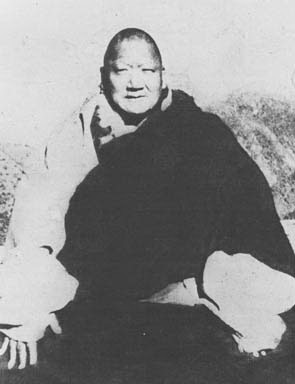
Turning the Mind Away from Samsara

Khentin_Tai_Situ_Rinpoche

The following is respectfully quoted from “The Dorje Chang Thungma” composed by Benkar Jampal Zangpo a commentary by Chamgon Kentig Tai Situpa 

Now going into a little bit more detail, the first is (and this is going with the particular order) zhen log; the literal meaning of which is one thing but it really means turning our minds towards enlightenment instead of samsara–turning our mind from samsara to enlightenment. It means that instead of going in circles, we now decide to go straight; because if we go in circles, no matter how big or how small the circles are, we still end up in the same place. The masters of samsara are going in such big circles that they don’t even know that they are going in circles–they don’t feel [that]; that is what we call ‘success’. But then after many lifetimes they end up in the same place, they don’t get anywhere. But those of us who are not good at samsara, our circle is so small that sometimes we just spin, then we get sick and we know something is wrong right away, but we still do it again and again and again. So that is both of us in samsara, going in circles.

Now the real meaning of zhen log is, instead of having attachment to samsara we turn our mind away from it by knowing that there is no point. For example, each one of us has been the king and queen of the universe countless times in the past; also each one of us has been born as a worldly god countless times in the past; each one of us has been born in the hells countless times in the past; each one of us has been born as an animal countless times in the past, and in the same way as a human being–right now we are human beings, right here. And each time we have done similar things to what we are doing right now–we want something, we don’t want something, we try to achieve something, we are very happy about achieving it. It is like trying to hit a target with a stone. For example, get the smallest thing you can and put it way over where it is almost impossible to hit, then find something very small and try to hit it. When you hit it you’re happy and when you can’t hit it you’re very upset; that is how samsara is–we make our own conditions for happiness; ‘If I get this I am going to be happy and if not I am going to be upset.’ You can get so many things, but you don’t even see them because you are not getting what you want. You might get so many things on the way but you want to get rid of something, and you will not be happy until you get rid of it, but on the way you are getting rid of so many things you don’t even see that, because you are focused on getting rid of one particular thing. So achieving something, avoiding something, all of these things are the kinds of conditions that we make, that we create.

Just go and look at the people in the street and you will know. For example, some people have their hair one way and they think it’s nice, other people have their hair another way and they think it’s nice, and other people have it backwards and they think it’s nice, then other people make it another way and they think it’s very nice. It is all created by us, all of these things, including money, including power, everything, what is precious or not so precious, everything we create and then we follow that. We follow that and make such a big deal about it, we invest so much of our time and energy in these things; that is samsara. It doesn’t mean bad and doesn’t mean good, but I guarantee you, a the end of the day it is exactly the same: whether youy are the Maharaja (Great King) of planet Earth or a guy in the street begging for a coin, in the end it is the same. If you are the Maharaja of the planet Earth you will be crying on your throne, which can be made out of gold inlaid with diamonds the size of your fist, all around, above and below, everywhere, but you will be crying there. The tears that come out of your eyes are the same tears. And if you are a beggar sleeping on the pavement under a tree, being bitten by mosquitos, adorned with cockroaches and all kinds of things everywhere instead of big diamonds, and you are crying, the tears are the same. The suffering is the same, the happiness is the same. At the end of the day it is the same. We often say that when we die it is the same–the beggar goes alone and the king goes alone, the most powerful go alone and the most powerless go alone. But in my opinion you don’t even have to die, right now it is the same. For example, you can eat chapati (bread) and dhal (beans) in a cheap dried leaf bowl or you can eat the rarest dish on a plate of gold, but the purpose of both is to fill your stomach. You are hungry so you eat; after eating bread and dhal you get pait naram (a smooth or full stomach) and after eating from a gold plate you also get pait naram, it is the same thing. Anyway, I am talking about pait naram and all of this in a Mahamudra context–of course Mahamudra is about everything so it has to include that.

This is in the context of turning the mind away from samsara, but this doesn’t mean against samsara, it is for samsara. Because, what would be the best thing for all sentient beings in samsara? To best thing would be to have a Buddha to guide one, and each one of us wishes to be that Buddha. In that way we turn our mind away from samsaric way to the dharmic way and the Mahamudra way.

Zhen Log Gom Gyi Kang Par Sung Pa Zhin,
As is taught detachment is the foot of meditation,

Ze Nor Kun La Chag Zhen Me Pa Dang,
Please grant your blessing,

Tse Dir Doe That Cho Pay Gom Chen La,
To this meditator who is no longer attached to food and wealth, and has cut ties to this life,

Nye Kur Zhen Pa Me Jin Gyi Lob
So that there is no attachment to honor and gain.

That is the first four sentences of the prayer. It means that turning the mind away from samsara is like the feet, legs, it is the foundation; that is number one, the first step. How we do that is by overcoming attachment for anything that is related to samsaric comfort, such as food, material wealth (fortune), fame, all of these things, try to overcome attachment for them, clinging to them. Also there is emphasis, tse dir doe thag cho pay gom chen la–gom means meditation and chen actually means meditator–the meditator should be free of all kinds of ambitions for this life. If I want to be famous, if I want to be rich, if I want to be powerful, then I am not a good meditator. But if I wish to be in peace, if I want to have wisdom, if I want to be able to make others happy, if I wish to be able to become a source of aspiration for others, for their wisdom, their happiness, their joy and their harmony, not struggle, not conflict, that is tse dir do thag cho pay, a person who has decided not to have any interest whatsoever for anything of this life; that is a good meditator. I’m not claiming that I am a good meditator, but anybody who is a good meditator, a good yogi, is a person who is not attached to the so-called nice things of this life and any ambitions for this life; that is a good yogi. Therefore, please bless me so that I will not have attachment for the respect of others and the offerings of others–material offerings and mental respect. I should have no attachment and clinging for that. That is the first four sentences.

This gives a very clear description of why Milarepa ran away from one cave to another–because others were making offerings to him and others were coming to seek his blessings and having a lot of respect for him and all of that. So if he stopped practicing in order to bless them it would be a very good thing, but then he would not have become enlightened. He would just be a quarter of the way to enlightenment, and then he would be using that so he would not go further. Then if he got attached to all of that, then he would have gone backwards and have become less than what he had achieved. It is like charging a battery: you charge a battery and then you use it and the battery goes down, then you have to charge it again. So it becomes like that, therefore nye kur zhen pa me par jin gyi lob.

This is really a very, very serious aspiration prayer of a serious and really dedicated yogi; that we have to understand. It doesn’t mean that all of you right now should have no ambitions for this life, no plans for this life and no attachment for anything. If you can that is wonderful, but whatever project, whatever business, or whatever kind of job you have, it will fall apart. Everything will fall apart, that is for sure, because if you just stop right now, everything you have planned will fall apart. But to get enlightened for the benefit of all sentient beings is worth it. But if you just get excited [about that] and give everything away, then after a couple of months think, “I miss this and I miss that” and try to come back, you will have a very, very hard time because you’ve made a big mess of everything and you have to fix everything. For example, if you abandon everything and then after two years come back and want to claim everything back it will be very difficult, because the minute you abandoned it everybody grabbed it, so when you come back after two years, everything that was yours will belong to someone else. You might have to file twenty court cases, which you may win or lose, but you will not have the money to pay for the lawyers, so it will be a big mess, a practical mess. So if you really want to be a yogi that is one thing, but if you just want to have a try then that is another thing. You can have a try for one week, just make a program so that for one week your attention is not required; you know, your telephone doesn’t have to be answered for that week, your emails don’t have to be answered for that week, so for that week you can be a yogi, a ‘yogi week’. So if you want to have a try you can do that, people do that, they call it a weekend retreat or a holiday retreat, all these sorts of things, but that is not a real retreat. A retreat for a real yogi is until you attain realization. For example, what kind of vow did Milarepa take before he went into retreat? He said, “I will not return to society until I attain enlightenment. If I do, I want all the dharma protectors to punish me.” He said that, that was an ultimate vow that he took. Then he said, “If I die without attaining enlightenment may I die in a cave in the wilderness so that nobody knows I am dead, and nobody will be there to cry for me. An may my body be consumed by little insects and sentient beings so that there will be no trace of me left.” He literally said this in his gur (people call it songs but it is ‘gur’). That is a real yogi’s vow. Without that sort of thing, trying to imagine that we will become a Buddha in this life is not really a possibility. That is my understanding, but of course I can be wrong, but it doesn’t look that way to me–I haven’t seen anywhere in any text about a great being attaining enlightenment without totally renouncing samsara.

But renunciation has many ways–no attachment at all is renunciation. For example, the King of Shambhala, Buddha manifested to him as the three mandalas of the Kalachakra and empowered him on one seat (without getting up from that seat the King was enlightened). That means he was ready for it; renunciation and everything took place right there on his seat. Buddha manifested above as the mandala of the stars, in the middle of the mandala of the deity, and below as the mandala of sound. So sound, the deity and the stars, three mandalas manifested to the King of Shambhala, empowered by the Buddha in the form of the Kalachakra deity (which has about nine hundred manifestations within the mandala itself). Inthat we he was enlightened right there. That is another way, but that is also renunciation in itself, non-attachment in itself. So that is the first four sentences.

WP2Social Auto Publish Powered By : XYZScripts.com