Drops of the Nectar of Oral Instructions 1

The following is respectfully taken from “Drops of Nectar” by Ngagyur Nyingma Institute:

Drops of the Nectar of Oral Instructions 1: Orgyen Terdag Lingpa

Om Svasti!

Relying upon him, one is completely protected from the many fears of worldly existence.
And established on the path of liberation.
I pay homage to the most kind Master, the Three Jewels Incarnate.
Understanding that he is the essence of my own wakeful awarness.

It is the responsibility of those who wish to attain liberation to follow the displine
Concerning what must be cultivated and what must be abandoned
In accordance with the Victorious One’s teachings, commentaries and instructions,
Thus, adopting this way of acting is appropriate.

The human body, adorned with freedoms and favorable conditions,
Is more extremely difficult to find and is of great importance.
At the time you have something like this, if you do not accomplish the ultimate aim
Who could be more stupid and deluded than that?

All composite things are impermanent and are certain to die.
The time of death is uncertain and the circumstances of death are limitless.
Since at the moment nothing but the sublime teachings will be of benefit,
Without procrastinating practice diligently.

The sufferings of the lower realms are unbearable like a pit of fire.
Sinking there once, how will you find the opportunity for liberation?
Even in the realms of happiness, suffering is actually experienced.
Therefore, you must conclusively establish the means of becoming free.

The seeds of constructive and destructive actions unfailingly
Ripen into the fruit of happiness and sorrow.
As this is the very nature of interdependence, you must rely on attentiveness and mindfulness
Concerning the manner of what to engage in and what to avoid.

From the bottom of your heart, pray to rest your hope permanently
In the unfailing protector, your Master, and the Three Jewels.
Cultivate the enlightened mind of Bodhicitta by offering your compassionate responsiveness
To your fathers and mothers, beings most kind, who are as pervasive as space.

From beginningless samsara until this moment,
Your mind has wandered continuously through ignorance and delusion.
From now on, with no attachment to deluded activity,
Make effort to realize the undeluded true nature of reality

Respectfully following a spiritual master who has all the defining characteristics,
By ripening your mind stream through receiving the perfectly pure four empowerments
Of the great mandala of Vajrayana
Establish yourself unmistakenly in profound interdependence.

As spiritual commitments themselves are the only root of accomplishment,
Without transgressing the boundary of prescribed precepts,
Knowing the restrictions and purposes, practice without confusion
The disciplines of adopting and abandoning according to the Three Vehicles.

The primordial reality and the nature of all phenomena
Is profound, tranquil, unelaborated, luminous and unconditioned.
Apply yourself in the methods of realizing exactly as it is
This vajra mind, perfected in its ground and unchanging.

The manifold appearances of mind, as many as there are,
From their mere appearance, are unreal as magical illusions.
Under the power of habitual tendencies towards singular phenomena,
The causes and conditions of attachment and hatred are
uncertain, and lack single identity.

If analyzed and investigated, it cannot be established as anything.
Yet everyting arises in the brilliant clear awarenss.
As the manifestations of mind are arising unceasingly
It is said that the appearances are themselves what is called mind.

The nature of mind is luminous, intangible and inconceivable.
Its expanse is free of mental constructs, and falls in no particular direction.
Vividly wakeful in the continuity of unconfined self-appearance.
Rest in the primordial purity that is changeless and perfect from the ground.

Binding the essential movements of body with the key points,
Let the movement of the breath in and out come to its natural state.
With no distraction from the focus of meditation on mind itself,
Focus the three doors in union on the essential practice.

Without attachment to the apparent yet empty form of the deities, the illusory bodies,
Engaging in recitation with indivisible wind and mantra train in the continuity
Of mind– luminous, uncompounded great bliss,
The path of method that purifies channels, energies and essential drops.

Through the yoga of the indestructible three vajras: body, speech and mind,
Cleanse the energy channels, dissolve the energies and thoroughly purify the essential drops.
Drawing on the interrelated enhancing pracitces of day and night.
You will experience the fruition of the natural state.

Clearly and without grasping, recognize your own nature by yourself
By the pair of calm abiding cultivated through resting in awareness
And the extraordinary insight of perceiving your nature nakedly.
Nurturing this without distraction is the essence of the path.

The view that understands emptiness is the natural state itself.
Cultivating undistracted mindfulness is the path of meditation.
For the yogi who trains in compassionate expressiveness
As diligently as possible, the foundation of liberation will be firmly laid.

Putting enormous effort into the meaningless activities of this life,
Many are left with only superficial practice toward the ultimate purpose.
Even with the intention to practice the Dharma, those who take it in hand are very rare.
Thus in short, concentrate on the holy dharma.

Persevere in the pure vision that knows with certainty the
Master to be your own awareness.
By arousing unbearable devotion and fierce respect,
You will be blessed to realize the self-arising primordial wisdom
And effortlessly conviction will develop from deep within.

Whatever unfavorable conditions of illness or malevolent influences may arise,
Through never finding their essential nature to be truly established
Except as manifestations of deluded ignorance,
Train yourself by taking adversities on to the path as the play of illusion.

Seek out different spiritual masters upholding their respective Dharma traditions.
According to the interests of those to be tamed, each is profound in its own manner.
In this way, without accumulating the evils of attachment and anger.
Genuinely train in pure vision, non-sectarianism and superior intention.

In a place of solitude, engaging in ordinary food and drink,
Being occupied with frivolous entertainment in attending to your retinue of disciples and patrons,
Endlessly engaged in deceiving people,
Do not be caught in samsara, deceiving yourself through confusion.

By becoming distracted into the many kinds of knowledge that appear to benefit others,
Methods of healing and astrological calculations,
Coming up with examples, and so on, ordinary thoughts build up, and
The images of a great many dharma practitioners are lost.

The natural disposition of the mind is to be self-aware and to rest in its own place;
The radiance of the mind is the unceasing arising of all manner of things.
Recognizing delusion’s own faults and the non-existence of the basis of delusion,
Study, contemplate, and train on the path of indivisibility.

In short, whatever arises, don’t construct thoughts about it;
Nurture it without fabrication, naturally, in its own radiance,
just as it is.
Whatever occurs, be it abiding or moving, do not obstruct or strive.
Always sustain the self-nature of your awareness without distraction.

When gazing directly at your mind,
From the instant of emergence, without defining it as ‘it is thus’
Strive to maintain with no distraction the original face
Of the natural state of your primordially self-liberated awareness.

You have the power to bear the meaningless hardships of this life
Yet for the sake of dharma you don’t give up a single session of sleep.
Be unmistaken in your choice of what to adopt and what to abandon;
Always strive to achieve the ultimate goal.

So be it. This copy is offered from the admonition of oral advice in the words of the King of Dharma, Orgyen Terdag Lingpa, which is known as the Drops of Nectar.

Nectar for Faithful Disciples: From “Drops of Nectar” by Ngagyur Nyingma Institute

The following is respectfully taken from “Drops of Nectar” by Ngagyur Nyingma Institute:

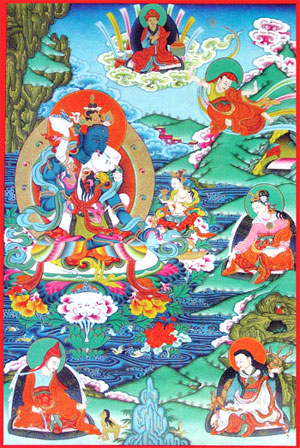
Biography of Longchen Rabjam (1308-1363)

Having acquired the enlightened intention of Dharmakaya in the expanse of exhausted phenomena,
And having seen the pure realm of Sambhogakaya in the sphere of luminosity,
He appears in Nirmanakaya form to untamed beings and benefits them through his enlightened activities.
To Longchenpa, the omniscient King of Dharma, I pay homage.

As stated in the Compendium of Sutras:
“One who possesses the wisdom that realizes the unborn nature
and the supreme quiescence of contemplation
Is a Bodhisattva who is adept in calm abiding
Thus it was prophesied by the Buddhas of the past.”

In the chronicles of Guru Padmasambhava entitled, “Sheldragma” it says;
“In the Monkey Year, my emanation will be born who is endowed with wisdom and sharp intellect. He will bless the Land of Jewels, Bumthang, guide fortunate ones and reveal treasure teachings from the lower part of the region. At that time I will be known as Drimed Ozer.”

As clearly prophesied in authentic scriptures, one of the Three Great Emanations of Manjushri in the Land of Snows, the Omniscient Kind of Dharma, Longchen Rabjam was born in Todrong village situated in the Tra valley of Yoru, middle part of U Tang province, on Saturday, 2nd March 1308 (10th day, 2nd Month, Earth Monkey Year of the Fifth Rabjung Cycle.)

His grandfather Lhasung, who lived for one hundred and five years, was a descendent of Gyalwa Choyang, one of the Seven Intelligents who were tested. His father, Lopon Tenpa Sung, was a master of the sciences and tantric practices, and his mother Dromza Sonam Gyen, was a descendent of the family of Dromton Gyalwai Jungne, the foremost disciple of Atisha.

Immediately after his birth, the Dharma protectress Namdru Remati appeared. Holding the baby in her arms, she said, “I shall protect him!” After returning the newborn back to the mother, she disappeared. From then onwards, the deity served him in various physical forms. From childhood, he naturally possessed the noble qualities of a bodhisattva such as faith, compassion and wisdom. At the age of five, he learned how to read and write. He received many esoteric teachings like, “The Eight Transmitted Precepts on the Gathering of the Sugatas” as well as other sciences.

When he was only 12, he understood the nature of samsara and felt that, like a nest of poisonous snakes, a pit of fire, and a continent of demons, he saw the world was not a safe place to live. He realized the only means of freedom from the suffering of samsara was to practice pure moral ethics, the basis of all noble qualities. Therefore, he gave up all worldly affairs and the clothing of a layperson and went to Samye, the monastery where he received the novice vows from Khenpo Samdrup Rinchen, Lopon Kunga Ozer and accurate number of sangha, who possessed both qualities of scholar and strict observer of moral discipline. After ordination, he was given the name Tshultrim Lodroe. He studied the vinaya teachings and without much difficulty, he understood it perfectly, which enabled him to teach it to others.

At nineteen, he went to the great university of Sangphu Neuthok, a popular center for advanced studies that was founded by Ngog Lekpei Sherab, the reputed Tibetan scholar of logic. There, under Lopon Tsengonpa and Ladrangpa Chopel Gyaltsen, he studied the Buddhist teachings of the Causal Vehicle including Maitreya’s Five Classes of Teachings, Dharmakirti’s Seven Treatises on Valid Cognition, the Madhyamika philosophy,Pranjnaparamita and so on. He also received the five profound sutras, which include the Samadhirajsutra (Sutra of the King of Contemplation) from Pang Lodroe Tenpa. In addition, he learned the common sciences of poetry, grammar, prosody, so forth, and mastered whatever he studied. He propitiated various deities such as Manjushri, Achala and as a sign of accomplishment; he had visions of these deities. Particularly Saraswati, the Goddess of Melody, placed him in the palm of her hand and showed him the four continents and Mt. Meru in seven days. At that time, Saraswati prophesied that he would become a great master and benefit countless beings in the future. After having this particular vision, he actualized the spiritual attainment of unobstructed intelligence, due to which he displayed fearless confidence in the ocean of scriptural teachings and reasoning. Thus, he came to be popularly known as Samye Lung Mangwa (Master from Samye who holds the Treasury of Scriptural Knowledge), and the great drum of his fame resounded in all directions.

He received the Trio of the Sutra with Gathers All Intentions, Magical Net Tantra and the Mental Classes as well as the collected tantras of the Nyingmapa tradition from Lopon Zhonu Dhondrup. Karma Rangjung Dorje bestowed him the empowerment and explanation on the Six Applications, the Means to Dispel Obstacles, the Six Yoga Trainings of Naropa and the introduction to the three truth bodies. From the supreme master of the Sakya tradition, Dampa Sonam Gyaltsen, he received the entire instructions on the Lamdre Chenmo (Great path and fruit), the three visions and three tantras. Lopon Zhongyel transmitted him the Chandrakirti’s Prasanapada (Clear worded Commentary)  and the Madyamakavatara (Introduction to the Middle Way). Following more than twenty spiritual masters from all the different schools of Buddhism, he mastered all the renowned tenet systems existing in Tibet.

Immensely disgusted and fed up with samsara, he resolved to live in solitude. The constant provocation by his fellow monks also added fuel to the fire thus compelling him to leave all worldly cares. On his way he had the auspicious and miraculous signs of meeting the teachings of Dzogpachenpo.

At the age of 29, he met Vidyadhara Rigdzin Kumaraza (1266-1343) in the upper part of Yartokyam valley, who took care of him with great compassion. The master always moved from place to place in order to free all his disciples from attachment to the material world never settling anywhere for long.

During the spring and summer of that year, Longchenpa wandered nine times from one deserted valley to the next due to which he faced many hardships surviving on three measures of flour and twenty-one mercury pills for two months. In the bitter cold of snowy winter, he lived on a sack garment, which served him as both a robe and a bed. He endured such inconceivable austerity for the sake of dharma, following the example of Milarepa.

After serving his root master with the three kinds of delight, his master conferred him all the transmissions and esoteric instructions on the three classes of Dzogchen together with the rites of the protectress. Hereby he was appointed as the lineage holder of the teachings.

At 32, when he gave the Nyingthig (Innermost Spirituality) teachings to eighteen fortunate yogis and yoginis, Ekasati, the protectress of Nyingthig appeared and served him at his command. At that time, Khandro Yeshe Tsogyal got into one of the yoginis and showed him the symbols, meanings and texts of the Khandro Nyingthig (Teachings of Innermost Spirituality transmitted from Guru Rinpoche) together with the entrustment seal. Thus, he is the direct recipient of the Khandro Nyingthig teachings.

As prophesied by Vimalamitra, during the renovation of the monastery of Zha in Uru, he arose in the wrathful form of Padmasambhava and pacified all the negative forces. During the consecration ceremony, he had the clear vision of Buddha Shakyamuni, Maitreya and the Sixteen Arhats. Particularly, Maitreya prophesied thus, “Your final birth will be in the pure realm of Pema Tsekpa where you will be enlightened as the Buddha Rirab Marmei Gyaltsen.”

Knowing the forthcoming conflict between the Sakya and Phagmodrubpa, Longchen Rabjam went to Bumthang. There he founded a monastery called Tharpa Ling (Palace of Liberation) with a gathering of monks. His enlightened activities enhanced the widespread propagation of Nyingma teachings in general and the Dzogchen teachings in particular.

When he returned to Lhasa and visited the image of Buddha Shakyamuni, (Jowo) light rays were emitted from the circle of hair between the eyebrows and dissolved between his eyebrows, which enabled him to recollect his former lives as a scholar at Vulture Peak and in Khotan. While expounding the vast teachings such as Bodhicitta at Lhasa and Ramoche, he subdued the pride of many learned Geshes who were there to test the level of his spiritual understanding and intellect, through his scriptural quotes and logical reasoning. In this way, he established them in ascertained faith and as a result, he was later addressed as “Kunkhyen Choeje” (All Knowing King of Dharma). Thus, his name and fame spread widely in all directions.

He had innumerable visions of the buddhas and bodhisattvas and with their encouragement and approval, he composed many treatises including Seven Great Precious Treasuries, the “Triology of Rest” and so forth, as mind treasure teachings. His works also include common study like prosody, up to the most profound Dzogchen teachings like Nyingthik Yabshi (The Four Parts of the Innermost Spirituality). Thus, his compositions totals to more than two hundred and fifty categories of teachings. All his teachings have these seven distinct qualities:

  1. With his knowledge of orthography, his writings delight the learned ones.
  2. Their profound meanings have the ability to liberate the fortunate ones.
  3. They are the image of ultimate realization that will exhilarate followers.
  4. They are like a spiritual friend who shows what to follow and what to discard.
  5. They are the roar of the lion that surpasses all opponents.
  6. They are the rays of the sun and moon, which illuminate the teachings of the Conquerors.
  7. They are the pinnacle of teachings adorned with precious gems.

In short, his teachings were no different from the direct teachings of Buddha Samantabhadra. They have the unique characteristics of elucidating the correct meanings with the clear words; uncomplicated and perfectly pure that cleanses all the negativities and obscurations. With compassion, he composed works for the well being of future disciples. In particular, while composing the Seven Treasuries at Gangri Thodkar, his attendant witnessed how Longchenpa ordered Vishnu to prepare ink for writing.

Longchenpa meditated in total isolation at various places like Gangri Thodkar, Samye, Chimpu and so forth. He spent most of his later life at Gangri Thodkar. Because of his boundless compassion towards his increasing gathering of disciples, he never accepted payment for his teachings and never wasted offerings made by the faithful. Concentrating only on the welfare of others, he tolerated all misdeeds of his disciples. His enlightened activities of skillful means were unbelievable, like knowing other’s minds and so forth.

Seeing his miraculous activities and scholastic achievements, even powerful persons in Tibet like Gompa Kunrin of Drigung, Situ Jangchub Gyaltsen, Yadrog Tripon and many others honored him like their precious crown yet had neither pride nor expectations of reward. He particularly loved the poor, sick and humble and he would joyfully accept their invitation as well as their frugal offerings without any arrogance. No matter how poor the food served to him was, he would eat it as if it were a great treat. He would then recite the sutras and the dedicational prayers with enthusiasm.

Ever ready to sacrifice his life and body for the welfare of others he was trained in the ocean-like conduct of the bodhisattvas. After accomplishing limitless benevolent deeds for his disciples, he intended to demonstrate his final enlightened activity. So at the age of 56, in the year 1363 (Water Hare Year, Six Rabjung Cycle), he went to the charnel ground in the Chimpu forest and said to Gyalse Zoepa, “Having understood the nature of samsara from the beginning, as there is no essence in the worldly things, I will discard this illusory body of impermanence, so, listen to this esoteric instruction which is of sole benefit.”

On the eighteenth of that month, leaving behind his last will, he relaxed in the sphere of the primordial nature, in the posture of Dharmakaya. The earth trembled at the time and countless miracles occurred. When his mind entered the state of the Dharmakaya, even the four seasons lost their fixed order. After his cremation, to indicate his attainment of enlightened body, speech and mind, his heart, tongue and eyes remained intact and fell into the laps of fortunate disciples.

Longchen Rabjam’s main disciples, who experienced the nectar of his enlightened speech, were the three learned and accomplished ones Deleg Gyamtso and others, the five sons of his enlightened mind were Gyalse Zoepa and so forth, his four spiritual friends included Tulku Paljor Gyamtso.

Work It Out

The following is from a series of tweets by Jetsunma Ahkon Lhamo:

I just watched some program on TV about sociopathic criminals and killers. Fascinating stuff. They do not know their crimes are wrong.

The killers, particularly, do not have empathy, thinking they are entitled to murder. They identify all people to be “less” than them. And their victim’s pain is pleasure to them, sometimes even erotic. They fixate, and cannot disengage unless there is a new victim. They may obsess over the victim until their “personality” totally unravels and they cannot control their rage.

Some have awful childhoods, though not all. There is a genetic component. They also cannot cope with feelings inside them. It is all directed outward, toward certain types, race, religion, or the world at large. Facts don’t influence them, they construct their own.

Fascinating how different they are from the norm of society. Really interesting stuff, the interviewer was a retired FBI special agent. She was impressive, knew how to manage the prisoner to avoid agitation and was skillful.

I’m still scratching my head, because many who also have had childhood trauma manage to work it out. They do not abuse others but they do suffer. But they do the inner “work” and grow to care for others. That’s how they fix it. They work it until they can make a medicine, an antidote. They flush the hate and live with compassion and love.

© copyright Jetsunma Ahkon Norbu Lhamo All rights reserved.

The Potent Nectar of the 7-Line Prayer: Full Length Video

The following is a full length video teaching offered by Jetsunma Ahkon Lhamo at Kunzang Palyul Choling:

The Seven-Line prayer is often called “the Kng of Prayers”. Through repetitio of this prayer many obstacles can be removed from your life, and your connection to your own spiritual nature is strengthened.

© copyright Jetsunma Ahkon Norbu Lhamo All rights reserved.

The Suffering of Suffering

The following is from a series of tweets by Jetsunma Ahkon Lhamo:

If , after some long time you cannot let go – ranting, raving and wailing for a year or more, that is called the suffering of suffering in Buddhism and can never be cured by hate, rage, or accusations.

Let it go, I do. The pain is yours, and only you can fix it, through compassion and self honesty. At least be honest with yourself!

There is treatment for PTSD, why make others deal with your pain because you won’t? You’ll feel better. To ruminate over pain is not helpful. Don’t you want to be free?

© copyright Jetsunma Ahkon Norbu Lhamo All rights reserved.

Love and Compassion: From Compassion in Tibetan Buddhism

The following is respectfully quoted from “Compassion in Tibetan Buddhism” by Tsong-ka-pa

The fourth of the seven cause and effect precepts is love. The field of observation is all sentient beings, and the subjective aspects are three:

  1. How nice it would be if all sentient beings had happiness and its causes.
  2. May all sentient beings have happiness and its causes.
  3. I will cause all sentient beings to have happiness and its causes.

These are three levels of increasing strength which should be cultivated gradually until the point of spontaneity is reached.

The King of Meditations Sutra (Samadhiraja) says that the benefit of cultivating love with all sentient beings as the field of observation is immeasurably greater than that of offering to  Buddhas and Bodhisattvas over many aeons even lands filled with food, drink, and articles. The Sutra of Manjushri’s Buddha Land (Manjushribuddhak shetra) says that there is a Buddha Land to the north-east of this world where beings have attained cessation of coarse feelings and discriminations, abiding most comfortably in meditative stabilization without suffering. Being so happy, they find it easy to behave purely, not killing, stealing, engaging in sexual misconduct, and so fort, for many thousands of ten millions of years. The sutra says that although the benefit of their practice is great, it is more beneficial to cultivate love here for the time it takes to snap the fingers.

One should first take as the object of observation a friend and cultivate the wish that this person have happiness. When this becomes easy, one should consider a neutral person and cultivate the wish as before. Then, one should consider an enemy and cultivate love until there is no difference between the wish for happiness that one has for the friend, the neutral person, and the enemy. The meditation should be extended slowly to all sentient beings throughout space, reflecting again and again on the disadvantages of not have the advantages of having happiness. One may then gradually ascent through the three subjective aspects.

Even if one meditates only for five minutes taking cognizance of all sentient beings and if even the love consciousness, due to unfamiliarity is weak, the virtue is inconceivable because the scope is so vast. For example, if a sesame seed is squeezed, only a little oil comes out, but if many are squeezed, a barrel can be filled with oil.

Initially the meditation should not be longer than fifteen minutes in order to avoid fatigue and retain enthusiasm. Later, it can be lengthened until immeasurable love, conjoined with meditative equipoise, is eventually attained. When love is cultivated little by little, very clearly, with all beings as the field of observation, it is as if one is repaying in part the immeasurable kindness that others have extended in former lifetimes.

The next step is to cultivate compassion. The field of observation of a compassionate mind is all sentient beings who have any of the three types of suffering – of pain, of change, and of being so composed as to be always  ready to undergo pain.

The suffering of pain is actual physical or mental discomfort including in which are birth, aging, sickness and death. Many billions of years have passed since this world was formed; many have been born here, but there is no one who has managed just to stay alive. It is necessary to die and take rebirth again and again.

Sufferings of change are feelings of pleasure which, when superficially considered, seem to be pleasurable but can change into suffering. For example, if a person is out in the sun where it is too hot, he is pleased to go to a cooler spot, but if he stays there too long, he will become cold and sick. Similarly, when one becomes too cold and then goes to a hot place, if one gets too hot, one will fall sick. Although there is seeming pleasure in becoming cooler or warmer, if one stays in that state too long, it turns into suffering. This shows that these situations do not have an inherent nature of pleasure.

Similarly, in this world of beings–whether animal or human–mate with pleasure, but if it is not done in a moderate amount, the pleasure is lost. Excessive copulation can cause a disease called “cold and wind” in the lower abdomen, harming both male and female genitals. Though enjoyable at first, it can ruin the very basis of comfort in the vital channels (nadi). Thus, these feelings of pleasure are said to be contaminated and are called sufferings of change.

The third type of suffering is called that of pervasive composition. Whenever a sentient being takes birth by the power of contaminated actions and afflictions in the desire, form, or formless realms, there are periods when he does not have manifest suffering. However, if certain conditions aggregate, suffering will be generated because the basic causes misery pervade all types of life within the three realms. For instance, though one might have no manifest suffering now, if one is pricked with a needle, cut with a knife, or kicked, pain is immediately produced.

The field of observation for the compassionate mind is all sentient beings who have these three types of suffering; however, to understand the suffering of others, it is necessary first to know the immeasurable fault of one’s own birth in cyclic existence. One should think:

I have engaged in non-virtue since beginningless time and have accumulated bad actions (karma). I suffer pain and change. I am afflicted by being always liable to suffer pain.

One should contemplate the causes of suffering–the ten non-virtues, how one has engaged in them, and how one has suffered in this lifetime. There are three physical, four verbal, and three mental non-virtues.

PHYSICAL NON-VIRTUES

  1. Killing: taking the life of a human or any other being. If one has committed murder, one is born in a bad migration, and then when the migration is finished, even if one is reborn as a human, the lifespan will be very short.
  2. Stealing: taking what is not given. Through its force one will have few resources in the future, and whatever one has others will steal.
  3. Sexual misconduct: incest, copulation in the presence of an image that is an object of refuge, or with a woman about to give birth, and so forth. Such misconduct leads to being controlled by desire and hatred in the future.

VERBAL NON-VIRTUES

  1. Lying: saying what is is not, that what one does not have one has, or the opposite. From such deception one will not hear the truth in the future.
  2. Divisiveness: creating dissension between people or increasing dissension that already exists. The fruit of dividing people is that one will not have friends and will hear oneself frequently faulted by others.
  3. Harsh speech: speaking from anger in order to harm. For instance, when directing someone to go here or there, one does not speak politely but says, ‘Can’t you get over here?!’ The effect is that one will be reborn in a place where one must always be scolded.
  4. Senseless talk: conversation that is not about religious practice, the affairs of one’s family or country, but about meaningless subjects. Through wasting one’s life unsconscientiously in meaningless talk one will not hear sensible talk in the future and will be reduced to speaking gibberish.

MENTAL NON-VIRTUES

  1. Covetousness: the desire for acquisition upon seeing the property of another person. This causes poverty and leads to losing whatever property one has.
  2. Harmful intent: the wish to injure another, male, female, animal and so forth. Based on this deed, people will not be agreeable in the future.
  3. Wrong views: asserting that the cause and effect of actions do not exist, that the Three Jewels are not sources of refuge, and the like. If due to such views one perversely holds that there is no fault in engaging in the three physical or four verbal non-virtues, this harms the roots of virtue already formed in one’s mental continuum and thereby induces great suffering in the future.

One should gradually call to mind one’s own non-virtues and reflect on the cause and effect process that induces suffering. It is appropriate to generate contrition, a sense of discomfort with former misdeeds, and a promise to refrain from those deeds henceforth.

Reflection on one’s own involvement in the causes of suffering ultimately generates an intention to leave cyclic existence. One comes to know that just as one has suffered in this lifetime, after death the process will begin again and wherever one is born–even as a god or a human, oe must suffer. Having formed a clear sense of one’s own situation, one should then consider a friend:

This person has the three types of suffering and is also engaging in the causes the further misery. Even when he finishes undergoing the suffering of this lifetime, he will have more in the next. How nice if he were free from suffering and its causes! May he become so! I will cause him to become so!

Then one should consider a neutral person and after that an enemy. Gradually and over a long period of time, one can slowly extend the meditation to all sentient beings.

Having developed facility first with respect to a friend, such as one’s mother, one is able to measure the progress with respect to neutral persons and enemies by comparing it to the strong feeling for the friend. Why should one make all neutral persons and enemies equal to one’s mother? If she had fallen into a ravine or a river, or into a chasm made by an earthquake, and if her own child whom she had helped from the time of his entry into her womb would not help her, who would?

Altruism: From “Compassion in Tibetan Buddhism”

The following is respectfully quoted from “Compassion in Tibetan Buddhismby Tsong-ka-pa

If the intention to overcome the process of cyclic existence is not conjoined with altruism, one will attain only freedom from suffering, not the Buddhahood that is a perfection of one’s own and others’ welfare. Therefore, the altruistic aspiration, called the mind of enlightenment (bodhicitta) is most important.

Within Buddhism, those of the Hearer and the Solitary Realizer Vehicles cultivate the paths of a being of middling capacity – the thought to leave cyclic existence, together with the view of emptiness. Thereby they attain liberation, but due to not cultivating the altruistic mind of enligthenment, they cannot attain Buddhahood. The mind of enlightenment, in general, is of two types, conventional and ultimate, and the conventional is again divided into aspirational and the practical.

The aspirational mind of enlightenment is the wish to attain Buddhahood in order to help all sentient beings; it marks the beginning of a Bodhisattva’s accumulation of meritorious power in conjunction with wisdom and continues until Buddhahood, having twenty-one forms called ‘earth-like’, ‘gold-like’, and so forth, which are instances of its increasing in strength as one progresses. The practical mind of enlightenment occurs when, having taken the Bodhisattva vow, one actually practises the six perfections of giving, ethics, patience, effort, concentration, and wisdom. The ultimate mind of enlightenment is a wisdom consciousness in meditative equipoise directly cognizing emptiness attained at the time of the Mahayana path of seeing.

To become a Bodhisattva one must cultivate the conventional mind of enlightenment, specifically in aspirational form. As was explained before, it involves seven steps in the system transmitted from Buddha to Maitreya to Asangha:

  1. recognition of all sentient beings as mothers
  2. becoming mindful of their kindness
  3. intending to repay their kindness
  4. love
  5. compassion
  6. unusual attitude
  7. altruistic mind generation

Having practiced equanimity and reflected on the plight of cyclic existence in the two previous meditations, one is prepared for the first step, recognizing all persons as mothers.

This meditation is to visualize individually every sentient being that one has known, beginning with recent friends, then passing to neutral persons, and then to enemies, identifying each as having been one’s mother. One should meditate until everyone, from bugs on up, is understood as having been one’s mother. Since this is the door to generating the mind of enlightenment, its benefit has no boundary or measure as will become apparent in meditation.

The next step is to cultivate mindfulness of the mothers’ kindness, first with respect to friends, then neutral persons, and then enemies. The essence of the practice is to become aware that even if persons are now enemies, neutral, or friends, they have in the past been as kind as one’s own mother of this life.

What is the kindness of a mother? First of all, one enters her womb while she copulates with a mate. At that time one’s mind has entered into the soft substance of the father’s semen and the mother’s blood. During the second week the fetus becomes a little hard, like yoghurt; in the third week, it becomes roundish, and during the succeeding weeks bumps appear that develop into limbs – head, arms, and legs. Then, while one’s body grows by stages over many weeks, one undergoes indescribable discomfort due to the way the mother lies, eats, and so forth, and she also suffers great physical and mental discomfort as one’s body forms. Still, she considers the child more important than even her own body; fearing that her child might be harmed, she makes great effort at proper diet, habits of sleep, and activity.

When about to be reborn, the baby turns around inside the womb and begins to emerge, causing the mother such pain that she almost swoons. Though finally her vagina is torn, her body harmed, and she has undergone great suffering, she does not throw one away like faeces, but cherishes and takes care of her child. Her kindness is greater than the endearment she has for her own life.

One should also reflect on the delightful ways a mother holds a baby to her flesh, giving her milk. She must provide everything; she cannot tell the baby to do this or that; she must attentively do everything herself. Except for having the shape of a human, the child is like a helpless bug. She teaches it each word one by one, how to eat, sleep, put on clothes, urinate, and defecate. If one’s mother had not taught these, one would still be like a bug. Even when a cat gives to a kitten, one can directly see that the cat undergoes great hardship to take care of the kitten until it is able to go on its own.

Just as one’s present mother extended great kindness, so those who now are enemies were mothers in former lives and extended the same kindness, and in later lifetimes they will again protect one with kindness. If it were necessary to become angry when it is determined that someone is an enemy, then since one’s present parents and dearest friends were enemies in a former lifetime and will be in the future, it would be necessary to hate them. But if one’s mother became incensed and attacked oneself, would it be right to become angry and beat her, or would one try to calm her and restore her mind to its usual state? In the same way, an enemy is one’s own best friend who has lost control and, without independence, is attacking oneself. He is not at fault; he is not attacking under his own power. He has helped before and will help again. When one was inside his womb, how much suffering he underwent! After one was born, how many difficulties he had to bear!

The thought is:

Each and every being, upon taking birth in cyclic existence over t beginningless continuum of lives, has protected me with kindness, just like my mother in this lifetime, and will do so again in the future. Their kindness is immeasurable.

When, having considered friends, neutral persons, and enemies, one is clearly mindful of their kindness, one should cultivate the third step, developing in the intent to repay their kindness:

I will engage in the means to cause all to have happiness and to be free from suffering. Just as they helped me in the past, now I must help them.

One should alternate analytical meditation – analyzing the reasons for repaying the kindness of others – and stabilizing meditation – fixing on the meaning understood – finally gaining a measure of the kindness of each and every being throughout space and developing a sense of the need to respond.

Sources of Major Tantric Scriptures

The following is respectfully quoted from “The Practice of Dzogchen” by Longchen Rabjam translated by Tulku Thondup:

Sources of the Major Tantric Scriptures

According to the history of the tantric scriptures, most of the tantras of the New Translation School of Tibet—such as Guhyasamaja and Kalachakra and the tantras belonging to the division of Outer Tantras—were expounded by Sakyamuni Buddha. But the tantras of the three Inner Tantras of the Old Translation School did not originate with Sakyamuni Buddha.

The original tantras of Mahayoga and Anuyoga first appeared in the human realm when they were received by a group of five Buddhist adepts called the Five Excellent Beings (Dam Pa’I Rigs-Cham Dra-Ma lNga) from Vajrapani Buddha in a pure vision on Mt. Malaya [Sripada, Srilanka?] twenty-five years after Mahaparinirvana, the passing away of Sakyamuni Buddha. They were then transmitted to King Jha (Dza) of the Oddiyana kingdom by Trimed Tragpa (Dri-Med Grags-Pa, Vimalakirti) of the Lcchavi tribe, who was one of the Five Excellent Beings.

In Mahayoga, in addition to tantras there is another category of scriptures known as the sadhanas [propitiations]. The following eight categories of scriptures of the sadhana section of Mahayoga were received in two ways, in canonical (bKa’-Ma) form and discovered treasure (gTer-Ma) form.

a)    The following scriptures were received by different masters by means of canonical transmission, which means transmission from person to person: Vajraheruka (or Yang-Dag) scriptures received by Humkara, Yamantaka by Manjusrimitra, Hyagriva  by Nagarjuna, Vajramrta (bDud-rTsi ‘Khyil-Ba) by Vimalamitra, and Vajrakilaya by Prabhahasti and Padmasambhava.

b)    Discovered Treasure Sadhanas: The following scriptures were concealed and entrusted by Dakini Lekyi Wangmo (Las-Kyi dBang-Mo) to the following masters, and those scriptures are known as the discovered treasure Sadhanas: Sriheruka (Ch’e-mCh’og) scriptures entrusted to Vimalamitra, Vajraheruka to Humkara, Yamaraja to Manjusrimritra, Hyagriva to Nagarjuna, Vajrakilaya to Padmasambhava, Mamo (Ma-Mo) to Dhanasamskrta, Chod-tod (mCh’od-bsTod) to Rombhuguhya, and Trag-ngag (Drag-s Ngags) to Santigarbha. She also entrusted the Desheg Dupa (bDe-gShegs ‘Dus-Pa) to Padmasambhava. Those masters transmitted the teachings to their disciples and most of them are in practice today.

The original tantras of Atiyoga were received in pure vision by Garab Dorje (dGa’-Rab rDo-rJe, S. Prahevajra), the first human master of Atiyoga, directly from Vajrasattva, a Buddha in Sambhogakaya form. He transmitted them to Manjushrimitra. The teachings of Atiyoga were brought to us through various lineages and are known in Tibetan as Dzogpa Chenpo, the Great Perfection, which is the subject of this book.

Some Major Tantric Scriptures of the Three Inner Tantras

The scriptures of Inner Tantras which have survived are preserved as the collections of Nyingma Gyud-bum (rNying-Ma rGyud-‘Bum) in twenty six volumes. There are different ways of classifying the tantras, and I have indicated the sources on which I relied to make the following lists.

The Tantras of Mahayoga

Mahayoga scriptures were brought to Tibet by Indian scholars and Tibetan translators including Guru Padmasambhava, Vimalamitra, Santigarbha, Jnanagarbha, Vairocana, Namkha’I Nyingpo (Nam-mKha’I Nying-Po), and Sangye Yeshey (Sang-rGyas Ye-Shes). In Mahayoga there are two major sections of scriptures, the eighteen tantras and the sadhanas. According to Gyurmed Tshewang Chogdrub, who says the list is based on the writings of Terchen Gyurmed Dorje (1646-1714), the major tantras of Mahayoga are as follows:

1)    Tantra Section:

a)    The Root of all the Mahayoga Tantras, the tantras of Guhyagarbhamayajala-tantra entitled: Dorje Sempa Gyuthrul Trawa Tsawa’I Gyud Sangwa Nyingpo (rDo-rJe Sems-dPa’ rGyu-‘Phrul Drva-Ba rTsa-Ba’I rGyud gSang-Ba sNying-Po)

b)    The Explanatory Tantras:

Five Major Tantras:

i)      Tantra of Body: Sangye Nyamjor (Sang-rGyas mNyam-sByor)

ii)     Tantra of Mind: Sangwa Dupa (gSang-Ba ‘Dus-Pa)

iii)    Tantra of Virtues: Palchog Tangpo (dPal-mCho’g Dang-Po)

iv)   Tantra of Action: Karma Male (Karma Ma-Le)


Five Tantras of Sadhana:

i)      Heruka Rolpa (Heruka Rol-Ba, missing)

ii)     Tachog Rolpa (rTa-mCh’og Rol-Ba)

iii)    Nyingje Rolpa (sNying-rje Rol-Ba)

iv)   Dudtsi Rolpa (bDud-rTsi Rol-Ba)

v)    Phurba Chunyi (Phur-Pa bChu-gNyis)

Five Tantras of Actions:

i)      Lanchen Rab-bog (Glang-Ch’en Rab-‘Bog)

ii)     Riwo Tsegpa (Ri-Bo brTsegs-Pa)

iii)    Yeshey Ngamlog (Ye-Shes rNgam-Glog)

iv)   Tamtshig Kodpa (Dam-Tshig bKod-Pa)

v)    Tingdzin Tsechig (Ting-‘Dzin rTse-gChig)

(The last four tantras are common to Anuyoga)


Two Supplementary Tantras:

i)      According to PKD bb/3: Namnang Gyuthrul Trawa (rNam-sNang sGyu-‘Phrul Drva-Ba).

ii)     Thabkyi Zhagpa (Thabs-Kyi Zhags-Pa)

2)    Sadhana [Ppropitiation] Section:

The scriptures of Sadhanas of Eight Great Mandalas of Deities (sGrub-Pa bKa’-brGyad) of which there are two kinds, the Canonical (bKa’-Ma) and Discovered Treasure (gTer-Ma) scriptures. The Eight Great Mandalas of Deities are: (a) Yamantanka of Body, (b) Hayagriva of Speech, (c) Vajraheruka (Yang-Dag) of Mind, (d) Dudtsi Chechog (bDud-rTsi Che’-mCh’og) of Virtues, (3) Vajrakilaya of Action, (f) Mamo Bod-Tong (Ma-Mo rBod-gTong), (g) Jigten Chod-tod (‘Jigs-rTen mCh’od-bsTod) and (h) Modpa Trag-ngag (dMod-Pa Drag-sNgags).


The Tantras of Anuyoga

The Anuyoga tantras were brought to Tibet by Vimalamitra, Vairocana and especially by Nubchen Sangye Yeshey (gNub-Ch’en Sangs-rGyas Ye-Shes). According to Gyurmed Tsewang Chogdrub, among the Anuyoga tantra are:


1)    Four Root Tantras:

a)    Kundu Rigpa’I Do (Kun-‘Dus Rig-Pa’I mDo)

b)    Sangye Thamched Gongpa Dupa (Sangs-rGyas Tham-Chad dGongs-Pa ‘Dus-Pa)

c)    Yeshey Ngamlog (Ye-Shes rNgam-Glog)

d)    Turthrod Khuchug Rolpa (Dur-Khrod Khu-Byug Rol-Ba)

2)    Six Branch Tantras:

a)    Kunto Zangpo Chewa Rangla Nepa’i Gyud (Kun-Tu bZang-Po Ch’e-Ba Rang-La gNgas-Pa’I rGyud)

b)    Wangkur Gyalpo (dBang-bsKur rGyal-Po)

c)    Tingdzin Chog (Ting-‘DZin mCh’og)

d)    Kabjor Dunpa (sKabs-sByor bDun-Pa)

e)    Tsonpa Donden (brTson-Pa Don-lDan)

f)     Tamshig Kodpa (Dam-Tshig bKod-Pa)

3)    Twelve Rare Tantras:

a)    Zhiwa Lhagyud (Zhi-Ba Lha-rGyud)

b)    Chonyid Zhiwa’i Lhagyud (Ch’os-Nyid Zhi-Ba’I Lha-rGyud)

c)    Throwo’I Lhagyud Chenmo (Khro-Bo’I Lha-rGyud Ch’en-Mo)

d)    Throwo’I Lhagyud Kyi Togpa Chenpo (Khro-Bo’I Lha-rGyud Kyi rTogs-Pa Ch’en-Po)

e)    Thugje Chenpo’i Torgyud (Thugs-rJe Ch’en-Po’i gTor-rGyud)

f)     Naljor Nangpa’i Tsog-gyud Chenpo (rNal-‘Byor Nang-Pa’i Tshogs-rGyud Ch’en-Po)

g)    Palbar Khroma (dPal-‘Bar Khros-Ma)

h)    Rakta Markyi Gyud (Rakta dMar-Gyi rGyud)

i)      Melha Zhiwar Kyurpa Barwa’i Gyud (Me-Lha Zhi-Bar Kyur-Pa ‘Bar-Ba’i rGyud)

j)      Throwo’i Jinseg (Khro-Ba’i sByin-bSreg)

k)    Hungdzed Chenpo (Hung-mDzad Ch’en-Po)

l)      Dasang Chenpo (Zla-gSang Ch’en-Po)


The Tantras of Atiyoga

Atiyoga has three divisions of tantras: They are Semde, Longde, and Mengagde.

1. In Semde (Sems-sDe) there are Twenty-one Major Tantras which were brought to Tibet by Vimalamitra and Vairocana. According to Longchen Rabjam they are:

A) The Five Earlier Translated Tantras, translated by Vairocana:

a)    Rigpa’i Khuchug (Rig-Pa’i Khu-Byug)

b)    Tsalchen Trugpa (rTsal-Ch’en Drug-Pa)

c)    Khyungchen Dingwa (Khyung-Ch’en lDing-Ba)

d)    Dola Serzhun (rDo-La gSer-Zhun)

e)    Minubpa’i Gyaltshen Namkhache (Mi-Nub-Pa’i rGyal-mTshan Nam-mKha’-Ch’e)

B)  The Thirteen Later Translated Tantras, translated Tantras, translated by Vimalamitra,         Nyag Jnanakumara and Yudra Nyingpo (gYu-sGra sNying-Po):

a)    Tsemo Chung-gyal (rTse-Mo Byung-rGyal)

b)    Namkha’i Gyalpo (Nam-mKha’i rGyal-Po)

c)    Dewa Thrulkod (bDe-Ba ‘Phrul-bKod)

d)    Dzogpa Chinching (rDzogs-Pa sPyi-Ch’ings)

e)    Changchub Semtig (Byang-Ch’ub Sems-Tig)

f)     Dewa Rabjam (bDe-Ba Rab-‘Byams)

g)    Sog-gi Khorlo (Srog-Gi ‘Khor—Lo)

h)    Thigle Trugpa (Thig-Le Drug-Pa)

i)      Dzogpa Chichod (rDzogs-Pa sPhi-sPyod)

j)      Yidzhin Norbu (Yid-bZhin Nor-bu)

k)    Kundu Rigpa (Kun-‘Dus Rig-Pa)

l)      Jetsun Tampa (rJe-bTsun Dam-Pa)

m)  Gompa Tontrub (sGom-Pa Don-Grub)

C)   Three Outher Major Tantras:

a)    The cycle of Kunched Gyalpo (Kun-Byed rGyal-Po)

b)    The Medchung (rMad-Byung)

c)    The Thirteen Sutras of Semde

2. The tantras of Longde (Klong-sDe) were brought to Tibet by Vimalamitra and Vairocana. According to Gyurmed Tsewang Chogdrub, some of the major tantras of Longde are:

a)    Longchen Rabjam Gyalpo (Klong-Ch’en Rab-‘Byams rGyal-Po)

b)    Kunto Zangpo Namkhache (Kun-Tu bZang-Po Nam-mKha’-Che)

c)    Rigpa Rangtsal Sharwa (Rig-Pa Rang-rTsal Shar-Ba)

d)    Dam-ngag Natshog Khorlo (gDams-Ngag sNa-Tshogs ‘Khor-Lo)

e)    Phaglam Kodpa (‘Phags-Lam bKod-Pa)

f)     Dorje Sempa Namkha’i Thatang Nyampa (rDo-rJe Sems-dPa Nam-mKha’i mTha’-Dang mNyam-Pa)

g)    Yeshey Sangwa Dronma (Ye-Shes gSang-Ba sGron-Ma)

h)    Rinpoche Khorlo (Rin-Po-Ch’e ‘Khor-Lo)

i)      Yeshey Sangwa (Ye-Shes gSang-Ba)

j)      Yeshey Dzogpa (Ye-Shes rDzogs-Pa)

k)    Changchub Kyi Sems Kunla Jugpa Namtag Tonpa (Byang-Ch’ub Kyi Sems Kun-La “Jug-Pa rNam-Dag sTon-Pa)

l)      Changchub Kyi Sem Dorje Odthro (Byang-Ch’ub Kyi Sems rDo-rJe A’od-‘Thro)

3.  The Tantras of Mengagde (Man-Ngag-sDe) were brought to Tibet mainly by Pandita Vimalamitra and Guru Padmasambhava. Some of the major tantras of Mengagde, which belong to Yangsang (Yang-gSang) orNyingthig (sNying-Thig) subdivision, according to Gyurmed Tshewang Chotrub and Pema Ledreltsal are:

  1. The Seventeen Tantras (rGyud-bChu-bDun):

a)    Dzogpa Rangchug (rDzogs-Pa Rang-Byung)

b)    Yige Medpa (Yi-Ge Med-Pa)

c)    Rigpa Rangshar (Rig-Pa Rang-Shar)

d)    Rigpa Rangtrol (Rig-Pa Rang-Grol)

e)    Rinpoche Pungwa/Pudpa (Rin-Po-Che’ sPung BalsPud-Pai)

f)     Kudung Barwa (sKu-gDung ‘Bar-Ba)

g)    Dra Thalgyur (sGra Thal-‘Gyur)

h)    Trashey Dzeyden (bKra-Shis mDzes-lDan)

i)      Dorje Sempa Nying-gi Melong (rDo-rJe Sems-dPa’ sNying-Gi Me-Long)

j)      Kuntu Zangpo Thugkyi Melong (Kun-Tu bZang-Po Thugs-Kyi Me-Long)

k)    Ngotrod Trepa (Ngo-sProd sTras-Pa)

l)      Mutig Rinpoche’I Threngwa (Mu-Tig Rin-Po-Ch’e’I Phreng-Ba)

m)  Kuntu Zangpo Longtrub (Kun-Tu bZang-Po Klong-Drug)

n)    Dronma Barwa (sGron-Ma ‘Bar-Ba)

o)    Nyida Khajor (Nyi-Zla Kha-sByor)

p)    Seng-ge Tsaldzog (Seng-Ge rTsal-rDzogs)

q)    Norbu Trakod (Nor-Bu Phra-bKod)


  1. Two Other Major Tantras:

a)    Ekatsati Nagmo Throma (Ekajati Nag-Mo Khros-Ma)

b)    Longsal Barma (Klong-gSal ‘Bar-Ma)


There are two other important categories of scriptures in the Yangsang sub-section of Mengagde, known as Instructional (Man-Ngag) category of teachings. They are as follows. According to Pema Ledrel Tsal the first is the Nyingthig teachings which contain the essential instructions of the Seventeen Tantras and Throma Tantra It was brought to Tibet by Vimalamitra and became known as Vima Nyingthig. The second is the Nyingthig teachings which mainly contain the essential instructions of Longsal Barwa Tantra. It was brought to Tibet by Guru Padasambhava and became known as Khadro (mKha’-‘Gro) Nyingthig.

Longchen Rabjam wrote a volume of commentarial and supplemental texts on Vima Nyingthig known as Vima Yangtig (Vima Yang-Tig) and one volume on Khadro Nyingthig known as Khadro Yangtig (mKha’-Gro Yang-Tig). He also wrote a volume on both Nyingthigs known as Lama Yangtig (Bla-Ma Yang Tig) or Yangtig Yidzin Norbu (Yang-Tig Yid-bZhin Nor-Bu). These two root scriptures and two commentarial texts are known as Nyingthig Yazhi (sNying-Thig Yab-Zhi), the Four Volumes of Nyingthig. They are some of the most important texts and writings on Nyingthig.


Relying on the Lineage and the Guru: Full Length Video Teaching

The following is a full length video teaching by Jetsunma Ahkon Lhamo offered at Kunzang Palyul Choling:

Relationship with the Guru is the “rocketship of Vajrayana”. These teachers appear for only one reason – us. So, we can rely utterly on their blessing.

© copyright Jetsunma Ahkon Norbu Lhamo All rights reserved.

WP2Social Auto Publish Powered By : XYZScripts.com