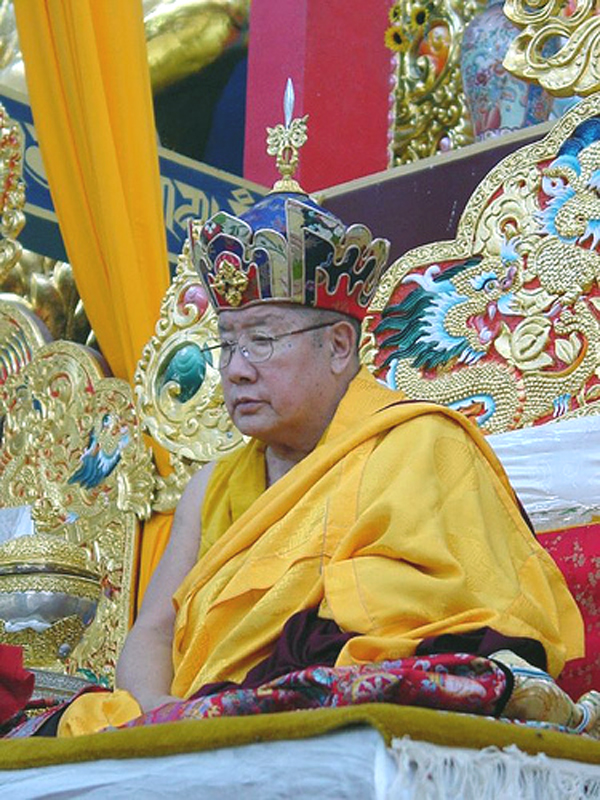
The following is an excerpt from a teaching by His Holiness Penor Rinpoche on Meditation, reprinted her with permission from Palyul Ling International:
This is the root of all the Dharma practices: generating the Bodhicitta [loving-kindness]. If one can really generate genuine Bodhicitta within one’s mind, then it is very easy to move nearer to ultimate liberation. Bodhicitta is known as the awakening mind. The awakening mind is without partiality and equally benefits all sentient beings. If we have the thought of doing something good and beneficial only for our families and friends and then we want to create all kinds of obstacles for someone we don’t like or whom we consider to be an enemy, this is not Bodhicitta.
Generating Bodhicitta, the awakening mind, is for the purpose of benefiting all sentient beings without any exception. Even living creatures such as ants, in their ultimate nature, they also have the Buddha nature. Even cockroaches. There is no difference in the size of the form. In the teachings it says that there is no limit to space, that space is immeasurable, and similarly there is no limit of sentient beings. Their number is immeasurable. Hence we have to generate the kind of Bodhicitta that is immeasurable for all these immeasurable numbers of beings.
The following is an excerpt from a teaching by Jetsunma Ahkon Lhamo called “Why We Suffer”
When we come into this life, although we are little drooling children, although we cannot understand very much, we will grow. And as we grow what we will see is the display of those habitual tendencies of the continuation of the movement of that which is called the mindstream. When we, seemingly as individuals, hold to the idea of self-nature as being inherently real, in order to continue that continuation of holding to self-nature as being inherently real, we constantly have to distinguish between self and other. Otherwise, we cannot understand self-nature. Self-nature is only a relative term. Self-nature has no meaning unless we continue to define the difference between self and other. That is one aspect of our habitual tendency that is so deeply ingrained that it must happen automatically. Because if it does not happen, the stream of continuation simply cannot exist. There is no continuation.
Believing self-nature to be solid and real, we must distinguish between self and other. Therefore, we must find other to be solid and real. And so, the way that we move through what seems to us to be linear experience is by clinging to self, defining it, creating all kinds of conceptual ideations surrounding self-nature, constantly being involved in distinction between self and other, and therefore constantly being involved in acceptance, rejection or indifference to other. Reaction. We continue in that mode. What is actually happening here, in the midst of this deluded and very energetic and very involving and actually narcotic experience, this dynamic continuation? It seems to us that we are individuals who are moving through linear time and that is the delusion, the active delusion that we are involved in. But, according to the Buddha’s teaching, we are actually experiencing the display of our own habitual tendency, our own mindstream.
Because of the belief in the distinction between self and other, because of this basic fundamental assumption of self from which all reaction, from which all ideation that is the foundation of every circumstance arises, we have our experience, and that is the material of our experience. But, actually if we were to examine our own experience from the point of view of realization, such as the Buddha experienced, if we were to examine at the most profound and the most deep level, if we could somehow eradicate our addiction to this kind of experience, our fixation on the solidity of self-nature and its distinction from other, if we could stop reacting, if the mind were completely relaxed, we would understand that what we are actually experiencing is the material of our own mindstream. This is very hard information to take in sometimes. Especially, it’s hard for Westerners because of our training.
In order to understand the Buddha’s teachings one has to understand cause and effect relationships, and in order to understand cause and effect relationships, one has to understand the two extremes of eternalism and nihilism. In this nation we are actually afflicted with both nihilism and eternalism. Culturally we have absorbed them. They are part of our mindstreams, they are prevalent throughout our culture, and they are hard to spot.
Eternalism is the belief that we will continue as we are, based on a belief in our self nature and its continuation. It is like postulating a stick with one end: it begins at some place and then continues on forever. Nihilism is the belief that nothing essentially exists. It says that things come together in some sort of natural, physiological way or through some chemical means, but that there is no real order to it or no context within which an evolutionary pattern exists. It is the belief that there is nothing outside what one sees with one’s eyes or feels with one’s hands or smells with one’s nose. It is the belief in the possibility, in our case, of experiencing cause without experiencing effect.
This is not the textbook definition of nihilism, but it is the description of nihilism as we experience it within our minds. For instance, it is possible for us to know the teachings of the Buddha and to see their logic, yet have our actions and lifestyle be inconsistent with that belief. We may understand that compassion reaps good results and brings us closer to enlightenment, so we exhibit kindness and have faith. Yet within our minds we think judgmentally about others and hold hatred and desire. We think that it is acceptable to act kindly toward a person even if at the same time we are thinking we would like to have that person’s clothes or that we don’t like that person. This is actually a form of nihilism, because we feel that what matters is what people see, not understanding that even what remains in our thoughts and feelings also produces results. We don’t really understand that cause and effect relationships occur from the subtlest levels to the grossest of levels, and are the underlying fabric of cyclic existence. We do not understand, therefore, our own nature and that all things are an emanation of our minds. We practice nihilism constantly because we believe that the only thing that is counted somehow in the book of countings (whatever that might be) is that which is seen and can be judged by others.
We are content to live with that kind of thinking, never realizing the terrible results that it produces. We continue to engage in activity that is not conducive to enlightenment, because we do not understand the depth and profound effect that cause and effect has upon us. We may act in a kind way when people are watching but in our minds, in our secret places where no one is watching, we are selfish, judgmental, uncaring, and jealous. All of these qualities we allow to exist within our minds, and we do not understand that if they exist within the mindstream they will also somehow appear in our physical reality. Holding hatred in our mindstreams, or jealousy, selfishness, grasping, feeling needy constantly, feeling that we must have something in order to be content, acting in a selfish way that is inconsistent with the Buddha’s teaching, these things produce the same results that physical activity of that kind produce, even though we may not see right away the effects that will surely ripen.
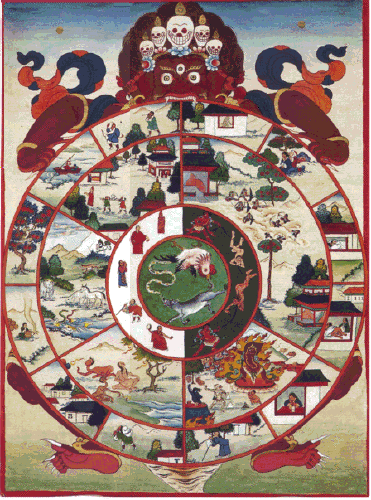
The Six Realms of Cyclic Existence
The Buddha teaches us that there are different causes that we hold within our mindstreams that create the circumstances by which we are reborn in the six different realms of cyclic existence.
Contrary to the popular New Age philosophy that says we always achieve a higher rebirth, or that since we are human beings now we can always count on being human beings in future incarnations, the Buddha teaches that we achieve rebirth according to the content or fabric of our mindstreams. For example, if we hold a great deal of hatred or anger, we can be reborn in the lowest realms called hell realms. These realms are extremely uncomfortable; they have a great deal of heat and fire or extremes of cold that are unbearable. It is so unbearable there that it is impossible to practice. It would be like trying to meditate while someone is sawing off your knee. All you can think about is yelling and screaming and how to get out of there quickly. That is the nature of the hell realms.
If you experience a great deal of desire, grasping, and neediness, you will be reborn in what is called the hungry ghost realm. This realm is so filled with longing that the nonphysical beings there have mouths as tiny as a pinhole and their stomachs are as large as Mount Mehru. It is impossible to satisfy them. It is the experience of insatiability. Beings there are so empty and unable to take in what is needed.
If we experience dullness, stupidity, or ignorance, we will be reborn in the animal realm. Animals are considered to be incapable of the kind of thought necessary to make fully aware decisions. They fall prey to whatever sufferings man might visit upon them. Oxen that must pull heavy carts all day with very little nourishment, animals that must endure testing, these animals are unable to save themselves and they suffer horribly. Animals in the wild are eaten or helplessly pursued by bigger animals. Even our pets do not know how to take care of themselves. If we feed them they are fed, if we forget them they are forgotten.
To be reborn in the human realm is considered the most auspicious of circumstances because here it is possible to practice the Buddha’s teaching and experience true awakening, Although it takes a great deal of merit to be reborn in the human realm, there is also a negative cause for human rebirth, and that is doubt. As humans we constantly experience doubt. It is so pervasive that we do not understand how great our doubt is. If we really examine ourselves, we will discover that we think and feel differently from the way that we believe intellectually. We may follow a certain philosophy, but we never follow any philosophy consistently because we are so filled with doubt. It is the same in following Buddhist teaching. We will follow it externally, but not consistently until we have come very close to realization and can understand for ourselves fully and completely about cause and effect relationships.
If we experience a great deal of jealousy and competitiveness, if we have a warlike quality to our minds, we will be reborn in what is called a jealous gods’ realm. Beings there have a great deal of power with super-normal experiences. They are very strong, competing constantly in war. There is no peace, no security, no time to think or feel or love. There is only a constant need to guard oneself against hurt and attack, and a compulsive need to be aggressive about maintaining whatever you have that seems to be yours.
The last of the six realms is the gods’ realm. It is considered to be the highest realm because it is the most pleasurable and the most blissful. The beings there are extremely beautiful with gorgeous fragrances, brilliant colors, and music that is so pleasurable that if we were to hear it, there would be instant healing. Bodies of the gods are pure and perfectly sweet. There is not a bit of decay, sweat, bacteria, aging or any processes that produce the foul smells we have. It is beauty beyond what we can understand, completely free of ugliness or decay. Pride is the main cause for being reborn here, and even though the gods live for thousands of years, life is not permanent there. It actually takes a tremendous amount of good karma and pure virtue to be reborn in the gods’ realm, but while there you use up all your accumulated good karma very fast, like a big V8 engine burning gas going up hill. Suddenly after a very long life span, decay sets in. One’s accumulated virtue becomes exhausted and death approaches. It is horrible to them because they who have experienced nothing but beauty, sweetness, bliss, gorgeous music, and celestial food are about to experience terrible suffering. This impermanence is the predominant suffering of the gods’ realm.
We as humans have within our mindstreams all of the seeds of the peculiar sufferings and the unfortunate qualities associated with the six realms of cyclic existence. The Buddha cautions us not to take this teaching symbolically, but to take it absolutely. He could actually see the six realms and could remember having lived in those realms. Having achieved the precious awakening, he was able to recall how he moved from these realms into enlightenment The head of our lineage, His Holiness Penor Norbu Rinpoche, has said that if you could only part the curtains of your inability to see, if you could only see for one moment what the six realms of cyclic existence were like and how you have come and gone in each of the realms, and what you have experienced and what you are yet to experience because of the qualities inherent in your thinking if you could understand this you would do nothing but recite the mantra OM MANI PADME HUM again and again. You would never stop.
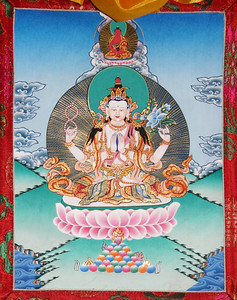
The mantra of Chenrezig is OM MANI PADME HUM. Chenrezig is the Buddha of Compassion, and has within his mindstream a clear and pure crystal awareness, which is the same as the mind of enlightenment. Inherent within that mindstate are the qualities that bring about the end of rebirth in all of the six realms. Constant mindfulness of Chenrezig, and learning to generate one’s mind as Chenrezig through the use of visualization, mantra, recitation and pure intention, can bring about the end of rebirth in cyclic existence, even in one lifetime.
The logic here is that in the practice you are the one who generates yourself as the Bodhisattva Chenrezig. You accomplish this pure mind state in order to be of benefit to sentient beings. The real end of suffering therefore can be understood as your capacity to generate yourself as that Bodhisattva of Compassion, thereby becoming the cause for the end of all suffering. In so doing, one brings about the end of one’s own suffering as well.
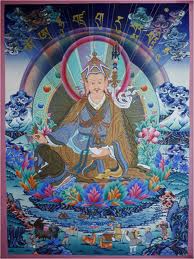
The mantra of Chenrezig, which is OM MANI PADME HUM, has six syllables. Each syllable has the ability to eradicate causes for rebirth in each of the six realms, because the mantra itself and each of the syllables is considered to be a miraculous condensation of wisdom. Through the activity of Guru Rinpoche we are able to experience in the hearing or reciting of the syllables and visualizing ourselves as Chenrezig, the perfect purification of the causes for rebirth in all of the six realms of cyclic existence. This is absolutely possible. It is promised that if you practice this every day you can achieve the end of rebirth in the lower realms. And if practiced in conjunction with other practices it is part of a proven technology to end suffering in all of the realms.
The following is a prayer from the Bodhisattva Vow Ceremony as translated in the Nam Cho Daily Practice Book from Palyul Ling International:
Alas! Fortunate ones!
Do not let ignorance overwhelm you.
Wake up now and be diligent.
Since beginningless time to this very moment
You have been sleeping in ignorance. Enough!
Now sleep no more and devote your three doors to the practice of Dharma.
Don’t you understand the suffering of birth, old age, sickness and death?
No moment of what is called “today” is permanent.
Now the time has arrived to practice diligently.
This is the moment to accomplish permanent happiness.
And not the moment to fritter away in the state of laziness.
Contemplate death and strive to accomplish your practice.
Life is uncertain, as the causes and conditions for death are innumerable.
If you do not attain the confident state of fearlessness in this very life,
Then what is the use of being alive?
All phenomena are selfless, empty by nature and free of elaboration.
They are like magical illusions, mirages, dreams, reflections, the cities of Ghandarvas, echoes,
Reflections of the moon in water, bubbles, optical illusions and manifested illusions.
By these ten known examples of the illusoriness of phenomena,
Understand all worldly and transcendental phenomena as these.
Thus sang the wisdom dakinis who then dissolve into space with sharp whistling sounds. By being mindful of the meaning and importance, generate awareness and determination to wake up immediately from the slumber if ignorance.
The following is an excerpt from a teaching by Jetsunma Ahkon Lhamo called “Mixing the Mind with the Guru”
What I would like to talk about in the adult portion of our teaching is the particular situation, the predicament actually, that sentient beings find themselves in. Sentient beings are in a situation that is something of a struggle, in that for sentient beings often they have problems and not much understanding in the way of being able to solve their problems because they do not understand how their problems have arisen. They do not understand that they must apply an antidote. And often in their efforts to alleviate their own suffering, they perpetuate their problems. So I’d like to explain something of the Buddhist idea as to how that actually comes about. The Buddhist idea as to how our suffering comes about may differ somewhat from what we ordinarily consider the sources and reasons of our problems; and certainly I would think that the Buddhist idea of how to solve the problem will differ from what we have been taught in our society. So I hope that you will listen patiently and really give it a shot, give it a chance. Give it an opportunity to settle into your mind. What I will try to explain, then, is the format or the backbone of some Buddhist ideas.
According to the way we ordinarily view things, we feel or perceive ourselves to be a real and solid object stuck kind of in the center of an environment; and we feel ourselves to be interacting with our environment. From our perspective, it seems as though, from what our parents told us, one fine day we were born. We don’t actually remember that, but we’ve been told that that’s the case; and some of us have birth certificates and pictures to prove it. It seems as though we appeared within this environment. We were born, and from that point on, it seems as though circumstances have acted upon us to cause us to form in a certain way. That is a very popular idea. It is the idea of the day. Whenever one wishes to go into some kind of deeper study, or deeper awareness according to the potential and fad, actually, of our society, generally if we are not deeply religious people, even if we are moderately religious people, we will be guided into an understanding of the psychological makeup of an individual and how it interacts with its environment. And expecting the fact that the individual is what it seems to be exactly, no more, no less, we will begin to study what seems to be the cause and effect relationships between an individual and its environment.
For instance, we have the idea that if we grow up with kindness that probably we will be more healthy psychologically, that we will be more stable. And we have the idea that if we grow up with suffering, such as deprivation or even abuse, that we will be not kind, really, not caring and very insecure and very unhappy people. The idea is that if one grows up with abuse and neglect that one will certainly give abuse and neglect to others. We have the idea that if we grow up with poverty that we will grow up with characteristics that are natural to the impoverished person, whatever those characteristics are thought to be. But there are certain expectant results that we have from the way that we grow up. And actually people in our society spend, comparatively speaking, a fair amount of time looking at the way that they interact with their environment, looking at the characteristics that they have, the qualities that they have, and actually trying to trace them back to things that happened in their early childhood. These are things that we are taught to do. And this is the fashion, actually, of our time in this particular cultural environment.
Buddhist philosophy differs from that greatly, actually. The reason why Buddhist philosophy differs so much is that there are certain foundational expectancies that I’ve just listed that are so ordinary, so normal in our society that we wouldn’t even think to question them. For instance, we would not think to question that our experience begins at the time of our birth; and we would not think to question that our experience is completely controlled by the input of our environment and our parents. We would never think to question that. While we might accept the idea that we have come into this life with certain genetic predisposition, we don’t really understand that genetic predisposition. We think of it as kind of a chemical thing. And yet, even though we have this certain genetic predisposition, we think that for the most part our habitual tendencies, our ideas, our qualities have more to do with the way that we respond to the catalysts that are contained within our early life. That’s how we think.
The Buddha thinks differently about all of that. The philosophy that’s presented is actually quite different in that the Buddha teaches us that this is not the first incarnation or birth that we have ever taken; that as sentient beings we have been involved in a great many birth and death experiences; that we are actually locked into what is called cyclic existence or samsara, which is a cyclic death and rebirth experience. We are actually taught that this birth and death process has taken place many times. In fact, if you are a human and you can even hear the word Buddha, or can hear the teaching that will bring you closer to enlightenment in any way, shape, manner or form, then that should be considered proof that you have lived many times, because it takes many lifetimes of accumulated virtue and merit in order for you to be in this position. One does not happen to be in the position just because in the same way that apples happen to fall from trees. One has to have accumulated a great deal of virtue and merit in order to be in the position of even considering to practice the path of enlightenment. So you’ve had to have had a lot of experience as a sentient being. Oh, it doesn’t mean that you’re at the point where your future is assured. It doesn’t mean that you’re in such good shape that you really don’t have worry about it. It doesn’t mean that it’s downhill from here. It means that you still have a lot to do, because until we achieve enlightenment, actually, we really aren’t safe. We are still sentient beings and we are still revolving in cyclic existence; and we still have the same conditions and situations associated with being a sentient being. But the Buddha teaches us that we must have lived many lifetimes before.
So when we come into this life, we are actually an appearance, or a re-birth, of one who has with them a whole conglomeration of cause and effect relationships already instituted—already begun, already in action, already arising. Some in seed form and some arising in a very obvious and blatant way. If a sentient being has revolved in cyclic existence for some time, they have accumulated many habitual tendencies. They have begun many different causes and experienced many different effects. For some great long time, they have assumed that self-nature, their own self-nature as well as the nature of all phenomena is inherently real, and they, for a very long time, acted accordingly. According to Buddhist philosophy, that continuation, that stream of continuing assumption can be called a mindstream. A continued push, a movement of dynamic occurrence, all of which is based on the assumption of self-nature as being inherently real and the constant need to hold to self-nature and to define it.
The following is an excerpt from a teaching by Jetsunma Ahkon Lhamo called “Bringing Virtue Into Life”
Another thing that happens that’s pretty interesting to me, too, is that while we’re not facing reality we also operate under the delusion that when we come here to practice Buddhism, we’re doing somebody a favor by doing this. It’s the truth. It is the truth. In my 15 years as a teacher, I will tell you I have had this experience again and again and again. Students will come to class and they’ll look at you like “Well I’m here. Isn’t that great? Aren’t you happy? Aren’t you pleased with me?” And then they will say things like “Oh, Jetsunma wants another stupa. So we better build another stupa because Jetsunma wants it.” I don’t need another stupa. I’m very happy with the stupas that we have. In fact I would have been O.K. if we had never built a stupa. Guess who needs the stupa? Come on, you can do this! You do! You’re right! You’re the ones that need the stupa.
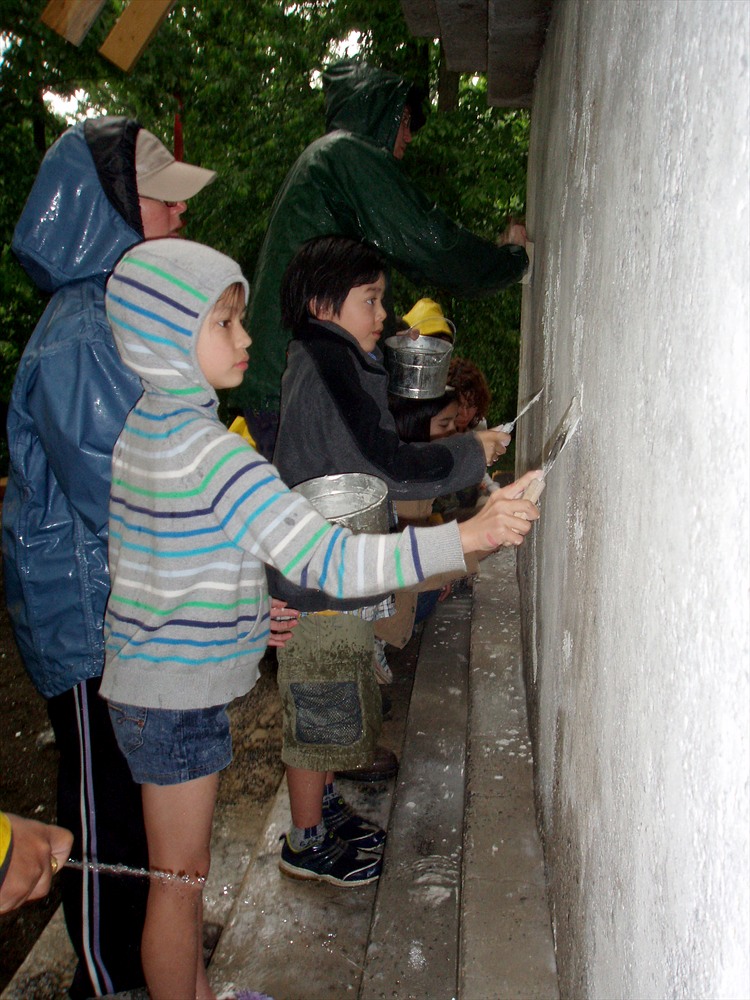
Then people will give you this attitude: “Well Jetsunma likes the temple clean so we’d better come and clean the temple.” No, Jetsunma has a real solution. If the temple gets dirty enough, Jetsunma can stay home in her clean house. So Jetsunma really doesn’t need the temple clean. You need the temple clean. You need to do that because the Buddha’s teachings tell us that if you build a stupa or care for the body of the three precious jewels—and here the three precious jewels, the Buddha, the Dharma and the Sangha are housed in this temple—then you are accumulating merit. You are changing your life. You are benefitting yourself and you are moving closer to enlightenment by accumulating merit and purifying your own nonvirtuous deeds, which all of us have accumulated. We have all had nonvirtuous deeds in our past, but we don’t want to face that. We don’t want to think like that. We don’t want to think that we have any needs at all. We don’t really want to look at our own fragile situation. We are afraid and we don’t want to admit it.
My experience has been that we are in such denial about our situations that we literally paralyze ourselves on the path. We prevent ourselves from going very far because we have not cultivated the kind of thinking that permits us and encourages us to practice more deeply and to go further on the path than we are going. Many of us are resistant to contributing to the temple. We are interested in coming to receive the teachings and then we are interested in going home and enjoying the rest of the day. We are interested in bringing friends to this exotic place. We are interested in seeing what this is all about. If any of you have received empowerments in the Vajrayana tradition, the Tibetan tradition, you know that we get pretty high church around here. We have a lot of ritual. We have a lot of color. And if you’ve come when the Tibetan lamas are here, you know that we have ritual instruments and ritual music and all sorts of really interesting exotic things. Unfortunately, many people come and dabble in Dharma simply because it is so exotic. But they miss the essential point and that is the Buddha’s heart advice to you, the Buddha’s heart teaching. That heart teaching, that heart advice, is encompassed and embraced in the thoughts that turn the mind towards Dharma. Those thoughts are, first of all, that we are existing right now in a precious and rare human rebirth. According to the Buddha’s teaching, it is very difficult to achieve this human rebirth. In order to achieve this human rebirth, you have to have number one, accumulated enough virtue, enough merit in your past, and number two, you have to have made some effort to move towards realization or to move towards benefitting others. There has to have been some element of movement toward the spiritual in your past.
Remember that those who have taken a lower rebirth such as the animals, are not capable of thought like that at all so they will not be accumulating the causes for a human rebirth in their present lifetime. They will not be able to do that. According to the Buddha’s teaching, however, we have somehow managed to achieve this human rebirth. A great way to understand how rare that would be and how miraculous it is, is to think about a gambling place like Atlantic City or Los Vegas, you know, where they have those machines called the One Armed Bandit. You pull the machine and a fruit comes up—a lemon or a cherry. It’s a gambling machine, a slot machine. Isn’t that what that is? So, our achieving a precious human rebirth is a bit like coming up with the three cherries in a row and you get the prize. But it is infinitely more rare than that. Infinitely more rare than that.
The following is an excerpt from a teaching by Jetsunma Ahkon Lhamo called “The Guru is Your Diamond”
Here in America, we have a lot of pop-psychology. We all have these little boxes about how relationships ought to be; and pop-psychology has told us how big they ought to be and what shape they ought to be in. And we are told that we should be independent in certain ways and then sharing in other ways. And then, you know, one way or another way we are told how we ought to be. I want to tell you that the relationship of Guru Yoga is not like that. For instance, in relationships we are taught, I’m ok, you’re ok. What is it? Don’t be co-dependent. So don’t be in a co-dependent relationship. Well, if you’re going to be in a co-dependent relationship, I guess it ought to be with your guru. But you don’t look at it that way, because a co-dependent relationship is where two people who are ill or not seeing clearly or deluded or neurotic in some way, are being neurotic together, and it fits.
Well, that’s not the same with one’s own root guru. You can freely and openly give your whole heart and know that you are not in danger. You can freely and joyfully walk, dance, through that door of liberation, and you will be happily and joyfully received. You can depend utterly and completely on the Three Precious Jewels and the condensed essence which is the root guru and never fall. This is the one time you should not guard your heart. A difficult habit to break for all of us.
So again, we’re not talking about personalities, because that’s ordinary. We’re not talking about you guys coming to live all at my house. Not like that. That’s ordinary, ordinary context. We are thinking that the blessing of my teacher resides as me, in me and I am that. And like we say in The Seven Line Prayer, “Following you, I will practice.” Through that devotion, through that practice, all the blessings of the Buddhas and the Bodhisattvas are yours, freely given. To the deserving student, to the practicing student, the guru will always appear. And we should always today be creating the causes for the guru to appear tomorrow, in whatever form.
The following is an excerpt from a teaching by Jetsunma Ahkon Lhamo called “The Guru is Your Diamond”
Guru Yoga can always be depended on to reestablish and continue the blessing. I promise you, if we call out to the guru with full heart, with determination and with fervent regard and recognition, the guru will respond, whether it’s in the way that you would like which is ‘Hi! I’m here for lunch,’ or whatever. It may not be that way. It may be something quite different; and sometimes it’s not something that feels good right away. One of my favorite students works herself to death and forgets to practice sometimes, and then periodically does things like break her back or, you know, injure herself in some way. And then she practices and amazing things happen. I wish she wouldn’t do it that way, but she does. You know who I’m talking about, out in Sedona. I have other students that kind of orchestrate separation and return in order for that feeling of return. But I wish they wouldn’t do that, because that feeling of separation often comes with some cause and effect relationship. And again if it were my diamond, I’d be shining it up all the time. I’d be collecting that interest all the time.
We use Guru Yoga that way to create the causes for continuation on the Path. The teacher should never be frightening. The teacher is your friend, your friend who will take your hand and walk you, lifetime after lifetime, even when you stumble and you fall. Something will arise through the devotion that you practice in this lifetime to protect you even in your next life. Eventually we come to the place where we see everything as the blessing of the guru. Everything. Sometimes we feel some confusion, and maybe even confusion for a long time, but you know that that guru would not let you down. You know that. And so you count on that, even the confusion, to be a blessing. Eventually because of that devotion, the confusion will clear and the guru will appear again like an underground spring coming once again to the surface.
Guru Yoga is the most potent of all practices and it’s the most simple. One can practice Guru Yoga simply by visualizing the guru above the crown of one’s head and making offerings in a visualization way, and then receiving the blessing, real quick. The white blessing from the guru’s body to your body, and it does come in the head, white to white; the red blessing from the guru’s speech, from the throat to your throat; the blue blessing from the guru’s mind, which is the heart, from his heart to your heart (or her heart). And you can receive that blessing constantly. It’s free. It’s yours. You can receive it periodically. You can receive it every morning, every night—whatever you want, as much as you want. That’s the beauty of Guru Yoga. You should think that the guru is like your constant companion. Not in a creepy way. I don’t want you guys looking in my window, But in a wholesome way, where we understand that this nature is freely given, like method that one can use. It is indistinguishable from the ground which is full Enlightenment, the method which is Dharma, and the result which is the completion or accomplishment of the precious awakened state.
So we understand the guru is the ground, the guru is the method, the guru is the result. We begin to mix, through the devotion, through calling out our own nature, our own mind, our own qualities, willingly with that of the guru; and over time, that blessing mixes like milk with water and we understand that, indeed, Lord Buddha resides in us all. We understand that indeed each one of us is some uncontrived beginningless and endless and yet fundamentally complete luminous nature, some state of awakened and yet uncontrived view. That we are that in our nature. And our job in this lifetime is to use the blessings of our gurus, to use their accomplishment, their qualities, their methods; to listen carefully and accordingly accomplish awakening to that, awakening to that nature. It’s the swift way. It’s the rocket ship. It’s powered because it’s like lighting something at both ends. You’re not thinking, ‘Oh I have to go there.’ We are thinking, ‘This is like a mirror and a mirror,’ inseparable in their nature.
The following is adapted from an oral commentary given by His Holiness in conjunction with a ceremony wherein he bestowed the bodhisattva vow upon a gathering of disciples at Namdroling in Bozeman, Montana, November 1999:
Next, consider the gold realm. Gods remain in their realm where they experience immeasurable bliss and happiness for long periods of time. They all have their own palace and gardens, wish-granting trees, and celestial food; everything in their external environment is inconceivably wonderful. Internally they experience only happiness and bliss throughout the entire course of their life. Eventually they exhaust their karma for that rebirth. Prior to that, the dying clairvoyant gods see the place of their future rebirth, which in most cases happens in the hell realm. They take such a rebirth due to having exhausted all tainted virtue that brought them rebirth in the god realm, and then nothing remains for them except an abundance of weighty negative karma. The vast storehouse of merit they once possessed is spent, and they have nowhere to go but to the lowest hell realm. Seeing the irreversible fate that awaits them, and knowing it is too late to reverse that, they experience tremendous suffering. They are powerless to reverse their karma of having to fall from the celestial realm of the gods to the lowest realms in existence.
Buddha therefore taught that there is not even a needle point’s worth of true happiness in samsara. Now you can understand the meaning of that teaching. Even if there is happiness, it always changes because it is impermanent. Happiness in samsara occurs as the result of the karma produced to cause it. Once that cause and result are exhausted, that happiness becomes something else, which is why the term cyclic existence is used to express the nature of life in the six realms. Sentient beings pass from rebirth to rebirth, revolving on this endless wheel of changing realms in dependence on their own karmic accumulations.
If your hair were suddenly to catch fire, you would immediately, without hesitation, try to put out that fire. Likewise, by understanding that cyclic existence is by nature permeated with suffering, and by understanding that it can never be anything other than that, you should immediately, without hesitation, focus on putting out the fire of cyclic existence. Focus totally on effort to extract yourself from this endless suffering of cyclic existence, so that you can achieve the state of permanent bliss and happiness, the state of fully enlightened buddhahood.
Thus it is taught that in order to be successful in reversing strong attraction and attachment to cyclic existence, we must practice dharma. Through the practice of dharma we can reverse attachment to existence and gain more momentum toward liberation, to the point where we realize the state of permanent bliss and cease to return to samsara.
The following is an excerpt from a teaching called “The Guru is Your Diamond”
If our teachers had not accomplished any Dharma, how would they be of any use to us? So we expect it of them and we rely on them to guide us in the way of Dharma. Sometimes it pisses us off. We’d rather go on vacation. We’d rather have a little more fun. I mean, it’s Sunday afternoon, isn’t it? And we have all kinds of reasons why we should maybe do something else, but we come back. There is my friend. If this teacher can bother to appear again and again for no reason other than to liberate sentient beings as my guru has, then I can at least be here. I can at least come half way, come full with devotion. When we are in the presence of our own root guru and we have that connection and we have the history and karma of the guru having ripened our mind in some way in the past, that ripening will surely come again. With faith and devotion and practice, it will surely come again. And so we have that kind of faith. We know in our hearts and our minds that we can rely on this one for that kind of help.
Should it happen that we cannot meet with the guru for some reason, or there is some difficult point in one’s path, some difficult moments, some difficult times, maybe even some difficult months or years, still, so long as the guru remains in the world, we can turn our face towards the guru and know. It’s like falling off a horse. You can always get back on.
But the problem, and there is a problem with that, is that if you waste your time with that precious jewel and don’t collect its interest, the jewel somehow becomes more distant, less potent, less present, less precious, less everything. And we think to ourselves, ‘Why is the guru not in my life so much?’ And we tend to think, ‘Oh, it’s because the guru’s over here or the guru’s over there, or the guru is not speaking right now, or the guru is this, or the guru is that.’ And you can think that way if you want to but it won’t help. We must think, ‘Now I’ve come to this place. I have chosen my guru and I am steadfast. And I have seen the door of liberation. Yet somehow things are a little mixed up here, I can’t quite get to it. I don’t feel focused. I don’t feel like I understand this blessing. I feel outsourced. I feel like I’m out to lunch somewhere on the Path here.’ And so we think, ‘Oh, what is the problem?’ Well, the first thing we have to do is correct our view and think, ‘This is the door to liberation. It is present in the world.’ Period. End of story. ‘What must I do? What must I do?’
Sometimes it takes traveling to see your guru. Sometimes it takes sitting down and doing Guru Yoga like you never did it before. And it can work out a myriad of ways according to one’s karma, according to one’s blessing. I’ve had it both ways. I’ve traveled to see my guru and the blessing was immeasurable and phenomenal. And then I’ve stayed home and practiced Guru Yoga and with amazing signs. The blessing was amazing and fundamentally life changing. And one, I saw the guru’s face; and one, I saw the guru’s face.
And that’s the nature of this blessing. It doesn’t depend on time and space. It doesn’t depend on ordinary things at all. And unless you neglect it, it cannot lose its potency. We must think, as pertaining to Guru Yoga, that every day, even while now we sit in comfort and enjoy being together, that every day, even this day, we should earn the blessing to see the guru tomorrow. How will I see the guru? Maybe I’ll see the guru’s picture and it will jump out at me and touch my heart. Maybe I’ll see Guru Rinpoche’s picture and it will jump out at me and touch my heart. Or maybe I’ll say The Seven Line Prayer. And wow, that one really…, that one did it. Or maybe I will do my practice and it feels deep and rewarding like an underground stream that has come suddenly to the surface and has given us something precious to drink.