The Four Noble Truths – An Introduction

The following is an excerpt from a teaching by Jetsunma Ahkon Lhamo called “Keeping Heart Samaya”

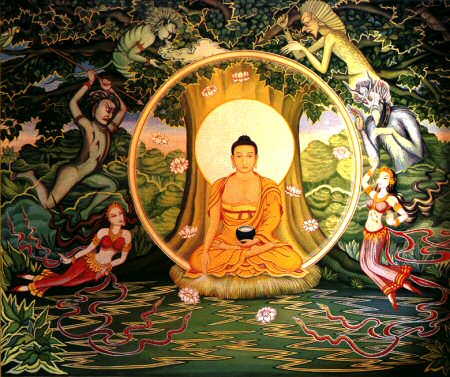
One of the things that I have learned since I met with my teacher is to follow the fundamental thoughts as taught by the Buddha very carefully, starting with the thought that all sentient beings are suffering, and that suffering is all pervasive.  According to the Buddha’s teachings, we are all suffering from desire.  It seems as though we are suffering from external circumstances, but, in fact, we are suffering from desire.  In fact, we are suffering from our response to desire as well.  So we have a complicated, dualistic, or I should say double-edged, kind of suffering.  We have the suffering that comes from desire, and we also have the suffering that is invoked when desire is not met.  So it is two-edged and more complicated than one would think.

All sentient beings are suffering. They are suffering from desire, but there is an end to suffering.  This is the news that is so good it is almost hard to take in.  This is the news that is so magnificent that it is actually hard to understand when we have had an entire life, and we have noticed that there is always something. There is always something.  Everything that comes together separates.  Everything that is really good and has brought a lot of joy and a lot of benefit, gone.  Even if we find ourselves in the most joyous, gorgeous, fabulous mood, it lasts about, oh, ten minutes.  So we have noticed that happiness is ephemeral.  It comes and goes. It sort of burns away and returns, and in between there is that suffering.

So when we hear that there is an end to suffering, a cessation to suffering, we wonder, how can this be?  How can this possibly be?

The Buddha teaches us the next thought then, that the end or cessation of suffering is called enlightenment.  Yes, that is true because none of us, being ordinary sentient beings, have experienced enlightenment yet.  Sentient beings simply have not experienced that, so they do not know what the cessation of suffering actually feels like.

Then after introducing these thoughts, Lord Buddha teaches us how to accomplish the cessation of suffering, or enlightenment.  In many forms of Buddhism, this is called the Eightfold Path.  In our system of Buddhism, this is condensed into the accomplishment of two things: wisdom and knowledge. We are taught that in order to accomplish the cessation of suffering we must exit samsara and enter into that precious awakened state called enlightenment.

Copyright © Jetsunma Ahkon Lhamo.  All rights reserved
The Mystical Bond

The following is an excerpt from a teaching by Jetsunma Ahkon Lhamo called “Keeping Heart Samaya”

The Lama, being the condensed essence of all three objects of refuge, is also considered to be inseparable from the Dharma.  The Buddha is like the Lama’s mind in this case.  The Dharma is like the Lama’s speech.  So as a student, together with one’s Lama, one takes on the responsibility of learning Dharma.  It really isn’t enough to go around and say, “I have a Buddhist teacher!  Oh, I have a Buddhist teacher!  This is very good!”  And feel really happy about that.  That is great.  I hope you do feel happy about it, but it is not enough to do that and no more because it really isn’t that valuable to have met with your teacher, which is really very precious, if you do not follow the Buddha’s teaching, which is the Dharma.  Otherwise, what you are doing is coming to the temple to be entertained once a week for roughly an hour and a half, or longer, if you engage in other activities.  So a relationship where only entertainment occurs is really not that valuable.  You can get that from Blockbuster.  You don’t need a Buddhist teacher for that.

What you need a Buddhist teacher for is to connect you to the method, the Dharma, which is the Buddha’s speech.  You need a teacher so that you can travel on this path in order to accomplish the supreme result of liberation.  So the second commitment that the student must make to the teacher is to practice and learn Dharma, to maintain a healthy spiritual interest in Dharma and that means, once again, reflecting on the Buddha’s foundational teachings–realizing the faults or flaws of cyclic existence.  Then we practice a kind of renunciation that makes us eager to drink the nectar of the Buddha’s teaching for our self and for all sentient beings.  We begin to develop the mind of compassion.  For our self and for all sentient beings this Dharma practice represents the end of suffering, so we are eager and pleased to learn Dharma, to learn to think like a Dharma practitioner.  That is the second commitment.

The Lama, as the condensed essence of all three objects of refuge, is also considered to be the Sangha.  The mystical relationship between the Lama and the Sangha is quite profound, quite beautiful.  The Sangha is like the Lama’s body in that the Sangha has the samaya, or the responsibility, of holding or anchoring the Buddha’s teachings in the world in the same way that the Lama’s body, or appearance or presence, establishes the Buddha’s teachings right here, in the world.  Teachings are here in the world, being conferred here in the world.  The Sangha becomes an extension of that appearance.

Here in this Sangha for instance, primarily the ordained, but other Sangha members as well are trained as umdzes, or chant leaders.  We have the chopön, who handles ritual objects during the puja.  The Sangha are all well-trained, and all of them have different jobs.  We have archivists who keep our books in good, healthy order and keep them in a respectable and clean place.  There are many, many different functions, and these are all considered extensions of the Lama’s body.  This is the Lama’s wheel of activity.  The entire Dharma community then is the Lama’s extended body or wheel of Dharma activity.  So the mystical bond between the Lama and the student is closer than one’s own breath, more essential than one’s own essence, more relevant than one’s own mind, speech, body, anything.

As the Lama’s body, the Sangha also has a certain responsibility to one another, and this responsibility is a very important part of the samaya or commitment to the Lama,.  Remember, there is the responsibility to uphold and propagate the Buddha’s teachings, to follow and learn more about Dharma, the responsibility to uphold and protect the Sangha, and the responsibility of the Sangha to be the extension of the Lama’s activity.

Copyright © Jetsunma Ahkon Lhamo.  All rights reserved
Caring for the Precious Sangha

The following is an excerpt from a teaching by Jetsunma Ahkon Lhamo called “Keeping Heart Samaya”

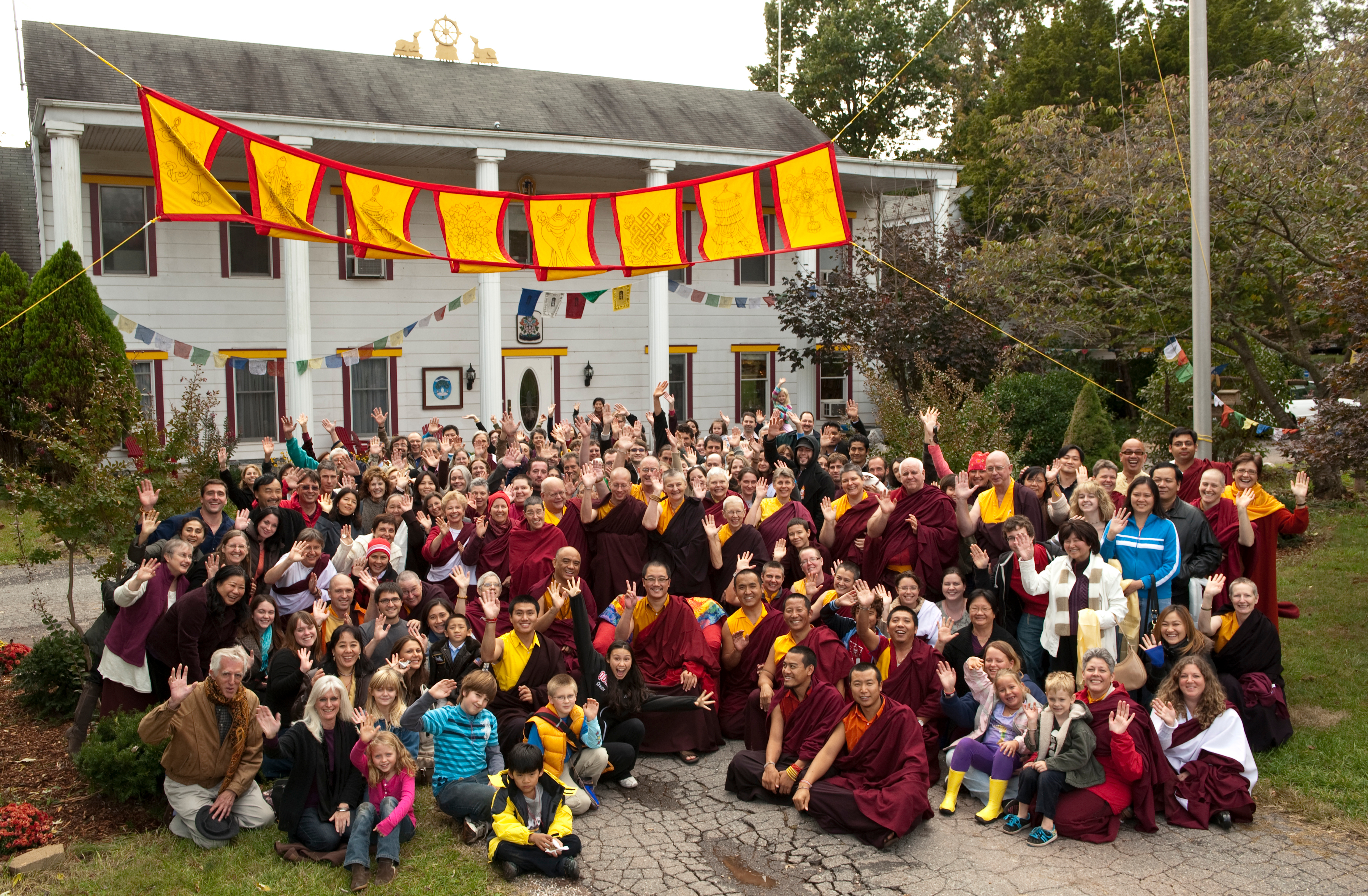
As a student, one of your responsibilities is to uphold and protect the Sangha, one of the Three Precious Jewels.  The way that works is this. The Sangha is one body.  If one part of the human body goes sour, if there is some negative consciousness rattling around somewhere – and nowadays even doctors know that there is some connection – the body will develop a cancer.  If even one part of it has become disorganized, then the whole body becomes sickened.  So the Sangha’s responsibility to one another is virtuous conduct.

By virtuous conduct I mean that in the Sangha there should never, ever be gossip and slander. NEVER!  I cannot say this strongly enough.  If there will ever be a time when the Buddha’s teachings are destroyed, it will be from the inside because there is nothing on this earth, other than Buddhist practitioners, that have that power.  If the Buddha’s teachings and their purity are ever destroyed, it will be by Dharma practitioners committing non-virtuous acts.  Gossip and slander that are harmful and disruptive to the Dharma community is a heinous crime because the Sangha is like a beautiful, virtuous, supreme and exalted body; not an ordinary body, but a body that leads to liberation, a body that walks to liberation, a body whose sole purpose is to bring about the liberation of all sentient beings.  This is purity itself.  This is truth itself.  If instead of upholding that truth by keeping samaya with the Lama, the Sangha instead engages in this kind of non-virtuous conduct, this cancer is created. This is such a heinous crime because of what is lost.  Where else in samsara can we find such great benefit as from the Sangha or spiritual community?  Where else will such help and support come than from the Lama’s extended body, this pure activity in the world?  So because something very pure and precious has been harmed, the weight of the crime is very great.

I particularly have a strong dislike for gossip and slander.  I have seen what kind of harm it can do in religious communities.  Even in the ordinary context in this day and age, gossip and slander have gotten to be so stylish and so outrageously prevalent and hip that we don’t even seem to mind closing down our government so that we can do it.  We don’t seem to mind paying any price, including completely disrupting the responsibility between people in office and the people they serve.  Not to say that any of these things that are said aren’t right, but this kind of gossip has become such a thing, such a fad.  In other religious communities as well as Buddhist communities, it is a general religious phenomena.  But there is always gossip and slander.  It seems to be that if people think a teacher is pure, other people have to knock that teacher down.  Or if people think a particular faith is pure, other people have to gossip about it.  Why does it have to be that way?

As far as I am concerned, if you bring gossip and slander into this community, which is the Lama’s body, being the Lama here, I take it very personally.  If you bring gossip or slander into this community, you are wrong, wrong because you brought it.  Even if the story you are telling is right, you are wrong because what we are doing here by creating gossip and slander, is to harm the body of the Sangha, and there is a breakage of samaya.  We have not upheld the three objects of refuge.

Now, of course, if there is ever a problem with misconduct on the part of any religious leader, anything like that, we hope that those who are engaged in this conduct will turn to their teachers and receive spiritual guidance.  But the antidote to that is support and compassion.  The antidote to that is not the hatred, disease and sickness of gossip and slander.  That only harms the body and creates a cancer in the Dharma community.  So part of the samaya between students and teachers – and I will tell you that if I could legislate that it would be 100 times as strong here – for any of you who are truly committed to being my students, you must cut out gossip and slander from your life immediately, whatever it takes.  Purify that non-virtue.  Stop now.  You help no one and you harm yourself.  It brings nothing but unhappiness.

Copyright © Jetsunma Ahkon Lhamo.  All rights reserved

Beginning to Look Deeper

The following is an excerpt from a teaching by Jetsunma Ahkon Lhamo called “Entering the Path”

What I would like to talk a little bit about is how it is when one first comes to the path. Many of you new students, as well as those of you who are not new students, find that eventually things come full cycle. And when you meet with certain problems on coming to the path, it’s likely that you don’t completely solve them.  When we first come to the path we’re generally not equipped to make the great gains that we need to in order to solve most problems, and we come to another cycle of meeting with a certain kind of problem. So let’s talk about that just briefly.

As a Dharma practitioner, or as a beginning Dharma practitioner, or perhaps as a practitioner who is simply testing the waters and hasn’t committed yet to practicing Dharma, it is no longer suitable, now that you have begun to study, to think of things in a superficial way.  The way that we used to think of our lives, the way that we used to try to understand the events in our lives, was on a very superficial level.  We did not look for depth.  We did not understand.  Our minds were filled with ignorance, and we simply tried to determine the events of our lives with a value system that could not possibly understand what was happening because we were looking only at the surface.

For instance, if something happened to us in our lives and it was uncomfortable or caused us suffering, we would simply look at that as being an external phenomenon that was happening to us. We did not try to understand the deeper ramifications of what was actually occurring. Now we’re way past that, or at least we should be past that, and it is no longer suitable to take phenomena and events within our lives at face value.  It is time now to plumb the depths of our practice in order to understand more deeply what is actually occurring.

According to the Buddha’s teaching, all things are a display of the primordial nature.  It is the lack of understanding of the primordial nature that makes the display unclear and deluded.  It is the lack of the awareness of the primordial wisdom nature and the belief in duality instead that absolutely ensures that we are going to see events happening to us as though projected from the external, and it’s going to be very difficult for us to understand.  Now, as practitioners we begin to understand in a different way.

Copyright © Jetsunma Ahkon Lhamo.  All rights reserved

Respecting the Three Jewels

The following is an excerpt from a teaching by Jetsunma Ahkon Lhamo called “Keeping Heart Samaya”

When we examine the student’s responsibility in the teacher/student relationship, we have to think like this: First of all, according to the teaching, the lama, as the spiritual teacher or spiritual master, is the condensed essence of the external and most familiar objects of refuge–the Buddha, the Dharma and the Sangha.  So, regarding the student’s samaya or commitment to the teacher, there are three aspects of commitment.

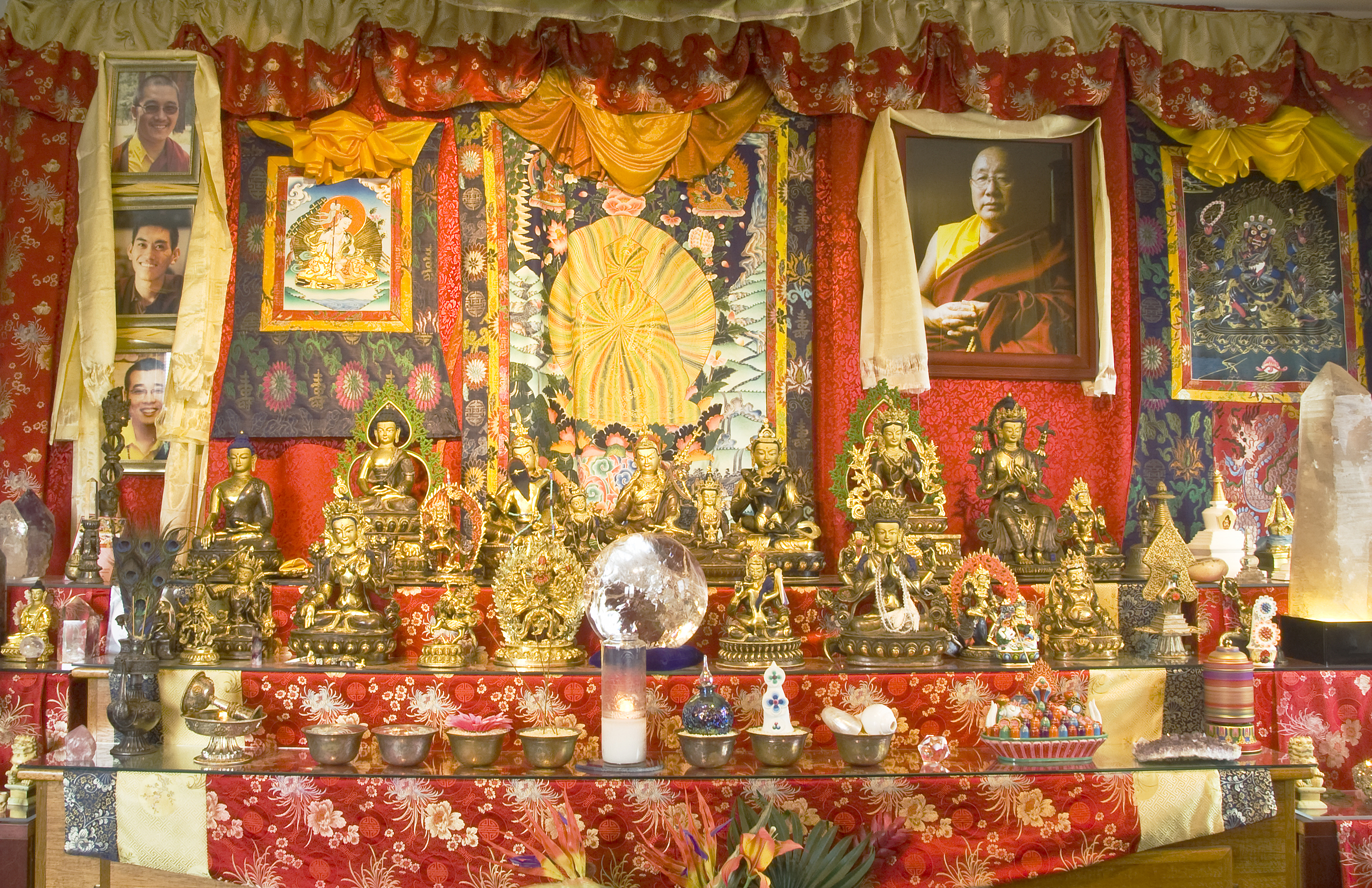
As the lama is the condensed essence of Buddha, Dharma and Sangha, the first commitment is to honor and uphold the Buddha’s teachings.  That is to say that if we are practicing the Buddhadharma, we should never disrespect the Buddhist prayers and the Buddhist text. We love and respect them as the Buddha’s own speech, the Buddha’s own speech emanation.  We should never throw them around or put them under our seats or step on them or treat them as though they were any like other object in samsara, like a rag or something.  We should never treat any objects that are representative of the objects of refuge like that, such as statues, Dharma texts, and images of the Buddhas.

It’s not that Buddhists have a superficial, external, worship of images.  It is not like that.  This rule or practice is meant to develop discrimination in the student’s mind so that the student can discriminate between what is precious and extraordinary and what is ordinary.  Ordinary things are things that arise in samsara and result in samsara, even things that we need, like enough water to live on.  Water is in the world, you can get it from the world and it results in the satisfaction of worldly thirst.  Water is not the same as Dharma.  Dharma arises from the mind of enlightenment, results in enlightenment and is not ordinary.  Water will support my life temporarily, so it is impermanent.  If I drink a glass of water and then don’t drink any more, I will last four or five days. But even though it may be necessary for me to drink that water in order to stay alive long enough to read the Buddha’s teaching, I won’t forget the teaching because it is extraordinary and does not arise from samsara.

This commitment not only supports my life temporarily and in this moment, but it also provides a path or a method by which I can accomplish Dharma, by which I can enter into the door of liberation and be free.  This is a miracle.  This is a treasure that doesn’t only last one life or one moment or four days.  Life after life after life this treasure lasts,.  So these things are held up as extraordinary. Part of the student’s commitment to the student/teacher relationship is to honor this external object of refuge–the Buddha image, to honor the Buddha’s presence in the world, to propagate the teaching, to hold it up and protect it.

Copyright © Jetsunma Ahkon Lhamo.  All rights reserved
Supplication to Mandarava

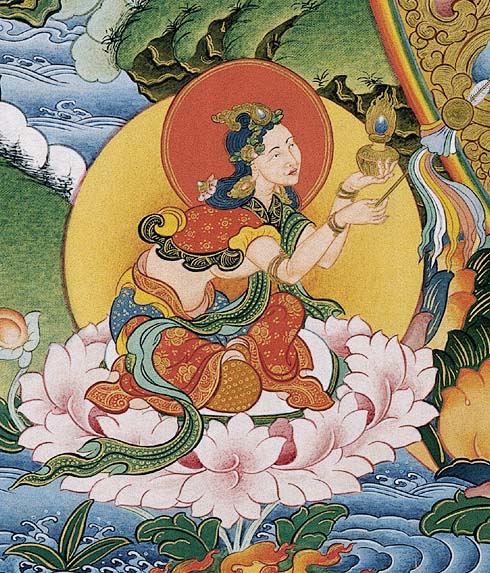
“Dissolving in the expanse of space
like a rainbow, without remains,
She departed to the
Akanishta Paradise of Pamavyuha.
She transformed into the embodiment
of the supreme consort,
The secret primordial wisdom dakini.
To the feet of Mandarava, I supplicate!
Together with nine hundred
pure awareness holder disciples,
After dissolving into a rainbow body,
she manifested herself once again
for the benefit of others.
Mandarava emanated unceasingly,
manifesting herself as a dakini to tame
the minds of beings in
every essential way.
To the feet of Mandarava I supplicate!”
— Guru Padmasambava

This Very Moment

Monk at MD Stupa2

To begin to develop Aspirational Bodhicitta is to understand the faults of cyclic existence, to understand the cessation of cyclic existence, to understand something of the nature of awakening or at least to understand that that is the cessation of suffering; and then to begin to develop from these foundational thoughts a caring and concern for all parent sentient beings. Aspirational Bodhicitta can take the form of just thinking as you ordinarily think. In the same way that you think of what will I have for dinner tonight, or in the same way that you think of what you would like to wear, or the ordinary things that we think of that concern ourselves. in that same ordinary way, without any kind of high-falutin’ dogma, you can begin now to develop a sense of the need and plight of sentient beings. And you can begin to speak what is in your heart, because it is in there somewhere in the natural state—the hope that all sentient beings will be free of suffering.

Each of you has a seed potential of that hope. You could not approach a truly spiritual path; you could not approach the Buddha’s teaching. You would have no karma to hear anything of the Buddha’s teaching if you did not have the hope that all sentient beings would be free of suffering. Because in order to be involved in these auspicious conditions, in order to hear the Buddha’s teaching, in order to have the opportunity to practice and the inclination to do so, in order to even begin the idea of moving onto a path that leads to supreme enlightenment, you must have accumulated an enormous amount of virtuous karma in the past and to accumulate an enormous amount of virtuous karma, there had to be kindness. So you should not be afraid thinking that you have no compassion.

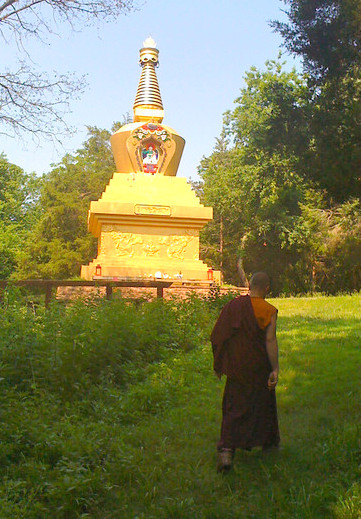
Some people tell me they have no compassion.  That is completely erroneous. That is impossible. But you must begin to dust off that jewel. You must begin to consider these foundational teachings, and to begin in whatever way you are comfortable with, to amplify and systematically develop Bodhichitta, the Aspirational Bodhicitta. You can begin to make wishing prayers for other sentient beings. One of the reasons why we built the Stupa that we built outside was to have a place here in this area that would have the fortunate quality of being able to enhance our prayers. Because of the cosmology of the Stupa—the way in which it is built, the empowerment that goes into actually consecrating it, and the wonderful relics that are present in it—because of the blessings of the prayer, the blessings of the mantra, because of all of these things, the Stupa actually has the ability, with faith, to amplify our prayers. We are taught to circumambulate in a clockwise direction making wishing prayers for all sentient beings. You can begin to do that. You can begin to make wishing prayers on your own, at any time. You can just think wishing prayers as you walk about. You can begin right now to developAspirational Bodhicitta in the same way that you develop muscle. You have the muscle fiber. You only need to strengthen it through use. That discipline is essential.

An excerpt from a teaching by Jetsunma Ahkon Lhamo called “Bodhicitta”

Copyright © Jetsunma Ahkon Lhamo.  All rights reserved
The Power of Ngondro

The following is respectfully quoted from “Natural Liberation” by Padmasambhava:

OM VARJASATTVA SAMAYAM ANUPĀLAYA VAJRASATTVA TVENOPATISTHA DRDHO ME BHAVA SUTOSYO ME BHAVA SUPOSYO ME BHAVA ANURAKTO ME BHAVA SARVA SIDDHIM ME PRAYACCHA SARVA KARMASU CA ME CITTAM ŚRĪYAM KURU HŪM HA HA HA HA HOH BHAGAVAN SARVATATHĀGATA VAJRA MĀ ME MUŃCA VAJRA BHAVA MAHĀSAMAYA SATTVA ĀH

This is an extremely important practice. It’s dealt with quite concisely here, but more more elaborate instruction can be found in other teachings on the preliminary practices. This practice is of very tangible benefit. There are other teachings on Atiyoga and so forth that we may consider more esoteric or advanced, but it’s questionable how deeply benefited we can be by those and how much we can truly enter into experience of the Great Perfection. Here, though, is something of practical benefit. If you are familiar with this practice, it’s good to share it with others who may be beginners. By such a practice as this, the two types of obscurations can be purified. Once all of your obscurations have been completely purified, you are a buddha; and that means you have realized the Great Perfection.

Due to ignorance, delusion and stupidity,
I have transgressed my samayas, and they have degenerated.
O spiritual mentor, protector, protect me!
Glorious Lord Vajradhara,
Merciful being of great compassion,
Lord of the world, protect us!
Please cleanse and purify the whole mass
Of sins, obscurations, faults, downfalls, and taints.
By this virtue, may I now
Swiftly actualize Vajrasattva
And quickly bring every sentient being
Without exception to that state.
O Vajrasattva, may we become exactly
Like your form, with your retinue, life span, pure realm,
And with your supreme , excellent signs.

OFFERING THE MANDALA

Once you have begun purifying the two types of obscurations, there is the task of accumulating the two collections of merit and of knowledge for one’s own benefit and the benefit of others. The welfare of others is accomplished in the realization of the Rūpakāya, or form embodiment, of the Buddha; and it is toward accomplishing that end that one offers the mandala.

OM VAJRA BHŪMI ĀH HUM
The basis becomes the powerful golden ground.
OM VAJRA REKHE ĀH HŪM
On the periphery is a surrounding jeweled iron fence.
In the center is the supreme king of mountains,
Majestic in its composition from the five kinds of precious substances.
Lovely in shape, beautiful, and delightful to behold,
Seven golden mountains are surrounded by seven concentric seas.
In the east is the continent Videha, in the south, Jambudvipa,
The west is adorned by Godàniya,
And in the north is the great Uttarakuru;
With the eight sub-continents of Deha and Videha,
Cāmara and Aparacāmara,
Śāthā and Uttaramantrina,
Kurava and Kaurava,
The sun, moon, Rāhu and kālāgni,
And this bounty of wealth and enjoyments of gods and humans
I offer to the precious spiritual mentor and his retinue.
Out of compassion, please accept this for the sake of the world.

The First and Only Constructed Wetlands In Maryland

Wetlands Planting

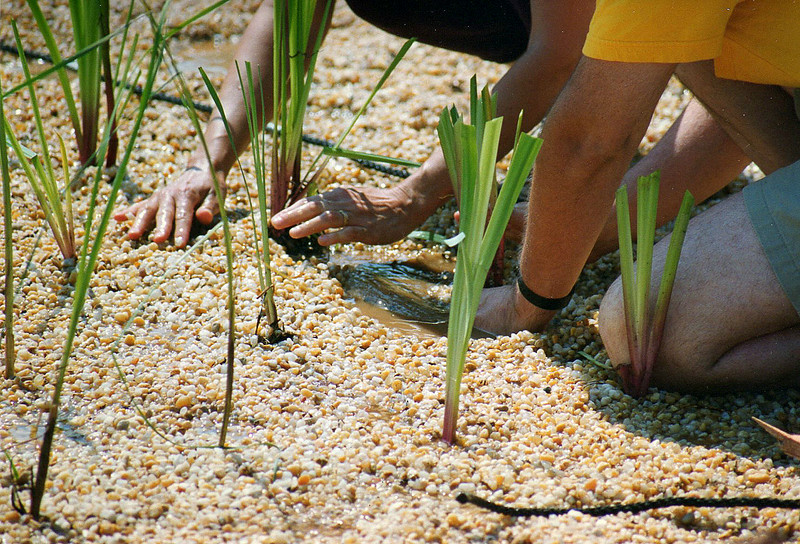
Did you know that since 1988, KPC has processed all of its wastewater (5 million gallons!) through a groundbreaking Constructed Wetlands Project, the first of its kind in the Chesapeake Bay estuary? Built by the monks and nuns and members themselves, we haven’t used a drop of chemicals, nor released an ounce of sewage in over 25 years.

Wow.

We are very proud of our commitment to environmental responsibility and the example we set and the experience we bring to the community, as evidenced by this little-known environmental victory.

The system has run successfully for over 25 years and now it needs some maintenance. Solids have built up that need to be removed, and invasive plant species are crowding out the aquatic plants we’ve planted and maintained to clarify the wastewater before release. It’s going to be costly ($33,000) and it needs to be done before the frost hits, so there is an urgency.

We have launched a campaign on Indiegogo, called Get your s**t together: Brown Is The New Green, to raise money for the maintenance. The success of the campaign relies on spreading the word about this innovative and environmentally responsible project to the widest possible audience. Please follow the link. Read the message. And then pass it on to everyone you ever knew. Like it, share it, forward it, tweet it, blog it, text it, post it, stand on the corner and hand out leaflets. However you can, spread the word. That is how we will succeed.

Thank you for your help with this very important project.

John Darrin on behalf of KPC

Heart Samaya

The following is an excerpt from a teaching by Jetsunma Ahkon Lhamo called “Keeping Heart Samaya”

We’ve talked about the commitment made by the teacher when accepting a new student. What about the commitment by the student to the teacher, the samaya between the student and the teacher?  What is that all about?  There must be some kind of reciprocal relationship.  Obviously the teacher cannot insist on the student’s progress without the student’s willingness.  The student has to be willing to follow Lord Buddha’s teachings, has to be willing to accept the objects of refuge as their true refuge from the sufferings of samsara.  So there is a reciprocal commitment that is required.

It is extremely important that the teacher maintain their ethical and moral responsibility to the student.  That is to say, the teacher honors the student and thinks of the student with such high regard and such respect that actually it is said that a pure teacher will consider the student to be worth more than their own safety or comfort.  In a sense, they hold the student up in the same way that a parent holds up their child, not necessarily as superior, but as vitally important and cared for.  Any of you who have been parents know that in a dangerous situation, before you think of your own safety, if you have that bonding and love with your child, you’ll think about the safety of the child first. That is always the case.  And when the mother hears the cry of her baby child for food, she doesn’t say, “I am not ready to feed you now.  It’s not convenient for me to feed you now.  I have no wish to feed you now.” Instead, the mother wants to answer the child’s call as though the mother were filled with milk and the child were very hungry.  It is very instinctive and very natural.

So the relationship occurs in that way on the teacher’s side of the fence.  Now what about the student, what is the student’s part in the equation?

Well, there are certain teachings and certain rules that one must follow, but I don’t like to think of them as merely following dogmatic rules.  I like to think of this samaya, or this commitment, as a samaya of the heart.  Something that is deep and profound,  instead of like a cheap and gaudy display. It doesn’t burn hot like paper, quick and then gone.  It burns deep and slow like good strong hardwood or even better, good strong coal-something that burns hot for a long time, steadily without interruption.  This is how the relationship between the Guru and disciple should be.

When the student learns about the samaya they are keeping with the teacher, they should hold that samaya not so much as a duty and responsibility but more as a jewel, just as the teacher holds the student as a jewel.  So that relationship then is considered precious, valuable, from the heart.  Not a methodical thing, not a thing done by rote, not a thing done blindly without any understanding, but a deep and pervasive samaya or commitment that is a heart connection that ultimately enhances the practice and the level of accomplishment that comes from practicing Guru Yoga.

Copyright © Jetsunma Ahkon Lhamo.  All rights reserved
WP2Social Auto Publish Powered By : XYZScripts.com