Introduction to Western Chod

The following is an excerpt from a teaching by Jetsunma Ahkon Lhamo called “Western Chod” 

The main thought about this teaching that I am going to describe to you is that all of this occurred before I ever met with my root guru, with either one of my root gurus. I have two root gurus,;I hadn’t met with either of them. I had not met with the path called “Buddhism”. I had not read any books about Buddhism. I did not know anything about Buddhism. In fact, I am embarrassed to say now that I thought the Tibetans were kind, smelly, old guys who sat on rugs. I really did think like that. I am sorry, but, you know that is the truth. I am bound to tell the truth.

I was about 20 at the time. I had known for about one year that I had to engage in a course of preparation for some later events in my life. I really didn’t know what the later events were. I had no idea about being connected with Buddhism or anything like that. But I had always known that there would be something, and I had always known that I should prepare for it.

At the age of 19 I received certain indications that it was time to prepare.  I had already begun on my program of meditation. Right around the time that I was twenty I gave birth to my first son, and he was a very cooperative son. He was willing to take naps during the day so that I could meditate. I swear that I didn’t bonk him over the head or anything. He just took naps. So, I was able to engage in meditation early in the morning,  then in the afternoon during his nap time, and then later on in the evening. I was very much involved with it. My feeling for my practice was that this was really the main part of my life, that everything else was kind of black and white, and, that was the colored part somehow. Every time I would come to a place where I felt as though I had engaged in a certain element of my practice for long enough, or it just simply felt naturally time to move on, I would request inwardly to, I would have to say, the absolute nature (which is the way I understood divinity at that time). What was the next step?  How could I practice?  How should I continue to grow and engage?  And this one time I received an awareness, and an indication and instruction that I should begin to practice in a certain way.

The practice will be presented in upcoming posts…

 Copyright © Jetsunma Ahkon Norbu Lhamo All rights reserved

You Can Make It

An excerpt from a teaching called Bodhicitta by Jetsunma Ahkon Lhamo given after her return from India and Nepal in 1996

In Nepal, right next to one of Guru Rinpoche’s caves where he practiced chemchok, lives a wonderful Dakini.  She is the consort of Lama Tulku Orgyen.  And she’s been there for years and years, practicing and practicing.  We had the pleasure of meeting her.  Whenever you go there, you can hear her ringing those bells and practicing.  She never stops.  She’s so beautiful. She’s actually kind of old, but when you look at her, her face is completely unlined, she’s got beautiful black hair and really deep eyes.  She’s just gorgeous. We went in there and gave her a scarf and tried to do prostrations, but she wouldn’t let us. Sangye Khandro came with us to translate, since the Dakini doesn’t speak any English, of course.  And she just practices all the time. She sat us down and we talked for a little while.

I told her that we have a Sangha here and that a large percentage is women.  And I said, “Would you give some advice to women practitioners in the West?”  She said first of all that there’s no difference between women and men practitioners.  There is no difference.  Women tend to think that they are held back by certain issues – family issues, lover issues, blah, blah issues, stupid issues.  There is no difference between women and men.  In fact, she said, women actually have a deeper sense of primordial wisdom.  They are closer to that Dakini archetype.  They have a deeper sense of that.  They’re more internal in some way.  She said women have an excellent chance to be practitioners.   And she said, “I would give this advice to both men and women equally.  You have to be courageous.  You have to never stop.  You have to decide that you are going to achieve the rainbow body and you will do whatever it takes because you really want to incarnate in such a way that you can help this world or any world that you land on.  You have to have courage.  You have to never let any circumstance stop you.  You have to practice as though it’s the most important thing in your life.  You have to remember that this is the only important thing there is.”  And she said, “Practice constantly with great faith and great courage.  Then you need to be sure that you are with a teacher that you have absolute faith in.  And you need to be with a lama who can give you initiation that can ripen your mind.  With all those factors, especially great courage, you can make it, even in this degenerate time.” She said, “You can make it.”

It was one of the most moving speeches I ever heard.  But she kept saying, “Have courage; don’t stop.  Break through whatever stops you.  Have courage.”  And my feeling when I watched her is that it must have taken tremendous courage for her to completely renounce the world that she lived in.  She is right up there in that little building right next to the cave.  It’s one room.  She’s got thangkas and rugs, it’s kind of nice, but there is no place to go to the bathroom.  You have to wash out of a bucket.  She has renounced the world and all the stupid trappings that go with it.  She’s going to make it.  When that Dakini dies, you are going to see signs and they’ll find her again when she reincarnates.

Copyright © Jetsunma Ahkon Lhamo.  All rights reserved

What Drives You to Practice?

An excerpt from a teaching called Bodhicitta by Jetsunma Ahkon Lhamo

Some of you show up for practice because you think your teacher will get mad at you if you don’t.  So you make yourself visible.  Some of you show up for practice because you’ve got to get it in today.  When do you do practice because you are sick of delusion? When do you do it because you are sick of death?  When do you do it because you are sick of watching sentient beings suffer and yet are helpless to help them?  When do you say those prayers so deeply that your heart and your mind are purified of delusion and of hatred, greed and ignorance, so that your heart and mind are so deepened that you will absolutely incarnate in such a way to benefit beings?

The single most abundant deepening quality that you all have is your great love and desire to help others.  If that’s the ticket with you, ask yourself if you really want to help others or if you want to look like you are helping others?   Sometimes I think people want to look like they are helping others so they can be a nice person.  As soon as you’re finished with that and you decide that you really help others because you really can’t bear to see their suffering and are finished with watching people suffer, then use that.

Why do you just practice by the book?  Why don’t you walk around the temple and make prayers constantly, visualizing the refuge tree; walk about the living quarters of your Lama and the temple itself and the Sangha that’s in it saying, “In this way, let me follow you forever.  In this way, let me always revolve around the Three Precious Jewels.  In this way, let me be born under whatever circumstances to help sentient beings,” making these profound and sincere prayers.  Maybe you can break through into depth.

Copyright © Jetsunma Ahkon Lhamo.  All rights reserved

Those With Hopes of Us

The following is an excerpt from a teaching by Jetsunma Ahkon Lhamo called “Antidoting the Mantra of Samsara”

The Buddha teaches us that there are literally so many sentient beings that, not all the great Bodhisattvas and lamas have connections with all of them.  That’s how many sentient beings there are.  We don’t have connections with all of them.  That means that there are sentient beings with whom you have connections, sentient beings that you have been involved with in one form or another since time out of mind, and their only connection to future practice, to being liberated from samsara, to practicing Dharma, is you.  Literally there are sentient beings right now who are waiting for you to achieve liberation.  The more you dance around with this, the more they suffer and the longer they wait.

From the moment that you begin to practice Dharma, these are the ones that you should live and breathe for—these precious ones who have hopes of you.  You should think of them as your children, as your purpose, as your parents, as your beloved because without you, they have not much hope.  That’s why we practice Dharma. That’s why we work hard at it— to alleviate suffering for self and others.  And we consider that to be completely nondual and equally importantSofor this reason it’s time to face the music, go deeper, and that hated word, commit.  That’s what it takes.

  Copyright © Jetsunma Ahkon Norbu Lhamo All rights reserved
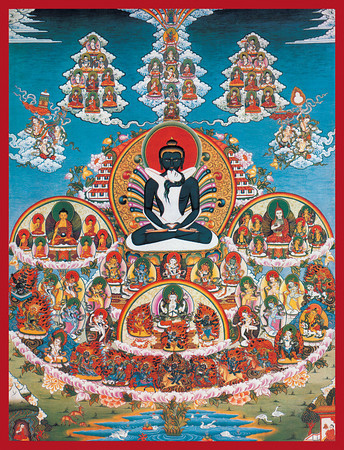
Where is Your Heart?

An excerpt from a teaching called Bodhicitta by Jetsunma Ahkon Lhamo

What makes you a deep practitioner?  What makes you a deep practitioner is really having renounced cyclic existence.   Those of you that are casual practitioners are practicing, but your mind is still a mind of distraction.  You are still running hither and yon, doing this thing and that thing, and you’re superficial.  You have to do this activity over here that is so important, so you go to the meat market. And you have to do this thing over here with your family.  All these have-tos have to happen. There is nothing wrong with going to the meat market, and I want you to have a wonderful family, but it’s that life of distraction that I am arguing with.  It’s that distracted mind that keeps you practicing superficially and keeps you a casual practitioner.

After having received all this teaching, all this loving, after all that you have felt and known in your own heart to be truth, if you are still doing that after all this time, then somehow you have not fully taken refuge in the Three Precious Jewels.  You are not a renunciate.  In your mind, there is still something in the world out there to be accomplished, something that you feel is going to meet your need or answer your problem.  In other words, you still believe in the world of appearances.  You still believe that this apparent reality has some solution or has some basis in realness. You still believe that something is there and you haven’t let go of it.  You haven’t really turned your mind away from it.

When I say turn your mind away from the world, I don’t mean that you have to become a monk or a nun necessarily.  I don’t mean that you have become a nerd or a dead person.  I don’t mean that you are limp and you just don’t have any fun anymore.  That’s not what I am talking about. You can engage in any activity that you feel to engage in, but you simply don’t take refuge in it.  It’s not something that you get tense about.  It’s not something that you get compulsive about. This is Nyingma philosophy.

Right now your mind is all divided.  You are off here and off there.  As you are running off in any of those directions, if someone were to say to you, “Where is your heart?”  You’d have to feel around for it, because you don’t know where it is.  You’re not thinking about the teachings of Lord Buddha.  You’re not thinking about the precious Dharma.  You’re not thinking about the Sangha, you’re not thinking about the Lama, you’re not thinking about the Buddha.  You’re not thinking about clear mind.  You’re not relating to that at all.  You’re all over the place.  You are all over the map.  You want this and you want that.

The reason why you haven’t renounced apparent reality, even though you know it’s going to kill you – this is a fatal condition we have here, even though it’s never answered your problems – never in the past and it never will, even though you know that, you still have one problem.  It’s a big problem and that problem is desire.  You have not overcome desire.  You have desire for this and that, and they are baubles.  This is one of the first teachings of Lord Buddha.  And if you listen to the teachings, after you get that bauble, even if you can get it, it is impermanent and if it doesn’t break apart or destroy itself in some way, you will die clutching it and then you can’t take it with you.  It’s all impermanent.  Even if you attain this bauble that you probably won’t attain in the first place, because it’s nothing but a conceptualization and has no basis in reality, after you’ve wasted all your time going over this desire, you have no guarantee.  Even though you were practicing the Dharma, that even though you’ve completed Ngondro, if you still have desire and you have not completely become a renunciate – a person who has renounced cyclic existence – you have no guarantee that you will not be reborn as a hungry ghost.  Hear what I am saying?

Copyright © Jetsunma Ahkon Lhamo.  All rights reserved

What Does Love Taste Like?


In this excerpt from a teaching called The Dharma of Technology, Jetsunma is speaking to her students who had recently received the Rinchen Terzod from His Holiness Penor Rinpoche who conferred the Rinchen Terzod at Kunzang Palyul Choling in 1988

Do you remember in the empowerments in the Rinchen Terzod we had the opportunity to taste different things, something sweet and something bitter, then His Holiness said, “Who is the taster?  You know what makes this sweet and this bitter?”  The taster does, because if you tried to find the essence of the thing that you’re looking at, remember, if you divided it down and looked at it under the microscope you would never find its thing-ness.  In fact, you would never find its sweetness.  Which molecule is the sweet one?  You would never really find that.  What is sweet is sweet to the tongue and the tongue is the determiner of that taste.  Who does the tongue belong to?   The tongue belongs to you.  So you, in fact, are the one that determines whether the thing is sweet or not.  You are the taster.  And so when you examine yourself and you boil everything down and smear it on the microscope, you can’t find where you are, then you realize that sweet and sour, sweet and bitter are concepts and they are just proliferations of the mind.

In the same way, this person that drives you crazy and this person that is the precious jewel in your life are equal.  It is the hatred and the desire, the hope and fear, the attraction and aversion in your mind that causes you to make a difference between them.  If you looked at them with the mind of enlightenment, you would see that they are the same.  Yet we all have our likes and dislikes.  But somehow through our practice, we have to accomplish such pure view, free of desire and on fire with love that they are the same.  We have to give our lives equally for both of them.  We have to be willing to eat an ocean of suffering for the ones we can’t stand and for the ones we truly love.  It’s easy to make sacrifices for the ones you love.  It’s easy to make sacrifices for your children.  That’s not hard.  Anyone can do that.  I was reading the other day about a creature called a midge.  It conceives its children inside its belly and then as the children grow, they eat the mother from inside out and the mother dies.  It’s a shell and it opens up and the children come out.   And then after a while they reproduce in the same way.  If a little bug can do that, if it can give its life to nurture its children, you can do that.  That’s not hard.  That happens even on the lowest realms.

What’s really hard is to give your life for all sentient beings, the ones that you know and the ones that you don’t know and to do so in a way so that the ones that you can’t stand are equal to the precious pearls in your life.  They have to be the same.  If you give only so much and you stop giving, only extending your love to your family or friends and to the people that you know here, or your nation or your planet or even your universe — what about the other 2,999 myriads of universes?  What about all of the sentient beings who are, with hatred in your heart, not worthy of your love, but with love in your heart, the same as you?

That’s when you have accomplished Dharma, when your love is that great, when you are that mindful of compassion, when through your meditation and through your practice, and through your understanding of the Buddha’s teachings, you have come to understand the equality of all that lives, that they are the same mind, the same uncontrived primordial wisdom nature, that they only appear to be different.  They suffer, they live and they die because of their confusion.  What makes the ones you hate so hateful?   First of all, it’s your vision of them.  You are the taster.  Someone else loves them.  Who loves them is the same as you and you’re the same as them.  The difference is the particular karmic pattern of attraction and repulsion, of desire that manifests in your life.

The one that you hate is the same nature as you with the same capabilities, with the same desire to be happy.  The difference is that this person may be confused and the only way they know how to reach for happiness is in the ways that make them unhappy.  And of course you, in your hatred and your greed and your ignorance interpret their activity because of the karma of your mind.  This sounds like elementary stuff. The sun pours forth and it doesn’t say, “Well, I think I’ll go to violets today and roses are going to be in the dark.”  The sun doesn’t do that.  Its nature is to pour forth and embrace all life and it is the source of life.  Your compassion, your mind is like that in its natural state.  It is that all-pervasive compassionate reality, that all pervasive non-dual mind state and so your love has to be that way.  Your accomplishment of Dharma has to be like that, with that understanding.

It sounds elementary.  It sounds simple.  But we still hate.  We still judge.  We still have the seeds for war in our bodies and in our minds.  We still have the seeds for old age, sickness and death.  We still have the seeds for all the six kinds of suffering in all of the six realms, and so in that way, we have not accomplished Dharma.

Copyright © Jetsunma Ahkon Lhamo.  All rights reserved

What Prayer Supersedes all others?

An excerpt from a teaching called The Dharma of Technology by Jetsunma Ahkon Lhamo

Compassion is the foundation of Dharma.  It is the meaning of Dharma.  Without compassion, there is no accomplishment of Dharma and you have to make a fervent prayer, a prayer that supersedes any other prayer that you will ever make.  You pray that you will accomplish the extreme great compassion, to put your mind and your heart in such a way that if Lord Buddha Amitabha did come to you and offer you the suffering of the six realms, you would eat it with happiness and with joy.  And just before you took your first bite you might say, “Please Lord Buddha, save me.  Help.”  And then you’d eat.

We are all in a body that has an ego associated with it, a body that is an ego that has an “I” identity.  We want to work for our safety. We are very concerned with our safety.  So it’s understandable that you might make that prayer, “Please, by the grace of the wisdom of your mind, let the suffering, once I eat it, be transformed.”  But you should eat it and not really care whether it works out that way or not.  If you could be the only one that suffered and all of the six realms could be liberated, if you could be the very last, the only one left, that should be your greatest joy.  If all of the ones that you have hated and judged, the ones that you thought were the thorn in your side, if they could achieve enlightenment before you, that should make you happier than the thought of your own enlightenment.  If you can really come to that understanding not in a superficial way, but from the depth of your heart that if Lord Buddha Amitabha would give you this opportunity you would take it in a minute, then you have accomplished Dharma and you are to me the light of the world.  You are to me the best student there is.  You are a treasure.  And I don’t really care if you accomplish anything else about Dharma, because the mind  that does not differentiate, the mind that is free of hatred, the mind that has overcome desire associated with the self to the extent that it will take on the suffering of all the worlds, that mind is the liberated mind.  That is a jewel.  That is the mind that is the wish-fulfilling jewel.

The reason why I am telling you this is because I want you to know as my students, I really want you to understand and have there be no question in your mind what I think Dharma is.  I want you to understand what I respect and what I admire.  I’ve told before that I see students that are learning the technology of Dharma and some of them hang out with the big lamas and they go for the big empowerments and stuff like that and they remain unloving, unchanged, and full of gossip, full of judgment and I don’t think much of that.  I wouldn’t have a student like that.

If my opinion is of any value to you at all, then please understand that to the best of my ability this is what Dharma really is.  This is the understanding that I have.  To the best of my ability, I understand Dharma to be that love. I am not going to teach you something that will not lead to enlightenment.  I don’t claim to have any special powers, but if you have any consideration that I’m your teacher, any faith in me, then hear this.  If you accomplish this and do nothing else, you will have accomplished Dharma and basically, that’s really all you’re ever going to learn from me.  That’s all I really have for you.  I hope that you will consider that precious.  There is no other Dharma.  There is no other enlightenment besides that.  The mind of bodhicitta, that is the supreme goal and there is none superior to that.  When you have accomplished that, that’s it.  Your mind is liberated from the very causes of suffering and you then are in the position where you can, in turn, liberate minds.

I wish that you would actually use this technique.  I wish you could really think about what if Lord Buddha Amitabha came to you and offered you the six realms of suffering.  Would you take it?  Try to cultivate your mind and gentle your mind and purify your mind to the point where you would gladly, willingly take it and be willing to suffer for an endless amount of time, and be really happy about that.  Think that your precious self, the one that you love so much, might be deformed and made gross by that suffering.  Think that might happen and still be happy about it.  You should think about all the people that drive you crazy and all the people that you hate and try to get to the point where you’re really happy if they make it ahead of you and think that the people that are precious to you, your family, the ones you make such a big deal about, make it in your mind where they are the same, exactly the same as the people that drive you crazy.  When you have accomplished that, through whatever means, and generally it happens through kindness and practice just in the way Lord Buddha dictates, then you have accomplished Dharma.

Through the cultivation of your mind to be pure in that way, through a mind like that, through that exalted mind of bodhicitta, you will certainly have the power to appear in an emanation form again and again under all circumstances, in all roles, in strange places, under strange conditions and be able to provide a means to enlightenment to all sentient beings, just through that and nothing else.  You don’t even have to be smart to do that.  That’s why sometimes I think intelligence is a pitfall.  You don’t have to be smart to do that, but you have to be determined to accomplish Dharma.

I hope that you find meaning in this and that you have it clear in your mind what I really cherish and what’s really important to me.  I would like it very much if you understood me that well at least because then if you decided that you really wanted to be my student for the duration and learn what I have to teach you, that’s it.  That’s all I can teach you.  But I can teach you that.

Copyright © Jetsunma Ahkon Lhamo.  All rights reserved

Time To Practice

The following is an excerpt from a teaching by Jetsunma Ahkon Lhamo called “Antidoting the Mantra of Samsara”

New students keep saying “Well this is amazing. I’ve been looking for something that’s that deep and that profound and this sounds really good, and as soon as I have time, you know, I’ll get into it. But right now I have children, and I have wife and I have a job and I have a car to support and all these things. So you know, I’m really for you and I hope lots of people become Buddhists and do all this. But right now for me I have to wait. I have to wait for a while. I have to wait ‘til my kids grow up. I have to wait ‘til my car is paid for. Right before I get the next one. And I have to wait for…, I just have to wait, you know, because waiting is what I do.”  And so the thought that we have when we’re waiting is that somehow this is all going to work out well. We’ll be exposed to the Buddha’s teachings and we’ll hear something. It’s that magical thinking: It’ll just sort of come together eventually.

Actually, if you really think about it, the Buddha’s teachings are so extensive, so developed, so profound, so deep that they take time to contemplate, to understand, to prepare for, to even build the foundation that causes you to practice foundational preliminary teachings. It takes time. Why? Because you have to change in the process!  We’re not in the business of applying bandaids here. It takes time for you to change. Some of you change faster than others. And it takes time to do the practice. The practice is extensive. So, I’m looking around the room now and I’m seeing that most of us are not under 10 years old. Therefore, whether we’re 20, 25, 35, 45, 55, 75 or however old we are, and it seems like there’s a mixture here, you need to start right now. Because there’s not much time.

There are two reasons: First of all the Buddha taught that there is no guarantee as to how long any of us are going to live, and you can’t understand this. For some reason it is beyond human capacity to understand this kind of thing, unless you yourself have been struck with a terrible illness or a terrible accident where you could have died or may still, or unless you’ve seen someone near you just kick off. Once you’ve had that experience you may understand, but before that, it’s very hard to understand what the Buddha has taught. There is no guarantee that you’re going to wake up tomorrow. Or next week. Or next year.

The second reason is the cause and effect relationships that constantly engage our own sea of karma. That sea of karma that is already hooked up and functional within our mindstream is very fluid and it’s constantly being catalyzed by other events. Each one of you most likely has the karma to live for a very long time and also the karma to die quickly. Which one will ripen?  Well, that’s up to you, according to how you practice, according to how you live, according to how you determine your mind state because everything you do, everything you think, everything you engage in is an additional cause and effect relationship and an additional catalyst. Everything you do is important.

So for each and every one of us the wisest thing to do is to begin to practice now. You know yourself very well. You know when you tighten up. You know what you need. You know when you get scared. You know when you do your best. You like to think you don’t know and you kind of get limp and act like you need guidance for everything, but in fact you do know. You do know how to take care of yourself if you stop and think about it and engage in some self-honesty. So do whatever it takes to mother yourself through, to nurture yourself through, to get to the point where you can actually practice.

Copyright © Jetsunma Ahkon Norbu Lhamo.  All rights reserved


Using the Enemy as Guru

An excerpt from a teaching called The Dharma of Technology by Jetsunma Ahkon Lhamo

Think about the people in your life.  Is there one person that you just can’t stand? I know that you’re a Buddhist, however, there is probably one person in your life that gets your goat every time.   If you think there is no such person that you can’t stand, then you don’t know yourself at all.  Think about all of the people in of your life and think about whether you can sincerely wish that each one of them gets ahead, has all the happiness, all the approval, all the food, all the money, all the goods, all the joy, all the accomplishment that they could possibly have.

Think about all the people in your life. There is somebody in your life, probably more than one person, who when they get praise or that good old pat on the back from the authority that you’d like to have approval from, you’re not happy about it.

You want all sentient beings to be happy.  You want everyone to get ahead.  You want everyone to have a new car, lots of food, a great house to live in, everything they could possibly want and then you want them under those circumstances to reach enlightenment even without trying.  That’s what you want for all sentient beings.  But if you examine yourself, there is at least one person in your life that you really would like to see work for it.  And you wouldn’t mind if this person got disciplined heartily along the way.  You’d like to see this person get what they really deserve.  It may be somebody that you flat out hate.  There is always somebody like that.

Take that person and then think of that person next to the person that you love the most in the world, the person whose qualities you think are the purest, the one you’d most like to be like, the person that you really love.  Maybe a child or a mate or a teacher or a friend who has given you so much, somebody that has been so kind to you and someone you really feel like you couldn’t make it in this life without. There must be somebody in your life who is such a treasure to you.

Your job, in order to fully accomplish Dharma, is to make that person that drives you crazy the same in your mind as the person who is the real treasure in your life.  They have to be the same.  And in fact, if the person who drives you crazy to the point that you can’t live with being crazy like that any more, and through the Buddha’s teaching you are able to accomplish loving that person equally with the jewel in your life, then that person is more valuable to you than the one you love easily.  That person is your real guru. You have to think about the one person in your life that you would never, under any circumstances, call your guru.  That’s the one you use, the one person that you would be embarrassed to have the world know that was teaching you anything.  That’s the one you use.

Somehow you have to develop a sense of stability of mind and that is only done through compassion where you understand the equality of those two, because they are equal.  They are exactly the same.

Copyright © Jetsunma Ahkon Lhamo.  All rights reserved

Ignorance: From “The Jewel Ornament of Liberation” by Gampopa

The following is respectfully quoted from “The Jewel Ornament of Liberation” by Gampopa as translated by Khenpo Konchog Gyaltsen Rinpoche:

Ignorance. Those who have more ignorance should contemplate the law of interdependent origination as a remedy. The Rice Seedling Sutra says:

Monks, he who understands the rice stalk can understand the meaning of interdependent origination. Those who know interdependent origination know the Dharma. Those who know the Dharma know the Buddha.

Furthermore,

a) the interdependence of samsara is explained in order and
b) the interdependence of nirvana is explained in reverse order.

1. The first one, interior interdependence with cause. As is said:

Monks, because of this, that is produced. Because this is produced, that is born. This way, by the condition of ignorance, mental formation arise. By the condition of birth, there occur old age, death, sorrow, lamentation, suffering, unhappiness, and distress. Therefore, in this way, this vast aggregate of suffering appears.

This is explained according to the desire realm and according to birth from a mother’s womb.

a) At the very first, there is ignorance, which is the confusion that misunderstands all knowledge.
b) Under the influence of ignorance is the mental formation of the karma called afflicted virtues and nonvirtues. This is called “mental formation conditioned by ignorance.”
c) The seed of that karma is carried by the mind so that is called “consciousness conditioned by mental formation.”
d) By the power of that karma, the mind is fully confused, enters into a mother’s womb, and an embryo and so forth arise. This is called “name and form conditioned by consciousness.”
e) By developing the name and form, all the senses of the eye, ear, and so forth are completed. This is called “six increasing fields conditioned by name and form.”
f) The interaction of the eye organ and so forth, the corresponding object, and the consciousness is called “contact conditioned by the six increasing fields.”
g) Through contact, one experiences the feelings of joy, suffering, or indifference. That is called “feeling conditioned by contact.”
h) When there is feeling, there is joy, attachment, and stronger attachment. That is called “craving conditioned by feeling.”
i) From that attachment, one craves more and more, and wishes to not be separated from the object of attachment. That is called “grasping conditioned by craving.”
j) Through that grasping, karma and existence by body, speech, and mind are again created. That is called “existence conditioned by grasping.”
k) That karma creates the five aggregates (Skt. skandas). That is called “birth conditioned by existence.”
l) After birth, the aggregates which actually exist increase, ripen, and cease. “Ripen” means aging; “cease” means death. That is called “aging and death conditioned by birth.” Due to ignorance, complete attachment, craving, death causes the inner pain called sorrow. That sorrow causes expression in words, called lamentation. When the five consciousnesses experience unhappiness it is called suffering. Bringing that in the mind, that suffering is called “mental unhappiness.” Furthermore, in this way and so forth, the entire afflicted subconsciousness is called “disturbed mind.”

These twelve should be understood in three groups. Ignorance, craving and grasping compromise the afflicting emotions group. Mental formation and existence are the karma group. Consciousness and so forth, all the remaining seven, are grouped as suffering. The Treatise on the Existence of Interdependence says:

The twelve interdependent elements
Should be understood in three groups.
The Sage described interdependence as
Afflicting emotions, karma and suffering.
The first, eight and ninth comprise the afflicting emotions.
The second and tenth comprise karma.
The remaining seven comprise suffering.

The examples of these are ignorance is like one who plants the seed, karma is like the field, consciousness is like the seed, craving is like moisture, name and form are like shoots, the others are like branches, leaves and so forth. If there were no ignorance, then mental formation could not appear. Likewise, without birth, aging and death would not happen. But because there is ignorance, mental formations are fully created. And so forth, when their is birth, aging and death occur.

Ignorance does not think, “I will create mental formation,” and mental formation does not think, “I was created by ignorance.” Likewise birth does not think, “I will create aging and death,” and aging and death do not think, “We were made by birth.” But when there is ignorance, then mental formations appear and manifest. Likewise when there is birth, aging and death appear and manifest. Thus, this is inner interdependence with cause.

WP2Social Auto Publish Powered By : XYZScripts.com