The Lord of Death

the_twelve_links_of_dependent_origination

The following is an excerpt from a teaching by Jetsunma Ahkon Lhamo called “The Foundation of Bodhicitta”

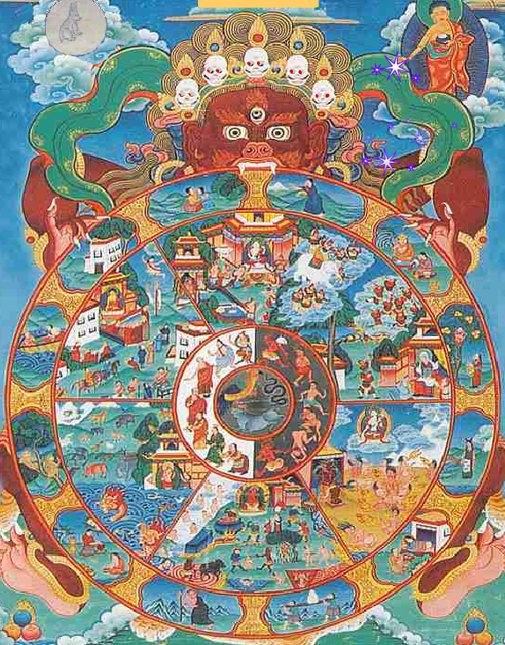
I am going to talk to you about some of the more traditional Buddhist teachings on the sufferings of cyclic existence. (She is using a pointer with the thangka of the Wheel of Life and Death.)  I am going to use the pointer here and show you this really horrible picture. This horrible picture is horrible because above the picture we have this beastly looking thing. When you see pictures of the temple, you see that all the pictures have white scarves around them, right? Pictures have white scarves because traditionally in Tibetan Buddhism one offers a white scarf as a greeting. So we are actually greeting the image in the picture. We are greeting it, honoring it, and making an offering; but you will never see a white scarf around this picture and that is because who wants to make a greeting to the Lord of Death. That is not your favorite friend, right? This is somebody that you want to avoid. But we can’t avoid it in cyclic existence. Cyclic existence means the cycle of death and rebirth; and death and rebirth constantly occur.

One of the faults of cyclic existence is that we have doubt. We do not believe that cyclic existence occurs in the way that it does because we cannot remember our previous death.  Therefore we cannot remember our birth. If somebody didn’t tell us for absolutely sure that we were born as a tiny baby, we might not actually understand that. It is something that we are taught and we were taught to understand that. We don’t actually remember our birth. We remember our childhood maybe from two years old on. Sometimes we have crib memories that are very, very vague, but we don’t remember really coming out of our mother’s body. So we don’t really know that for sure. Likewise we don’t really know that we are going to die for sure. Intellectually we do. We are told by our parents and teachers and everybody that we come in acquaintance with that would speak in that way that we are eventually going to die. And we look around and we see that everything that has lived will also die. So from that we deduce that we are going to die, but we don’t believe it.

If we believed it, we would act differently than we do. If we believed that we really only had about seventy-five years, we would make better use of those years than we have; don’t you think? Haven’t you ever lost whole days and said to yourself, “Where did this day go?”  Well, if you don’t know where it went, then it wasn’t put to good use. It sort of slid by you. Have you ever gotten the scary idea that you don’t know where the week went? Have you ever gotten the idea that you don’t know where the summer went? That happens to me all the time. Did you ever get the idea that you don’t know where the year went? Did you ever get to be forty-two years old and you don’t know where twenty-two years went? That happened to me recently. Did that happen to you? You know that one, huh?

Sadly I spoke to my mother a while back and I asked her, “How old are you now Mom?” We were talking about that and I said, “How does it feel to be sixty-five?”   And she said, “You know sometimes I look in the mirror and I see this old lady looking back at me and she said, “I don’t know how that happened to me.”  And she had a lost quality in her voice. She said “How did that happen to me? I feel like I should still be young. How did that happen to me?”  We all come to that point where we realize that we haven’t really taken hold of our lives. We haven’t really used them. Time passes so quickly. In fact we are taught that the cycle of death and rebirth passes like a waterfall down a mountain, but still we don’t believe in our death. We do not make use of our days, of our hours, of our minutes. We do not make use of our weeks. And how much use have we made of those twenty-two years? Yeah, we have made some gains, but twenty-two years worth? Seems like if you really worked hard and consistently, you could have done a lot better.

So you deduce from the way people act that they really do not understand that death is impending. And this is one of the Buddha’s teachings. The Buddha teaches us not to get depressed. The Buddha teaches us this so that we can use our time effectively because it is our nature to waste our time; and one of the faults of cyclic existence is ignorance in that regard. We do not use our time. We do not effectively overcome the ignorance of passing through this time so quickly and not being able to use it and not really understanding that this time will pass quickly. We do not seem to understand that.

We are reborn again and again and again and we have no memory of it, so we have no way to understand that these realms of cyclic existence actually exist. Not too many of us here have been to China or the Soviet Union, but we all know for certain that we would stake our lives on the fact that these places exist. Why? Because we have some pictures of them, and we have been told that they exist. Yet many of us will not believe that these six realms of cyclic existence actually exist. The Buddha has told us that they exist. The Buddha has told us that they exist. The Buddha is enlightened. The Buddha knows better than anything, but we would believe a dumb camera that only knows what to do when we push its button. That we would believe. That doesn’t make any sense to me either. Sometimes we act like we are a little retarded, you know?

Copyright © Jetsunma Ahkon Norbu Lhamo All rights reserved

I Am Awake

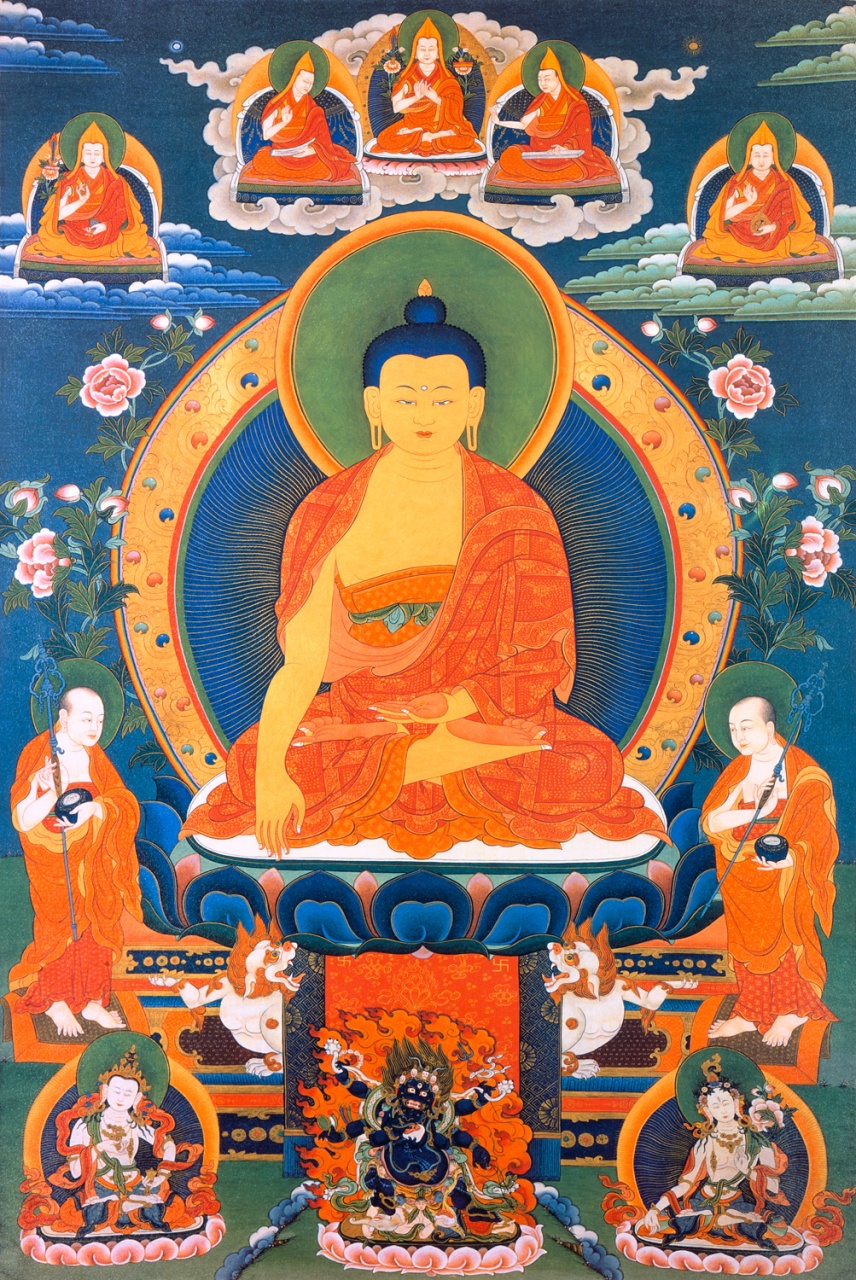
Buddha Shakyamuni

The following is an excerpt from a teaching by Jetsunma Ahkon Lhamo called “The Foundation of Bodhicitta”

The Buddha simply displayed enlightened activity and he gave teachings on enlightened activity. It has not been the custom of those who have truly obtained realization or those who have obtained a high level of realization (perhaps not complete realization but a high level of realization), and certainly has not been the custom of any of the Lamas in my lineage, to speak of themselves in that regard. It has only been their custom to give of themselves unceasingly and to strive constantly to do better.  To strive constantly to give more and more and more. They do not speak of themselves in that way. So compassion has many different facets; but the way that Bodhicitta should be understood in the world is that it should be understood as a display of the primordial wisdom nature. But again we are not able to display that nature because we are not acquainted to it. The difference between ourselves and the enlightened Buddha is that the Buddha only described himself as, “I am awake.” He said, “I am awake.”  Students asked him, “What is it about you? Are you a king?Are you a master? Are you an enlightened one? Are you a great being? What are you? ”  He only said, “I am awake.” That is all. Awake to that nature, awake to that nature that is inherent in each one of us. And being awake to that nature absolutely ensures that effortless enlightened activity will be shown. That activity will always lead to enlightenment. The Buddha’s teaching has lead to enlightenment in students many, many uncountable times—full visible enlightenment with all the signs. And so that activity must be understood as the very essence of compassion. Any activity that leads to enlightenment is the essence of compassion.

Copyright © Jetsunma Ahkon Norbu Lhamo All rights reserved

Amitabha Buddha and the Bardo

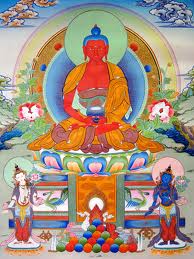
Amitabha

The following is an excerpt from a teaching by Jetsunma Ahkon Lhamo offered during a Phowa retreat:

Lord Buddha Amitabha is considered to be that one who once looked upon the suffering of sentient beings as he was becoming Buddha, as he was moving into his fully enlightened state, and saw the condition of sentient beings and began to cry. He grieved in a terrible way. It was a kind of grieving that one can only understand if one has tasted the food of enlightenment. If one has tasted enlightenment and then looked at the condition and suffering of sentient beings and truly seen the difference. There is no other grief like that. One cannot understand that kind of grief. It is unlike losing a loved one or even losing one’s own life. The grief that one will feel, having tasted the natural bliss, the natural birthright that is your true nature, and then watching that while that is so, it is also so that sentient beings are suffering horribly;  watching that they are suffering uselessly and senselessly, and that because of their own ignorance they are making themselves suffer, and making their own mistakes, and that all that they would have to do is stop… There is no grief that is stronger or more complete than that: to know, from the vantage point of bliss, what sentient beings suffer. And so Lord Buddha Amitabha gave rise to the most profound bodhicitta, the most profound kind of compassion, a compassion that colored him, that dictated his method, a compassion that filled his intention, that became his intention. And the compassion was so strong and dominating that he made the most profound wishes. And he made those wishes, not as we would make wishes when we circumambulate the stupa, even when we make wishes with faith, but he made those wishes from the potency of his enlightened accomplishment. He had fully accomplished the view of non-distinction. He had fully accomplished the primordial wisdom view of equanimity. He had fully accomplished the ability to see the nature that is the nature of all sentient beings. He had fully accomplished the ability to see the lack of separation between oneself and others.

So when Amitabha looked to the plight of samsaric beings he began to cry, and it was his very tears, they say, that became the emanation which is Chenrezig, the Buddha that gave us the mantra ‘Om Mani Padme Hung,’ that keeps us from falling into the lower realms. That is how strong and how forceful his grief for sentient beings actually was. And so Lord Buddha Amitabha actually practiced in such a way as to set up a pureland called Dewachen, which is the easiest of all the pure lands to enter. It is meant to be a home, a welcoming place, a source of refuge for those of us who have met with samsara and have been so damaged and hurt and traumatized and deluded, and have continued so much in our own habitual tendency without any understanding of what samsara actually is, that we have become almost drunk beyond repair. Even though we too are that nature which is indistinguishable, that nature that is both the enlightened nature and the samsaric nature—while we too have that Buddha seed, yet we are so deluded and so wrapped up in the delusion, that while it is potentially so, you can also say it is almost impossible to expect or to hope that any of us might attain the other Buddha fields.

The other Buddha fields are associated with the kind of accomplishment that sentient beings are very rarely able to have. Lord Buddha Amitabha saw that, and he wept and grieved for those students who would be prevented, due to their circumstances. He was angry and would not accept that some sentient beings would be excluded because of their inability to practice. And he became extremely angry and extremely upset that some sentient beings would be excluded because of their ignorance and their slothfulness. He became extremely angry and extremely upset that some sentient beings would be excluded because they had not understood devotion. He became so upset with these things that he practiced in such a way that the very nature of his pureland is easy to enter. There is an ease of passage. And he made it his work from this point until all sentient beings are finished. This is his work from now until all of us are finished. Think of that. That he would be available constantly—and he doesn’t have office hours either, this is the great thing—he would be available constantly. I have office hours; Lord Buddha Amitabha does not have office hours. No, just kidding! Lord Buddha Amitabha has said that he will always be available for those beings that cry out for him. And literally, if, in the bardo, if you can remember to cry out for him once, and to call his name and to ask him to come and rescue you, surely he will come. He will not be able to ignore your voice. He will not be able to keep away from you. He will come.

The way he has set up his pureland, it will be very easy for you to follow only on that small cry. He’s like a mother. He’s so tuned to the cry of the babies that only the slightest whimper—only the slightest whimper, that’s no effort on your part—will invoke his great compassion. Therefore you can have confidence and faith and trust in Amitabha. He is as sensitive as your own mother was when she heard you breathing and whimpering in your crib when you were unable to fend for yourself. He’s like that. And furthermore, Lord Buddha Amitabha has also given us this practice and he has made his very body, his very nature, accepting of us to the degree that he is instrumental in the transference of our consciousness. So, while his body is subtle, while his body is pure, still somehow he connects with us in a mystical way that we cannot understand, and uses his very appearance, his very nature, as a vehicle to carry us into bliss. It is because he is so frightfully sad for the suffering of sentient beings, who have no hope and have no method, and have such strong habitual tendency that is weighing them down. He is the kindest, the purest. There is no other Buddha like him; he is completely unsurpassed. There is nothing and no one that can meet the kindness and the quality of Lord Buddha Amitabha. He should be considered your singular protector. You should think that his face is always turned toward you, and that all you have to do, like a little baby, is to follow the voice of your mother. A little baby learns very early on where the milk comes from and learns to follow the voice of its mother. And so in this way you should understand that the nectar of Lord Buddha Amitabha is all-pervasive, and it’s easily digested, even for those of us who have no will to take care of ourselves, or to befriend ourselves in a firm and disciplined way. Lord Buddha Amitabha is such that he will not only offer you the nectar and the milk of loving kindness, but he would also take it into his own mouth and digest it within his own body, and give it to you in that way, already digested. That is the kindness and the nature of Lord Buddha Amitabha. You can have complete faith and trust in him. He does not prefer Tibetans; he does not prefer any one kind. He has developed his practice to the point where he has eyes and ears and helping hands that extend in every direction. Right now he hears your voice; there is no sentient being that is separate from his hearing. Even if the tiniest bird were capable of calling out his name, even if the tiniest of creatures, the meanest of worms, has any connection with Lord Buddha Amitabha, he will try in some way to resonate with that creature so that they will have a chance. He is extremely active, extremely persistent in benefitting sentient beings. And when it comes to those of us who have practiced very little and are not very confident, he is our sole guide and mentor and hope when it comes to the time for our own death. So when we see ourselves moving our consciousness into Amitabha, we shouldn’t think that we are moving ourselves into something that is strange or separate or unfamiliar or unpleasant. We should think that we are going home. We should think that we are going to our own kind mother. We should think that we are going to our own truest heart. We should think that we are bathing in our own true nature. There is nothing foreign or unfamiliar, or strange or unfriendly about Lord Buddha Amitabha. He is your greatest hope. And if you remember no other image in your life, if you can never call out to your teacher, if you cannot do anything, if you are utterly and completely helpless when it comes to your practice, then please at least remember the kindness of Amitabha, because he will remember you. You should think like that.

Lord Buddha Amitabha has developed his practice so that he himself is the doorway to liberation. It is through him that we can pass, because he has made himself available. Coincidentally, it is also true that the practice of the wisdom of equanimity is often one of the first accomplishments that we can practice through meditation. Interestingly, when we sit in practice, simple meditation like shamatha, we can think that in that meditation it is possible to practice the wisdom of equanimity. We can begin even in a simple, quiet meditation like that, or just watching the breath, or simply letting the attention rest lightly on space, which is a very simple and very wonderful meditation that all of us should practice in order to help our minds not be so heavy and fixated on samsara the way they are. Keeping the attention just lightly resting on space, one then begins to awaken immediately to the wisdom of equanimity in a small and subtle way. And then gradually through that kind of practice one progresses. So, you see, even then, it is Lord Buddha Amitabha’s wish that that should be the most easy and most accessible method for us. That we should be able to firmly and easily—even those of us who are not excellent practitioners—move toward his nature. Move toward our nature. Move toward Dewachen. And it is through Lord Buddha Amitabha’s practice that he has reached out to us, through making his practice such that it is easy for us.

If you could understand the philosophy of burning the candle on both ends: What is happening on one side is also happening on the other side from our point of view, but in truth there are no two sides. It only appears that way. Someday, some scientist is going to come up with something in quantum physics that will be a mathematical formula that will help some of you to understand that this is how reality actually is. This is what actually is. That it is possible for Lord Buddha Amitabha to practice in such a way as to grease our wheels: to practice in such a way as to create a chute, in a way, that we can just sled down, in a sense. An easy access, a very open method, a very accessible method. That that could be a truth. And it could also be a truth when I say that perhaps in simple meditation one could easily develop the wisdom of equanimity. These are not two separate statements; they are the same statement. When you turn to Lord Buddha Amitabha, ultimately you are turning to your own kind nature. Ultimately you are turning to that to which you will awaken. Ultimately you are turning to that with which you will know again, or awaken to, become cognizant of, the connection. It is that strong connection that I am trying to describe.  Coincidentally, that connection will probably be through the Phowa.Then we will know in our heart of hearts that Lord Buddha Amitabha has touched us, just as right now it is Lord Buddha Amitabha who is speaking to you. Because if it were not possible, if it were not so, the truth about how to die and how to be reborn would not be available in the world. It is Lord Buddha Amitabha, therefore, who speaks to you now through these teachings and these words, and you should follow without hesitation, with full confidence, and without question. This is only done because Lord Buddha Amitabha grieves that you should wander any longer in samsaric existence. His nature is that of equanimity; his nature is that of compassion. His nature is that of ultimate depth that we cannot fathom, the depth that is the true empty nature that is our nature. And it is Lord Buddha Amitabha upon whom we can rely as a bridge, a bridge that is easily crossed between ignorance and bliss.

That’s all that we have time for today. I promise you that towards the end of the retreat we will have more teaching, and will have more questions. I know that you have lots and lots of questions. Lots and lots of questions. But I’m hoping that some of your questions will be answered by end of the retreat. Also, I would like you to practice waiting on the kindness of your teacher. Waiting on the kindness of your teacher—that is a hard one. Students don’t want to do that. They don’t want to wait on the kindness of their teacher. They want to ask questions now because ‘we want to know, and we are important.’ You’re not practicing being important; you’ve already practiced that. You’re so darn important we don’t know what to do with you. You are so important we just don’t know what to do with you. You are already important; that has been accomplished. You have accomplished the mantra of importance; you’ve accomplished the mantra of ‘gimme, gimme, gimme.’ You have accomplished the mantra of ‘I think, I want,’ and now you are going to accomplish the mantra of devotion. So what you need to practice now is waiting on the kindness of your teacher, trusting in the kindness of your teacher. Looking for what is already there, rather than defining what you don’t know. I ask you questions, because in the bardo there will be no one to ask questions. You will have done it, or not, you see. That is what we are training for now, so it is appropriate for us to train in that way. Require of yourself to mature. Grow up. Pull yourself together. That’s the kind of thing we have to do in the bardo. Rely on that stability of mind. That’s what we’re training for now.

Copyright © Jetsunma Ahkon Norbu Lhamo All rights reserved
 

The Opportunity to Practice Phowa

Varjasattva

The following is an excerpt from a teaching by Jetsunma Ahkon Lhamo offered during a Phowa retreat:

The signs that you must see in order to know that you are prepared for death have to happen now. They don’t happen before you die; they will not happen before you die. You will not have time at the moment of death to prepare for your death. That isn’t going to happen. So the signs that have to happen now must be received at this time. We want them now. This book, this preparation, this Ngöndro, which helps us to gather merit and helps us to purify karma, and helps us to make it possible for our minds to have the kind of quality to be able to hold, like a good bowl without a crack, such a practice, this is for now.  Now is when you have to do this. The winds have to be purified now. The channels have to be unkinked now. Your mind has to be stabilized now. You have to learn not to be such whiners now. You have to learn to renounce cyclic existence now. You won’t have time at the time of death. You’ll have time for maybe a quick thought. If you’ve already practiced renouncing cyclic existence, at the moment of death you will have time to simply give all of that to the Three Precious Jewels. That you will have time for. That kind of inclination, that kind of giving, you will still, even after the elements dissolve, have the wherewithall to practice. But of course you will not have time to practice every aspect of the visualization and the prayers.

Forgive my language, but I have to scold you a little bit. Do you think that the Dharma was written by enlightened beings that were so anal, excuse me, that they said, “Well, if you do every one of these prayers, especially the ones that I’ve written, then we’ll let you in! But if not,…” What are you thinking! You know it’s not like that. It can’t be like that. That would not be logical or realistic or sensible. What superficial view of reality do we have if we hold such bizarre and crazy ideas? What we are doing now is to prepare ourselves—through gathering merit, through accumulating virtue; through purifying our inner winds, channels and fluids; through understanding what bardo is, through studying and contemplating the nature of cyclic existence including the bardo, through having preparation as to how the bardo experience will actually take place; through developing devotion. All of these things have to happen now. If you’re waiting ’til, oh, a week before you drop dead, what is that? First of all, you don’t know when that will be, and second of all, what’s a week? Even if you have that much time, you don’t have enough time during the course of a week, or month, or even a year. Preparation starts now, and you do what you can as quickly as you can with as much devotion as you have now. With as much devotion as you can now. So that’s what has to happen.

At the time of one’s death, if you are fortunate enough to have spent a long time dying, and you have been in the bardo of the condition of your death, which means that the cause of your death is already within your body and is active in your body, so you’ve known for a long time that you’re going to die… And let’s say you have the good fortune that a physician—this would have to be a heck of a physician, wouldn’t it—would come into your room and say, “Well, looks like four o’clock today. That’s what I say. Four o’clock you’re on your way out. Toes up kid, four o’clock.” And let’s say everything is perfect, and somewhere around two thirty you still have your mental faculties complete so you pick up your book and think, “I’m just going to open my practice.” This could happen. I mean, it could happen; but really, what is the likelihood? There’s no likelihood that that’s going to happen. The rarity of such a situation is ridiculous. Plus the fact that when people are getting ready to die they’re not at their best condition, you know. They’re not necessarily right with the program. There are some people that remain alert right until they cross that threshold. Lucky them, but it is not [usually] the case. So don’t you think that, since this Phowa was authored and given to us by those who have achieved enlightenment, who have practiced Phowa successfully, that they would have taken into consideration that this Phowa is written for you, for sentient beings? It is written for sentient beings that have not solved their problems yet, haven’t got renunciation down, haven’t got anything down yet. In fact, this kind of Phowa is kind of Last Hopeville. It’s really designed for those who could not practice generation and completion stage practices excellently. Those kinds of practitioners who can practice those practices excellently probably will not [need] the Phowa. So you must understand that this is not only possible, it is not only accomplishable, do-able, but is also necessary; and it is necessary for you to step back and have a proper view about it. Lighten up. Give yourself a break. Give me a break. It will come to you; We’ll get it done, don’t worry.

So, now that I’ve finished spanking you I’ll teach you some more. That’s not a bad spank, is it? Nah.

Copyright © Jetsunma Ahkon Norbu Lhamo All rights reserved
The Necessity of Training in Phowa

SD-371_51-M

The following is an excerpt from a teaching by Jetsunma Ahkon Lhamo offered during a Phowa retreat:

Last time I saw you guys you were dead; and the Buddhas appeared to you, and you were still dead. We spoke last about the section of the bardo where the Buddhas and the Bodhisattvas appear, and we spoke of the forty-two peaceful deities and the fifty-eight wrathful deities. I explained yesterday that on the appearance of the peaceful deities, one should understand, first of all, that one is unfamiliar with that. Remember, to understand in terms of Vajrayana why we act the way we do and how we should practice, we have to understand what an important part habitual tendency takes. Remember, when the Buddhas appear to us, the peaceful Buddhas that is, in the bardo state, they appear to us with extraordinarily brilliant lights. I have explained to you that in that state of the bardo those lights may even be so impactful that they will also impact the other senses—like a light so bright that you can almost hear it, if you can imagine such a thing. I actually had an experience like that. I once had a pulse of light flash to me from one of those newfangled flashlights that have big halogen bulbs in them. You’re not supposed to look at them. If you look at them, they will damage your eyes. You can’t look at them. I had a pulse of that sent at me and it actually registered in my ears. I don’t know whether, scientifically, it meant there was like a pulse of blood in my ears, as a strong reaction, or whatever. But your senses do shift like that, particularly in the bardo. There are no clean cut lines for your senses in the way there are now. Clearly, smell goes through your nose now; clearly hearing goes through your ears now. Well, of course, in the bardo, although you have those same habitual tendencies, you do not have the same definite places for this information to come into, and so there is something of a bleed through.

When the Buddhas come to you, again, that will be very unfamiliar if you have not practiced. The brilliance of the light of the Buddhas will be unlike anything you’ve ever seen; and it will be somewhat terrifying if there is no preparation. It will be much more comfortable to look at the corresponding other lights that come at the same time. We talked about Buddha Vairochana. He appears on the first day and his light is the blue light, and it will be so brilliant it will almost hurt—so brilliant—because it is not our habitual tendency to have awakened to that element of our mind, of our nature, that is in fact identical to and inseparable from that blue light nature that is Vairochana, you see. We will not have had time to do that so we are not familiar. It will be exactly the same phenomena that causes us not to see the black, or clear, path in the first part of the bardo experience. Unfamiliarity. We will, however, as I said yesterday, be familiar with the other light that shows at the same time, and that is the light of the god realm. In a sense, the light of the god realm, which at that point will be a very soft, welcoming, and very sweet kind of white, will be much more familiar because we will have exhibited some of the qualities that it takes to get into the god realm—that is, some accumulation of merit—and we will also have accumulated some of the unfortunate problems, or the obstacles, that cause us to be born into the god realm. So we have much more familiarity with them than we do with our own primordial wisdom nature. Interestingly, as the different Buddhas appear, and then as the different realms appear, you’re also looking in a sense at the flip side of the same cointwo different sides of the same coin. One is our pure nature, and the other is a display of our nature in defilement, in confusion. Of course, we will have the strong habitual tendency to go toward our nature in defilement, stronger than we will to go toward the purity of our own buddha nature because, simply, we have more familiarity and more habitual tendency with our samsaric nature than we do with our awakened nature.

So, of course, this is something that you are being prepared for right now. When you hear something like that you think, “Oh, that scares me. Of course I’m going to want to go towards a soft, glowing white light more than I’m going to want to go towards something that’s almost painful it’s so bright. So I want to be really prepared for that. How can I prepare for that?” Those of us that have no spaciousness in our mind and have not practiced very much, and have a tendency or habitual pattern for our minds to act in a very neurotic way will think things like, “Oh, I have to practice liking bright lights, . I have to practice not looking at soft lights and not liking them anymore.” really, that [kind of thinking] is completely unnecessary. Again, have faith in your spiritual mentor. You must know that you are already, right now, applying the antidote for whatever fear you might have had about going into the bardosimply training in the knowledge that there is a bardoand to the degree that when you hear this information, you hear it as a respectful student would hear it, hearing it from someone who has crossed the ocean of suffering, hearing it from the Buddha who has given us this information based on his many experiences of crossing the ocean of suffering himself, and also helping others to cross the ocean of suffering. So as a student our posture would be to listen and go, “Yes, yes, yes. Thank you, yes.” That really would be the perfect posture.

Of course our training tells us, “Well, we have to think things through. We have to be individuals.” But that very thought will prevent you from absorbing these teachings that you have to remember on a very deep level—a memory that is really deeper than the mind that you use to call yourself ‘I’ with. It will have to go much deeper than that. And the only way it’s going to go deeper than that is if the student practices devotion while hearing. Devotion is the bridge; devotion is the method. That is why it is a useful practice that connects the student and the teacher and makes the information, in a sense, go in even more. The student who does not take advantage of their teacher’s teaching simply has no devotion. It doesn’t have anything to do with how good a practitioner they are or how lazy or slothful they are. Of course, those are elements, but really, it has to do with the lack of devotion. The student does not have the karmic scenario to make a bridge by which the lama can reach them and touch them. We assume that the lama you have chosen is qualified. Once you have chosen a lama, you should have chosen them on the basis of their qualifications, on the basis of their ability to speak to you. Once that happens there is no room for any doubt. You should have spent your time considering and thinking and wondering and asking yourself, and looking and checking. But once you have chosen, there is no more time for the head games that you play as a student. Now you have to apply yourself, and that’s the only reasonable thing to do at that point. The time for doubt is finished. The time for practice and preparation has now begun. Now that responsibility becomes yours. The teacher can lead you; the teacher cannot force you. It is up to you to follow. So that is what has to be done.

Copyright © Jetsunma Ahkon Norbu Lhamo All rights reserved
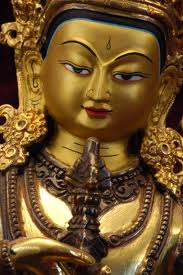
 

The Time to Practice Phowa is Now

AS-x-21 Charlie Grant-M

The following is an excerpt from a teaching by Jetsunma Ahkon Lhamo offered during a Phowa retreat:

I would like to explain one question that I think is necessary to clear up at this point, because if it isn’t cleared up, you will assume you know more than your spiritual mentor. You will assume that you know how things will go at the time of your death, and you will not follow through with your practice. Many people look at their books and they think, “Well, here’s a pretty thick book and here’s a kind of thin book. I have no idea whether, at the time of my death, I will have time to open my practice.” Well, you’re right, you don’t have any idea whether at the time of your death you will have time to open your practice. Now do you really think that wasn’t thought of? I mean, c’mon guys, lighten up. Remedial Dharma 101. This has been thought of. Really. Lots of people have died. We pretty much got it down. So worry not. Now here’s what actually has to happen. This book [thick] and this book [thin] are not for the time of your death; they are for now. They must be practiced now. There’s a really good chance that at the time of your death you will not be able to pick the books up in time. And you may drop them. And you may not have enough breath to finish. Really. This has all been thought of. Don’t worry. These books are for now.

Copyright © Jetsunma Ahkon Norbu Lhamo All rights reserved
The Peaceful Deities

bardo_mandala

The following is an excerpt from a teaching offered by Jetsunma Ahkon Lhamo during a Phowa retreat:

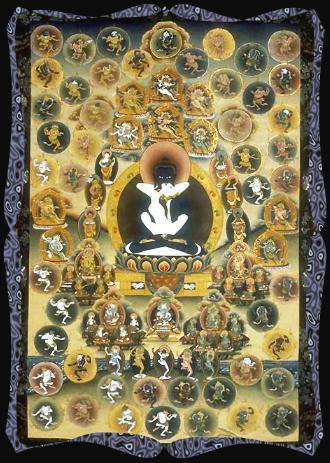
On the third day Ratnasambhava Buddha appears with yellow light. Again, same scenario: too brilliant, scary. At the same time, the blue light of the world of humankind is also manifested, and you will feel very familiar with the blue light of the world of humankind. Although being reborn as a human is considered a very auspicious rebirth, if you have a chance to either go to Ratnasambhava’s pureland or experience that nature that is Ratnasambhava, or be reborn as a human, take Ratnasambhava.

Amitabha Buddha appears on the fourth day with red light. The red is so brilliant and so luminous and so pulsatingly brilliant that we can hardly bear it. And at the same time the yellow light of the world of hungry ghosts will appear. We’re used to yellow light because we’re used to desire. It is vibrationally familiar to us, and it will seem, therefore, like a softer and more welcoming light. Do not follow the yellow light of the hungry ghost realm.

Amogasiddhi Buddha appears on the fifth day with green light. At the same time, the red light of the worlds of animals and demigods are manifested. Again, do not follow the red light. In this case, it is softer, easier to live with, and yet it is Amogasiddha that you want to follow, with the brilliant green light. Always choose that brilliant light.

On the next day, the sixth day, all five Buddhas appear at the same time, with the lights of the six classes of beings. All of the forty-two manifestations of the Buddha that are considered the peaceful deities will then appear. They will be manifested because they are all representative and they are displays of the very elements that are intrinsically within our own nature, so therefore they must appear. It is the nature of the bardo that what appears subjective then becomes objective. What appears to be our own intrinsic nature is seen in an external form. So all of the forty-two peaceful deities will be manifested in our mind, and then they are followed by the fifty-eight wrathful ones. These manifestation scenarios last for about three weeks, unless you take one of the doors. One of the doors would either be, again, recognizing and going toward the Buddha nature in whatever form it appears, or it will be taking one of the doors of the six realms that constantly appear as a more seductive and more familiar light. This goes on for about three weeks.

Now you say to yourself, “When the peaceful deities show up, sounds to me like a good day at the park. I can live with that, being surrounded by all the deities.” But again, it will be unfamiliar; remember that—for a non-practitioner, and even for a practitioner who has not really accomplished their practice very well, or not yet. How are you going to deal when the wrathful deities come in, and what is their nature? What are they? Are the peaceful deities the pleasant and friendly ones and the wrathful deities the punishing ones? Who are the wrathful deities and how should they be understood? How can we avoid being frightened of them? Because they are terrifying. This is what we are going to learn in our next session.

Copyright © Jetsunma Ahkon Norbu Lhamo All rights reserved
Vajrasattva in the Bardo

Vajrasattva-single

The following is an excerpt from a teaching by Jetsunma Ahkon Lhamo offered during a Phowa retreat:

On the second day, here they’re saying Vajrasattva Buddha appears. This is Vajrasattva, the very same one that you are practicing in your Ngöndro. Think how ready you will be for him! The minute he shows up you’re going to go, “Yes! I know who you are!” In this case, Vajrasattva Buddha is also associated with Akshobya Buddha, but he will appear as Vajrasattva Buddha on the second day with white light. And again, the white light will be unnaturally brilliant, according to what we have understood, dazzling, frightening in its dazzling light; and at the same time a softer, easier on the eyes (even though there are no eyes, we have that kind of perception in the bardo at that point), black light, the softer black light of the hell world, will manifest. Now listen to how tricky this is. We are faced with an unnaturally white, unnaturally bright, scary light, or a softer, black light that, because we have felt hatred more than we have felt Vajrasattva, we are more familiar with. It will not be so frightening to us. It will be softer, and it will seem to be seductive, more so than the white light. So what we have to do is to be sure and avoid that black light, because that black light results in rebirth in one of the hell realms.

Copyright © Jetsunma Ahkon Norbu Lhamo All rights reserved
The Bardo of Dharmata

five-buddhas-2

The following is an excerpt from a teaching by Jetsunma Ahkon Lhamo offered during a Phowa retreat:

After the three and a half days of unconsciousness occur, another period begins which is called the bardo of dharmata. It’s also called the bardo of becoming. It looks or feels as though a person is emerging from a deep sleep. It is at that time that a person actually fully realizes that they are dead. If they have no training, then they have no capacity to realize beforehand. This is, again, three days after, and in some cases the body has been handled, or the body has been cremated. The person, although they are unconscious at that time, still has enough of a connection that when they wake up they are aware (and they are even residually aware in their sleep) of what the body is experiencing. Do not cremate the body before three days. Do not do that. Giving body organs? It depends on how you feel about it. There’s a lot of virtue in that. The timing? Well, you have to do that immediately; there’s no choice. But in that case you would be doing something compassionate, and even though it wouldn’t be the best for your own death situation, you would wait until the inner death ceased. The wise thing to do would be to have a lama come and practice Phowa with you. The inner wind would have ceased. If the lama is worth their salt and you have any devotion, you should be all right by that time, and you can then donate the organ within a reasonable amount of time. But for myself, my decision is that even though I would love to just keep manufacturing organs for lots of people to have, I would love to just keep giving them out, my decision is that I feel I can help people better during the course of my life; and I also want to achieve for myself, again and again, the most auspicious birth so that I can return again and again in a form to benefit sentient beings. I feel that that is ultimate benefit for sentient beings, rather than what my eyes could give, or something like that. So it’s a question of how you want to benefit sentient beings.

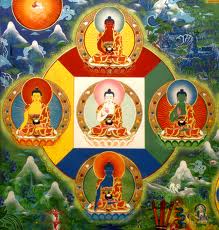
It is during this period, in the bardo of dharmata, that the Buddhas of the five families begin to manifest themselves. Now when you think of the Buddhas of the five families manifesting themselves, what do you think happens? Do you think that they have some sort of warning bell that tells them when you die, and they sort of know,“Oh, she’s dead. Better hurry up,” so they run from the five different directions and they come over and visit you, and they just sort of hang out, wave at you? No, it’s not like that. Actually, the Buddhas of the five families are seen as separate displays and separate emanations, but they are intrinsically present in our minds as our own nature, our own five wisdoms. So you can say that the Buddha families each represent our own subtle intrinsic wisdoms. Whether we have them developed or not, that’s another story. For instance, we think about Amitabha Buddha. That family, the Lotus family, is associated with discriminating wisdom. Ratnasambhava Buddha, associated with the Ratna family, is the wisdom of equanimity. Amoghasiddhi Buddha, associated with the Karma family, is accomplishing plain wisdom, and Vairochana Buddha accomplishes the wisdom of the dharmadhatu. That’s the awareness of what is and what is not, as one. Akshobya Buddha is considered the Buddha of mirror-like wisdom. So each one of these is our own intrinsic awareness, our own intrinsic wisdom. As to whether or not we have them developed, that is another thing.

Copyright © Jetsunma Ahkon Norbu Lhamo All rights reserved
 

The Faint

20125251534_darkness

The following is an excerpt from a teaching offered by Jetsunma Ahkon Lhamo during a Phowa retreat:

Now I want to refer back to this book [Death and the Art of Dying by Bokar Rinpoche] to give you a couple of statements that I think may be helpful. When we last were together we spoke about the white path or the white bindu that dropped from the top of the head to the heart, and we spoke about the white light that is shown. The white method would be to move toward and expect and recognize that white light; that would be the white method. According to this book, the white method or the white path results in the body of emanation or the nirmanakaya form. It is considered that when a tulku appears in the world that a tulku is a nirmanakaya form of the Buddha. So recognition of the white path results in the body of emanation and the nirmanakaya form. Recognition of the red path results in the body of perfect experience or the sambogakaya, also called the bliss form. And recognition of the black path, which is also the clear light that we spoke about, results in the absolute body or the dharmakaya. Now it is considered, actually, that of these, the black path or the clear path, the one that we spoke of last, the recognition of the dharmata, the recognition of the clear light is the most difficult of all of the recognitions. It’s considered that the black path or the clear path is usually available only to those who have practiced mahamudra, which you are learning to practice even as we speak.

I wanted to read to you exactly how this lama put it, but I’m not seeing it. Well, then I’ll explain it to you in my own words, which may not be quite as dramatic but the meaning will be there. It is considered that the great vast majority—that is to say, 99.999 percent—of sentient beings who experience death, and remember, they all do, will not be able to recognize either the white, or the red, or the clear, or black, method. They will not be able to recognize any of those three stages. This is really, really interesting. During each of the times that the lights appear—first the white light, the red light, and the clear light—after those events are finished and you have not recognized any of those lights (and it is very likely that that will happen), it is at that time that you continue on into the bardo. It is then that you actually slip into the bardo of becoming.

If you do not recognize the white light, if you do not recognize the red light, and then if at the end the fundamental clear light is not recognized, then the lama says here, “The mind slips into a deep state of unconsciousness of variable duration, which is generally said to last three and a half days.” Now I have had the experience and the good fortune to have the opportunity to do phowa for a number of other beings. The clear or dark light is, in fact, the appearance of one’s true buddha nature, appearing just so. Just as it is. It is the true face of the primordial Buddha, but those of us who have no training to be able to witness the face of the primordial Buddha literally will not see it. It will be much like going to some sort of desert tribe that has never seen a picture of a boat or large body of water. If you show them a picture of a boat and a large body of water, they won’t be able to recognize it. They do not have the brain pathways or something that will help them to recognize that. And in our case, even though the very face of our true nature, which to a practitioner would be as recognizable as the mother is to the infant or to the child, for a non-practitioner it would be, again, like the child who was adopted out right at birth and never saw the face of their mother. They would not be able to recognize their mother; they would not be able to connect. They would not be able to have the force of surety in conviction to be able to move toward and direct themselves with their own inner force to be able to move toward that reality. They will not be able to slip into meditation on that nature. They will not be able to slip into that non-dual state, even though all of their distracting elements will be dissolved at that point. Literally, if you were a meditator and had that experience, that would be the time, ironically, during the course of your whole life and death experience, where you would be able to meditate the best. If you had experience. But 99.999 percent of the people go to sleep at that time. They have a faint, or sleep, because it looks like darkness to them, rather than light clarity. Their mind is not awake in their meditation. Not awake. When that happens there is no choice and nothing for it, but that we have to go on into the bardo of becoming.

Copyright © Jetsunma Ahkon Norbu Lhamo All rights reserved
WP2Social Auto Publish Powered By : XYZScripts.com