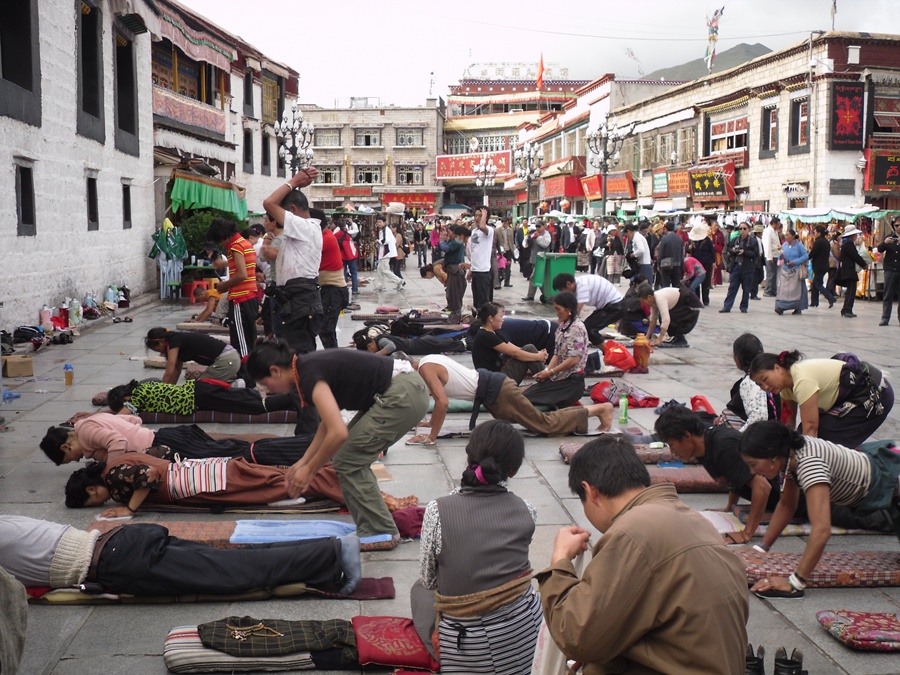
The Challenge of Self Honesty

buddhists-prostrating-outside-the-temple

The following is an excerpt from a teaching by Jetsunma Ahkon Lhamo called “Art of Dispelling Anger”

We must take ourselves to task more. I don’t want to speak harshly because harshness doesn’t help, but I want to say succinctly and directly, we have to take ourselves to task regarding our faults and our poisons.   When I think of the Tibetan culture, that’s a lot easier because there isn’t that attachment to materialism.  Even in terms of the roots of the culture itself without religion, they were a nomadic people and they had things, but you couldn’t carry much.  You had your yaks and your yurts and that was it.There wasn’t that much variety in food; there wasn’t that much variety in clothing.  It’s true that the aristocratic Tibetans used to collect jewelry—some of the strangest looking jewelry.  It was intense jewelry, and that was considered a status thing. But for the most part, culturally, a Tibetan Buddhist would not have a hard time understanding that hatred, greed and ignorance and particularly desire, as the Buddha taught, keep us revolving endlessly in samsara.  We, unfortunately, are programmed quite differently.

I know in my household and in those of many people that I’ve talked to, there was confusion.  My mother was sort of a lox and bagel Jew and my father was a twice a year Catholic; and we were supposed to somehow dance in the middle. So when mama won we were going one way and when daddy won we were going the other way. I think that this happens with a lot of people.  They are raised with a lot of confusion around religion.  And even when they are taught that faith and religion should be a part of their life, and even when they are given the Western ten commandments, still there is so much confusion because we seem to find ways around that.

Thou shalt not kill.  But you can kill bugs, animals and enemies.  So who are you not supposed to kill?  I will not kill you.  That will do it.  So there is tremendous confusion around that.  How does one venerate these absolute laws that have to do with a moral and ethical human when there is so much confusion around them?  I mean, thou shall not kill but go to war.  How does that make sense to a child?   And so, as we grow up with religion, even though we have been founded in religion, or have some foundation in it, the information that we’re given is very confusing.  Thou shalt not commit adultery.  Whose family hasn’t had a little bit of that? You know, it’s just crazy.

And so, first of all, we’ve learned to be a little bit hypocritical; but most of all, we’ve learned that these laws don’t really matter, and that’s really sad.  So when we become Buddhist, we hear that there is a Vinaya and there are certain things that we must not do. And that if we take a life,  we understand that we will be giving our lives someday from having taken a life because karma works like that. Karma is exacting. When the cause arises, the results arise independently and simultaneously.  It’s our misjudgment through having the mind of duality that makes it seem like time stretches out. So even though you may not have the result of that bad karma until later on in life or even some future life, definitely we know from studying, at least. And every once in a while we get blessed with a little instant karma, so we have sometimes the opportunity to learn; but still that confusion is rampant, really rampant.

We want to practice Buddhism, so we take the teachings. We get to all the retreats; we see the right teachers; we try to do the practices. Yet we don’t really change ourselves.  It is an amazing thing to me that students can be on the path for so long and even try to go to the completion stage practices,  the tsa lung and the trekchod and togyal, and go to those levels and practice them with some part of their mind, and yet the rest of them is somehow remaining the same.  To me that is probably the worst tragedy on the path.  It’s the one that makes me not like to teach, but that’s the battle I fight with myself, you know. I’m just being honest.

Copyright © Jetsunma Ahkon Norbu Lhamo All rights reserved

Warriorship on the Path

mindfulness-istock-prv

The following is an excerpt from a teaching by Jetsunma Ahkon Lhamo called “Art of Dispelling Anger”

The theme that we will work on today is working through one’s five poisons. I think it’s an important one. And I think what we should do is take our time and pick through it.  That doesn’t mean working through one’s five poisons.  That means getting rid of them.  In a sense when we take to the path, we think that, ‘Oh, I am going to be like the picture of the Buddhist where I get to sit on top of the Himalayan Mountains somewhere all by myself, and eventually people will climb up and ask me profound questions.’  But it really doesn’t work out like that.  When we enter upon the path we want to go forward with the most exotic practices and wear the most exotic robes and collect all the implements and learn how to use them.  I know there is the tendency to want to get into the customs and trappings and surroundings of Dharma. But really the first thing that should be done when we enter onto the path is to take hold of and begin to think of ourselves as a warrior regarding our own poisons.

Now when we say “warrior” everybody thinks they can’t be very Buddhist, because Buddhists are peaceful.  Well, Buddhists are peaceful.  We’ve never had a war that I know of.  We’ve been attacked, but we’ve never had a war.  There is no other religion that can say that.  Every other religion has brought about war and that has never happened in Buddhism. Yet we are warriors. And we consider ourselves warriors in the sense that we must take to task that which prevents us from attaining liberation, because the goals here are very different.  In other religions, there are lots of materialistic ideas about possessions, like how much land a certain religion should have or how many pieces of gold they should collect.  There is a certain materialism in it.  But with Buddhism, there is really no materialism.  In truth, students will give their last dime to make an offering to the three precious jewels.  There are many stories of practitioners whose generosity and unthinking faith—no, not unthinking, more like spontaneous faith—is so strong that they would offer even their last garment at the altar to give to the three precious jewels knowing that it is so much more important to gather the merit of making that kind of offering. That it is important to have done it.

Copyright © Jetsunma Ahkon Norbu Lhamo All rights reserved

Step by Step

StepByStep

The following is an excerpt from a teaching by Jetsunma Ahkon Lhamo called “Reclaiming Our Merit”

Based on the eightfold path of the contemplations on the meditations, and so forth, that are prescribed, we start to build the wisdom, which is more than knowledge. Let’s say we find an ordinary person who is 70 years old. with general and average sensibilities, a person as honest as Woody Allen, who said that he never gained any wisdom his whole life.. I think that’s strange, but anyway, coming back to reality here. A 70 year old person is going to have to experience some of the cycles of life, the passages and changes that we negotiate through that change us, make grownups out of us. Somebody much younger may have the same capacity, but they have not had that repeated experience. So that’s the kind of wisdom: The way a 70 year old person would have calmer view, a better wisdom, a better grip, a bigger understanding, perhaps, of how the world works, than say, a 20 year old.

In the same way, we build our practice carefully, step by step in the way you have to live year by year. You can’t skip years if you want to do that with our practice. And don’t even dare to think to go on to the higher practices until you’ve accomplished what was before that. Really, back in the old days, that’s how it was. A teacher gave you a teaching. You climbed back down the mountain and didn’t go up again to visit your teacher until you accomplished it. And it was not, ‘I did this many mantras.’  You accomplished it. And back in those days, teachers weren’t worried about lawsuits. They would throw you down the mountain if you didn’t do it right. But nowadays we’re worried.

So these are dark times and there are reasons why we should get together more. There is a universe of reasons why we should get together and practice our art. We have the robes. We have the teachings. And I pray that we have the pure intentions, the willingness to experience a little bit of discomfort, inconvenience—oh, perish the thought—so we can actually contribute.

Copyright © Jetsunma Ahkon Norbu Lhamo All rights reserved
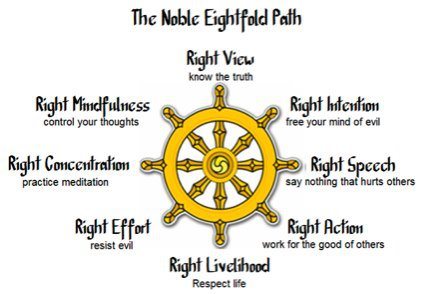
The Foundation

EightFoldPath

The following is an excerpt from a teaching by Jetsunma Ahkon Lhamo called “Reclaiming Our Merit”

Lord Buddha built the path sequentially.   First what did he teach?  That all sentient beings are suffering, that suffering is all pervasive,. that the cause of that suffering is desire and greed. None of which we, by the way, have bothered to get rid of. But he also taught that there was an end to suffering, and he taught that as the eightfold path. Unfortunately, we’ve gotten so ahead of ourselves, thinking that we are Dzogchen practitioners that we haven’t bothered to have right mind, right concentration, right meditation, right work, … (I have a list somewhere. I’ve forgotten them all.) But all of the eightfold path, all of those different qualities, they have to be looked at one at a time. Right speech: That means cut out the gossip; that means you cut out the bullshit and the bad words you have toward each other. Right contemplation:. Ok, what is wrong contemplation?   Wrong contemplation is watching phenomena dance around you and just buying in, dancing with it. Right contemplation would be taking the Buddha’s teachings one by one and studying them carefully. Have any of you practiced the eightfold path?  No. No. Then the Buddha came along, and he took the eightfold path and he sort of condensed it into the Mahayana view, which is wisdom and compassion.

The thing is, that when we have wisdom and compassion, we think, ‘Oh, that’s much easier.’ So we leave behind the eightfold path and we go right to the wisdom and compassion; and really we do ourselves a disservice by faking our way through it. Wisdom is something that arrives through practice, through service to fulfilling the ideas that Lord Buddha presented before. In other words, wisdom and compassion are not considered separate or different or above the eightfold path. You still have to accomplish the eightfold path, you see. And when you have fulfilled that, then you have the capacity to give rise to wisdom and compassion. And then you find out that the reason why the eightfold path was taught first, and Mahayana second, , is that it’s almost impossible to keep your commitment as a bodhisattva and to practice the way of the bodhisattvas for even one hour.

And so we have to rely on all that we’ve learned before this to build this house of Dharma. We have to make sure it’s all standing correctly, and we’re all here in line, and the foundation is good. Then you can start to build a house. That’s your wisdom and your compassion. And you have to ask yourself, has it come yet? We’re waiting for compassion to come likeHappy Birthday, you know, some sort of thing that is coming from a wave from the sky. Suddenly you’ll be good. But in order to really give rise to compassion like that, you have to have your foundation; and then as you begin to give rise to the bodhicitta, you have to base it on what you learned before.

What did you learn before?  All sentient beings are suffering. That in samsara, suffering is so pervasive that our perception is askew. We don’t know up and down. We’re running so fast to get away from discomfort and pain; we really don’t have ourselves in order. This is what the Buddha taught. And so you look at the situation of sentient beings.  If you did that right contemplation and you did it right, you really spent some time on it. And you open your eyes. You don’t close them and say, ‘I hate this stuff. I can’t look.’ You open your eyes and see it, and be willing to shoulder the burden of noticing that what Lord Buddha taught was right: That there is nothing but suffering, really, and we’re causing it ourselves through our being asleep and our lack of understanding.

Copyright © Jetsunma Ahkon Norbu Lhamo All rights reserved

You Get What of You Pay For

Jetsunma_3-23-13

The following is an excerpt from a teaching by Jetsunma Ahkon Lhamo called “Decision Time”

Who are you?  Is being busy your guru?  Good luck. Good luck. Is being fearful your guru?  Is keeping your heart in a place where it doesn’t have to mingle with the cry that I hear from samsara that says help me now, help me? You have to ask yourself because this is the time. Who am I?  How many people will suffer at my hand?  How many people will slip through my fingers that I did not offer Dharma?  These are the questions that you have to ask yourself.

You get what you pay for. That rule is as good in Dharma as it is anywhere else. And if you don’t do the work, the work does you. Each of us has karma and we will experience it. Karma is exacting. There is no way out of it, unless we rely completely and utterly upon the teachings and our teachers as the door of liberation. To delude yourself into thinking that you are practicing that you are Buddhist or that your life has meaning whatsoever, unless you are walking through the door of liberation, is a waste of time. My time and yours.

So I’m asking you, won’t you please let go of your habitual tendencies?  Won’t you please let this precious nectar of the Buddhas and bodhisattvas enter your heart and heal you?  Won’t you please respond in kind to the cries of sentient beings, because if you are not helping them onto the path of Dharma, not your make up stuff… You can’t have a bunch of people that sit there and talk Dharma to you and think you’ve done your job. Unfortunately, you haven’t practiced that well and you are not the Buddha yet, and you’re not awake. So when you talk about Dharma, it’s just you talking about Dharma. People learn by your practice. They don’t learn by your ego talking about Dharma and saying, ‘I’m so great, I have some Dharma.’ They learn by watching your humility, your qualities, your practice. What is your practice?  How do you change week by week, month by month. That’s what people learn  That’s when people can learn by your example. But if you yourself are lost in samsara, you have nothing for anybody. Nothing. Your little gifts that you give when you say, ‘Here’s a little Dharma. I know a little Dharma. Try that, I know a little Dharma.’ It’s nothing. It’s a little kabuki dance. You know, you’re playing your little ego thing and they’re playing their little ego thing and everybody’s doing their little ego thing. Real Dharma is not like that. Real Dharma is a method. It is method that must be practiced every day. If you do not rely 100 percent upon your guru, then you are not practicing that path—relying on the teachings, relying on the wisdom, and most of all, relying on the compassion.

Our teachers understand our minds without being inside of them. Did you know that?  Teachers can look a certain way, and we can see what you think you’re hiding. In fact, we see it so well that we find that what you’re hiding is running your life. It’s in charge. Whatever you are doing in your mind is in charge.

And I’ll tell you that the Buddhas and the bodhisattvas love you. You know in the East, they talk more about the bodhicitta and it sounds very intellectual. They talk about compassion, and that sounds good. They talk about respect and devotion, and these are all good things. But being a female I can tell you this, I know this from my own experience: You are loved, each and every one of you. Your egos and your stupid stuff, that’s not the part we love the best. We can be patient with that, but we see it killing you. Clinging to life is the very cause of death.

We see you scratching on top of that dirty field and we see the diamonds, and those diamonds are calling to you, ‘Go deeper, go deeper. You can’t see me, but I’m here; and you can’t see me because you are scratching.’ Like beggars under the table of a great feast, we pick up a little crumb, we think, ‘Oh, I got a crumb,’ while the Buddhas and bodhisattvas are saying to us, ‘Come to this feast, eat everything. Have enough for your whole life. Take it all. Take me.’ I’d take everything. And like beggars, we just have a little piece; and we’re so proud. Show it to everybody, got this little piece. And that’s the nature of human beings. Your teachers understand. There’s no question of forgiveness. It’s not like that. There’s no question of guilt. There’s no question at all, actually. It’s simple. The nectar is here and because your teacher has been recognized as the consort of Guru Rinpoche, we’re speaking of the nectar of immortality. That’s the offer. The feast is here, but you have to want to eat, and you have to be willing to chew.

And the love and respect is real. I don’t know of any teacher that purposely gives a student a hard lesson that is so unbearable that they cannot bear it. The teachers hold us as close as they can, like a bond, a bond that is a tether of love; but at the end of that tether of love, if we are not looking to our root gurus with faith and with good mind and proper thinking and proper view, then we will never receive the blessing. It will never come. And instead, what happens is we dance at the end of that tether. And that is what I see. From my heart, I tell you this. You’re dancing at the end of a tether of love, absolutely ensuring that you will never, never come to the feast. It’s decision time. You have to decide who is on the throne: your ego, your fear, your idiot mind, selfishness, delusional thinking. Whatever is on the throne, you’ve got to fix it. No one else can fix it but you. And no one else can come to this table and eat with me  this beautiful feast but you.

He who I love beyond all measure lives in you, my teacher, and you betray him every moment. You do not seat him on your throne. He is Guru Rinpoche, teacher of teachers, Buddha of Buddhas; and I tell you this because I have mixed my mind with his.

You are wandering in samsara, my darlings, and I’m asking you, please come back. Please practice the teachings. Please abandon the world. You will do so soon enough. Soon enough we will leave this world and then there will be no choices, only results.

I don’t think there is anybody more qualified than me, forgive me, to tell you that it’s not easy to be a true disciple, that it’s not easy to mix one’s mind with the mind of the guru; it’s not easy to learn. But I can tell you, and nobody is more qualified to tell you this, that when you give up, you win. When you let go, you have it all. And when you stop wiggling, the tether of love binds you so tight, there is nothing else. Please don’t forget the Buddha, the Dharma and the Sangha, and please invite the guru to be seated upon the throne of your heart. I can tell you that there is bliss and happiness in doing so and I can tell you that samsara will always, always be the whore she is and will continue to let you down.

So that’s my teaching for this evening and I’m really thrilled that I had the opportunity to give it to you. And I thank you for listening.

Copyright © Jetsunma Ahkon Norbu Lhamo All rights reserved



Understanding the Opportunity

candle

The following is an excerpt from a teaching by Jetsunma Ahkon Lhamo called “Decision Time”

I want to say a few words, if I may. How many of you, I wonder, feel that you have absorbed enough of the teachings over the years to have a good enough idea of the pointing out instructions that Lord Buddha and many teachers over time have given us?  How many of us, I wonder, have really taken the time to contemplate the teachings in such a way that they really become a part of our inner gyroscope?  How many of us have taken to heart teachings that were given generously and kindly over the years in order to help us to see our way through?

I think about, in the beginning, how many times I taught that life is like going through a dark room with lots of furniture. And, of course, you have free will, lucky you. You can choose to go through that room in the darkness with the furniture right there, taking your chances. And, of course, we know what happens if you are operating in perfect darkness with lots of furniture in your room, or obstacles or past karma ripening, which we all have, or being in samsara, which we all are. How many of us have even taken that first step, I wonder, to make that decision to say, ‘I will not go through this room in darkness, I will not go through this life in darkness’? Why would someone teach you that?  Why would someone say that life is like a dark room and there is so much furniture and so many things that, without being able to see or negotiate or understand without any wisdom, without a map, without any instruction,. you’re likely to have difficulty. Why would one’s teacher teach that? Because it’s true.  This is not a made up agenda. These are the teachings of the Buddhas and bodhisattvas and the gurus throughout time.

We have this incredible stubbornness though, a terrible inner stubbornness that for some reason doesn’t want to take that teaching to heart. For some reason, we want to risk it, having the idea that we are strong or that it will work out or that maybe the teaching wasn’t true. Or because we didn’t actually take it to heart or never even learned it in the first place. I don’t know what the reason is, but we still have this kind of stubbornness that says to us, ‘You can do it, kid. Find your own way.’ Well, nobody is arguing that we can do it, but find your own way you will not,. not across the ocean of samsara. Will you make it through that room in the dark not knowing what’s in there?  Not bloody likely, is it?  Well, it is bloody likely if you think about it. You’ll probably get awfully bloody doing it.

Since time out of mind, the Buddhas and bodhisattvas have been coming to us, and not through their own need to experience or to come for fun or to come for torture or whatever. Buddhas and bodhisattvas appear in the world. They come for us; and they come to give us these teachings. And yet we are somehow so continuing in our delusion and habitual in this stubborn clinging to the idea that my ego has the answers, we still feel that way after all these years.

That is a teaching that is taught to you out of kindness, not out of a wish to push you around. If one cannot take at face value a teaching of that merit, that you must rely on the root guru, that you must rely on the Buddha, the Dharma and the Sangha, have we somehow not put out the effort that it takes to come to terms with such a powerful truth as that?  It reminds me of alcoholism. It reminds me of the place where you say, ‘I can control my drinking.’ It reminds me of the place where you say, ‘I’m really on top of this. It hasn’t gotten me. Samsara hasn’t gotten me somehow.’ Or the idea that maybe the Buddha was lying or maybe he had his own agenda, or maybe Guru Rinpochewas just a phony. Maybe he was just on some sort of crazy power trip.

Why would somebody warn us of the suffering of samsara, of the danger of samsara? Because the Buddhas and the bodhisattvas are different than ordinary beings. They are different in one way: They have awakened. That’s the main difference—awakened to where the delusional phenomena of samara is simply that. Its dreamlike state is understood. Its seduction is also understood. To be human is to know that. But you have to decide once and for all, who is your guru? I’m asking you another question. How much time have you spent studying, reasoning out any of the teachings you have received so far? The Buddha’s teachings. Not that I am the Buddha, but my teachers have been saying all this time I’ve been teaching Dharma all these years. So I’m not making this up.

Copyright © Jetsunma Ahkon Norbu Lhamo All rights reserved

 

Jealousy

Jealousy

The following is an excerpt from a teaching by Jetsunma Ahkon Lhamo called “The Foundation of Bodhicitta”

The next realm is the jJealous gods realm. The jealous gods realm is actually the war-like gods, the competitive gods. We have stories about them in our old testament, don’t we? We have stories about a god that is very jealous and war-like. We have stories about Old Testament,not Buddhist but Christian-Jewish Old Testament. The jealous god realm consists of gods who are very willful and very bossy and very competitive; and they really want things done their way, now. And if you don’t do it, kaboom, thunderbolt to you pal, turning you into salt or something like that. They are constantly fighting each other. They are constantly doing things that make you look at them and say, “Get a life.”  I mean I wouldn’t do some of the things that they do, and what do I know? They act like three year olds. (She looks up at the ceiling in anticipation of retaliation. laughter)  Don’t you hope that I would get away with that? If I got struck by lightening, though, it would prove what I just said, maybe.

Anyway, there is terrible suffering in the jealous gods realm; and that suffering is the suffering of warfare and competitiveness; and it is ongoing. It never ends. There is a violence there; there is a constant, violent outpouring there. It is a very strong war-like energy. They are not particularly happy. They are happy in some ways: They have lots of riches, and they have lots of people underneath them. I guess that makes them happy. They are actually always engaging in some kind of very active war-like activity; and therefore they are not happy and eventually they die. All of these realms are impermanent. They all begin with birth and end with death.

So what is the cause of being born in the jealous gods realm?. The cause of being reborn in the jealous gods realm is jealousy, competitiveness and jealousy—that kind of arrogance, ego kind of thing. Have you ever seen people like that? Have you ever been like that? Have you ever seen people who just think they are so glad that they have it and you don’t? Have you ever seen people who sort of set themselves up in a very high place and they really engage in activity to try to get as much money as they can, and they compete and they really like the game? Think of the movie Wall Street. Remember that a few years back? That kind of thing. That is jealous god activity right there, a perfect example of what is going to happen. The people involved with that when they take rebirth could very likely end up in a jealous gods realm. They were like gods, and they were always engaged in that kind of competitive activity.

Copyright © Jetsunma Ahkon Norbu Lhamo All rights reserved
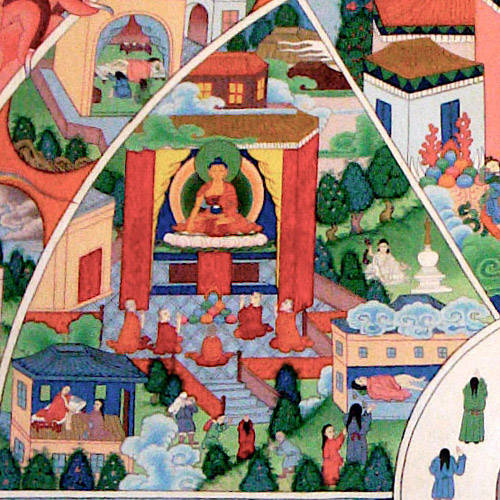
Relief From Suffering

HumanRealm

The following is an excerpt from a teaching by Jetsunma Ahkon Lhamo called “The Foundation of Bodhicitta”

Now having been introduced to the six realms, you should look at all of the different qualities that produce these rebirths: anger, grasping, ignorance, doubt, jealousy and pride.  You should think that the thing to do, if you have any understanding at all, is to begin to engage in activity that pacifies those kinds of qualities.  How does this mesh with compassion?  When you think about engaging in compassionate activity, you have to view compassionate activity in accordance with this teaching because you might think that compassionate activity would only be to be nice to people, and actually that is one kind of compassionate activity, or to give money to the poor, or to feed people.  That is one kind of compassionate activity; that is one kind of bodhicitta, but it is temporary bodhicitta.  It will produce a temporary cessation of suffering for the people that you help.  If you give them food when they are hungry, it will produce the end of temporary suffering.  If you give them money when they are poor, it will produce the end of temporary suffering.  But if you really want to get into ultimate bodhicitta, which is the quintessential practice of the Mahayana vehicle, and Vajrayana as part of Mahayana—Vajrayana is what we practice here—what you really want to do is to practice ultimate or supreme bodhicitta.  Ultimate or supreme bodhicitta is creating some kind of practice that will be a vehicle by which the qualities that produce this result will be pacified both in yourself and in other sentient beings.

I’ve described the six realms of cyclic existence.  Where in the six realms is there relief?  Nowhere.  Will you find relief as a result of temporary help in any of the six realms?  No, because you will be reborn again. And where?  We don’t know.  We just don’t know.  In cyclic existence, there is no true relief.  All there is in cyclic existence are the components of cyclic existence.  That is all that is in that pot.  You cannot expect true relief from cyclic existence.  So ultimate bodhicitta and an ultimately compassionate act would be to become a Buddha yourself.  To become highly enough realized yourself to make that commitment to attain realization in order to return again and again and again, emanating from the mind of enlightenment in order to be of benefit to sentient beings, because that is where relief comes from.

Now let me see if this is a typical thangka?  No this is not a traditional thangka.  The traditional thangkas usually show a path coming out from the human realm leading to enlightenment.  As a human, you can make the ultimate gift.  You can engage in the supreme practice.  You can achieve enlightenment yourself and, therefore, you can be a returner.  You can return again and again and again in order to lead sentient beings through a display of your enlightened compassion.

Copyright © Jetsunma Ahkon Norbu Lhamo All rights reserved

The Hungry Ghost Realm

glass of water

The following is an excerpt from a teaching by Jetsunma Ahkon Lhamo called “The Foundation of Bodhicitta”

The next of the lower realms is the realm of the hungry ghosts.  The hungry ghosts actually have a traditional appearance and they are described in this way, but again you must understand that this is us looking with eyes that are born having to distinguish between subjective and objective.  These are the eyes that are born in the realm of duality. So keep that in mind when their description is given.  The description is that of beings that have very, very, very tiny mouths—they are said to be about the size of a pin, just a tiny opening—and great big stomachs, and these stomachs are empty.  They are not able to take in the amounts of nourishment that they need.  This is the picture that we are given.  The reality of the realm of the hungry ghost is that they experience extreme need, extreme hunger, beyond what you feel when you have big Mac attack.  Way beyond that!  We are talking hunger like you have never felt.  It is a different color of hunger entirely.  Have you been real, real hungry?  Have you never been real, real hungry in your life?  I’ve been real, real hungry in my life.  I’ve been real, real hungry in my life, and I remember how that felt.  I remember being so hungry once that I could feel my blood sugar doing wacko things and I actually had the feeling of panic.  I was that hungry that you feel panicky because your body is just telling you, “I need food now!”

So you imagine that there is that kind of hunger, with that kind of panic and need, times more than you can ever imagine.  That would be the feeling of a hungry ghost.  It is extremely needful.  Now you say to yourself,  “Please! I worked out my whole life and for me to be reborn with a tiny little mouth and a big, big belly like that… That definitely is not going to happen to me.”  So you think that that’s not going to happen?  Well, you have to examine yourself from a different and more subtle point of view.  Let me ask you if you have ever gone through a period in your life when you were extremely needy.  “Oh no, not me.”  Right?  Extremely needy?  For women that happens at least once a month, right?  And for men I think it happens about every 48 hours.  Now they get needy in a different way, but it’s basically also, “Do you love me?”  We have within our mindstream the potential for tremendous neediness and graspiness.

O.K., this is a little bit less painful.  Have you known a person in your lifetime that was compulsively, neurotically, unsatisfiably needy?  Have you known a person like that?  Haven’t you had from that person the feeling that this hole is just too darn big to fill?  You feel like you’re throwing it in and throwing it in and throwing it in and trying to love and trying to give them something, and they’re still whining.  It never ends; and you spend the rest of your life doing this and nothing happens.  The hole never fills up.  Well, that is the kind of cause that results in a rebirth as a hungry ghost—a person whose habitual tendency is simply wrapped around self-absorption and what they need.  I need, I need, I need.  Can you gimme gimme gimme?  They see every other being in their life as a prop, a prop by which they can achieve satisfaction.  They use people as props in order to achieve satisfaction.  You know we’ve all gone through periods in our lives when we’ve done that, haven’t we?  Absolutely.  We have used other people for our own satisfaction.  Absolutely, and for many of us, we made careers out of it.  Right?  And maybe still, maybe still.  We have seen how people can wrap their whole lives around graspiness and neediness; and every time they meet with somebody it’s like you can hear the suction.  You can just hear it.  You feel like the blood is coming out of your pores.  And that’s the kind of person you instinctively stay away from because literally you can feel your energy being sucked into them.  Haven’t you felt that kind of thing?  You can feel the energy being sucked into them. And it’s true.  If you could see it with different eyes, your energy would be sucked into them.  That’s true.  That kind of cause, that kind of habitual tendency that the person might experience, or if it’s you, you might experience, would result in rebirth as a hungry ghost.  Particularly, also, it is the kind of person who is against and has no compatibility with compassion and generosity.the person who is chronically, without hesitation, selfish to the bone.

Now you may think, “Are there really people like that?”  Oh, ho ho, yes.  I remember once, I’ll tell you this briefly, this story..  In New York once I went to give a teaching, and I remember walking into the room and thinking, “Oh no.”  You know, a lama does develop the ability to sort of intuit who we’re talking to, and I remember walking into the room and going “NO-O-O!” because I could see that it was going to be very, very difficult. And sure enough, here we were in New York and I was talking about the most benign [subject]. I wasn’t talking about hell realms.  I would never be dumb enough to talk about hell realms in New York!  You guys want to hear that you have to come to Poolesville!  So anyway, I was talking about the most benign and charming—talk about white picket fence!—subject that you could possibly think of: kindness.  Talking about Bodhicitta.  I was talking about how, in the most fundamental way, kindness makes one feel.  Really, being kind to others makes one feel better.  I was talking about how developing the habit of kindness brings this result, just kindness.  I was talking about Bodhicitta being consistent with our own nature.  And I swear to you not one, but on different occasions, three women stood up and argued with me about the validity of kindness.  This one woman in particular said, “This is ridiculous.  Kindness has no place in my life. I mean you have to get what you want!  I don’t see the point of what you say.  This is whoosh.  Tell me something real!”  That is literally what happened.

I remember just feeling this compassion for them, for what can the result of that be?  What do you think their next experience is going to be like?  Do you think they’re going to fall into the lap of mother love?  Do you think that kindness is going to be just heaped on them in their next life?  I don’t think so.  I don’t see how that’s going to happen.  So these poor people are up against the wall, and they don’t even realize it. And in her haughtiness, she defended what was going to make her suffer horribly.  So you see there is that kind of thing operating in the minds of sentient beings.  There are some people that categorically refuse and reject the idea of kindness and benefitting others. In fact, it is not inconsistent with all of the world religions, that we should take equal responsibility with ourselves as with other sentient beings.

There are even types of teaching that the Buddha has taught that are meant for that kind of person who cannot appreciate compassion, who is not even set up to hear the word ‘compassion’.  The Hinayana point of view: yeah we’re taught to be kind to others, but not in an aggressive way.  We’re taught to do no harm.  That’s different from saving sentient beings from suffering.  So there are sentient beings that have no capacity for kindness or generosity, you see?  And so the result of that kind of mental state is to be reborn as a hungry ghost, experiencing only need.  Only being able to experience that which comes toward oneself, literally not having the chip, the computer chip, to be able to send out.  It would be like a computer that has no printer.  Everything happens internally, in a way.  Do you see what I’m saying?  Nothing goes out.  This person is not wired to send out anything; and that comes through having only the habitual tendency of self-absorption and selfishness. And the result is life as a hungry ghost.  In the hungry ghost realm, it isn’t that there is no food. It is that they are so weak because of the habitual tendency of their mind  has produced this weakness. Literally their arms and legs are like threads.  They cannot get over to where the food is.  They cannot get there.  The only thing big about them is their stomachs. And even if they could get there, their little mouths would not be able to take in enough.

Plus, it is said that even when they see food, if they can (we’re not talking about sea food here), even if they do see some food, they cannot get to the food. And if they somehow manage to get to the food, it then will turn to… Like this glass of water here.  I have the karma for this water to refresh me.  Water, little bit of lemon—pretty good.  If I were a hungry ghost in the hungry ghost realm, even if I were able to make it to that water (and I would feel the need for it very strongly), the water would be like a glass of pus or something, horrible and repulsive, literally, sewage or something horrible and repulsive.  It would turn to that before you reached it.  And that’s because of the habitual tendency of our mind.  How different from sewage is the need to only satisfy oneself and not care at all for the condition of other sentient beings?  To take from others and never give?  How different is that than sewage?  You see?

What Creates a Hell Realm?

  1. Anger

The following is an excerpt from a teaching by Jetsunma Ahkon Lhamo called “The Foundation of Bodhicitta”

The realms of cyclic existence are depicted in . the Wheel of Life and Death.   The Buddha teaches us that there are six realms. Now one of the reasons that people like to become Buddhist and to get away from Christianity is they don’t like the idea of heaven and hell. Guess what?  Guess what?  But here in Buddhism we view it a little bit differently.

This is the hell realm. This is a noxious picture. I don’t want to describe it to you because you are new and you are delicate. But it is rough. It is rough. In Buddhist tradition, we are taught that there are hot hells and there are cold hells, and there are people-cutting-each- other-up hells; and there are horrible burning things and yucky terriblenesses. And if you look at this picture, you will see terriblenesses that you cannot believe. I don’t mean to make light of the hell realm. I personally have no intention of going there, that is why I am working very hard to create virtue. But anyway these hell realms are considered to be very difficult. In Christianity if you are not saved, you will go to hell, I think. I am not sure; I am not a very good Christian. I am not any kind of Christian actually, and so I don’t really know exactly what the teachings are. In Buddhism, this hell realm here is arrived at due to hatred and anger. Now think about that for a minute. Do you think that it is so inconceivable that one will experience a hellish rebirth? That’s what we consider in terms of rebirth—not that you go to hell forever but [that you will experience] a hellish rebirth. Is it so inconceivable that due to hatred and anger you will experience a hellish rebirth?

Think about the capacity to experience nightmares. Have any of you ever had a nightmare?   Where you were suffering horribly?  Did you ever dream where a monster was after you?  Did you ever dream where somebody really hurt you?   Maybe you even dreamed that you hurt somebody else. Most of the time we project, though, our own hatred and we dream that somebody is hurting us. Everyone has had nightmares, different kinds of nightmares—nightmares like monsters getting us and even getting stuck in a burning house, or nightmares of falling, or nightmares of not being able to get ourselves out of a situation. Have you ever had a nightmare where you were stuck and unable to run and you were suffering greatly because of that or even stuck in some horrible tight place? Something like that. People have described many different kinds of nightmares. When you are in that nightmare are you saying, “Heh, I am having a nightmare, no problem. I’m out of here. As soon as I wake up, I am going to have my cereal.”  No. You are thinking,” Aah!  Let me out!”  That is the same as a hell realm. The mind can produce a short event like that, of being stuck in a nightmare. The mind can produce amazing, elaborate nightmare scenarios.. For some reason, students love to tell me their dreams. It is just unbelievable what some of you dream. It’s just like you all should have cameras and movies. You would put a Friday the 13th to shame.

So if it is possible for the mind to create a scenario of a nightmare, then you must understand that it is possible for the mind to experience rebirth in a hell realm. It is the same thing. The same capacity is at work there. Psychologists say that nightmares are probably due to fear, probably due to anxiety, probably due to hostility. And Buddhists say that rebirth in a hell realm is due to the same thing basically; But we tend to think more that this kind of rebirth is produced due to hate and anger. The mind experiences its own hate and anger projected outward on a screen in the same way that your own anxiety is projected outward on a screen in your dream experience. So that is how it happens. Just as you have the capacity to have been reborn as a human, each one of us has the capacity to be reborn in a hellish realm while we have anger. So long as there is even one drop of anger in our minds that capacity is there. Anger is the seed of that unfortunate lower rebirth. That anger is the seed of that low rebirth. You don’t think you have anger?  Let someone back you into a corner, you come out fighting every time. Let someone put you down, let someone treat you in a way that you don’t think is right, let someone challenge your ideas, then anger comes up. So we all have it.

Copyright © Jetsunma Ahkon Norbu Lhamo All rights reserved



WP2Social Auto Publish Powered By : XYZScripts.com