The following is a full length video teaching by Jetsunma Ahkon Lhamo on the Seven Line Prayer:
Copyright © Jetsunma Ahkon Norbu Lhamo All rights reserved
A sacred space for everyone
The following is a full length video teaching by Jetsunma Ahkon Lhamo on the Seven Line Prayer:
Copyright © Jetsunma Ahkon Norbu Lhamo All rights reserved
The following video is a true story as presented by Ben Zeoli expressing his personal experience with the power of prayer:
A devotional song by Jetsunma Ahkon Lhamo for His Holiness Penor Rinpoche:
Copyright © Jetsunma Ahkon Norbu Lhamo All rights reserved
The following is a full length video teaching offered by Jetsunma Ahkon Lhamo on Saga Dawa Duchen 2013. Kunzang Palyul Choling temple is currently closed for public assembly due to required renovations to meet Montgomery County, Maryland Use and Occupancy Codes. Read more about the situation here.
Copyright © Jetsunma Ahkon Norbu Lhamo All rights reserved
The following is a full length video teaching by Jetsunma Ahkon Lhamo offered at Kunzang Palyul Choling:
Copyright © Jetsunma Ahkon Norbu Lhamo All rights reserved
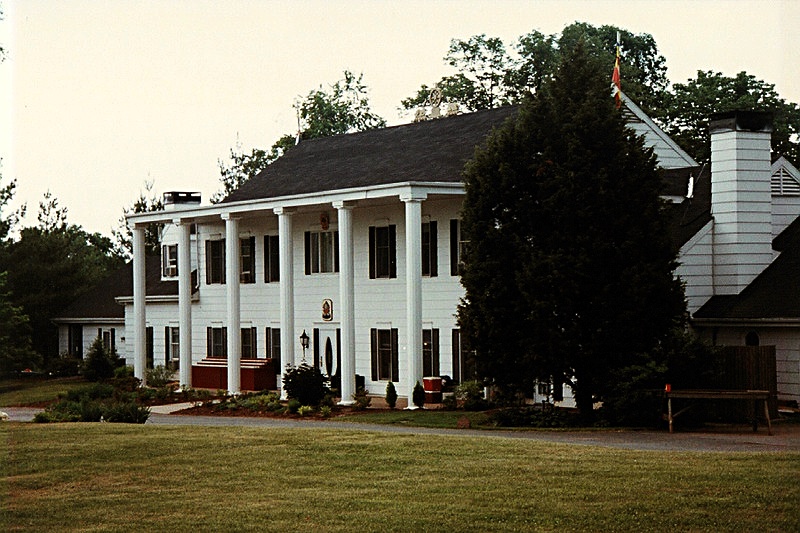
The following is respectfully quoted from “Reborn in the West” by Vicki Mackenzie. This section begins with Jetsunma discussing the role of the guru:
She went on to talk a little about the place of the guru in Buddhism. ‘The guru is an emanation of enlightened compassion, and that compassion is like a hook or a piece of Velcro,’ she explained, slipping into her hallmark mode of putting Eastern concepts into Western terminology. ‘Now Velcro has to have a corresponding piece, otherwise it won’t connect–which means that at some time in the past you have already had a relationship with the guru. It is not as though the teacher will know your name, or something like that. But the power, the intention of compassion and loving kindness sets up a vibration, almost like a sound, and students begin responding to that vibration. And the student will be called.
‘That sound is so subtle, yet so powerful, that it changes the student’s life–like that,’ she said, clicking her fingers. At this point I realized she was talking about herself as ‘guru’ too. ‘And it can sustain that change. It can change the world. That sound is the greatest, most gossamer force there is–bodhicitta, the force of compassion. That’s the sound that is being vibrationally cloaked to suit the student’s mind,’ she explained.
At Washington Airport, however, Jetsunma had no idea that the small, rotund man who was making her weep was her guru; that was to come. Instead she was contemplating how to get him back home and what to give him for lunch. He eventually scrambled into her old car and was driven back to Poolesville, where the group fed him hot dogs and potato crisps on the back porch. For an auspicious meeting it was, like Jetsunma herself, highly irregular.
‘We didn’t know what to do with him,’ she confided. ‘We had a barbecue going and were sitting down next to him, being friendly and chatty. I had no idea one doesn’t do this. Be he seemed really happy to be with us and said he wanted to meet all my students and ask them questions. I was amazed. He added that we could ask him questions too. Now that I could understand,’ continued Jetsunma.
All week long Penor Rinpoche interviewed all of Jetsunma’s students in great depth, probing to find out exactly what she had been teaching them. When eventually Jetsunma herself managed to get some time with Penor Rinpoche, she acknowledged him as the teacher and confessed her ‘sin’ of teaching without any real qualifications.
‘Forgive me, but I did not feel I could sit and do nothing,’ she said. ‘But the authority under which I’ve been teaching is twofold. First of all, I look around me and see there is suffering, and I have to do something. The other is that I’ve tried my own practices and I know that they work. But I don’t really know why these teachings come to my mind. Can you please tell me where it comes from?
Penor Rinpoche looked her straight in the eye and broke the news–at least, part of it. ‘In the past you were a great bodhisattva, a person who works throughout all time to liberate sentient beings. You have attained your practice to the degree that in every future lifetime you will not forget it. You will always know it, it will always come back to you. It is in your mind and will not be forgotten.’ He gave her no name, no clue as to what kind of bodhisattva she had been. He just advised her to keep on doing precisely what she was doing, in the way she was doing it, and confirmed that her teachings were exactly what her students needed. That was all. It seemed that no great demands were to be made of her–until he dropped the bombshell.
‘He told me I had to buy a centre, a real temple, that I shouldn’t be afraid. He said I was going to see several different places but I had to buy the one with the white pillars in the front. “You’re going to think you can’t afford it,” he said–and oh, we can’t!–“but you will find a way. Have faith, it will be all right. Eventually,” he added, “you will have places all over the world.” The last part of the prophecy is still to come about.
First, before a teaching or practice, we always establish motivation. In Mahayana or Vajrayana – the Liberation of all beings from suffering.
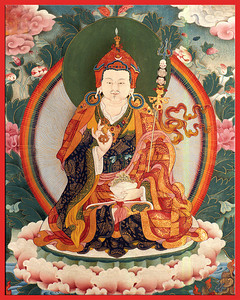
Today we discuss the immutable Seven Line Prayer. In Nyingma, this is the King of Prayers. In fact, it is a complete Puja in itself. Within are contained Refuge, Bodhicitta, making offerings, request for blessing and samaya. The prayer has three levels of meaning.
The three levels are Outer, Inner, and Secret. The Secret level should not be taught until an aspirant has accumulated 300,000 repetitions!
The first, outer level of meaning is as it seems. This is a Prayer to Guru Padmasambava, second emanation of Buddha, who brought Dharma to Tibet. His Birth and Death were not ordinary. He was born on the pollen heart of a Lotus, appearing as an eight year old, a golden Sublime Child. His body had ALL the major and minor marks of Buddhahood. He was born stainless, fully awake, and realized. This is described in the Prayer.
In describing this way, Devotion is generated purely. He is surrounded by a retinue of Dakinis. Dakinis are female aspects of Buddha. Dakinis are varied. Some are Primordial Wisdom. There are Vajra Dakinis and Offering Dakinis. Dakinis are “Sky-Dancers” and are the activity aspect of the Buddhas. So the meaning is Guru Padmasambava has accomplished all activities, qualities, and wisdom of all the Buddhas. This is acknowledged in the prayer.
Next is the Samaya-commitment to follow and to practice. Then the request for the Guru to bless us. In Vajrayana that Blessing means everything, as it ripens and deepens one’s consciousness, without which we remain ordinary, unfulfilled. The inner meaning is that we are connecting with and awakening to our OWN Enlightened Nature. Through devotion your mind mixes with the Guru’s like milk with water, and they become inseparable; same taste and essence.
We are taught that to recite this prayer brings Enlightenment within seven lifetimes. To accomplish this prayer can bring enlightenment within one life. Accomplishing is 300,000 times or more. E MA HO! One not only awakens, but also accomplishes Buddha’s activities, qualities, and blessings. (Remember? Dakinis).
As I’ve said the secret level cannot be taught at this stage, not on twitter! A very broad explanation is that the sacred syllables purify psychic winds, channels, and fluids. All of which are invisible to the unawakened mind. This is the very means to Enlightenment! One should have wind (lung) transmission, which I cannot confer here, so you may commit to seek out Lung Transmission from a qualified Nyingma Lama. So here we go.
HUNG – ORGYEN YUL GYI NUB JANG TSAM
On the northwest border of the country of Urgyen
PEDMA GESAR DONG PO LA
In the pollen heart of a lotus
YA TSEN CHOG GI NGODRUP NYE
Marvelous in the perfection of your attainment
PEDMA JUNG NE ZHE SU DRAG
You are known as Lotus Born
KOR DU KHANDRO MANG PO KOR
And are surrounded by your circle of Dakinis
KYED KYI JE SU DAG DRUP KYI
Following you I will practice
JIN GYI LOB CHIR SHEG SU SOL
I pray you, come and confer your Blessings.
GURU PEDMA SIDDHI HUNG!
(Not translatable. Sacred words)
That is the prayer and translation. You can accumulate prayer like Mantra, Counting on a Mala (prayer beads) AND should repeat this prayer three times before any other practice, such as the Amitaba recitation from yesterday.
After reciting, the Guru melts into light and pours into the crown chakra, accomplishing the great blessing. May all beings benefit!
And as always, one considers Guru Padmasambava as inseparable in essence from one’s own Root Guru. This then is inseparable from your mind.
One more thing, the condensed essence of the Seven Line Prayer is the Vajra Guru Mantra. OM AH HUNG BENZAR GURU PEDME SIDDHI HUNG!
May my mistakes in transmission be fully purified by OM BENZAR SATO HUNG!
I have so far accumulated over a Million. My goal is 5 million, but I’m a slacker! LOL! I love to chant this prayer, my favorite.
Here is a recording of me chanting the prayer at three different speeds to facilitate progress. I ask new students to accumulate 10,000 repetitions. Easy!
Jetsunma chanting slowly-for beginners
Jetsunma chanting the prayer a little faster
Jetsunma chanting the prayer rapidly

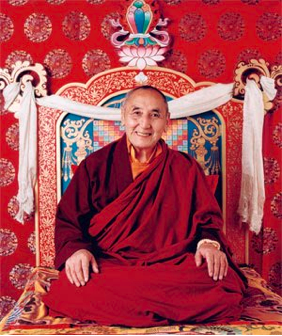
H.E. Ven. Yangthang Tulku is a highly revered Lama in the Nyingmapa Lineage of Tantrayana Buddhism. He is known to be the embodiment of Vimalamitra, a Dzogchen Master regarded as the chief propagator of Buddhism in Sikkim. In his past life he was also the great terton Lhatsen Namkha Jigmed from Sikkim whose treasures are included in the Rinchen Terzod. But he is perhaps most well known as the reincarnation of Dorje Dechen Lingpa, the Tertön from Dhomang, who has successfully retrieved many Terma Buddhist scriptures which were secretly concealed by Padmasambhava. Only the truly accomplished Dharma practitioner prophesied by Padmasambhava, can reveal these sacred treasures.
At the very moment that Dhomang Terchen’s incarnation was born (1923) in Sikkim, all directions in the sky in Sikkim resounded in thunder, “I am here!” He was discovered exactly as described, born into the Yangthang family. This is why Rinpoche is known now as Yangthang Rinpoche. A second emanation was born in Sikkim and was brought up together with his older counterpart. When Yangthang Rinpoche was invited back to his monastery in Tibet, the younger emanation also insisted upon joining him. The two young boys departed with their party, playing and performing many miracles along the journey.
Upon returning to Dhomang Monastery both tulkus were put in the hands of Sogtrul Rinpoche and many other lamas at Dhomang. They were given the finest and best education with Khenpo Pema from the Palyul Mother Monastery as their personal instructor. Thus, both tulkus were able to fully complete all their studies. In addition to mastering the extensive training in practices of his lineage, Yangthang Rinpoche was completely trained in the Kangyur and Tangyur, and in the works of Longchenpa.
In Tibet, before the Cultural Revolution, Yangthang Rinpoche gave the entire Kangyur transmission and many other great empowerments. He became the head of Dhomang Monastery and carried out all the administrative duties personally.
After remaining in retreat for more than 20 years under harsh conditions, Ven. Yangthang Rinpoche moved to Pelling, West Sikkim in 1958. That same year, the Communist Chinese captured and killed Sogtrul Rinpoche and the younger tulku. In 1959, Yangthang Rinpoche fled Dhomang. He was later captured by the Chinese, and imprisoned for 22 years. While imprisoned, he helped many fellow prisoners who could not bear the hardship to die peacefully by performing P’howa, transferring their consciousness to Pure Lands. Though he witnessed and experienced much torture, he bears no resentment to his captors, only compassion. In fact, he became a spiritual advisor to some of the guards. When people express sympathy about his imprisonment, Rinpoche says that because of Dharma, his mind was freer in prison than worldly people experience in the best of circumstances.
Following the death of Mao Tse Tung he was released. He returned to Dhomang to find his monastery completely dismantled. He then obtained permission to go to Sikkim. As a simple yogi he traveled back and forth to Nepal and Bhutan, receiving transmissions and empowerments from His Holiness Dilgo Khyentse Rinpoche and His Holiness Dodrubchen Rinpoche.
In 1985, while circumambulating the Great Stupa in Bodhanath, Yangthang Rinpoche met with Gyaltrul Rinpoche, who at that time was leading a group of his American students on pilgrimage to the sacred shrines of the Dharma. These two lamas had not seen each other in 26 years. Fleeing from the invading Communist Chinese, they had initially left Dhomang together but parted company at a fork in the road. One fork led Gyaltrul Rinpoche to freedom in India, the other led Yangthang Rinpoche to imprisonment. At the request of Gyaltrul Rinpoche, Yangthang Rinpoche first came to the U.S. in 1990. He gave many profound teachings and transmissions, and was enthusiastically welcomed wherever he taught. Yangthang Rinpoche returned to the U.S. for a second tour of teaching and transmission in 1997, and for a third tour in 2002. In between his travels to the United States, Europe and Asia, Rinpoche has gone back to his root temple, Dhomang Temple in Sichuan, China to rebuild and refurbish the dismantled temple.
Among the Tertons, exceptional manifestations have been given the title ‘Lingpa’ in acknowledgment of their remarkable qualities. Like Ratna Lingpa, Karma Lingpa, Chogyur Lingpa and others, Dorje Dechen Lingpa revealed many volumes of treasures and was an undisputed realized master, a manifestation of the wisdom and compassion of all the Buddhas. Moreover, Yangthang Tulku is of course also an emanation of Vimalamitra, just as Kyabje Penor Rinpoche was. Vimalamitra’s wisdom is inseparable from Guru Rinpoche’s, the source of the blessings of all the revealed treasures. Yanthang Rinpoche is known as a compassionate, humble, no-nonsense Dzogchen master and one of the principle lineage holders of the Nyingmapa Lineage. He is widely recognized for the quality and depth of his realization, the power of his attainment, and the purity of his transmissions.
Kyabje Pema Norbu Rinpoche, the 11th throne holder of Palyul Lineage, has pronounced that “There is no difference between myself and Yangthang Rinpoche.” Gyaltrul Rinpoche has stated that “Yangthang Rinpoche is the great achiever of Dharma, an extremely precious gem in this modern age.” Venerable Yangthang Rinpoche currently resides in West Sikkim.
References: PathtoBuddha.org
Mahasiddha.org
OrgyenDorjeDen.org
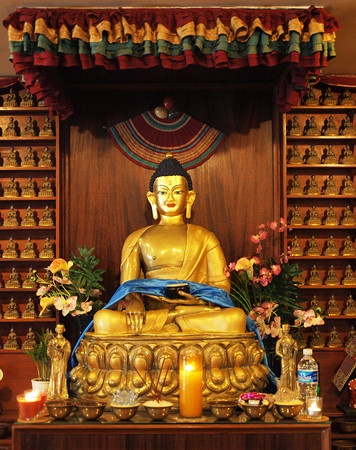
KPC has wonderful news! In a meeting with the Interfaith Advocate from Montgomery County, we were informed that we can open our doors, that visitors can come and go, taking advantage of the many blessings the temple has come to offer. The Prayer Room will be open 24 hours a day, 7 days a week once again for ANYONE seeking a place of spiritual refuge. You will be welcome to meditate quietly or pray, and take in the wealth of blessings offered by the statues, thangkas and crystals.
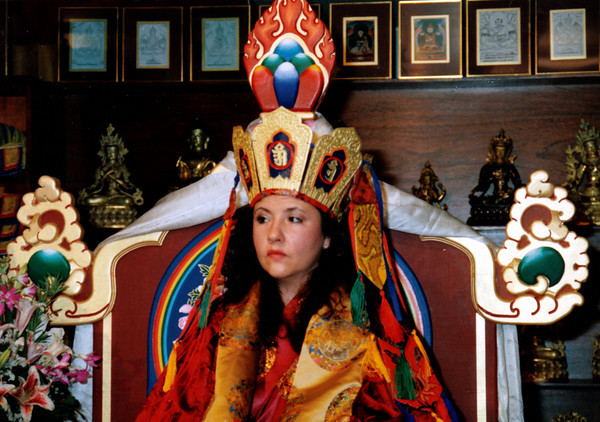
The following is respectfully quoted from “Reborn in the West” by Vickie Mackenzie:
The journey to Poolesville, Maryland from New York had taken almost four hours. First one of those silver cigar-shaped trains from Penn Station in downtown Manhattan to Washington, D.C. Then a modern automatic train to Poolesville, green and lush, in the wealthy outskirts of the nation’s capital. I had had much time to ponder.
I recalled how, several years previously, I had read in a newspaper about a woman who had been recognized as a Tibetan tulku and who had run prayer vigils for world peace. That was the sum total of all I knew. Somehow, this small snippet of information had lodged in the outskirts of my brain, to be called up when the notion of this book appeared. Now, on the train rattling down the eastern seaboard of the United States, the idea of meeting a woman Western tulku beckoned alluringly. This, after all, was a rare commodity indeed: a female who had been granted the highest spiritual accolade and authority within the overly masculine world of Tibetan Buddhism. And a Westerner at that. Tracking her down, however, had not been easy. I had not been able to remember her name, and since her official enthronement in 1988 she had kept a very low profile. Through various Tibetan contacts in the USA I finally found her. Her name was Jetsunma Ahkön Norbu Lhamo, and she had a centre just outside Washington.
Over the seventeen years I had been visiting Tibetan Buddhist centres I can honestly say I had seen nothing like the one that was about to greet my eyes. It glistened in the sunlight, a grand, two-story white house fronted by six vast white pillars, looking for all the world like an exclusive country club. I reached this imposing edifice by means of a winding drive flanked with rows of tall flagpoles, immaculately manicured lawns and flower beds. Glancing up to the roof, I saw the first sign of the place’s true identity–two golden deer supporting a golden Dharma wheel, the national emblem of Tibet. And there, written large on a sign near the entrance, was the equally foreign name: Kunzang Odsal Palyul Changchub Chöling. Since its English translation was even more of a mouthful–the Fully Awakened Glorious Dharma Continent of Absolute Clear Light–it was called by its inmates simply ‘KPC’.
If the exterior was impressive, the inside was breathtaking. A large central staircase swept up from the central hall to the upstairs rooms, and the whole place was carpeted wall-to-wall in beige. But this paled into ordinariness when I entered the two gompas, without doubt the most beautiful shrine rooms I had ever seen. They were crystal palaces–around the walls was an extraordinary array of huge crystals, strategically placed on plinths and individually lit, like museum pieces. It was, I was told later, the biggest crystal collection outside the Smithsonian Institution in Washington.
The first gompa, where the teachings and ceremonies take place, was hung with royal blue and gold curtains and furnished with fine chairs for those who could not sit cross-legged on the floor. The throne for the teacher stood under a canopy of red, gold and royal blue. In the middle of the room was a huge mandala, surrounded by golden stupas at the base. Against one wall was a statue of Padma Sambhava, the founder of Buddhism in Tibet, and in front of it was the biggest solid round crystal of all. The effect was extraordinary–a cross between sumptuously exotic Western drawing room and a magic Eastern temple. It occurred to me that no man in Tibetan Buddhism would ever have had the courage to produce such a place of worship, let alone envisage the concept. It managed to break all bounds of convention, and yet remain unmistakably a gompa of Tibetan Buddhism.
The second gompa was even more fabulous. This was the prayer room, lit by candles, where the twenty-four-hour vigil for world peace still goes on. In the semi-light I picked out yet more gigantic crystals, individually glowing, and the impressive sight of a wall lined with 1,002 small Buddha statues standing neatly row upon row, like sentinels watching over the holy activity taking place before them. I had seen such sights in Tibet, where entire walls are painted with thousands of Buddhas turning black with accumulated grease of millions of burning butter lamps–but nothing could match the pristine splendor that Jetsunma had created in here in the Poolesville countryside. Turning round to view another wall, I saw an equally amazing spectacle–a display of of twenty-one golden statues of Tara, the female aspect of the enlightened mind which represents fast, effective action; they stood in tiers, like some beautiful female spiritual court. It seemed an accolade particularly appropriate here. With a solitary monk sitting on his cushion sending out prayers for universal harmony and compassion, and the taped voice of Jetsunma herself crying out her haunting invocation for the Buddha to be present, the room vibrated with spiritual power.
Who was the woman who had created all this? Jetsunma Ahkön Norbu Lhamo walked into the upstairs sitting room emanating warmth, a discernible kindliness, a bubbling vivacity and, it has to be said, in appearance at least, a middle-of-the-road American ordinariness. She was dressed in a straight-cut beige skirt and top and was wearing make-up and fashionable dangly earrings. Her fingernails were long and painted, her dark brown curly hair was shoulder-length and wild. She was tall, rounded and in her early forties. Nothing gave away her unique status except for the mall–a string of prayer beads–which she played with constantly in her hands; that and the fact that, with her dark, slightly almond-shaped eyes, her slightly down-turned mouth and the general shape of her face, she had a distinctly Tibetan look about her.
I learned that she was, in fact, a walking example of curious contradictions. In the modern Western way she had been married and divorced, more than once. She was the mother of three children–two sons, now in their twenties, and an adopted girl aged five. She lived in a house behind the centre where she cooked, scoured mail order catalogues for clothes (one of her passions), and looked after her husband and family just like millions of American women all over the country.
And yet in the ancient Eastern way, she carried the name ‘Jetsunma’–a title more honorific even than ‘Rinpoche’, the recognition bestowed on male reincarnates. Here before me, in her make-up and high heels, was a woman who had been hailed as a ‘Sublime Incarnation’, no less. Here was a woman who, it was said, had achieved the spiritual mastery from which she could be reborn in any form she chose and teach directly from her own memory, without any formal training. It was a rare accomplishment indeed. Unlike the other tulkus I had met, Tibetan and Western alike, Jetsunma Ahkön Norbu Lhamo had not been discovered at an early age, nor taken into any Tibetan monastery to bring forth her potential. She had developed it entirely by herself, secretly and alone in the middle of America without help from anyone. The testimony of what she had achieved was there for all to see: the magnificent centre with its beautiful grounds, its exquisite meditation rooms, and the thriving community of followers she had gathered around her. This was clearly one very special lady indeed.