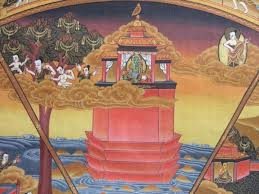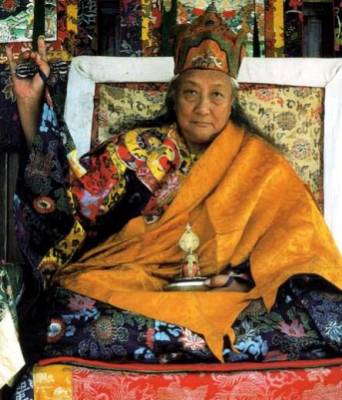
The General Preliminaries: by His Holiness Dilgo Khyentse Rinpoche

Dilgo-Photo

The following is respectfully quoted from “The Excellent Path to Enlightenment” by His Holiness Dilgo Khyenste Rinpoche:

The main source of progress on the path is devotion, so begin each session by visualizing in the sky before you, or above your head, your root teacher in the form of Guru Padmasambhava, resplendent with wisdom and smiling compassionately, seated in the midst of a mass of rainbow light. Then with fervent devotion say three times, “Lama Kyeno!” — “Guru, you know everything! I am in your hands!”–and ask him to bless you so that you achieve complete realization of the profound path this very life. Rays of light emanate from the Guru, removing the veil of ignorance and filling you with blessings.

Then reflect on the six topics that make up the outer or general part of these preliminaries. First, reflect upon the rarity of human existence; this will turn your mind towards the Dharma. Second, contemplate death and impermanence; this will make you realize how urgent it is to practice the Dharma, and will spur you to endeavor. Next, reflect on the third topic, the law of karma, of cause and effect, actions and their results, so that you understand clearly how this law works. After that, reflection on the fourth topic will help you recognize that the deluded condition of samsara is never without suffering. With the fifth, you should recognize that through receiving and practicing the teachings you can free yourself from samsara and ultimately reach the unsurpassable level of omniscience, or enlightenment. Finally, you should recognize that in order to achieve that level you have to rely on the blessings and instructions of a spiritual leader.

1. THE RARITY AND PRECIOUSNESS OF A HUMAN BIRTH

Ask yourself how many of the billions of inhabitants of this planet realize how rare it is to have been born a human being. How many of those who realize this think of using this chance to practice the Dharma? How many of these actually start to practice? How many of those who start continue to practice? How many of those who continue attain ultimate realization? The number of those who attain ultimate realization is like the number of stars you can see at daybreak compared to the number you can see on a clear night.

There are various kinds of human existence. Some are wasted in ordinary pursuits and some are used to progress towards enlightenment. Human birth can only be called precious when one is free to practice the Dharma and has met all the favorable conditions for doing so. So to have the opportunity to practice the Dharma we need to be free from the eight unfavorable conditions. These are: to be born in the hells, the realm of the pretas or hungry ghosts, the animal kingdom, among barbarians, among the long-lived gods or among those with erroneous views, or in a dark age where the Buddha has not appeared, or as someone who is mentally deficient and incapable of understanding the Dharma. But simply to be free from these is not enough. We also need ten favorable conditions, five that depend upon ourselves and five that depend upon others.

The five intrinsic conditions arising from our own situation are: to be born a human being, to be in a place where we can find the Dharma, to have all our faculties, not to live and act in a completely negative way, and to have faith in those worthy of faith.

We need to be born a human being, as this is the only state of existence in which there is enough suffering to give us an acute desire to be free from samsara, yet not so much suffering that we no longer have the opportunity to free ourselves through the practice of Dharma.

We need to be born in what is called a “central land,” meaning a place where the Buddha’s teachings exist. Otherwise, we have no chance of encountering these teachings and progressing along the path.

We need all our faculties so that we can study, reflect on, and practice the Dharma. If we were blind, for instance, we might not be able to read the teachings; if we were deaf, we would not be able to hear them.

We need to lead our lives in a positive way. If our lives are dominated by negative actions–if, for example, we are hunters or thieves, or spend our lives fighting wars–that naturally leads in the opposite direction from the positive conditions needed for Dharma.

We need to have faith and confidence in those who can guide us along the path to enlightenment, namely the Three Jewels and a spiritual teacher.

The five external conditions that depend upon others are: a Buddha must have appeared in the kalpa or aeon in which we are living; the Buddha must have taught the Dharma; the teachings must still be present; they must be practiced; and we must have a spiritual teacher to guide us.

Al this constitutes a human birth endowed with all the freedoms and favorable conditions for practicing the Dharma. That is what we call a precious human birth. Why is it precious? Because by using this human birth, enlightenment can be achieved in this very lifetime. All the great accomplished beings of the past were born ordinary beings, but, by entering the door of Dharma, following a realized teacher, and devoting their whole lives to practicing the instructions they received, they were able to display the enlightened activities of great Bodhisattvas.

If we examine the six realms of samsara one by one, we can see that, except in the human realm, the obstacles to Dharma practice are too strong. In the inferior realms such as the hells, suffering is so intense that it is impossible for the mind to contemplate and practice the teachings. In the celestial realms, where beings can fly through the sky, feed on ambrosia and enjoy all sorts of pleasures, the conditions might seem more favorable. But because the beings there are so enticed and distracted by these things, and their suffering is so minimal, they never get tired of samsara and therefore never think of practicing the Dharma. So if we do not use the precious opportunity of a human existence, we cannot but go downwards, like a stone rolling down a hill.
Astrology for 4/14/2017

4/14/2017 Friday by Norma

A change has occurred and unsaid things have been said. A new sense of freedom is in the air and a different direction is possible. The entire environment is in flux: the wheel is turning and you won’t know the outcome for several days or weeks. All you know is that the old situation is gone. Dorothy said, “Toto, I’ve got a feeling we’re not in Kansas anymore.” A current dust-up or mix-up will settle down within three days but the big picture takes longer to manage. What’s good now? A renewed sense of opportunity, expanding parameters, the breakdown of an unworkable pattern and shopping! It’s a great time to manage money and someone you love is waiting for you.

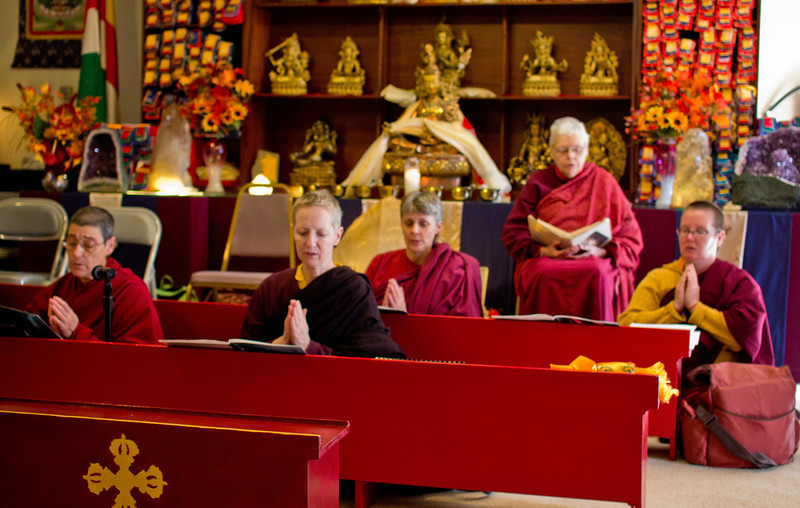
Navigating Samsara – The Vows

TK-268_OccupyPrayerAtKPC-10-L

The following is an excerpt from a teaching by Jetsunma Ahkon Lhamp called “The Habit of Bodhicitta”

As Buddhists, I would like you to think about what your directive is. I want to ask first those who are in robes. I want to actually ask them and give you the answer, but I’m going to pretend that I’m asking them, because I’m desperately afraid that they might not know.
Your primary directive is to follow the Vinaya. Vinaya is a set of cause- and effect-oriented rules, basically, a format that those in robes should follow, and the Vinaya becomes the heart practice of your life. You should, of course, receive teachings on the Vinaya, which you have. You gradually begin to understand the Vinaya. It is your responsibility to study the Vinaya; it is your responsibility to go after information about the Vinaya, because that’s your code. The Vinaya has a great many items that we should practice and look at. In particular, as robed persons, as monks and nuns, there are certain rules that seem very strict, but that you must follow. For instance, I don’t know if the lay people are aware of this or not, one of the rules in the Vinaya is that at a certain level of ordination, monks and nuns should not touch members of the opposite sex. Yet, here in Kunzang Palyul Chöling, one sees monks and nuns shaking hands, hugging, handing things to each other. Are we breaking the Vinaya here? Are we doing that?

We have a slightly different perspective. The Vinaya has not changed. Not in any way. What has been will always be. These are the Buddha’s words. But in Vajrayana, we have a slightly different perspective. If we have the idea in our minds, according to the Vinaya, that we should not touch members of the opposite sex in order to keep our celibacy really pure, that we should keep it very pure, yet we find ourselves [ touching] each other, how does that actually work out? If I, for instance, were a nun, let’s say, and I were to see a man that was very hungry or in need of some sort of medical help… Perhaps he fell down and he needed help getting up. Do you think I would hesitate for one moment to help that person or to give them some food? Or if I saw that a person needed the connection of a hug, needed the connection of some comfort; needed a greeting in order to feel accepted and welcome, do you think I would hesitate for one moment to give that sort of sustenance? Even if the Vinaya says not. That’s because the highest ordination that I feel as a Mahayana and Vajrayana practitioner is that of compassion. And in our tradition, compassion and love supersede everything. So the Vinaya is kept, but it is kept differently.

The way that these monks and nuns should be keeping the Vinaya is that, for instance, as a nun, whenever one sees a man, you should think of pure view about the man: You should think of the man as what we call a yidam or meditational deity. You should think that in that man’s pure form, he is the very Buddha. One should think like that. One should recognize the innate Buddha nature in each and every one; and one should think that each and every one holds that nature and that nature is actually present. We accomplish our practice by thinking of each man as the meditational deity. Those of you who are monks would think of the woman as being the goddess or the enlightened female deity, the primordial wisdom dakini. And in that way, upon touching a man or a woman, one is never actually touching a man or a woman. One is only approaching the meditational deity or the goddess. One still keeps one’s inner commitments, yet the highest commitment is that of compassionate pure view.

Of course, you can’t bend that irresponsibly, in fact you can’t bend it at all. None of you can take marital partners; none of you can engage in any kind of ordinary relationship in that way. But in order to uphold the highest ordination of compassion and the highest practice of pure view, you can engage in those kinds of activities that enhance that view.

Now for lay people, we don’t have the same strict approach. As lay people, though, we should never, never think that we can do more than them. We should never think like that. Because if we are thinking like that, quite frankly, that is a pretty schlocky practice. That’s just not going to cut it. We should never think that, ‘Oh, because I’m a lay person, my conduct can be very loose, I can do whatever I want.’ As Buddhists you have to actually move into the posture of being a Buddhist practitioner. You have also in common with these monks and nuns the highest ordination, and that is the high ordination of the practice of bodhichitta, or compassion. If you were to hold in your mind the idea that everything you do comes from the perspective of caring, of love, of kindness for others, then you’re still holding your vows. The trap that we fall into, though, as lay practitioners, is the idea that because we are lay practitioners, we can basically get away with murder. Actually, the Vajrayana point of view is very much geared and directed toward lay practitioners. Lay practitioners have a great distance that they can go and a great breadth and depth of practice that they can practice. They don’t have the strict guidance rules to the degree that the ordained people have, but in a sense, they have even more responsibility, because not having those strict rules, they must find a way to practice purely. And as lay practitioners, that’s our job: to seek out and really try to get for ourselves a way to practice purely. We may not understand how and we have to search it out. It isn’t enough to remain passive in our practice, to think that, ‘Well, eventually I’ll get the answer, and it will be clear to me, and in the meantime, I’ll just kind of scoot along.’ That would not be holding a proper view, that would not be holding our practice as a precious jewel, and that would not be doing a good job.

As a lay practitioner, we also have the responsibility of seeking out the absolute best way that we can hold our most precious inner vow, that of bodhichitta, or compassion, and we should aggressively seek out ways to do that. In order to seek out ways to do that, we must first examine how it is that we are in the condition that we are in. The Buddha teaches us that the primary directive, or motivating force, the reason for all of our suffering, is self cherishing, ego cherishing. Sometimes it looks like some of us have a lot more ego cherishing than others. Sometimes it looks as though some people are able to do a lot for others, and to be real kind and other people are only thinking about their own needs. But in the truest sense, that’s just a very superficial appearance. In fact, we are all exactly the same in that we are all in a samsaric condition, stuck on ego cherishing, stuck on the belief in the inherent reality of self nature, and therefore, suffering due to desire, hope and fear, not able to actually witness or see or relax into our own primordial wisdom nature.

Copyright © Jetsunma Ahkon Norbu Lhamo All rights reserved

Astrology for 4/13/2017

4/13/2017 Thursday by Norma

Robust activity energizes a lethargic situation and everything to do with electronics, technology, machines and gadgets is electrifying. This is not a good day to to start things that haven’t been pre-planned, but it’s a great day to finally launch a long awaited project. Love is in the air, exercise is great and a business project hums along nicely. Today it is better to circle a matter carefully rather than charging directly toward it. Direct action, taking the shortest route to something, doesn’t work. Vaclav Havel said, “Life is its own journey, presupposes its own change and movement.” What’s good today? Behind-the-scenes strategic planning, emotional reassurance from someone you thought didn’t care, sidestepping a dispute, and physical healing.

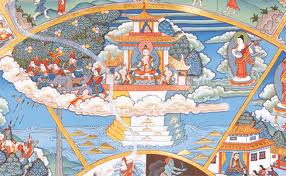
The Realm of the Gods

The God Realm

The following is an excerpt from a teaching by Jetsunma Ahkon Lhamo offered during a Phowa retreat:

The last of the realms, the highest of the realms, is the one that’s like Club Med. Lots of people say that they want to try this, at least for a little while. I do, certainly. I would like to try this for a little while. I was thinking maybe a couple of weeks, you know, a couple of weeks in the god realm. This place is great. This place is really super. This is the superior realm. In order to be born in the god realm you have to have a lot of merit, but a particular kind of merit. It’s a kind of merit that is not necessarily coupled with wisdom. That is to say, you’ve done a lot of nice things, probably spread out over a long period of time. Or you might have done a few nice things, really nice things, that were just aimed right, like, let’s say, you gave life. Oh, here’s one: Think of the Buddha’s mother.  She gave life to a Buddha, but she herself had not attained realization, so she was born in the god realm. She had accumulated a great deal of merit and virtue. So those that are born in the god realm have accumulated a great deal, a tremendous amount, an inconceivable amount, of merit and virtue, but not necessarily coupled with wisdom.

Their experience is beautiful, just beautiful. Breathtaking, in fact. The gods and goddesses of the god realm, of that particular god realm, are beautiful to the degree that if one of them were to walk amongst us now, it would be blinding. We simply could not perceive the sum total of their beauty. It would be out of the realm of possibility with our eyes. Our eyes are of flesh and not made to take in that much beauty. The colors in the god realm are brilliant. Breathtaking. Not like here. Their reds, their blues, their greens are inconceivable to us. Inconceivable to us. Brilliant. Fabulous. In fact, all of the things that exist within the god realm have these kind of interconnected qualities. To only see one of the jewel-like colors of the god realm will instantly cause healing through sight. That’s how perfect they are. Healing through sight only upon seeing a color.

The gods and goddesses themselves are breathtakingly beautiful, I mean to the point where they are just unbelievable, even to each other; and they are adorned with gorgeous colors and beautiful things. Not only that, they also have the quality of extraordinary perfumed scent. Not like our kind of perfume, the kind you buy, phssst, phssst, phssst, phssst, not that kind, alcohol based. Not Esteé Lauder. It’s much better than that. Their scent is the scent of virtue and merit. And so, the fragrance that comes from their bodies…  It is said that upon simply smelling one of their bodies, one would receive healing, based on scent. Healing from scent. Their smells are like nothing we can imagine. If we could smell one of them, first of all our noses would not be able to take in all of the scent, and our brains would not be able to process it all. But what we could smell would be so fantastical to us that it would be shocking, like nothing we’ve ever smelled, you see. Furthermore, the level of joy in their minds… Now think about this: What if you were so darn gorgeous that people could hardly look at you? Just think about that. And you smelled so darned good that people just couldn’t get enough of it ?Not only that, but you don’t change. You’re always gorgeous. You don’t have bad hair days in that realm. You don’t have acne in that realm. Nothing changes. You don’t ageuntil the very moment of transition into death. Doesn’t that sound like a great place to go?

Let me tell you a couple of other factors about the god realm. You see how here I have my lemon water and I have my ever-popular coffee? Remember, in the hungry ghost realm I told you that this appearance to a hungry ghost, even though it’s the same thing, it is the same nature, same stuff, to a hungry ghost would appear like a glass of pus, or something horrible. And to a human it would appear like water. You’d say, “Well, that’s what it is. That’s ‘cause we can really perceive.” No, this is Buddha, so we perceive it as water—water to nourish our bodies. However, what would a god or goddess perceive this as? This would be to a god or goddess delicious beyond anything we could conceive of. Furthermore, it would be the nectar or elixir of life. One sip is healing upon taste. Healing upon taste. One taste of this liquid in the god realm will heal every single ill, if there were ills in the god realm. And it’s because of the condition of their minds.  Remember, our perception is because of the condition of our minds, not because the object has changed. So everything they eat… And music! There’s music in the god realm that’s nothing like the music you hear here. Not even the best music, not even the finest, most uplifting classical music, nothing like what we have here. The music in the god realm is, again, healing upon hearing, but nothing we can imagine. Celestial. Words don’t explain. So doesn’t that sound like a great place to go? Wouldn’t you love to go there? I definitely feel like we ought to have at least two-week passes. Something, if we knew we could get back in pretty good shape.

Let’s talk about the drawback of the god realm and why you don’t actually want to go to the god realm. Because in the god realm they are so filled with pleasure they can’t practice. If you were to say to a person, “You should practice your Dharma because even your life in the god realm will end.  It will, and wait until I tell you how. Your life in the god realm will end.” They wouldn’t be able to hear. They’re so deluded and intoxicated with the product of their virtue that they can’t hear those words and they don’t compute them. They can’t take them in. In the same way that we couldn’t take them in when we were younger and not feeling as though our lives were forfeit, when we believed we were going to live forever, and couldn’t hear about how you have to prepare for death. But much more so. They can’t even compute it; they can’t take it in. It ain’t happenin’ for them. Plus they don’t have the space in their minds to even consider practice. They can’t even stop experiencing pleasure long enough to say Om Mani Padme Hung, which would liberate them from that delusion. They can’t do it; they simply cannot do it.

Now what happens to the hungry ghosts? What is their lifetime? Their lifetimes are very, very long. It’s the same at the high end and the low end of cyclic existence. Generally speaking, their rebirth in the hell realms and hungry ghost realms are quite long. Our lifetime would be like a day in a year of their life. It would be very, very long. It’s different with each of the different realms, but it’s quite long. The same for the god realm. For the god realms, lifetimes can be as much as an eon. Nobody’s real sure how much an eon is. People keep asking me; I don’t know. Tibetans have one idea, westerners have another idea. It’s a long time. Trust me on this. So the gods and goddesses can live in that realm for eons. Eons. There are many stories of the different gods and goddesses that have lifespans of two kalpas, or two thousand years. There are many stories like that. And then, upon their death, another one takes their place in the very same form, and none of us realize that gods and goddesses are in fact dying and being reborn. We think they live forever.

Here’s how it works. Once again, it takes a tremendous amount of virtue and meritto be reborn in that god realm. So what happens is during the course of their lives they are burning that merit and virtue up, much like an eight cylinder car going up hill. Remember what those guys were like? You burn a lot of gas. And so they are literally burning merit, because their lives are so pleasurable. They’re spending it like money. Just buying everything, you see. If you were spending your money on a poorer life, or spending your merit on a poorer life there wouldn’t be so much expended, but they’re spending their merit on this extremely pleasurable life. And there is a continual outpouring of one’s merit, or using up of one’s merit.

So what literally happens is that at the end of this span, when one’s merit and virtue is completely exhausted, then suddenly the gods and goddesses begin to wake up from their pleasure experiences, as though waking up from an erotic dream, or an extremely pleasurable dream. And suddenly you find yourself in your own bed and you’re wondering what’s going on here. That kind of thing. The gods and goddesses have the same experience: Suddenly they are shaken and they look around and they see. And at that time they are not only able to see all of the god realms, which they do have the power to do, but they are also able to see down toward the other five realms. And then, when they have already used up everything they’ve got, they finally see that they have used up all their virtue and merit, and that they are about to fall into the lower realms. The only time that they are able to see that is right at the time of death. And it’s because their using up all of their virtue and merit gives them that moment, that pause, that removal from the drunkenness of pleasure, to where they can see.

Suddenly all the other gods and goddesses move away from the one who is having that experience. Here’s why. Suddenly they are not so beautiful. Their beauty begins to decay in the same way our beauty begins to decay as we age. Their beauty begins to decay and their smell begins to change. We don’t notice, but here, as physical beings, we carry the scent of death with us always. We do. We carry with us that scent, because our bodies are in process; and there’s always some part of our body that is living and dying in cycles. That is not true of the god realm. What happens is suddenly at that moment when the merit is used up, the smell of death can be detected. And all of the other gods and goddesses who do not have the capacity to register that distress because they’re still drunk with the pleasure realm move away. They simply can’t see you anymore. And not only does the poor sentient being realize what they are about to experience but they also realize that they are also utterly and completely alone, and that is a grave and great suffering for them. They are abandoned. And then they do fall. At that time they have no virtue and merit left to cash in, because they’ve used it up in the god realms, and their experience for a period of time after that is quite negative.

So this is why we do not wish to be reborn in the god realms. Even though it would be great to take a vacation there—I’m ready, we could go right now—still, you do not want to be reborn there. And it is better to think in a realistic way. If you were to think, “Oh, I would like to have a vacation right now, I would like to go to the beach,” but you knew for sure that going to the beach would end your opportunity, or would cause you to suffer greatly later on, you would be smarter to choose not to go to the beach, even though you want to go. So it’s like that. The only realm worth aspiring to is the realm of human rebirth, because it is only uniquely in human rebirth that we can practice Dharma. And it is only uniquely in the human rebirth that we can aspire to and look forward to being able to benefit sentient beings.

These, in a nutshell, are the sufferings of cyclic existence. Now this teaching that I have given you is brief and concise, and it fits in the category of Ngöndro or preliminary teachings: preparation for the mind, or turning the mind toward Dharma. It is not directly connected with Phowa, even though we are speaking about life and death and the experiences therein. At this moment we are speaking of the bardo of life, and this is the experience of the bardo of life as experienced by the many different kinds of sentient beings that are revolving in cyclic existence. Having understood their suffering, can you feel compassion for them?

Copyright © Jetsunma Ahkon Norbu Lhamo All rights reserved

Astrology for 4/12/2017

4/12/2017 Wednesday by Norma

Saturn and Venus continue to stare each other down, generating a slow-motion sense of deflation like a leaking tire or balloon. If you feel that your joie de vivre has vanished you’re right, Saturn is spoiling the party; yours and everyone else’s. Nobody is getting what they want, which is a sad consolation. Use this time to make amends for behavior that brought pain to others. Dive right in. (“Remember the time I stood you up at the altar, laughed when you did a belly flop in the pool, stole your social security check and pretended it was mine? I am sorry.”) What’s good today? Emotional intelligence that knows more than your brain, good investments, a chance to help someone out of a jam and good-natured smiling at everyone, knowing we’re all in the same boat.

The Realm of the Jealous Gods

Jealous God Realm

The following is an excerpt from a teaching by Jetsunma Ahkon Lhamo offered during a Phowa retreat:

Now, the next realm of cyclic existence is the realm of jealous gods. And unfortunately the jealous gods have a mixed bag of tricks. The jealous gods are kind of interesting, because in one way they are powerful. They’re a little bit like the story of the old Jehovah god as demonstrated in the Old Testament. They’re very powerful. They can turn someone into a pillar of salt. They could do that sort of thing. They manifest magical powers, and they are very powerful. There is a certain buzz or excitement or happiness, or something, that goes with that kind of power. You know what I mean? In the experience of the person who is impoverished to the point where they simply cannot do anything, they have no power in their lives. They can’t even buy a loaf of bread; they don’t have the power to do that. The quality of that person’s life is going to be different from the rich person’s life where they have the power to get whatever they want. And in the jealous god realms they have a lot of power.

However, the reason for being born as a jealous god is literally competitiveness, egocentricity, and jealousy. And these jealous gods do nothing all day long but what is their habitual tendency: They compete with one another. But when jealous gods compete with one another they don’t just try to outdress each other. These guys have power, and they are constantly waging war with one another. The jealous gods are constantly waging war.

There is actually a terrible and immense suffering that comes with the jealous god realm. Even though you know you are powerful, you are powerful in an odd way. Powerful like the person who has built a fortress, an impenetrable fortress, and nothing can come in. Yes, nothing can come in, but everybody knows  you really can’t build an impenetrable fortress, you see. Everybody knows that. We have it in our minds that we’ve done this, but it’s not true and we know it. Because death can come in, sickness can come in. Nobody can build an impenetrable fortress. So we know this. Their kind of suffering is like that. They feel powerful because they’ve build this powerful realm; they have this powerful experience and they have this protection.

On the other hand, they also know that there’s no such thing, and that the other gods are just as powerful and can come in. And so they are jealously guarding their safety. What does ‘jealously guarding your safety’ feel like? Is it a happy experience? No, it is an experience of intense suffering, and it only increases the suffering that they feel. It only increases the jealous god’s need to go out and attack the other guy, compete with the other guy, and get on top of the other guy. Their experience is warlike. Constantly warring, warring, warring, warring; nobody wins. You win, you lose, you win, you lose. Kind of like that. That is the experience of the jealous gods. They love to dominate others. That’s their habit.

In the realm of the jealous gods, they are so concerned with their own safety and jealously guarding their safety, as well as competing with others for that safety, that they have not one moment with which to practice Dharma. Dharma would be to them the same as if you were to, say, talk to a warrior type that was schooled only in being a warrior. Okay, back to Star Trek, whaddya say? Let’s say you talk to a Klingon, like Warf, and you say to Warf, “Yo, Warfy-baby, here’s what we need to do. Instead of you being a warrior with all your stuff on (you know, he wears all this stuff and looks pretty powerful), why don’t you sit down and meditate gently, like a little girl? Why don’t you sit down and meditate very quietly, and in that way you can be very strong.” What would Warf say about that? Warf would say, “Pleeease!”  Warf wouldn’t have time to hear about this. Neither would any warrior who was trained to think of being strong and protecting one’s turf, and only thought like that. Neither could a person like that ever think that meditation or Dharma practice or anything like that is strength. And so they will push that away, not having time for it. They have to do what they have to do. That’s the way that a sentient being in the jealous god realm would think. They simply don’t have the instinct and they will not practice Dharma. They just will not practice Dharma. They’re too busy.

Copyright © Jetsunma Ahkon Norbu Lhamo All rights reserved


Astrology for 4/11/2017

4/11/2017 Tuesday by Norma

A thoughtful person comes up with a way to overcome a stalled negotiation. Accept the solution that is offered and be prepared to take some heat at the same time. Emotional volatility is a feature of the day: expect to deal with strong emotions and you won’t be flustered by them. Elizabeth Kenny said, “He who angers you conquers you.” Avoid the tendency to reminisce about the past, instead consider brushing up your talents and your bag of tricks. Consider your strengths and weaknesses, evaluate what you’ve actually accomplished, and use this as a springboard for what comes next. Avoid new beginnings
for the time being. It is better to wrap up matters from the past and learn from what has happened. This process of evaluation will take several weeks, but when you do move ahead your foundation will be firm.

Astrology for 4/10/2017

4/10/2017 Monday by Norma

Mercury has decided to review the past, along with Venus, making it difficult to stay focused on the present. If you’re involved in litigation an appeal is in the wings, if you thought a deal was sealed it’ll come back for review! Everyone is trying to be diplomatic, refusing to say what they really think, making everything more difficult. An emotional appeal is successful where reason fails. Benjamin Disraeli said, “Never apologize for showing feeling. When you do so, you apologize for truth.” What’s good today? Plugging away on business matters, reviewing prior transactions, exchanging items you can’t use and giving people another chance. Be generous with others, you may need another chance some day!

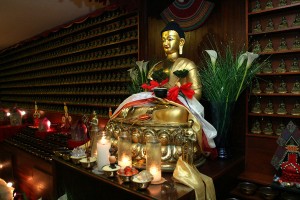
The Value of Human Existence: Treasury of Precious Qualities

WM-198-23 Shakyamuni altar-M

The following is respectfully quoted from “Treasury of Precious Qualities” a commentary by Longchen Yeshe Dorje, Kangyur Rinpoche:

SAMSARIC EXISTENCE

For ages we have lingered in samsara, unaware of its defects, believing that this is a wholesome, beneficial place. And yet it is a state in which suffering and its causes abound and where the qualities of liberation languish and wither. It is a desolate wilderness in which many times in the past our bodies and minds have burned in agony and have endured pains of mutilation and decapitation. Moreover, latent within us, there are still many karmic seeds that will provoke such sufferings in the future. Human beings generally do not see this and are thus not only without regret for their condition but actually crave the transient and futile pleasures of the higher realms. Totally unaware that they should engage in virtue and refrain from evil, they pass their lives sunk in negativity. Theirs is what is called a “mere human existence.” By their negative actions of thought and deed, they destroy themselves and render meaningless the freedoms and advantages of their human condition. From their lofty position in samsara they plunge again into evil circumstances. Thus they wander in the three lower realms, in heavens of insensate gods without perception, or in barbarous regions (where the Dharma is not heard); they are born physically or mentally handicapped, have wrong views, and take birth in places where no Buddha has appeared.

EIGHT CONDITIONS IN WHICH THERE IS NO FREEDOM TO PRACTICE DHARMA

On the ground of burning iron, without a single moment of relief, beings are slain again and again by the henchmen of the Lord of Death, who brandish frightful weapons, swords, and hammers and inflict terrible pain. Until their evil karma has been exhausted, these beings in hell are unable to die, and, due to karmic effects resembling the cause–in other words, their compulsive tendency to negativity–they are caught in a web of evil karma inspired by hatred, and their infernal life span is measureless.

Pretas generally are completely deprived of food and drink; they do not find even the slightest filthy fragment of pus, blood, or excrement to eat. No need to say, then, that they are tormented by hunger and thirst. The cooling effect of the moon in summer and the warming effect of of the sun in winter are all reversed; rain and hail are misperceived as lightening and thunderbolts; and the rivers are filled with pus and blood. For pretas that are afflicted outwardly, streams and orchards dry up as soon as they look at them. Those afflicted inwardly have heads that are not in proportion to their bodies: their mouths are as small as the eye of a needle, while their bellies are the size of an entire country. If they swallow a little food and drink, it scorches their intestines and they suffer intolerable pain. Their lifespan is uncertain, depending on the strength of obscurations due to former avarice. Generally speaking one of their days is equal to a month by human reckoning, and they live for five hundred of their own years.

In the depths of the great oceans, fish and sea monsters devour each other, the bigger ones gulping down the smaller. Animals scattered over the surface of the earth, wild and unclaimed, are the prey of hunters with their nets, traps, their poisoned arrows and their snare, and they die cruel deaths. Animals domesticated by man are slaves to their masters. They are tamed and subjugated with saddles, bridles, and nose-ropes. Their masters ride on them, tether them, and place burdens on their backs. They herd and castrate them, shear off their hair, and bleed them while still alive. And through such treatment, animals are reduced to every extremity of suffering. Being without intelligence, they cannot recite even a single mani. When beings are born in such a condition, they are helpless, and we are told the lifespan of animals ranges from the momentary existence of insects to that of nagas and such-like that can live for a kalpa.

Since the unwavering action that sustains their life-principle is extremely protracted, and their lives are therefore very long, lasting twenty intermediate kalpas, the gods of the formless realm have no occasion to cultivate a sense of disgust for samsara and a desire to leave it. Moreover, the consciousness of the insensate gods, who are without perception, does not operate throughout the duration of their existence. They are therefore deprived of any basis for hearing and reflecting on the Dharma. Their abode is far removed from that of the gods of the fourth samadhi, just as a solitary place is remote from a populous city. These divine beings have no notion of Dharma, and thus when their thoughts begin to stir at the end of their existence, they conceive the false view that there is no path to liberation, and as a consequence they fall to the lower realms. To be born in these states is to be deprived of the freedom to practice Dharma.

The inhabitants of so-called barbarous lands do indeed have a human aspect, walking upright on their two feet. But they live practically like animals are are utterly ignorant of the Doctrine. Virtue is foreign to their minds and they are given over to negativity. They live immersed in various kinds of evil activity such as wounding others with poisoned arrows, and even making it a tenet of their religion. They wander in the undergrowth of false views and, worse than animals, turn upside down the moral principles of what is to be adopted and what is to be rejected. The way of liberation is unknown to them.

Those whose faculties are impaired, who lack, for instance, the ability to speak, and especially those who are mentally handicapped, may encounter a spiritual guide who is on the supreme level of accomplishment, and they may even hear his or her teaching. But what is said is unintelligible to them, like the booming of an echo. The sense of the teaching is lost to them, and they fail to grasp the vital point of what actions are to be adopted and what should be forsaken. Thus their fortune is marred and they suffer greatly in this desolate and fearful wasteland of samsara.

To be born in samsara through the effect of karma and defilements is like being adrift upon a vast ocean, unfathomable and shoreless. To obtain a human form is like having a great boat with which to cross this ocean and reach the island of liberation. But though people may possess all their faculties, and though they may have intelligence, like a sail to propel them in the direction of freedom, this excellent support is wasted when the mind is clouded by false beliefs. As a result, such people fail to enter the Dharma and do not undertake the path to liberation so pleasing to the Buddha, who appeared in the world to set it forth. Denying the karmic principle of cause and effect, and claiming that there is no afterlife and so forth, they are beset by demons hindering them from the path of liberation. They fall under their power and lose their freedom.

To take human birth during a dark kalpa is once again of no avail, for these are periods when the light of Dharma does not shine, when no Buddhas appear in the world from the time of its formation until its destruction. To take such a birth is to be like a man who has fallen into a pitch-dark crevasse and has broken his legs. However much he tries to get out, he can neither see the way nor even move, for his legs are shattered. In just the same way, without the light of the path of freedom, people are unaware of the three trainings that could lead them to liberation. They constantly pursue false paths because of their ignorance and defilements. Not only have they fallen into a dreadful place from which they cannot escape, but by degrees they fall deeper and deeper, from the states of animals and pretas down to the infernal realms. The freedom to practice Dharma is totally absent.

In all such terrible circumstances, in which evil actions bring forth results in manifold suffering, whirling like the all-destroying hurricane at the end of time, the body is worn away with pain, and fear is the natural condition of the mind. Beings indulge in negative habits; they turn their backs on the sacred teaching. Thus we are advised to reflect again and again on how we might avoid being born in the eight conditions in where there is no freedom to practice the Dharma. Jigme Lingpa calls us to follow the path of liberation with diligence, so that by relying on the teacher and his profound instructions, we might make meaningful the opportunity we now possess.

FIVE INDIVIDUAL AND FIVE CIRCUMSTANTIAL ADVANTAGES

To have taken birth in a “central” land where the Dharma is proclaimed is like being a sapling planted in pure soil. To have fully functioning sense faculties and healthy limbs, and thus to have the basis for the reception, meditation, and practice of the teachings, is to be like a healthy tree in leaf and branch. To have confidence in the Doctrine of the Victorious One; to have the karma of one’s body, speech, and mind in perfect flower, undamaged by the hail of evil actions contrary to the Dharma (sins of immediate effect and false views concerning the Three Jewels); to have been born a human being able to uphold the Dharma and acquire the qualities of liberation: all this is like a miraculous, wish fulfilling tree. It is exceedingly rare and significant, and to put these five individual advantages to good effect is of the highest importance.

The fact that a Buddha has appeared in our world, an occurrence that is rare as the flowering of the udumbara; the fact that he proclaimed the Doctrine and that the three turnings of the Dharma wheel have blossomed into flower; the fact that through explanation and practice this Doctrine in both transmission and realization still exists in our day without decline; the fact that there are still teachers who have perfectly embraced the Dharma; and finally the fact that we have been welcomed into the “cool shade” of a virtuous friend, a perfect guide on the path to liberation: these five advantages are even rarer than the five individual ones.

THE RARITY OF A PRECIOUS HUMAN EXISTENCE

Why is it so necessary to treat the path with diligence and without delay? As we have said, the five individual advantages are as rare as the wish-fulfilling tree, while the five circumstantial advantages are like the udumbara flower, even rarer than the earlier five. These ten taken together form the special characteristics, and the eight freedoms form the basis, of what we call a precious human existence. If we do not take advantage of this now, an opportunity such as this will not be found again. The reason for saying this may be illustrated with examples. One could imagine, for instance, an ocean, vast as the three-thousandfold universe. In the depths of this ocean lives a blind turtle that rises to the surface only once every century. To attain a human birth is rarer than the chance occurrence of the turtle surfacing to find its head inside a yoke drifting at random on the water’s surface. Or again, one could suggest the difficulty of attaining a precious human existence by using numerical illustrations. Compared with the number of beings in the animal kingdom, humans are like stars seen during the day as compared with stars seen at night. And the same ratio may be applied between animals and pretas, and again between pretas and the denizens of the realms of hell.

This precious human existence is thus most rare and extremely meaningful. If those who journey on the pathways of the Dharma with liberation as their goal, who now have in their possession the great ship of freedom and advantage, and who have met with a holy teacher who is the guide and, as it were, the navigator of such a ship–if such people fail to cross the ocean of the boundless and unfathomable sufferings of samsara to the dry land of liberation, their opportunity will have been completely squandered. All this should be a subject of reflection and a spur to greater exertion.

WP2Social Auto Publish Powered By : XYZScripts.com