The Dakini

kw-752-0021-dorje-phagmo-ed-234x300

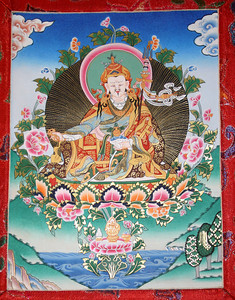
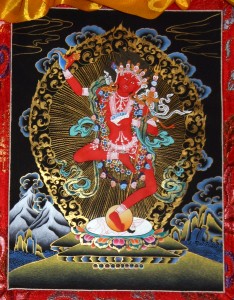
The female plays an important role in Tibetan Buddhism.In this video, Khenpo Tenzin Norgey teaches about the female manifestation of enlightenment – the Dakini or Khandro (Kha = Sky and Dro = Dro).“Khandro” is frequently translated as “Sky Dancer.”In an ultimate sense, “Space” or “sky” can be translated as emptiness, that which is beyond conditional phenomena.Empty but still dynamic.The Khandro is the root of enlightened activity.

The full length teaching is available at Palyul Productions

Relax

The following is an excerpt from a teaching by Jetsunma Ahkon Lhamo called “Entering the Path”

In a sense, the first thing the teacher does for you when you come to the path is to say, “Put on your crash helmet, study this obstacle course, fill up with gas, gun your motor, here we go. Put a spare in the trunk, carry a set of jumper cables, be fully equipped. Have a miniature, dehydrated tow truck in the back of your car. Just add water, and you’re set to go!” That’s the kind of instruction your teacher gives you. Your teacher very carefully lays out a program and says do the Seven-Line Prayer, do your Ngöndro. Do these things in order to accumulate merit because what happens is that should you use up a vast amount of merit when you first come to the path – and you will – you may experience obstacles. This doesn’t mean that you should not come to the path; this means that these obstacles are in your own mindstream. The causes for these obstacles have been in your mindstream since who knows, time out of mind maybe. They would have ripened eventually, they will ripen anyway, but if they ripen without the guidance of the teacher and without the tool of the path, they will ripen out of control. One never knows.

You know yourself that you’ve gone through life and things have wham! hit you just when it looked like things were going great and you had everything under control. Several times during the course of your life already you’ve looked in the mirror and said, “There is no such thing as control here in samsara! Things are really wacky!” But whatever obstacles arise when you first come to the path are yours. They’re not mine. I didn’t give them to you. I mean really, I didn’t do it. They’re not someone else’s. They didn’t do it.  And yet, as new practitioners we think, “What’s happening here? Everything’s wrong. Maybe I shouldn’t do this stuff.”

Actually the opposite is true. You should think like this. You should think, “Now my mind is being ripened. Due to my merit and virtue I am able to hook into the path. I have to stabilize that. I have to take responsibility.” Think like a big boy or a big girl for a change: “I have to take responsibility for this. I have to stabilize my mind and stabilize my practice.”

So how is that going to happen?

The thing that you need to do to flush out any obstacles that ripen on the path is to first of all stabilize your mind. Relax. Don’t be such a heavy breather. Chill, will you? Get mellow! So you relax. Just relax. Be confident on the path. Be confident that you are in a boat with no holes.

Yeah, it’s scary to cross the ocean of suffering, but friend, you’re going to do that anyway, either in a boat or not. So you’ve got a choice. You can get out and do the backstroke or cross the ocean of suffering in a boat with no holes. You’re in a boat with no holes. You’re fine.  You’re OK. Plus you have a good captain, a good captain who has themselves crossed the ocean of suffering before and brought others. So you should be confident in that. Relax. Try not to get yourself so worked up all the time. Just relax.

Remember, the more emotional you get, the more bent out of shape you get, it’s like you’re stirring up the water. Think of your mind as being like a bowl full of liquid soap, and if you start stirring it up like that with emotion, you know what you get? Bubbles and foam. Have you ever had that happen to your dishwasher or your washing machine where you get the bubbles and foam that come out all over the floor and then you’ve got to spend the rest of the day cleaning it up and the clothes are not clean, everything’s a mess? You have to think like that. Cheer up. Don’t get yourself all foamed up. Just relax. You’re on the path. You’re safe. Be cool.

Copyright © Jetsunma Ahkon Lhamo.  All rights reserved

The Way Out

An excerpt from a teaching by Jetsunma Ahkon Lhamo called Turning Adversity Into Felicity

When we practice Guru Yoga, we actually begin to develop the view that the lama is the source of liberation.  We begin to understand using traditional, prescribed images.  For instance, we are taught that we should think of samsara as being like a burning room. In samsara there is a great deal of suffering, and it’s actually just as probable that you will experience adversity as it is probable that you will experience felicity.  It is just as probable that you will experience suffering as it is that you will experience happiness and joy.  So we think of samsara as being untrustworthy, and we think—and this is true—that within samsara, because of our confusion and our lack of awareness about what our nature actually is,  we are constantly giving rise to the causes for more suffering.  This is constantly the case.  So we think of samsara as being like a burning room with no windows, that there is no escape except for this one door.  In our practice we think that the Lama is like that door.

The Lama is considered to be the door to liberation, the very means by which the blessing comes to us.  Without the Lama, we would not have been hooked onto the path.  Without the Lama, we would not receive the teaching.  Without the Lama, we would not understand the teaching.  Without the Lama, our minds would not be empowered and ripened and matured.  That is the responsibility of the relationship between the guru and disciple.  The mind must be matured in order to progress on the path.  So we rely on the Lama for all of these things without which we remain wandering in samsara experiencing birth/death/birth/death/birth/death with very little control.

Of course, when life is going well we think that this must not be true.  It looks like we have a lot of control in our life.  But if you think that, then you should read the newspaper more frequently, and you should talk to people who have been inflicted with incurable, diseases, who were afflicted completely out of the blue, not expecting that their lives would come to this.  You should talk to people who have suffered through circumstances that seemed to come from outside, misfortune, the loss of a job, the loss of loved ones.  These are terrible sufferings for us as human beings, and until we have experienced our fair share of them — and we will, eventually; old age, sickness and death, these things occur to all of us — we have the delusion of a certain kind of control in our life.  Ordinarily that kind of delusion comes with youth, and then later on, as we pass the age of supreme omniscience at about 30, we begin to discover that, in fact, we are not totally in control, that life seems to control us.

So we think of samsara as being this untrustworthy, inescapable difficulty, and we think of the lama as being the door to liberation.  We hold that kind of regard.  It isn’t that we worship a personality.  Of course, it’s not like that.  That would be very superficial and useless.  What good is a personality?  If we conceive of the Lama as a personality, what good would that do us?  We are a personality, and look where it’s gotten us!  That’s nothing to rely on.  So we rely on the Guru as the condensed essence of all the objects of refuge: all the Buddhas, all the Bodhisattvas, all the Lamas, all the meditational Deities, the Dakinis and the Dharma protectors all rolled into one, including all of the teachings.  These are the liberating truths of Dharma.  These are the objects of refuge.  So the Lama becomes the door through which we exit samsara.

© Jetsunma Ahkön Lhamo

The Four fold Prayer for Motherly Sentient Beings Equal to Space

The following prayer is from the Nam Cho Ngondro, The Great Perfection Buddha in the Palm of Hand

MA NAM KHA DANG NYAM PA’I SEM CHEN THAM CHED

I pray that all motherly sentient beings, countless as space,

LAMA SANGYE CHÖ KYI KU LA SÖL WA DEB SO

May realize the Guru’s Dharmakaya Buddha Body.

MA NAM KHA DANG NYAM PA’I SEM CHEN THAM CHED

I pray that all motherly sentient beings, countless as space,

LAMA DE CHEN LONG CHÖD DZOG PA’I KU LA SÖL

WA DEB SO

May realize the Guru’s Great Bliss Sambhogakaya Body.

MA NAM KHA DANG NYAM PA’I SEM CHEN THAM CHED

I pray that all motherly sentient beings, countless as space,

LAMA THUG JE TRUL PA’I KU LA SÖL WA DEB SO

May realize the Guru’s Great Bliss Nirmanakaya Body

MA NAM KHA DANG NYAM PA’I SEM CHEN THAM CHED

I pray that all motherly sentient beings, countless as space,

Increase Your Capacity to Love

An excerpt from a teaching called Dharma and the Western Mind by Jetsunma Ahkon Lhamo

Having taught Westerners I can see that the ones that last on this path, the ones that change and gentle and deepen in their practice are the ones that are motivated by this intensity of loving.  The ones that will do almost anything to end suffering, these are the ones that make it.  These are the ones that I have hopes for.

It is a Buddhist tradition that we should pray for the ones who have hopes of us because we have many karmic connections. Each one of us have karmic connections, it’s just like a giant web of connections, and some day each one of us will attain supreme enlightenment just as Lord Buddha did.  Surely we will, because our nature is the same as his.  We are the same and we will some day become awakened to that nature.  And on that day, those with whom we have connections, those who have hopes of us, will rejoice because at last they have a chance.  You should think right now there are those who are waiting for you, whose future it is, whose karma it is that when you achieve supreme realization they will depend on you as your disciples and you will be their teacher. You will be the one by which the door to liberation is opened for them.

Some day you will be reborn as a teacher that opens the door of Dharma, or makes the path available and you will be the cause of the end of their suffering.  You should think about them every day.  You should pray for those who have hopes of you.  It is a very important thing to think about and in teaching Westerners I find that they must remember this.

Even if all of the concepts associated with the Buddha Dharma are difficult, even if the idea of devotion is difficult, even if the idea of doing prostrations is difficult because we are unfamiliar with these things, we can do anything in order to benefit beings.  We can accustom ourselves to any idea in order to benefit beings.  Once your mind has been gentled and softened by that kind of loving you can begin to understand that the most important thing is to eliminate suffering.  You can understand also that the idea of doing what is unfamiliar to you – repetition of mantra, practice of different kinds, meditation of different kinds, sitting for a very long time, doing prostrations, developing a relationship with the guru, these things, that are not common in our Western society, become acceptable because we can see that they bear fruit and gentle our minds.  They increase our capacity for loving and they bring us closer to enlightenment.  Then we can do it.

©Jetsunma Ahkön Lhamo

Dakini’s Blessing

Mandarava-small

An excerpt from a teaching by Jetsunma Ahkon Lhamo from the Dakini Workshop

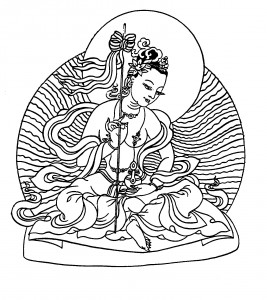
The Dakini is considered to be the enlightened or concerned activity of the Buddha nature. In order to understand the enlightened or concerned activity of the Buddha nature one should understand thoroughly the activity of samsara.  In order to do that, one should observe one’s own activity. The key word to describe one’s own activity is effortfulness.  Everything that we do requires effort.  There is nothing that we can simply do spontaneously without effort.  Everything requires effort; including starting with the effort it takes to get up in the morning and the effort that it takes to continue throughout the day.  Every single item on our agenda requires some effortfulness.

Of course, there are degrees of effortfulness and there are degrees of ease.  You can describe some things as being easy.  You can describe some things that you do as being very, very difficult but the key word, the mark of samsaric experience, samsaric movement, is that everything one does requires effortfulness.  That is the basis of it.  And of course, in order to understand that basis of effortfulness, one must understand the foundation or the basis of activity.  All activity experienced within samsaric existence is based on the idea of self-nature as being inherently real because the self is doing the activity.  It has to be based on that.  And in order for self to interact with the environment, self has to distinguish between self and other.  That distinction has to be made.  That is the activity that is going on in samsaric experience.


In order for that to happen, one must have attraction, repulsion or neutrality.  One must interact with, or continue to meet up against and reinforce duality in every sense.  Therefore, in samsaric experience concerning activity, there is always an inherent friction.  Nothing slides through.  There is no effortlessness.  There is always a friction.  There is always a bumping up against. That bumping up against has to do with the mind of duality and the distinction between subject and object.  There is no movement in samsara without that.  All movement occurs in that way.

Therefore, in order to understand the nature of the Dakini and enlightened activity or compassionate activity, one must understand the concept of effortlessness.  In order to understand the concept of effortlessness, one must understand the basis for the appearance of miraculous enlightened activity in the world, and that, which is consistent with the nature of the Dakini.  The basis for enlightened compassionate activity is that this activity is consistent with, inseparable from and indistinguishable from, enlightenment itself – Buddha nature.  That must be understood.

How is that distinct from ordinary activity? Ordinary activity has that friction and struggle associated with its basis. This basis is the fundamental idea of self-nature as being particularly solid.  Remember that in order to determine self-nature, one has to distinguish between self and others, so immediately there has to be division, there has to be distinction, there has to be cleavage – there has to be a breakage of some kind.  That movement is very hard. It is a movement very much involved in a solid process of continuing the continuum.  That is the basis for any activity or movement seen in samsara.  That is not the case pertaining to the nature of the Dakini, enlightened activity or compassionate activity.

If we can think of the nature of the Buddha we should think of the great sphere of truth, the undifferentiated expanse, the great sphere of emptiness.  We should think that there is no basis for the sphere of truth, there is no basis for emptiness, and there is no building block or cause and effect relationship because there is no distinction within the great expanse.   In order to understand the great expanse, the mind has to relax utterly.  There is no arising of the components of distinction.  There is no contrivance.  There is no ripple or friction or cleavage or distinction of any kind.  The great sphere of truth is simply suchness. The moment one tries to box up suchness or put it in a bottle or put in a certain shape or color it or distinguish it from suchness, it is no longer that.  So, the great sphere of truth is as it is – simply suchness.

Yet, all potency arises from the sphere of truth.  All that one sees, all richness, all diversity arises from the sphere of truth: that which we perceive as diversity arises from the sphere of truth.  How can that be so?  Either a thing is empty or it is not?  Well, the mistake, the delusion comes after the idea of self-nature as being inherently real. At that point, the mind operates in the posture of distinction. It operates in the posture of duality.  And everything that is perceived from that point is engaged in that process.  Yet, from the point of view of enlightenment, when one has awakened to that nature and the view is correct, when one no longer engages in the process of distinction, when the mind is restful, spacious and luminous in the natural state, the mind is not operating in distinction.  There is no distinction.  And so, all that arises from the sphere of truth arises spontaneously and effortlessly and is spontaneously completed and insubstantial, like a rainbow.

Copyright © Jetsunma Ahkon Lhamo.  All rights reserved
WP2Social Auto Publish Powered By : XYZScripts.com