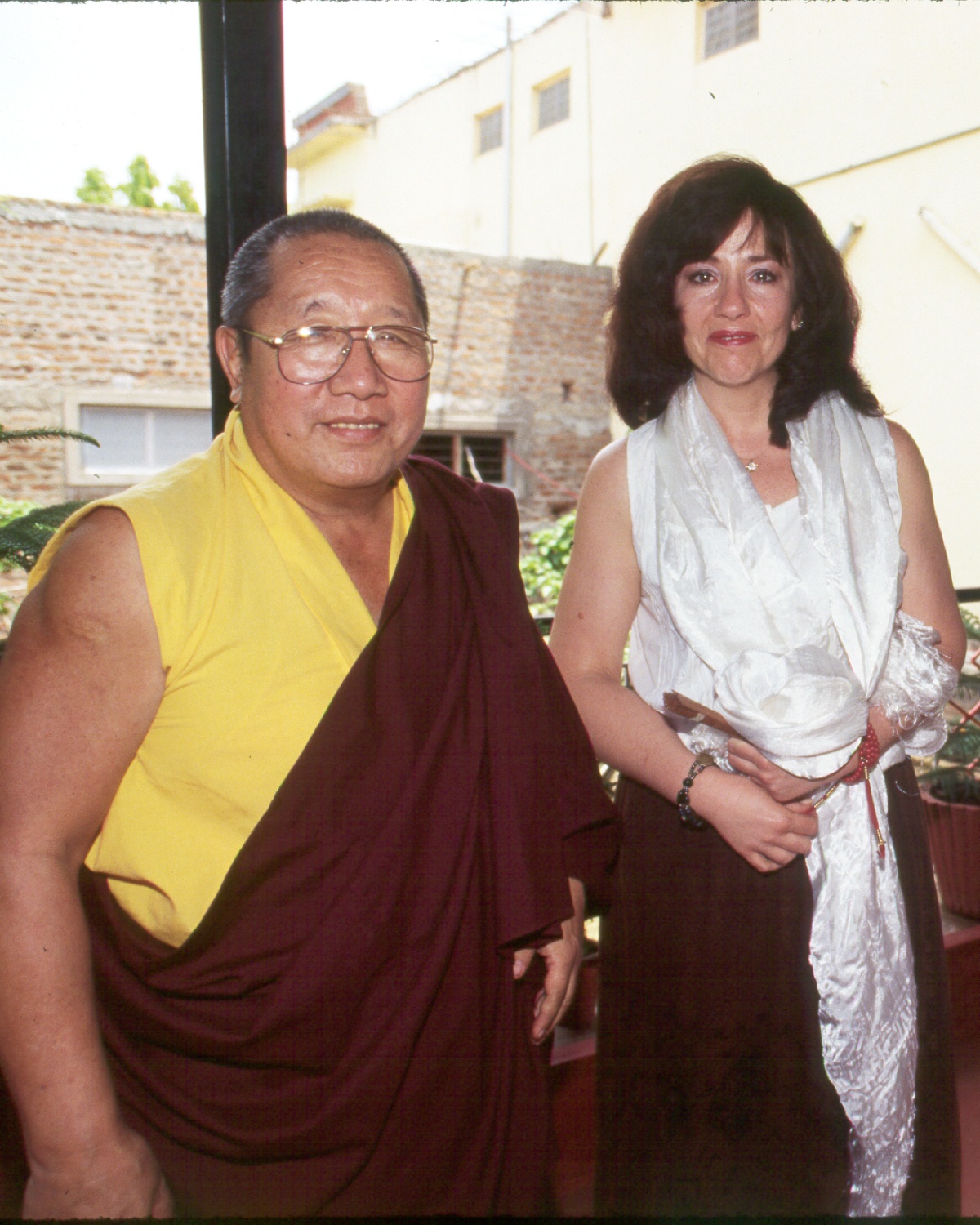
The Path: Are We There Yet?

An excerpt from a teaching called The Seed of Your Buddha Nature Within by Jetsunma Ahkon Lhamo

When one begins to understand some of the ideas that are presented in Dharma, one realizes that the goal that we are engaged in “moving toward,” if you’ll forgive that bad choice of words, is actually Buddha Nature itself. We tend to consider that the path is like a thing that goes from here to there, like a movement toward, and it’s very hard not to conceptualize it in that way. But, in fact, when one practices Dharma, the ability to practice Dharma is actually based on the understanding of the innate Nature. If we did not have within us right now the seed of Enlightenment, if we did not have within us the potential to actualize ourselves as the Buddha, there would be no point of practice. The very basis for practice is that understanding. This is what the Buddha himself taught – that all sentient beings have within them the seed of Buddha Nature, that that Nature is their true Nature, in fact. However, they have not awakened to that Nature and so, in order awaken to that Nature, one engages in the path.

The path should not be considered a ‘thing’, a straight line that connects from here to there. The path should be understood as a method that one uses in order to awaken to that Nature which is already our Nature; which is complete, unchanging, and will never get any bigger or any smaller. One should understand that Dharma is actually an activity that is meant to awaken that potential. But the ultimate goal that one wishes for when one engages in Dharma, is, of course, Enlightenment itself.

© Jetsunma Ahkon Lhamo

Changing Habits

An excerpt from a teaching called How Buddhism Differs from Other Religions by Jetsunma Ahkon Lhamo

Many people have gone to teachers and said, “What was I in my past life?   What kind of being am I?” thinking that they are different somehow and that this is important.  It’s really not the case.  We are all exactly the same.  But a lot of times the people will go to the teacher and ask questions like that.  Buddha Shakyamuni’s answer was, “If you want to know who you were in your past life, look in the mirror.”  Not necessarily at your physical appearance, and how your mascara is and that sort of thing.  Look at who you are.  Look at your life.   Look at what you’ve accomplished.  Not what you’re spinning in your head that you’re going to accomplish, but what you have accomplished.  Then you can begin a certain analysis.

Let’s say that you are chronically poor.  You tend to work wage jobs, and can’t get the big jobs, and just can’t make the money thing work.  It’s a chronic condition.    Most people think that the best thing to do is to go looking for the fabulous job or meet the fabulous man with the big money or something like that so you can get rich.  That kind of thinking will keep you in exactly the same position you’ve always been in, and it will never change.

If you find yourself in a state of chronic poverty, you must understand that cause and effect relationships are operating here.   You are now reaping the result of a cause that was created maybe early in this lifetime, more likely in another lifetime.  This is why it’s so hard, because you can’t see it.   We don’t know what happened in our last life or ten lifetimes ago.  We really don’t know what the cause is.

Again the Buddha says that this is where analysis is very useful.   So, we look and we say, “Well, I’ve always been poor.  It’s always been an issue.   So, what can I do to solve this problem?”  Is hoping for a rich person or a rich job to come along really the solution?  Actually, not.  What you should start doing if you are chronically poor, is to give all you can to the poor.  The shirt off your back if you have to.  Now, people will try that and they’ll come back to me and say it didn’t work.   How long did you try it?   It took you lifetimes to get this habitual.   You’ve got to work at it awhile.  You can’t expect to just be kind for a couple of weeks, and then boom!  We’re home and dry.   It’s not like that.  You have to actually take the grasping energy that you’re feeling, “I want the money.  I want the money.  I want the money.”  And turn it around into “I give what I can give.”  If it’s a quarter, if it’s twenty cents, if it’s a penny, if it’s a hug, if it’s some extra clothes to people who don’t have clothes, or a warm blanket in the wintertime.  Anything.  It doesn’t have to be big bucks, but you develop the habit of generosity to the degree that it outweighs that graspiness that says, “When am I gonna get rich?  When am I gonna get rich?  When am I gonna get rich?”  By the time you’ve changed that habit, things are changing in your life.  But until you change the habit, nothing will change.  It’s all about our habitual tendencies.  There is nobody that knows this better than a recovering alcoholic.

I think recovering alcoholics make the best students, because they understand what habitual tendency is all about.  And they understand what addiction is all about too, including the addiction to “gimme, gimme, gimme.  I want it.  I want it.  I want it.  More, more, more.”   That’s an addiction.

We begin to break our habitual tendencies and turn them around, and we change the addiction.  At that point, we begin giving.  When you start giving to others, generally, you give to people who have less than you.   And one of the first things it does is make you realize how much you actually have.   Because we don’t generally realize how much we actually have.  Impoverishment is in here.  So, when we begin to act kindly and generously towards others and give what little we have, the grasping hand turns around and becomes a giving hand.   The mind relaxes about the issue of having.  And that clears the way for the ripening of virtuous karma.  Virtuous karma will bring us happiness, joy, money, whatever it’s tuned into.  Whatever it is the result of.  But it’s the graspy neediness that keeps us from giving and makes us so unhappy.

© Jetsunma Ahkön Lhamo

The “Chicken Suit”

The following is an excerpt from a teaching by Jetsunma Ahkon Lhamo called “Neurotic Interaction to Guru Yoga”

It seems you have these strong habitual tendencies and project them onto an environment stimulated by just about anything. And when the stimulation looks like it’s even on the same continent as a predetermined habitual karmic scenario that you have been going through cyclically, you’ll do it again.  So many people do not have a good or honest or true relationship with their teacher because they are basically having a relationship with their own neuroses.  That’s the truth!  That’s the truth!  They’re having it with their own neuroses. But you see here again is a mystery, something beautiful that you really need to understand. I’m using a very western way of explaining this so that you will understand better.  That’s part of the gift of having a teacher.  It’s part of the gift, because the teacher will show you your own mind, will mirror something.  There’ll be that little bounce-back phenomena there so that when you have a meeting with the teacher, and something begins, you begin to feel like, “What’s happening here?  I’m beginning to feel a little itchy twitchy.  Now wait a minute, I’m seeing some authority figure stuff come out.” Or, “Oh God, that reminds me of my mother!!”

Or men are like, ALL women do that!!  I hate that!!  So that will start to happen, and when that starts to happen, what the student doesn’t realize is that is a perfect opportunity to look at your mind.  It’s a gift.  Of course, you can make this gift happen anywhere in your life and actually this is the best way to practice Guru Yoga.  There is a lot of poetry and a lot of very profound Dharma text written about seeing the Guru’s face everywhere—in every person, in every situation, in every hardship, in every joy, in everything that comes to you one way or the other—seeing the Guru’s face, and therefore turning adversity into felicity.  Using the practice of seeing that the teacher’s face, the Guru’s face  is everywhere.  Therefore I turn all adversity into felicity because I honor that blessing, you see.  So that would be a great way to practice.

But what happens instead is that we project our own neuroses onto the teacher.  Now as a teacher I’ll tell you that oftentimes what happens is that you have to hang back and just let the student do that thing they’re going to do.  Just let them spin around and do whatever it is they have to do.  Go on, knock yourself out. You kind of watch them go through their little freak out. They’re smooth. They kind of do their little neurotic thing, and they’ll freak in their response to this and their reaction to that and so forth.  After a while the student will kind of calm down.  What they’ll find is that it will come in their face so much that they’ll have to work some of it out.  And they’ll also notice that, pretty much, the teacher’s not playing.  You know, the teacher just doesn’t play the game with you.

Once in a while a student has been so locked in that confusion that (I’ve had to do this too) I’ve seen teachers kind of put on the chicken suit and go in there and dance with the student a little bit, because they need to make some kind of connection.  They feel kind of out in space somewhere and they need to make some kind of connection. So even if there aren’t honest and true, disciplined and pure student-teacher relationship responses happening, there is the introduction to that which is the student and teacher kind of dancing around a little bit. But you must understand the teacher is dancing with your neuroses.  That’s what’s happening.

In order to practice Guru Yoga well, here’s the trick: Most people think that Guru Yoga is about giving up your will.  Now you don’t have to think any more, you have a teacher.  Wonderful!  Mazel tov!  This is terrific! In fact, when you have a teacher, what that means is that you have to take responsibility.  It means more responsibility, not less.  The teacher is not here to blow your nose for you.  The teacher is not here to take responsibility for you.  If the teacher were here to take responsibility for you, the teacher could also have your enlightenment. And since that’s not what she wants because the teacher has already got their own situation handled hopefully, then you must understand that the responsibility is yours.

Copyright © Jetsunma Ahkon Norbu Lhamo.  All rights reserved

AA and Buddhism

hitting-rock-bottom-when-to-seek-treatment-200x300

The following is an excerpt from a teaching by Jetsunma Ahkon Lhamo called “AA and Buddhism”

In our teaching today, strangely enough, I’m going to talk about alcoholism and addiction; but I’m not going to talk about alcoholism and addiction in a way that specifically is meant to treat or help a person who is addicted to a substance. What I’d like to do is examine addiction, examine the idea of substance addiction or alcoholism and see how very much it actually is like the condition that we all find ourselves in in samsara. Although I myself have never been involved in the program, I know people who have and some of my best students actually have. I have been fascinated with the program that is used by Alcoholics Anonymous, the 12 Step Program, fascinated by it in that I can hardly believe the more I learn about it how completely compatible it is with the Buddha’s teaching, how completely compatible it is with Buddhist thought.

Now I can’t even say that about other religions. I myself saw His Holiness the Dalai Lama speak to the highest Episcopal bishops in the country, and heard these bishops say to His Holiness the Dalai Lama, ‘Well we’re all one religion anyway and we basically believe the same thing.’Now you must understand this is a man who is the head of a theistic religion talking to a man who is the head of a non-theistic philosophy. So, of course, His Holiness the Dalai Lama said, ‘While I appreciate that there are certain things that we hold in common, such as the wish to benefit sentient beings, the wish to act compassionately, and these are the important things that we have in common, still I must say your religion and my religion are not the same. And it betrays both of them to pretend that they are.’ Because, in fact, the heart of Buddhist philosophy is the awareness of the primordial empty state and that is not the heart of Christianity. The heart of Christianity is different than that and the way that it‘s practiced is different than that. The technology is different than that. So there are some common denominators. But I can say that far more than other religions, a program like Alcoholics Anonymous is very, very similar to Buddhism, and I find that fascinating. I’m really quite taken with that.

The reason why I want to bring this up at all is because of the way, personally, I view samsara, or the cycle of death and rebirth, and the way that I have been taught to view samsara by my teachers. Also, I’m bringing it up because of the similarity in a certain point or inner posture that one has to get to, that each one of us has to get to, in order to go further in either program. Whether it be Buddhism or Alcoholics Anonymous, there is a certain point that one has to get to. That point is the recognition of the condition. That point is the recognition of one’s state, the condition that one finds one’s self in. Now, again, I know very little about Alcoholics Anonymous, and any of you who wish to argue with me or contribute to what I’m saying are free to do so. But one thing I do understand is that generally it’s considered that an alcoholic is not help-able, is really beyond help, until they bottom out. That means they get to a point where they are just disgusted. They see that their life is really falling apart and there is literally nowhere to go other than forward or up. There is a bottom that’s reached. And many times during the history of an alcoholic, they’ll reach low points certainly, but they will not reach a point at which they bottom out. And it isn’t until they reach that point that they are help-able. They have to basically find themselves stripped down to a point where there is no other useful or beneficial or pleasant way to go. It’s just the bottom. How else can you describe the bottom? It is the bottom. And it is at that point that alcoholics are help-able, that they can begin to help themselves. Am I right, any of you guys who know about this? OK.

So from that point of view, when an alcoholic’s or an addict’s life becomes bottomed out like that, they are at the first good point they’ve been at for a long time. It may not feel like that to the alcoholic. To the alcoholic it is the most deluded and confusing time. It is the most helpless of times. It is the time in which they have almost no skills, no resources, and they are quite helpless. But it is the first time where any benefit can actually happen.

Copyright © Jetsunma Ahkon Norbu Lhamo All rights reserved


Experiencing Practice

galaxy

The following is an excerpt from a teaching by Jetsunma Ahkon Lhamo offered during a “Good Heart Retreat”

When I start to talk about all of this, it seems like I’m saying, “Okay, go do this, and go do that.” Please don’t hear it that way. I wish that there was some way you could not hear so much with your ears, so that they go in two different channels and you have all those voices in your head arguing with you. But instead hear it with your heart and really kind of vibes with the spirit of the message that I’m putting out here. Again I’m encouraging you not to keep your practice outside as this isolated separate little phenomena that you do in your prayer room. But remember I’m asking you to integrate your faith into your life. To make it real. If we are talking about impartiality, equanimity, and purifying the poisons, then we are talking about abolishing hatred, greed, ignorance, jealousy, and pridefulness. We are talking about making the world a better place—to see as the Buddha has taught us. Really see it. Really get it. In our nature, we are the same. This is what the Buddha has said. In our nature we are the same. To really get that. You can’t do that by simply running around doing all these things that I’m telling you to do. Make a foundation, collect some soup, you know, buy a couple of Christmas presents. That’s not how it’s going to happen.

I have another revolutionary idea. Supposing, once again, you were to really get into your path in such a way as to get into the mysticism of your path. Not simply by visualizing properly, not simply by memorizing the entire Celestial Palace Mandala, so that you have every little bit of it just right. I don’t mean that. If you can do that, it’s great. But in the meantime while you’re doing that, let’s also do something else. Let’s have a mystical experience, shall we? I mean how hard can it be? We’re Buddhists. We’re supposed to be mystical. So rather than talking about the end of ethnic prejudice, the end of hatred, the end of pride, the end of greediness, instead of talking about it, what if we really practiced it and felt it in our practice. Supposing we could kick off this grand idea of being a spiritual community in the world by actually feeling it, by actually doing it in our practice and in our prayers. Supposing we together as a Sangha were to gather periodically and do a meditation. Oh, wow! It’s not written down in the Buddhist books! That’s okay. It’s not a sin to do this. I mean, you know, it’s a funny thing. We have this idea that since we’ve become Buddhist and our prayers are written down in here, we don’t get to say any others. You only get to say those, in Tibetan. Like the Buddhas are up there and they don’t understand anything but Tibetan. If you talk to them, they aren’t really listening, they only talk to the Asians. That’s ridiculous, isn’t it? That’s impossible.

So supposing that we, as Buddhist practitioners had meditations. These are meditations that I like to do by myself. What if we did these as a group together? What if we sat in meditation, simply watching the breath as we do in Vipassana meditation or in shiney meditation, simply gentle meditation with no particular visualization. In our meditation we would relax the mind and abide naturally in the natural state, simply watching the breath as the Buddha has taught. But from that point, what if in this meditation, abiding gently in the nature, we were to expand our view to include first, everyone that we were praying with, to celebrate in meditation, in practice, and in truth, one nature, to meditate gently and abide naturally together. If it’s possible for one, it’s got to be possible for all of us. Supposing after that, we were to reach out, gently, and in that natural state, abiding spontaneously, embrace or include the community around us. Supposing we could recognize that in essence, our breath is the same. Literally, it is. That our breath is the same. Supposing we could understand that in our nature, there’s no place where I end and you begin. Supposing we could do away with those ideas of separation, and in our meditation, expand and embrace till we are meditating as one people. Supposing we could go a little further and meditate as one nation. And what if we could go a little further still and meditate as one world.

Supposing we got so good at this, that in our meditation, we would begin to awaken to the equality and the sameness of all that lives, just like the Buddha said. Supposing in our meditation, we could feel our oneness, our sameness with everybody in Africa, everybody in India, everybody in China, everybody in Europe, everybody everywhere. Supposing we went beyond that to include, as inseparable from that nature, beings who are other species, like the animal kingdom. Supposing we got so good at this that we knew that we were one and could begin to live it. How hard can it be? Nobody’s asking you to work out or anything. All you got to do is sit there and do that. How hard can it be?

And then supposing beyond that we could think about those great pictures they’re sending back from the Hubble telescope. Hmm? We could think about this galaxy and what it looks like. We could think about all the galaxies, those beautiful pictures of all those galaxies in deep space. Have you seen any of those? Oh, breath taking! What if all of that were inseparable from you? What if all of that were inside of you?

Copyright © Jetsunma Ahkon Norbu Lhamo All rights reserved

Cultivating a Good Heart

Eat At Joes

The following is an excerpt from a teaching by Jetsunma Ahkon Lhamo during a “Good Heart Retreat”

Seriously, I do feel that there’s something wrong with the way we’re practicing religion. I really do feel that it is the job of spiritual people, who have as a centerpiece in their religion the idea of compassion, to really move forward towards ending suffering. A great first step is a good, hot meal for someone who’s hungry; some nice warm clothes for someone that doesn’t have enough; to know for sure that there is no child in your community who doesn’t get a Christmas present, a good one, not just left over crap, a good one.

Last year I remember when I was doing a little Christmas shopping, I think it was at Borders Bookstore, that I had this great, terrific little plan. I like to buy my daughter a lot of books. She’s a big reader and they keep her really quiet, when she’s not listening to Alanis Morrisette. So anyway, I buy her a lot of books and she’s very much a lover of books. When I went in there to buy a stack of books for her Christmas present, there was this great idea. It was a Christmas tree, and the Christmas tree had kids’ names on it and what grade they were in, what sex they were. You could pick one of the ornaments with the kids’ names off of the tree and you could buy them a book right there. I bought about ten books that day. How much more trouble is it to make it 11 or 12? It was a great idea. It was just a great idea. If we really started to brainstorm and think like that, we would come up with similar ideas.

Most of the lack that we experience, most of the poverty that we profess to have is merely conceptual. You know, it kind of goes like this: You say, ‘Gee, you know, it’s Sunday night and I’d really like to go out to eat, but I already went out to eat on Friday night and my budget only let’s me go out to eat once a week. So I can’t go out to eat tonight, but I’d really like to. Well, maybe I’ll just kind of mosey on over to a very cheap place, and I’ll get a very cheap thing.’ So you go to “Eat at Joe’s” or something, and it may not be the best food in the whole world, but you’re getting to eat out tonight. That means no dishes, so this is great. So you sit down at this place and you think, ‘All right now, I’m sticking to my budget, so I’d better get a cheap thing.’ You look at the cheap things and you go, ‘Well, you know, for just $2 more I could have a nice thing. And for $1 more than that I could have a salad too.’ So pretty soon, you kind of warm up to the idea that $2 or $3 extra’s not so bad. You know? Well, that kind of thinking can be encouraged in other ways also, because that extra $2 or $3 or that thing that you did by going out to eat and treating yourself is not going to break the bank. You have a concept that it’s going to break the bank, but it’s not going to break the bank.

So what if we were able to think that way ourselves. Like for instance, what about when we go grocery shopping? Supposing when we go grocery shopping, we have to spend $150, some families $200. Hey it happens, right? When was the last time you walked out of the grocery store with less than $100 worth of food? So, let’s say we walk in there and we think to ourselves, ‘Well, I’m going in to buy $100 worth of food, $150 worth of food.’ Would it really kill us if it cost us an extra 10% this time? Maybe $15 worth of canned goods or some food that we could share with our community. How painful is that? How painful is that when we see ourselves going up and down the Keeblers little elves aisle thinking which one of these gizmos do I want, because I can have them all. Or we go by the deli and think, ‘What deli thing must I have today?’ You know, we are an affluent society and we do that. And that’s fine, that’s fine. But supposing while we’re doing that, we could also buy some food that we could share with the community.

It’s not so unimaginable. Okay, maybe you don’t have that extra 10%, or don’t think you do. Start with 5%; start with one can. Start by asking somebody else if they have a can to lend you. But start, anywhere. I mean this is something that’s just easy to do. No one in our community has to go hungry. Even if we’re living here in Montgomery County and there’s not so much hunger here. If we can’t find any here, cross the line folks. There’s plenty in D.C.. What’s wrong with that? How hard is it? It’s not hard at all. So maybe this week you get Bartlett pears rather than exotic pears, and with that extra money you can buy a can of soup for somebody. That’s okay. You’ll live.

What I’m asking you to do now is to begin to formulate how as a community we are going to move into the world. As I explained earlier in the retreat, we are to some degree following a monastic format that was presented to us in Tibet. We have our ordained community. We have our lay community. But it’s never going to fly in that format here. In Tibet, the monasteries were isolated and separate. They experienced a whole different world which did not interface with the community very much. That’s not going to work here. The majority of Buddhists are probably not going to be ordained. So Buddhists have to get involved with the lives of householders. That has to be part of the Buddhist community in as respected and as strong a way as the ordained Sangha. So it would seem to me that while we are searching for a way to express the Buddha’s teachings in our society without fear and hesitation, with compassion and equanimity, let’s also toy with the idea of, as a Sangha, as a spiritual family, as a community, being a visible presence in our world. There should be a place to go to, and someone you can count on, but mostly a good heart in our community.

Copyright © Jetsunma Ahkon Norbu Lhamo All rights reserved

Commitment: From “The Way of The Bodhisattva” by Shantideva

The following is respectfully quoted from “The Way of the Bodhisattva” by Shantideva as translated by the Padmakara Translation Group and published by Shambhala:

Commitment

1.
With joy I celebrate
The virtue that relieves all beings
From the sorrows of the states of loss,
And places those who languish in the realms of bliss.

2.
And I rejoice in virtue that creates the cause
Of gaining the enlightened state,
And celebrate the freedom won
By living beings from the round of pain.

3.
And in the buddhahood of the protectors I delight
And in the stages of the buddha’s offspring.

4.
The intention, ocean of great good,
That seeks to place all beings in the state of bliss,
And every action for the benefit of all:
Such is my delight and all my joy.

5.
And so I join my hands and pray
The buddhas who reside in every quarter:
Kindle now the Dharma’s light
For those who grope, bewildered in the dark of suffering!

6.
I join my hands, beseeching the enlightened ones
Who wish to pass beyond the bonds of sorrow:
Do not leave us in our ignorance;
Remain among us for unnumbered ages!

7.
And through these actions now performed,
By all the virtue I have just amassed,
May all the pain of every living being
Be wholly scattered and destroyed!

8.
For all those ailing in the world,
Until their every sickness has been healed,
May I myself become for them
The doctor, nurse, the medicine itself.

9.
Raining down a flood of food and drink,
May I dispel the ills of thirst and famine.
And in the ages marked by scarcity and want,
May I myself appear as drink and sustenance.

10.
For sentient beings, poor and destitute,
May I become a treasure ever plentiful,
And lie before them closely in their reach,
A varied source of all that they might need.

11.
My body, thus, and all my good besides,
And all my merits gained and to be gained,
I give them all away withholding nothing
To bring about the benefit of beings.

12.
Nirvāna is attained by giving all,
Nirvāna the objective of my striving.
Everything therefore must be abandoned,
And it is best to give it all to others.

13.
This body I have given up
To serve the pleasure of all living beings.
Let them kill and beat and slander it,
And do to it whatever they desire.

14.
And though they treat it like a toy,
Or make of it the butt of every mockery,
My body has been given up to them–
There’s no use, now, to make so much of it.

15.
And so let beings do to me
Whatever does not bring them injury.
Whenever they catch sight of me,
Let his not fail to bring them benefit.

16.
If those who see me entertain
A thought of anger or devotion,
May these states supply the cause
Whereby their good and wishes are fulfilled.

17.
All those who slight me to my face,
Or do me any other evil,
Even if they blame or slander me,
May they attain the fortune of enlightenment!

18.
May I be a guard for those who are protector less,
A guide for those who journey on the road.
For those who wish to go across water,
May I be a boat, a raft, a bridge.

19.
May I be an isle for those who yearn for landfall,
And a lamp for those who long for light;
For those who need a resting place, a bed;
For all who need a servant, may I be their slave.

20.
May I be the wishing jewel, the vase of plenty,
A word of power and the supreme healing;
May I be the tree of miracles,
And for every being the abundant cow.

21.
Like the earth and the pervading elements,
Enduring as the sky itself endures,
For boundless multitudes of living beings,
May I be their ground and sustenance.

22.
Thus for everything that lives,
As far as are the limits of the sky,
May I provide their livelihood and nourishment
Until they pass beyond the bonds of suffering.

23.
Just as all the buddhas of the past
Embraced the awakened attitude of mind,
And in the precepts of the bodhisattvas
Step by step abode and trained,

24.
Just so, and for the benefit of beings,
I will also have this attitude of mind,
And in those precepts, step by step,
I will abide and train myself.

25.
That this the most pure and spotless state of mind
Might be embraced and constantly increase,
The prudent who have cultivated it
Should praise it highly in such words as these:

26.
“Today my life has given fruit.
This human state has now been well assumed.
Today I take my birth in Buddha’s line,
And have become the buddhas’ child and heir.

27.
“In every way, then, I will undertake
Activities befitting such a rank.
And I will do no act to mar
Or compromise this high and faultless lineage.

28.
“For I am like a blind man who has found
A precious gem within a mound of filth.
Exactly so, as if by some strange chance,
The enlightened mind has come to birth in me.

29.
“This is the draft of immortality,
That slays the Lord of Death, the slaughterer of beings,
The rich unfailing treasure-mine
To heal the poverty of wanderers.

30.
“It is the sovereign remedy,
That perfectly allays all maladies.
It is the wishing tree bestowing rest
On those who wander wearily the pathways of existence.

31.
“It is the universal vehicle that saves
All wandering beings from the states of loss–
The rising moon of the enlightened mind
That soothes the sorrows born of the afflictions.

32.
“It is a mighty sun that utterly dispels
The gloom and ignorance of wandering beings,
The creamy butter, rich and full,
All churned from milk of holy Teaching.

33.
“Living beings! Wayfarers upon life’s paths,
Who wish to taste the riches of contentment,
Here before you is the supreme bliss–
Here, O ceaseless wanderers, is your fulfillment!

34.
“And so, within the sight of all protectors,
I summon every being, calling them to buddhahood–
And till that state is reached, to every earthly joy!
May gods and demigods, and all the rest, rejoice!”


The Way Out

Four_Noble_Truths

The following is an excerpt from a teaching by Jetsunma Ahkon Lhamo called “Faults of Cyclic Existence”

According to the Buddha’s teaching, the only end to the sufferings of cyclic existence in a permanent way is the cessation of cyclic existence. There is no intermediate or impermanent means that can accomplish the end of suffering that we experience in cyclic existence. Only the termination of the causes by which we are reborn in cyclic existence actually produces the end of suffering.

So the fault of cyclic existence is that there is suffering, and even happiness is impermanent; that it is unpredictable, and that its causes and effects are so interdependent that it is inescapable. The means by which one can escape cyclic existence is the miraculous intention of the enlightened mind, kind of penetrating into cyclic existence as a light being would penetrate into a tunnel and give us the means to go out of the tunnel. There is nothing about the tunnel, or the darkness in the tunnel that brings about the end of the tunnel. It is the light at the end of tunnel that brings about the end; and it is toward that light that we walk. In the same way, it is the practicing of a pure path, such as the Buddhadharma that brings about the cessation of the causes of being entrapped in cyclic existence. That is the cessation of desire, the cessation of the belief in self nature as being inherently real through meditation and practice. These things are actually the ones that bring about the end of the tunnel, or the end of cyclic existence and its sufferings.

It is necessary for us to examine the faults of cyclic existence. I believe that. Even if our intention is so kind, even if we have extreme kindness, even if we are so completely tuned into the suffering of the world that we are willing, at least initially, to practice til the end of our lives until we accomplish Dharma for the sake of sentient beings. And we should hold to that practice. I have taught again and again and again that our hearts need to be on fire with that love. I have tried to describe that fire as being the only allowable passion, the one that should warm you and should sustain you in every way. Still we must also discipline ourselves, really, or cause ourselves, or allow ourselves to experience what the faults of cyclic existence truly are. We must have an understanding of that in order to gain a firm foundation in our practice.

If we do not understand that all the joys of cyclic existence are impermanent, as well as the sufferings, that all of the circumstances are constantly changing and unpredictable, and if we do not understand that cause and effect are never ending and inescapable, we may not understand that nothing that we do in an intermediate way will really help the situation. And we will continue to do what we are doing now which is to try to solve our problems by moving things around a lot.

You know how we manipulate the circumstances of our lives. We will change our job, or we will find a new loved one or find a new boyfriend or girlfriend, and have another baby, or take ourselves out or go on vacation. These things are great. You should do them all. I don’t care. Have ten million babies. Have a hundred thousand lovers. Do whatever you want to. I don’t mean any of that. You will find out that ultimately all of these are very impermanent; and at that point we have to understand that it doesn’t matter how we manipulate the circumstances of our lives. Ultimately we have to understand that cause and effect relationships continue to cause cause and effect that continues and perpetuates cyclic existence. That’s it. The only way to really end suffering, to really bring about the cessation of suffering, is through accomplishing enlightenment. Nothing intermediate can work. In fact it tends to bring about more disappointment.

Haven’t you ever understood or seen yourself when you experience great happiness? Say you do have the boyfriend or girlfriend, and say you do have that new baby, and you do find yourself on vacation, almost afraid to experience how happy you are at that moment because you know that pretty soon that happiness will be terminated. There is almost a superstition that we have that if we are too happy right now that pretty soon that happiness will wear off real quick. And you know there is something to that in that if we think of that happiness as the end of suffering, we will be disappointed. You should allow yourself to be happy. Every moment that you can have a moment of happiness, by golly, be happy. Don’t worry, be happy just like the song says. One of my favorite songs. However, while you are not worrying and while you are being happy, please understand the faults of cyclic existence. Please understand that in order to accomplish the end of suffering truly and completely and permanently, and in order to be in a place and to be at a level of wisdom and understanding that you yourself can actually bring about the end of suffering for all sentient beings, that you yourself can experience the competency and the qualities necessary to bring about the end of suffering for all sentient beings, in order for that to occur, you must understand the faults of cyclic existence.

There is nothing in cyclic existence that brings about the end of suffering. It is the cessation of desire and of all causes that trap us in cyclic existence. These things brought to an end will bring about the end of suffering. And the name of the end of suffering is enlightenment. It is the only name of the end of suffering. There is no other way to look at it. Anything else is impermanent. It is okay, but it is merely phenomena. The end of suffering is enlightenment.

Please hold that in your mind as you catch yourself manipulating your life. Use that manipulation as you catch yourself trying to make yourself happy through intermediate ways or through holding on to instant gratification or doing all the things that we do so habitually. I don’t expect that we will change overnight, but use those situations as a catalyst to motivate yourself, to really hold on to and accomplish a true path. Use these things as a means to make your understanding move in the direction of a true path so that you can begin to establish a firm foundation or motivation in order to accomplish enlightenment. This is really the end of suffering, and in fact the only one.

So I hope that you will take these things to heart and use them. They are no good if you don’t use them. It doesn’t do you a bit of good if you just come here to listen. You really have to use these insights and try to develop for yourself a way to bring about your own enlightenment.

Copyright © Jetsunma Ahkon Norbu Lhamo All rights reserved


Meditation Instruction: Tonglen

HHPR and JAL

The following is an excerpt from a teaching by Jetsunma Ahkon Lhamo:

I would like to show you one more technique that you can use. This is a very common technique. It’s a sending and receiving, but with a slight variation.

The first time that I met His Holiness Penor Rinpoche,  this was the first thing he told me to do. His Holiness asked me, “Do you wish there to be no more suffering?”

“Of course! Of course, this is my only wish.”

Then he said, “As a Bodhisattva, will you take on the suffering of others, if you have the opportunity?”

I said, “Of course!”

And then he said, “Do you think if you do, that it will harm you?”

I said, “No, of course not. How can love harm somebody? That’s ridiculous!”

And he said, “Well, I’ll tell you, when you have faith in the Three Precious Jewels, the Buddha, the Dharma and the Sangha, and you align yourself with the great purpose of the Bodhisattvas, then you have nothing to fear.” And he said, “In that case, let me teach you how to practice.” He said, “Every breath that you take, every moment that you walk around, your breath is a cycle of OM, AH, HUNG.”

OM. We take in the suffering, no matter what it is, of all sentient beings, no matter who they are. We breathe it in. OM.

AH —is the space between the inhale and the exhale. AH is an immediate meditation on non-duality with the Three Precious Jewels, an immediate meditation on the nature as it is—inseparable, indivisible, free of concept. So there’s that meditation. AH.

And then, HUNG. Breathe out all of the virtue and merit that you and all practitioners have accomplished in the past, in the present and in the future. (This is like a spiritual credit card deal. You get to borrow on what you hope you’re going to do later).

So it’s OM, I take in the suffering of all sentient beings. I’m not separate. AH, I rely on the Three Precious Jewels. I am inseparable from the Three Precious Jewels. I rely on the strength of the Three Precious Jewels. And I am that. HUNG, I offer all of my virtue and merit, all the good I have ever accomplished in the past, present, and future, for the liberation and salvation of all sentient beings, every breath.

To walk past poor people, different colored people, people of different religions, and breathe in their suffering, breathe it in, really breathe it in. Hold your place, hold the line. Hold your place as a representative of the Buddhas and Bodhisattvas on this earth with confidence, vajra courage. Then breathe out to them all of the virtue and merit that you have accomplished in the three times. Every breath of your life. It’s very, very hard to do at first because you get a little obsessive. OM-AH-HUNG, OM-AH-HUNG. People that have practiced watching the breath realize that once you start watching the breath, the breath starts acting weird. But little by little, you practice and you get through that. It becomes a very natural, sincere and very deep intention. Freely, I take on. Spontaneously, I abide naturally. Freely, I offer what I have. In a way, you become like a circle, inseparable from all that is, inseparable from others. You have the sense, eventually, of breathing for them, of inhaling and exhaling for them, of carrying them, of being completely inseparable from them. In that meditation, you find yourself just singing, ‘I love you.’. Is it okay for a Buddhist to say something, oh I don’t know, gushy? Yes it is. Because although the Buddha used different words, like compassion, in the west we are more familiar with the word ‘love.’ And so, to hold ‘all that is’ within you and from that place of mystical awareness, instead of painting a picture, ‘I love you,’or an affirmation, ‘I love you,’ to know from the depth of your being, ’I love you,’ it will change your life. And it will change our community if we begin to practice in that way.

Here we are asking for recognition. Not just saying the words. Not just doing the practice. But recognition. This is a different step. If we are going to be potent in our spiritual lives, and if Buddhism is going to be a potent force in this world, that’s where it has to start. And the great thing about spiritual practice is that there is no time better to start it than right this minute. I’d like to invite you to participate in that.

Now you know my everlasting practice. This is what I do all the time, because my teacher told me to, and I wish to repay his kindness. So I’m doing that all the time. I also find that when I meditate in a mystical way, and experience, accept and awaken to the inseparability and non-duality of all that lives—the sameness, the equality of all that lives—I’m always inspired, because there’s nothing else but to offer all that I have—my feet, my legs, my torso, my arms, my neck, my head, everything—for the liberation and salvation of all sentient beings. This is how to be moved by your practice, to be deep in your practice. This is why you’re wearing the robes, because you are ministers. It’s hard for us to understand because of the cultural change, but you are ministers. Make circumambulation around the Stupa. Pray to Guru Rinpoche as sincerely as you can that this pact that you have made is sealed. Pray that you will accomplish this. Pray that you will be a spiritual voice in a world that is longing to hear such a voice.

Copyright © Jetsunma Ahkon Norbu Lhamo All rights reserved


Inescapable Cause and Effect: The Importance of Buddhist Teaching

A1wheelrealm

The following is an excerpt from a teaching by Jetsunma Ahkon Lhamo called “Inescapable Cause and Effect”

Each of us has really difficult karma, tremendous obstacles, and each of us also has the karma for tremendous bliss. We cannot ripen them all in one lifetime. However, when one leaves this lifetime it is up for grabs what ripens in the next incarnation; and there are many factors that are a catalyst for the ripening in the next incarnation. Some of them are the condition under which you die;  the thoughts that are in your mind as you die; the mind state that you have as you die; the ability to be able to negotiate the consciousness after the death state; the ability to remain aware, to not faint, to remain aware and with it during the after-death state, which almost no one has. The desire that you have experienced in this lifetime will act as a catalyst to ripen the events for the next lifetime. Everything that you have done in this lifetime will act as a catalyst to ripen the events for the next lifetime and in all future lifetimes. So according to the Buddha’s teachings, it is not necessarily a linear progression in that it is not possible to account for all the ripening karma in the course of one lifetime, and even in the course of the next lifetime and the next lifetime.

So you can actually be reborn under any circumstances. This is one of the main faults of cyclic existence. Even though we have a circumstance here that seems relatively bearable in that we are not very hungry, we are not very ugly, we are not very sick, and we are okay, still we will experience death in order to take rebirth at another time. Not knowing what the conditions of that rebirth will be can be considered an unbearable circumstance. I want to know where I am going. I find it unbearable to think that I wouldn’t know where my next incarnation would be: To not have the option to prepare for the next incarnation; to not be able to know that I would not be reborn in some other life form that is offensive to me or that is ugly to me or is not at all pleasing to me; or to be reborn as a human being where I would experience intense suffering. These things I find not bearable. So if we understand that cyclic existence is structured in that way, or seems to occur in that way, we might find that even the idea that we might take rebirth becomes something that we can use as a motivation to practice.

The thing about cyclic existence is that it is unpredictable. You must know this by now; and this should give you a clue as to how we hide these things from ourselves. But I know that you know this by now because all of you have had experiences, I have certainly, where, , things will be going along just fine in a way that looks like everything is under control and it looks as though you have what you need. You have the relationships that you need, the money that you need; you are doing okay. It looks like things are progressing nicely. And then suddenly something will hit you right out of the blue, whether it is a terrible mood or whether it is a circumstance or whether it is a death, somebody that you know, or a loss of some kind, some experience that will seem as though it came from nowhere. And if only this hadn’t happened everything would be just fine. We have at least a million of, ‘Oh, if this only hadn’t happened,’ in our lives and we don’t see where they come from. And so cyclic existence is extremely unpredictable and there are always things that can ripen in an instant way and bring about change that is unbearable to us.

Another fault of cyclic existence is that there is nothing in cyclic existence that brings about the end of cyclic existence. That is hard to understand. And if you examine it yourself, you will find that you think that if you just keep playing along with it eventually it will work itself out. We think that if we just kind of live through our lives it will just sort of guide its way through or naturally flow in such a way that we will reach a threshold of wisdom, and suddenly all of our problems will be solved. This is Western thought. This is what we are brought up to believe. We are taught, however, by the Buddha, who has experienced both cyclic existence and also the awakening called supreme enlightenment, that this is not true. There is nothing inherent in cyclic existence that will bring about its end. Cyclic existence is simply that, cyclic.

In cyclic existence there are the root causes such as the belief in self nature as being inherently real and the clinging to ego that bring the perception of self and other and the constant compulsion to reinforce the perception of self and other, that bring about desire. And desire is the root cause of all suffering. But from those root causes are begun the next level of root causes which are hatred, greed and ignorance. And hatred, greed and ignorance, we constantly experience to some degree or another. We constantly need to reinforce ourselves by putting down someone else or experiencing a negative feeling toward someone else. We need to judge something in some way in order to understand our own nature. We constantly have the experience of not realizing the profound nature of enlightenment or the nature of primordial wisdom, and that we call ignorance. We constantly experience greed and we constantly need to define ourselves by what we have. We constantly need that and from these points come the other forms that continue cause and effect relationships, continually experiencing one cause begetting an effect, begetting another cause and begetting an effect. We experience that constantly and consistently. According to the Buddha’s teaching, whenever we experience a moment of hatred or whenever we experience a moment of anger…. Anger. Who among you has not experienced anger? How many times a day?  According to the Buddha’s teaching, even when we experience even a moment of anger it has within it the potential for worlds of karmic interaction.

One cause continually creates, always and always. There is never any exception. Cause will create effect. There is no cause that does not create effect; and effect will actually act as another cause. If someone, for instance, strikes you, that must have a cause. You may not know what the cause for that is, but it didn’t just happen. It has a cause. And if you get angry when that person strikes you, then that continues and that is an effect from the striking, but it is also another cause and it will begin new circumstances. This relationship of cause and effect constantly perpetuating itself is called interdependent origination. It is such an interdependence it is almost like the weaving of a fabric; and cyclic existence is actually made of this fabric that is woven together, a constant cause and effect. There is no circumstance within cyclic existence that brings about the end of cyclic existence.

The exception to that—it isn’t really an exception—is that within cyclic existence one can begin to strive to purify the mind. One can begin to strive to practice in such a way that one’s own pure nature is realized. One can begin, very importantly, to accomplish compassionate activity to purify the mind through kindness, to begin to experience loving kindness and compassion. And through that, cause and effect will happen so that one can meet a pure path; and a pure path is the means by which one can exit cyclic existence. There is nothing within cyclic existence itself that will naturally begin the end of cyclic existence, that will actually bring about the end of cyclic existence. But in fact one can actually begin to purify the mind in such a way that you can meet with a pure path. And the pure path is actually considered an emanation, the miraculous intention of the Buddha, or the mind of enlightenment. It intersects with cyclic existence in such a way that one can practice this pure path, and having practiced this pure path can thereby exit cyclic existence and accomplish enlightenment.

Copyright © Jetsunma Ahkon Norbu Lhamo All rights reserved


WP2Social Auto Publish Powered By : XYZScripts.com