The Animal Realm

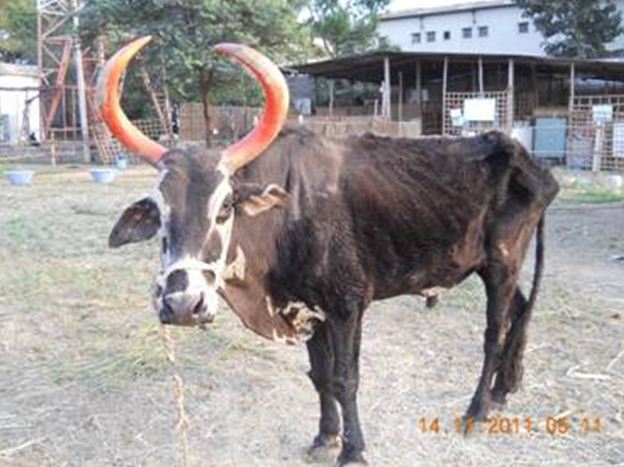
2011-11-Abdul-new-retired-bullock-at-RBH1

The following is an excerpt from a series of teachings offered by Jetsunma Ahkon Lhamo on Phowa:

After the hell realms and the hungry ghost realms, then the next of the lower realms is the animal realm. Included within the animal realms are all the different kinds of animals, not just the cute little puppy dogs and the cute little kitties, and all the cute little guys that we love when they are tiny little babies. I have had students say to me, “Well, you talk about the animal realms being one of the lowest realms, but I wouldn’t mind being a cute little animal.” I’ve had people say that to me. And they’ll say, “Well, to be a cute little puppy dog would be great, because then people will pet you, and love you and feed you and call you their very own.” You have to examine what is the habit of your mind if you’re thinking like that! ‘I desperately want someone to feed me, pet me, and call me their very own.’ But I have, in truth, had people say to me that this is what they’d like. They’d like to be an animal. Let us think this through. Let’s examine the realm of the animal, if we may.

In the animal realm, there are all different kinds of animals, and the ones we are most familiar with in  America, of course, are the ones that are probably the most pleasant to look at, relatively speaking. We do have places that pick up the old and mangy and suffering animals, and so we don’t see them too much. They pick them up and carry them off to places where we don’t see, and they do things to them that we don’t know about—or at least we don’t want to. And so we wonder to ourselves, “Is it really nice to be an animal?” Because most of them do look fluffy and happy, and most of them are fed, and most of them are petted and loved.

In fact, in America, we have this distinct disadvantage on all accounts, and that is that we don’t get to see enough suffering. Suffering is removed from us, particularly suffering associated with death. On a human level, there is a taboo against being with our loved ones, touching them, loving them, at the time of death. What will generally happen is that even the people closest to you will be taken away before you actually get to see what death is like. And even during the time of your own death, unless you are particularly lucky, you and the people next to you will not get to experience death in any kind of natural way. You will only experience death with terrible, invasive practices. Terrible if they don’t work, because if they don’t work they have spoiled your death transition and they have still been ineffective in prolonging your life. There are always, of course, the cases in which—and we’ll talk about this later—life can be continued through invasive measures. So one has to think about these things.  We’ll give some guidelines for thinking about these things later on.

Where it concerns animals and other life forms, we just don’t get the depth of suffering in cyclic existence. So let’s think about animals different from and other than the ones that we generally see. Then we’ll talk about the ones that we generally see. A good example of that is something that I experienced when I went to India and Nepal. I spent some time there receiving teachings.  It was quite a remarkable situation, because I had never seen animals in the way that I saw animals when I went to India and Nepal. I had never seen this. I remember one of the first things that I saw after I recovered, or tried to, from the suffering I saw human beings in, was to see the suffering of animals. In an Indian society, and also in a Nepali society, any less advanced society, there’s a much stronger relationship between humans and animals. In fact, animals are depended on for their strength, for their meat, for their hide, for their flesh. And particularly, they are depended on, not only in their death, , but during the course of their lives to help human beings.

There are many animals that have no choice but to sacrifice their entire lives in order to help others. They are literally beasts of burden. For the first time in India, I saw a bullock pulling a cart, and I saw that the bullock customarily is painted. The Indian people are very childlike in certain ways, and they like to decorate. They like to paint things up They like to make things more fun and to make their existence less poverty-oriented and less bleak, and so they decorate their animals. I saw that the horns were painted; and on the horns were these little tassels, and every time the animal would shake their head the tassels would spin around. And they had interesting things draped on them, and their hides were fashioned with bells and had lots of heavy things on them in order to make noise and adorn the animals.  The only purpose of it was adornment. . The animals themselves were not only painted and adorned in this unnatural way—that I’m sure if they could speak they would not be thrilled about—but also they were encased with a great harness that fit onto them and in some cases would fit into their mouths and actually pull their flesh back to where you could see pus and fluid and blood coming out from the sides of their mouths.

Oftentimes you would see one bullock, or perhaps two, pulling a cart, that, for one thing, was so old and broken down that you could see that there was no ease in pulling it. Even if the cart were empty it would be very difficult to pull, because it was an old broken down thing, and the wheels didn’t  work very well—that sort of thing.

Even more than that, you could see that the carts, the things that they were pulling, had to have weighed more than the animals. Had to have been a heavier burden than the animals could easily carry. You could see the sweat on the animals, and the foam of their sweat, and the pulling and the straining; and the owners behind them whipping them, constantly whipping them to pull more, pull more. They’re not pulling down superhighways either; they’re pulling up hills and through marshes. This is the life of these kinds of animals. Do you think that there are only one or two bullocks in the world that help people to get through their lives? There are uncountable animals that get us through our lives at the cost of their happiness, safety, and freedom. And this is the lot of the animal kingdom.

Furthermore, we think about oysters. Oysters are farmed and grown for their flesh. Obviously they have the instinct to protect themselves, so we must logically assume that they have the fear of being unprotected in some form or another. These oysters have developed around themselves a very hard shell with which to protect their tender hearts, their tender middles. And yet human beings, without qualm, pull them out of the water which is their natural element, cut and rip open their safe shells, pull their soft flesh out and eat it while it is just newly dead. These animals, even if they could practice Phowa, would never have that choice. They would never have that chance; there would be no time. That is characteristic of the lower realms. There’s no space, no time, no opportunity to practice, due to the condition of the mind. Furthermore, these little oysters are sometimes farmed only for their pearls. Their bodies are opened, and grains of sand are shot into them. It makes them so uncomfortable that they have to form a pearly covering around the sand in order to make it bearable. And this is the lot of the animal kingdom. So you can see that you do not, in fact, wish to be reborn an animal. Do you?

Further, we think about frogs. We think about frogs and their delicious legs. How wonderful! The old frog on the lily pad, hanging out; ribbit, ribbit. And then you think about what happens to frogs. They are taken, live, often speared live, and whether they are living or not, they are thrown into a container. They are picked up, put on a deck, live or not. Bam, bam, the legs are cut off. This is the condition of the animal kingdom. And it is like that with all of the different kinds of animals—even the cute little puppy dogs and the cute little kitty cats, and the wonderful little songbirds and parakeets, and all of the little critters that we keep with pretty collars around their necks and pretty little beds and pretty little clean cat boxes. We pride ourselves on taking care of them in pretty little cages, and we buy them pretty little toys, and we think, “How wonderful for them, that they’re going to live the life of ease and comfort here in the world.” But, in fact, even if somehow we could manage to make them happy from the very time of their birth to the very time of their death, could we give them freedom from fear? That is the main suffering of the animal kingdom—the fear of being taken over by those beings who are superior in the way that they are able to take over the lives of these lesser beings. Lesser in the sense of their competency and intelligence at this point, not lesser in the sense of their nature. So these beings live in fear.

Let’s say we can protect them from their fear. We can keep them fed; they can stay warm, they can come in and out as they please. We can make sure nothing ever happens to them. We give them plenty of love; they are our friends. We take them to the veterinarian, make sure they have all of their problems taken care of, blah, blah, blah, blah, blah. But. you cannot prevent that they will get sick, because all sentient beings experience sickness at some point. You cannot prevent, unless they die young, which is another kind of suffering, you cannot prevent that they will experience old age, because all sentient beings grow toward oldness. It is characteristic of our delusion— the delusion that we experience ourselves  as individual realities going through a continuum that we’ve labeled ‘time’.

We will experience old age. It is the nature of samsara. And these little creatures will also. Have you seen that you’ve tried to make them happy and keep them comfortable, and have watched them grow old, decrepit, and sick anyway? And the poor things can’t even tell you what hurts. You can only deduce by the way they’re acting what hurts. They don’t know how to tell you; they don’t know how to act in a way to help you perceive.  All we have is a shot in the dark of making them happy for a period of time. And then those little animals will eventually die. Now here’s the rub: Even if you were able to keep them happy from the time of their birth to the time of their death, you cannot follow them into the after-death state. You cannot experience with them their particular passing into death, their bardo, their movement into a new life. And so, even if they were temporarily happy for a short period of time—and that’s true of human beings as well—they still will experience all of the sufferings that samsaric beings suffer. And so, they too must be prepared for the bardo, or death, experience.

The problem with animals is that they are so instinctual. They are so tightly wrapped in what is a kind of a reactive mode. You would have to say a ‘knee jerk reactive mode.’ Their experience is not the kind of mental deliberation or consideration or even logic that we have, where we can see phenomena, and even with our deluded minds, can sometimes step back from that and say, “Okay, let’s think about what this means.” You see, an animal can’t do that. An animal is going to be deeply and profoundly reactive every time, and they will react only instinctively. So the animal has literally no space in their minds. Everything they feel they react to unthinkingly.  That’s why we say animals are dumb. It isn’t because they’re less than us; it is because they’re unthinking. They react only instinctively, which is a kind of core, gross, inconceivably heavy form of emotion, in that emotion comes from instinctual reaction, and is the outgrowth of that. So instinctive reaction is even heavier, even more demanding. You know how you can’t help reacting emotionally. Instinctive reaction is much heavier than that. You can’t even think about hoping to react any other way. It is an automatic and profound knee jerk reaction. So the animals literally cannot practice Dharma.

Now we spoke about the bug crawling on the arm of the Buddha earlier, and what that actually means. You would think, “Ah, I’d give anything to be that bug, love to be that bug crawling on the arm of the Buddha, because then salvation is right there.” And I have to say to you, “Yeah, right there. Right there. Not within, where it has to be.” Because that is where it has to be. One must recognize one’s own Buddha nature. To be crawling on the arm of the Buddha is useless. That bug will still age, that bug will still die. That bug has no room or fortune or leisure of mind or spaciousness within the mind, or capacity to practice Dharma, to learn Dharma, to accomplish Dharma, even if they are within the very mouth of the Buddha, because realization is accomplished by awakening to one’s own primordial wisdom nature. The apparent reality of a bug, wherever they are, is the apparent reality of a bug.

Likewise, even our own animals, our own pets. They are happy; and many of us have taken them around the stupa so they can receive the blessing of having gone around the stupa, and that is some help. I thank you for that. Many of you have said Om Mani Padme Hung to the animals, knowing that once any sentient being has heard Om Mani Padme Hung it is absolutely only a matter of time before they enter onto the Path and begin to practice Dharma. So many of you have given your animals that great blessing. But still, even though you have done that, we still are not able to liberate these animals, because these animals cannot liberate themselves. They cannot practice Dharma.

Now, the only exception to that rule, of course, is in the case of a lama—that is, not an ordinary practitioner, but a lama—who has themselves not only practiced Phowa and received the signs, but also crossed the ocean of suffering and returned for the sake of sentient beings. That is to say they have accomplished liberation. In some cases a lama, through the force of their own meditation, can take part in the liberation of an animal, even though the animal itself cannot practice. However, you must understand, the only way that would be possible is if, even though that animal were appearing as an animal, it had previous experience with practice, and it has the karma for this event to occur. That’s the only way it can happen. It depends on the force of the individual’s karma. Literally, if your karma were not like that, if you did not have the kind of karma necessary, all the Buddhas and Bodhisattvas could be around you on your deathbed and push—or pull, or whatever—and the result would not be perfect. It is because that door opens from the inside, you see, and only you can open it. In the same way that no one can take your Buddha nature from you, neither can anyone force it down your throat.

So, in the case of the animals, they themselves are actually helpless. They suffer from being beasts of burden, from our taking their bodies for food; they are harvested like objects, and they have no hope to accomplish Dharma. And this is the suffering of the animal realm.

 Copyright © Jetsunma Ahkon Norbu Lhamo All rights reserved
The Human Realm

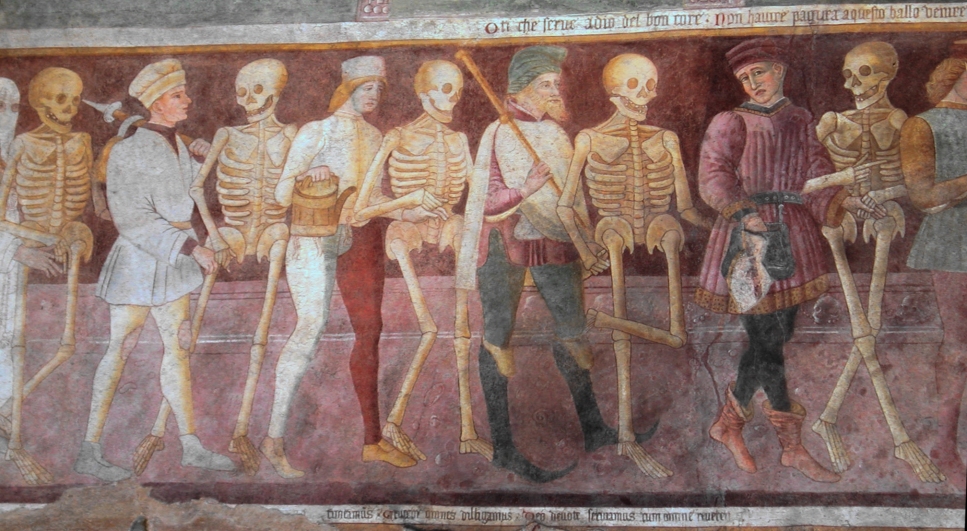
clusone_danza_macabra_detail

The following is an excerpt from a teaching by Jetsunma Ahkon Lhamo during a Phowa retreat:

The next realm is actually the human realm. Now it’s funny, because in the ascendency of the different realms, although the human realm is not considered a lower realm, it comes after the three lower realms, and we tend to think ‘staircase.’ We’re just like that. That’s just how we’re set up. It’s one of our big problems. So when we hear the human realm we think, “Oh, well I guess humans are not that much better than animals. Maybe we should try to go higher.” And then we sort of think in a worshipful way of the higher realms. But in fact, I will tell you right now, as I begin to talk about the human realm, that the human realm, of all the realms—even though there are other realms that are more pleasurable—the human realm is the superior realm. And it is the superior realm because only in the human realm does one have enough spaciousness, or the potential to accomplish spaciousness, within the mind. This is also called the leisure to practice, and has nothing to do with how much work you do. It has to do with the spaciousness in your mind. So only in the human realm is there the kind of mind that can compute the factors necessary in order to create the spaciousness necessary to contemplate and practice Dharma. Only in the human realm is that possible.

Now, once again, by way of explanation, this has nothing to do with how busy you are. People will say to me, “Well, this sounds great and I’m really excited and I’m a real excited kind of person and I wish you well, but I don’t have time to practice Dharma because I’m very busy.” And this really is what people say, “I wish you well. It’s wonderful. Thank you for doing this, but I don’t have time to practice Dharma.” And they think that because of that they don’t have the leisure to practice; and they make a decision based on that idea. And pretty soon, before you know it, our entire lives have gotten away from us. We’ve been busy, but we have not practiced any Dharma, or prepared for our deaths. And now we’re coming to the part of our lives where suddenly we’re getting ready to face our death. And we realize that everything that we’ve accomplished has added to our lives, but now we can’t take our lives with us. Not one piece of them. And we’re unprepared for our death. And that is one of the terrible things that can happen during the course of our lives as a human being.

When people tell me that they have no leisure to practice, that in fact I was wrong about that, that they are very, very busy and cannot practice Dharma, then I have to go back and explain to them again about the lower realms. Now think about this. If you want to know if you have the leisure to practice, even if you feel like you’re up against the wall and you’re elderly and you don’t have much time, or you’re sick and you don’t have much time, let’s talk about this. Compared to the other realms, you still, even now, perhaps one day before your death, have the leisure to practice, have the leisure to prepare, where the other realms do not. And the reason for that is if you think about the hell realm, you want to think about how the hell realm works. Think about the last time you went through all-pervasive, intense suffering. When is the last time you went through all-pervasive, intense suffering? Really think about it for a minute.

For some of us it will be the untimely death, let’s say, of a loved one. Unbearable to lose someone that you care about so deeply. Or for others it will be the, to us, untimely end of a relationship on which we were completely dependent and about which we had a great deal of hope. We lost, let’s say, a loved one. We were abandoned, or something like that. Many people say that there is no greater suffering than to be abandoned by someone on whom you depend utterly, and whom you love utterly. Many women have experienced husbands going through their second childhood in their forties and suddenly they’re out the door. The women feel helpless, and many sufferings occur. So that might be an indication of that.

Another instance might be discovering that one is in fact sick and preparing for death. That is also an intense and all-pervasive suffering. And there are unfortunately in this day and age many more people who have that suffering than ever before. It is an all-pervasive suffering and it feels as though it takes you over. You feel like you cannot pull yourself together. It could be the suffering of losing the family, losing the job. There are so many different sufferings that occur in that way. And do you remember, when you were in the midst of a suffering like that, how all-pervasive the suffering was? And how little space there was to do anything but experience the suffering of suffering? Do you remember? During the suffering like that, if someone were to say, “Now come on, pull yourself together. Let’s do what’s best. What’s best is to pull yourself together. Think positively. Let’s lighten up a little bit. Come on now, pull back from this,” you literally cannot do it. And you feel like making obscene gestures at the people who suggest that you do. You feel like,”I’m suffering. I have the right to suffer. I deserve this suffering, and I need to go through it. Get lost.” We really actually protect ourselves in that way.

Now if we, who are human, have that condition, then think about how those beings in the lower realms must have that condition. The hell beings are suffering from intense heat that literally burns their bodies repeatedly again and again. The beings in the cold realm, intense cold that repeated breaks their bodies again and again. The beings in the varied and individual hell realms. The beings in the hungry ghost realms who experience need and hunger to the point where all you can feel is the panic and longing of not having. You know what that feels like. When was the last time you experienced in a really acute form the need and longing to be connected to another human being in love so that you can feel appreciated and approved of? Most of us spend our lives going crazy trying to act that one out. How much worse must it be in the hungry ghost realm? Because in the hungry ghost realm, then we are constantly, uniquely, singularly, and exclusively involved in our own needs and our own longing and what we can and cannot have. There’s literally no space to practice Dharma, in the same way that you cannot teach Dharma to a hungry person. You simply can’t. You cannot teach Dharma to a hungry person because they don’t have the subtlety of mind to be able to appreciate and practice Dharma. Their mind is centered on the grossness and heaviness of the physical need for food. You cannot teach Dharma to a hungry person. You have to feed them first.

So, in these lower realms there is absolutely no space to practice Dharma. One cannot engineer the mind. Think about what it would be like to be cut with a knife right now. Somebody sawing your arm off. What’s that feel like? Oh, this is unbelievable. While someone was sawing your arm off, unless you’re some kind of great yogi or yogini, it’s likely that you would not have the time to practice. What do you think? You know, we’re sawing your arm off! Think about this for a minute. You’re not going to have time to practice. And the reason why you’re not going to have time to practice is because the suffering is unbearable. There’s no space in your mind to practice. I mean, literally, you do have time, if you think about it. You have the time, from the time the saw gets to the skin, to a major artery, and all the blood leaks out. You have a little time. But you don’t have time in your mind. Time in your mind is what we’re talking about. So the lower realms do not have that. The reason why the human realm, therefore, is so auspicious and why sentient beings wish to attain human rebirth is because we uniquely have time to practice here in this realm. If only a moment; if only a day. That does not indicate how well we will practice. Yet still we have the capacity for practice, and that is unique to this realm.

The main suffering of the human realm, believe it or not, even after we look at the traditional sufferings of old age, sickness and death—and these are sufferings, you’ll know it when you get there—the biggest and most horrible suffering actually of the human realm is, believe it or not, the very cause of the human realm. That while we have the merit to be human there is also a non-virtuous cause and that cause is the suffering of the human realm. It is doubt. Doubt is the main suffering of the human realm. It’s what you’re fighting right now. It’s the demon that has arisen in your mind, the one that says, “She’s not talking about me.” Or the one that says, “Death? Me? Nah. I will think about that later. I don’t have to think about that. I’m probably not going to die. I’ll just think positive. I’ll never die, I’ll think positive.” Ha ha ha. Yeah, you’ll be the only one that worked for, too. So we’ll think, “Okay, I’ll just think positive and I’ll just get through it. And besides, I don’t believe her. I think what I’ll do is just get all the different religious beliefs in the whole world and I’ll lay them out in front of me and I’ll select the prettiest, the one I like the best.”

For example, Kalu Rinpoche left while he was sitting up practicing Phowa. He simply practiced Phowa the way the tulkus practice Phowa. The tulkus don’t have to memorize this book.They just go. They go. They actually transfer the consciousness, literally. And this is the true way to practice Phowa—from ignorance into bliss. They go. And they go because their minds are such that there is nothing holding them back. They’ve practiced so their minds are smooth and not filled with the pitfalls that other sentient beings have. Sohe emptied his bladder and his bowels, because he knew that would be a good idea, and went over to his bed, smiled at everybody, and was kind of like leaving on a train, y’know. Kind of like, “Goin’ to the beach for a while. Be back. See ya.” Kind of like that. Rinpoche just sat down, smiled at everybody, looked real pleased with himself, got into his posture and meditated, and left. What a nice way to go. And he left consciously, the way tulkus do, preparing for, again, a conscious rebirth. How wonderful! How wonderful to be able to practice to leave in that way! And so that is the most extreme, wonderful example of what a human being can attain.

In the human realm we can study and practice and prepare for that going, and at that time death is no big deal. It’s not an event. There is no difference, literally, between the death and the life. It is only different in the way that one room in a house is different from another. Yes, different. But for that level of practice it is the same experience, and the same experience has the same taste. And the taste is always simply the emanation, the display, the coming forth, and the giving rise to the great bodhicitta. So death is simply another day in the life of giving the bodhicitta, of expressing the bodhicitta. Not frightening to him. Frightening to us when we watched him, frightening to us when we lost him, frightening to us when people heard that he was dead. One more great lama who could guide us through the sea of suffering dead, gone. That’s how we think. But he just left for the beach for a week. He’ll be back. He’s back. They come back! So for a lama like that who practices, that’s what it is. But for us, we’re so scared. because we’re not ready. So in the human realm,  we can prepare ourselves and we can be ready.

Copyright © Jetsunma Ahkon Norbu Lhamo All rights reserved
A Short Method to Antidote to Pride

The following is pith advice Jetsunma offered to a student who asked her how to work on pride:

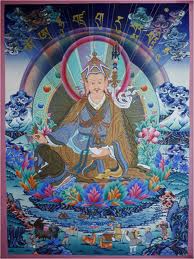
When you wake up in the morning put all sentient beings above the crown of your head. And then put Guru Rinpoche above all of them. So essentially you’re seeing that Guru Rinpoche blesses all sentient beings but also that all sentient beings are above you, and therefore more important than you.
Try that.

Copyright © Jetsunma Ahkon Norbu Lhamo All rights reserved
Giving Rise to Bodhicitta

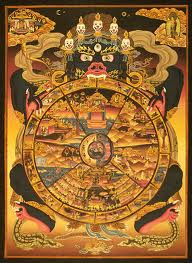
Samsara

The following is an excerpt from a teaching by Jetsunma Ahkon Lhamo offered during a Phowa retreat:

When you think about the suffering of sentient beings, when you think about those that are in the hell realms suffering horribly, is there a part of you that wishes you could do something to liberate them from the hell realms? That wishes that you could pass your magic wand and have them be free at last? Is there a part of you that hears the story about the hungry ghosts and thinks, “Oh my, how can I nourish them? How can I give them milk? How can I make them not suffer like that? How can I help those sentient beings that are about to fall into that condition by asking them or encouraging them to turn the way their minds work?” Do you feel any compassion like that? Is there any part of you that wants to reach out to them and help them? When you hear of the suffering of human beings, when you hear how many times human beings come into the same realm with the very teaching that will bring about the end of their suffering, and yet due to their doubt do not participate in that teaching but walk away from it empty handed, do you wish that you could change that? Do you wish that you could help them to see the truth before it’s too late? Do you wish that you could help the jealous gods and the gods and goddesses of the god realms? Do you wish that you could open their eyes so that they will not be so drunk with their own habitual tendencies, but rather so that they will see the benefit and impact of practicing Dharma? Do you wish that they could use the time that they have right now in order to be free of suffering? Do you wish that you could liberate all sentient beings including yourself from suffering, that suffering would no longer be heard? That the very word of suffering, the very name of death would never be heard in our ears again? Do you wish that you could do that? Is there any part of you that responds to that? Yes? No? Is there some part of you? Then hold onto that part of you, because that is the part of you that is the most precious possession that you have. Hold onto that thread. It is the very thread of life. It is more precious and more important than any other thought that you have or have ever had. And it is the only pure thought that you will ever have during the course of your life until you achieve liberation.

This is the very method by which one gives rise to the bodhicitta, the very method by which one accomplishes. I tell you that you will not accomplish Phowa successfully, you will not have the promised signs that everybody’s waiting for, if you do not first give rise to the bodhicitta based on the understanding of what sentient beings in cyclic existence suffer. So you must give rise to this. It is the foundation of the Path. Without the milk of kindness flowing through you, without giving rise to compassion, there is no method and therefore there is no result. So that is why this preliminary teaching, although it is general, must be included with the Phowa.

Copyright © Jetsunma Ahkon Norbu Lhamo All rights reserved
The Hungry Ghost Realm

HungryGhost

The following is an excerpt from a teaching by Jetsunma Ahkon Lhamo called “Why P’howa?”

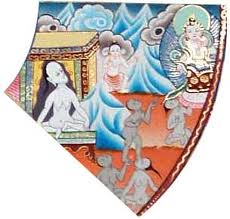
The next of the lower realms is the realm of the hungry ghosts.  The hungry ghosts actually have a traditional appearance and they are described in this way, but again you must understand that this is us looking with our eyes that are born having to distinguish between subjective and objective.  These are the eyes that are born in the realm of duality,. So keep that in mind when their description is given.  The description is that of beings that have ver,y very, very tiny mouths—they are said to be about the size of a pin, just a tiny opening—and great big stomachs; and these stomachs are empty.  They are not able to take in the amounts of nourishment that they need.  This is the picture that we are given.  The reality of the realm of the hungry ghost is that they experience extreme need, extreme hunger, beyond what you feel when you have Big Mac attack.  Way beyond that!  We are talking hunger like you have never felt.  It is a different color of hunger entirely.  Have you been real, real hungry?  Have you never been real, real hungry in your life?  I’ve been real, real hungry in my life.  I’ve been real, real hungry in my life, and I remember how that felt.  I remember being so hungry once that I could feel my blood sugar doing wacko things, and I actually had the feeling of panic.  I was that hungry that you feel panicky because your body is just telling you, “I need food now.”

So you imagine that there is that kind of hunger, with that kind of panic and need times more than you can ever imagine. That would be the feeling of a hungry ghost.  It is extremely needful.  Now you say to yourself, “Please, I worked out my whole life and for me to be reborn with a tiny little mouth and a big, big belly like that, that definitely is not going to happen to me.”  So you think that that’s not going to happen.  Well, you have to examine yourself from a different and more subtle point of view.  Let me ask you if you have ever gone through a period in your life when you were extremely needy.  “Oh no, not me.”  Right?  Extremely needy?  For women that happens at least once a month, right?  And for men I think it happens about every 48 hours.  Now they get needy in a different way, but it’s basically also, “Do you love me?”  We have within our mindstream the potential for tremendous neediness and graspiness.

O.K., this is a little bit less painful.  Have you known a person in your lifetime that was compulsively, neurotically, unsatisfiably needy?  Have you known a person like that?  Haven’t you had from that person the feeling that this hole is just too darn big to fill?  You feel like you’re throwing it in and throwing it in and throwing it in and trying to love and trying to give them something, and they’re still whining.  It never ends; and you spend the rest of your life doing this and nothing happens.  The hole never fills up.  Well, that is the kind of cause that results in a rebirth as a hungry ghost—a person whose habitual tendency is simply wrapped around self-absorption and what they need.  I need, I need, I need.  Can you gimme, gimme, gimme?  They see every other being in their life as a prop, a prop by which they can achieve satisfaction.  They use people as props in order to achieve satisfaction.  You know we’ve all gone through periods in our lives when we’ve done that. Haven’t we?  Absolutely.  We have used other people for our own satisfaction.  Absolutely. And for many of us, we made careers out of it.  Right?  And maybe still, maybe still.  We have seen how people can wrap their whole lives around graspiness and neediness; and every time they meet with somebody it’s like you can hear the suction.  You can just hear it.  You feel like the blood is coming out of your pores.  And that’s the kind of person you instinctively stay away from because, literally, you can feel your energy being sucked into them.  Haven’t you felt that kind of thing?  You can feel the energy being sucked into them,. And it’s true.  If you could see it with different eyes, your energy would be sucked into them.  That’s true.  That kind of cause, that kind of habitual tendency that the person might experience, or if it’s you, you might experience, would result in rebirth as a hungry ghost.  Particularly, also, it is the kind of person who is against and has no compatibility with compassion and generosity.  The person who is chronically, without hesitation, selfish to the bone.

Now you may think, “Are there really people like that?”  Oh ho ho, yes!  I’ll tell you , this story briefly.  In New York once, I went to give a teaching. I remember walking into the room and thinking “Oh, no,” because, you know, a lama does develop the ability to sort of intuit who we’re talking to. And I remember walking into the room and going, “No-o-o!”  because I could see that it was going to be very, very difficult. And sure enough, here we were in New York and I was talking about the most benign… I wasn’t talking about hell realms.  I would never be dumb enough to talk about hell realms in New York!  You guys want to hear that you have to come to Poolesville!  So anyway, I was talking about the most benign and charming—talk about white picket fence!—subject that you could possibly think of. Kindness.  Talking about Bodhicitta.  I was talking about how, in the most fundamental way, kindness makes one feel.  Really, being kind to others makes one feel better.  I was talking about how developing the habit of kindness brings this result, just kindness.  I was talking about Bodhicitta being consistent with our own nature. I swear to you not one, but on different occasions, three women stood up and argued with me about the validity of kindness.  One woman in particular said, “This is ridiculous.  Kindness has no place in my life. I mean you have to get what you want!  I don’t see the point of what you say.  This is whoosh.  Tell me something real!”  That is literally what happened.

I remember just feeling this compassion for them, for what can the result of that be?  What do you think their next experience is going to be like?  Do you think they’re going to fall into the lap of mother love?  Do you think that kindness is going to be just heaped on them in their next life?  I don’t think so.  I don’t see how that’s going to happen.  So these poor people are up against the wall and they don’t even realize it. And in her haughtiness she defended what was going to make her suffer horribly.  So you see there is that kind of thing operating in the minds of sentient beings.  There are some people that categorically refuse and reject the idea of kindness and benefitting others. In fact, that is not consistent with all of the world religions. We should take equal responsibility with ourselves as with other sentient beings.

There are even types of teaching that the Buddha has taught that are meant for that kind of person who cannot appreciate compassion, who are not even set up to hear the word compassion.  The Hinayana point of view: Yeah, we’re taught to be kind to others, but not in an active way.  We’re taught to do no harm.  That’s different from saving sentient beings from suffering.  So there are sentient beings that have no capacity for kindness or generosity, you see?  And so the result of that kind of mental state is to be reborn as a hungry ghost, experiencing only need.  Only being able to experience that which comes toward oneself, literally not having the chip, the computer chip, to be able to send out.  It would be like a computer that has no printer.  Everything happens internally, in a way.  Do you see what I’m saying?  Nothing goes out.  This person is not wired to send out anything, and that comes through having only the habitual tendency of self-absorption and selfishness. The result is life as a hungry ghost.  In the hungry ghost realm, it isn’t that there is no food. It is that they are so weak because of the habitual tendency of their mind which has produced this weakness.  Their arms and legs are like threads.  They cannot get over to where the food is.  They cannot get there.  The only thing big about them is their stomachs. And even if they could get there, their little mouths would not be able to take in enough.

Plus it is said that even even if they do see some food, they cannot get to the food; and if they somehow manage to get to the food, it then will turn to… Here is a glass of water.  I have the karma for this water to refresh me.  Water, little bit of lemon, pretty good.  If I were a hungry ghost in the hungry ghost realm, even if I were able to make it to that water (and I would feel the need for it very strongly), the water would be like a glass of pus or something, horrible and repulsive, literally, sewage or something horrible and repulsive.  It would turn to that before you reached it.  And that’s because of the habitual tendency of our mind.  How different from sewage is the need to only satisfy oneself and not care at all for the condition of other sentient beings?  To take from others and never give.  How different is that from sewage?  You see?

 Copyright © Jetsunma Ahkon Norbu Lhamo All rights reserved
A Brief Biography of Dilgo Khyentse Rinpoche: Tulku Thondup

Dilgo_Khyentse_LH_med

The following is respectfully quoted from “The Collected Works of Dilgo Khyentse Rinpoche” published by Shambhala Publications

A Brief Biography of Dilgo Khyentse Rinpoche by Tulku Thondup:

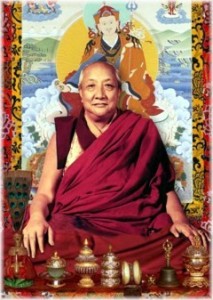
Kyabje Dilgo Khyentse Rinpoche Tashi Paljor (1910-1991) was one of the few great lineage holders, writer, teachers, and transmiters of teachings and powers of Nyingma tantras in general and Longchen Nyingthig in particular who reached numerous disciples in Tibet, India, Nepal, Bhutan and the West.

He is also known as Gyurme Thekchok Tenpe Gyaltsen, Jigme Khyentse Özer, and Rabsel Dawa.

He was born on the thirteenth of the fourth month of the Iron Dog year of the fifteenth Rabjung (1910) in the family of Dilgo, a minister (nyerchen) of the king of Dege in the Nyö clan in Dan Valley. His father was Tashi Tsering. It was the very day that the great master Mipham Namgyal and his disciples were performing the feast ceremony at the completion of his one-and-a-half month teaching on his Commentary on Kalachakra at Dilgo. Mipham immediately gave pills of Sarasvati, the female Buddha of wisdom, with the sacred letters DHIH and HRIH to the baby to eat even before tasting his mother’s milk. About a month after the birth, Mipham gave empowerments for purification and longevity and named him Tashi Paljor. Since then until Mipham died at the beginning of 1912, Khyentse was given blessed substances continuously.

When he was only four months old, Ngor Pönlop Loter Wangpo recognized him as the tulku of Khyentse Wangpo. At the time of the death of Mipham, Shechen Gyaltsap Pema Namgyal (1871-1926) saw him and asked the family to give him to Shechen.

At the age of six, he was accidentally burned badly in a fire and was seriously ill for about six months, which caused him to take ordination as a novice.

When he was fifteen, Gyaltsap recognized him as a tulku of Khyentse Wangpo, enthroned him at Shechen Monastery, and named him Gyurme Thekchok Tenpe Gyaltsen. He also gave him numerous transmissions, including those of Dam-ngagk Dzö and Nyingthig Yabzhi. From Khenpo Pema Losal of Dzogchen he received transmission of Longchen Nyingthig. From Adzom Drukpa, he received teachings on Longchen Nyingthig Ngöndro.

With Khenpo Zhephen Chökyi Nangwa (Zhen-ga) of Dzogchen, Khenpo Thubten Chöpel (Thupga) of Changma hermitage, Dza Mura Asanga, Abhidharma, Yönten Dzö, the commentaries of Guhyagarbha-mayajala-tantra, and many others. Khenpo Thugpa recognized him as the tulku of Önpo Tenzin Norbu (Tenli).

Then from Khyentse Chökyi Lodrö he received the transmission of Sakya, Kagyu, Geluk and Nyingma teachings, including Rinchen Terdzö, Nyingthig Yahzhi, Longchen Nyingthig, and Lama Gongdu. From Khenpo Tendzin Dargye of Shechen he received transmission of the nine volumes of Jigme Lingpa. From Shechen Kongtrul (1901-1959) he received transmissions of the thirteen volumes of Minling cycle. He received teachings of all the Buddhist traditions of Tibet from over seventy teachers. Among them, Shechen Gyaltsap and Khyentse Chökyi Lodrö were his principle teachers.

Starting from the age of eighteen, for twelve years he stayed in solitary places and practiced various teachings, including Three-Root Sadhanas of Minling Terchen and Lonchen Nyingthig.

Throughout his life he dedicated himself to giving teachings and transmissions to all, whoever came to receive them. He wrote that by the age of sixty-four, he had given empowerments of Nyingthig Yabzhi and Longchen Nyingthig over tend times. From the age of forty till eighty-two he gave discourses on Chokchu Münsel, the commentary on Guhyagarbha by Longchen Rabjam at least once a year, and gave extensive commentaries on Jigme Lingpa’s Yönten Dzö. Among countless other teachings, he gave five times the transmission of the Rinchen Terdzö, four times those of the Nyingma Kama, and thrice that of Dam-ngak Dzö,  and twice that of Kanjur.

Rinpoche and his consort, Khandro Lhamo, had two daughters. His daughter Chime’s son is the seventh Shechen Rabjam.

At the invitation of the royal family of Bhutan, he spent years in Bhutan teaching and transmitting the teachings.

Since the early 1960’s, he single handedly maintained and propagated the unique nonsectarian tradition of Khyentses, and tirelessly with the continuity of a stream he spread the teachings by traveling, teaching, practicing, and building monuments without any pause, for the sake of Dharma and people.

In 1980 he built Shechen Dargye Ling Monastery (a name he took from his monastery in Tibet) at Bodhnath in Nepal, an elaborate complex with over two hundred monk-students. In 1988 he established a shedra at the new monastery, where monks are studying scholarly texts.

Starting in 1975, he visited many countries in the West many times and taught various levels of teachings and transmissions. Also he established Tekchok Ösal Chöling, a Dharma center in France. He visited Tibet three times from exile to teach and to help in rebuilding the monasteries and the faith in his homeland.

He conferred on the fourteenth Dalai Lama many empowerments and teachings on the commentaries of Guhyagarbha and Yönten Dzö and oral teachings of Dzogpa Chenpo combined with teachings on Yeshe Lama.

He discovered many teachings and sadhanas as terma and wrote many scholarly texts and commentaries on various subjects, totaling twenty-three volumes. Among his writings on Longchen Nyingthig are a commentary on Palchen Düpa and Wangki Chokdrik.

At the age of eighty-one, at three A.M. on the twentieth of the eighth month of the Iron Sheep year (September 28, 1991, his enlightened mind merged in to the ultimate openness at a hospital in Thimbu, the capital of Bhutan. Since then, his monastery in Nepal has been presided over by his Dharma heir and grandson, Rabjam Rinpoche, Gyurme Chökyi Senge.

He was one of the greatest learned and accomplished masters of Tibet of our age. He was tall and giant. When he was among other masters, he stood like a mountain in the midst of hills or shone as the moon among stars, not because of his physical prominence, but because of the breadth of his scholarship and depth of his saintliness. When he gave teachings, it was like the flow of a river, with hardly any pause. If strangers heard his lectures, their first impression might be that he was reading a beautiful text from memory, as the words of his talks were poetry, his grammar was perfect, and the meaning was profound.

Another most astonishing feature was his memory. He remembered not only scholarly and liturgical texts and details about his teachers and friends, but also those people whom he had seen only once years earlier.

His kindness was boundless, and there was room for everybody. Whenever I had an audience, he gave me the feeling that there was a place for me reserved in his vast mind. If you watched carefully, you got the feeling that he was always in the meditative or realized wisdom of openness and reaching out to people with the power of compassion, love, and directness, without any alteration.

He practically held the transmissions of all the Buddhist teachings of Tibet, but was constantly searching for additional transmissions, no matter how minor they might be. He had a huge library collection, but never stopped looking for even a page of rare writing. He was also immensely loyal.

In his last trip from Bhutan to Kalimpong, instead of flying he insisted on making the arduous journey by car in order to see an old disciple of his on the way. While that effort might have exhausted the last drops of his physical strength, it would have been his joy and fulfillment, an act of compassion.

Urgyen Tenzin Jigme Lhundrup (b.1993), the grandson of Tulku Urgyen Rinpoche (1919-1996) and the son of Kela Chokling Rinpoche and Dechen Paldron of Terdhe, has been enthroned as the reincarnation of Dilgo Khyentse Rinpoche.

Kyabje Dilgo Khyentse Rinpoche was one of the great Lamas who recognized Ahkon Lhamo Rinpoche

Looking Beyond the Self

universe_wallpaper_2-normal

In order to practice effectively, we have to give rise to the great Bodhicitta.  We have to see the needs of sentient beings—what their situation is, what their condition is. For that reason I’m going to talk, first of all, about the six realms of cyclic existence.  These are the different types of reality that one may experience during the bardo or passage of living.  We are beginning then with the passage, or bardo, of living.  Bardo is not actually a time period.  You can’t say that bardo is a period from Thursday to Thursday, or from the 24th to the 3rd of the month.  Bardo is not a marking time or a markable time.  It is perceived that way because of our delusion.  We will see the bardo of the passage through our lives as being, oh, let’s say 75 years.  We can see this as a passage. From the point of realization, this is a movement, a display, a passage, a color.  It is something other than the way we experience it.  We experience it as the date that we were born and the date that we die, and time in between.  But, in fact, what we are actually experiencing is not a length of time, but rather we are experiencing the bardo, or passage, of living.

According to the teachings on the bardo or passage, of living, we’re not the only ones here.  What a big surprise!  Now everybody is thinking “Oh great!  She’s going to tell us about flying saucers!”  I wish.  I wish!  I’m still waiting for them to come pick me up.  I don’t know if any of that stuff is true.  I’m definitely into Star Trek and I hope to heck it’s true. It seems logical to me that it’s true, there being so many planets out there, but I don’t know that for sure.  What we’re going to talk about today is the honest-to-goodness. This is what the Buddha has taught us about the realms of cyclic existence.

According to the Buddha’s teaching, the amount of those sentient beings who can achieve rebirth as a human being is so small that it would be like the amount of particles of dust  on our thumbnail, compared to those sentient beings that are not human beings.  That would be comparable to the particles of dust on the earth.  Are you perceiving the vast amount of difference?  So we have to think of ourselves as the smallest group really. There are other sentient beings who are revolving in cyclic existence. But in what way?  This is what we want to know. There are so many of them!  What are their sufferings?  What are their conditions?  How can we help them? Should we consider them?  What are they to us?  These are the thoughts that will help us to understand our condition and the condition of sentient beings.

According to the Buddha’s teaching, there are actually 3,000 myriads of universes.  Three thousand myriads of universes.  That is a way of saying uncountable reality.  Uncountable, unmentionable, unthinkable display, so much display as to be inconceivable to the kind of mind that we have that likes to count beings, or likes to count numbers.  There are that many wandering in cyclic existence. And according to the Buddha, there are basically six realms of cyclic existence. I will talk about these six realms of cyclic existence briefly so that each one of us can understand the condition of cyclic existence and the results of our own actions, because none of these beings in cyclic existence have ended up where they are, including us, through anything other than by the results of our own action.  You are here listening to Dharma teaching because somewhere in the past you have been exemplary, exemplary.  Oh naturally the room gets quiet!  They want to hear about this!  Don’t you love it! Every time. This is so predictable.

All right, let me tell you how wonderful you are. In order to have received the teachings that may ultimately result in your liberation in one lifetime… I mean, you talk about grains of dust on a thumbnail. That would be equal to grains of dust on the head of a pin!  That is how rare this opportunity is. You must have done some extraordinary things in your past in order to be able to hear this teaching.  You must have been kind to sentient beings.  You must have helped other sentient beings or supported them as they sought truth, just as you are being supported in your search for truth.  You must have been helpful.  You must have been seeking.  You must have been looking for a better way.  You must have had some devotion.  You must have had some faith, and more.  It would take extraordinary kindness, extraordinary virtue, to come to this point.

Now within this point, there are some people in this room, and you can see that they are sleepy. They can’t listen very well, and they sort of miss most things.  Well, why is that?  That is not because of what they had for breakfast, really, unless of course you had a candy bar for breakfast in which case, go back to sleep!  It is not because of their hearing.  It is not because they speak a different language.  It is not because of any of the things that you might think are contributing factors.  If the person is too dulled out to be able to hear the teaching, it is because while they have the extraordinary merit and virtue to be able to hear the teaching, they don’t have quite enough to be able to absorb it deeply.  It’s a little bit like if you could imagine a bug crawling on the arm of a great lama, or crawling on the arm of the Buddha.  I mean, that’s a pretty good position to be in!  If you’re a bug, that’s where you want to be!  Crawling on the arm of the Buddha.  Certainly if I were a bug, that’s where I would want to be. In the Buddha’s armpit or, you know, someplace safe.  But still, the Buddha could be giving the most extraordinary teachings.  The bug won’t hear it.  The bug won’t accept it and the bug certainly won’t like it.  The bug just wants to be the bug on the Buddha’s arm.  It doesn’t even know it’s on the Buddha’s arm, really.  It just wants to be comfortable. You see?  So you may wish to be comfortable.  You may wish to take a nap.  You may think about the things that you’re used to thinking about.  You may wish to keep the same exact attitude that you’ve always had, so this way you don’t have to change.  Even though that all seems very logical to you, actually that’s because you don’t quite have enough merit to absorb the teachings deeply.  Everything is due to cause and effect.

Copyright © Jetsunma Ahkon Norbu Lhamo All rights reserved

Removing the Blinders

Turn-the-lights-on

The following is an excerpt from a teaching by Jetsunma Ahkon Lhamo called “Why P’howa?”

One thing that happens as we are turning the mind toward Dharma is we literally begin to examine the condition of cyclic existence,  We come to understand that we are not the only ones that are wandering in cyclic existence. All sentient beings that we see of all types, not only counting those that are human but also animal sentient beings and sentient beings that live in other realms, these too are wandering aimlessly and are suffering.  So we begin to develop a sense of empathy through examination.

Now some people might think “Gee, what a downer!  Why would you want to examine the suffering of others?  Better to close one’s eyes and think happy thoughts.”  There is a time and place for closing one’s eyes and thinking happy thoughts.  There is a time for joy and a time for happiness. And the kind of joy and happiness that is healthful and that increases our ability to attain liberation and to have happiness is the kind of joy that is not the same as suppression of information.  It is the kind of joy that is not the same as closing one’s eyes and being blind to cause and effect relationships.  It is an all-pervasive natural kind of joy that is in harmony with our true nature, and is the very display of our nature.  That joy promotes health and well-being, promotes longevity; and it is born of moral and ethical and compassionate conduct.

The kind of joy that we are giving ourselves when we try to fake it, literally fake it through our lives, ignoring all the bad news and just playing the way children play in the sandbox, picking and choosing what we want to think about and what we want to see, that is a joy that is an artificial recipe.  It is a joy that exists in the same world with suppression, ignorance and lack of information. That joy is not healthy for us because it does not promote longevity, it does not promote happiness.  It is literally like this: Let’s say we were to take all the chairs that are in this room and distribute them throughout the room in a haphazard way and then pile in a few more pieces of furniture, and  wait til it’s pitch-black midnight. Turn off all the lights, close all the curtains until it’s absolutely pitch dark in this room.  Then try to negotiate going through this room.  Would you like to negotiate going through this room, just trying to feel your way through with all of its furniture upturned and barricaded and brought up in your way and that sort of thing?  Would you like to go through the room, getting from this door to that door? And let’s imagine that door is the ultimate door, the one we need to get out of.  We must get out of that door for whatever reason.  Would you like to go from this door to that door with the lights off or with the lights on?

I don’t know about you, but I’m a sensible, practical kind of girl and if I have to make a journey, I want to know the facts.  I want to go with the lights on.  I want to turn the lights on so that I can walk around the furniture, go under it, step over it, do whatever it takes to negotiate this scary passage through samsara. It makes no sense to close the eyes and not take in information and pretend, suppress the facts in order to go from one place to another, because you will surely fail.  You will surely hurt yourself and have a very painful journey in the process.

So for this reason we must examine cyclic existence. We must examine the condition of sentient beings, and we must examine our own condition in order to truly turn our minds toward Dharma.  Once we have seen the faults of cyclic existence and seen the good results of understanding, of growing in understanding, and the joyfulness of virtuous and moral and ethical conduct and compassion, we will develop the habit of wanting to know, of opening the mind, of having the mind be very much like a bowl, a very pure thing in which nectar can be poured.  We will crave information.  We will crave practice.  We will literally crave turning on the light so that we can understand.  If we do not crave now, if we wish to remain in ignorance and darkness because it is easier or because we like being drunk, it is simply because it is our habit to do so and that does not excuse us from the need to change.

Develop a new habit.  You can see that that young person who partied down and worshipped the porcelain god every weekend morning, literally is watching their well-being go down. We on the outside can see that that needs to change, but that person, in the flux of their own ignorance, cannot see that that needs to change.  So I am pointing these things out to you so that you can make new and acceptable decisions in your lifetime so that you can actually turn your mind toward Dharma.

Copyright © Jetsunma Ahkon Norbu Lhamo All rights reserved

 

Cultivating Compassion

A-man-with-a-hangover-007

The following is an excerpt from a teaching by Jetsunma Ahkon Lhamo called “Why P’howa?”

It is not foreign to our nature, and it is also not separate from the goal that we wish to achieve by practicing in this way, for us to give rise to the great Bodhicitta, or the great compassion.  The way that that is done on the Buddhist path is to consider that our own goals and the goals of sentient beings are indistinguishable, that they are nondual.  That is to say that our goal to practice in order to achieve liberation, is inseparable from the goal of sentient beings.  They also have the goal of practicing in order to achieve liberation.  Not all of them know it, in the same way that some of you don’t know it either.  You may think you know it, or you may know that you don’t know it, but many of you are still at the party, not growing out of the party, not grown up and looking back and saying “Oh, that won’t do me much good.”

You remember that situation that you found yourself in as you were growing up?  When you were a young person you had a few knockdown drag out parties, didn’t you?  I mean the kind where, at some point in your life, you probably got drunk.  Nobody makes a sound, like “Drunk?  What is that?”  At some point in your life you probably were out of control, just party down, not thinking straight, doing things that were compulsive and obsessive and not appropriate and not healthy for you, not good for your well-being—unthinking, deluded things.  This is something that we have all experienced, but particularly in the case of when we were younger, we would party hearty. And if you think about it, if any of you have done that, and I’m sure that one or two of you have, you may remember that once you’ve partied hearty, there was a period of regret afterwards, and that was primarily the next day.  Of course the, how shall I say, the cure for that is, of course, prostrations to the porcelain god; and with all of that, one comes to understand that one is literally destroying oneself, that there is no hope for happiness from doing that to oneself.  After doing that repeatedly, we tend to grow up after a while.  We tend to be unwilling to put ourselves through that kind of stuff again.

So that happens to us spiritually too. We go through the same compulsive obsessive behavior with no good result. And at some point, either through our own good fortune, through our own gathering together of merit which causes literally a kind of smarts arising in the mind, or through the instruction of our teacher, we can begin to realize that what we are doing makes no sense.  It simply makes no sense.  It is destructive.  It is painful, and it is not pleasant.  So that is the stage in which we find ourselves turning our mind towards Dharma.

What we have to realize in order to give rise to the compassion, to the great Bodhicitta, is that this is true of all of us, not just you.  If you have come to this realization, that it’s time to turn the mind towards Dharma, then what of those who have not yet come to that realization?  They are still putting themselves through that.  They are still acting in a destructive way that disintegrates their spiritual strength.  They are acting in such a way that literally brings them suffering.  What of them?  Perhaps you have heard the good word, but what of them?  Who will help them?  And so we develop a sense of compassion.

Copyright © Jetsunma Ahkon Norbu Lhamo All rights reserved

Qualifications for Receiving Teachings

Hermitage

The following is an excerpt from a teaching by Jetsunma Ahkon Lhamo called “Why P’howa?”

If you’re one of those lucky people who is about to embark on a journey to either a monastery in India or a monastery in Tibet where you can study the texts and receive the teachings that we as Americans literally cannot receive because they have not been translated or they are not available in this country…  If you are one of those fortunate people that can go and do that and you will learn to practice by studying Tibetan and you will literally become a Tibetan in that environment even though you will be an American, you will completely change your life into that space. If you are able to do that, perhaps it’s not so important for you to study Phowa right now.  Of course that’s assuming that you’ll live long enough to complete all of your practices.  There are a lot of assumptions we’re counting on here, aren’t there! So at any rate, if you’re one of those people, then you may not need to practice Phowa in order to attain liberation in this lifetime.

We are also assuming that you have the karmic setup, and that you are literally wired in order to be able to achieve liberation in this lifetime, because it is also the case that there are people who can come into contact with the entire volume of what is available, every single essential pith teaching, every single possible cause for realization that we are able to come into contact with, and literally they cannot go in.  The intake button is broken. The student cannot hear it. And eventually, because they cannot hear it, they will leave Dharma.  They will go away from it.  They will have to go away from it because they cannot stand to be in that presence.  Karmically they are not prepared to be in the presence of such teaching, of such potent teaching.  They will remove themselves.  They will simply remove themselves.  That’s simply how it is.

So, all of these things being the case, it sounds reasonable and sensible, does it not, to practice Phowa in order to take advantage of the most extraordinary opportunity in order to achieve the result at a time that seems reasonable to us.  It does not seem reasonable to us to practice now for a result that may not ripen for another thousand years, our time.  Ten thousand years, our time.  We’re not motivated for that, but we can understand the positive result of practicing in order to achieve liberation in one lifetime.

Now, in order to be qualified to have these teachings, there are two things that must happen.  First of all we must establish the proper motivation, and this is something we hear about again and again and again.  How many flavors can ice cream come in?  But this proper motivation absolutely makes it possible for you to receive the teaching.  With no proper motivation, the teaching is very much like seed falling on stone.  It will not take root.  It will not blossom.  There will be no result through no fault of the seed, but through the fault of the ground on which the seed is placed.   So having the proper motivation is of the utmost importance, and for that reason I want to take some time to explain.

According to the Buddha’s teaching, our own nature is not inconsistent with the Bodhicitta or what we call the great compassion.  The Bodhicitta is actually the true nature of our mind in its emanation or display form. So you can consider that our nature is, in a nondual way, wisdom, or emptiness, and method or Bodhicitta, compassion.  These things are our nature.

The way that our language works is because of the way our dualistic thinking works.  We have to mention emptiness as being separate from method.  We have to mention wisdom as being separate from Bodhicitta because of the way our minds work—because of our internal separation, because of our delusion, our belief in the separation between self and other, between subjective and objective.  But in truth, that primordial wisdom nature which is emptiness, which is wisdom, is inseparable from that which is method, from that which is the display, Bodhicitta or compassion.  It is inseparable in the same way that, on a coin, one side is inseparable from the other.  You cannot use a coin without using both sides.  You cannot take a coin in your hand without using both sides.  These are inseparable.  They are nondual.  They are indistinguishable from one another and yet, typical of our delusion and indicative of our delusion, we make distinction between that which is in truth not distinguishable.

Copyright © Jetsunma Ahkon Norbu Lhamo All rights reserved
WP2Social Auto Publish Powered By : XYZScripts.com