The Trap of Duality

The following is an excerpt from a teaching by Jetsunma Ahkon Lhamo called “Tools to Deepen in Your Practice”

We see ourselves in a dualistic way.  We have very concrete roles as to how that dualism plays out: in the way that we procreate, in the way that we die, in the way that we’re born.  We have very exacting ways in which it plays out because of our belief systems, because of the system of duality.  And we’ve had a long time to work out the kinks.  So, when we believe in physical reality as being essentially real, we can find all kinds of facts and information and people who will agree with us.

And if you wish to avoid awakening to the primordial state, you’ll have lots of friends,  because most everyone is locked into that confusion of the five senses.  Like a dream. We know how it is when we’re in a dream.  We may on some level understand it’s a dreamlike state, but the emotions are so strong.  It just pulls us into it.  A dream can be very sensual.  It can be very alluring.  It can be very stimulating in that you’ve had dreams with interesting things that happen and interesting colors, or something.  But we’ve had all kinds of dreams. We’ve had all kinds of phenomena as well.

That’s a terrible obstacle.  That’s a mean one, oh boy!  Because when you are getting ready to generate the deity, you cannot even allow the deity to arise naturally, as it does, from the from the wisdom that is emptiness because your brain has a better idea.  That’s unfortunate, because it is that wisdom that we need.

Here in Tantric practice, particularly with the Nyingma tradition, we are considered the ‘ancient’ ones, the oldest.  They say, “How many Nyingmas does it take to change a light bulb?  Well, none.  We all meditate in the dark.”  (much laughter).  So we are the ancient ones and we like to meditate in the dark.

So in Vajrayana, what is the most precious capacity is that capacity to simply let go the thoughts, the conceptualization, the products of the five senses—you know, all the conceptual proliferations that we’ve built around what we sensed.  It is letting go of that. It is opening the senses to allow the view. That is the wisdom that we really work on that becomes the very foundation for any accomplishment that we have on the Path. That’s the foundation for it.

Copyright © Jetsunma Ahkon Norbu Lhamo All rights reserved

The Basis of Vajrayana

The following is an excerpt from a teaching by Jetsunma Ahkon Lhamo called “Tools to Deepen Your Practice”

Today I would like to discuss the depth at which one practices. That is to say, how to avoid practicing in a superficial way where there is no mental or emotional investment. That’s really not the ideal kind of practice.  It’s a little bit like watching TV, or listening to the radio, or something like that where you do it with half-a-mind, you know, and the rest of the time, of course, the mind is involved with other things.  And so, we’ve all heard that we don’t want that to happen, that we want the mind to be gentled and stilled but yet we have a hard time understanding that really the key to that is the depth, the level, and the absorption with which we practice.  That depth or that absorption is called the Dakini’s breath.  That is actually what makes one’s practice relevant, delicious and sweet, meaningful and nourishing. Without that depth and that level of absorption, it’s very difficult to practice in any way that is more profound than say, recitation by rote.  So that’s the effort that we want to make. In order to do that, I would like to explain things a little differently, perhaps a little more deeply than you may be used to.

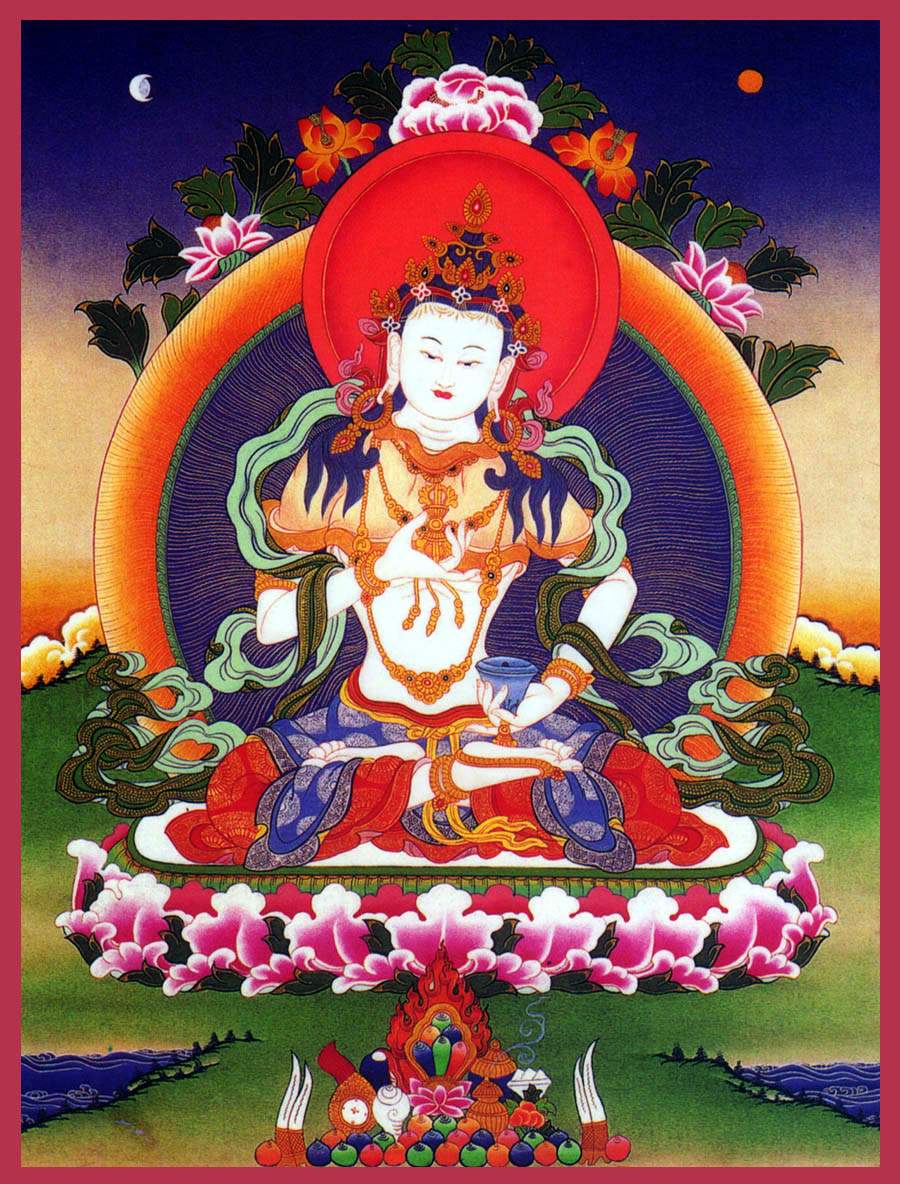
One of the things that I would like to mention is that in Tantrayana,  or the path of Vajrayana (which is the same thing), which is where we are now, you could say that the Path has two eyes or two legs, two supports.  Another way to say it would be that the Path can be distilled to its essential nature in two words: wisdom and compassion.  In fact one sees in many of the thangkas, the traditional paintings that are all around, pictures of a female and male in union, two lamas as consorts in union.  And of course having ordinary minds and being used to billboards and stuff like that, we think “Oh, what is this?” But we shouldn’t look at those pictures with an ordinary mind because they have a profound meaning.  The meaning of the union between lama and consort is the union of wisdom and compassion, the union of emptiness and method. The union of emptiness and method is the perfect balance, the perfect ship by which to cross the ocean of suffering.  It’s the perfect vehicle.  And of course, first we should understand what it means.  Wisdom and compassion or emptiness and method. . .  What does it really mean?

Well the meaning is this.  First of all, wisdom is something that you cannot arrive at by accumulating facts, because facts are phenomenal. They are believed to be self-existing. They are part of samsara, even if they are very smart facts.  Even if they are PhD-style facts!  Even if they’re MD-style!  No matter how many facts you know, you can never accumulate wisdom through the accumulation of facts, or what we would call the accumulation of knowledge.  It’s not to say that the accumulation of knowledge is not necessary.  If that were the case, then none of us would need training.  We would simply sit and do our best at meditating.

Of course facts are necessary.  It is necessary for us in our practice to understand how it is that the preceding lamas and excellent practitioners  accumulated merit and how they accumulated tremendous achievement.  It’s tremendously helpful to know facts, for instance, about the great lamas and the great saints and the Buddhas that have come in this time, and in other times, in order to understand with our ordinary minds what it is about them, how they come to be.  In fact, to some degree, our ordinary minds do require satisfaction.  And that’s where Vajrayana is ideal, because Vajrayana gives us ‘mental food.’  We have visualization. We have mantra recitation. We have the absorption in emptiness and then the springing from emptiness as the deity; and then the vajra confidence and the vajra pride.  It’s busy work!  Sometimes when people who are used to just sitting quietly and doing whatever it is they do, you know, when they have that habit of just sitting quietly, and there is a part of Vajrayana Buddhism in which you do sitting meditation; but if students only have that experience, they come here and they say, “Well, my mind is not calm.  I’m reciting all this stuff and I’m really stressed because I can hardly pronounce it.  And the tunes—forget about it.  And so there!”  And of course the response to that is, “Well really in Vajrayana the task is not to calm the mind.  The task is to awaken to the emptiness of all nature,to awaken to emptiness, that is, to perceive emptiness.

Copyright © Jetsunma Ahkon Norbu Lhamo All rights reserved


Abandoning Love: The Fourth Root Downfall

The following is respectfully quoted from “Perfect Conduct” with commentary by Dudjom Rinpoche:

4.b.3(b.4) Abandoning love:

The fourth is wishing that any sentient being should be separated from happiness and losing heartfelt love for them.

To wish any sentient being should be separated from happiness and to stop feeling heartfelt love for them is the fourth root downfall. The object can be one sentient being or many. To wish for them to be separated from happiness and to meet with suffering or misfortune, thus forsaking them and giving up any love for them at all, constitutes this downfall.

His Holiness Penor Rinpoche: Compassion in Action

The following is an excerpt from a teaching given by Jetsunma Ahkon Lhamo at Palyul Ling Retreat in the summer of 2012:

I am very pleased by all the effort that you’ve put forth to make this place grow and shine as it has, keeping it going even in great adversity, for instance the passing of His Holiness Penor Rinpoche.  We all suffered and now we’re doing what we can to bring about the causes that he can return to us.

I remember back in the beginning when I first met His Holiness Penor Rinpoche.  It was on his first visit to the United States.  He wanted to see me.  Back in those days dharma was kind of confusing.  We didn’t understand each other when the lamas first came to America.  It took awhile for us to come to that point, where we really understood each other.  Mostly it was our lack of understanding as Westerners that made the problems.

You all have beautiful, nice, and condensed practice books.  I want to show you what we were working with.  We mostly had loose-leaf sheets of paper, pictures, and books stuck together.  [Shows an old practice binder]  There are things here that I don’t even recognize anymore.   We all made our own books.  We were all new and we did our very best.  I wanted to show you this because I thought, ‘What a mess.’  I thought you’d get a kick out of it.  Those were my first practice books.  And it was a long time ago.

Personal reflections on His Holiness Penor Rinpoche

I had the happiness of knowing His Holiness for a long time, and had many wonderful experiences with him.  I don’t mind sharing them with you if you’d like to hear some of them.  I’d like to tell you about one time when I was in India and we were traveling around looking for statues.  It was so unbearably hot.  We were staying in this hotel and it was about 104 degrees Fahrenheit or more.  His Holiness was used to heat but he made sure to put me in a hotel with an air conditioner, which I stuck to, and that was very nice.  While at the hotel, I met the woman who cleaned my room, and she told me about her husband.  He was sick, had cancer and was dying.  She said, “Would you come and give a blessing to my husband before he dies?”  And I said, “Oh, it’s worthless if I give him a blessing, but if His Holiness gives him a blessing, that’s something. That’s definitely worthwhile.”  And so she said, “Oh!  Would he do that?”  And I said, “I don’t know.  I’ll ask.”

They were Hindu.  When I asked His Holiness, he said, “I don’t think Hindus like Tibetans very much.  We eat meat.”  And I said, “With due respect, Holiness, I think in this case it doesn’t matter.  These people so want to see you.  They so want the blessing.  These people are going through misery.  They live in a tin box on top of the roof, and she has to raise children by herself.”  His Holiness was very wrathful with me.  He said, “I had to leave Tibet and come to America.  I watched my own people die.  And now I am supposed to think that this is important?”  He was very wrathful.  But I know what he was doing.  He was creating the merit, and clearing the obstacles for this event to happen.  But as you know, His Holiness was very kind.  So finally he stomped his foot and he said, “Ok.  I’ll go.”

We climbed up to the roof, and it was hellish really.  His Holiness’ knees were bad then too.  I was so sorry and embarrassed that I had put His Holiness through that, but then I was so happy for the people that would receive the blessing.

When he came to the door of the tin shack they were living in on top of the building, it must have been 115 degrees inside.  It was so horrible.  We said, “His Holiness is here to give the blessing.  And the woman got down on the floor, and put her head to his feet and then she prostrated again at his feet.  She couldn’t stop.  She just kept doing it.  It was heart breaking to see the devotion that she felt for someone who would not abandon her in this terrible time; who would provide comfort and some help.  And His Holiness did that.

He spoke to her in Hindi.  And he asked her, “What is the problem?  How long has he been sick?”  She could hardly speak.  They were both so grateful and happy to have his blessing, and that he would think of them, because they were lowly people according to the caste system in India.  They were lowly people and poor beyond belief.  They said that some days he didn’t even eat, because there was no food.  And so His Holiness was told the condition of this man, and you could see in his face that he had great compassion.  The man had cancer of the mouth.  You could see that something was terribly wrong, but he had no medicine.  The agony that he was experiencing was hard to understand.

Here’s the kicker.  His Holiness said, “Open your mouth.”  When he said this, I tried to peak, and what I saw in there was horrible.  His Holiness said, “Open your mouth wide.”  He started pounding out mantras. Nothing I recognized.  He really pounded out the mantras.  And as he did that, he was blowing, blowing, blowing in the man’s mouth.  Holiness pounded out more mantras, and blew in the man’s mouth.  He kept doing this for quite a long time.

The couple was so thankful.  They offered Holiness food and drink, which of course he didn’t take.  They offered him food and drink.  He was working his heart out for them.  As we were leaving, they were bowing and bowing, and bowing.  It was so beautiful.  When we got down towards the room, I said to him, “Holiness is he going to live now?”  And he said, “No, there’s no chance.  The merit is gone.  There’s no chance for him to live now,” he said, “But he will have no pain.”

Already the man’s mouth was chewed up with cancer, and yet His Holiness said he would have no pain, and I know that’s true, because I met the woman again on the next day of our travels.  She said he had no pain that day.  I was so happy that happened.  I was just thrilled.

I left the my room door open so I could see where His Holiness was, and he could see where I was, and when he went passed by room, I just went down to him and I said, “Holiness, I know that was difficult, but thank you.  On behalf of them, thank you so much.  I don’t know how to express my gratitude.”  And he said, “No, I thank you.”

I will never forget that story.  He was grateful that I had insisted that he take this opportunity to help them.  He saw the value of it.  He saw that these people were helped and that they were just regular, innocent people.  His Holiness helped them so much that to my knowledge the man never had pain.  The woman and I wrote back and forth for a little while after that, and she said that he never had pain.  To me that am the most moving story about His Holiness that I know.  And I find it impossible to have seen that and not understand that he was Buddha, that he is Buddha.  No one but a Buddha would or could do something like that.  I miss him so much.  I know that you do too.

Copyright © Jetsunma Ahkon Lhamo.  All rights reserved


Relax

The following is an excerpt from a teaching by Jetsunma Ahkon Lhamo called “Entering the Path”

In a sense, the first thing the teacher does for you when you come to the path is to say, “Put on your crash helmet, study this obstacle course, fill up with gas, gun your motor, here we go. Put a spare in the trunk, carry a set of jumper cables, be fully equipped. Have a miniature, dehydrated tow truck in the back of your car. Just add water, and you’re set to go!” That’s the kind of instruction your teacher gives you. Your teacher very carefully lays out a program and says do the Seven-Line Prayer, do your Ngöndro. Do these things in order to accumulate merit because what happens is that should you use up a vast amount of merit when you first come to the path – and you will – you may experience obstacles. This doesn’t mean that you should not come to the path; this means that these obstacles are in your own mindstream. The causes for these obstacles have been in your mindstream since who knows, time out of mind maybe. They would have ripened eventually, they will ripen anyway, but if they ripen without the guidance of the teacher and without the tool of the path, they will ripen out of control. One never knows.

You know yourself that you’ve gone through life and things have wham! hit you just when it looked like things were going great and you had everything under control. Several times during the course of your life already you’ve looked in the mirror and said, “There is no such thing as control here in samsara! Things are really wacky!” But whatever obstacles arise when you first come to the path are yours. They’re not mine. I didn’t give them to you. I mean really, I didn’t do it. They’re not someone else’s. They didn’t do it.  And yet, as new practitioners we think, “What’s happening here? Everything’s wrong. Maybe I shouldn’t do this stuff.”

Actually the opposite is true. You should think like this. You should think, “Now my mind is being ripened. Due to my merit and virtue I am able to hook into the path. I have to stabilize that. I have to take responsibility.” Think like a big boy or a big girl for a change: “I have to take responsibility for this. I have to stabilize my mind and stabilize my practice.”

So how is that going to happen?

The thing that you need to do to flush out any obstacles that ripen on the path is to first of all stabilize your mind. Relax. Don’t be such a heavy breather. Chill, will you? Get mellow! So you relax. Just relax. Be confident on the path. Be confident that you are in a boat with no holes.

Yeah, it’s scary to cross the ocean of suffering, but friend, you’re going to do that anyway, either in a boat or not. So you’ve got a choice. You can get out and do the backstroke or cross the ocean of suffering in a boat with no holes. You’re in a boat with no holes. You’re fine.  You’re OK. Plus you have a good captain, a good captain who has themselves crossed the ocean of suffering before and brought others. So you should be confident in that. Relax. Try not to get yourself so worked up all the time. Just relax.

Remember, the more emotional you get, the more bent out of shape you get, it’s like you’re stirring up the water. Think of your mind as being like a bowl full of liquid soap, and if you start stirring it up like that with emotion, you know what you get? Bubbles and foam. Have you ever had that happen to your dishwasher or your washing machine where you get the bubbles and foam that come out all over the floor and then you’ve got to spend the rest of the day cleaning it up and the clothes are not clean, everything’s a mess? You have to think like that. Cheer up. Don’t get yourself all foamed up. Just relax. You’re on the path. You’re safe. Be cool.

Copyright © Jetsunma Ahkon Lhamo.  All rights reserved

Wisdom: From “The Way of the Bodhisattva” by Shantideva

The following is respectfully quoted from “The Way of the Bodhisattva” by Shantideva:

1.
All these branches of the Doctrine
The Powerful Lord expounded for the sake of wisdom.
Therefore they must generate this wisdom
Who wish to have an end to suffering.

2.
Relative and absolute,
These two truths are declared to be.
The absolute is not within the reach of intellect,
For intellect is grounded in the relative.

3.
Two kinds of people are to be distinguished:
Meditative thinkers and ordinary folk;
The common views of ordinary people
Are superseded by the views of meditators.

4.
And within the ranks of meditators,
The lower, in degrees of insight, are confuted by the higher.
For all employ the same comparisons,
And the goal, if left unanalyzed, they all accept.

5.
When ordinary folk perceive phenomena,
They look on them as real and not illusory.
This, then, is the subject of debate
Where ordinary and meditators differ.

6.
Forms and so forth, which we sense directly,
Exist by general acclaim, though logic disallows them.
They’re false, deceiving, like polluted substances
Regarded in the common view as clean.

7.
That he might instruct the worldly,
Buddha spoke of “things,” but these in truth
Lack even momentariness.
“It’s wrong to claim that this is relative!”–If so you say,

8.
Then know that there’s no fault. For momentariness
Is relative for meditators, but for the worldly, absolute.
Were it otherwise, the common view
Could fault our certain insight into corporal impurity.

9.
“Through a buddha, who is but illusion, how does merit spring?”
As if the Buddha were existing truly.
“But,” you ask, “if beings likewise are illusions,
How, when dying, can they take rebirth?”

10.
As long as the conditions are assembled,
Illusions, likewise, will persist and manifest.
Why, through simply being more protracted,
Should sentient beings be regarded as more real?

11.
If thus I were to slay or harm a mere mirage,
Because there is no mind, no sin occurs.
But beings are possessed of miragelike minds;
Sin and merit will, in consequence, arise.

12.
Spells and incantations cannot, it is true,
Give minds to mirages, and so no mind arises.
But illusions spring from various causes;
The kinds of mirage, then, are likewise various–

13.
A single cause for everything there never was!
“If, ultimately,” you will now enquire,
“Everything is said to be nirvāna,
Samsāra, which is relative, must be the same.

14.
“Therefore even buddhahood reverts to the samsaāric state.
So why,” you ask, “pursue the bodhisattva path?”
As long as there’s not cutting of the causal stream,
There is no routing of illusory appearance.

15.
But when the causal stream is interrupted,
All illusions, even relative, will cease.
“If that which is deceived does not exist,
What is it,” you ask, “that sees illusion?”

16.
But if, for you, these same illusions have no being,
What, indeed, remains to be perceived?
If objects have another mode of being,
That very mode is but the mind itself.

17.
But if the mirage is the mind itself,
What, then, is perceived by what?
The Guardian of the World himself has said
The mind cannot be seen by mind.

18.
In just the same way, he has said,
The sword’s edge cannot cut the sword.
“But,” you say, “it’s like the flame
That perfectly illuminates itself.”

19.
The flame, in fact, can never light itself.
And why? Because the darkness never dims it!
“The blueness of a blue thing,” you will say,
“Depends, unlike a crystal, on no other thing.

20.
“Likewise some perceptions
Rise from other things–while some do not.”
But what is blue has never itself imposed
A blueness on its nonblue self.

21.
The phase “the lamp illuminates itself”
The mind can know and formulate.
But what is there to know and say
That “mind is self-illuminating”?

22.
The mind, indeed, is never seen by anyone,
And therefore, whether it can know or cannot know itself,
Just like the beauty of a barren woman’s daughter,
This merely forms the subject of a pointless conversation.

23.
“But if,” you ask, “the mind is not self-knowing,
How does it remember what it knew?”
We say that like the poison of the water rat,
It’s from the link with other things that memory occurs.

24.
“In certain cases,” you will say, “the mind
Can see the minds of others, how then not itself?”
But through the application of a magic balm,
The eye may see the treasure, but the salve it does not see.

25.
It’s not indeed our object to disprove
Experiences of sight or sound or knowing.
Our aim is here to undermine the cause of sorrow:
The thought that such phenomena have true existence.

26.
“Illusions are not other than the mind,” you say,
And yet you also claim that they are not the same.
But must they not be different if the mind is real?
And how can mind be real if there’s no difference?

27.
“A mirage may be known,” you say, “Though lacking true existence.”
The knower is the same, it knows, but is a mirage.
“But what supports samsāra must be real,” you say,
“or else samsāra is like empty space.”

28.
But how could the unreal proceed to function,
Even if it rests on something real?
This mind of yours is isolated and alone,
Alone, in solitude, and unaccompanied.

29.
If the mind indeed is free of objects,
All beings must be buddhas, thus gone and enlightened.
Therefore what utility or purpose can there be
In saying thus, that there is “Only Mind”?

30.
Even if we know that all is like illusion,
How will this dispel afflictive passion?
Magicians may indeed themselves desire
The mirage-women they themselves create.

31.
The reason is they have not rid themselves
Of habits of desiring objects of perception;
And when they gaze upon such things,
Their aptitude for emptiness is weak indeed.

32.
By training in this aptitude for emptiness,
The habit to perceive substantially will fade.
By training in the view that all lacks entity,
This view itself will also appear.

33.
“There is nothing”–when this is asserted,
No “thing” is there to be examined.
For how can nothing, lacking all support,
Remain before the mind as something present?

34.
When real and nonreal both
Are absent from before the mind,
Nothing else remains for the mind to do
But rest in perfect peace, from concepts free.

35.
As the wishing jewel and tree of miracles
Fulfill and satisfy all hopes and wishes,
Likewise, through their prayers for those who might be trained,
Victorious Ones appear within the world.

36.
The healing shrine of garuda,
Even when its builder was long dead,
Continued even ages thence
To remedy and soothe all plagues and venom.

37.
Likewise, though the bodhisattva has transcended sorrow,
By virtue of his actions for the sake of buddhahood,
The shrines of buddha-forms appear and manifest,
Enacting and fulfilling every deed.

38.
“But how,” you ask, “can offerings made
To beings freed from all discursiveness give fruit?”
It’s said that whether buddhas live or pass beyond,
The offerings made to them have equal merit.

39.
Whether you assert the relative or ultimate,
The scriptures say that merit will result.
Merits will be gained regardless
Of the Buddha’s true or relative existence.

40.
“We’re freed,” you say, “through seeing the (Four) Truths–
What use is it to us, this view of voidness?”
But as the scriptures have themselves proclaimed,
Without it there is no enlightenment.

41.
You say the Mahāyāna has no certainty.
But how do you substantiate your own tradition?
“Because it is accepted by both parties,” you will say.
But at the outset, you yourselves lacked proof!

42.
The reasons why you trust in your tradition
May likewise be applied to Mahāyāna.
Moreover, if accord between two parties shows the truth,
The Vedas and rest are also true.

43.
“Mahāyāna is at fault,” you say, because it is contested.”
But by non-Buddhists are your scriptures also questioned,
While other Buddhist schools impugn and spurn them.
Therefore, your tradition you must now abandon.

44.
The true monk is the very root of Dharma,
But difficult it is to be a monk indeed.
And hard it is for minds enmeshed in thoughts
To pass beyond the bonds of suffering.

45.
You say there’s liberation in the instant
That defilements are entirely forsaken,
Ye those who from defilements are set free
Continue to display the influence of karma.

46.
“Only for a while,” you say. “For it is certain
That the cause of rebirth, craving, is exhausted.”
They have no craving, granted, through defiled emotion.
But how could they avoid the craving linked with ignorance?

47.
This craving is produced by virtue of sensation,
And sensation, this they surely have.
Concepts linger still within their minds;
And it is to these concepts that they cling.

48.
The mind that has not realized voidness,
May be halted, but will once again arise–
Just as from a nonperceptual absorption.
Therefore, voidness must be cultivated.

49.
If all that is encompassed by the sūtras
You hold to be the Buddha’s perfect speech,
Why do you not hold the greater part of Mahāyāna,
Which with your sūtras is in perfect harmony?

50.
If due to just a single jarring element,
The whole is held to be at fault,
How might not a single point in concord with the sūtras
Vindicate the rest as Buddha’s teaching?

51.
Mahākāshyapa himself and others
Could not sound the depths of such a teaching.
Who will therefore say they are to be rejected
Just because they are not grasped by you?

52.
To linger and abide within samsāra,
But freed from every craving and from every fear,
To work the benefit of those who ignorantly suffer:
Such is the fruit that emptiness will bear.

53.
From this, the voidness doctrine will be seen
To be immune from all attack.
And so, with every doubt abandoned,
Let us meditate upon this emptiness.

54.
Afflictive passion and the veils of ignorance–
The cure for these is emptiness.
Therefore, how could they not meditate upon it
Who wish swiftly to attain omniscience?

55.
Whatever is the source of pain and suffering,
Let that be the object of our fear.
But voidness will allay our every sorrow;
How could it be for us a thing of dread?

56.
If such a thing as “I” exists indeed,
Then terrors, granted, will torment it.
But since no self or “I” exists at all,
What is there left for fears to terrify?

57.
The teeth, the hair, the nails are not the “I,”
And “I” is not the bones or blood;
The mucus from the nose, and phlegm, are not the “I,”
And “I” is not accounted for within the six perceptions.

60.
If the hearing consciousness is permanent,
It follows that it’s hearing all the time.
If there is no object, what is knowing what?
Why do you now say that there is consciousness?

61.
If consciousness is that which does not know,
It follows that a stick is also conscious.
Therefore, in the absence of a thing to know,
It is clear that consciousness will not arise.

62.
“But consciousness may turn to apprehend a form,” you say.
But why, then, does it cease to hear?
Perhaps you say the sound’s no longer there.
If so, the hearing consciousness is likewise absent.

63.
How could that which has the nature of perceiving sound
Be changed into a form-perceiver?
“A single man,” you say, “can be both son and father.”
But these are merely names; his nature is not so.

64.
Thus “pleasure,” “pain,” “neutrality”
Do not partake of fatherhood or sonship,
And we indeed have never yet observed
A consciousness of form perceiving sound.

65.
“But like an actor,” you will say, “it takes on different roles.”
If so, then consciousness is not a changeless thing.
“It’s one thing,” you will say, “with different modes.”
That’s unity indeed, and never seen before!

66.
“But different modes,” you claim, “without reality.”
And so its essence you must now describe.
You say that this is simply knowing–
All beings therefore are a single thing.

67.
What has mind and what does not have mind
Are likewise one, for both are equal in existing.
If the different features are deceptive,
What is the support that underlies them?

68.
Something destitute of mind, we hold, cannot be self,
For mindlessness means matter, like a vase.
“But,” you say, “the self has the consciousness, when joined to mind.”
But this refutes its nature of unconsciousness.

69.
If the self, moreover, is immutable,
What change in it could mingling with mind produce?
And selfhood we might equally affirm
Of empty space, inert and destitute of mind.

70.
“If,” you ask, “the self does not exist,
How can acts be linked with their results?
If when the deed is done, the doer is no more,
Who is there to reap the karmic fruit?”

71.
The basis of the act and fruit are not the same,
And thus a self lacks scope for its activity.
On this, both you and we are in accord–
What point is there in our debating?

72.
A cause coterminous with its result
Is something quite impossible to see.
And only in the context of a single mental stream
Can it be said that one who acts will later reap the fruit.

73.
The thoughts now passed, and those to come, are not the self;
They are no more, or are not yet,
Is then the self the thought which is now born?
If so, it sinks to nothing when the latter fades.

74.
For instance, we may take banana trees–
Cutting through the fibers, finding nothing.
Likewise, analytical investigation
Will find no “I,” no underlying self.

75.
“if beings,” you will say, “have no existence,
Who will be the object of compassion?”
Those whom ignorance imputes and vows to save,
Intending thus to gain the lofty goal.

76.
“Since beings are no more,” you ask, “who gains the fruit?”
It’s true! The aspiration’s made in ignorance.
But for the total vanquishing of sorrow,
The goal, which ignorance conceives, should not be spurned.

77.
The source of sorrow is the pride of saying “I,”
Fostered and increased by false belief in self.
To this you may say that there’s no redress,
But meditation on no-self will be the supreme way.

78.
What we call the body is not feet or shins,
The body, likewise, is not thighs or loins.
It’s not the belly nor indeed the back,
And from the chest and arms the body is not formed.

79.
The body is not ribs or hands,
Armpits, shoulders, bowels or entrails;
It is not the head or throat:
From none of these is “body” constituted.

80.
If “body,” step by step,
Pervades and spreads itself throughout its members,
Its parts indeed are present in the parts,
But where does the “body,” in itself, abide?

81.
If “body,” a single and entire,
Is present in the hand and other members,
However many parts there are, the hand and all the rest,
You’ll find an equal quantity of “bodies.”

82.
If “body” is not outside or within its parts,
How is it, then, residing in its members?
And since it has no basis other than its parts,
How can it be said to be at all?

83.
Thus thre is no “body” in the limbs,
But from illusion does the idea spring,
Tobe affixed to a specific shape–
Just as when a scarecrow is mistaken for a man.

84.
As long as the conditions are assembled,
A body will appear and seem to be a man.
As long as all the parts are likewise present,
It’s there that we will see a body.

85.
Likewise, since it is a group of fingers,
The hand itself is not a single entity.
And so it is with fingers, made of joints–
And joints themselves consist of many parts.

86.
These parts themselves will break down into atoms,
And atoms will divide according to direction.
These fragments, too, will also fall to nothing.
Thus atoms are like empty space–they have no real existence.

87.
All form, therefore, is like a dream,
And who will be attached to it, who thus investigates?
The body, in this way, has no existence.
What is male, therefore, and what is female?

88.
If suffering itself is truly real,
Then why is joy not altogether quenched thereby?
If pleasure’s real, then why will pleasant tastes
Not comfort and amuse a man in agony?

89.
If the feeling fails to be experienced,
Through being overwhelmed with something stronger,
How can “feeling” rightly be ascribed
To that which lacks the character of being felt?

90.
Perhaps you say that only subtle pain remains,
Its grosser form has now been overmastered,
Or rather it is felt as mere pleasure.
But what is subtle still remains itself.

91.
If, through presence of its opposite,
Pain and sorrow fail to manifest,
To claim with such conviction that it’s felt
Is surely nothing more than empty words.

92.
Since so it is, the antidote
Is meditation and analysis.
Investigation and resultant concentration
Is indeed the food and sustenance of yogis.

93.
If between the sense power and a thing
There is a space, how will the two terms meet?
If there is no space, they form a unity,
And therefore, what is that meets with what?

94.
Atoms and atoms cannot interpenetrate,
For they are equal, lacking any volume.
But if they do not penetrate, they do not mingle,
And if they do not mingle, there is no encounter.

95.
For how could anyone accept
That what is part less could be said to meet?
And you must show me, if you ever saw,
A contact taking place between two partless things.

96.
The consciousness is immaterial,
And so one cannot speak of contact with it.
A combination, too, has no reality,
And this we have already demonstrated.

97.
Therefore, if there is no touch or contact
Whence is it that feeling takes its rise?
What purpose is there, then, in all our striving,
What is it, then, that torments what?

98.
Since there is not subject for sensation,
And sensation too, lacks all existence,
Why, when this you clearly understand,
Will you not pause and turn away from craving?

99.
Seeing, then, and sense of touch
Are stuff of insubstantial dreams.
If perceiving consciousness arises simultaneously,
How could such a feeling be perceived?

100.
If the one arises first, the other after,
Memory occurs and not direct sensation.
Sensation, then, does not perceive itself,
And likewise, by another it is not perceived.

101.
The subject of sensation has no real existence,
Thus sensation, likewise, has no being.
What damage then, can be inflicted
On this aggregate deprived of self?

102.
The mind within the sense does not dwell;
It has no place in outer things, like form,
And in between, the mind does not abide:
Not out, not in, not elsewhere can the mind be found.

103.
Something not within the body, and yet nowhere else,
That does not merge with it nor stand apart–
Something such as this does not exist, not even slightly.
Beings have nirvāna by their nature.

104.
If consciousness precedes the cognized object,
With regard to what does it arise?
If consciousness arises with its object,
Again, regarding what does it arise?

105.
If consciousness comes later than its object,
Once again, from what does it arise?
Thus the origin of all phenomena
Lies beyond the reach of understanding.

106.
“If this is so,” you say, “the relative will cease,
And then the two truths–what becomes of them?
If relative depends on beings’ minds,
This means nirvāna is attained by none.”

107.
This relative is just the thoughts of beings;
That is not the relative of beings in nirvāna.
If thoughts come after this, then that is still the relative.,
If not, the relative has truly ceased.

108.
Analysis and what is to be analyzed
Are linked together, mutually dependent.
It is on the basis of conventional consensus,
That all examination is expressed.

109.
“But when the process of analysis
Is made in turn the object of our scrutiny,
This investigation, likewise, may be analyzed,
And thus we find an infinite regress.”

110.
If phenomena are truly analyzed,
No basis for analysis remains.
Deprived of further object, it subsides.
That indeed is said to be nirvana.

111.
Those who say that “both are true”
Are hard pressed to maintain their case.
If consciousness reveals the truth of things,
By what support is consciousness upheld?

112.
If objects show that consciousness exists,
What, in turn, upholds the truth of objects?
If both subsist through mutual dependence,
Both thereby will lose their true existence.

113.
If, without a son, a man cannot be a father;
Whence, indeed, will such a son arise?
There is no father in the absence of a son.
Just so, the mind and object have no true existence.

114.
“The plant arises from the seed,” you say,
“So why should not the seed be thence inferred?
Consciousness arises from the object–
How does it now show the thing’s existence?”

115.
A consciousness that’s different from the plant itself
Deduces the existence of the seed.
But what will show that consciousness exists,
Whereby the object is itself established?

116.
At times direct perception of the world
Perceives that all things have their causes.
The different segments of the lotus flower
Arise from similar diversity of causes.

117.
“But what gives rise,” you ask, “to such diversity of causes?”
An ever earlier variety of cause, we say.
“And how,” you ask, “do certain fruits derive from certain causes?”
Through the power, we answer, of preceding causes.

118.
If Ishvara is held to be the cause of beings,
You must now define for us his nature.
If, by this, you simply mean the elements,
No need to tire ourselves disputing names!

119.
Yet earth and other elements are many,
Impermanent, inert, without divinity.
Trampled underfoot, they are impure,
And thus they cannot be a God Omnipotent.

120.
The Deity cannot be Space–inert and lifeless.
He cannot be the Self, for this we have refuted.
He’s inconceivable, they say. Then likewise his creatorship.
Is there any point, therefore, to such a claim?

121.
What is it he wishes to create?
Has he made the self and all the elements?
But are not self and elements and he, himself, eternal?
And consciousness, we know, arises from its object;

122.
Pain and pleasure have, from all time, sprung from karma,
So tell us, what has this Divinity produced?
And if Creation’s cause is unoriginal,
How can origin be part of the result?

123.
Why are creatures not created constantly,
For Ishvara relies on nothing but himself?
And if there’s nothing that he has not made,
What remains on which he might depend?

124.
If Isvara depends, the cause of all
Is prior circumstances, and no longer he.
When these obtain, he cannot but create;
When these are absent, he is powerless to make.

125. If Almighty God does not intend,
But yet creates, another thing has forced him.
If he wishes to create, he’s swayed by desire.
Even though Creator, then, what comes from his Omnipotence?

126.
Those who say that atoms are the permanent foundation
have indeed already been refuted.
The Sāmkhyas are the ones who hold
The Primal Substance as enduring cause.

127.
“Pleasure,” “pain,” “neutrality,” so-called,
Are qualities which, when the rest
In equilibrium, are termed the Primal Substance.
The universe arises when they are disturbed.

128.
Three natures in a unity are disallowed;
This unity, therefore, cannot exist.
These qualities, likewise, have no existence.
For they must also be assigned a triple nature.

129.
if these qualities have no existence,
A thing like sound is very far from plausible!
and cloth, and other mindless objects,
Cannot be the seat of feelings such as pleasure.

130.
“But,” you say, “these things possess the nature of their cause.”
But have we not investigated “things” already?
For you the cause is pleasure and the like,
But from pleasure, cloth has never sprung!

131.
Pleasure, rather, is produced from cloth,
But this is nonexistent, therefore pleasure likewise.
As for permanence of pleasure and the rest–
Well, there’s a thing that’s never been observed.

132.
If pleasure and the rest are true existents,
Why are they not constantly perceived?
And if you claim they take on subtle form,
How can coarseness change, transforming into subtlety?

133.
If coarseness is abandoned, subtlety assumed,
Such transition indicates impermanence.
Whey then not accept that, in this way,
All things will have the character of transience?

134.
If you say the coarser aspect is itself the pleasure,
The manifest sensation is of course impermanent.
And what does not exist in any sense,
Because it has no being, cannot manifest.

135.
you do not intend that which is manifest
Lacked earlier existence–yet this is the meaning.
And if results exist within their cause,
Those who eat their food, consume their excrement.

136.
And likewise with the money they would spend on clothing,
Let them rather buy the cotton grain to wear.
“But,” you say, “the world is ignorant and blind.”
Since this is taught by those who know the truth,

137.
This knowledge must be present in the worldly.
And if they have it, why do they not see?
You say, “These views of worldly folk are false.”
Therefore, what they clearly see has no validity.

138.
“But if there is not truth in their cognition,
all that it assess is perforce deceptive.
Meditation on the supreme truth of voidness
Ceases, therefore, to have any meaning.”

139.
If there is no object for analysis,
There can be no grasping of its nonexistence.
Therefore, a deceptive object of whatever kind
Will also have a voidness equally deceptive.

140.
Thus, when in a dream, a child has died,
The state of mind which thinks he is no more
Will overwhelm the thought that he was living.
and yet, both thoughts are equally deceptive.

141.
Therefore, as we see through such investigation,
Nothing is that does not have a cause;
And nothing is existent in its causes
Taken one by one or in aggregate.

142.
It does not come from somewhere else,
Neither does it stay, nor yet depart.
How will what confusion takes for truth
In any sense be different from a mirage?

143.
Things, then, bodied forth by magic spells,
And that which is displayed by dint of causes–
“When have these arisen?” we should ask;
And where they go to, that we should examine!

144.
What arises through the meeting of conditions
And ceases to exist when these are lacking,
Is artificial like the mirror image;
How can true existence be ascribed to it?

145.
Something that exists with true existence–
What need is there for it to have a cause?
Something that is wholly inexistent–
Again, what need has it to have a cause?

146.
Even by a hundred million causes,
No transformation is there in nonentity.
For if this keeps its status, how could entity occur?
And likewise, what is there that could so change?

147.
When nonbeing prevails, if there’s no being,
When could being ever supervene?
For insofar as entity does not occur,
Nonentity itself will not depart.

148.
And if nonentity is not dispersed,
No chance is there for entity to manifest.
Being cannot change and turn to nonbeing,
Otherwise it has a double nature.

149.
Thus there is no being,
Likewise no cessation.
Therefore beings, each and every one,
Are unborn and are never ceasing.

150.
Wandering beings, thus, resemble dreams
And also the banana tree, if you examine well.
No difference is there, in their own true nature,
Between states of suffering and beyond all sorrow.

151.
Thus, with things devoid of true existence,
What is there to gain, and what to lose?
Who is there to pay me court and honors,
And who is there to scorn and revile me?

152.
Pain and pleasure, whence to these arise?
And what is there to give me joy and sorrow?
In this quest and search for perfect truth,
Who is craving, what is there to crave?

153.
Examine now this world of living beings:
Who is there therein to pass away?
What is there to come, and what has been?
And who, indeed, are relatives and friends?

154.
May beings like myself discern and grasp
That all things have the character of space!
But those who long for happiness and ease,
Through disputes or the cause of pleasures,

155.
Are deeply troubled, or else thrilled with joy.
They suffer, strive, content among themselves,
Slashing, stabbing, injuring each other:
They live their lives engulfed in many evils.

156.
From time to time they surface in the states of bliss,
Abandoning themselves to many pleasures.
But dying, down the fall to suffer torment.
Long, unbearable, in realms of sorrow.

157.
Many are the chasms and abysses of existence,
Where the truth of voidness is not found.
All is contradiction, all denial,
Suchness, or its like, can find no place.

158.
There, exceeding all description,
Is the shoreless sea of pain unbearable.
Here it is that strength is low,
And lives are flickering and brief.

159.
All activities for sake of life and health,
Relief of hunger and of weariness,
Time consumed in sleep, all accident and injury,
And sterile friendships with the childish–

160.
Thus life passes quickly, meaningless.
True discernment–hard it is to have!
How then shall we ever find the means
To curb the futile wanderings of the mind?

161.
Further, evil forces work and strain
To cast us headlong into states of woe;
Manifold are false, deceptive trails,
And it is hard to dissipate our doubts.

162.
Hard it is to find again this state of freedom,
Harder yet to come upon enlightened teachers,
Hard, indeed, to turn aside the torrent of defilement!
Alas, our sorrows fall in endless streams!

163.
Sad it is indeed that living beings,
Carried on the flood of bitter pain,
However terrible their plight may be,
Do not perceive they suffer so!

164.
Some there are who bathe themselves repeatedly,
And afterwards they scorch themselves with fire,
Suffering intensely all the while,
Yet there they stay, proclaiming loud their bliss.

165.
Likewise there are some who live and act
As though old age and death will never come to them.
But then life’s over and there comes
The dreadful fall into the states of loss.

166.
When shall I be able to allay and quench
The dreadful heat of suffering’s blazing fires,
With plenteous rains of my own bliss
That pour torrential from my clouds of merit?

167.
My wealth of merit gathered in,
With reverence but without conceptual aim,
When shall I reveal this truth of emptiness
To those who go to ruin through belief in substance?


WP2Social Auto Publish Powered By : XYZScripts.com