Even Small Kindnesses Matter

The following is an excerpt from a teaching by Jetsunma Ahkon Lhamo given at Palyul Ling Retreat 2012:

One way that I teach people is online.  I have a Twitter account and many times we just tweet.  Do you know what Twitter is?  Some of you do?  Maybe?  Ok.  So what we do is we teach them Om Mani Pedme Hung, and then show them how the letters look in Tibetan and have them see blessing mantras so that they will, you know, experience liberation through seeing.  They will receive the blessing of that because these people will never ever practice Dharma.  So should we throw them out?  No, of course not.  People like urban people.  People in countries that probably have never even heard of Dharma.  Inner city people.  Outer city people.  People down the bible belt in the middle of the country.  All of them.  All of them hear a little bit of the Dharma and the kindness that it shows and they want to learn.  They want to learn.  So I do the best that I can to teach them online. We make films, and sort of document some small teachings.  Nothing very deep because that would require another kind of opportunity, but we are able to teach them just so that there is a blessing in being human.  So that as human beings there will be some use, that they have the capacity to think and to understand.

Of course I love animals.  We all know that, but animals cannot learn the Dharma.  As much as I would love to see my animals achieve liberation, that will never happen through practicing Dharma.  If I practice and I dedicate, maybe that’s something.  If you practice and you dedicate, maybe that’s something.  But still they cannot practice.  They don’t have that part of the brain that can make them practice, but they can hear mantra and receive the blessing.  We even tell people, “Say this blessing to your animals as they die.  Om Ami Dewa Hri.”  Of course you all know that , but that’s a revelation to someone who has never heard Dharma before, or to someone who didn’t know there was some way that they could help their little dogs and their cats as they die.  And their little birds and so forth.  They didn’t know that there was any real way to do that.  So we’ve told them that if they are coming close to death, if death is coming, at this time you should say in their ears, “Om Ami Dewa Hri.”  And we even put up recordings of how it sounds so that they can recite it correctly.   They will get the closest thing possible to a lung.  It’s not the same, but it’s the best we can do.

I’m not proud.  If anything I’m shy and I’m not proud.  One thing that I feel is if what you can do is a small thing, you should do it.  If all you can do is give a little bit, you should give it.  If all you can do is say, “Well, my dog can’t have any blessing,” and you give nothing, that’s not so good.  But instead, why not do for them what you can do for them?  They can hear the sound of mantra.  They can see the letters.  They don’t cognize them.  They can’t understand what it means, but they can see it.  They can see images.

I have made an Amitabha recording of singing the mantra so that it can be played for people who are dying or who have just died.,so the Amitabha mantra will be in their ears as they are dying.  These are all the things that I know how to do.  They are very simple, but these are not people who will ever come here.  And their pets—they will never come here.  How can they receive a blessing if we don’t reach out and make it possible?

I’m very interested in R&B music and hip hop.  Sorry.  If that disappoints you, I’m really sorry.  But I’m interested in that kind of music.  I’ll be honest with you and say that.  And what I’ve noticed is that when I reach out—I have 65,000 followers, no 68,000 followers—and when they contact me and ask me, “What is the answer to this question?”  You know.  “You said this. Does that mean that or does that mean this?”  And these are people that have never heard of Dharma before, just know nothing about it.  And then they want to know.  And I recommend books for themand that sort of thing.  We send out pictures of stupas, all the stupas that I’ve built so that they’ll have that contact of being able to see. So I’m proud of that.  I’m happy about that.  And I think that even as we get to the higher levels of teachings, we should never ever think that it’s inappropriate to lower oneself to do simple goodness for all beings.

Copyright © Jetsunma Ahkon Norbu Lhamo All rights reserved
Go Back to Bodhicitta

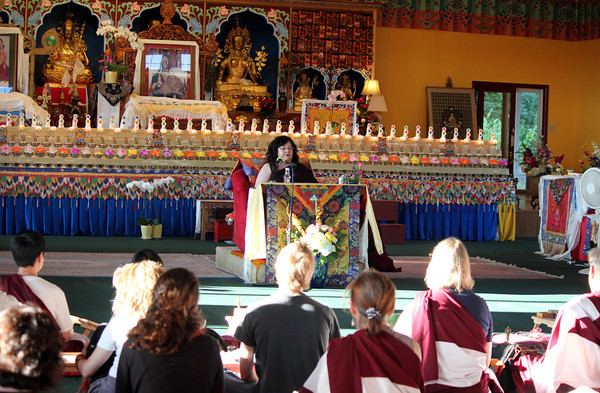
The following is an excerpt from a teaching given by Jetsunma Ahkon Lhamo at Palyul Ling Retreat in New York 2012:

In the beginning, all the lamas, including His Holiness Penor Rinpoche, ever taught us about was the bodhicitta. All we ever got was the bodhicitta. People would ask for Dzogchen. Give us Dzogchen. And the lamas would say, “No, you’re not ready. You’re not ready. Let’s start with the bodhicitta.”  After awhile, Americans got really sick of the bodhicitta. It’s really sad, but they did. I never did. In fact, I never stopped teaching bodhicitta. I know that now the bodhicitta is kind of reduced to a small bit of speech or teaching that comes right at the beginning of a practice or a wang or teaching. It is very condensed compared to what it used to be. When the lamas first came to America, it was just bodhicitta, and really nothing else. But the American students were insistent that they were ready for the Dzogchen. Eventually the lamas gave in. And I am sorry that happened, because I think we missed something.

I notice that when some practitioners practice, they’re calm and that’s good, but they are also solemn. They are not so happy looking, not so joyous. Dharma is joyous. To be able to practice Dharma is a feast.  There’s nothing in the world more joyous than that, because you have something—. \you have Buddha in the palm of your hand. You have something that nobody else has here in America. Other people have other teachers. And they have other lineages and that’s great, but we have this. And we should be thrilled and happy, and try to maintain the understanding of how precious this is.

The day we decide that we are too advanced for bodhicitta is the day that we’ve lost our way. Because if all we ever studied from this point on was the bodhicitta, it would be enough. Sometimes when we go into the higher teachings, we forget what the root is. Bodhicitta is the root. Bodhicitta is the root of everything that comes after. If you cannot develop the bodhicitta, it will be very difficult to stay on the path. As they say, the bodhicitta is like the dakini’s warm breath. It is what we consider to be the activity of the Buddhas, the nature of the Buddhas, like the sun’s rays—part of the sun and yet coming out to bless all. So when we think about the bodhicitta and we think that maybe it’s an early practice, and maybe we are being insulted by being taught this practice or maybe we should be allowed to go on, don’t hurry.

If I had my choice, I would teach nothing but bodhicitta. I used to do that, almost like Baskin Robbins’s 51 flavors of ice cream. I used to think about 51 different ways, as many ways as I could, to teach bodhicitta. I would get really creative so that it wouldn’t be boring. And what I found is that most people didn’t notice that they were only being taught the bodhicitta, because I would teach it in such a way that it would seem different and interesting. And I would make people laugh, and that always helped. You can’t be stiff when you are laughing. I made it joyful. All of us felt great joy to be together, as I see you do too. I think it is the most beautiful part of the Dharma. If we say that it is the smallest part, or the least of the parts, it is a mistake. Do all of you understand that?  It is a mistake if we put bodhicitta lower than anything else, because in order to practice we need the bodhicitta desperately. It is what keeps us going. It is nourishment.

My philosophy is that if we are on the path and every year we practice really hard and really purely here and then go home, but then forget about it, as so many of us do, then in my experience we need to go back to the bodhicitta and study the suffering of sentient beings again, again and again. Study the suffering of sentient beings so that you can understand why it is that you are practicing. You’ll have strength to practice because you will see them, and they are suffering terribly.

Seeing that woman and her husband on the roof was for me a great motivator. It was a great strengthener. It gave me spiritual muscle so that whatever I did, bodhicitta was always the crown on the head of my practice. And then above that, of course, is Tsawai Lama—above the crown of my head, and in my heart, as I know he is in yours.

Copyright © Jetsunma Ahkon Lhamo.  All rights reserved

This Very Moment

Monk at MD Stupa2

To begin to develop Aspirational Bodhicitta is to understand the faults of cyclic existence, to understand the cessation of cyclic existence, to understand something of the nature of awakening or at least to understand that that is the cessation of suffering; and then to begin to develop from these foundational thoughts a caring and concern for all parent sentient beings. Aspirational Bodhicitta can take the form of just thinking as you ordinarily think. In the same way that you think of what will I have for dinner tonight, or in the same way that you think of what you would like to wear, or the ordinary things that we think of that concern ourselves. in that same ordinary way, without any kind of high-falutin’ dogma, you can begin now to develop a sense of the need and plight of sentient beings. And you can begin to speak what is in your heart, because it is in there somewhere in the natural state—the hope that all sentient beings will be free of suffering.

Each of you has a seed potential of that hope. You could not approach a truly spiritual path; you could not approach the Buddha’s teaching. You would have no karma to hear anything of the Buddha’s teaching if you did not have the hope that all sentient beings would be free of suffering. Because in order to be involved in these auspicious conditions, in order to hear the Buddha’s teaching, in order to have the opportunity to practice and the inclination to do so, in order to even begin the idea of moving onto a path that leads to supreme enlightenment, you must have accumulated an enormous amount of virtuous karma in the past and to accumulate an enormous amount of virtuous karma, there had to be kindness. So you should not be afraid thinking that you have no compassion.

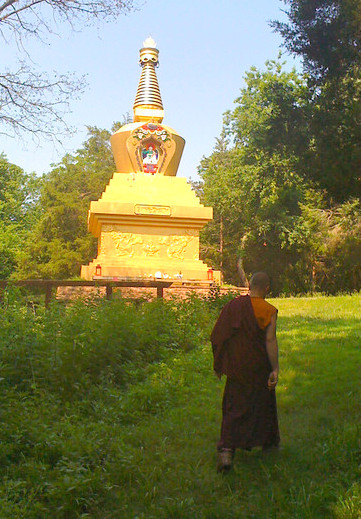
Some people tell me they have no compassion.  That is completely erroneous. That is impossible. But you must begin to dust off that jewel. You must begin to consider these foundational teachings, and to begin in whatever way you are comfortable with, to amplify and systematically develop Bodhichitta, the Aspirational Bodhicitta. You can begin to make wishing prayers for other sentient beings. One of the reasons why we built the Stupa that we built outside was to have a place here in this area that would have the fortunate quality of being able to enhance our prayers. Because of the cosmology of the Stupa—the way in which it is built, the empowerment that goes into actually consecrating it, and the wonderful relics that are present in it—because of the blessings of the prayer, the blessings of the mantra, because of all of these things, the Stupa actually has the ability, with faith, to amplify our prayers. We are taught to circumambulate in a clockwise direction making wishing prayers for all sentient beings. You can begin to do that. You can begin to make wishing prayers on your own, at any time. You can just think wishing prayers as you walk about. You can begin right now to developAspirational Bodhicitta in the same way that you develop muscle. You have the muscle fiber. You only need to strengthen it through use. That discipline is essential.

An excerpt from a teaching by Jetsunma Ahkon Lhamo called “Bodhicitta”

Copyright © Jetsunma Ahkon Lhamo.  All rights reserved

What Causes Happiness?

The following is an excerpt from a teaching by Jetsunma Ahkon Lhamo called “Faults of Cyclic Existence”

In order to understand what to do, we have to understand the definition of the cessation of suffering. The cessation of suffering doesn’t happen when everything external gets all right. Can you learn this?  Can we all learn this, please?  If we learn this, it will change your life!  The solving of this problem occurs when we are able to cut off the causes of suffering at the root. And the causes of suffering have to do with desire and the experience of duality.

So now we have to find a solution that is not anywhere in samsara. How in the world are you going to fix this? Well, you’re not… in the world. Where in the world is your solution?  Guess what?  Nowhere. Then we have to find something else. And what is that something else?  Well, now we are looking to understand that desire and this original ideation is the cause for all suffering. So the way to cut that would be to cut it off at the root. We have to move beyond the realm of cyclic existence in order to get any satisfaction, in order to get an answer, in order to understand, literally in order to prevent the causes from manifesting. In order to cut them off at the root, we have to move outside of the realm of samsara.,  So we look to see if everything we’ve known and experienced arises from the idea of self-nature being inherently real. What is outside of samsara?  Well, it is the one thing that, as samsaric beings, we cannot perceive. It is our own Buddha nature, the primordial wisdom nature that is the innately wakeful , sheer luminosity called Buddha.

While we are revolving in the realm of duality, we cannot see this nature.  Yet it is this very nature that is the cessation of the causes of suffering.. In order to cut off suffering at the root, one would have to cut off the connection to the potency of the desire realm. We, as samsaric beings, are desire beings. We are motivated solely by desire. and  the Buddha teaches us that this is the very cause of suffering. So what we’re hearing here is that everything we know, everything we call “me”, every habitual tendency, everything that has come together to knit the tapestry of our lives, is of that cause for suffering.

What monumental effort should happen in order to reach beyond that? How to even define what is beyond that when, by definition, we are the samsaric beings whose first assumption is that of self-nature being inherently real? This is where the power and the majesty and the potency of the practice of refuge comes into play. Because when we look at the appearance of the Buddha, the Dharma and the Sangha in the world, and the inner and secret refuges as well, we can see that that which we call Buddha nature, that which we call Buddha, does not originate from the desire realm. It is that ground—uncontrived, innately wakeful luminosity—that is the underlying primordial wisdom state, suchness, from which all display, all emanation actually comes.

This that we are caught in and experiencing is simply some offshoot, some manifestation in a way, whereas the fundamental all-pervasive truth of our nature, is to us unseen. Yet it is that nature, that which we are naturally, which we must strive toward in order to be awakened, That is the clue; that is the key. In our natural state as Buddha, as that sheer luminosity, there is no distinction, no distortion, no conceptualization, no idea that self is separate from other, no understanding that it could even occur that way. No distinction. Only suchness, one taste, that nature which is conditionless. As we are now we cannot even imagine a conditionless state, a conditionless nature, and yet this is our nature.

So when we practice refuge, we do it in stages. The ultimate refuge is when we understand and awaken to our own face, our own true nature. But in the beginning we practice by conceptually isolating that which is without conception. We have to. On an ordinary level, let’s say the goal was physical fitness and strength. Well, that’s an abstract concept. How do you get that?  You can’t buy that. You can’t hold that in your hand, but you can do the exercises, you see?  Same thing. Buddhahood. We can’t buy it, we can’t hold it in our hand, but we can establish the method.

The method begins with the recognition of the Buddha which is the primordial, uncontrived nature that happens to have appeared in cyclic existence at this time, during this aeon, as a man. But the man is not the thing. Lord Buddha is the display of that nature. We use his image and his teachings as a way to understand because he speaks directly from that nature. But we understand that we are awakening, awakening, awakening. That’s the understanding of refuge. We are looking for that which is not composed of the causes of suffering. And here while we are suffering and revolving endlessly, and watching others revolve endlessly, here while this occurs, we are that, in truth, which is the cessation of suffering, Buddhahood.

 Copyright © Jetsunma Ahkon Norbu Lhamo All rights reserved
Letting Go of Judgment

moms against hunger

The following is an excerpt from a teaching by Jetsunma Ahkon Lhamo called “Bodhicitta”

 We should begin to think of these teachings that the Buddha has given us in such a way that we awaken within ourselves a real caring for the well-being of sentient beings. If you saw a tiny rabbit caught in a trap, and its leg was bleeding and bruised, I know that you would open the trap and let the rabbit be free. If you saw a child that was really hungry, hopefully you would be not in the circumstance where you would make all kinds of judgments about that hunger, such as, if you looked at a bum who was drinking alcohol or something like that where your discursive mind got in the way. But if you just looked at a child, just a child, a helpless child, who was hungry; if you had food on your plate, I know that you would give some to that child. In this way, you should think of other sentient beings and begin to, through utilizing that kind of thought, understand their plight. It is most necessary to understand their plight, and through that begin to polish away the dirt and the filth that covers that precious jewel which is our inherent nature. 

We should take a hold of ourselves in such a way that we do not feel separate from Bodhicitta as though it were a thing that we have to get, but instead begin to develop the understanding that ultimately it is the awakened state. Because of supreme awakening, we will understand fully the faults of cyclic existence. We will understand absolutely the awakening that is the cessation of all suffering and be naturally and completely motivated to bring about the end of suffering for all sentient beings, because at the same time, we will understand that the self that we cling to, the one that causes us to think only of selfish concern, this self is also illusory.

Having realized that, there is literally nothing to do other than to emanate in a form or to engage in miraculous activity that brings about the liberation of all sentient beings. So this activity is not something we do when we get kind. It isn’t something that we collect as though it were wisdom. It is the natural state of awakening.

Copyright © Jetsunma Ahkon Norbu Lhamo All rights reserved
Looking for Happiness

The following is an excerpt from a teaching by Jetsunma Ahkon Lhamo called “Faults of Cyclic Existence”

If we broaden our perspective, we look out from our own self-absorption into our immediate environment which is generally pretty easy for most of us.  We have friends and relatives that we don’t mind increasing our space to include and we look at them and we consider them part of our lives. But let’s move out and see all the rest of humankind.  They are all, in the same way as we are, striving to be happy.  And then look out beyond that to the animal realm.  Even though these animals don’t have a forehead, even though these animals cannot conceptualize in the same way that we do, still each one of them in their own way is trying to be happy according to their capacity. The predator is trying to be happy when it chases its prey.  The prey is trying to be happy when it fixes itself or creates for itself a safe environment and develops coping mechanisms with the reality that the predator is always out there.

There are many different ways to view this, but we can see if we really study, that we all have that in common and so we become, in a sense one family with a fundamental genetic code.  Even across species, even across the form and formless realms, we become one family with this particular underlying reality in common. Now if we were to really contemplate this issue in this way, we might come up with a new world view.  Wouldn’t that be wonderful!  We might come up with a new, more universal perspective.  Wouldn’t it be delightful!  We could use that tool as a way to end self-absorption, and to really open our eyes and look at everything around us with a new kind of vision, a new kind of empathy, a new kind of understanding, a new kind of willingness to put oneself in the place of others, a new kind of planetary human, you know, aware of life around itself, a new kind of cosmic perspective, a new understanding as to what life is all about.

Now how does this relate to refuge?  Well, as we are turning our minds towards Dharma,  that means softening them, preparing them, fertilizing them, plowing the field so that the mind is turned toward the path that leads to liberation and renouncing what does not lead to liberation.

Where does the idea of Bodhicitta actually come into play?  Actually it comes into play as both a motivator and as a clarifier.  As a motivator , we understand that part of the process of turning the mind towards Dharma is to truly look at the six realms of cyclic existence and all the conditions and situations of sentient beings.  Having done that, we see that cyclic existence is faulted and that these sentient beings, although they do wish to be happy, have no understanding of the causes of happiness.  That’s the main different between a Dharma practitioner, and the serial killer.  The Dharma practitioner wants to be happy just like the serial killer, but they are engaging in method.  Method means we are looking at cause and effect relationship.  We see the faults.  We look at cause and effect relationships and we are trying to work it out where we produce the causes that allow the desired effect.

The serial killer is also trying to do that.  He perhaps feels some kind of need build up in him and then he goes and tries to satisfy that need.  So in his way, this serial killer is doing the same thing.  He is engaged in trying to create the causes that produce happiness.   The difference is he does not understand.  There is such heavy delusion that there is no understanding of what causes produce happiness, so the serial killer is in a way, like a completely ignorant, completely confused, completely hatred-oriented basket of misconstrued ideas acting in a knee-jerk way to get some kind of result.  He is not able to think it through and has no guidance to think it through.  So the serial killer is yes, engaging in method, but what method?  The serial killer is engaging in the method of hatred, is engaging in the method of destruction, is engaging in the method of harm-doing, and is thinking that it will bring some sort of power or happiness or relief in some way.  And yet what this person doesn’t understand is that the seed and the fruit cannot be unrelated.  You cannot produce happiness from the fruit of hatred, destruction, ignorance and harm doing.  You cannot produce happiness in the same way that a peach seed cannot produce a banana tree.

 Copyright © Jetsunma Ahkon Norbu Lhamo All rights reserved

Do We Know How to Be Happy?

dogs_with_the_habit_of_chasing_cars_on4bh

The following is an excerpt from a teaching by Jetsunma Ahkon Lhamo called “Faults of Cyclic Existence”

When we broaden our view and look out,  we see that this is happening to a greater or lesser degree to all sentient beings.  All sentient beings are striving to be happy.  They wish to be happy, but in varying degrees, they do not understand the causes of happiness.  We see this also in our own lives.  See, we’re the good guys, we’re the Dharma practitioners. But even in our lives we see that we engage in compulsive, neurotic habitual tendency time and time again. Cyclically actually. We’ve noticed this and we talk about this and we laugh about it.  You know, women get together and we have girl talk.  We know this one really well;. And men are in the same situation.  We repeat patterns that are nonproductive.  Is that a light-weight way to say it?  We literally put ourselves through the lowest of the realms.  We put ourselves through hell, literally.  We are not our own best friends. And we only see it when we are coming out the other side of the compulsion and it didn’t bring us what we want. Then it’s like, “Well I knew that!  Why didn’t I think of that!  I knew that!  How ridiculous!”  And then you know, six months later there we are, going down the pike again.

In one way, then, our compassion is increased because we see that the serial killer is busy bumping off everybody else in order to get happy, and we are busy bumping off ourselves to get happy.  And the confusion and habitual tendency is there.  It’s there. We have that in common.  So we look out and we say, “Wow, if this is the case for myself and I am a Dharma practitioner, how much more so the case for those beings who have had no information on what produces happiness?  We are the children of a materialistic society.  We were told that if you have two good cars, a chicken in your crock pot and several more in your freezer and a good husband or wife, good children, all these good things—everything that’s good has been labelled, you know, we already know what’s good—and an ongoing prescription of Prozac that we could be happy.Aand an occasional face lift.  It gets more complicated as you get older.  Did you notice that?  I mean, at first it was just finding the right man andyou’re home free.  Now it’s find the right man and make sure once you’ve got him, these things don’t drop. And it’s beat gravity and beat the clock and all that other stuff.

So we are, in our way, almost as clueless.  We still engage in these funny things that we do. And every time that we do them, we think they’re going to make us happy.  And then we come out the other side of it with open eyes—like whoops, that didn’t work!  But you know, we’ve noticed for ourselves how limited our capacity is to learn.  Is that not the most astonishing thing? How really intelligent people cannot learn?  Is there a button we’re supposed to be pushing that we don’t know about.? I mean, where is the input button?  We just don’t know. So this is the condition of sentient beings.

Now I know, as you must know, how much I want to be happy.  You know how much you want to be happy, right?  I mean, if push comes to shove, you’re pretty motivated by this.  Isn’t that  right?  Of course you want to be happy.  You’d be a maniac if you didn’t want to be happy.  Are you a maniac?  So we want to be happy.  I certainly want to be happy.  And there are days, are there not, when the yearning to be happy and the feeling that you are very distant from that happiness is so strong that there’s a lot of grief, isn’t there?  A lot of upheaval and grief. There are times when it’s just so difficult and so very far away.  It’s funny how it happens.

Now if we were to take that grief and that feeling and project it outward and think, “Here I am with all the understanding that I have about what makes happiness, and all the skill that I have and all the intelligence that I have and all the good fortune that I have that makes it possible for me to get a grip here and really see what’s going on, and still I can’t manage it.  How much worse must be the condition of other sentient beings who are completely out to lunch about the subject?”  Now if you think about the animal realm, they don’t even have the capacity to take in the information about cause and effect, an extraordinarily limited capacity to learn cause and effect.  Have you ever watched a dog that has the habit of chasing cars?  No matter what you do to them, they will chase the car.  They are terrified because they are so close to getting killed and somehow they know it, but they can’t learn!  They can’t learn that not chasing that car is going to make them feel much more relaxed.  They simply can’t learn that.

So how much less is the capacity for other sentient beings to be free of that kind of suffering?  Now we look out and we really see that all around us is this terrible, terrible grief and suffering and disappointment that is masked in certain ways, is covered in certain ways, is disguised, is transmuted, is rearranged, is redirected, is re-routed, is lied about. And yet underneath it there is that grief, there is that loneliness, there is that difficulty that we have in understanding what makes us happy, and how to be happy.

So this then becomes a causative factor when we engage upon the path.  It’s one of the reasons why we practice refuge so sincerely.  We use this idea not only as a practice in itself, but as a way to motivate ourselves.  Literally, as practitioners we should come to the point where we look around and we see for ourselves that all sentient beings are wandering in this confusion and we develop a profound sense of compassion.  If we really were to study and look around and emphathize and see beyond ourselves how others are suffering even more than we are, that feeling of great love and great compassion would well up within our hearts, and this feeling that enough is enough!  Enough! There has been enough suffering in the world.  Enough!

So by that compassion and that love, we become motivated. And the times that we are feeling undisciplined or feeling dry or off-track on the path, we can rely on that love to come up and nurture us.  It’s happened even on an ordinary level within our lives.  We make a determination to take a more difficult route to accomplish something, even not so much concerning the path, but a difficult route to accomplish something in our lives.  Then to accomplish that requires such a great herculean effort like changing, that after awhile, somewhere in the process, we lose focus.  We ask ourselves, “Now why am I doing this again?  I really can’t remember today!”  Then we look at someone else near us who is suffering terribly, just suffering terribly, and we vow to organize everything around us to make it better so that the person next to us is not going to suffer so much.  We’re motivated by that and it brings us back into focus.

The same kind of situation happens on the path.   We utilize the suffering of others, the understanding of that suffering, to center us, to motivate us, to keep us nourished on the path.  At the same time, and here’s where the double blessing comes in, at the same time, we are also giving rise to the Bodhicitta which is the awakening mind, the mind that is in its essence the very display of compassion.

 Copyright © Jetsunma Ahkon Norbu Lhamo All rights reserved

The Dharma

The following is from a series of tweets by Jetsunma Ahkon Lhamo:

The Dharma is as vast as samsara, and is also as stable, as long as there is samsara there will also be Dharma.

As long as there is Dharma there will also be Samsara, because the Dharma is natural, uncontrived and would not exist without Samsara.

Copyright © Jetsunma Ahkon Lhamo.  All rights reserved

All Sentient Beings Wish to Be Happy

The following is an excerpt from a teaching by Jetsunma Ahkon Lhamo called “Faults of Cyclic Existence”

When we are considering the thoughts that turn the mind, we consider the teachings on the six realms.  We consider the faults of cyclic existence.  We consider teachings on cause and effect.  We consider teachings on impermanence.  But also we consider teachings on compassion, and they start with, and are absolutely related with, those teachings that you have just had on the six realms of cyclic existence and the faults of cyclic existence.

The idea of compassion, of Bodhicitta, is intimately related to that.  The way that they are related is like this:When one is actually considering entering onto the path, or considering making one’s relationship with the path much more firm and solid, or if one is a more advanced practitioner, to deepen on the path, one always has to go back and re-examine the faults of cyclic existence. One of the main thoughts that we have concerning the faults of cyclic existence is that we look around and we see the Buddha’s first teaching in action.  We see that all sentient beings wish to be happy. We all have that in common —we all wish to be happy.  It is our motivating force.  Whatever it is that we are doing, whatever form it takes, underneath that is the wish to be happy. Now each one of us has delusions.  Each one of us has habitual tendencies. But underneath all of them is the wish to be happy

One way to understand this and to really broaden the perspective on it is that in some cases it is very easy to see that a person is striving to be happy.  You might see one person, one particular type of personality, for instance, using every skill that they have to maintain happiness and joyfulness and equilibrium and that sort of thing.  Maybe they go to psychotherapy in order to clear out neuroses, or maybe they do a lot of affirmations, you know, positive thought—thinking in affirmations about themselves in order to try to be happy.  And for the people like that who are trying to maintain a certain kind of energy in their personality, it’s very obvious that they are trying to be happy.  You can mark that and see it very easily.

But what about somebody like a criminal?  What about someone who is a committed criminal? I mean a serious criminal, somebody who has done something unthinkable, such as even a serial killer?  I don’t mean somebody that kills cheerios, I mean, kills people in a row—a serial killer.  Let’s say somebody like that.  We can’t even understand what the mind of a serial killer would be like.  They are filled with obsession, filled with compulsion, filled with hatred.  In many cases they are psychologically incapable of empathizing with other human beings.  It’s like they have a microchip missing.  They are all kinds of messed up.  All kinds of messed up.  To many of us their thinking, their world, may not even be recognizable.  It may not have even the same landmarks.  And internally, certainly, if we could go into their minds, it would not be recognizable as any kind of internal reality that we’ve ever experienced.  So they would seem very different from us.

But there is one factor that we have in common with somebody like that, and that is that we are both equally, in our own way, trying to be happy.  Believe it or not!  This person who commits such a horrendous crime, and does so repeatedly,  is compelled to continue doing so. If we were to really go within and try to slice and dice enough to find out what moves this person, what is happening here, we would find out that there would be a lot of jungle to go through.  I’m sure that that’s the case.  There are a lot of entanglements in there and a lot of mental confusion.  However, underlying the dynamo that drives this engine is aperson who wishes to be happy and, in that way, is completely the same as you, completely the same as you.

Now I’m not recommending that because of that we should be nice and pat them on the head and let all the serial killers out on the street.  I’m not saying that.  I realize that this issue is far more complicated than I am presenting it, but the fact that I’m mentioning does not change, no matter how complicated the situation is.  And that is that this person has something in common with you that is very strong and it is what drives both of you.  You wish to be happy.  Interestingly, neither one of you really knows how to be happy until, as a mature practitioner, you have really contemplated and studied the Buddha’s teaching and learned something about that, and then maybe had enough life experience, in terms of maturity, to go within and approach oneself honestly, to look at oneself and examine one’s habitual tendencies.  These are the kinds of skills that we learn as life skills, and skills that we learn on the path in order to help us to begin to learn what comprises happiness, what actually makes it up, and to develop the skill of how to produce it.

But until that happens, we are the same as anyone else.  All sentient beings are exactly the same in that way.  Maybe not in too many other ways, you know, but in that way we are exactly the same.  And this is true of all the beings in all the realms of cyclic existence, not only in the human realm.

Copyright © Jetsunma Ahkon Norbu Lhamo All rights reserved

Polishing the Diamond

white-diamond-on-the-polishing-wheel_1852.eeb69

The following is an excerpt from a teaching by Jetsunma Ahkon Lhamo called “Bodhicitta”

I have been aware that people in our age and people who are awakening to spirituality and meditation and these different philosophies have been exposed to the idea that we have lived only just a few times, whereas the Buddha teaches us that is not true. The Buddha teaches us that we have lived, we have revolved in cyclic existence over countless aeons. An aeon alone is a very long time. And countless aeons, that kind of terminology is inconceivable to us. In order to have revolved since beginningless time, in countless aeons of cyclic existence, we had to have parents every time unless we were born in a realm in which parents were not the way of birth. But whether we were animals or humans or some other form that we don’t recognize at this time, whether we were born in the form or formless realms, there is a great potential for all sentient beings to have been our parents endlessly. And the way in which to understand the kindness of all sentient beings, the way in which to understand their kindness to us so that we can begin to build Aspirational Bodhicitta, is to understand that at this moment we’re here. We are hearing the Buddha’s teaching and we are experiencing comfortable circumstances in which to practice. We have no defects of mind or body that would prevent us from practicing the Buddha’s teaching. We are capable and we are able and we have the leisure to accomplish practice. We have very auspicious circumstances. 

To have come to this point, we must think of the kindness of all of the situations that have brought us to this point. We shouldn’t think that our parents had any capability to prevent us from coming to this point, because they haven’t prevented us from coming to this point. So we shouldn’t think of their cruelty. We should think of their kindness because somehow, having birthed us, they have given us this precious opportunity to accomplish enlightenment. This is true for all of the circumstances that we have ever experienced, all of the births that we have ever experienced. Having come to this point, we should be thankful and grateful and happy, filled with joy realizing that this auspicious moment has occurred at last. And like finding a precious jewel while sifting through garbage, here we are and we have found the Dharma.

So having experienced this joy, we can begin to understand that all sentient beings have been our kind mothers and fathers, and that we owe them a great debt. We can remember once again that cyclic existence is just that, it is cyclic and endless, and that they are struggling night and day working very hard to make themselves happy and have no way to do it. We should think again and again that they are lost. Although they have given us birth in such a way that we can accomplish Dharma, and that all of these many parents who have birthed us over these many lives in order to help us to create the causes by which we might meet with this perfect Dharma, that even while they have participated in that, they themselves have not done it. It reminds me of a form of animal that I read about. It’s actually an insect called the midge. It conceives its young within itself and the young, as they begin to grow, actually eat the inside of the mother; and consume the mother. By the time they are ready to come out, the mother is dead, and they simply break out of her body as though it were an egg. We should think of that, and we should think that perhaps all sentient beings have done that for us. If they remain in a condition of suffering and we have now found the perfect path by which to alleviate their suffering, then perhaps it’s time to begin to develop the kindness that will liberate them from their unbearable suffering and their continued involvement in cyclic existence.

So when we hear about this Aspirational Bodhicitta, we become confused as to how to think of it. Time and time again students have said to me, “What practice will help me develop Bodhicitta?  Isn’t it true that once I begin to practice, I will develop Bodhicitta?” or, “How can I best develop Bodhicitta?” They talk about Bodhicitta or compassion as though it were something separate from themselves because we think of all phenomena, both internal and external, as separate from ourselves. That is part of the basic delusion of believing in self-nature as being inherently real. It seems to come with the package. Yet, we need to take a hold of ourselves and begin to understand that Aspirational Bodhicitta is potentially the way we are. It is not a reality separate from ourselves. It is not a mystery that we should approach in a linear way, perhaps in the way that we used to think of spiritual mastery. It used to be that, before we studied the Buddha’s teachings, we began to think of spiritual mastery as accumulating this wisdom and that wisdom and this wisdom and that wisdom and this wisdom and suddenly, you would become a great master. And that’s it. Now you’re a master. Well that isn’t really how the Buddha considers realization. The Buddha considers that you cannot collect wisdoms or knowledges and that they in a sum total will create mastery. The Buddha considers that true wisdom is the realization of the emptiness of all phenomena and the emptiness of self-nature, the illusory nature of phenomena, the illusory nature of self. This is the true wisdom, and it is not something that you can collect or gather.

In the same way, when Bodhicitta is fully realized, it is none other than the Primordial Wisdom state. It is none other than supreme awakening. Bodhicitta then, ultimately, when it is fully realized, is our own nature, and we should not treat it as though it were something separate from ourselves. We should not treat it as though it were a thing that we could collect by doing this practice or that practice. Instead, we should take a hold of ourselves and begin to uncover the diamond of Bodhichitta, the jewel of Bodhicitta. We should begin to uncover it by polishing away the delusion that occurs through the selfish concerns which are born of a lack of understanding of what awakening truly is.

Copyright © Jetsunma Ahkon Lhamo.  All rights reserved

WP2Social Auto Publish Powered By : XYZScripts.com