Who is Padmasambhava?

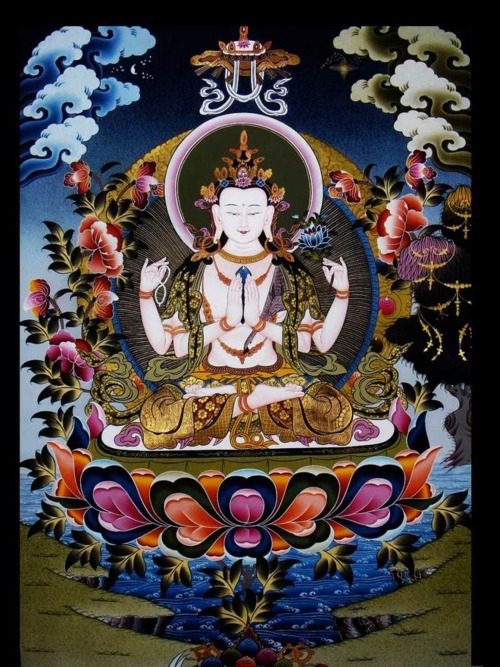
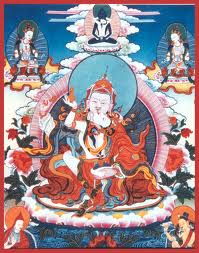
PadmasambhavaMandarava

The following is respectfully quoted from “The History of the Nyingma School of Tibetan Buddhism” by Dudjom Rinpoche:

He studied all the sūtras, tantras, and sciences under the many scholars and accomplished masters of India, of whom the foremost were: the eight great awareness-holders, from whom he received the Eight Classes of Means for Attainment; Buddhaguhya, from whom he received the Magical Net; and Śri Simha, from whom he received the Great Perfection. Training himself thus, he fully understood all doctrines after studying them only once. He could see the deities even without propitiating them. In this way, he became renowned as Loden Chokse (Intelligent Boon-seeker), and he demonstrated the ultimate attainment of a holder of the awareness of spiritual maturation.

Then he gained influence over Mandāravā, the daughter of King Ārsadhara of Sahor, who possessed marks of a dākinī. He took her to the Māratika Cave, to serve as the consort for his practice; and for three months they practised the means for attainment of longevity. Lord Amitāyus actually came there and empowered them, and he consecrated them to be no different than himself. He granted them one billion rites of longevity, whereby Padmasambhava attained the accomplishment of awareness-holder endowed with power over the duration of his life.

Having thus attained the body of indestructible reality that is beyond birth and death, Padmasambhava went to subdue the kingdom of Sahor. When the king and his ministers tried to immolate him, he performed the miracle [of transforming the pyre into] a lake of sesame oil, in the midst of which he remained seated on a lotus. Thus he secured them in faith and introduced them all to the doctrine, so that they reached the level of no-return.

Hells?

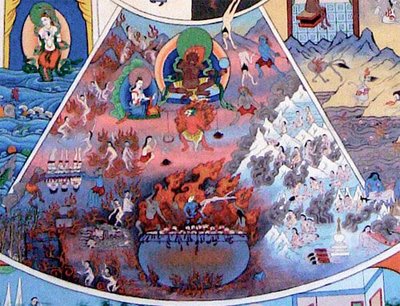
Hell realm z.about.com

The following is an excerpt from a teaching by Jetsunma Ahkon Lhamo called “Why P’howa?”

According to the Buddha’s teaching, there are six realms of cyclic existence, and I will begin with what is called the lowest of the realms.  Now generally, when Westerners hear about the different realms, oh, we love the high realms.  Those are our favorites.  But the lower realms scare us a bit.  Westerners don’t want to hear about the lower realms, because they are associated with something archaic that their mothers told them, or that their old preachers told them sometime in the past.  Every world religion has a story about a result that will occur if one engages in a lifelong non-virtue, or even in temporary periods of non-virtue, every single world religion that has the kind of strength to have lasted through fads and trends and teachers that say they have it, and then they drop dead just like everybody else and there is no good result.  Every world religion has a teaching about this result from non-virtuous behavior so for those of you that are uncomfortable about this, I’m sorry.  Here’s what you need to do.  Get out of it.  Get out of cyclic existence.  That’s the point.  That’s why we’re having this teaching.  If you don’t like the idea of the result of your non-virtue, don’t commit it.  If you don’t like the idea of sinking to a lower realm or experiencing any of those lower realms, create the causes for not sinking to a lower realm.  First let’s learn about the realms.

Again, we’re walking through a room with the lights turned on.  You want the lights on so that you can get around it.  The difference with the Buddha’s teaching is that we are taught a method to avoid this [experiencing a lower realm].  We are taught a method to purify the causes.  There is method.  There is long-term method that is geared for a certain result, like the ability to turn the light on.

Of the six realms, the realm that we will speak of first is the rebirth in the hell realm.  There are many sentient beings that are now, even as we speak, revolving helplessly in the hell realms.  I guess the Christian idea of hell is a place under the earth where things are burning.  That is not the idea that we have here.  The hell realms are varied.  They are varied in their condition.  There are, in fact, extremely hot hell realms and there are Dharma texts in our bookstore [that tell about them]. I don’t feel the need to go into that at any great length at this time because that isn’t technically what we are about at this time; I’m going into this in a condensed form, but there are the hot hell realms, and the hot hell realms are all results that are associated with the cause of hatred, extreme hatred, the kind of virulent hatred and attitudinal hatred that many people allow to remain in their mind.

A perfect example of that kind of hatred would be the Ku Klux Klan kind of mentality you see, or the Hitler kind of mentality, the kind of mentality in which hatred simply pours out of the pores.  There is such a strong habitual tendency of hatred that simply is unconditional negative hatred instead of unconditional positive regard.  It is habitual.  It is constant.  It is simply an outpouring of hatred.  This is associated with the cause of truly torturing and hurting others. There have been many throughout time who have tortured and mutilated the bodies and lives of others in a horrible way that we, living  middle America lives, really can’t imagine except through what we’ve read.  There are, of course, other certain heinous sins that also result in the rebirth in the most difficult of the hells. Those heinous things are the murdering or killing of one’s mother and father, the murdering or killing or harming of one’s Guru, the murdering or killing or harming or drawing blood of a Bodhisattva.  That is not to say that if you were taking a blood sample for the health of the Bodhisattva, … Well, people would not exactly be standing in line for that job would they!  No, but that would not be intentional harm, like really harming a Bodhisattva, someone who could bring enlightenment to others. Harming or taking that one out of the world is considered to be a heinous crime because it actually literally changes the future of the world.  It changes the world in a negative way.  It prevents the world from moving forward in its evolution, in its continuum.

For extraordinary non-virtue, for those really extraordinary sins, there are the hell realms consisting of the extremely hot hell realms and the extremely cold hell realms. Characteristic of both the hot and cold hell realms is that there is no respite from the suffering.  There is no respite from the suffering.  Literally, when one takes rebirth in the cold realms, one will be reborn in inconceivable cold with no protective clothing.  What will happen to oneself will be the experience of what we think would happen to ourselves if we were to be suddenly now naked in an extremely cold realm.  That is to say, the skin would freeze, crack open.  Things would happen strangely to our bodies and you would think that that would be the end of it.  But in these very cold hell realms, until the non-virtuous karma is exhausted, one continues to reappear even after death from cold has occurred, and that is the same with the hot realms.  Continuously apparent, there is no respite.

There are other forms.  There are the individual hells; and I can tell you for a fact that I know, through my own perception, that this is true.  I have seen this sort of thing and this is the kind of thing that people mistake as being ghosts.  Often you go to a house and at a certain time of night you will hear footsteps or you’ll hear a door creaking or you’ll hear chains rattling, whatever it is that people hear, that sort of thing.  Probably what has happened there, although not exclusively, but probably what has happened there is that there is a sentient being stuck in an individual hell realm.  This is the hell realm that is individual to the person’s experience, whatever their expected experience is. It’s according to the content of the mindstream, their consciousness, their habitual tendency.  Write that word down somewhere in your notes, or remember it—habitual tendency. That will come up again and again during the course of your practice as a Buddhist. Due to the force of their habitual tendency, they will remain and this kind of hell realm is the result of again, extreme non-virtue, but it is also a non-virtue that is mixed with ignorance and a determination to remain ignorant.

Think about that, because you have done this.  Think about this now.  The determination to remain ignorant is the one where you make a decision to go away from pursuing wisdom and pursuing your method, your path.  And you just go, “It’s too hard.  I don’t like this.  It’s not easy for me, I don’t want it.  Hard.  And I’m just a little kid and I have to play some more.”  When you do that, you are actually turning your mind away from Dharma and you are committing a very strong non-virtue. The other one is, “I don’t have to learn that.  I know enough to get by.  I’ll just read…, Who was that one that wrote about death and dying?  A non-Buddhist.  They wrote that you see a tunnel and you see a white light.  Do you remember who that is?  I’ll just read Ross’ book and I’ll be fine.  Maybe I’ll read it, if I have time, but I really like to read other books better.”  And this kind of thing.  You have this kind of idea.

Sometimes, I’ll see a person in class with ‘attitude’ written all over their heads, and have no idea why they’re here.  Why did they come?  I don’t know, but they have attitude written all over their head; and the attitude is actually like putting yourself in chains because you are absolutely setting up that you are not going to have a positive rebirth, that you can sit in the presence of what could possibly be your own root guru, or at least a guru, a teacher, and just simply turn your mind away.  Literally, what you would be doing there is to make your mind like a bowl filled with poison so that the milk that pours in there is tainted, and then you are responsible for tainting the milk within your own mind.  So that kind of thing is the kind of thing that leads to rebirth in the individual hells.  That kind of ignorance.  That is an ignorant move to make.  It is born of ignorance.

The individual hells are very strange, very unusual.  I can describe a couple that I know of personally.  One good example would be of an individual who perceives themselves to be stuck in the opening and closing of the door. Of course this is all relative and it is all a deluded perception.    This is the kind of person that perhaps would remain stagnant within the course of their lives, locked themselves in, did not grow, wouldn’t grow, would not challenge themselves to go the extra mile and be kind towards others, remained extremely self-absorbed.  They literally shut their eyes during the course of life.  Again, that sounds pretty mild in terms of a sin.  You could commit worse sins, but we are talking about sins against one’s own nature and those are important.  Those are very important.   So this person would be stuck in the opening and closing of the door and would experience the door being closed on them and would experience the door being opened again. They would experience it as though their bodies were literally stuck in that, again and again.

I have also seen sentient beings that are literally stuck walking up and down a hall.  That’s it, walking up and down a hall.  They are stuck calling, calling, calling for someone.  Literally they go through bardo—and this will make sense for those of you that have taken the teachings. They will go through the bardo state: They will go through the experience of the white Bodhicitta, the experience of the red Bodhicitta.  They will go through the experience of the appearance of the Dharmadhatu that is experienced as blackness.  They will go through the re-awakening of the perception of the Buddhas and Bodhisattvas.  They will go through the reawakening of the perception of the wrathful deities. Then they will enter into the bardo of becoming, and in the bardo of becoming they will immediately experience rebirth. It will be very disconcerting because suddenly they will be walking up and down a hall, trying to reach the others that they were so attached to.  Those of you that have very strong attachments on a human level, try to imagine what this would feel like.  They will continually try to reach out for the others and they will sort of see them, but sort of not see them because they are not really there.  Try to imagine seeking the safety of a loved one, and it changes all the time.  You don’t understand.  That’s the kind of experience of someone in an individual bardo. They experience walking up and down the hall, literally, almost seeing safety and then feeling all of the feelings that would go with doing that endlessly.  So that is the kind of experience that one might experience if one were to engage in a non-virtuous life and not practice Dharma. And it happens.

Now what we’re talking about today, once again, is the antidote.  The purpose of talking about the disease is so that we can explore the antidote.  The antidote should not be taken without an understanding of the disease.  These kinds of life forms will also be registered.  From our point of view they will seem like repetitive ghosts doing the same kinds of things again and again and again.

There are many different kinds of hell.  There are hells of entrapment.  There are hells of destruction in which one is literally cut up and then reassembled and all kinds of things, and they go according to the level of non-virtue that one has committed.  Compared to the amount of sentient beings that are now physical as humans, the amount of sentient beings locked in those hells is inconceivably more.  We cannot understand how many more beings are locked there than are now approaching awakening on the physical human level listening to Dharma.  We cannot imagine how many of those there are.

Sometimes as one finishes the karma that has brought them to a lower hell realm, they will then go on to a higher hell realm which is less uncomfortable.  What we are talking about is a playing out the grosser and heavier non-virtue and then cleaning up the more subtle and more lightweight non-virtue.  One may graduate from one experience in the hells to another.

You may think, “Well this is inconceivable to me.  I can’t understand that.  Being stuck in a doorjamb? No way.  Hell no!  Frozen?  No.  Hell no!  Frozen, burned up?  Come on, that stuff doesn’t sound realistic to me.  I can’t believe in that.”  Well, let me ask you if you’ve ever had a nightmare?  Who has had a nightmare?  Will you raise your hand if you have ever in your life had a nightmare.  Just pretty much everybody.  That means that your mind has the capacity to manufacture a hell.  So for you to say that there is no such thing and you will never end up there, after you’ve had a nightmare, it goes to show that you’re not thinking. Because if you can manufacture a nightmare, that is not different from manufacturing a hell realm.  It is the same thing.  The seed, the content, the potential is within the mindstream and it is due to non-virtue.  That’s what it is.

So you know that that’s possible.  You have been there in a very small way.  When you have a nightmare you literally are, in a subtle way, reborn from the bardo of dreaming into this bardo of experience, which is also part of the bardo of dreaming. You are kind of reborn from one subtle element, one subtle level, to another.  And this is the very same thing that happens in a much grosser and denser level for that person who is unprepared for death, which fortunately is not going to be you.  Right?  Good.

Copyright © Jetsunma Ahkon Norbu Lhamo All rights reserved
 

The Benefits of the Awakening Mind

Here is another excerpt from the first chapter of A Guide to the Bodhisattva’s Way of Life called “The Benefits of the Awakening Mind.”  May these words written by Shantideva inspire all who encounter them.

 #26

How can I fathom the depths

Of the goodness of this jewel of the mind,

The panacea that relieves the world of pain

And is the source of all its joy?


#31

If whoever repays a kind deed

Is worthy of some praise,

Then what need to mention the Bodhisattvas

Who do good without it being asked of them?


#32

The world honors as virtuous

One who sometimes gives a little, plain food

Disrespectfully to a few beings,

Which satisfies them for only a half a day.


#33

What need be said then of one

Who eternally bestows the peerless bliss of the Sugatas

Upon limitless numbers of beings,

Thereby fulfilling all their hopes?


#34

The Buddha has said that whoever bears a harmful thought

Against a benefactor such as a Bodhisattva

Will remain in hell for as many aeons

As there were harmful thoughts.


#35

However, if a virtuous attitude should arise (in that regard),

Its fruits will multiply far more than that.

When Bodhisattvas greatly suffer they generate no negativity,

Instead their virtues naturally increase.


#36

I bow down to the body of those

In whom the sacred precious mind is born.

I seek refuge in that source of joy

Who brings happiness even to those who bring harm.

The Trap of Duality

The following is an excerpt from a teaching by Jetsunma Ahkon Lhamo called “Tools to Deepen in Your Practice”

We see ourselves in a dualistic way.  We have very concrete roles as to how that dualism plays out: in the way that we procreate, in the way that we die, in the way that we’re born.  We have very exacting ways in which it plays out because of our belief systems, because of the system of duality.  And we’ve had a long time to work out the kinks.  So, when we believe in physical reality as being essentially real, we can find all kinds of facts and information and people who will agree with us.

And if you wish to avoid awakening to the primordial state, you’ll have lots of friends,  because most everyone is locked into that confusion of the five senses.  Like a dream. We know how it is when we’re in a dream.  We may on some level understand it’s a dreamlike state, but the emotions are so strong.  It just pulls us into it.  A dream can be very sensual.  It can be very alluring.  It can be very stimulating in that you’ve had dreams with interesting things that happen and interesting colors, or something.  But we’ve had all kinds of dreams. We’ve had all kinds of phenomena as well.

That’s a terrible obstacle.  That’s a mean one, oh boy!  Because when you are getting ready to generate the deity, you cannot even allow the deity to arise naturally, as it does, from the from the wisdom that is emptiness because your brain has a better idea.  That’s unfortunate, because it is that wisdom that we need.

Here in Tantric practice, particularly with the Nyingma tradition, we are considered the ‘ancient’ ones, the oldest.  They say, “How many Nyingmas does it take to change a light bulb?  Well, none.  We all meditate in the dark.”  (much laughter).  So we are the ancient ones and we like to meditate in the dark.

So in Vajrayana, what is the most precious capacity is that capacity to simply let go the thoughts, the conceptualization, the products of the five senses—you know, all the conceptual proliferations that we’ve built around what we sensed.  It is letting go of that. It is opening the senses to allow the view. That is the wisdom that we really work on that becomes the very foundation for any accomplishment that we have on the Path. That’s the foundation for it.

Copyright © Jetsunma Ahkon Norbu Lhamo All rights reserved

The Basis of Vajrayana

The following is an excerpt from a teaching by Jetsunma Ahkon Lhamo called “Tools to Deepen Your Practice”

Today I would like to discuss the depth at which one practices. That is to say, how to avoid practicing in a superficial way where there is no mental or emotional investment. That’s really not the ideal kind of practice.  It’s a little bit like watching TV, or listening to the radio, or something like that where you do it with half-a-mind, you know, and the rest of the time, of course, the mind is involved with other things.  And so, we’ve all heard that we don’t want that to happen, that we want the mind to be gentled and stilled but yet we have a hard time understanding that really the key to that is the depth, the level, and the absorption with which we practice.  That depth or that absorption is called the Dakini’s breath.  That is actually what makes one’s practice relevant, delicious and sweet, meaningful and nourishing. Without that depth and that level of absorption, it’s very difficult to practice in any way that is more profound than say, recitation by rote.  So that’s the effort that we want to make. In order to do that, I would like to explain things a little differently, perhaps a little more deeply than you may be used to.

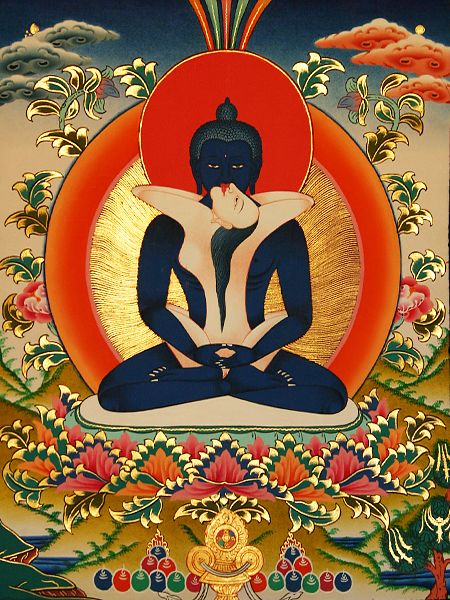
One of the things that I would like to mention is that in Tantrayana,  or the path of Vajrayana (which is the same thing), which is where we are now, you could say that the Path has two eyes or two legs, two supports.  Another way to say it would be that the Path can be distilled to its essential nature in two words: wisdom and compassion.  In fact one sees in many of the thangkas, the traditional paintings that are all around, pictures of a female and male in union, two lamas as consorts in union.  And of course having ordinary minds and being used to billboards and stuff like that, we think “Oh, what is this?” But we shouldn’t look at those pictures with an ordinary mind because they have a profound meaning.  The meaning of the union between lama and consort is the union of wisdom and compassion, the union of emptiness and method. The union of emptiness and method is the perfect balance, the perfect ship by which to cross the ocean of suffering.  It’s the perfect vehicle.  And of course, first we should understand what it means.  Wisdom and compassion or emptiness and method. . .  What does it really mean?

Well the meaning is this.  First of all, wisdom is something that you cannot arrive at by accumulating facts, because facts are phenomenal. They are believed to be self-existing. They are part of samsara, even if they are very smart facts.  Even if they are PhD-style facts!  Even if they’re MD-style!  No matter how many facts you know, you can never accumulate wisdom through the accumulation of facts, or what we would call the accumulation of knowledge.  It’s not to say that the accumulation of knowledge is not necessary.  If that were the case, then none of us would need training.  We would simply sit and do our best at meditating.

Of course facts are necessary.  It is necessary for us in our practice to understand how it is that the preceding lamas and excellent practitioners  accumulated merit and how they accumulated tremendous achievement.  It’s tremendously helpful to know facts, for instance, about the great lamas and the great saints and the Buddhas that have come in this time, and in other times, in order to understand with our ordinary minds what it is about them, how they come to be.  In fact, to some degree, our ordinary minds do require satisfaction.  And that’s where Vajrayana is ideal, because Vajrayana gives us ‘mental food.’  We have visualization. We have mantra recitation. We have the absorption in emptiness and then the springing from emptiness as the deity; and then the vajra confidence and the vajra pride.  It’s busy work!  Sometimes when people who are used to just sitting quietly and doing whatever it is they do, you know, when they have that habit of just sitting quietly, and there is a part of Vajrayana Buddhism in which you do sitting meditation; but if students only have that experience, they come here and they say, “Well, my mind is not calm.  I’m reciting all this stuff and I’m really stressed because I can hardly pronounce it.  And the tunes—forget about it.  And so there!”  And of course the response to that is, “Well really in Vajrayana the task is not to calm the mind.  The task is to awaken to the emptiness of all nature,to awaken to emptiness, that is, to perceive emptiness.

Copyright © Jetsunma Ahkon Norbu Lhamo All rights reserved
 

Abandoning Love: The Fourth Root Downfall

The following is respectfully quoted from “Perfect Conduct” with commentary by Dudjom Rinpoche:

4.b.3(b.4) Abandoning love:

The fourth is wishing that any sentient being should be separated from happiness and losing heartfelt love for them.

To wish any sentient being should be separated from happiness and to stop feeling heartfelt love for them is the fourth root downfall. The object can be one sentient being or many. To wish for them to be separated from happiness and to meet with suffering or misfortune, thus forsaking them and giving up any love for them at all, constitutes this downfall.

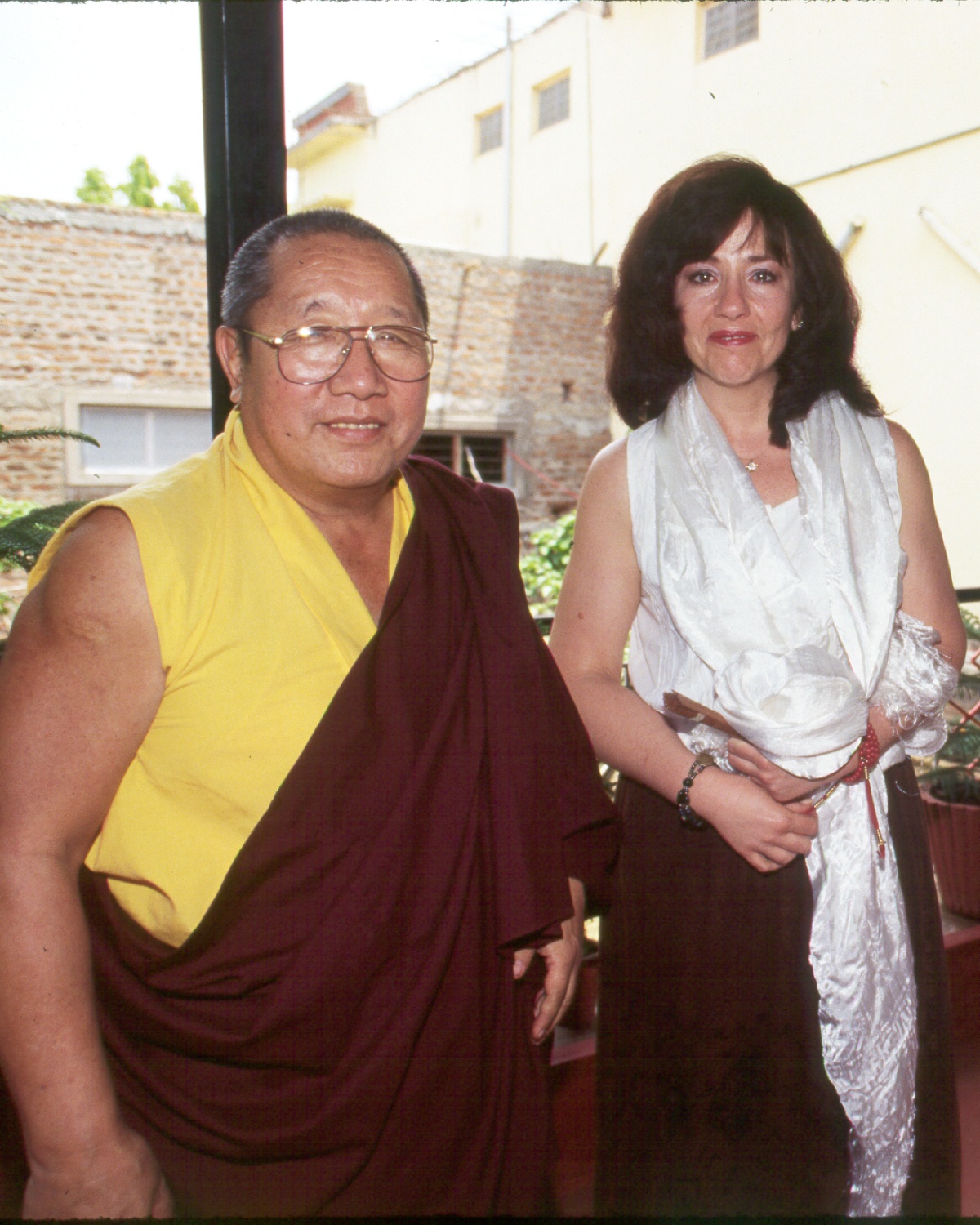
His Holiness Penor Rinpoche: Compassion in Action

The following is an excerpt from a teaching given by Jetsunma Ahkon Lhamo at Palyul Ling Retreat in the summer of 2012:

I am very pleased by all the effort that you’ve put forth to make this place grow and shine as it has, keeping it going even in great adversity, for instance the passing of His Holiness Penor Rinpoche.  We all suffered and now we’re doing what we can to bring about the causes that he can return to us.

I remember back in the beginning when I first met His Holiness Penor Rinpoche.  It was on his first visit to the United States.  He wanted to see me.  Back in those days dharma was kind of confusing.  We didn’t understand each other when the lamas first came to America.  It took awhile for us to come to that point, where we really understood each other.  Mostly it was our lack of understanding as Westerners that made the problems.

You all have beautiful, nice, and condensed practice books.  I want to show you what we were working with.  We mostly had loose-leaf sheets of paper, pictures, and books stuck together.  [Shows an old practice binder]  There are things here that I don’t even recognize anymore.   We all made our own books.  We were all new and we did our very best.  I wanted to show you this because I thought, ‘What a mess.’  I thought you’d get a kick out of it.  Those were my first practice books.  And it was a long time ago.

Personal reflections on His Holiness Penor Rinpoche

I had the happiness of knowing His Holiness for a long time, and had many wonderful experiences with him.  I don’t mind sharing them with you if you’d like to hear some of them.  I’d like to tell you about one time when I was in India and we were traveling around looking for statues.  It was so unbearably hot.  We were staying in this hotel and it was about 104 degrees Fahrenheit or more.  His Holiness was used to heat but he made sure to put me in a hotel with an air conditioner, which I stuck to, and that was very nice.  While at the hotel, I met the woman who cleaned my room, and she told me about her husband.  He was sick, had cancer and was dying.  She said, “Would you come and give a blessing to my husband before he dies?”  And I said, “Oh, it’s worthless if I give him a blessing, but if His Holiness gives him a blessing, that’s something. That’s definitely worthwhile.”  And so she said, “Oh!  Would he do that?”  And I said, “I don’t know.  I’ll ask.”

They were Hindu.  When I asked His Holiness, he said, “I don’t think Hindus like Tibetans very much.  We eat meat.”  And I said, “With due respect, Holiness, I think in this case it doesn’t matter.  These people so want to see you.  They so want the blessing.  These people are going through misery.  They live in a tin box on top of the roof, and she has to raise children by herself.”  His Holiness was very wrathful with me.  He said, “I had to leave Tibet and come to America.  I watched my own people die.  And now I am supposed to think that this is important?”  He was very wrathful.  But I know what he was doing.  He was creating the merit, and clearing the obstacles for this event to happen.  But as you know, His Holiness was very kind.  So finally he stomped his foot and he said, “Ok.  I’ll go.”

We climbed up to the roof, and it was hellish really.  His Holiness’ knees were bad then too.  I was so sorry and embarrassed that I had put His Holiness through that, but then I was so happy for the people that would receive the blessing.

When he came to the door of the tin shack they were living in on top of the building, it must have been 115 degrees inside.  It was so horrible.  We said, “His Holiness is here to give the blessing.  And the woman got down on the floor, and put her head to his feet and then she prostrated again at his feet.  She couldn’t stop.  She just kept doing it.  It was heart breaking to see the devotion that she felt for someone who would not abandon her in this terrible time; who would provide comfort and some help.  And His Holiness did that.

He spoke to her in Hindi.  And he asked her, “What is the problem?  How long has he been sick?”  She could hardly speak.  They were both so grateful and happy to have his blessing, and that he would think of them, because they were lowly people according to the caste system in India.  They were lowly people and poor beyond belief.  They said that some days he didn’t even eat, because there was no food.  And so His Holiness was told the condition of this man, and you could see in his face that he had great compassion.  The man had cancer of the mouth.  You could see that something was terribly wrong, but he had no medicine.  The agony that he was experiencing was hard to understand.

Here’s the kicker.  His Holiness said, “Open your mouth.”  When he said this, I tried to peak, and what I saw in there was horrible.  His Holiness said, “Open your mouth wide.”  He started pounding out mantras. Nothing I recognized.  He really pounded out the mantras.  And as he did that, he was blowing, blowing, blowing in the man’s mouth.  Holiness pounded out more mantras, and blew in the man’s mouth.  He kept doing this for quite a long time.

The couple was so thankful.  They offered Holiness food and drink, which of course he didn’t take.  They offered him food and drink.  He was working his heart out for them.  As we were leaving, they were bowing and bowing, and bowing.  It was so beautiful.  When we got down towards the room, I said to him, “Holiness is he going to live now?”  And he said, “No, there’s no chance.  The merit is gone.  There’s no chance for him to live now,” he said, “But he will have no pain.”

Already the man’s mouth was chewed up with cancer, and yet His Holiness said he would have no pain, and I know that’s true, because I met the woman again on the next day of our travels.  She said he had no pain that day.  I was so happy that happened.  I was just thrilled.

I left the my room door open so I could see where His Holiness was, and he could see where I was, and when he went passed by room, I just went down to him and I said, “Holiness, I know that was difficult, but thank you.  On behalf of them, thank you so much.  I don’t know how to express my gratitude.”  And he said, “No, I thank you.”

I will never forget that story.  He was grateful that I had insisted that he take this opportunity to help them.  He saw the value of it.  He saw that these people were helped and that they were just regular, innocent people.  His Holiness helped them so much that to my knowledge the man never had pain.  The woman and I wrote back and forth for a little while after that, and she said that he never had pain.  To me that am the most moving story about His Holiness that I know.  And I find it impossible to have seen that and not understand that he was Buddha, that he is Buddha.  No one but a Buddha would or could do something like that.  I miss him so much.  I know that you do too.

Copyright © Jetsunma Ahkon Lhamo.  All rights reserved


Relax

The following is an excerpt from a teaching by Jetsunma Ahkon Lhamo called “Entering the Path”

In a sense, the first thing the teacher does for you when you come to the path is to say, “Put on your crash helmet, study this obstacle course, fill up with gas, gun your motor, here we go. Put a spare in the trunk, carry a set of jumper cables, be fully equipped. Have a miniature, dehydrated tow truck in the back of your car. Just add water, and you’re set to go!” That’s the kind of instruction your teacher gives you. Your teacher very carefully lays out a program and says do the Seven-Line Prayer, do your Ngöndro. Do these things in order to accumulate merit because what happens is that should you use up a vast amount of merit when you first come to the path – and you will – you may experience obstacles. This doesn’t mean that you should not come to the path; this means that these obstacles are in your own mindstream. The causes for these obstacles have been in your mindstream since who knows, time out of mind maybe. They would have ripened eventually, they will ripen anyway, but if they ripen without the guidance of the teacher and without the tool of the path, they will ripen out of control. One never knows.

You know yourself that you’ve gone through life and things have wham! hit you just when it looked like things were going great and you had everything under control. Several times during the course of your life already you’ve looked in the mirror and said, “There is no such thing as control here in samsara! Things are really wacky!” But whatever obstacles arise when you first come to the path are yours. They’re not mine. I didn’t give them to you. I mean really, I didn’t do it. They’re not someone else’s. They didn’t do it.  And yet, as new practitioners we think, “What’s happening here? Everything’s wrong. Maybe I shouldn’t do this stuff.”

Actually the opposite is true. You should think like this. You should think, “Now my mind is being ripened. Due to my merit and virtue I am able to hook into the path. I have to stabilize that. I have to take responsibility.” Think like a big boy or a big girl for a change: “I have to take responsibility for this. I have to stabilize my mind and stabilize my practice.”

So how is that going to happen?

The thing that you need to do to flush out any obstacles that ripen on the path is to first of all stabilize your mind. Relax. Don’t be such a heavy breather. Chill, will you? Get mellow! So you relax. Just relax. Be confident on the path. Be confident that you are in a boat with no holes.

Yeah, it’s scary to cross the ocean of suffering, but friend, you’re going to do that anyway, either in a boat or not. So you’ve got a choice. You can get out and do the backstroke or cross the ocean of suffering in a boat with no holes. You’re in a boat with no holes. You’re fine.  You’re OK. Plus you have a good captain, a good captain who has themselves crossed the ocean of suffering before and brought others. So you should be confident in that. Relax. Try not to get yourself so worked up all the time. Just relax.

Remember, the more emotional you get, the more bent out of shape you get, it’s like you’re stirring up the water. Think of your mind as being like a bowl full of liquid soap, and if you start stirring it up like that with emotion, you know what you get? Bubbles and foam. Have you ever had that happen to your dishwasher or your washing machine where you get the bubbles and foam that come out all over the floor and then you’ve got to spend the rest of the day cleaning it up and the clothes are not clean, everything’s a mess? You have to think like that. Cheer up. Don’t get yourself all foamed up. Just relax. You’re on the path. You’re safe. Be cool.

Copyright © Jetsunma Ahkon Lhamo.  All rights reserved

WP2Social Auto Publish Powered By : XYZScripts.com