Pick Up the Shovel

The following is an excerpt from a teaching by Jetsunma Ahkon Lhamo called “Take Control of Your Life”

When we create a close relationship with our teacher on the path of Vajrayana—once we have examined the teacher’s qualities and have decided for ourselves that this is indeed the root guru—then we must follow.  If the root guru can teach us Buddhism, they have to have something of that same capacity [as the Buddha].  Now maybe the root guru can see what it is that’s brought us here—the suffering that’s brought us here, and the accomplishment.  The root guru looks at you and sees you are Buddha,  and yet you suffer.  So the root guru says, “I wish to teach you how to live, how to practice, so that your suffering ends and so that you can benefit others.”  Nowhere else is one taught that way: understanding the true nature, one’s appearance and one’s nature that is empty. Therefore only the Buddha is the appropriate guide.

The Buddha teaches us that everything is about karma. It’s about choices; it’s about cause and effect; it’s about realizing one’s nature and remaining stable in the bliss of emptiness.  If we remain stable in that, we are free to examine any part of our lives. And most of all, first and foremost, we should examine our minds.

The Buddha has taught us that first, and most importantly, we should establish our motivation,.  And our motivation is based on the first teaching of Lord Buddha—that all beings are equal in their nature. All beings.  That they are all suffering and yet what they all have in common is that they all equally wish to be happy.  The smallest worm, anything with consciousness in its own way, in its own language, is striving to be happy.  Then the Buddha teaches us the pristine message—the message of hope and the one that allows us to practice at last.  The Buddha says, “All beings are suffering, but there is an end to suffering, and that end is called enlightenment.”

Beyond that, Lord Buddha says we must examine our minds, our intention.  This is profound work; this is deep work.  You can’t practice a little Dharma over here and commit a little adultery over here.  You can’t practice a little Dharma over here and have someone in your life whom you know doesn’t have a bite to eat and not help them.  You can’t practice a little Dharma over here and have no respect for the Sangha or the temple or the teacher.  In other words, Dharma’s not like a pretty little high church package.  Even though we have bunches of fancy things around here, it isn’t like you walk into a giant temple and go, “Oh, I’m moved emotionally, and it’s Sunday.  I did it.  I’m a good Buddhist.”  No.  That’s not Dharma.  “I came on Sunday, I sang some songs and I’m impressed with the church. Now I’m going home.”  No, that’s not Dharma.

Dharma is different.  When we see these objects that are beautiful and magical and we see the brocade and we see the statues, yes, it thrills our hearts and we recognize on some level that something very precious and beautiful is here.  But the Buddha didn’t tell us to sit around and think about how things are precious and beautiful in the temple.  The Buddha taught us that Dharma isn’t like a beautiful package of golden brocade.  Dharma is a knife, and it’s meant to cut.  It has a sharp edge, and it’s not always painless.  Dharma teaches us that the honest truth is that non-virtuous activity and habitual patterns will only lead us to more unhappiness. That means we have to go in there with a shovel and a pick axe and start changing our minds.

Copyright © Jetsunma Ahkon Norbu Lhamo All rights reserved

Unconditional Love

The following is an excerpt from a teaching by Jetsunma Ahkon Lhamo called “Keeping Heart Samaya”

When we consider the student’s relationship with the teacher on this path, we are talking about very high stakes.  We are not talking about a student-teacher relationship in order to get through a six week course.  We are not talking about a student-teacher relationship with which to graduate with so many credits from college.  We are talking about a student-teacher relationship wherein the end result is the ultimate fruit or jewel, the crown of cyclic existence, that is, the potential or capacity to enter into the door of liberation and be free of suffering at last.  These are enormous stakes.

So both parties in the student-teacher relationship have to take that relationship very seriously, very seriously.  I know for a fact that the teachers regard the students with great seriousness.  Their love for the students is unconditional.  Once that student-teacher relationship has taken place, the teacher has become, for the student, Guru Rinpoche’s appearance in the world, Lord Buddha’s appearance in the world.  Once that happens, there is a love there or a bonding that cannot be undone by anything in the world.  There is nothing in the world that can take Lord Buddha’s blessing, Guru Rinpoche’s blessing out of your heart.  Nothing can do that.

Even if the students themselves were to act in a very inappropriate way, breaking the samaya bond, acting out of accordance with what the teacher has taught, even committing really negative actions like harming the teacher in some way, it is always the truth that if the student were to make restitution, were to turn their face towards Dharma again and truly wish to accomplish Dharma, and wish to separate themselves from their previous non-virtuous acts, the teacher would immediately respond to that.  There is no question.

As parents we do that with our children, don’t we?  Sometimes children will do pretty bad things, throw baseballs through windows, knock the cookie jars over, and really much worse things. So even though these acts may occur, the parent will always accept the child again.  The parent will not stop loving the child.  It may be true that there is a difficulty there, a burden, a strain, a suffering, but that is your child.  A good parent would never turn their face away from their child just because their child made a mistake.  Parents know that children are immature with very little discrimination.  They are learning, and it’s the parents’ job to teach them.  Exactly the same with the student and the teacher.

The teacher knows that students are sentient beings.  According to the Buddha’s teaching, all sentient beings are suffering.  They all wish to be happy, but they do not know how to make the causes of happiness occur.  They don’t understand cause-and-effect relationships.  So isn’t it to be expected that mistakes will be made?  Of course mistakes will be made. It’s only reasonable and logical.  So the teacher would never hold it against the student.  That relationship is like the Buddha’s compassion, all pervasive, beginningless, conditionless, without end.  That is the nature of that love.

So when we look to the student’s commitment, or samaya, to the teacher, we should look to see the same depth, the same bonding, the same beauty in that commitment as well.  And that commitment should be a joy on both parts.  Less the flavor of duty and responsibility than the flavor of love.  The love between the student and teacher is like the Buddha’s compassion.

Copyright © Jetsunma Ahkon Lhamo.  All rights reserved

Flower of Gods: From “Sutra of the Wise and Foolish”

The following is respectfully quoted from “Sutra of the Wise and Foolish” by Stanley Frye 

Flower of the Gods

Thus have I heard at one time: the Enlightened One was residing in the sity of Śrāvastī at Jetavana monastery in Añathapindika’s park together with an assembly of one-thousand two-hundred and fifty monks. At that time, in that country, when a handsome and comely son was born to the wife of a householder of the highest caste, a shower of flowers of the gods fell from the sky and filled the house, and the boy was named Flower of the Gods. When he had come of age, he went to the Buddha, and seeing the Lord’s body endowed with the incomparable signs, rejoiced greatly and thought: “I have been born into this world where I have met the Supreme Among the Noble Ones, I shall invite the Lord and his assembly”, and said: “Lord, tomorrow I shall prepare alms-food in my home. In order to lay the foundation for Enligthenment, I beseech the Lord and his Sangha to deign to come”. The Buddha, seeing the boy’s pure and firm intention, said: “We accept your invitation”.

Thereupon the boy called Flower of the Gods returned to his home and in his mansion caused a great throne of jewels to magically appear along with many other seats, and adorned the dwelling with various kinds of decorations.

Upon the morrow the Enlightened One and his Sangha came, and when each had taken his seat according to seniority, the boy though: “Now I shall offer various kinds of food,” and, because of his virtue many different kinds of food appeared by themselves and these he offered to the Lord and Sangha.

When the Buddha had taught the boy the Dharma, the house became filled with flowers of the gods and the boy requested permission of his parents to become a monk. When his parents consented, he went to the Buddha, bowed his head at his feet, and said: “Lord, I request ordination”, and when the Buddha said: “Welcome, monk”, his hair and beard fell away by themselves and he was dressed in the red robes. Exerting himself in the word of the Buddha, he became an arhat.

When Ānanda saw what had taken place, he knelt and said: “Lord, this monk Flower of the Gods–by reason of performing what former good deeds did a shower of flowers descend and jeweled thrones and various kinds of good appear? I beg the Lord to explain the reason for this.”

The Buddha said: “Ānanda, if you wish to hear this, listen carefully. In aeons long past, when the Buddha Kāśyapa was in the world and was visiting the cities for the weal of beings, a householder of the highest caste honored and made offerings to the Sangha. When a poverty-stricken beggar saw the Noble Sangha, great faith was born in him and he thought: ‘I have nothing with which to make an offering to the Sangha’. He gathered various kinds of grasses and flowers and with a mind of faith showered them on the monks, bowed, and venerated the Sangha. Ānanda, this monk Flower of the Gods was that beggar who at the time made offerings of flowers. Because he sought Enlightenment with a mind of firm faith and gathered flowers and showered the Sangha with them, for sixty aeons, wherever he was born he was always handsome and comely and endowed with whatever he wished to eat and drink. As a result of that merit he has attained bliss. Therefore, Ānanda, one must not think that there is no merit when one gives, even if it is very little. As was the case with the boy Flower of the Gods, the fruits will come by themselves.”

Thereupon Ānanda and the assembly believed what the Lord had taught and rejoiced.


Why Enlightenment Matters

Shakyamuni Buddha

After practicing Aspirational Bodhicitta, you will move into Practical Bodhicitta. Practical Bodhicitta is where one actually attempts and begins actually to develop the technology or method by which the cessation of suffering can be brought about.

Again, back to the foundational teachings of the Buddha: The Buddha teaches us that the sufferings that we see and think we understand the causes for are only symptomatic of a deeper suffering; and that deeper suffering is actually the faults of cyclic existence. These are the real sufferings: Impermanence; the fact that cyclic existence has nothing inherent within it that leads to the end of suffering. These things are the faults of cyclic existence.

Having understood the faults of cyclic existence, we must then think what the Buddha has told us: Only enlightenment brings about the cessation of suffering. And to carry that further, only an enlightened being, and ultimately a supremely realized being, can truly bring about the end of suffering. So you have to consider Practical Bodhicitta in more than one way. You must actually consider that you wish to accomplish whatever means will bring about the cessation of suffering for all sentient beings: whatever practices will bring about the end of suffering; whatever methods. You have to employ these methods; but you must also think that your own enlightenment then becomes significant. Even if you are thinking only of sentient beings—and that is the proper motivation—even if you are thinking only of motherly sentient beings and their suffering and not thinking of your own suffering so much, if you have come to that profound level of Aspiration Bodhicitta because of entering into the phase of Practical Bodhicitta and the need for you to accomplish enlightenment in order to lead other beings to enlightenment, then one’s own enlightenment becomes significant. And that is the real reason why one’s own enlightenment becomes significant. Yes, it’s true that each of us wishes to be free of suffering. But from the point of view of Bodhicitta, the proper motivation for practice then is the cessation of suffering for all sentient beings.

An excerpt from a teaching by Jetsunma Ahkon Lhamo called “Bodhicitta”

Copyright © Jetsunma Ahkon Lhamo.  All rights reserved

Navigating the Darkness

The following is an excerpt from a teaching by Jetsunma Ahkon Lhamo called “Keeping Heart Samaya”

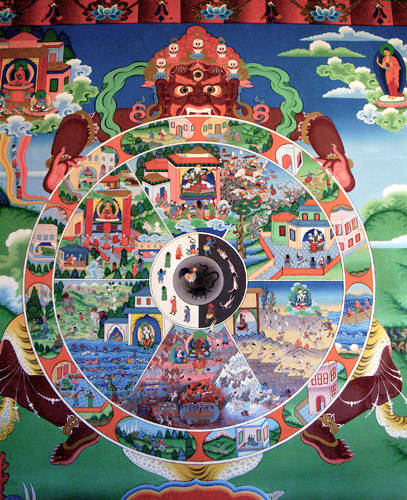
As sentient beings revolving in samsara, trying to go through life in the ordinary ways that sentient beings go through life, we are unable to see some of the conditions of samsara.  For instance, the Buddha teaches us that there are six realms of cyclic existence, six different realms, only one of which is human.  There are the hellish realms, the hungry ghost realms, the animal realms, the human realms, the jealous god realms, the long life god realms.

The Buddha teaches us about those different realms.  Well, I haven’t seen all of them, and most everybody I know hasn’t seen all of them, at least not that they can remember.  I know for sure there are animals. I know for sure there are humans. But how can any of us know about these other realms?  We have to rely, therefore, on the Buddha’s enlightened perception that is born from the profound realization that the Buddha accomplished and described when he said simply, “I am awake.  I am awake.”

So we rely on that perception, and from that perception the Buddha has taught us many things.  One of the things that Buddha has taught us is that all sentient beings are suffering.  Suffering is all pervasive, and – sorry to ruin your perfect day – you need to learn the reality of cyclic existence.  It is a little bit like needing to walk through a room full of furniture and obstacles and room dividers and shelves and sofas and rugs, and all kinds of things. Unfortunately because our vision is so obscured, it is as though that room were dark and the shades drawn and there were no lights on.

The Buddha teaches us that to learn about cyclic existence would be like turning the light on in that room.  If you are unaware of the condition of cyclic existence, it is kind of like trying to get through a room full of obstacles with no help, with no vision, no way to decide how to get through that room.  So you are going to stumble over things; you are going to fall over things.  There will be many, many hurtful and painful obstacles.  Instead, the Buddha recommends turn the lights on.  Be aware of the condition of cyclic existence.  Know what you are up against.  Strategize your path through life intelligently rather than living carelessly and haphazardly, stumbling over everything, having every obstacle that could take you down, in fact, take you down.

Many of us have experienced painful life situations that could have been prevented by the generation of some merit or kind acts that produce virtue within the mind stream.  So the Buddha teaches us to know carefully what samsara actually is.

Copyright © Jetsunma Ahkon Lhamo.  All rights reserved

The Karma of a Cup of Water

An excerpt from a teaching called Perception and Karma by Jetsunma Ahkon Lhamo, July 19, 1989

I’d like to illustrate some very basic teachings on the six realms of cyclic existence by looking at a cup of water.  In the human realm, this is a cup of water and it has lemon in it.  I know that it’s water because it smells like water.  It tastes like water with lemon.  I know what that tastes like.  I can tell the difference between tastes.  I know that water is good for me; I know that it will quench my thirst.  The reason why I’m having this experience is because of my karma.  In the animal realm, a dog would also experience that.   Let’s say a dog or some kind of lion or tiger or bear would experience that as water, also.  They wouldn’t know what the lemon was, they would think there was something funny in there, but they would experience it as water.  They don’t taste very much.  They know the water by smell.  They can’t taste the difference between city water and country water.  They might be able to smell a difference. But they know it to be water, and they instinctively drink it when they are thirsty.  They don’t think much about whether it will do this or that for them.  They don’t think about how much they need.  So their experience with water is similar, but different.

In the hungry ghost realm, beings are horribly thirsty and horribly hungry, and their mouths are very, very tiny, so they’re not able to take in food.  Someone from the hungry ghost realm would experience that as a cup of pus and would not be able to drink it because their experience is that it’s pus, it’s horrible and it isn’t drinkable, it isn’t water.  It smells foul and is foul.  It is not something you would drink.  So, they do not drink and they continue to be extremely  thirsty.  This is my cup of water, I know that it’s not pus but in the hungry ghost realm it would be experienced as pus and they would be terribly thirsty.

Why do they experience it that way?  Are they jinxed?  Did some magician go to the hungry ghost realm and transform all the water?  Is someone out to get them?  Had they just not looked in the right places? Should they keep on checking around? Should they think positive? What would happen if they could get it down?  Would it act like water?  No, it would act like pus, right?  Even if they could drink it, the water would act like pus to them.  No matter what they do, it remains pus and they remain thirsty.  That’s really disgusting, isn’t it?  Why does that happen?  It happens because of the karma of their mind.  Their perceptual experience that they have, the construction that they abide within has that reality or that quality because it is an emanation of their mind.  It is the karma of their mind.  It’s as real and as solid to them as the fact that this is water to me.

What about someone from the hell realm?  Depending on which hell realm it is, it would be either a cup of fire or a cup of ice.  Unfortunately, it would be a cup of fire if they were in the hot realms and it would be a cup of ice if they were in the cold realms. The difficulty is that if they held their nose and said, “I really think this is probably water.” They would drink fire and be burned. It’s very real, very real to them.  Why is that the case?  It is the case because that is the karma of their mind.

On the other hand, if this were experienced in the god realm, it would be experienced as a cup of elixir, the nectar of long life, or the elixir of infinite power, or the nectar of infinite beauty.  The gods would drink it and live a long time, anyway.  Nothing is forever in the god realm.  They would take it and it would be like an elixir that would put them into a state of absolute bliss for a while.

Well, I drank that water.  I drink lots of water, and so far, no bliss.  So it isn’t happening to me.  That’s because the gods have the karma of their minds and that’s how it works out for them.  Each one of these different beings that I have described arises from emptiness.  They are the same as emptiness; they are inseparable from emptiness.  Each cup in those different realms, no matter what was in it, arises from emptiness, it is the same as emptiness, it is inseparable from emptiness, and yet the experiences are totally different.  The experiences are different due to the karma of our minds.

Everything that you have ever experienced is completely relative, completely artificially constructed and totally experiential. Everything that you have experienced is like that, and yet what do we do?

Let’s think about the poor old guy in the hungry ghost realm with a cup of pus.  That’s really disgusting, isn’t it? Let’s say that he picks it up and he sees that it’s pus, and he puts it back down. Now what is the next thing he does?  He sits there and he feels really miserable.  He feels agonizingly miserable and thirsty.  Then he thinks, “Why does this happen to me?”  Then he thinks, “Everywhere I go, there’s this stuff.”  He thinks, “There’s no relief.”  He goes on and on and on and continues with the experience.  The experience does not stop when he decides not to drink it.  He continues with the experience.  He reacts to the experience.  The karma is that he experiences pus.  He’s in the hungry ghost realm and he’s experiencing phenomena as he experiences it, which is pretty disgusting, and he’s experiencing also this great longing for nourishment and help and respite from his suffering.

Then, after he doesn’t drink it, he continues with this process of saying, “Why doesn’t anybody love me and give me something to drink?  Why do I have to suffer this way?”  And then goes on with, “I’m so hungry, I’m so thirsty, I’m so ugly” and so on. What I have just described is an elaboration process that branches from the original karmic occurrence.  That elaboration is a very important factor and a very important thing for us to look at and understand.  It is the process of exaggeration.  Now, it sounds really far fetched to talk about this guy in the hungry ghost realm, but I use that example because it’s so solid, you can really understand how that might happen.

What about us?  Let’s use for example the experience that we have when we lose our job. We lose our job, and it’s not the first time we’ve lost our job.  The karma of that particular relationship that you had in order to have the job, ended. Maybe it just ran out because it was time.  Maybe it ended because you ended it but the karma of that particular relationship ran out.  What happens after you’re fired, though, is a process that continues and becomes more a part of you than the actual firing or even the job ever was.  That process is the process of exaggeration and elaboration.  You begin to elaborate on the process.

The first thing that happens is you begin to make an entire scenario about what really happened.  What really happened has a certain flavor.  You have perceived it in a certain way.  You have lost your job and you have the perception that your boss was kind about it, or your boss was mean about it, or it happened in this way, it happened at midday, it happened at night, it happened in the morning, it happened when it was a good time for you, it happened when it was a bad time for you, it happened before your car payment, it happened after your car payment.  You have your own kind of perception about it.

Spinning off from that, you have your determination, which is a more subtle process, about what the real story is. In other words, you’re always going to decide for yourself whether you should have been fired, whether that was righteous, whether you should be treated meanly or whether you should be treated nicely.  You’re always going to decide for yourself whether things happen as they do for good reasons, and then you’re going to make up a whole story about how it should have happened.  Probably you spend the next few days, weeks or months reworking the entire thing, and imagining what you might have said to your boss under different circumstances.  You have your own particular belief about how things should have happened.  From that you continue to elaborate and exaggerate situations, working it into the roots of your being, thinking ultimately, after you really work it down the pike, I’m a failure.  “Nobody loves me. My mother didn’t love me.  My father didn’t love me.  I’m destined to be poor and I am deeply flawed.” You know what you do.  I don’t have to tell you. You go into the entire scenario of all the different things that you feel are absolutely true.  So the experience doesn’t end with the cessation of a certain job opportunity, it continues with an elaboration process and that process is as real as the actual experience.  The exaggeration process usually is the one that sticks with you, longer that the experience itself, often longer than the job itself.  That is the experience that sticks with you.

Copyright © Jetsunma Ahkon Lhamo.  All rights reserved

Be Careful

An excerpt from a teaching called Perception and Karma by Jetsunma Ahkon Lhamo, July 19, 1989

The subject of perception – how perception relates to the nature of emptiness, how perception occurs, and the antidote to impure perception – is very difficult to understand.  In truth, it can’t really be taught effectively.  When it is taught, it is communicated in such a way that one has a taste of it.  However, in order to truly understand something about the perceptual process, that all phenomena, all experience, all feeling, as well as all sense of self, is merely an artificial construction and experiential phenomena, one must have something of an understanding of emptiness.

When you hear these kinds of teachings, you should know that at worst what you’re getting is no understanding whatsoever – like a bowl turned over where the water hits and it bounces off. On an intermediate level you may hear the teaching and have some intellectual or theoretical understanding.  Since we have not practiced on the most profound levels, the best that could happen under these conditions is that we will hear the teachings, have something of an understanding intellectually, and through one’s contemplation, develop a sense of insightfulness as to what this might mean.  The best thing that could happen is that in one’s practice one might have a moment of space or a moment in the generation process or perhaps in the dissolution process, where there might be a recognition of what I’m talking about, or a feeling that maybe you stood on the ground floor of that understanding and somehow you have a broader view of it, that you have ascended into a more profound level of understanding.

However from hearing these kinds of teachings, we do not understand the nature of emptiness.  We do not understand phenomena.  We do not get that the experience that we have of phenomena is that it is a perceptual process.  We do not stop relating to “thing” as thing, we do not stop relating to “self” as self.  You should not make the mistake that many practitioners have made, of thinking that hearing teachings like this, you have come to understand emptiness.   You should not, and this is the worst possible scenario, take these teachings and think that you have a profound understanding, and then act like you do. That’s the worst thing that you can do with the teaching.  There is nothing worse than that.  It is also the most common, unfortunately.

In acting as though you understand what these teachings are about, you might fall into the trap of reinforcing your sense of self, reinforcing the ego-clinging and ideation, as well as the clinging to phenomena as being real.  Ultimately, these ideas are phenomena, just as all things are phenomena.  When realization is attained, even the most profound teachings, even the deepest dharma is understood to be merely phenomena, and also empty.

You should be very careful. You should watch your mind and watch how you assimilate these teachings.  Be very, very watchful of yourself, and be certain that you literally understand that no understanding will come without sincere effort and contemplation.

The best way to increase one’s understanding of these kinds of teachings is to practice Guru Yoga.  When you practice Guru Yoga you increase your connection with Guru Rinpoche.  You increase your awareness of his teachings.  You begin to develop a sense of union and therefore the ability to receive the empowerment of his enlightened intention.  You are able then to hear teachings from your own teachers better.  All of the auspicious conditions that can occur will occur when you practice Guru Yoga.  If there’s any teaching being given out that is profound and worthwhile, then perhaps the best thing to do in order to increase your understanding is to practice Guru Yoga, and that includes the Seven-Line Prayer.  Practice in any way that will increase devotion.  Devotion is like a golden highway that connects your heart with Guru Rinpoche’s heart, your mind with Guru Rinpoche’s mind.  It allows his enlightened intention to bring forth empowerment, and that is the same with our own root teachers.  In practicing Guru Yoga, in practicing all practices that have anything to do with devotion, the connection with our root teachers is established. The connection is established and one realizes one’s root teacher to be inseparable from Guru Rinpoche, and therefore inseparable from the nature of emptiness itself.

These are some of the methods that you might use so that you can have a deeper understanding. I, also, wanted to give you some insight as to how not to hear these teachings and how not to accept these teachings.  This is of the utmost importance.

Copyright © Jetsunma Ahkon Lhamo.  All rights reserved

From “How to Follow a Spiritual Master” – From the Vinaya

The following is from “How to Follow a Spiritual Master”  – According to the Vinaya:

We should first request and receive the pure precepts or vows from him and further make abundant offerings, honouring him at all times with out body, speech and mind. The three hundred verses of the precepts of novice give us step-by-step guidance on correct behaviour.

In the morning, we should arise before our Master, wash and make prostrations to the Buddhas, our Master and recite prayers until daybreak. Then we should visit our Khenpo and knock quietly, prostrating whilst entering, enquiring about his well-being. We should further enquire what kind of activities we should have in the morning.

We should keep his residence clean, prepare all toiletries for his bath, as well as laying out all he needs, washing his begging bowl and so on. We should serve him so as to avoid letting him become tired. We should prepare the mandala offering and receive his teachings. In all activities of our three doors, we should have respect according to Vinaya monastic rules. In spare time, we should endeavor to practice meditation and study earnestly. In the evenings, prostrations to the stupa, teachers and supreme objects of virtues, should be performed. The Master’s feet should be cleansed with clean water. We should enquire what we should do during the night and follow his instructions without falling asleep at that time.

Usually when we are close to our Teacher, we should get up immediately when he stands, when he is sitting we should enquire what he needs, providing according to his wishes. When we go as his attendant, we should not precede him as we are showing our back to him. If we walk behind him we should not step on his footprint. We should not step over the shadow on his right but walk to his left slightly behind.

However, if there is some danger about, we can precede him. We should not step over his seat nor use his means of transport (horse, vehicle etc.).

We should always take care to keep our vows pure following our Master with respect from three doors avoiding disrespect such as not rising when the Master does so. When the Master is seated, we should seek a lower seat, not standing, behaving calmly and humbly. During alms round we should not go ahead nor stand on the right of the Master but follow him behind on his left. Among the few possessions we are allowed to keep through Lord Buddha’s instruction we should offer the best to our Master without stinginess.

Whatever we do for our Master, we should do so out of pure respect not arising out of pretension, disinterest nor grudgingly. Such impure motivations are not in accordance with the teachings and they are not genuine. The sole purpose of the above is to make our Master happy.

By making our Master happy though we are not benefiting him nor rendering a service to him. However we have many opportunities to accumulate merit, cleanse our bad habits and tame the wildness of our mind. Henceforth this behavior is very beneficial for us and lays the foundation for he growing of trust and respect.

As time progresses, these two qualities in turn will naturally develop into faith and devotion and form the support required from our side for the pouring of blessings. In this context, our self-centered society has lost any means to even understand the concept or even the need for respect, rendering service to others  even less honouring. Instead, we are constantly focusing our our personal needs, emotions, and well-being. No wonder that, since everyone is pursuing the same type of ideals, we experience ever-increasing conflicts, first in the wildness of our untamed mind, in the relationship between close and distant families, social classes, work colleagues and even nations. When the only means of focus is self-interest and increase in personal gains, whatever kind they may be, conflict is never far away. Thus, the first step in training of the mind is that of basic re-learning process of respect through the recognition of our Master’s qualities, qualities we do not possess ourselves as yet but we feel are worthy of emulating.

In essence, the teacher we meet is the result of the quality of our view and the consequence of our past karma. There was once an illiterate man with great faith in the dharma and his Master who was sitting at the back of the monks during prayers. As he could not read or even fully understand all which was recited, he used to pray very simply, may I too accomplish whatever they are saying. And so, through the power of his devotion his short prayer bore fruit.

and further:

The best way to serve him is to dedicate our life to practice and uphold the teachings.
The next best way is to serve him in body and speech that will cleanse our obscuration.
Lastly we should make offerings to him that allows us to perform the two accumulations.

Caretaking the Gift

The following is an excerpt from a teaching by Jetsunma Ahkon Lhamo called “Commitment to the Path”

It is so important and so precious that we have this human existence. We should consider ourselves caretakers of that—that prize, that gift, that blessing—that it should not be taken lightly.

Sometimes we think, “Oh, you know, I would really like to live a life that is warm and fuzzy.  I don’t want to live a life where I have to know about all these bad things and apply antidotes all the time.  Oh gosh, that’s just so…  I’d rather be warm and fuzzy like a puppy.”  Well, all right, but I have puppies and I can tell you that I love my puppies so much I can’t explain it.  They are so adorable.  I love them so much.  They are so good for me.  I am so good for them.  I love my puppies.  They are like my kids.  However, my puppies cannot hear the Dharma.  They cannot look at me and say, “This is my teacher.” The devotion they feel is clearly based on food and scratching behind the ears and I hope it’s not the same for my students.  They cannot attain view.  They cannot recognize anything but the most minimal cause and effect relationships.  They know not to sit in an uncomfortable place if they’ve sat there before or they recognize something hot if they’ve seen it before, like that—the simplest associations—but they have no capacity for practice.

And yet, I have my students that say to me, “Oh, they are so lucky. They get to live with you all the time and go with you wherever you are and they sit on your lap.” No they’re not.  You don’t want to travel with me all the time, be with me all the time and sit on my lap.  What is that going to do?  How is that going to get you through life? And what are you going to do in the bardo?

So we have to understand that Buddhism is about really examining what is in front of us, seeing what is on our plate.  And although we may not be so glib and so cool and savvy with the positive remarks and the upbeat thinking, we will be savvy and smart and intelligent and able to change things that would seem to be impossible to change once we understand what the Buddha has taught.

Copyright © Jetsunma Ahkon Lhamo.  All rights reserved


Drakmar Tulku on Termas

On April 11th, 2014 Drakmar Tulku visited Jetsunma Ahon Lhamo in Dakini Valley, a retreat land in Arizona. While there Jetsunma showed him a naturally occurring Phurba she had found in a rock formation. This is the teaching Grudrag Khentrul Rinpoche offered to the students that were gathered there.

© Jetsunma Ahkön Lhamo


WP2Social Auto Publish Powered By : XYZScripts.com