
The Seed and the Fruit

fruit

The following is an excerpt from a teaching by Jetsunma Ahkon Lhamo called “Art of Dispelling Anger”

The fruit of potential and method is the awakening.  But in Buddhism we see all three as the same and it is taught that all three are the same. And in truth, there is no realization without understanding the sameness of these three,. It is easy to think that we are evolving in a step by step way; and it is easy to think that we’re on the ladder. See, I am up here and somebody else is down there and some of the people are over here. And we get into that view, and that’s not what the Buddha taught. The Buddha did not teach that someone is higher and someone is lower. The Buddha taught that we should recognize the appearance of the Buddha nature in the world as our root gurus. The root guru gives us the method, and therefore we have the result. But nobody is better than anybody else. That is a different religion or a different idea, or something else. I don’t know what that is, but we don’t have that here.

Ridding ourselves of hatred is based on that kind of thinking, that kind of view.  Really understanding the Buddha’s teaching that there is the foundation, the method and the fruition, and that is the path. Succinct, boom, right here. This is it. And we understand that, again, according to the Buddha’s teachings we are all suffering. We are all in the same place. Here we are. Even the people that are not in this room, we are in samsara together. They want to be happy like you do.  You struggle for happiness, don’t you? Come on, don’t you?  Every day. Every day. And we do it sometimes rightly or wrongly. It’s a mixed bag because we lack understanding. But the method is to recognize that all beings wish to be happy. If there are three people sitting in front of you, and two or three of them are unhappy, you come out of yourself and try to help. Efforts like that are what move us along on the path. Not just doing the fancy practices and knowing the fancy words.

Of course, we do not achieve realization by deeds alone. That is a long and difficult path. We have the Dzogchen path, which is so remarkable. It not only gives us method and the opportunity to give rise to the bodhicitta, but we also are given the wisdom to understand the empty nature of phenomena. Through that method we can understand that in samsara we are in a bit of a bubble, or an echo chamber. It’s kind of like that. Unfortunately, it’s also the nature of samsara to be somewhat blinded to that. Again, we are still asleep. It’s like a dream. It has a dream-like quality. You know how in dreams crazy things happen? And it’s OK. It makes sense somehow. Like you could be somewhere and then you are somewhere else, and it makes sense. But that dream-like quality exists right here and right now. We literally do not understand that when we gossip about a fellow vajra brother or sister, or any sentient being of any quality, or put them down, at the same time, we create that energy, that cause. Somewhere in samsara, the result is also being born. Right then. Something will change because of that hatred. Now we often don’t see it immediately, but it comes back to us; and the way it comes back to us is according to our conceptual belief. We believe in relative phenomena being solid as it is until we become practitioners, hopefully. So when somebody sends a negative energy at us, like their anger, we think, ‘Oh, it’s coming from them. Everybody hates me.’ But in fact, what has happened is that you have sent out hatred. It echoes back and it will come through somebody else’s mouth. Do you know why it’s nobody else’s fault?. Because there is nobody else. Bingo. There is nobody else. And how you can sit there and say you are practicing trekchod and togyal and you don’t know that yet, I can’t figure out.

We must take responsibility for our experiences. How will we ever awaken if we don’t understand the unhappiness that comes to us is of our own making? It may have been in the past, the past in some past life. It may have been recent. I see you guys creating the causes of suffering all of the time. And so, get back to the basics. Follow the Buddha’s teachings. To antidote hatred,… And I know, hatred is my big one today, OK? We’ll do greed and ignorance some other time and the other ones as well. To antidote hatred, the antidote has to be very strong, because hatred is such a strong energy that it brings about war in places where there is a lot of emotional, egocentric agitation that has hatred as part of it. Any time there is emotional, egocentric agitation, there will be hatred. Places like that often have a lot of earth movement and strange weather and that sort of thing. And war.  Who would have guessed it?.

And so, we have to understand that we want to awaken, but we don’t want to take responsibility. We want to awaken, but we don’t want to stop dreaming. We want to awaken, but we don’t want to go through that effort of bringing ourselves into truer awareness, something that is more profound and deeper and more real than our own simple habitual tendencies.

Copyright © Jetsunma Ahkon Norbu Lhamo All rights reserved
Astrology for 7/12/2017

7/12/2017 Wednesday by Norma

Take advantage of the quick thinking that comes up with a solution to a problem. An “AHA” moment supplies an explanation you have needed to understand an equation. There’s an odd disconnect between rationality and emotion today. Be fully aware of which part of yourself you are using- your mind or your feelings- as you go through the day and use the appropriate faculty at the appropriate time. (Don’t complain about your mother to your boss, and don’t try to teach your baby calculus.). Harriet
Beecher Stowe said, “Common sense is seeing things are they are and doing things as they ought to be.” What’s good? Going for a drive or a walk, writing to others, humor, information and friends.

Without Bodhicitta, There Is No Path: from His Holiness Penor Rinpoche

The following is an excerpt from a teaching by His Holiness Penor Rinpoche on Mediation, reprinted with permission from Palyul Ling International:

Many of you are interested and have asked, “Please give us the Dzogchen teachings.” But even I myself don’t know what is Dzogchen and I don’t have anything to teach you!

Anyway, as I explained to you earlier, if one practices the Bodhicitta, that kind of pure intention to really benefit all other sentient beings, and then the samatha meditation practices to establish one’s mind in full concentration, then of course there will be the Great Perfection (“Dzogchen”) meditations.

But if one cannot cultivate the Bodhicitta within one’s mind, the path to Enlightenment is already broken. Without Bodhicitta, there is no real path. Bodhicitta is that which is without any partiality. The pure intention of Bodhicitta, the thought to benefit all sentient beings without any exception, can be understood by realizing that in one or another lifetime, each being has been one’s parent. If we understand this and think of how dearly they have taken care of us, then we will feel grateful to all the parently beings and we can generate Bodhicitta to all of them.

This present body of ours is here because of our parents. If we did not have parents, there is no possibility that we could have these bodies. And if we don’t have this physical body, then we cannot accomplish any kind of worldly or Dharma activity. So our mothers are indeed very kind and we should be grateful.

Of course, there are many kinds of parent-child relationships in this world, but we should remember that whether or not we are close to our parents is based on our own desires and our own thoughts. Beyond that sort of thing, the main meaning here is that without our parents, we could not have this body, and because of this we should understand and be grateful for their kindness. So first one really concentrates on generating Bodhicitta based on one’s gratefulness to this life’s mother, and from that one can extend this Bodhicitta to all sentient beings equally.

So the most important points are to have faith and devotion in the Dharma, then meditating and contemplating on Bodhicitta and compassion. Then one can apply these into practice through the meditations on emptiness.

In the Dharma practice one should not think, “Oh, I am doing all this practice for the benefit of this lama or for these Buddhas.” Never think in this way. The Dharma practice is for yourself. Each and every one of you as individuals has to liberate yourself from Samsara. You are attaining Enlightenment for yourself. You are attaining Buddhahood for yourself. By your practice, your lama is not going to attain Enlightenment nor is Buddha going to attain Enlightenment! Buddha has already achieved Buddhahood! And if you cannot attend to Dharma practice in the proper way, then it is yourself who will fall down into the three lower realms. It is not the lama or the Buddha who will fall into the lower realms!

So, though it is important to think spiritually of one’s own benefit and how one can attain Enlightenment, still the achievement of that kind of liberation is by the path of benefiting all other sentient beings. Without that kind of Bodhicitta one cannot attain complete Enlightenment.

The Bodhicitta we can generate right now, however vast, is beneficial. In the future, when one attains Enlightenment, according to the vastness of that Bodhicitta, that many sentient beings can benefit and liberate themselves from the sufferings of Samsara. Right now we cannot really perceive all that fruition, but if we continue to practice, then in the future we will realize it as a direct perception.

Astrology for 7/11/2017

7/11/2017 Tuesday by Norma

Friendship and groups are enjoyable today, spend time with your posse. A friendly gesture of goodwill enhances a partnership so step up if an opportunity arises and watch a relationship blossom. Ignore the temptation to push against a closed door, to use a battering ram to gain something that has disappeared. Stay away from things that confuse you and head straight toward that which you understand completely. Virgil said, “Believe one who has tried it.” A problem is slowly being resolved and will be gone soon unless you chase it. What’s good? Happy conversations where everyone has their say, ideas well expressed, scientific discovery, space travel and food.

Faults of Cyclic Existence

[Adapted from an oral commentary given by His Holiness Penor Rinpoche in conjunction with a ceremony wherein he bestowed the bodhisattva vow upon a gathering of disciples at Namdroling in Bozeman, Montana, November 1999. —Ed.]

Of all worldly phenomena, whether great or small, nothing is permanent and nothing endures. Therefore, when you find yourself attracted to or attached to the happiness of existence, you must bring to mind the faults of existence. Consider that not even a single phenomenon is permanent, no matter how great, wonderful, or powerful it may seem. Consider especially how once that phenomenon [you associate with a happy existence] changes, you will experience nothing but suffering as the result. That way you can move your mind away from having strong attachment to impermanent phenomena and begin to change your habit of always following apparent phenomena based on [experiencing] temporary pleasure and attachment.

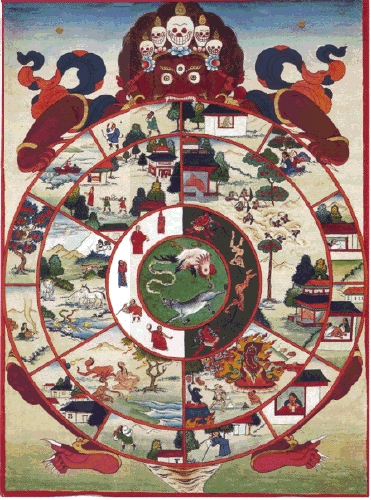
Think, for instance, about sentient beings that, due to anger and aggression, have accumulated the negative karma to fall to the hell realm. Those beings have accumulated tremendous negative karma that will keep them in the hell realm indefinitely. In that realm, unable to establish any positive causes at all, they will experience nothing but intense suffering. Think about the eight hot hells, the eight cold hells, as well as the peripheral hells surrounding them. Although it is inconceivable, think about the suffering that sentient beings in those hells must endure.

Then consider the deprived spirit realm. Think about the beings that accumulate an abundance of negative karma through the passions of avarice and strong desire. The result of such accumulation is rebirth as a deprived spirit. There are different categories of deprived spirits, such as outer and inner ones, but essentially they all endure inconceivable hunger and thirst that is insatiable. Furthermore, they never die from that; they just continue to suffer indefinitely, without ever being satisfied.

Next, consider the animal realm. Negative karma accumulated through the passion of delusion produces the result of animal rebirth. Animals suffer from basic delusion and ignorance, mistreatment by humans, and being preyed upon by one another. From the largest to the smallest, those who are as large as mountains to those smaller than the tip of a needle, all suffer from basic stupidity and ignorance, so they are unable to escape and are unable to do much more than just endure the karma in that rebirth until it is eventually exhausted.

Then consider the rebirth that is so difficult to obtain: that of a human being. Compared with the three lower realms of existence, human life seems very blissful; nevertheless, there is great suffering in the human realm. Human beings suffer from confinement in the womb and from the processes of birth, illness, disease, and growing old and the decline in their faculties, until eventually they experience the suffering of death and of leaving everything behind. Humans are subject to all kinds of indefinite circumstances and situations throughout the course of their life. Some die at birth, some die as infants, some as adolescents, and some as adults. Some die alone and unwanted or in an untimely manner.

In addition to the four great rivers of suffering, human beings experience—birth, old age, sickness, and death—humans experience compounded suffering. For example, humans suffer mistreatment at the hands of their enemies, and they suffer when they lose their loved ones. In fact, they suffer from fear that precedes the actual events themselves. Humans also suffer from not getting what they want and from having to accept what is not desired. They even suffer from acquiring what is desired, because then they have the fear of losing that. Against their will, humans endure all these unexpected consequences.

Many people think that after they die and leave this life they will easily return as a human being. Many believe they will just be able to return to a happy state of existence, such as the one they might now be accustomed to. That is a mistake. I can guarantee that unless you have the specific karma to do so, you will not take another rebirth as a human being. Without the karma that creates the causes for it, the result of human rebirth is impossible. Make no mistake about it.

Next, consider the god realm. Gods remain in their realm where they experience immeasurable bliss and happiness for long periods of time. They all have their own palace and gardens, wish-granting trees, and celestial food; everything in their external environment is inconceivably wonderful. Internally they experience only happiness and bliss throughout the entire course of their life. Eventually they exhaust their karma for that rebirth. Prior to that, the dying clairvoyant gods see the place of their future rebirth, which in most cases happens in the hell realm. They take such a rebirth due to having exhausted all tainted virtue that brought them rebirth in the god realm, and then nothing remains for them except an abundance of weighty negative karma. The vast storehouse of merit they once possessed is spent, and they have nowhere to go but to the lowest hell realm. Seeing the irreversible fate that awaits them, and knowing it is too late to reverse that, they experience tremendous suffering. They are powerless to reverse their karma of having to fall from the celestial realm of the gods to the lowest realms in existence.

Buddha therefore taught that there is not even a needle point’s worth of true happiness in samsara. Now you can understand the meaning of that teaching. Even if there is happiness, it always changes because it is impermanent. Happiness in samsara occurs as the result of the karma produced to cause it. Once that cause and result are exhausted, that happiness becomes something else, which is why the term cyclic existence is used to express the nature of life in the six realms. Sentient beings pass from rebirth to rebirth, revolving on this endless wheel of changing realms in dependence on their own karmic accumulations.

If your hair were to suddenly catch fire, you would immediately, without hesitation, try to put out that fire. Likewise, by understanding that cyclic existence is by nature permeated with suffering, and by understanding that it can never be anything other than that, you should immediately, without hesitation, focus on putting out the fire of cyclic existence. Focus totally on effort to extract yourself from this endless suffering of cyclic existence, so that you can achieve the state of permanent bliss and happiness, the state of fully enlightened buddhahood.

Thus it is taught that in order to be successful in reversing strong attraction and attachment to cyclic existence, we must practice dharma. Through the practice of dharma we can reverse attachment to existence and gain more momentum toward liberation, to the point where we realize the state of permanent bliss and cease to return to samsara.

From “THE PATH of the Bodhisattva: A Collection of the Thirty-Seven Practices of a Bodhisattva and Related Prayers” with a commentary by Kyabje Pema Norbu Rinpoche on the Prayer for Excellent Conduct

Compiled under the direction of Venerable Gyatrul Rinpoche Vimala Publishing 2008

Astrology for 7/10/2017

7/10/2017 Monday by Norma

If your emotional displays are getting the cold shoulder and people you’ve come to depend on are vanishing, consider whether your demeanor has become unreasonable. Are you asking more than people are willing to give, have you become a demanding companion? Others will change as soon as you change. Tunky Abdul Putra said, “Some people think that as soon as you plant a tree, it must bear fruit. We must allow it to grow a bit.” Fortunately, Venus is here with every charming trick up her sleeve- kind words, smiles, compliments and pleasing manners- to generate a happy mood. Forget criticism and demands for the time being, charm people with friendship and kindness, and watch your problems disappear.

The Roots of Anger

AA_thumb

The following is an excerpt from a teaching by Jetsunma Ahkon Lhamo called “Art of Dispelling Anger”

For most of us, when we are wrathful or angry, it’s not wrathful. It’s not righteous wrath, you know, in order to help that person. The only time I can see where it would be useful for an ordinary person to be wrathful would be to maybe encourage somebody else to stand on their own two feet or to be less dependent or something like that. Now look, I really want you to do that, and you can talk sternly. But otherwise, where in your life should hatred be?  Hatred is one of the three things that binds you to this world of samsara in which you will get old, you will get sick and you will die. And so we are taught that we must handle this hatred.

So when we approach hatred and look at it, we have to really examine our habitual tendencies. We can’t just say, you know, ‘I’m not going to hate anybody,’ or it’s kind of like a recovering alcoholic. It’s difficult, very difficult, to just say, ‘I’m not going to drink anymore. I’m going to use will power and I’m not going to drink anymore.’ You know, they say some people can do that, but most people can’t. And why is that?  Because you have to learn about yourself. Because there is a reason why you drank in the first place. Because you have to learn to look inside of yourself and see what’s in there and you have to work it. What do they say in the program?  ‘It works if you work it.’ What do I say about Buddhism?  ‘It works if you work it.’ It’s the same deal. We are addicted to our habitual tendencies like a bunch of alcoholics. That’s why I love recovering alcoholics, because I feel such a kinship with them. And it’s beautiful that it’s so obvious to them that they are recovering addicts. Those of us who maybe have a little shot every now and then or whatever, a little wine every now and then or we’re teetotalers, we think, ‘Oh well, I’m not an addict. Oh, I’m pure, because I take vitamins and I eat bananas,’ and whatever.

But I tell you what. It’s that recognition that from the point of view of recovering from the addiction to the five poisons and from that awakening to Buddhahood, most of us are still at the stage where we are living like bag ladies and men under the bridge, because we ain’t recovered yet. We still have our hatreds; we still have our resentments. And we practice them.

When a Buddhist approaches ridding themselves of hatred, it can’t be done through willpower. It must be done through understanding, through practicing and ultimately through attaining view. Understanding means looking within oneself with honesty. None of us have been perfect. We’ve hurt others. We’ve killed bugs, people; I don’t know what, swatted flies, whatever. None of us has been perfect. And when we approach that, we need to look at that without excuses, bald-faced, you know?  Where have I fallen down here?

Now we don’t want to look at in a harsh and miserable way.  When I say take oneself to task, I mean have a long, sobering talk with oneself. I don’t mean self-hatred. That is useless and I don’t like it. I don’t want to see it. I don’t want to talk about it; and I will slap you next week if I see it, because you are just as worthy as anyone else, and that’s just a game. When we get into self-hatred, it’s because we have bad qualities and we don’t want to deal with them. So I say, accomplish those qualities and your image of yourself will rise up like a mountain.

Most people that have poor self-image are stuck in a kind of fearful narcissism where they do not respect or understand what is outside. They do not respect or understand what is inside. They can’t tell the difference between outside and inside. And they are so internally focused, focused on their own needs, wants and dramas, particularly dramas, that it is really very difficult for these people to step out of their shell, their shell of narcissism, and begin to truly try to be of benefit to others.  This narcissism, this kind of fearful self-absorption, often is one of the causes of a kind of hatred. If you are fearful and self-absorbed in your own drama, it’s really, ultimately when you trace it down, pretty much all about you. You know? If you have that kind of thing, there is never the opportunity to understand the nature of phenomena. There is never the opportunity to understand the primordial naturally luminous wisdom state that is our nature because of the drama. And there is even a posture with that. Forthe people who have that kind of thing, as they grow older, their body tends to go like that. It caves in like that. And it’s the protecting that we’re doing of something that we feel is inherently real–ego.

When you think, ‘Oh, what can I do about this? I’m so fearful. Of course she’s saying I’m narcissistic, but it’s really that I am afraid.’ Well, what can we do about that?  I think one step is to notice that are there are other people who are afraid, also. Notice that everybody is afraid. Notice that there is a humanity that we share of brother-sisterhood, a humanness that we share, human experiences that we will all have together. We will grow old. We will be sick. We will die. This is the condition that humanity shares in samsara. So learn to recognize in others that connection, even if it’s a sad one, that we all suffer the same; and we have the same wants, too. That narcissistic self-absorbed person who is very fearful wants desperately to be happy but doesn’t know how. And so in order to make themselves better, they stay frozen. They have hatreds and fears toward everybody else. And that’s the reaction.

Copyright © Jetsunma Ahkon Norbu Lhamo All rights reserved
 

Astrology for 7/9/2017

7/9/2017 Sunday by Norma

Avoid making an effort to change something today, it’s more powerful than you think and will push back against any resistance. A new rule or proclamation generates strong feelings but the time is not right for counter-action. Rumi said, “Don’t grieve. Anything you lose comes round in another form.” Things that come apart today are put back together within three days. Go for a walk or a drive, speak with enjoyable people who encourage happiness in the moment. Food is excellent and it’s a good day to spend time with family and close friends.

The “How To” of the Method

LeavingTibet

The following is an excerpt from a teaching by Jetsunma Ahkon Lhamo called “Art of Dispelling Anger”

There is no confusion regarding Dharma. It’s spelled out that conduct is everything, that working with one’s poisons is everything. And there are no modifications on not killing. Not killing is all pervasive. It means bugs. It means worms. It means enemies. In fact, we are the only ones that I know of who are taught to raise our enemies in loving concern higher than ourselves. Not that we do a personality cult thing, you know. We don’t do the wave every time we see our enemies. It’s not like that. But if our enemies are harming us, then they must be harming themselves also. So our compassion for them should be even greater. Tibetans were thrown out of their own country. They were killed; they saw their lamas abused; they saw their lamas murdered; they saw their texts being walked on by Chinese boots, their precious Dharma texts, and then many destroyed, as Palyul was destroyed. And yet because their culture is so different, rather than going to war or hating, from the Dalai Lama on down, they all say, “The Chinese are our gurus.  They taught us that we must have had some fault or we wouldn’t have been thrown out of Tibet, or there wouldn’t have been this huge problem.”  That’s the way Tibetans think. They think, “Oh, now maybe the problem is that we kept our faith to ourselves and we were happy just in our country, Shambala,.” And so the lamas said, “Go out and teach others. This is what we must do.”  And now they are grateful for that happening, although of course we want Tibet back. No doubt about that. But they are grateful for what happened there, for what they learned, for what they taught. It is no less a travesty. It is no less genocide than it was when it happened, yet this speaks to the quality of our faith. This speaks to the quality of our practitioners and our lamas. And so, now that we see it, we see that, in fact, it was the Chinese that sent Buddhist lamas around the world. And so we find out there are never any exceptions.

There were powerful practitioners at that time whose blessing was so strong (and I’ve heard stories about this from other lamas), whose powers were so strong that they would go out when the Chinese were shooting and they would stand in front of people with their robes held out to protect them. And then they would come inside and shake the bullets out because the blessing was so strong, their power was so strong; but they never fought. They died, but they never fought. There were many lamas who knew when the Chinese were coming, and it was hopeless. They simply did phowa and left. They didn’t wait. They knew the Chinese would kill them.  So rather than allow the Chinese to take on that non-virtue, they did phowa. And phat! they left their bodies. What was the year when the Chinese came into Tibet?  ’49?  I was born in ’49. So that’s what happened there. But there was never the thought of revenge. Never the thought of hatred or barbarism, because this is not our way. And what is great is that we can teach our children there are no exceptions. It’s black and white. That’s what is really great. Never kill. Each sentient being values its life just as much as you do. I really like that about our faith.

I see a problem in people who are trying to defeat their own poisons in this lifetime, even you guys whose faces and hearts I know so well. We tried this. We’ve given a lot to be Buddhists,  on the one hand. Yet we’ve gained a lot more by being Buddhists, on the other hand. And we’re very much involved; and each person is as committed as they can be to their path. So I know that the willingness is there. I think the caring is there, but there is so much confusion. How in the world are we supposed to defeat our poisons when it is not clear to us how we should live?

For instance, we are told in Buddhism that we must conquer hatred, greed and ignorance, and let’s see, lust and competitiveness, or warlike behavior. Let’s see. What else? Did I say sloth?  Well, that one, too.  So, we are supposed to conquer all of these things; and yet we’re not even clear what hatred is. We’re not even clear on that, because of how we were brought up.   If we acted out ,you know, few of us had parents that would sit down and say, ‘This is why this isn’t working.’  Most of us had a backhand or time out, or go away, or watch TV, or something like that; but there is never any clarity, because we ourselves don’t understand. So when we look at abolishing hatred in our mind stream, which we must do, which we’ve committed to do for the sake of sentient beings, where do we even start?  It’s so confusing. And not only where do we start? What are the perimeters?  . What does that mean, not hating?  Ok. I don’t hate you outright, but you know, if we mush with that a little bit and fool around and dance a little a bit, there’s a lot of leeway in there according to the way ordinary people think. But, in fact, that’s not true, because if you just look at the one poison, which is hatred, it’s much more widespread than you think, my poor little lambs. You know, when you go ballistic sometimes, because somebody let you down or somebody was rude to you or whatever the particular thing is?  That’s hatred. You can say it’s not because you don’t hate the person, but the rage, the thing that comes out of you is the same energy, just a little tweaked to fit our culture. It’s that same thing when you go off on somebody, . Or when you gossip. Like when you gossip to put another person down, you indicate that their qualities are down: They are not a good practitioner, they are not a good person, they are mean, they are mean to me, they are just bad. You have that kind of gossip, you know. Somebody looks at you cross-eyed and you’re going to hold a grudge for the rest of your life. That kind of thing. And every chance you get, you’re going to tell somebody how bad that person is. Or maybe you are a lightweight gossiper. You just do it with a smile on your face,  ‘She never practices.’

However you do it, whether you smile, or whether its grudge-oriented or whether you do it because there is nothing in your head but gossip, well, it’s still hatred. Now here’s where we get lost, because we think, ‘I’m not hating.’ But still, we are putting others down in order to raise ourselves up in our mind. Now there are a couple of unfortunate things that are happening there. First, the hatred. Any time that you need to raise yourself up at the expense of anyone else, that is about as far away from Buddhadharma as you can get. The instructions from Buddhadharma are that we should gain so much compassion from giving rise to the bodhicitta. And when is that going to happen?  When it feels right?   No. You have to practice. You have to make it happen, even if you’ve got to grit your teeth. One step at a time, you give rise to the bodhicitta. And eventually, hopefully, you lose the habit of putting someone else down in order to climb on top of them, because the bodhicitta requires that we understand this: We are one being. Out there is everybody else, so it seems, in relative phenomenal reality. That being the case, there are more of them than there is of me. They are therefore more important. That is what the Dharma teaches.

The basis for that is not martyrdom.  We’re not going to go to the heaven of 87 virgins or whatever. Not that I would be interested in that. Anyway, I think it was only for men. You know, that’s not going to happen to us. We don’t think of it in terms of martyrdom. We think of it in terms of view. According to what the Buddha teaches, the idea of duality, the idea that we are separate, the idea that time and space are separate, the idea that mind is separate from time and space, these are all the confusions that we live with. And so, because of that, it looks like there are so many of us out there and me over here. But in truth, if I were to meditate the way the Buddhas and bodhisattvas meditate, with pure Dzogchen view, I literally could not find a place where I end and you begin. And so I am you. I look into your eyes and I see Guru Rinpoche. How much do I love Guru Rinpoche?  That’s how much I love you. Like that.

And so sometimes, I have the occasion to speak very harshly to my students. On occasion, I’ve had to, figuratively speaking, slap them around. I mean really. Here is half of a piece of rice. You must know there there is not even that much hatred in that, none whatsoever. When I come to the point that I feel like a student needs a spanking, it’s because they are at a probability point. It could go this way or it could go that way, and I like to whap them over them that way. And that’s my job—to keep my eye on those probability points.

Copyright © Jetsunma Ahkon Norbu Lhamo All rights reserved

 

Astrology for 7/8/2017

7/8/2017 Saturday by Norma

Thinking turns serious today making this a good time to organize your affairs. Relax, the end is not near, just the end of the things you let slide because you were too busy to deal with them. Clean out the garage, organize the bills, wash the car, plow into anything you’ve let grow out of control. Planning and organization are highlighted today. Serious questions should be answered with respect and care; be aware that someone may need your help. Set your own plans aside and step up. Ray Everson said, “It takes a lot of thought and effort and downright determination to be agreeable.” Fortunately, chatty Venus in Gemini is on the job with smiles, Buddihist Tea Pet and kind words for everyone, and noble Mercury in Leo makes pronouncements that dignify and stabilize every situation.

WP2Social Auto Publish Powered By : XYZScripts.com