The following is an excerpt from a teaching by Jetsunma Ahkon Lhamo called “Why P’howa?”
According to the Buddha’s teaching, there are six realms of cyclic existence, and I will begin with what is called the lowest of the realms. Now generally, when Westerners hear about the different realms, oh, we love the high realms. Those are our favorites. But the lower realms scare us a bit. Westerners don’t want to hear about the lower realms, because they are associated with something archaic that their mothers told them, or that their old preachers told them sometime in the past. Every world religion has a story about a result that will occur if one engages in a lifelong non-virtue, or even in temporary periods of non-virtue, every single world religion that has the kind of strength to have lasted through fads and trends and teachers that say they have it, and then they drop dead just like everybody else and there is no good result. Every world religion has a teaching about this result from non-virtuous behavior so for those of you that are uncomfortable about this, I’m sorry. Here’s what you need to do. Get out of it. Get out of cyclic existence. That’s the point. That’s why we’re having this teaching. If you don’t like the idea of the result of your non-virtue, don’t commit it. If you don’t like the idea of sinking to a lower realm or experiencing any of those lower realms, create the causes for not sinking to a lower realm. First let’s learn about the realms.
Again, we’re walking through a room with the lights turned on. You want the lights on so that you can get around it. The difference with the Buddha’s teaching is that we are taught a method to avoid this [experiencing a lower realm]. We are taught a method to purify the causes. There is method. There is long-term method that is geared for a certain result, like the ability to turn the light on.
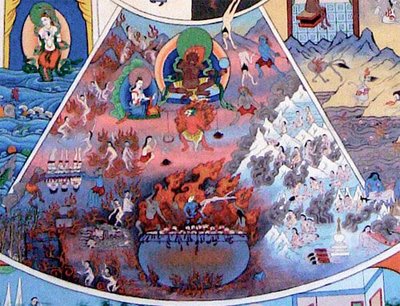
Of the six realms, the realm that we will speak of first is the rebirth in the hell realm. There are many sentient beings that are now, even as we speak, revolving helplessly in the hell realms. I guess the Christian idea of hell is a place under the earth where things are burning. That is not the idea that we have here. The hell realms are varied. They are varied in their condition. There are, in fact, extremely hot hell realms and there are Dharma texts in our bookstore [that tell about them]. I don’t feel the need to go into that at any great length at this time because that isn’t technically what we are about at this time; I’m going into this in a condensed form, but there are the hot hell realms, and the hot hell realms are all results that are associated with the cause of hatred, extreme hatred, the kind of virulent hatred and attitudinal hatred that many people allow to remain in their mind.
A perfect example of that kind of hatred would be the Ku Klux Klan kind of mentality you see, or the Hitler kind of mentality, the kind of mentality in which hatred simply pours out of the pores. There is such a strong habitual tendency of hatred that simply is unconditional negative hatred instead of unconditional positive regard. It is habitual. It is constant. It is simply an outpouring of hatred. This is associated with the cause of truly torturing and hurting others. There have been many throughout time who have tortured and mutilated the bodies and lives of others in a horrible way that we, living middle America lives, really can’t imagine except through what we’ve read. There are, of course, other certain heinous sins that also result in the rebirth in the most difficult of the hells. Those heinous things are the murdering or killing of one’s mother and father, the murdering or killing or harming of one’s Guru, the murdering or killing or harming or drawing blood of a Bodhisattva. That is not to say that if you were taking a blood sample for the health of the Bodhisattva, … Well, people would not exactly be standing in line for that job would they! No, but that would not be intentional harm, like really harming a Bodhisattva, someone who could bring enlightenment to others. Harming or taking that one out of the world is considered to be a heinous crime because it actually literally changes the future of the world. It changes the world in a negative way. It prevents the world from moving forward in its evolution, in its continuum.
For extraordinary non-virtue, for those really extraordinary sins, there are the hell realms consisting of the extremely hot hell realms and the extremely cold hell realms. Characteristic of both the hot and cold hell realms is that there is no respite from the suffering. There is no respite from the suffering. Literally, when one takes rebirth in the cold realms, one will be reborn in inconceivable cold with no protective clothing. What will happen to oneself will be the experience of what we think would happen to ourselves if we were to be suddenly now naked in an extremely cold realm. That is to say, the skin would freeze, crack open. Things would happen strangely to our bodies and you would think that that would be the end of it. But in these very cold hell realms, until the non-virtuous karma is exhausted, one continues to reappear even after death from cold has occurred, and that is the same with the hot realms. Continuously apparent, there is no respite.
There are other forms. There are the individual hells; and I can tell you for a fact that I know, through my own perception, that this is true. I have seen this sort of thing and this is the kind of thing that people mistake as being ghosts. Often you go to a house and at a certain time of night you will hear footsteps or you’ll hear a door creaking or you’ll hear chains rattling, whatever it is that people hear, that sort of thing. Probably what has happened there, although not exclusively, but probably what has happened there is that there is a sentient being stuck in an individual hell realm. This is the hell realm that is individual to the person’s experience, whatever their expected experience is. It’s according to the content of the mindstream, their consciousness, their habitual tendency. Write that word down somewhere in your notes, or remember it—habitual tendency. That will come up again and again during the course of your practice as a Buddhist. Due to the force of their habitual tendency, they will remain and this kind of hell realm is the result of again, extreme non-virtue, but it is also a non-virtue that is mixed with ignorance and a determination to remain ignorant.
Think about that, because you have done this. Think about this now. The determination to remain ignorant is the one where you make a decision to go away from pursuing wisdom and pursuing your method, your path. And you just go, “It’s too hard. I don’t like this. It’s not easy for me, I don’t want it. Hard. And I’m just a little kid and I have to play some more.” When you do that, you are actually turning your mind away from Dharma and you are committing a very strong non-virtue. The other one is, “I don’t have to learn that. I know enough to get by. I’ll just read…, Who was that one that wrote about death and dying? A non-Buddhist. They wrote that you see a tunnel and you see a white light. Do you remember who that is? I’ll just read Ross’ book and I’ll be fine. Maybe I’ll read it, if I have time, but I really like to read other books better.” And this kind of thing. You have this kind of idea.
Sometimes, I’ll see a person in class with ‘attitude’ written all over their heads, and have no idea why they’re here. Why did they come? I don’t know, but they have attitude written all over their head; and the attitude is actually like putting yourself in chains because you are absolutely setting up that you are not going to have a positive rebirth, that you can sit in the presence of what could possibly be your own root guru, or at least a guru, a teacher, and just simply turn your mind away. Literally, what you would be doing there is to make your mind like a bowl filled with poison so that the milk that pours in there is tainted, and then you are responsible for tainting the milk within your own mind. So that kind of thing is the kind of thing that leads to rebirth in the individual hells. That kind of ignorance. That is an ignorant move to make. It is born of ignorance.
The individual hells are very strange, very unusual. I can describe a couple that I know of personally. One good example would be of an individual who perceives themselves to be stuck in the opening and closing of the door. Of course this is all relative and it is all a deluded perception. This is the kind of person that perhaps would remain stagnant within the course of their lives, locked themselves in, did not grow, wouldn’t grow, would not challenge themselves to go the extra mile and be kind towards others, remained extremely self-absorbed. They literally shut their eyes during the course of life. Again, that sounds pretty mild in terms of a sin. You could commit worse sins, but we are talking about sins against one’s own nature and those are important. Those are very important. So this person would be stuck in the opening and closing of the door and would experience the door being closed on them and would experience the door being opened again. They would experience it as though their bodies were literally stuck in that, again and again.
I have also seen sentient beings that are literally stuck walking up and down a hall. That’s it, walking up and down a hall. They are stuck calling, calling, calling for someone. Literally they go through bardo—and this will make sense for those of you that have taken the teachings. They will go through the bardo state: They will go through the experience of the white Bodhicitta, the experience of the red Bodhicitta. They will go through the experience of the appearance of the Dharmadhatu that is experienced as blackness. They will go through the re-awakening of the perception of the Buddhas and Bodhisattvas. They will go through the reawakening of the perception of the wrathful deities. Then they will enter into the bardo of becoming, and in the bardo of becoming they will immediately experience rebirth. It will be very disconcerting because suddenly they will be walking up and down a hall, trying to reach the others that they were so attached to. Those of you that have very strong attachments on a human level, try to imagine what this would feel like. They will continually try to reach out for the others and they will sort of see them, but sort of not see them because they are not really there. Try to imagine seeking the safety of a loved one, and it changes all the time. You don’t understand. That’s the kind of experience of someone in an individual bardo. They experience walking up and down the hall, literally, almost seeing safety and then feeling all of the feelings that would go with doing that endlessly. So that is the kind of experience that one might experience if one were to engage in a non-virtuous life and not practice Dharma. And it happens.
Now what we’re talking about today, once again, is the antidote. The purpose of talking about the disease is so that we can explore the antidote. The antidote should not be taken without an understanding of the disease. These kinds of life forms will also be registered. From our point of view they will seem like repetitive ghosts doing the same kinds of things again and again and again.
There are many different kinds of hell. There are hells of entrapment. There are hells of destruction in which one is literally cut up and then reassembled and all kinds of things, and they go according to the level of non-virtue that one has committed. Compared to the amount of sentient beings that are now physical as humans, the amount of sentient beings locked in those hells is inconceivably more. We cannot understand how many more beings are locked there than are now approaching awakening on the physical human level listening to Dharma. We cannot imagine how many of those there are.
Sometimes as one finishes the karma that has brought them to a lower hell realm, they will then go on to a higher hell realm which is less uncomfortable. What we are talking about is a playing out the grosser and heavier non-virtue and then cleaning up the more subtle and more lightweight non-virtue. One may graduate from one experience in the hells to another.
You may think, “Well this is inconceivable to me. I can’t understand that. Being stuck in a doorjamb? No way. Hell no! Frozen? No. Hell no! Frozen, burned up? Come on, that stuff doesn’t sound realistic to me. I can’t believe in that.” Well, let me ask you if you’ve ever had a nightmare? Who has had a nightmare? Will you raise your hand if you have ever in your life had a nightmare. Just pretty much everybody. That means that your mind has the capacity to manufacture a hell. So for you to say that there is no such thing and you will never end up there, after you’ve had a nightmare, it goes to show that you’re not thinking. Because if you can manufacture a nightmare, that is not different from manufacturing a hell realm. It is the same thing. The seed, the content, the potential is within the mindstream and it is due to non-virtue. That’s what it is.
So you know that that’s possible. You have been there in a very small way. When you have a nightmare you literally are, in a subtle way, reborn from the bardo of dreaming into this bardo of experience, which is also part of the bardo of dreaming. You are kind of reborn from one subtle element, one subtle level, to another. And this is the very same thing that happens in a much grosser and denser level for that person who is unprepared for death, which fortunately is not going to be you. Right? Good.
Copyright © Jetsunma Ahkon Norbu Lhamo All rights reserved