The Foundation of Compassion

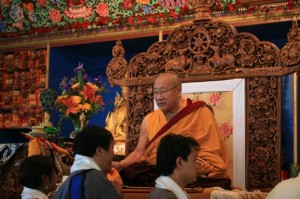
Kapala

The following is an excerpt from a teaching by Jetsunma Ahkon Lhamo called “The Foundation of Bodhicitta”

You have to understand the faults of cyclic existence in order to practice the ultimate bodhicitta. One must truly come to understand and be able to make the commitment that there is a cessation to suffering, but it is not found in revolving endlessly in cyclic existence. It is found in achieving enlightenment. In the state of enlightenment, having abandoned the faults of cyclic existence, the hatred, greed and ignorance and all of those qualities that produce the suffering of cyclic existence, one has effectively ended their involvement with cyclic existence and can come back by choice as a returner in order to be of benefit to others. This is the ultimate bodhicitta, the ultimate kindness.

I think about my teachers and I cannot believe their kindness. . For instance,  when I was recognized as a reincarnate lama,people asked me how I felt about my own recognition.

I said to them, “There are days when I’m not too thrilled with it. To tell you the truth, I wish it could have some other way. It is not what it is cracked up to be.”  When I think about my recognition, I think about one thing that amazes me. I think about my guru. How in the world did he pull the strings to make it happen? I had never heard of him before. He comes from the other side of the world, from India, into my living room and recognizes me. How did he find me?  How did he do that?  What kind of compassion would make that possible?

The story that I hear is that when he was a little boy and a young lama engaging in certain practices in the temple in Tibet, he actually said prayers that he could find this incarnation because he witnessed one of the relics from the predecessor of this incarnation. Just due to that prayer because he has such enlightenment, this amazing thing happened. How could I have met him?  How could that have happened?  It’s a miracle. I think about the kindness of such an effort as that. I think of this incredible kindness to be of such a mind that can do something in such an effortless way and have it benefit sentient beings. What practice he must have engaged in! How pure that mind must be! How amazing that he would go through the trouble—ultimate compassion, incredible, ultimate compassion. Unbelievable. He is the only one that could have done that, and he didn’t fault on that responsibility. He did that. That is what I think about that recognition: It is proof of his kindness. Only with the mind of enlightenment can we affect cyclic existence in such a way as to produce enlightenment for others. That is the kind of kindness that I wish to emulate. I wish to throw myself into that. I hope that you do. I hope that you can see the value of that.

This doesn’t mean that you have to wear robes or hole yourself up in a cave somewhere. You practice as you can, the best way that you can. Just give it your best shot. But in order to make your decision you must first understand the faults of cyclic existence. You must understand how cyclic existence develops. And you must understand what the end of suffering actually is and the meaning of ultimate bodhicitta. It means the end of all of it. It means the end of all the cause and effect relationships that create this phenomena.

Copyright © Jetsunma Ahkon Norbu Lhamo All rights reserved

Antidoting Non-Recognition

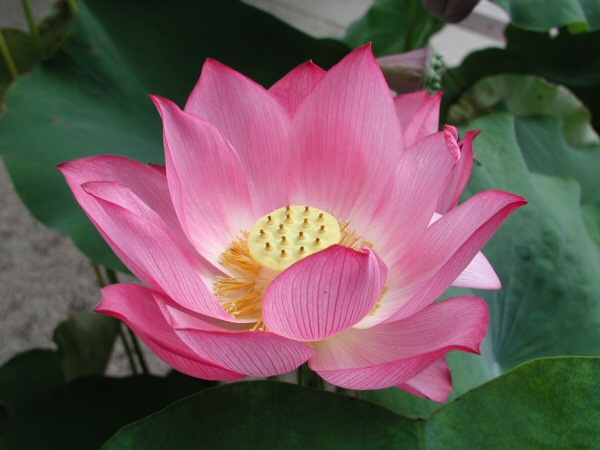
LotusFlower

The following is an excerpt from a teaching by Jetsunma Ahkon Lhamo offered during a Phowa retreat:

When we practice generation stage teachings, what are we practicing? We’re practicing perfect rebirth, enlightened rebirth. We are practicing letting go of our strong clinging to ego. We meditate on shunyata, realizing that the empty primordial wisdom nature is inseparable from that which is our display, and then we give rise to ourselves as the deity. Now if we give rise to ourselves as the deity, that is coming from a place of enlightened awareness, even though we ourselves are not enlightened. We’re practicing enlightened practice. So we give rise to ourselves as the deity, and we visualize that we are born on a lotus. That’s why the deity is seated on a lotus. What we are doing there is we are purifying our next rebirth. Our previous rebirth, since we were born as humans filled with desire, was not so auspicious. We saw our parents, we were running with fear, we had not recognized our mind, we were in a state of confusion. Then on top of it we felt lust and desire for our parents; we got stuck in the middle of that whole scenario. Lust and desire is the seed of our very lives. And of course, then, our experience was that when we were born we were born in pain, which if we had awakened or could be awakened or could taste the awakened nature, we would see that is not the case. We were not perceiving ourselves to be born in a lotus, We should have perceived the lotus of our birth as pure, without defilement, because it is the seat of our birth, and if we were awake we would have known that. But instead, what did we perceive ourselves coming out of? An ordinary physical body. The birth is painful; it is traumatic; it is messy. You can call it beautiful if you want to, if you are some kind of nature lover, but it ain’t pretty. I mean, you know, horse manure is natural too, but I’m not going to brush my teeth with it. It’s how we perceive ourselves, and it’s because we do not understand our nature. We had an ordinary birth, ordinary childhood, ordinary experiences, and here we are, ordinary. So now we are practicing for miraculous rebirth.

In generation stage practice, we practice the pure view of seeing our birth. Since we achieve the miraculous rebirth in our practice, and we give rise to the miraculous birth with the compassionate and pure intention, we are then practicing the view of being reborn on a lotus. Now if we could practice that well enough to recognize our nature within the bardo, literally one is reborn on a lotus. In Dewachen, in the pure lands, one is literally reborn on a lotus. That is the experience. It is a miraculous rebirth. One is born aware of one’s condition, with a stronger awareness and with a continuation.  It’s said, in Dewachen you are not only born aware but you are also born practicing the path. Of course, with pure view we understand that the seed of Buddhahood, the path of Buddhahood and the result of Buddhahood, while they seem to be three different things, are indistinguishable. So in the mind of enlightenment, that would make sense. To us, it doesn’t make sense. We are grappling here with the difference between ignorant awareness and enlightened awareness.

Within the bardo of becoming, since we have not recognized our nature, we will surely take rebirth in the six realms of cyclic existence. However, we can do much at this time to determine the extent of our next rebirth. First of all, both during the times of the appearances of the peaceful Buddhas and the wrathful Buddhas, if a person has practiced devotion to the point where they can call upon their spiritual mentor, their guru, and recognize the touch, or the scent, or the appearance, or the method of their guru as being present, they will be liberated through devotion, through seeing the guru. But you have to remember, to the degree that your devotion is a guiding force and a strength in your life now, to that degree it will be a guiding force and a strength in the bardo. That means not much yet. More devotion needs to be practiced. Even more so in the case of the bardo of becoming. When one is bound to go into the six realms of cyclic existence, one will surely take rebirth in the six realms unless one is somehow at that time able to recall the words of the teacher, the practice of the teacher, the kindness of the teacher, to reach out for the teacher, to recall and bring to oneself the mindfulness of the teacher—actually reach out for the teacher. In that bardo, the teacher can also appear and liberate. Still, through the force of devotion. Even then, that is the only exception. Otherwise, you will be reborn in the six realms of cyclic existence. But at that point you still have much that you can do.

At that point, the bardo takes on what appears to be seven day cycles, and they are seven day cycles of birth and death. They are very subtle expressions of the kind of death and rebirth that we have already experienced in the bardo. It’s like a subtle going to sleep and forgetfulness, and then a reemergence, a remembering that you are in the bardo knowing that you are dead; and you begin to wander in search for a life. At that point, you’re actually wandering. You’re moving closer to rebirth, so you have many of the faculties that you do in life: consciousness—the kind that thinks, the kind that discriminates in a certain way, but not enough to where reality seems very solid. So that part of the bardo can be very frightening. It’s very wispy, ghostly, but you have enough wherewithall to know that it’s wispy and ghostly. It’s kind of scary.

You see lots of different things that you have a harder time interpreting during this part of the bardo. The person in the bardo is able to travel instantaneously anywhere through thought, and they don’t know that. So what happens is many things come to your mind— too many things—and you seem almost mentally incontinent and confused.. At that point, the bardo becomes frightening enough that even lower rebirth seems to the person to be preferable to the confusion and kind of wishy-washiness that we’re experiencing in the bardo. But the teaching at this time is: Do not look for a place of safety during the time of becoming. When things become shady, when you appear to be wandering, when the Buddhas and Bodhisattvas have not appeared, do not be afraid. Stay where you are, do not exit. Remember the words of your teachers, do not exit at that time. Stay where you are; stay exactly where you are, and call for the teachers, the Buddhas and the Bodhisattvas to come to you. Do not exit. Call for the Buddhas and Bodhisattvas to come to you. Call for your teacher. Remember that. I’m telling you this with directness and firmness, to plant it firmly in your mind so you will not forget. Call where you are. Do not wander. Just as you wander in your practice and you wander in your life, going from spiritual teaching to spiritual teaching, thoughtlessly seeking without any intention of finding, that habit will cause you to wander again, thinking that you and you alone must find the way, can find the way. And it is you and you alone who will get yourself lost, in truth. So stay where you are. Calm the mind, be at peace, and call your teacher. Prepare your mind to recognize your teacher. That is what you should do at that time. And at that point there is still the option of liberation.

However, if at the very last you have no memory of your teacher but you can remember one thing, at least, of all the births, and all the parents that are seen by you, —and you will see many different, potential parents, animal parents, non-physical parents even—look for those parents that are human.  And at that time you should pray for an auspicious rebirth with human parents who will help you to meet the Dharma immediately. You can make prayers at that time, and at that time they will be answered. But above and beyond every single effort that you might make, call to your teacher. And with that, and indistinguishable from that, at any time of the bardo, one can call for Lord Buddha Amitabha because it is uniquely and singularly Lord Buddha Amitabha who will answer your prayers at the time of death and becoming, because he has taken that vow. He has understood the sorrow that human beings are afflicted with and his compassion is very great concerning this condition of sentient beings. In a way you could say that that’s Amitabha’s specialty. Amitabha is especially moved by the plight of beings when they are lost and wandering like that. So you can call to your root guru, you can call to Lord Buddha Amitabha; and you can consider that they are the same and indistinguishable from one another.

Copyright © Jetsunma Ahkon Norbu Lhamo All rights reserved


Force and Energy of the Buddhas

Phurba

The following is an excerpt from a teaching offered by Jetsunma Ahkon Lhamo during a Phowa retreat:

The wrathful deities are the same pure, holy, primordial wisdom nature that is your nature. They’re fully awakened. They are just as terrific as the guys that sit around looking fancy in their robes. But these deities, when you see them, will look terrifying, because what you are seeing is a visual display, or a visual indication of the quality that they are displaying. That is the quality that they are displaying registering in your eyes. That and none other—it is your eyes that do the interpreting. Now when we see them artfully drawn for our purposes, we see them in a way that we can interpret. We see them with skull necklaces and we see them with animal skins on them. We see them with a mala or necklace of dead skulls, and then we see some of them with necklaces of freshly severed heads. I mean, really, what an outfit! Myself, I wouldn’t mix gold and silver, and I wouldn’t mix dead heads with fresh heads, just seems inappropriate to me. But anyway, that’s different! Anybody listening? Or is it thunder outside, huh? So, they appear to us in a form that we can understand. We are to understand, for instance, that the mala of freshly killed heads indicates the death of ego. I mean, he didn’t run around and chop off heads and make a necklace. This is an indication of the death of ego, you see. So a functional display is what that is.

Now you will see the wrathful deities in the bardo also with a similar functional display; and it may look exactly the way the thangkas look, or it may look slightly different according to your individual interpretation. But guaranteed, when you see the wrathful deities, the first tendency will be to run and be frightened because you are looking at the activity of the Buddhas. If we were to jump up and down in our ordinary bodies and make as much noise as we possibly could, we would still be only gathering together samsaric powers. You see what I’m saying? We’d only be using what we have right now to use, and that’s not even all of our brains, let alone all of our nature. We’re not even awake to our nature. So we’d only be able to use this kind of power.  And yet we could make a fearsome din if we really tried, couldn’t we? Well, think about, then, the wrathful deities. They are expounding all of the forcefulness of the Buddha nature as it transforms ignorance into bliss, and it’s being displayed. Well, it’s going to be noisy, it’s going to be really dramatic, it’s going to be impressive, it’s going to be colorful, and it’s going to be unusual as hell! Because there is nothing usual or ordinary that we have ever seen that can, in fact, pop us from ignorance into bliss. So you must prepare yourself for the seeing of the wrathful deities.

Those of you who  practice Vajrakilaya and have taken the time to purify your minds through the actual visualization of Vajrakilaya, will then become familiar, even if you do not recognize Vajrakilaya per se, which may happen, because in the bardo state one of the things that you’re fighting is the same thing you’re fighting when you’re sleepy in practice. To the degree that you are able to overcome sleepiness in practice and while you are receiving teachings, to that degree you will have clarity in the bardo. Doesn’t that scare you! To the degree that you have the dullness and the lethargy and the inability to stay awake during class and the inability to stay awake during practice, you have in the bardo a funny kind of…  Y know how it is when you’re either practicing or just waking up during the practice, when you try to remember what the visualization is and your mind kind of slides off of it? You know what I’m talking about? You sort of get the visualization and suddenly it’s almost like you fell off. It’s slippery almost, and you find yourself someplace else. Well, you’re kind of half in and out of the bardo of dreaming there, believe it or not; not too well in the bardo of concentration or meditation. You’re kind of half in the bardo of dreaming, and the mind has this slip-slidey kind of funniness, a jelly-like quality that sort of runs everywhere. Well it’s the same thing in the bardo. So you may look at Vajrakilaya and if your practice has not been that good you may not actually truly recognize Vajrakilaya and what that is. But you may be able to center on one small object, like, let’s say, the phurba that Vajrakilaya holds. That may key you and you just recognize the hand implement. All you have to do is take refuge in the hand implement. That is the first step, and it will lead to liberation in the bardo. Recognizing the meaning of the hand implement, thinking to yourself, “That is the very phurba that will pierce the ignorance of my mind. I see that, I want that.” The devotion comes up, like ‘that is the phurba that will pierce the veil.’ You look at that phurba and with the force of your own inner awareness that you still have in the bardo state, you will go toward that phurba. And that is liberation through recognition.

That is the kind of thing that happens with the blessing of generation stage practice, but, remember, you have to be prepared and forewarned for the movement, dynamism, the dramatic display of the wrathful deities. They are the force and activity of the Buddhas. What do you think that’s going to look like! That’s a big deal. That’s a big deal. That is equal to the force that it takes to liberate all sentient beings. It’s got to be more forceful then Hiroshima, any bomb that we have ever seen, the biggest bombs that we can imagine. It must be more forceful than that. Therefore, prepare yourself to recognize the blessing of the wrathful energy of the Buddhas.

Copyright © Jetsunma Ahkon Norbu Lhamo All rights reserved

The Appearance of the Wrathful Deities

Vajrakilaya

The following is an excerpt from a teaching by Jetsunma Ahkon Lhamo offered during a Phowa retreat:

So, you are training; you are preparing. You know what to expect. You know that you will go into a state that is unfamiliar to you, with senses that act differently than your senses act now, although they will be similar in some ways. You know that you will have many choices. You know you will see things that are uncomfortable for you and unfamiliar; you will see things that are more familiar. You are beginning to understand that there are things that you should look for and things you should go toward, but mostly, you have heard the most precious piece of information. You will hear it again and again and again. And that is that these things that you see in the bardo are not to be feared. They are displays and emanations of your own mind. No matter what they look like, no matter what you see, no matter how unfamiliar you are. From the very brightest lights to the very most confused and deluding negative lights…  The lights that emanate from the hell realm are things that are an expression of some particular aspect of your own nature—whether it is your nature in a state of defilement, or the samsaric elements of your nature, or whether it is your nature in this most pure form, which is your ultimate primordial Buddha nature. Everything that you see in the bardo will be you. There is nothing to run from; it is childish and stupid to run. You cannot run away from yourself; it will pursue you. As you will see in the bardo, there are cycles of coming back and trying to choose again, coming back and trying to choose again. You’ll see that as we move on. So let’s move on.

Now we have come to the part of the bardo where the peaceful Buddhas have finished appearing. In order for you to be continuing in the bardo now, this means that the peaceful Buddhas have appeared. You have seen your nature in all its different elements and displays;. You have seen the displays of the qualities of your nature, but you did not recognize them, and you did not follow them. Fortunately, you also saw the displays that are sort of vibrational showings or displays, and also ways to enter the different six realms of cyclic existence, and so far you have not entered those either, for whatever reason.

It is hard to say what the reasons are. It can be that habitually you are a person of extreme caution and are unwilling to do anything without a great deal of examining. Of course that won’t work, because if you have not been trained, you are examining bardo with the same, if not more, delusion than the delusion that you have in life, when you could not examine enough to be able to get yourself out of samsara anyway. So that kind of examination will not serve you. It is this training and devotion to one’s spiritual mentor that will save you. That is what actually works. But somehow you’ve managed not to go into rebirth at this time. You are still in the bardo. Now at this time, the wrathful deities appear.

When the wrathful deities appear, they do so singularly and they do so en masse. They appear to you in different ways—it’s a very dynamic kind of presentation. It is also with the peaceful Buddhas, but with the wrathful Buddhas it is even more so. The reason why is that the wrathful Buddhas—you’ve seen pictures of them, or the next time you go into the Prayer Room you should look at some of the wrathful Buddhas and you will see—they are downright spooky looking. And you ask yourself, “Whoa, what, are they like Guido and Raoul, the hit men from New York?” What is it? When the good guys can’t talk you into it, the bad guys beat you into it? You must wonder what the wrathful deities are. The wrathful deities actually are symbolic and are meant to display the aspect of enlightened compassion and method that is forceful, dominating, expanding, progressing, purifying. These are all very active words, aren’t they? They’re very dynamic and active words. There are, of course, displays and expressions of one’s Buddha nature that appear as absolute stillness and absolute emptiness, and very peaceful kind of display. Of course, that is the wisdom aspect of one’s own nature. But what is the method aspect of one’s own nature? If wisdom and method are non-dual and completely inseparable, as they are, looking at them from the purely awakened state, then it must also be, just as much, if stillness is your nature, then movement is your nature. They are the same and indistinguishable. If emptiness is your nature, then fullness is your nature, because in truth, in the awakened state, emptiness and fullness cannot be distinguished. They are not only inseparable, they are not distinguishable. It is only we that separate emptiness from fullness and peacefulness from aggression or activity.

So, as in the case of Vajrakilaya, which many of you here practice, Vajrakilaya is the very wrathful display of Vajrasattva. Vajrasattva. Who could be more peaceful than that deity who is meant to purify all of our samsaric afflictions, who has the capacity to purify all of our “sins,” all of our afflictions, all of our ego clingings, our hatred, our greed, and our ignorance? Who is more forgiving and more peaceful than that? And yet the wrathful display of Vajrasattva is Vajrakilaya. Does that mean that Vajrasattva has PMS and on a monthly basis emerges as Vajrakilaya in a real bad mood? Do you think that’s what it is? No, that’s not what it is; of course it’s not. It is the same nature. It is the same. Vajrakilaya is completely indistinguishable from Vajrasattva. They are the same in their function.  They are the same in their capacity.  They are the same in their enlightenment. But they are different in the display of method. That is all.

Copyright © Jetsunma Ahkon Norbu Lhamo All rights reserved

Eternal Fountain of Blessings

The following is an excerpt from a teaching by Jetsunma Ahkon Lhamo called “Take Control of Your Life”

We have an amazing thing here.  We have an opportunity to participate in something that you don’t have almost anywhere else—I don’t know of anywhere else—and that’s the 24-hour a day prayer vigil.  I don’t know of another place, and there may be one, but I don’t know of another place where prayer for sentient beings goes on 24hours a day.  This place is like a giant merit machine.  To participate in that and the satisfaction of knowing that you have participated somehow in alleviating the suffering of the world is a thing that we should contemplate with joy.  And we’re beginning to win over other people.  Apparently, there are some non-Buddhist preachers locally that want to know how we did it.  How did we motivate our people to practice 24-hour a day prayer for all beings?

Well, we taught what the Buddha taught: that all beings are equal in their nature, that they are all suffering horribly, that they all wish to be happy, that enlightenment is the [end] to suffering, and here is the method.  So we have the means by which to understand how to change the worldnot only how to change our personal world, but the world at large. Can you imagine if we had even a dozen major cities around the world with this same effort?

Can you imagine?  Stupas and 24-hour a day prayer.  This is my dream, my hope.  That the field of joyful practice, virtuous activity and enlightenment will swallow up the world and bring us all blissful contentment. That’s what I want to do.  I want to make stupas everywhere.  I want to make prayer vigils everywhere.  I know you want to help.  I know you want to join me.  It’s the only game in town.  There’s nothing else that you can do that will bring so much joy.  Nothing you can eat, drink, have, do, that will bring you that much happiness.

Here’s where we start, right here, to change our lives into vehicles that bring happiness to other beings, to practice every day to attain a virtuous peaceful calm mind and to offer that as food and drink to those who are so locked in their own phenomena and confusion that they don’t know that they are.  To offer our practice as an eternal fountain of benefit, as eternal as this world anyway, for all the beings of this earth and for all the three thousand myriads of universes, because we should be impartial like the sun.  We should pray for all beings equally.

Copyright © Jetsunma Ahkon Norbu Lhamo All rights reserved

The Path to a Joyful Mind

The following is an excerpt from a teaching by Jetsunma Ahkon Lhamo called “Take Control of Your Life”

On the Vajrayana Path, the teacher will say, “I will beat you to death if you don’t straighten up.  I will just take a stick to you.”  You know, His Holiness [Penor Rinpoche] is famous for doing that.  He once had a Tulku who was dying and this Tulku was someone that His Holiness had a lot of hopes in.  Obviously there was some obstacle to his life.  What was it? We don’t know.  But His Holiness realized the Tulku was dying. So he went in to see the Tulku, and the Tulku must have said something that brought up His Holiness’ awareness of this obstacle.  His Holiness took off his mala and starting beating him with his mala, just beating him and beating him.  And the next day, the Tulku was completely well.

Sometimes the lamas are wrathful in order to remove obstacles.  Sometimes the lamas are so wrathful that they are more wrathful than any parent we’ve ever had and we see that. Or we love the lama so much that the wrathfulness of the lama seems like a big stick and we can hardly bear it. Or the disappointment of our lama seems like a big stick and we can hardly bear that. Then sometimes the lama says, “You are such a special being.  You are so intrinsically special, even your karma is special.  You are special to me.  I love you so much.  Come here.  Come on.”  And the lama says, “I love you.”  And the lama says, “I know you.”  And the lama says, “I see your heart. Feel that?”  And the lama says, “I have great gifts to give you. Dharma is beautiful.  It’s a joy to practice.  It’s everything the Buddha has offered.  I’ll set this immense banquet in front of you and you can eat the food of Dharma.  How beautiful.”

Of course the lama neglects to mention that Dharma is difficult, that the path is hard, that the things that we have to face about ourselves are horrible and ugly and the things that we have to change about ourselves are very hard work.  It’s very hard to change that ego-cherishing into pure generosity and bodhichitta.  It’s so hard. The lama may invite you to have some tea.  But if you have real potential, the lama’s going to smack you upside the head and say, “Straighten out, buddy.  That’s not the way to practice Dharma.”  And that’s the part that we should be grateful for.  Not only should we not get mad because that would be a big mistake; but instead we should say, this is the very nectar of the Buddha’s teachings.  The Buddha has instructed us how to ‘wake-up’ and now we must do the work of waking up.  When we practice Dharma, Dharma is something that we practice 7 days a week, 24 hours a day, 365 days a year.  There’s no Sunday in Dharma.  We’re just practicing the habits of our culture [having teachings on Sunday] and we know that you work. Otherwise, there’s no Sunday in Dharma.  Dharma is every day.  We shouldn’t come here to see an altar; there should be an altar in our homes.  To come here and practice is wonderful.  We welcome you with open hearts and open arms; but this should not be the only place you practice.  You should maintain your practice every day.

This is the way to be happy.  Because if you create the habit of practicing and doing some Dharma, making prayers and offerings, practicing say, Ngöndro every day, or even just reciting Seven Line Prayer every day, the mind begins to change.  It’s less inflamed, less needy, less concerned with what you want, less concerned with bad habits.  The mind begins to change in such a way that it’s less inflamed, more relaxed.  And a more relaxed and spacious mind is the prescription for a more joyful mind.

 Copyright © Jetsunma Ahkon Norbu Lhamo All rights reserved

Putting the Teachings Into Practice

The following is from a series of tweets by Jetsunma Ahkon Lhamo:

I wish my Sangha was more concerned with the welfare of others. And more concerned with our Temple (KPC) to the degree that they help.

Some in our community work for othersand do their practice with depth and concern. They truly have the proper intention and the Bodhicitta Many are simply lazy and unconcerned. They like the dog and pony show and the exotic belonging to a place like KPC. They sign up but do nothing, start but never finish, are like children who expect to have their toys cleaned and picked up for them. They don’t even recognize What needs doing. They just show up and enjoy the show. That is not Dharma and will not lead to the precious awakening .

This is a great weekend to do some outside cleaning and picking up. Get some fresh air and sunshine. The grounds are a mess. Plants that have gone down for the winter need cutting back and fallen branches, leaf trash, all need cleaning up. It is good to present ourselves in a neat, respectful way. We should have no junk laying around and get rid of abandoned, and now useless things like the RV. Which we really needed to transport animals and other things and people, especially to Dakini Valley, while we sat slack-jawed watching it rot.

Copyright © Jetsunma Ahkon Norbu Lhamo All rights reserved

Pick Up the Shovel

The following is an excerpt from a teaching by Jetsunma Ahkon Lhamo called “Take Control of Your Life”

When we create a close relationship with our teacher on the path of Vajrayana—once we have examined the teacher’s qualities and have decided for ourselves that this is indeed the root guru—then we must follow.  If the root guru can teach us Buddhism, they have to have something of that same capacity [as the Buddha].  Now maybe the root guru can see what it is that’s brought us here—the suffering that’s brought us here, and the accomplishment.  The root guru looks at you and sees you are Buddha,  and yet you suffer.  So the root guru says, “I wish to teach you how to live, how to practice, so that your suffering ends and so that you can benefit others.”  Nowhere else is one taught that way: understanding the true nature, one’s appearance and one’s nature that is empty. Therefore only the Buddha is the appropriate guide.

The Buddha teaches us that everything is about karma. It’s about choices; it’s about cause and effect; it’s about realizing one’s nature and remaining stable in the bliss of emptiness.  If we remain stable in that, we are free to examine any part of our lives. And most of all, first and foremost, we should examine our minds.

The Buddha has taught us that first, and most importantly, we should establish our motivation,.  And our motivation is based on the first teaching of Lord Buddha—that all beings are equal in their nature. All beings.  That they are all suffering and yet what they all have in common is that they all equally wish to be happy.  The smallest worm, anything with consciousness in its own way, in its own language, is striving to be happy.  Then the Buddha teaches us the pristine message—the message of hope and the one that allows us to practice at last.  The Buddha says, “All beings are suffering, but there is an end to suffering, and that end is called enlightenment.”

Beyond that, Lord Buddha says we must examine our minds, our intention.  This is profound work; this is deep work.  You can’t practice a little Dharma over here and commit a little adultery over here.  You can’t practice a little Dharma over here and have someone in your life whom you know doesn’t have a bite to eat and not help them.  You can’t practice a little Dharma over here and have no respect for the Sangha or the temple or the teacher.  In other words, Dharma’s not like a pretty little high church package.  Even though we have bunches of fancy things around here, it isn’t like you walk into a giant temple and go, “Oh, I’m moved emotionally, and it’s Sunday.  I did it.  I’m a good Buddhist.”  No.  That’s not Dharma.  “I came on Sunday, I sang some songs and I’m impressed with the church. Now I’m going home.”  No, that’s not Dharma.

Dharma is different.  When we see these objects that are beautiful and magical and we see the brocade and we see the statues, yes, it thrills our hearts and we recognize on some level that something very precious and beautiful is here.  But the Buddha didn’t tell us to sit around and think about how things are precious and beautiful in the temple.  The Buddha taught us that Dharma isn’t like a beautiful package of golden brocade.  Dharma is a knife, and it’s meant to cut.  It has a sharp edge, and it’s not always painless.  Dharma teaches us that the honest truth is that non-virtuous activity and habitual patterns will only lead us to more unhappiness. That means we have to go in there with a shovel and a pick axe and start changing our minds.

Copyright © Jetsunma Ahkon Norbu Lhamo All rights reserved

Unconditional Love

The following is an excerpt from a teaching by Jetsunma Ahkon Lhamo called “Keeping Heart Samaya”

When we consider the student’s relationship with the teacher on this path, we are talking about very high stakes.  We are not talking about a student-teacher relationship in order to get through a six week course.  We are not talking about a student-teacher relationship with which to graduate with so many credits from college.  We are talking about a student-teacher relationship wherein the end result is the ultimate fruit or jewel, the crown of cyclic existence, that is, the potential or capacity to enter into the door of liberation and be free of suffering at last.  These are enormous stakes.

So both parties in the student-teacher relationship have to take that relationship very seriously, very seriously.  I know for a fact that the teachers regard the students with great seriousness.  Their love for the students is unconditional.  Once that student-teacher relationship has taken place, the teacher has become, for the student, Guru Rinpoche’s appearance in the world, Lord Buddha’s appearance in the world.  Once that happens, there is a love there or a bonding that cannot be undone by anything in the world.  There is nothing in the world that can take Lord Buddha’s blessing, Guru Rinpoche’s blessing out of your heart.  Nothing can do that.

Even if the students themselves were to act in a very inappropriate way, breaking the samaya bond, acting out of accordance with what the teacher has taught, even committing really negative actions like harming the teacher in some way, it is always the truth that if the student were to make restitution, were to turn their face towards Dharma again and truly wish to accomplish Dharma, and wish to separate themselves from their previous non-virtuous acts, the teacher would immediately respond to that.  There is no question.

As parents we do that with our children, don’t we?  Sometimes children will do pretty bad things, throw baseballs through windows, knock the cookie jars over, and really much worse things. So even though these acts may occur, the parent will always accept the child again.  The parent will not stop loving the child.  It may be true that there is a difficulty there, a burden, a strain, a suffering, but that is your child.  A good parent would never turn their face away from their child just because their child made a mistake.  Parents know that children are immature with very little discrimination.  They are learning, and it’s the parents’ job to teach them.  Exactly the same with the student and the teacher.

The teacher knows that students are sentient beings.  According to the Buddha’s teaching, all sentient beings are suffering.  They all wish to be happy, but they do not know how to make the causes of happiness occur.  They don’t understand cause-and-effect relationships.  So isn’t it to be expected that mistakes will be made?  Of course mistakes will be made. It’s only reasonable and logical.  So the teacher would never hold it against the student.  That relationship is like the Buddha’s compassion, all pervasive, beginningless, conditionless, without end.  That is the nature of that love.

So when we look to the student’s commitment, or samaya, to the teacher, we should look to see the same depth, the same bonding, the same beauty in that commitment as well.  And that commitment should be a joy on both parts.  Less the flavor of duty and responsibility than the flavor of love.  The love between the student and teacher is like the Buddha’s compassion.

Copyright © Jetsunma Ahkon Lhamo.  All rights reserved

Flower of Gods: From “Sutra of the Wise and Foolish”

The following is respectfully quoted from “Sutra of the Wise and Foolish” by Stanley Frye 

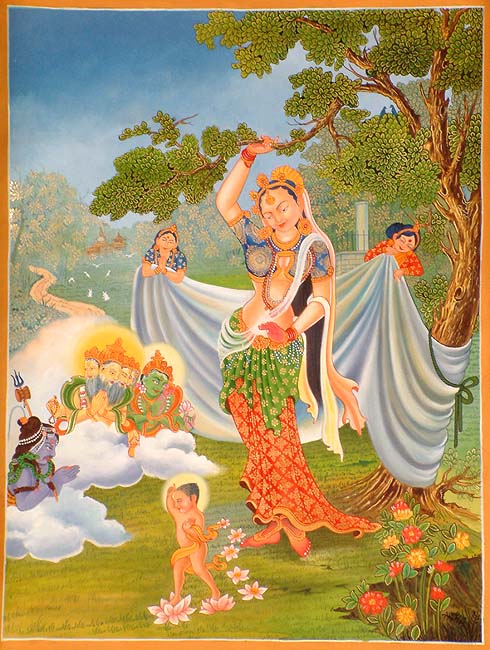
Flower of the Gods

Thus have I heard at one time: the Enlightened One was residing in the sity of Śrāvastī at Jetavana monastery in Añathapindika’s park together with an assembly of one-thousand two-hundred and fifty monks. At that time, in that country, when a handsome and comely son was born to the wife of a householder of the highest caste, a shower of flowers of the gods fell from the sky and filled the house, and the boy was named Flower of the Gods. When he had come of age, he went to the Buddha, and seeing the Lord’s body endowed with the incomparable signs, rejoiced greatly and thought: “I have been born into this world where I have met the Supreme Among the Noble Ones, I shall invite the Lord and his assembly”, and said: “Lord, tomorrow I shall prepare alms-food in my home. In order to lay the foundation for Enligthenment, I beseech the Lord and his Sangha to deign to come”. The Buddha, seeing the boy’s pure and firm intention, said: “We accept your invitation”.

Thereupon the boy called Flower of the Gods returned to his home and in his mansion caused a great throne of jewels to magically appear along with many other seats, and adorned the dwelling with various kinds of decorations.

Upon the morrow the Enlightened One and his Sangha came, and when each had taken his seat according to seniority, the boy though: “Now I shall offer various kinds of food,” and, because of his virtue many different kinds of food appeared by themselves and these he offered to the Lord and Sangha.

When the Buddha had taught the boy the Dharma, the house became filled with flowers of the gods and the boy requested permission of his parents to become a monk. When his parents consented, he went to the Buddha, bowed his head at his feet, and said: “Lord, I request ordination”, and when the Buddha said: “Welcome, monk”, his hair and beard fell away by themselves and he was dressed in the red robes. Exerting himself in the word of the Buddha, he became an arhat.

When Ānanda saw what had taken place, he knelt and said: “Lord, this monk Flower of the Gods–by reason of performing what former good deeds did a shower of flowers descend and jeweled thrones and various kinds of good appear? I beg the Lord to explain the reason for this.”

The Buddha said: “Ānanda, if you wish to hear this, listen carefully. In aeons long past, when the Buddha Kāśyapa was in the world and was visiting the cities for the weal of beings, a householder of the highest caste honored and made offerings to the Sangha. When a poverty-stricken beggar saw the Noble Sangha, great faith was born in him and he thought: ‘I have nothing with which to make an offering to the Sangha’. He gathered various kinds of grasses and flowers and with a mind of faith showered them on the monks, bowed, and venerated the Sangha. Ānanda, this monk Flower of the Gods was that beggar who at the time made offerings of flowers. Because he sought Enlightenment with a mind of firm faith and gathered flowers and showered the Sangha with them, for sixty aeons, wherever he was born he was always handsome and comely and endowed with whatever he wished to eat and drink. As a result of that merit he has attained bliss. Therefore, Ānanda, one must not think that there is no merit when one gives, even if it is very little. As was the case with the boy Flower of the Gods, the fruits will come by themselves.”

Thereupon Ānanda and the assembly believed what the Lord had taught and rejoiced.


WP2Social Auto Publish Powered By : XYZScripts.com