
The Most Important Practice

human-kindness-11

The following is an excerpt from a teaching by Jetsunma Ahkon Lhamo called “The Habit of Bodhicitta”

The traditional fundamental ideas of all sentient beings as being equal—the realization that all sentient beings are suffering equally, that it is unacceptable to see their suffering, that all sentient beings are interrelated with us—these fundamental thoughts are really important. But go on from that and practice the mechanics of changing habitual tendency. It is not enough to be theoretical. The biggest fault that I find in Buddhist practitioners is that they keep it academic. I do not myself like academic Buddhist students. I would rather you knew nothing about the academics of practice and a heck of a lot about changing the habitual tendency of self-absorption through a real practice. Because academics is not going to get you anywhere but between your ears. On the other hand, giving rise to the bodhicitta and pure view and changing habitual tendencies will lead to profound realization, to the perfect awakening. Not only that, but it will lead to a better world.

So for my money, I feel like the best thing you can do is to begin to practice in a small and simple way. You don’t have to be a Buddhist to do that either. And you don’t have to be a high falutin’ practitioner to do that either. You don’t have to wear the robes, or walk the walk or dance the dance or talk the talk, or even have a nifty mala which seems to be the highest priority when we first become a Buddhist. Big deal! The highest priority should be loving kindness and you should begin in whatever small way that you can, making no conclusions, other than the fact that you have a pattern and that you can change it. Remember the idea of the scales. That’s really important. Remember the idea of applying the method today. Now. Remember the idea of confession and restitution immediately after any breakage. How potent. What an incredibly potent way to live! Can you imagine living without the burden of guilt or the burden of the false assumption that you are a bad person?  You’d have so much spare time on your hands. You wouldn’t know what to do. Because all the things you do to prove yourself you wouldn’t have to do anymore. Isn’t that true?

Do yourself a favor. Live simply in that way. It’s the best and highest practice. In the Vajrayana tradition we are given many things that we can do. We practice Ngöndro, preliminary practice. We meditate on the Thoughts that Turn the Mind.We practice generational stage practice, completion stage practice. We visualize ourselves as the meditational deity and pronounce mantra. All of those things are meant to put more in this pile. The most important practice is that of loving kindness, that of viewing others as equal. Don’t view them as worse than you, no matter what they look like and that way there won’t be anybody better than you.  All of this has been taught by the Buddha and is absolutely true.

Copyright © Jetsunma Ahkon Norbu Lhamo All rights reserved

The Buddhist Way

magnifying-glass1

The following is an excerpt from a teaching by Jetsunma Ahkon Lhamo called “Art of Dispelling Anger”

And then, of course, you can do it the Buddhist way. And the Buddhist way is:Wait a minute. Where is this anger?  Show me the anger. OK. It’s coming out of my mouth, but I can’t quite hold it. Where is it?  Take time and play with it. Is this anger solid?   Well, who is the person I’m angry at?  I’m angry at her or him or somebody. Let’s see. I’m angry at her.  (This is a pretend person I’m pointing at.) I’m angry at her. OK. Where exactly is her?  I’m going to go through the Buddhist teaching: Where is the ‘I’ in her?  Where is the part that is actually her?  Is it the ear?  Is it the mouth?  What part of the mouth?  The teeth?  The tongue?  Is it the brain?  Slice the brain and find her.

Do yourself a favor. Take yourself off the track of hatred and work the method, because the more you let that go,… You think you feel better after you’ve had a rage thing because it’s addictive. It’s like alcohol. The more you drink, the more you want. The thing to do is to keep yourself from that by stepping back, taking a breath and examining what you are doing. Just examine the basis of it. Just take a minute and examine the basis of it. It will be very hard to do at first, very hard to stop yourself, first of all. But you must practice and you must learn. And the first time you are successful at it, yes!  And the second time you are successful at it, yes again; and the third time it’s a little easier. And you begin to start noticing things. It’s a step upon step upon step sort of building process of awareness that is actually happening, because in fact, there is no enemy, there is no self, there is no anger. And we just need to wake up to that.

Our nature is the pure primordial luminosity—that spontaneous nature which is utterly empty and absolutely complete, that emptiness which is not empty within which is all phenomena, all potential . So that emptiness is our living, dynamic nature. Having forgotten it, we are asleep. Being asleep, we act like criminals, while we should be acting like the celestial deities with the vajra pride that we visualize, giving rise to those good qualities of helpfulness.

Copyright © Jetsunma Ahkon Norbu Lhamo All rights reserved
Warrior of Virtue

eowyn_warrior-1

The following is an excerpt from a teaching by Jetsunma Ahkon Lhamo called “Art of Dispelling Anger”

For myself, I have that commitment. I made it a long time ago. There’s no backing out now. Every time I try, my commitments are made. It’s a done deal. I’ve always known that. My aspiration is to leave the footprint of bodhicitta every time I incarnate, to leave it so it is undeniable , and to help others so that they can leave that same footprint. And I don’t intend for that to ever stop until all sentient beings are free. Now why is that?  It is because I am such a great kid? I am  such a doll? Iam such a wonderful person?  That may all be true, but that’s not why. It’s because I cannot be truly free without you. There are many gurus of different kinds who are self-realizers. They realize mastery of self. But that is not our gig here. That is not what we do in Buddhism. At least not Vajrayana. We don’t do that in Vajrayana. In Vajrayana, our goal is to understand and give rise to the primordial nature in display, which is the great bodhicitta. End of story. And so I will not abandon you. I cannot abandon you, because you are me and I am you and I cannot be free without you.

That’s the understanding we should all aspire to. In our selfishness and our self absorption, we forget and we commit this abomination of even fighting with each other when if we could only truly look in each other’s eyes, if we could truly see,… We are the same, we are the same, we are the same taste. And so, this is why we need to break our habitual tendencies, train ourselves thoroughly, look at ourselves honestly and most of all, if any of you are in that childbearing age, anyone who is listening, please, raise your children right. Raise your children right. Teach them responsibility for what they do. The ‘I help with the household chores’ is one thing. Teach them to clean up their own messes. Teach them that pencils were made with erasers for reasons—so that we can correct ourselves. We can erase our mistakes and correct them and make better. Teach them ethics. Teach them the ethics of liberation.

The reason why we have so much difficulty teaching people proper values and how to stick with the beginning stages of the Buddhadharma, which is about virtue and conduct, the reason why that is so hard is that most of weren’t raised up. We were kind of dragged up. You know? We weren’t raised up with thoughtfulness and regard and respect. Many of us were just kind of fed and watered and whatever. When you raise a child, you must teach the child to be a good citizen in the world and to leave the world better than they found it.

So that’s my hope for you and that’s my hope for anybody’s children and that’s my hope for all sentient beings. Just think if we could really just get that message across. Forget the big practices and the bells. Just think. The most fundamental of the Buddhist teachings allows one to be whatever faith they wish, but teaches us how to live with good qualities.

So take up your sword, take up your shield and beat the crap out of your bad qualities, lest I have to do it for you. That wasn’t a threat. I am a nice person.

Copyright © Jetsunma Ahkon Norbu Lhamo All rights reserved

 

Habitual Tendency

anger

The following is an excerpt from a teaching by Jetsunma Ahkon Lhamo called “Art of Dispelling Anger”

If you have the habit of gossip, go through the method. Fix it. Understand that if you allow that hatred in any form to continue, you will get more and more unhappy as you age. The people who are youthful and beautiful when they are elderly are the people who kept something alive, even if they aren’t Buddhist. I’ve met people like that. A duty, a responsibility, an ethical responsibility they feel to be kind. Maybe they don’t understand extraordinary kindness, but they are kind. An ethical responsibility to not put shit in the pool of earth. Some people just seem to have that karma to understand that even without the Buddhadharma. I respect that so much.

And that’s true of all of us, too. As we get older, we get the wrinkles. and this is crazy, the wrinkles, and this is crazy, the wrinkles, and this is crazy, the wrinkles. It’s a symbol, if you think about. It’s a symbol of how much deeper the lines of our habitual tendencies get over time. Do you see what I am saying?  Our habitual tendency is in our posture; it’s in our face. We screw up our faces when we are doing our habits, and all of this aging stuff is phenomena—our phenomenal habitual existence becoming more solid and more real and more heavy in samsara as we get older. That’s unfortunately how most people age. They get stiffer. They get harder. They get querulous, frightened to death, frightened of death. And for many people, it’s an ugly, humiliating time.

I don’t want that for you. But it’s going to happen if you don’t take yourself in hand and say, ‘Let’s walk through this.’ Really look to benefiting yourself. Instead of being steeped in habitual hatred, conquer that monster. It’s a bubble; it’s a dream; it’s not a solid thing. There’s no elephant in this room, not really. We have to practice away from that.  Start simple. If you can’t find anything good about a person, first of all, that’s your fault right there.  If you can’t find anything good about the person, make it your business to find something. If it’s just you like the way they tie their shoes, work from there. If that is where you are starting from, if that is what you have to do, forgive yourself and move on from that point. But start. If you can go a little further and understand through practicing and contemplating, and through the method that we teach here, that all sentient beings wish to be happy and in their nature they are the very Lord, and that there is an end to the suffering and that is liberation. With understanding, we can then give rise to the bodhicitta and compassion.

Copyright © Jetsunma Ahkon Norbu Lhamo All rights reserved

Learning to Step Back

contemplation

The following is an excerpt from a teaching by Jetsunma Ahkon Lhamo called “Art of Dispelling Anger”

I study sentient beings.  I must have done it in another life, because as a child I knew this. I sort of woke up from my childhood knowing that all beings are suffering. And I understood somehow that it was a spiritual thing and that they needed love. No matter what it looked like, they needed love. That was as a child; as a child I understood that. Now as a woman and a practitioner, I understand what the Buddha has taught and it’s the same. And I understand that my fervent prayer is that should I leave a footstep in this world, it will be a living display of the bodhicitta through my students, through any works that I might do. That’s what I care about. And each one of us should participate in that dream. If you are really my student, then you must care. We should all care to advance the aspirations of our teacher. That’s part of Vajrayana. We may not individually have the power to give rise to a stupa or to give rise to an ordained Sangha, but we are part of that and we should take responsibility for making that dream come true. My dream is love. It is bodhicitta. Temporary love. Feed the birds. Feed people. Feed somebody that’s hungry. I feed everything that moves. If there was sputum in a jelly dish and I could prove that it needed food, I would feed it. This is how I am. I am crazy with it.

And then, you know, beyond that recognize them because they’ll never recognize themselves without a little help. Recognize them as being Buddha. Know that they are suffering because they don’t know what to do—not because they want to suffer—and do what you can to give rise to compassion. Make it a commitment. Disallow those rage things. Disallow that anger that we have to have when we have to go and punch a wall or something like that.

The way to do that is to get a little space from that. No suppression. We don’t like suppression. Suppression is bad. It makes us all crazy, and we’re crazy enough. You work it, you work it, you work it. The rage that we have, step back from it. The way you step back from it is you question yourself. And there are two different ways you can do it. You can do it the good old American way or you can do it the Buddhist way. The good old American way works too. You can say, ‘Now what’s really making me mad here?  Do I really mean what I am saying about this person?’ You can sort of take a step back and analyze it a little bit. Just look at it sort of cool, calm and collected if you can. I mean, you let yourself go back to your rage if you need to, but step back and tell yourself you can go back to the rage if you need to. But if you really do well and you think it through, you won’t. The rage will be gone because your understanding will have come up and your mind will be smoother. The mind gets inflamed like an arthritic joint, like with rheumatoid arthritis. It’s kind of like that. The mind gets inflamed.  The more we are emotional, up and down, up and down, and full of hatred, and judgmental and gossipy and stuff like that, the more inflamed the mind gets, the more unhappy we get and the more we blame other people for it, and the more unhappy we get and the more inflamed we get. That is the cycle of samsaric existence.

Copyright © Jetsunma Ahkon Norbu Lhamo All rights reserved

When We Blow It

oops

The following is an excerpt from a teaching by Jetsunma Ahkon Lhamo called “The Habit of Bodhicitta”

So little by little, you begin to change your habit. If you really blow it, and you will, … Accept that right now, too. You will. You’re bound to blow it. When you blow it, you can prepare yourself for that by saying, ‘As a sentient being, I will probably blow it again. And when I do, I’m going to get right back on the horse and I’m going to make restitution and I’m not going to form any conclusions about myself. I’m going to let my mind relax.’ And get right back on the horse by practicing bodhicitta in the very next moment, plus confess in your mind that you were wrong just there. Confession in your mind is very, very important. ‘Boy, I really blew it just then. I was really wrong just then.’ And make restitution as quickly as you can.

Sometimes we have a kind of pride that says you’re going to look like a jerk if you say, to somebody that you were just mean to, ‘Well, I’ve really been trying to practice generosity and I realize that I was not generous to you at all. I realize that was pretty sleazy, what I just did, and so I’d like to ask you if there is anything I can do for you.’ Now most of us have too much pride to do that, but it’s the very right thing to do. And you’ll feel like a new person once you begin to do that. And that will be not only a pebble in this pile, but that kind of thing—the confessing and making restitution of an already established non-virtuous habit—is like a boulder going into that pile. It’s more important than little kindnesses. That kind of acceptance and inner peace and moving forward regardless, really, really helps. It’s like a boulder going into that pile, so much more quickly when you get into the habit of kindness. So I heartily recommend that method.

Copyright © Jetsunma Ahkon Norbu Lhamo All rights reserved

 

Short Confession from Nam Cho Ngondro Vajrasattva

The following prayer is a short confession from the Nam Cho Dzogchen Ngondro Vajrasattva practice:

In the View, I confess all commitments broken through mental activity. Knowing the View is the all-pervasive foundational Bodhicitta; realizing that the View exists in non-existence, and practicing meditation that is non-existent, realizing that activity is neither existent nor non-existent, the Bodhicitta is without expectation or disappointment. All root and auxiliary commitments, breaches and failure to uphold them, are unborn, ungenerated, and liberated in the indivisibilty of the object to confess and the confession itself.

OM BENZAR SATO SAMAYA
MA NU PA LA YA
BENZAR SATO TE NO PA
TISH TRA DRI DHO ME BHA WA
SUTO KHAYO ME BHAWA
SUPO KHAYO ME BHAWA
ANU RAKTO ME BHAWA
SARWA SIDDHIM ME PRA YATTSHA
SARWA KARMA SU TSA ME
TSITTAM SHRI YAM KU RU HUNG
HA HA HA HA HO
BHAGAWAN SARWA TATHAGATA
BENZAR MA ME MUNTSA
BENZAR BHA WA MA HA
SAMAYA SATO AH


The Seed and the Fruit

fruit

The following is an excerpt from a teaching by Jetsunma Ahkon Lhamo called “Art of Dispelling Anger”

The fruit of potential and method is the awakening.  But in Buddhism we see all three as the same and it is taught that all three are the same. And in truth, there is no realization without understanding the sameness of these three,. It is easy to think that we are evolving in a step by step way; and it is easy to think that we’re on the ladder. See, I am up here and somebody else is down there and some of the people are over here. And we get into that view, and that’s not what the Buddha taught. The Buddha did not teach that someone is higher and someone is lower. The Buddha taught that we should recognize the appearance of the Buddha nature in the world as our root gurus. The root guru gives us the method, and therefore we have the result. But nobody is better than anybody else. That is a different religion or a different idea, or something else. I don’t know what that is, but we don’t have that here.

Ridding ourselves of hatred is based on that kind of thinking, that kind of view.  Really understanding the Buddha’s teaching that there is the foundation, the method and the fruition, and that is the path. Succinct, boom, right here. This is it. And we understand that, again, according to the Buddha’s teachings we are all suffering. We are all in the same place. Here we are. Even the people that are not in this room, we are in samsara together. They want to be happy like you do.  You struggle for happiness, don’t you? Come on, don’t you?  Every day. Every day. And we do it sometimes rightly or wrongly. It’s a mixed bag because we lack understanding. But the method is to recognize that all beings wish to be happy. If there are three people sitting in front of you, and two or three of them are unhappy, you come out of yourself and try to help. Efforts like that are what move us along on the path. Not just doing the fancy practices and knowing the fancy words.

Of course, we do not achieve realization by deeds alone. That is a long and difficult path. We have the Dzogchen path, which is so remarkable. It not only gives us method and the opportunity to give rise to the bodhicitta, but we also are given the wisdom to understand the empty nature of phenomena. Through that method we can understand that in samsara we are in a bit of a bubble, or an echo chamber. It’s kind of like that. Unfortunately, it’s also the nature of samsara to be somewhat blinded to that. Again, we are still asleep. It’s like a dream. It has a dream-like quality. You know how in dreams crazy things happen? And it’s OK. It makes sense somehow. Like you could be somewhere and then you are somewhere else, and it makes sense. But that dream-like quality exists right here and right now. We literally do not understand that when we gossip about a fellow vajra brother or sister, or any sentient being of any quality, or put them down, at the same time, we create that energy, that cause. Somewhere in samsara, the result is also being born. Right then. Something will change because of that hatred. Now we often don’t see it immediately, but it comes back to us; and the way it comes back to us is according to our conceptual belief. We believe in relative phenomena being solid as it is until we become practitioners, hopefully. So when somebody sends a negative energy at us, like their anger, we think, ‘Oh, it’s coming from them. Everybody hates me.’ But in fact, what has happened is that you have sent out hatred. It echoes back and it will come through somebody else’s mouth. Do you know why it’s nobody else’s fault?. Because there is nobody else. Bingo. There is nobody else. And how you can sit there and say you are practicing trekchod and togyal and you don’t know that yet, I can’t figure out.

We must take responsibility for our experiences. How will we ever awaken if we don’t understand the unhappiness that comes to us is of our own making? It may have been in the past, the past in some past life. It may have been recent. I see you guys creating the causes of suffering all of the time. And so, get back to the basics. Follow the Buddha’s teachings. To antidote hatred,… And I know, hatred is my big one today, OK? We’ll do greed and ignorance some other time and the other ones as well. To antidote hatred, the antidote has to be very strong, because hatred is such a strong energy that it brings about war in places where there is a lot of emotional, egocentric agitation that has hatred as part of it. Any time there is emotional, egocentric agitation, there will be hatred. Places like that often have a lot of earth movement and strange weather and that sort of thing. And war.  Who would have guessed it?.

And so, we have to understand that we want to awaken, but we don’t want to take responsibility. We want to awaken, but we don’t want to stop dreaming. We want to awaken, but we don’t want to go through that effort of bringing ourselves into truer awareness, something that is more profound and deeper and more real than our own simple habitual tendencies.

Copyright © Jetsunma Ahkon Norbu Lhamo All rights reserved
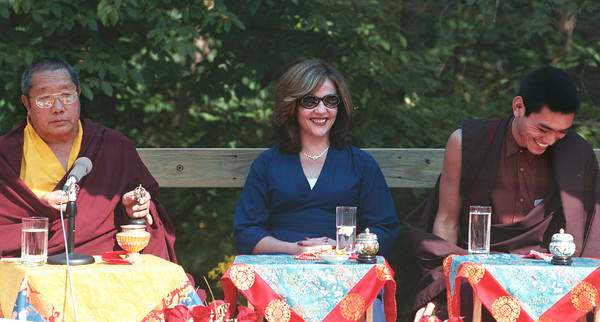
Without Bodhicitta, There Is No Path: from His Holiness Penor Rinpoche

The following is an excerpt from a teaching by His Holiness Penor Rinpoche on Mediation, reprinted with permission from Palyul Ling International:

Many of you are interested and have asked, “Please give us the Dzogchen teachings.” But even I myself don’t know what is Dzogchen and I don’t have anything to teach you!

Anyway, as I explained to you earlier, if one practices the Bodhicitta, that kind of pure intention to really benefit all other sentient beings, and then the samatha meditation practices to establish one’s mind in full concentration, then of course there will be the Great Perfection (“Dzogchen”) meditations.

But if one cannot cultivate the Bodhicitta within one’s mind, the path to Enlightenment is already broken. Without Bodhicitta, there is no real path. Bodhicitta is that which is without any partiality. The pure intention of Bodhicitta, the thought to benefit all sentient beings without any exception, can be understood by realizing that in one or another lifetime, each being has been one’s parent. If we understand this and think of how dearly they have taken care of us, then we will feel grateful to all the parently beings and we can generate Bodhicitta to all of them.

This present body of ours is here because of our parents. If we did not have parents, there is no possibility that we could have these bodies. And if we don’t have this physical body, then we cannot accomplish any kind of worldly or Dharma activity. So our mothers are indeed very kind and we should be grateful.

Of course, there are many kinds of parent-child relationships in this world, but we should remember that whether or not we are close to our parents is based on our own desires and our own thoughts. Beyond that sort of thing, the main meaning here is that without our parents, we could not have this body, and because of this we should understand and be grateful for their kindness. So first one really concentrates on generating Bodhicitta based on one’s gratefulness to this life’s mother, and from that one can extend this Bodhicitta to all sentient beings equally.

So the most important points are to have faith and devotion in the Dharma, then meditating and contemplating on Bodhicitta and compassion. Then one can apply these into practice through the meditations on emptiness.

In the Dharma practice one should not think, “Oh, I am doing all this practice for the benefit of this lama or for these Buddhas.” Never think in this way. The Dharma practice is for yourself. Each and every one of you as individuals has to liberate yourself from Samsara. You are attaining Enlightenment for yourself. You are attaining Buddhahood for yourself. By your practice, your lama is not going to attain Enlightenment nor is Buddha going to attain Enlightenment! Buddha has already achieved Buddhahood! And if you cannot attend to Dharma practice in the proper way, then it is yourself who will fall down into the three lower realms. It is not the lama or the Buddha who will fall into the lower realms!

So, though it is important to think spiritually of one’s own benefit and how one can attain Enlightenment, still the achievement of that kind of liberation is by the path of benefiting all other sentient beings. Without that kind of Bodhicitta one cannot attain complete Enlightenment.

The Bodhicitta we can generate right now, however vast, is beneficial. In the future, when one attains Enlightenment, according to the vastness of that Bodhicitta, that many sentient beings can benefit and liberate themselves from the sufferings of Samsara. Right now we cannot really perceive all that fruition, but if we continue to practice, then in the future we will realize it as a direct perception.

The Roots of Anger

AA_thumb

The following is an excerpt from a teaching by Jetsunma Ahkon Lhamo called “Art of Dispelling Anger”

For most of us, when we are wrathful or angry, it’s not wrathful. It’s not righteous wrath, you know, in order to help that person. The only time I can see where it would be useful for an ordinary person to be wrathful would be to maybe encourage somebody else to stand on their own two feet or to be less dependent or something like that. Now look, I really want you to do that, and you can talk sternly. But otherwise, where in your life should hatred be?  Hatred is one of the three things that binds you to this world of samsara in which you will get old, you will get sick and you will die. And so we are taught that we must handle this hatred.

So when we approach hatred and look at it, we have to really examine our habitual tendencies. We can’t just say, you know, ‘I’m not going to hate anybody,’ or it’s kind of like a recovering alcoholic. It’s difficult, very difficult, to just say, ‘I’m not going to drink anymore. I’m going to use will power and I’m not going to drink anymore.’ You know, they say some people can do that, but most people can’t. And why is that?  Because you have to learn about yourself. Because there is a reason why you drank in the first place. Because you have to learn to look inside of yourself and see what’s in there and you have to work it. What do they say in the program?  ‘It works if you work it.’ What do I say about Buddhism?  ‘It works if you work it.’ It’s the same deal. We are addicted to our habitual tendencies like a bunch of alcoholics. That’s why I love recovering alcoholics, because I feel such a kinship with them. And it’s beautiful that it’s so obvious to them that they are recovering addicts. Those of us who maybe have a little shot every now and then or whatever, a little wine every now and then or we’re teetotalers, we think, ‘Oh well, I’m not an addict. Oh, I’m pure, because I take vitamins and I eat bananas,’ and whatever.

But I tell you what. It’s that recognition that from the point of view of recovering from the addiction to the five poisons and from that awakening to Buddhahood, most of us are still at the stage where we are living like bag ladies and men under the bridge, because we ain’t recovered yet. We still have our hatreds; we still have our resentments. And we practice them.

When a Buddhist approaches ridding themselves of hatred, it can’t be done through willpower. It must be done through understanding, through practicing and ultimately through attaining view. Understanding means looking within oneself with honesty. None of us have been perfect. We’ve hurt others. We’ve killed bugs, people; I don’t know what, swatted flies, whatever. None of us has been perfect. And when we approach that, we need to look at that without excuses, bald-faced, you know?  Where have I fallen down here?

Now we don’t want to look at in a harsh and miserable way.  When I say take oneself to task, I mean have a long, sobering talk with oneself. I don’t mean self-hatred. That is useless and I don’t like it. I don’t want to see it. I don’t want to talk about it; and I will slap you next week if I see it, because you are just as worthy as anyone else, and that’s just a game. When we get into self-hatred, it’s because we have bad qualities and we don’t want to deal with them. So I say, accomplish those qualities and your image of yourself will rise up like a mountain.

Most people that have poor self-image are stuck in a kind of fearful narcissism where they do not respect or understand what is outside. They do not respect or understand what is inside. They can’t tell the difference between outside and inside. And they are so internally focused, focused on their own needs, wants and dramas, particularly dramas, that it is really very difficult for these people to step out of their shell, their shell of narcissism, and begin to truly try to be of benefit to others.  This narcissism, this kind of fearful self-absorption, often is one of the causes of a kind of hatred. If you are fearful and self-absorbed in your own drama, it’s really, ultimately when you trace it down, pretty much all about you. You know? If you have that kind of thing, there is never the opportunity to understand the nature of phenomena. There is never the opportunity to understand the primordial naturally luminous wisdom state that is our nature because of the drama. And there is even a posture with that. Forthe people who have that kind of thing, as they grow older, their body tends to go like that. It caves in like that. And it’s the protecting that we’re doing of something that we feel is inherently real–ego.

When you think, ‘Oh, what can I do about this? I’m so fearful. Of course she’s saying I’m narcissistic, but it’s really that I am afraid.’ Well, what can we do about that?  I think one step is to notice that are there are other people who are afraid, also. Notice that everybody is afraid. Notice that there is a humanity that we share of brother-sisterhood, a humanness that we share, human experiences that we will all have together. We will grow old. We will be sick. We will die. This is the condition that humanity shares in samsara. So learn to recognize in others that connection, even if it’s a sad one, that we all suffer the same; and we have the same wants, too. That narcissistic self-absorbed person who is very fearful wants desperately to be happy but doesn’t know how. And so in order to make themselves better, they stay frozen. They have hatreds and fears toward everybody else. And that’s the reaction.

Copyright © Jetsunma Ahkon Norbu Lhamo All rights reserved
 

WP2Social Auto Publish Powered By : XYZScripts.com